Support WBUR
Kamala Harris makes her case to voters
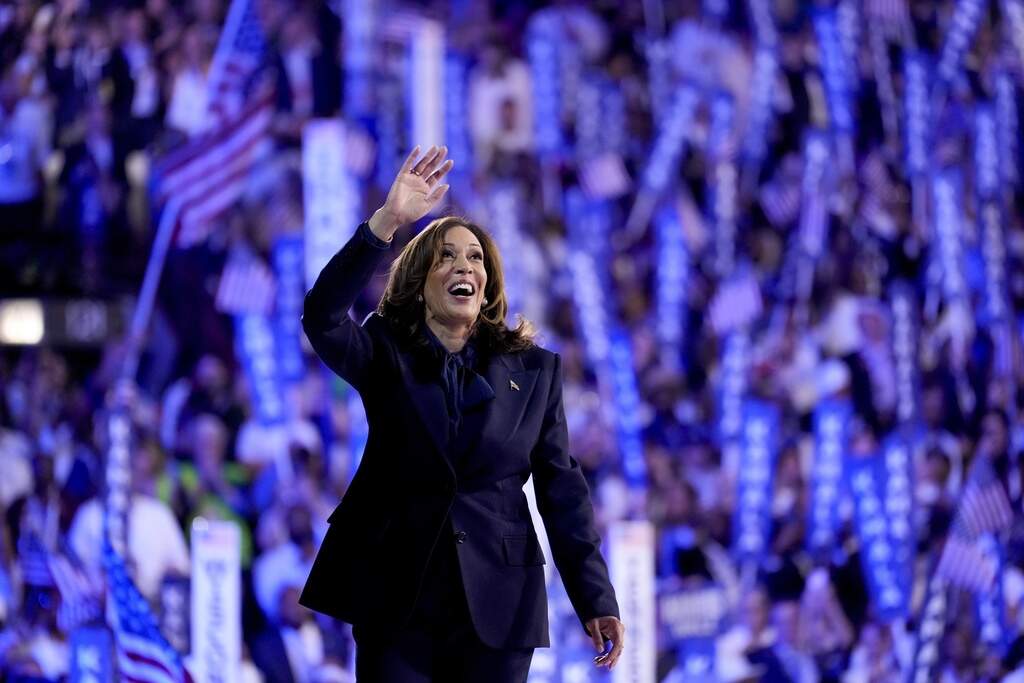
Kamala Harris accepted the Democratic presidential nomination. The first Black woman to do so. Thursday night she gave the biggest speech of her life. How did she do?
Today, On Point: Kamala Harris makes her case to voters.
Guests
Evan McMorris-Santoro, national political reporter for NOTUS, a Washington based publication from the nonprofit, nonpartisan Allbritton Journalism Institute. He’s been in Chicago all week covering the Democratic National Convention.
James Fallows, contributing writer at The Atlantic and author of the Substack Breaking the News. He was the chief White House speechwriter for President Jimmy Carter from 1977 to 1978.
Transcript
Part I
KAMALA HARRIS: On behalf of everyone whose story could only be written in the greatest nation on earth, I accept your nomination to be president of the United States of America.
TIZIANA DEARING: Vice President Kamala Harris made it official last night, and while she's the first woman of color ever nominated for president from either major party, she was not looking to bask in the historic moment.
HARRIS: Thank you. Thank you all. (CHANTS) Thank you all. Okay. We gotta get to some business.
DEARING: And to business she got. In a 40-minute address that broke precedent at the convention by actually happening in the primetime window, she covered everything from abortion rights to immigration, gun violence, Russia's war with Ukraine, Israel, Hamas, and the plight of Palestinians, threats from Iran, and kitchen table issues like taxes and housing.
Harris said her mother taught her how to get down to business. She actually started her speech talking not about herself, but her mom, Shyamala Gopalan Harris.
HARRIS: She taught us to never complain about injustice. But do something about it. Do something about it. (APPLAUSE)
That was my mother. And she taught us. And she always, she also taught us. And she also taught us, and never do anything half assed, and that is a direct quote.
DEARING: Before laying out a blend of broad policy strokes and specific policy measures, Harris took aim at her opponent, emphasizing what she and Democrats see as the stakes in November.
HARRIS: We were underestimated at practically every turn. But we never gave up. Because the future is always worth fighting for. And that's the fight we are in right now. A fight for America's future.
Fellow Americans, this election is not only the most important of our lives, it is one of the most important in the life of our nation.
DEARING: Harris characterized the moment as fleeting and particularly dangerous after a Supreme Court ruling this summer granting immunity to presidents for official acts. It is a future, Harris argued, that isn't American.
HARRIS: Our opponents in this race are out there every day denigrating America, talking about how terrible everything is. My mother had another lesson she used to teach. Never let anyone tell you who you are. You show them who you are.
America, let us show each other and the world who we are and what we stand for. Freedom, opportunity, compassion. Dignity, fairness, and endless possibilities.
DEARING: As for policy specifics, she vowed to protect Social Security and key government agencies like the Department of Education. She gave broad strokes on issues like taxation, and in some cases, addressed lingering questions about where she stands, notably about Israel, its war with Hamas, and how it's prosecuting that war.
Now, the day after, Kamala Harris and the Democratic Party have just 73 days left to make a successful case to voters. And polls showed going into last night, voters who might still be swayed often knew little about the new candidate. So how did Harris do with the most important speech of her life? What do voters now know about Kamala Harris that they didn't a week ago?
And most importantly, coming out of the convention, will her message resonate outside the walls of the United Center in Chicago. Joining us now, Evan McMorris-Santoro. He is a national political reporter for NOTUS, a Washington based publication from the non-profit, non-partisan Allbritton Journalism Institute.
He has been in Chicago all week covering the Democratic National Convention. Evan, welcome to On Point.
EVAN MCMORRIS-SANTORO: Hi, thanks for having me. I'm still in Chicago, actually. I'm just in the O'Hare Airport with everybody else who's leaving the convention.
DEARING: I imagine it's like a second convention at O'Hare and I promise we'll let you sleep after this.
But I do want you to actually take us back to the building you spent much of the week in and let us know what it was like during that speech last night, tell us about the feel, how delegates received what they heard from their nominee.
MCMORRIS-SANTORO: Democrats here have been hoping for a home run of a speech all week, right?
This is a huge moment for them, because as you mentioned, they're trying to launch a new candidate into a general election that they have very little time to build out and win. And I think that everybody in that hall that I heard from and talked to and saw last night, they think that they got what they needed from Vice President Harris.
She struck the right note for Democrats. They felt very tuned in and turned on. The historic nature of her candidacy was very present in the building and in the room. A lot of women decked out in their Alpha Kappa Alpha gear, which is of course the sorority that Vice President Harris is a part of.
It was just, I think for a party that has been really hoping all summer to turn things around and to be on offense, no longer on defense. I think they couldn't have had a much of a better night than they had.
DEARING: Did they really know what they needed, Evan? Was it one of those, we'll know it when we see it? Or if you had talked to delegates, and maybe you did, on Tuesday and Wednesday, could they say very clearly, listen, here's what we think the vice president needs to do in her speech on Thursday night?
A, B, C, D, E.
MCMORRIS-SANTORO: It's a fantastic question, actually. It's the only important question really from this convention, the reality is people think that they do know what the Democrats need, but they have no idea how to do it or what to actually pull off. Vice president, the actual thing that happened last night that people need to remember is that in June, Vice President Harris was essentially written off as a political figure in America. That she had this rise.
She ran for president in 2020, the campaign didn't go very well, and she was going to be, also ran alongside Joe Biden, who would not step aside. Because, and one of the reasons why is because Harris had no possibility of being a credible presidential candidate. In the time since then, and now, she has emerged as somebody who has united this party in a way that has not been united in a very long time, has created a surge of momentum in the country that no other Democrat has been able to do all year.
This change is so dramatic. I don't think that Democrats completely know what they have on their hands yet. And so I think that they want to see a lot of things happen. They all have predictions of things that they were hoping to happen, but really, they're like the rest of us sitting back and watching what's going on here and just seeing what might come next.
It's very hard to predict anything in this election. Particularly when it comes to Vice President Harris, and particularly right now.
DEARING: So Evan, it is interesting you remind us of the arc just of the week, which in some ways mirrored the arc of the summer. I want to take us back to Monday night, the kickoff of the Democratic National Convention.
President Joe Biden at 11:30 Monday night, they say thank you to him. He officially passes the baton to Vice President Kamala Harris, and here's what he said about her.
JOE BIDEN: Selecting Kamala was the very first decision I made before I became, when I became our nominee, and it was the best decision I made my whole career.
We've not only gotten to know each other; we've become close friends. She's tough, she's experienced, and she has enormous integrity. Her story represents the best American story. And like many of our best presidents, she was also vice president. That's a joke.
DEARING: So you know, the joke aside, four things there, tough, experienced, integrity, American story, a little bit of what it feels, maybe Evan, was a blueprint of the speech that we heard her give last night.
MCMORRIS-SANTORO: Yes, actually here at NOTUS, we reported that the speech that Harris gave last night was actually in the works back when it was supposed to be her vice presidential speech for Biden's convention, that actually they made some changes. Obviously, they tweaked some language, they moved their stuff around, but the basic sort of framework is essentially the same.
And so when you saw what Biden was saying about her on Monday night and what the voters heard from her on Thursday night, there is a consistency that according to our own reporting is like really a key part of Harris and how she was thinking about her role in this race, even before she became the nominee.
And those four pillars that Biden was talking about are the ones that have now become the way that she's going to run and run the Democratic party forward. That's the kind of conversation that she's having. And it's actually the sort of thing that, again, was not really part of the conversation that much before.
Just a few weeks ago, but people who didn't know her, people like Biden who obviously endorsed her, they're seeing a person that they know already, they're hearing a message that they already know. They're not building a new Kamala Harris, they're using the old one that existed, and they're tweaking it slightly, as she now is like in charge of the entire Democratic Party.
DEARING: So Evan, we've got to go to break in a little less than a minute, but give me the tweak. The one big tweak that isn't what we would have already heard anyway, that you heard last night, just briefly.
MCMORRIS-SANTORO: When you go from the second in command to the person in command, the job changes. The second in command's job is to essentially do no harm.
Don't do anything to the message of the person at the top. Person at the top is a person who sets the agenda. And last night in this speech, we saw vice president Harris talking about history. And the history of this country and what role she has in it and what that means for the future of this country, in a way that President Biden could never do and was not doing.
And so that tweak is really her saying, I am here, I am part of this American story, and now here I'm going to lead you to the next chapter of it.
Part II
DEARING: Today, we're discussing Democratic presidential nominee Kamala Harris's speech from last night, probably the biggest speech of her life. So how'd she do? What did she say? And did she create a message that will resonate in the little more than 70 days left between now and Election Day in November.
We're joined by Evan McMorris-Santoro. He's a national political reporter for NOTUS. ... We're also joined by James Fallows. He's a contributing writer at The Atlantic and author of the Substack Breaking the News.
He was the chief White House speechwriter for President Jimmy Carter from 1977 to 1978. And James Fallows, as we welcome you, I actually, I want you to give us a little bit of the sausage making. As you heard Kamala Harris last night as a speechwriter, could you hear and see the choices of what went in and what didn't?
Tell us a little about that.
JAMES FALLOWS: Yeah. One of the challenges in speech writing is that the farther in advance people know a speech is coming, the more of a pain in the neck it is to put that speech together. That's why State of the Union addresses, for example, are a nightmare for writers, because the entire government sees it coming a year in advance and they're all trying to get their lines, their specific pleas in there, et cetera.
There is a plus and a minus to the way that Kamala Harris and her team had to do this, the plus, the minus is that everything is so compressed, has been barely a month that she's been the nominee presumptive. And now the nominee. That also has, that's a minus, but it is a plus in terms of being able to concentrate and say, okay, what's the message we need to do right now.
And I think as we were hearing before, there were parts of this that would have been similar to what she would have said if you were running as Joe Biden's wedding mate, his VP for another term, but things that were distinct to what a first-time candidate needs to do when introducing himself or herself.
And I thought there was a useful combination, essentially telling your own story, who are you, telling what you would do, and she had that part, and then giving some theme and just tone and both explicitly and implicitly what it would be like to have you in charge. And I think you could see all those parts of the speech, and I thought it was a very successful one.
DEARING: So I feel like definitely between you, James Fallows, and you, Evan McMorris-Santoro, part of what I'm learning today is some of this was going to be there no matter what, and then some things had to be different. So I'm going to pretend I'm your student for a minute, and I'm going to see if I can pass the test, if I can tell the difference.
So I'm going to start with Harris vowing that building up the middle class will be what she calls a defining goal of her presidency.
HARRIS: And I'll tell you, this is personal for me. The middle class is where I come from. My mother kept a strict budget. We lived within our means, yet we wanted for little.
And she expected us to make the most of the opportunities that were available to us. And to be grateful for them. Because, as she taught us, opportunity is not available to everyone. That's why we will create what I call an opportunity economy where everyone has the chance to compete and a chance to succeed.
DEARING: Now I'm assuming most of that would have been there already. Maybe the, and I'm going to create an opportunity economy, would be new, but most of that would have been there already. But then there's this, where Harris addresses another issue that many claim is a weakness for her campaign, the war in Gaza.
She was very clear that she will, quote, always stand up for Israel's right to defend itself, unquote, and stress that she'll also stand up for the Palestinian people and that a ceasefire deal can't wait any longer.
HARRIS: What has happened in Gaza over the past 10 months is devastating. So many innocent lives lost.
Desperate, hungry people fleeing for safety over and over again. The scale of suffering is heartbreaking. President Biden and I are working to end this war such that Israel is secure, the hostages are released. The suffering in Gaza ends and the Palestinian people can realize their right to dignity, security, freedom, and self determination.
DEARING: James Fallows, is that an example of would have already been there and new and had to be there now?
FALLOWS: Yes, but I think both of these segments you chose are really interesting in showing what is similar, what would have been different. On the first one, which was a combination of Kamala Harris telling her own origin story in Oakland, middle class family, being careful of what came in and what went out and then the ways in which that would lead to an economic vision for her administration.
That would have been the same, but there would have been less urgency of portraying herself with who she is and where she came from and the role of her mommy in her life, which she and her sister I think very charmingly use that term for her. So there was a greater connection between economic policy and who she wanted the people to know she was.
And the other is in talking about the policy itself. If this had been a different universe, and she was speaking as the VP nominee, there would have to have been more linear connection. This is what we have done in the past four years. This is what we're going to do in the four years ahead. Joe Biden on the first night did most of the work of saying, here is what I, President Biden have done.
Nominee Kamala Harris was able to say, here is what we are going to do next on the Gaza situation. If Joe Biden had still been the nominee, there would have been less heat and pressure and attention on Kamala Harris to talk about this most divisive issue in U.S. foreign policy right now and most divisive issue within the party.
And so I think she could have, it wouldn't have been as much an obligation of her. And I think she walked the very careful line between continuity with what Joe Biden has been saying. And word by word, these are things that Biden could have and has said in the last year or so, but also suggesting the change in emphasis on suffering in Gaza and need for a ceasefire more than we have inferred from Biden.
So both of those would have been the same, but different.
DEARING: Evan McMorris-Santoro, let me just have you pick it up from there.
MCMORRIS-SANTORO: Let me just first say it's very cool to be on a show with James Fallows. He's so awesome and this is really great for me. Look, this is a message versus messenger thing as well, because the reality of the situation is Harris's position on the Israel-Gaza conflict is not that much different than the Biden administration's existing position.
The idea of focusing on the middle class, one of the things that frustrated Democrats so much before Biden dropped out is that they have a pretty strong record on building the middle class up during Biden's term, that just wasn't translating with voters. They didn't believe it. They didn't really believe it coming out of Biden's mouth.
And when it comes to some of these issues, Harris is a new person. One of the things that's so important about this convention and so fascinating about this convention, is that I traveled the country, for the whole year before this convention happened. And voters were really talking about how they were annoyed that there was not something new for them to talk about or something new for them to look at.
This election, up until Harris took over, was really referendum on 2020. It was like, do you want to do 2020 again? Do you want, do you wish you'd voted differently in 2020? Because now you get a chance to. And now it's a question about do you want to carry the country into something different?
And so even though Vice President Harris has a similar policy on paper when it comes to this very divisive issue inside the Democratic Party of Israel-Gaza, the progressive movement that was prepared to really almost shut down this convention, they did not really show up in great numbers for Harris. Because I think that they see somebody new with a different background, different history, and even though it's some of the same, it's some of the same political concepts, they believe her more than they believed Biden, that people hear about the middle-class stuff.
They just believe her more than they believe Biden. And because she's new and she's saying things that are new. And that is, I'm not saying things that are new, but that is like the most fascinating part about all this, is that the messenger is so important. And Harris has proven to be one of the strongest ones Democrats have had in a very long time.
DEARING: So James Fallows, let's take what Evan just said. Let's take some more sound from Harris last night and hold that up to the light. So here she's drawing comparisons between Trump and herself on several issues, including taxes, which is the economy is something voters wanted to hear about.
HARRIS: I think everyone here knows he doesn't actually fight for the middle class. Not, he doesn't actually fight for the middle class. Instead, he fights for himself and his billionaire friends. And he will give them another round of tax breaks that will add up to $5 trillion to the national debt. And all the while, he intends to enact what in effect is a national sales tax, call it a Trump tax.
That would raise prices on middle class families by almost $4,000 a year. Instead of a Trump tax hike, we will pass a middle-class tax cut that will benefit more than 100 million Americans.
DEARING: Now, James Fallows, I'll note that The Washington Post in their fact checking this morning actually said that both of the numbers that she used about Trump's positions were stretching it. And I want to note that, but an interesting blend there of that is 2020 over again.
She's talking about the candidate who ran in 2020 and policies that were sort of Trump-Biden issues, and she's not that far from the Democratic platform, which was drafted, and when Joe Biden was still the candidate and yet ... James Fallows.
FALLOWS: Yes. And yet, and again, I'll say also, I'll say it's a pleasure to be on with Evan too.
Who's reporting I've been following and admiring. I think that the continuity with the platform is both a, it's one more thing that she pulled off and the entire convention pulled off in an artful way, that of course you would want continuity with the platform. She's been part of the administration for the past three and a half years.
She's been a candidate for less than a month, to have any kind of radical shift would be bizarre. And she's there as the one member of the Biden-Harris ticket. I thought there were a couple elements of her treatment of Donald Trump and his ideas that were really noticeable. The first was early in the speech she made, I thought, what was a very important line and distinction, when she said that Donald Trump is not a serious person, but that his idea, his election could have serious consequences. And that was a way of squaring the circle of making fun of him. And these people are out of their minds and all that, but saying it actually still matters, that he can't, he needs to be laughed at.
But not entirely laughed at, because these things are serious. There was, in the portion of the speech, which was going into some of the meat and potatoes of how things would differ, how the Democratic vision of growing the economy from the middle out and the bottom up and all the rest, why that mattered, trying to remind people.
And then I thought just after the part you were playing, she got into a prosecutorial tone, by which I don't mean nagging or things like that, but there, I thought it was Kamala Harris had been part of our public life for three and a half years, but we haven't seen her perform that much. She had only a brief run in 2020 for the presidency, her vice-presidential duties have been photo ops, as opposed to hearing a lot of her and she was able to have a combination of her warm and smiling and lighthearted sign. And what we now think of as a courtroom side, we've all seen enough courtroom dramas to recognize the tough prosecutor. And I thought she was able to bring those things out, too. Of a sunny bearing of saying that Donald Trump is not serious, but we have to take his movement seriously.
Giving some of the dollars and cents of what this might mean. And then also having the prosecutorial courtroom air. I thought all in all, it was a very effective way of showing this range of what we would see if she becomes president.
DEARING: We're here with James Fallows and Evan McMorris-Santoro, who are delighted to be together as we talk about Kamala Harris.
MCMORRIS-SANTORO: And with you.
DEARING: Thank you. Kamala Harris. We're all just happy to be here. The speech last night and how it, whether it made its case and with 73 days left, whether that case will resonate with voters. That last piece, we will spend some more time on a bit. I want to stay with the sort of the Paris piece of it now.
James Fallows, you talked about Donald Trump is an unserious man, but it would be serious if he were reelected. You also made a reference to a point where she referred to Republicans as out of their minds. I want to hit that one for just a minute. She was talking about abortion policy and access to reproductive health care.
HARRIS: As a part of his agenda, he and his allies would limit access to birth control, ban medication abortion, and enact a nationwide abortion ban with or without Congress. And get this! Get this! He plans to create a national anti-abortion coordinator and force states to report on women's miscarriages and abortions. Simply put, they are out of their minds.
DEARING: Now Evan, I'll note that actually Donald Trump made, required that a national abortion ban was not in the Republican platform. And that often Democrats this week have presented a document called Project 2025 which was written in part by people close to Donald Trump as the official platform of the Republican Party.
So duly noted, but clearly with the response there in the audience, you can hear that one hit a strong note. Before we go to a break, Evan McMorris, anything she didn't do well? Anything she got wrong or fell short on as you listened last night and thought, Ooh, I would have liked to have seen that differently given the objectives the candidate has.
MCMORRIS-SANTORO: I'll tell you, this is something that I would ask, that I asked the delegates, and I talked to people around the convention about, right? Cause that's what we want to know. We want to know, what do you have this speech play out for you? And look, they didn't have that feeling. They thought this speech was an absolute home run and a lot of people said you talk about this thing with the abortion issue, this is political 101 stuff.
This is X's and O's making the choices here, the Republican party and Donald Trump have to shift on this issue. And the Democrats and vice president Harris don't have to shift on this issue. And that's why you find them, the Republicans have been flopping around on this.
Because they're the ones who are having to recalibrate themselves wildly while the Democrats can just say we're just where we were before, which is that we support Roe v. Wade. So it's a really interesting moment in terms of like where Harris is and what she's able to do, because it is not just the fact that she's a new messenger and able to take advantage of things that that she brings, but also there's a lot of bad things going on in the Republican campaign right now.
And she's able to leap right on them. Because of the missteps that they're making.
Part III
DEARING: It's time to step outside of Chicago.
Evan, I know you're trying to do that by sitting at O'Hare to fly outside of Chicago, but the question is, will the message resonate now? James Fallows, I think you had a thought you wanted to carry over from our conversation we were just having on Harris's speech, her comments on abortion policy.
So pick it up there.
FALLOWS: Yes. So this is, I'm going to use only one sporting analogy. When we think about sports, we recognize that athletes have a certain shot or a certain skill. Or a tennis player can hit a backhand overhead or not, or a baseball pitcher has various pitches.
There's a certain skill in politics of being able to make listeners feel as if they're in on a joke with you, as if we are having fun together, rather than being lectured to or instructed or scolded. That's a skill that Ronald Reagan had. For example, when in a debate with my one-time employer, Jimmy Carter, he said, there you go again. And made it into a light moment, and Carter did not have that skill.
It's a skill that Bill Clinton had. And the first George Bush did not, a skill that Obama has and had a skill that Pete Buttigieg has, Gretchen Whitmer. Tim Walz too, I think we saw that this is also in the repertoire of what Kamala Harris has. She's able to make a joke rather than having to make every point very serious.
This is a skill Donald Trump does not have whatsoever because his so-called humor is all insult comedy, which gets old very quickly. So I thought that was interesting to me in the way she was saying. In addition to all the chapter and verse about what's happening in abortion policy, these people are out of their minds.
It's something that Ronald Reagan might have said, that Bill Clinton might have had to, might have done too.
DEARING: So I'm going to use that chance. James Fallows, to pick up a thread that came throughout the convention and I knew they were going to do it. We all knew they were going to do it.
The question is how much is it going to be a successful piece of the puzzle going forward? So this is the week, making the case to voters on why Harris is the right person to be president and why Donald Trump isn't. And I want to do a collection of some of those voices from the week.
(MONTAGE)
The choice could not be clearer. Donald Trump rants about law and order. As if he wasn't a convicted criminal running against a prosecutor.
Two days ago I turned 78. The oldest man in my family is four generations. And the only personal vanity I want to assert is I'm still younger than Donald Trump.
There's the childish nicknames. The crazy conspiracy theories. This weird obsession with crowd sizes.
Is it weird? Absolutely. Absolutely.
So the next time you hear him, don't count the lies. Count the eyes.
Who's going to tell him that the job he's currently seeking might just be one of those Black jobs?
DEARING: The voices, many that you mentioned there, James Fallows, we had Pete Buttigieg, we had former presidents Clinton, Obama, we had vice presidential nominee, Tim Walz, former first lady, Michelle Obama, displaying a lot of the humor that you were talking about. Evan McMorris-Santoro will the attack dimension have legs going forward?
Is that something voters want?
MCMORRIS-SANTORO: Democrats have said all cycle, right? Even when the darkest days of the Biden polling decline, that the end of this election was always going to come down to Trump. And do you want him back? Do you want what there was before? And it was like a whole conversation about when are we actually going to be able to pull this and get our base excited about this again.
And America talking again about the idea of, do you want this again? Now, what you have with Harris and Walz is you have two people who can say, not just, do you want to go back to a thing that you didn't like? Are you afraid of this thing that you didn't like? They can say, we've been watching it like you, we're coming in and we're saying, we can do something totally different.
And look how silly this actually was. Look how silly this was. This is the thing that has resonated with voters in a way that I think Democrats, once again, so much of this Harris moment, so much of this convention is about Democrats being like. Really? We had no idea that this would work. That speaking about Harris, that speaking about comedy, that speaking about this idea of even talking about really ideas versus just running the election is a referendum on keeping democracy, it doesn't matter who the other candidate is, as long as it's not Trump.
That was a huge part of the message. This whole thing is they're learning this in real time. And we are seeing that this humor stuff, just in the nature of the younger vote, which was a huge part of Biden's coalition, that almost went completely away by the time of that first debate, where Biden stumbled so much.
That has come back in full force. The memes, the content creation that's going on online. It's all-around Harris and it's all around trying to be funny and clever and dunking on Trump and dunking on JD Vance, constantly dunking on JD Vance. And this is a thing that like was not a huge part of the Democratic agenda.
And now because of what's going on, it is. So whether it has any impact down the road, I can tell you as somebody who's covered this entire year, I will not tell you what's going to happen next. No one can tell you what's going to happen next. If they do tell you, they're lying to you, but I can tell you that at this moment, the things that are working are things that Democrats didn't think that they had in their repertoire, but they have again because of Harris.
DEARING: James Fallows, there is another dimension to this that I wonder about, which is it did feel, many times this week, including with Harris last night, the line that you mentioned, Donald Trump is not a serious man, that felt like direct trolling.
Of former president that they knew would be watching, in the hopes to goad him into something that would be self-damaging. And I wonder, with these pieces of strategy in the mix, as somebody who's been involved in watching for a long time, is there a higher set of values here, where we need serious policy debate and more time should be spent on those things, versus trolling. And social media and memes, or is the answer, listen, there's plenty of time for governing, just you get the ball down the field and you worry about victory afterward.
FALLOWS: You have taken the words out of my mouth with the way you wound that up.
DEARING: Sorry.
FALLOWS: Yes. There's, I think nobody has ever finished a campaign saying, Oh, gee, if we only had more policy, if we only had more things about what long term social security funding is going to be, and what's going to be our answer to the trans pacific partnership and dealing with Japan and Korea and all those sorts of things.
So there will be plenty of that, never fear. It's also the case that people, you feel better about somebody who makes you feel better about yourself. And humor always goes a long way. And having a little sparkle in your eye, the trait of having a sparkle in the eye is one of those through lines in American politics.
That doesn't guarantee a winner, but is often associated with a winner. Like Evan, I have no idea what's going to happen day by day. Everything can change. And I think the trolling of Donald Trump, they saw during the Republican convention, which was a big victory celebration at the time, that even then, modest trolling Trump was receiving, made him give this, it seemed like 93 hour closing speech that went into every one of his grievances and the shark stories and Hannibal Lecter and all that.
And keep putting that little cocktail hors d'oeuvres spear into his very thin skin. He'll keep erupting, as he did even last night. So I think that, of course, they're going to and will talk about policy. Of course, they'll emphasize freedom. Of course, we'll emphasize women's rights in particular to be free about their own bodies.
But also, I think they will, they recognize they can have some fun and that will pay off too.
DEARING: I enjoy the fun part. Wait, Evan, say that.
MCMORRIS-SANTORO: I want to jump in and just on what James said and double on that because, Harris really does have a lot of potential vulnerabilities. Her 2020 platform when she represented the first time in that very progressive primary is not one that any democratic strategist would design for the next 70-some-odd days until the general election.
It's very dangerous for them if the election becomes about that. But the thing is, as James pointed out, Trump keeps rising to the occasion every time he gets poked a little bit, and that makes the election constantly about Trump and that's what the Democrats want. So right now, this idea of this humor, and we're talking about this, just calling him weird one time, it made one guy, the vice-presidential nominee Walz, he said it, and then now he's vice presidential nominee.
And it sent the entire Republican campaign spinning off into space in a way that people who are Republicans are wringing their hands. Like what is going on here? And this is the thing, that as long as it stays as a conversation about Trump versus Kamala versus rather than Harris versus the sort of mainstream Americans belief systems, and when it comes to like swing voters and things like, that's better for Democrats.
And it has not failed them yet, like they can keep poking Trump, and he keeps rising to it. And so I think that's why you're going to see him keep doing it.
DEARING: So I was going to say, I enjoy fun in any campaign season, right? Any long campaign, but you both have made some nods to at least uncertainty, right?
And so I want to pick that thread up now, in our last few minutes. And I'm going to go back to Tuesday night of the Democratic National Convention and former first lady, Michelle Obama. Emphasizing in her speech that the energy is high for Democrats right now, but not to be complacent.
MICHELLE OBAMA: It's up to us to remember what Kamala's mother told her.
Don't just sit around and complain. Do something. So if they lie about her and they will, we've got to do something. If we see a bad poll, and we will, we gotta put down that phone and do something. If we start feeling tired, if we start feeling that dread creeping back in, we gotta pick ourselves up, throw water on our face, and what?
CROWD: Do something!
OBAMA: We only have two and a half months, y'all. To get this done.
DEARING: Evan, James, we've talked policy and trolling and humor and Kamala Harris defining herself, et cetera. There is ground game. Get out the vote. Precinct by precinct, organizing. And as we get closer to voting dates and I say dates because of early voting, et cetera, in states all around the country, that emphasis shifts.
How are each of you thinking about that piece now? James Fallows.
FALLOWS: I thought it was already striking that so many of the major speeches at the convention, notably Oprah and Michelle Obama with two very powerful speeches, Barack Obama too, and Kamala Harris last night, they were trying to make people feel conditional optimism that things could get better, but they're not going to automatically get better.
And it's still a long road ahead. And it seems notable to me that as Donald Trump spends less time trying to win any actual swing voters, he seems to be concentrating more and more on the machinery of the election, of making it harder for people to vote, having some control of how the votes are counted, how they're certified.
So I thought it was a well-coordinated combination of here's what to be hopeful for, but here's what you need to do day by day. And coach Walz, as we say, was putting this into a final drive of a football game comparison too, I'm going to say one other thing on early voting. My one-time employer, Jimmy Carter.
Turns, would turn a hundred years old on October 1st. I believe he's already requested his early ballot in Georgia. I think what's keeping him alive now, is just not only his own hundredth birthday, but the idea that he could see this result.
DEARING: Wow, that is a profound thought. Evan McMorris-Santoro, in your reporting, as you're talking to voters, potential voters, maybe disenfranchised Americans what do they want now?
MCMORRIS-SANTORO: Let's start here in Chicago, because I have a story with my colleagues Calen Razor and Jasmine Wright, going up on NOTUS, NOTUS.org, today, specifically about what happens now that the convention is over, and about this ground game and ground operations. And we spoke to Jaime Harrison, who is the chair of the Democratic party.
And he was locked in on this idea. This is a great convention. We're having a time of our lives. Everybody's got the t-shirt. Everybody's feeling great. The big sigh of relief at the beginning of the year, but now we're in a dead heat coin flip election against a Republican candidate that has an extreme amount of unity in his party and a very powerful group of supporters who will follow him no matter where he goes.
It's a very difficult, difficult climb for anybody to go up against, particularly a new candidate is just building this campaign as they're doing it. And what Harrison told us, the chair of the DNC, is that they have been spent so much time on infrastructure in the past couple of years, since 2022, they built a bunch of ground game operations out for that midterm, that, as you recall, went surprisingly well for Democrats.
Much of that is still in place. And the most interesting thing about this handover, the most interesting thing for the political mind, as I think about this election going forward, is that so much of the infrastructure built by Democrats for the general election is still in place, even though Harris has taken it over.
And that, according to Democrats, means that they have the equipment and tools and people who are experienced and ready to go for the final push.
This program aired on August 23, 2024.