Support WBUR
Is Mexico's judicial reform a good or bad idea?
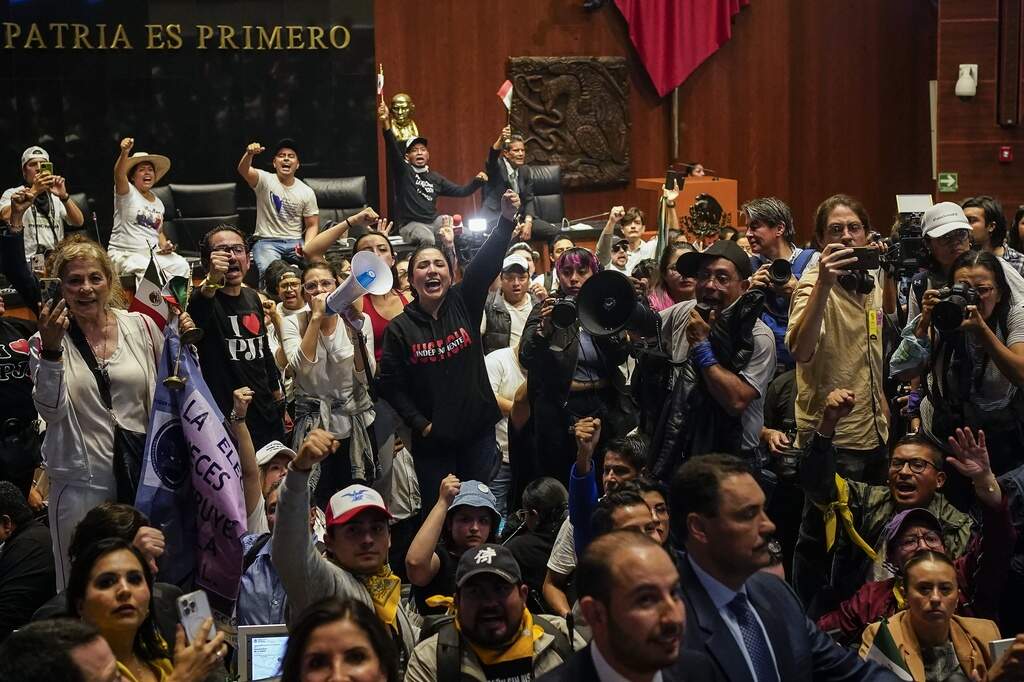
Mexico could soon become the world's first country to elect every single one of its judges, even on the Mexican supreme court. Will it combat corruption or is it a political power grab?
Guests
David Shortell, a reporter in Mexico City who covered this issue for CNN.
Gabriel Ferreyra, associate professor of criminal justice and criminalistics at California State University in Los Angeles. He used to be a lawyer in Mexico for many years and has extensively researched Mexico's judicial system.
Mitchel Lasser, law professor at Cornell Law School who has written about the different ways of selecting judges around the world.
Also Featured
Tyler Mattiace, an Americas researcher at Human Rights Watch, primarily covering Mexico.
Transcript
Part I
MEGHNA CHAKRABARTI: Mexico is on the path to making one of the most sweeping national reforms in the world. It will soon be the first country to have its entire judicial branch stand for election. All the way up to the Mexican Supreme Court. The proposal has already passed the Mexican House.
And this morning, after 12 hours of debate and interruptions by protesters, Mexico's Senate also passed the judicial reform 86 to 41. Here's Senator Enrique Inzunza of the Morena party on the Senate floor before the vote.
(SPANISH TRANSLATION)
Inzunza says, quote, "We will vote for the refoundation of the judicial power to guarantee that with democratic and direct effectiveness of the people, it serves alone and equally to the cause of the rights of all Mexicans. With the authentic independence of other powers," he continues and says, "And subject only to the mandate of the Constitution and the laws. The legislation's final hurdle now is getting it ratified at the state level, where it is more than guaranteed to pass."
CHAKRABARTI: The ruling party, Morena, who are pushing the reform, have a majority in 27 of 32 Mexican state legislatures. So all this means that soon, approximately 7,000 Mexican judges from local, state, appeals courts, and even to the Supreme Court will have to earn the vote of the people to be seated at the bench.
Currently in Mexico, all judges are appointed. This is a reform that has turned the legal community in Mexico upside down. For weeks, thousands of judges and other court employees have been on strike, and many of them have taken to the streets in protest to block the reform.
(PROTEST SOUNDS)
Current and soon to be outgoing President Andrés Manuel López Obrador's party champions the idea. Obrador himself says the aim of the reform is to rid the judiciary of corruption and nepotism, a problem that many argue needs fixing.
(TRANSLATION)
That they impart justice! It is so that they impart justice to the benefit of everyonen. Ad so that they are not at the service of organized crime and white-collar criminals, so that they serve the people.
CHAKRABARTI: But critics argue this specific judicial overhaul is merely a power grab by the Morena party, that is Obrador's party. They say Morena wants to concentrate power by weakening judicial independence. Since Morena holds an overwhelming majority in Congress, if voters elect Morena back to judges, the party would control all three branches of Mexico's government.
Alarm bells have not just been raised inside Mexico, but also outside, from NGOs who fear that, ironically, putting judges to a popular vote would in fact weaken Mexican democracy. Mexico's business community is also worried that the change would rattle foreign investment. Mexico's hemispheric neighbors, the U.S. and Canada, also are concerned that it could damage trade relations. Here's the U.S. Ambassador to Mexico, Ken Salazar.
(TRANSLATION)
KEN SALAZAR: It will not solve judicial corruption, nor will it strengthen the judicial power. It would also undermine efforts to make North American economic integration a reality and create turbulence as the debate on direct election of judges by vote will continue for years to come.
CHAKRABARTI: But incoming President Claudia Scheinbaum, also of the Morena party, strongly disputes this.
We want to strengthen the judiciary. It is false that we want to minimize it. How much stronger can a judicial power be if the people elect the judges, ministers, and magistrates?
CHAKRABARTI: With state legislatures likely to swiftly ratify the constitutional judicial change, when President elect Scheinbaum takes office in Mexico on October 1st, electing judges will be the new law of the land. So this hour, we want to take a look inside this judicial reform and understand better what would electing judges look like in Mexico. Again, this is from the state level, all the way to the Mexican Supreme Court. How would this reform be implemented? And of course, the core question is, will this make justice?
Reforming the judicial branch corruption problem in Mexico better or worse. Joining us now is Gabriel Ferreyra. He's the associate professor of criminal justice and criminalistics at California State University in Los Angeles. He used to be a lawyer in Mexico for many years and has extensively researched Mexico's judicial system.
Gabriel, welcome to On Point.
GABRIEL FERREYRA: Hello. How are you?
CHAKRABARTI: I'm very well, except I apologize for my confusion there. My notes got slightly out of place here. Let me just ask you a quick question and then we will also go to a reporter that we have in Mexico. But tell us about the core problem here, and that is there seems to be a pervasive lack of public trust in the Mexican judiciary.
Why is that?
FERREYRA: It is a long-term situation that has come from the authoritarian government that ruled Mexico for more than 70 years in the past decades, in which the judicial branch was used as a tool to pursue political power, and it was back then dependent the judicial branch of the executive branch.
So the president governors have a lot of influence in deciding who will be the head of the judicial corp and that's on how affected the independence of the judiciary. There was a huge overhaul in 1994, 30 years ago that changed that. And the federal judicial system and at the state level, it became more independent and was able to gain more authority to have this judicial independence, which is a core element of the judicial branch, but a lot of problems that permeated the judicial system before that reform were brought, and corruption is one of them, among cronyism, influence peddling, et cetera.
CHAKRABARTI: Okay, so we're going to talk in more detail in just a few minutes, Gabriel, about why Morena seems to think that electing judges would be a solution to these problems, as you've outlined. But let me turn now to David Shortell, who's a reporter in Mexico City and is covering this issue for CNN. David, thanks for joining us today.
DAVID SHORTELL: Yeah. Thanks for having me.
CHAKRABARTI: Okay. So you're in Mexico City right now. Set the scene for us. How big of a deal is this? We talked a second ago about all the protests that have been happening in opposition to this judicial reform.
SHORTELL: Yeah, this is a monumental moment in Mexican history.
You had senators in the debate yesterday saying this was the most transcendent debate they had taken part of in their careers. And as the professor mentioned, this is only one of the few times that they've reformed this constitution, the opposition has really swelled. We saw yesterday protesters break into the Senate building, eventually pushing their way through security onto the Senate floor, where they were chanting and unfurling banners.
The senators eventually reconvened in a separate building, the old Senate headquarters downtown to finish debate and vote in the early hours of this morning and pass it by the narrowest majority. Judicial workers have been on strike for several weeks now as well. That's including members of the Supreme court.
They have ground all courthouse and judicial proceedings. Most of them in the country to a halt, because of these protests. And students, a very historically powerful constituency in Mexico, students have also been protesting in the Capitol in recent days. And then we should also mention a protest from the U.S. ambassador, Ken Salazar in Mexico City. He wrote a fairly stinging letter a couple weeks back, saying that this reform would, could damage the democracy of Mexico. And also insinuating that cartels and other nefarious organizations and political groups could weigh heavily in these elections, tilting judges, potentially in their favor.
So this is something that has created enormous opposition. It's of course, something that the president Andrés Manuel López Obrador and his party, the Morena party, which is a vast support within the country right now, they feel is necessary to reform corruption. They say there's nepotism and elitism within the judiciary, but it's something that's really --
CHAKRABARTI: So it does seem though that this is going to become the law of the land in Mexico, because it passed the Senate. And barring, I suppose, some kind of massive revolt in the individual state legislatures in Mexico, it's expected to go through. So how would the elections play out, work for the some 7,000 judges?
SHORTELL: Yeah, exactly. It's practically a foregone conclusion at this point. It needs a majority of the state legislators, legislatures to pass the reform for it to be then sent to the president and the constitution will be amended. And that is likely to happen given Morena has the power in most of those state legislators.
The elections could come as soon as next year, and there will be about 7,000 judges in total. Not all will be up for reelection or election in this first round of elections that could take place in 2025. But thousands of judges at least will have to run for their seats. The judges who are currently in their seats will be eligible to take part in those elections, but it's not a foregone conclusion that they will retain their seats.
Now, there's a process for deciding who can participate in the elections, that is decided by the 3 branches of government. It's committees within the executive branch, the legislative branch, and the judicial branch that will field applications from lawyers. The amount of experience that these lawyers need to apply to take part in the elections is quite slim.
It's something like a few years, and they need some recommendations ... as well, and that really pales in comparison to what you saw historically in Mexico. Which is at the federal level, judges really entering courthouses through what they call a judicial career here that involves strenuous examinations and weeding out on a meritocratic basis. There's still very much to be designed in terms of how these elections will take place. In Mexico City alone, there's hundreds of judges at the local level who will need to be put in place and it's unclear how voters are going to be able to know who they're voting for.
Part II
CHAKRABARTI: Can you tell us in more detail regarding the, excuse me, the judiciary specifically? What is the evidence of corruption there?
FERREYRA: I don't know if you're familiar with Mexico, but corruption is a serious problem that has prevailed in the country for decades, centuries. I would say since the colonization process from the Spaniards, but in the judicial system traditionally, there has been some tolerance, at least at the local level.
Of petty corruption, salaries are not really good and there's a lot of red tape. So it is not unusual for attorneys in law, for people who go to the courts to oil the system by giving what people euphemistically called tips or to buy a sandwich, money to people in the courts to get some copies to get things done, not necessarily to affect the outcome, but that also, it is included. However, it is important to understand that, and then you just contextualize the reform. Because it's important to know the bolts and nuts. This constitutional reform will only affect the federal judicial system.
It doesn't cover the 32 states, because every state has its own legislation. So they will have to pass the corresponding reform. But this one is going to affect only the federal judicial system. And the federal judicial system in Mexico, it is an elite institution. It has really salary, well paid salaries.
It has a civil service career. It has training. People are really prepared, and they are really hardworking employees, from the bottom of the judicial workers, all the top to the justices. People who work in the course in general, they are really well trained. You need to be well trained in order to handle the workload, the kind of cases that they handle every day.
And it is an elite institution. Now, that being said, corruption exists in the federal judicial system. It doesn't exist in the way that it does at the state level, the petty corruption, but exist in the form of cronyism. For instance, nepotism, this is something that I found in my research that I did for my dissertation. Nepotism is very common, around 40% of, a little less than 40%of people working in the federal judicial system have family members that are cliques, that are networks of families who have up to 26 family members working there.
So it is a different kind of corruption. Also based on research, I found out that the corruption that happens is very subtle, is more like an influence peddling. For instance, you are dealing with lawyers. They know how to avoid being caught. One of the things, for instance, that I was told by many interviewees and informants is that at the top level, there is corruption.
For instance, justices will have a family member who has a law office or a good friend. And if there is a big corporation, if there is a company who wants to influence a big case in which millions of dollars are at stake, they will go to the law firm that has a connection with the justice. And then the law firm will handle the case, and they will be able to somehow influence one way or another the case.
It's not like a typical corruption. That is something that, for instance, let me just for comparison with an example in the U.S. Supreme court, for instance, Justice Clarence Thomas has been revealing lately that he had received really expensive gifts from conservative donors, like luxurious ... or really expensive trips. And that kind of conflict will be deemed corruption in Europe or in Mexico. That is not all in Mexico and yet in the U.S. is allowed. But as you can think, that kind of connection and gifts creates a conflict of interest that might or might not influence the mindset of justice Clarence Thomas, but it is legal, but it is questionable.
Similarly speaking in Mexico, you have this kind of corruption that actually is one of the main elements that a Lopez Obrador is trying to get rid of. I'm sure this is not the best way to do it, by the way. I do not support the reform, but he has a really truly desire to get rid of this influence peddling that a lot of corporation groups, people with money have in the Supreme Court, because that kind of corruption, it still exists. It's not the overwhelming majority, but it happens.
CHAKRABARTI: Your comparison to the United States is very apt. And I want to draw some more of those comparisons in just a second.
But right now, in Mexico, in the federal judiciary, I had mentioned earlier that judges are appointed. Appointed by whom?
FERREYRA: It is a combination of elements. Definitely, you need to be smart. You need to have training. You need to take exams. And that makes all the appointees really well prepared.
However, when the final decision has to be done, you have equal appointees or applicants with the same, let's say, score in exams, the same credentials. Usually, the one who has the connections, who has a family member there, or who knows a justice or who knows a magistrate, will be selected. It's a very subtle way, but not always, though, it is a combination.
I was told by many interviewers that around 50% of the appointments are done through a kind of cronyism element, but the other 50% is truly based on credential.
CHAKRABARTI: But who's doing the appointing though? Is it the Mexican president?
FERREYRA: No, at the local level, justices and magistrates.
Appointments are done by the council of the judiciary. This is the kind of orginzation who is in charge of the selection of justices and not the justices that the judges, federal judges and magistrates, justices of the Supreme Court are selected there by the Senate and then not by the President.
And then the Senate selects one, but similar to the United States, and we saw that during the Trump administration, the three appointees that were selected in during the Trump administration, they were really, in terms of judicial experience, crafted, but definitely there is a political element, right?
They were three conservatives that actually shaped the makeup of the Supreme Court. And one of the major outcomes of that was that abortion rights was turned down, and then there was a new reality with that, among other things. So a political influence cannot be avoided in most democracy, I would say.
And that is the case for Mexico. There is always this element in which the political party in power will try to appoint, of course, candidates who will favor.
CHAKRABARTI: So this is exactly another point of comparison that I wanted to make, and I'm so glad you brought it up. Because as you just mentioned, Professor Ferreyra, critics of the appointment system in the United States, would say and do say, just as you mentioned, it is a fundamentally political process, right?
Because the President of the United States gets to make appointments to the federal judiciary, which could be hundreds of judges, during the course of that person's tenure in the White House. And regardless of whether or not we actually believe that judges are completely impartial and make their decisions only through the letter of the law, there is more than a small political tinge to that process.
And I think from the quotes we played earlier from Obrador, the argument of Moreno party is the way to depoliticize that, is to turn it over to the purest form of expression of the will of the people. To give Mexico's democracy a chance to, for the people, to say here's who we want on the bench.
But of course, elections are also political, as well. That doesn't seem to resolve that problem.
FERREYRA: Absolutely not. It's important to understand that this reform that is happening, it is not an isolated element. You have to understand the contextualization of the current administration that is ending at the end of the month.
Lopez Obrador came to power in 2018 with a new idea. He wanted to run away from neo liberalistic policies and to really truly help to create more equality and social justice. He wanted, and his slogan has been for the benefit of everyone, first the poor. And I think that is, important because, for instance, he put a cap on the salary that the president can get around 130,000 pesos.
But since the very beginning of his administration, the judicial power was very reluctant to adjust to that. What is going on is that in Mexico, it's happening a truly political transformation without violence, without actually resorting to traditional elements in order to create new change and this trend that Obrador wants to pass on to the new president.
Also means to include the judicial branch, because the federal judicial branch has been very reluctant to give away a lot of the perks that he has gained throughout the years. They work really hard, and they have in general judicial independence, but they were incapable to understand this new trend.
That's why Obrador had to resort to the nuclear options, so to speak, they call the plan C, but basically what he's doing, and this is something that is happening, this is not just about corruption. That's the kind of official justification, but this is a political maneuver, of course, to get rid of the change, the kind of status quo in which just a small sector of people, groups, families in Mexico, use the federal judicial system to benefit in order to pursue their own interests. Not always is the case. It's a combination of factors. It's not a black and white situation. You have to understand there are a lot of hues. There are a combination of factors, but definitely this is not the best way to do it, I would say.
CHAKRABARTI: Professor, though, let me jump in here because I think the context you provided is so critical. It's actually utterly fascinating. Because earlier, I mentioned that a lot of the critics of this reform say actually, this is the Moreno party attempting a power grab across all three branches of government.
But on the flip side, and as you said, it's not black and white. There are lots of complexities here, but from what you just described, it seems that part of the deep resistance, coming from Mexican business leaders, coming from students, as we heard earlier, coming from people associated with the judiciary, has to do with class, if I can just put it bluntly. We're saying elite, but this is once again, laying bare the major class divide in Mexico and a struggle over who should have power in the country?
No?
FERREYRA: Absolutely. That is the case, because the people who have been more outspoken against the reform are those who are in power. It is, of course, the opposition. It is, of course, the businessman community, the corporations, because they are the ones who will be affected the most if there is a way in which they cannot influence the Supreme Court.
And if they are not able to have that kind of smile control that they have, to these days for the cases when they go to court, they will lose that kind of access and then it will be difficult for them to make sure that they win those really huge litigation processes in their favor. Now, that being said, of course, the reform also gets rid of a lot of judges. And with a civil career service that exists, it really creates an unprecedented element.
And that is one of the dangers of that, because just let me remind your audience in Mexico, as in the U.S., there is always a gap between the law in the books and the law in practice. So no matter how beautiful you have the Constitution, of the United States. Everyone is equal under the law. We know that is not true because if you don't have money, you are poor.
If you are illiterate, you're going to go to court and fight a case. If you are innocent or if you're accused of a crime, or you don't have a lawyer to pay for it, it will be really hard. And miscarriages of justices just show us that. In Mexico is similarly the case, of course, although it's not as expensive as in the U.S. But you don't have a lawyer. You don't have someone who fights on your behalf. That will be really difficult. Now, this going back to the reform. This is my take. And I'm going to give away my perspective. We will have a new president coming up In less than a month, October 1st, she's a woman. She's smart.
She's educated. She's not that traditional politician, in the sense that overall was and all the his generation. Once the reform begins to be implemented, it will require secondary loss. It will require a whole set of rules to be implemented, and that is going to take time. I do not think that the reform at the federal level, which is meant to be done in the 1st weekend, the first election of June of 2025, and then the second part of the federal judiciary in 2027.
I don't think it will be implemented to be honest, because it is such a huge transition that it will require a kind of adjustment. And the new president being a woman, she's going to come and clean up the mess left by Obrador, because she knows that this is not the best way to do business, the best way to make changes.
She will probably negotiate a reform. Because we know that a reform is needed in the federal judicial system.
CHAKRABARTI: But Scheinbaum is so closely allied with him, though. He's her mentor. That would be a very public break on her part if she did that.
FERREYRA: Of course that before she takes part, before she takes office, that is the way, in the U.S. and everywhere, the face of the political landscape is one thing, but in the background, in the context, the situation is very different. Once she becomes the president, she will have to break with him. In some fronts or another. Why? Because she needs to cut the psychological dependence from him in order to become the person.
And she will do it because she has the guts to do that.
Part III
CHAKRABARTI: Professor Ferreyra, hang on for just a second, because we wanted to hear a little bit more about what people think the true. Cause of corruption or failures in the Mexican legal system, what those causes are.
And to do that, we turn to Tyler Mattiace, a researcher at Human Rights Watch in Mexico. He spent the past year interviewing more than a hundred people within the Mexican justice system, including prosecutors, investigators, attorneys, judges, and victims advocates. And based on those interviews, Mattiace concludes that the biggest problem in Mexico's justice system are not the judges.
But the prosecutor's offices.
TYLER MATTIACE: So one of the big problems that a lot of them mentioned was a lack of basic capacity in terms of budget, in terms of training, in terms of the things that they can do and provide to investigate a case or to be able to bring a case to trial.
CHAKRABARTI: In fact, in 2022, out of the 2.2 million investigations opened in Mexico, only 10% of them made it before a judge, meaning 90% of criminal cases are closed without ever going to trial or being resolved. Mattiace says that's partially driven by a sore lack of resources in prosecutors offices, including things like forensics equipment.
MATTIACE: Officials were saying to me, the problem here is the refrigerators in the morgue don't work. So if we open an investigation and there's an unidentified homicide victim, we can't actually keep the person's remains in the morgue for long enough to do the process to identify them.
CHAKRABARTI: And if the victim is not identified, Mattiace says, the investigation simply goes cold.
But one of the biggest reasons cases do not make it to trial in Mexico is that witnesses are simply too afraid to talk.
MATTIACE: A lot of those people make a statement. That's written on paper that they're willing to sign, that they then are not willing to appear in court to repeat what they said in that initial statement.
In many cases, people told us that's because the witnesses will either get threatened or paid or both, by the perpetrators, by defense attorneys.
CHAKRABARTI: Mexico does have witness protection laws on the books to encourage people to come forward safely. But victims advocates told Mattiace those laws are simply toothless because they have not been appropriately implemented.
Mattiace also found rampant corruption within prosecutors offices. He was told of many instances where prosecutors asked victims for money in order to investigate a crime, or even asks perpetrators for money to get rid of or change evidence.
MATTIACE: I heard about many cases, particularly related to domestic violence and femicides, where men had killed their wives or girlfriends, and in exchange for money.
This program aired on September 11, 2024.