Support WBUR
Why young men are attracted to Donald Trump's MAGA movement
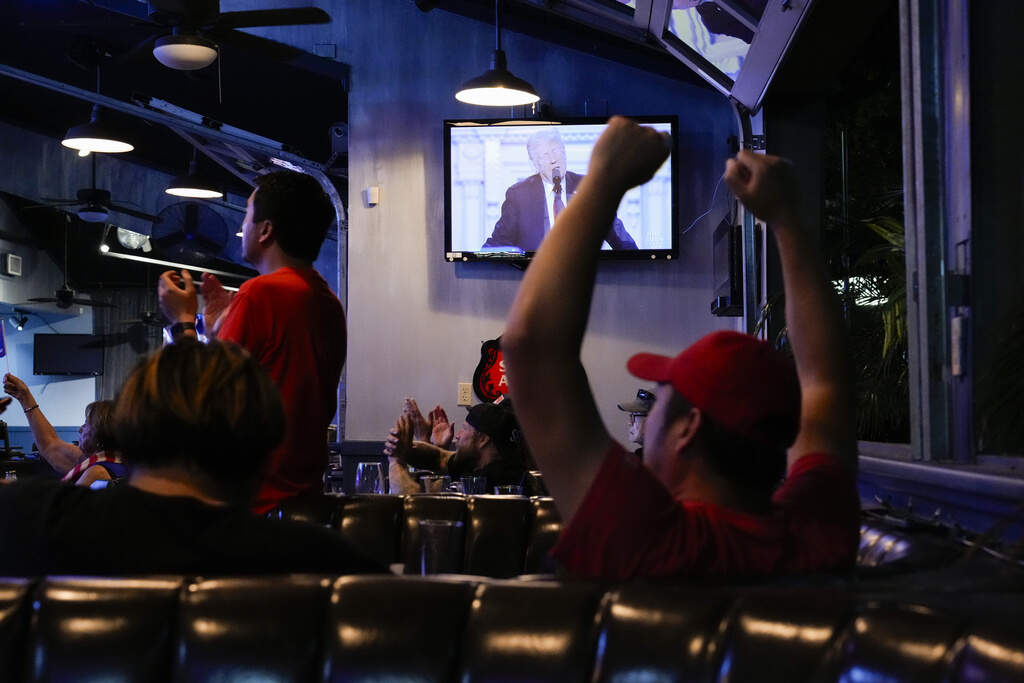
The gender divide among Gen Z voters is deeper than any other generation. Young women are drawn to progressive politics. Young men are drawn to Trump. But why?
Today, On Point: Why young men are attracted to Donald Trump's MAGA movement.
Guests
Richard Reeves, president and founder of the American Institute for Boys and Men.
Melissa Deckman, CEO of PRRI, the Public Religion Research Institute. Author of "The Politics of Gen Z: How the Youngest Voters will Shape our Democracy."
Transcript
Part I
MIA PICKERING: When my son was in high school, he played football. I tried to get him to look at the old-fashioned newspaper, at least start out with the sports section. 'Cause I'm like, you know, there's other things you might get exposed to.
MEGHNA CHAKRABARTI: Mia Pickering lives in Seattle, Washington. She’s talking about her son, Spencer Pickering, who is now 26 years old. Looking back, Mia admits that her efforts with old fashioned newsprint didn’t make a huge impression on Spencer.
PICKERING: A number of years ago, Spencer and I had a conversation about where he gets some of his ideas and I had never heard of Joe Rogan at that time. We're talking, 5, 6 years ago kind of thing.
(JOE ROGAN MONTAGE)
JOE ROGAN: There was a woman who, it was in the 1970s, who had some sort of analogy to pain pills. They put wires into her brain and gave her a device. Do you know the story?
GUEST: Where it actually hits the pleasure center. Yeah. And then you're like, my God.
PICKERING: And I was an early adopter of podcasts. I've listened to him some.
ROGAN: She was just, she became just an orgasm junkie.
PICKERING: I love a in depth interview. I'm thrilled when I hear long form interview.
ROGAN: It was, it's madness.
PICKERING: I did not find Joe Rogan to my personal tastes.
ROGAN: Fascinated by the idea that this could eventually become a part of the phone.
GUEST: We could definitely make that happen.
PICKERING: And I went, Oh, so this is where a lot of your ideas are being formed.
ROGAN: That, you wouldn't do it, but the Chinese sure. I don't know. Huawei phones immediately with a button.
CHAKRABARTI: This is On Point. I'm Meghna Chakrabarti. In his podcast, The Joe Rogan Experience, Rogan's interviews run the gamut, from long riffs on martial arts, to having used racial slurs, to browbeating flat earthers and climate deniers. Those excerpts you just heard were from one of Rogan's interviews with Billionaire Tesla founder and Twitter now ex owner, Elon Musk.
It just wasn't what Mia had ever imagined Spencer would be listening to, which surprised her, because she and her son have had a close and inquisitive relationship ever since he was a boy.
PICKERING: We talked about cannabis use from before he was legal and abortion rights and human rights and all of that.
So yeah, his personal views would be more humanitarian.
CHAKRABARTI: You hear those long pauses? To me, Mia's pauses are the sound of a mother trying to understand her son. See, Mia's confusion stems partially from the fact that she describes Spencer's upbringing, including where they lived, who their friends were, and how they spent their time, as quote, the bluest of the blue.
PICKERING: We have a famous parade here in the solstice. Where from time beginning, there's been naked bike riders, and I actually had one of my dear friends say when the kids were like in first or second grade, we better take them to the more traditional torchlight parade, so that they get to see the guys marching with the flags, do you know what I'm saying?
So we're, and we're like, and my friend Carl at the time said, if we only ever show them how our liberal side, they're going to absolutely turn out to be conservatives, because that's what kids do, right? And so we've laughed about that.
CHAKRABARTI: But lately, Mia has noticed her 26-year-old son's politics have changed.
He's much more conservative now, more like his grandmother than like Mia.
PICKERING: My mom, who was a solid Trump fan, 100%, to the last breath she took on this planet, she would say where she went wrong was sending her children for a liberal education. So when I talk about Spencer, do I look at his education outside of the house?
Yeah, partially, we ask a lot of our education system, right?
CHAKRABARTI: One of the biggest political gender gaps in decades is emerging right now among Gen Z voters. Gen Z men are swinging dramatically to the right, and to Donald Trump. In a recent Time-Siena poll of six swing states, men ages 18 to 29 favored Trump by 13 points, while women the same age favored Vice President Harris by 38 points.
A 51-point gap. That's more like a chasm. Now there's always been a gender gap in politics, even when men and women favor the same candidate. It's often by different margins. But this Gen Z gender gap is the whitest seen since at least 1980. And why? For one, the Trump campaign is actively courting Gen Z men.
Trump shows up at Ultimate Fighting Championship bouts.
UFC ANNOUNCER: Making his way into the building, one of the bigger Mixed Martial Arts fans I know, President Donald Trump, taking his Octagon side seat for UFC 295.
CHAKRABARTI: He jokes around with Gen Z social media influencers like wrestler and YouTuber Logan Paul.
LOGAN PAUL: Yeah, I always see you at UFC.
TRUMP: By the way, do you ever fight your brother? That's the question.
PAUL: You wanna know something?
TRUMP: I wanna know. Yeah. 'Cause you're both, you are both good. Do you ever fight him?
CHAKRABARTI: Paul's interview with Trump has been viewed more than 6.5 million times. And Paul's political endorsements come disarmingly wrapped in bro talk for his more than 23 million YouTube subscribers.
PAUL: Tell Trump 2 million dollars for the hat he was wearing, for the attempted assassination and my full endorsement. Not that he needs it, but that's my offer.
That's your bid?
My bid's 3 million.
Then I'll do 4.
I'll do 4. Six.
I would pay probably 12 million for that hat.
Let's go halfsies actually.
Tell him.
I doubt he would sell it.
That is a family heirloom. Why the [expletive] would he sell that to us?
CHAKRABARTI: But there's something more. JP Villasmil, a fellow at the Spectator World, a conservative magazine, says there's something even more essential about Trump's appeal to Gen Z men.
JP VILLASMIL: Excuse my generation's language here, if I may. Donald Trump is a Sigma.
CHAKRABARTI: Yeah, a Sigma. Someone who goes against the flow, who plays by his own rules, but still dominates the game. It's an uncompromising model of masculinity, attractive to many young and middle-aged men, for that matter, who have come of age at a time where powerfully positive public models of masculinity have been harder to find.
Seattle mom Mia Pickering says, She's surprised at how pervasive that feeling is.
Earlier this year, she and her son Spencer visited New York, and she wanted to do stuff that he was interested in. So they went to a bunch of comedy shows that he suggested.
PICKERING: The middle aged white male comedians talking about how they feel displaced.
And I was like, holy gosh, that is so interesting that these males are talking to their audience like somehow, they are being shamed for their perspectives.
CHAKRABARTI: Or it could be that the comics were connecting with an experience Spencer is already living. Because later, Spencer told his mom that he also feels displaced.
Dan Cox directs the Survey Center on American Life.
DAN COX: I think it goes to this sense feeling lost or a sort of feeling of displacement where men don't feel like really anyone's on their side.
CHAKRABARTI: And in the social media age, that sense of displacement is endlessly algorithmically amplified, reflected back to young men, and then capitalized by savvy political campaigns.
LOUDON: I wouldn't put my biggest support in someone that thinks I'm stupid.
CHAKRABARTI: Bo Loudon is a 17-year-old conservative social media influencer. He's the son of former Missouri State Senator John William Loudon. Bo is also reportedly close friends with Barron Trump, the former president's son. He was recently on Fox News.
LOUDON: Because that's what Kamala said, 18- to 24-year-olds are stupid.
CHAKRABARTI: Loudon is referring to a viral video posted by the Daily Wire, a conservative news outlet. It's been viewed millions of times. And it's where Vice President Kamala Harris did indeed say:
KAMALA HARRIS: What else do we know about this population, 18 through 24?
They are stupid.
CHAKRABARTI: Now, viral videos, of course, are almost always entirely devoid of context, and context in this case includes the following. Harris spoke those words in 2014, back when she was serving as California Attorney General. She'd been describing Back on Track, a prison recidivism reduction program aimed at providing low level young offenders with higher education opportunities and reentry services.
Harris explained why the program was designed as a deliberate intervention for 18- to 24-year-olds.
HARRIS: We recognize the fact that 18 through 24, when I was at Howard University and we were in college, we were 18 through 24. And you know what we were called? College kids. But when you turn 18 and you're in the system, you are considered an adult, period.
Without any regard to the fact that is the very phase of life in which we have invested billions of dollars in colleges and universities, knowing that is the prime phase of life during which we mold and shape and direct someone to become a productive adult.
CHAKRABARTI: Niobe Way is a psychology professor at New York University and also author of Rebels with a Cause: Reimagining Boys, Ourselves, and Our Culture.
And she says context like that does not stand a chance against the combined forces of culture and technology that are leaving many young men listless.
NIOBE WAY: They feel like they've been put on the bottom of the hierarchy, either as a working class person, as a white person, as a boy, it doesn't matter. They feel like they've been put on the bottom of the hierarchy of humanness.
And they don't want to be on the bottom.
CHAKRABARTI: And to hear teen influencer Bo Loudon tell it, Donald Trump is the man to pull them up.
LOUDON: And Trump loves the youth. Gen Z loves Trump. And he's got the support. And he is going to do great things for Gen Z, but all voters. And he makes that very clear with all his policies, his whole campaign.
It's booming.
CHAKRABARTI: So those are some of the factors leading to that yawning 51 point gender gap between Gen Z men and Gen Z women, when it comes to men's support of Donald Trump.
Part II
CHAKRABARTI: In at least six swing states in this country, there's a 50-point difference between Gen Z women who support Vice President Kamala Harris's bid for the presidency and Gen Z men who are increasingly gravitating towards Donald Trump.
Richard Reeves joins us today. He's president of the American Institute for Boys and Men and author "Of Boys and Men: Why the modern male is struggling, why it matters, and what to do about it." Richard, it's great to have you back.
RICHARD REEVES: Yeah, it's great to be back, Meghna, thank you.
CHAKRABARTI: And Melissa Deckman is also with us. She is CEO of the Public Religion Research Institute and author of "The Politics of Gen Z: How the Youngest Voters Will Shape Our Democracy." Melissa, welcome to you.
MELISSA DECKMAN: Thanks for having me today, Meghna. Happy to be here.
CHAKRABARTI: Richard, let me first start with you. What's your first read into the fact of this really large Gen Z gender gap when it comes to presidential preferences?
REEVES: Yeah. The first thing to point out is that it's a two way street. What's really happening here is that there's a really strong move to the left. Among young women, they've become much more liberal, much more likely to identify the Democrats. And as you point out in your opening, that young men have gone somewhat the other way, but it's more strongly a leftward move by young women than a rightward move by young men, of course, it's important to focus on both of those.
And to some extent, they might be feeding off each other a little bit. I think there could be a little bit of reaction going on among certain young men. The second thing I would say, which is to the point about young men, which is that there's more of a sense that they feel a little bit homeless.
In some cases, I think it's more of a cultural issue, but if I were to reframe the question a little bit, sometimes there's a tendency to say, why are young men turning to the right? I think it might be as useful to say, why are they turning away from the left? Because that is where young men would usually be, as you pointed out earlier.
And so it's more interesting in some ways that they don't feel at home in the place that young men have historically, which is on the left. And so it may be feeling a little bit less welcome on the left and somewhat more welcome on the right than it is this sort of huge conversion, I don't see this mass road to Damascus conversion among young men, not big change on policy views, not really much of a change in any attitudes towards gender equality.
I think it's just more of a sense of feeling a bit more seen and a bit more heard perhaps on the right than it is some huge shift in opinion among young men.
CHAKRABARTI: Okay. So this is important, right? Because in that polling that I quoted, earlier the Times/Siena poll found that Gen Z men are still somewhat more likely overall to identify as Democratic than Republican, right?
30%to 20, 24%. Actually Melissa, that's from polling from PRRI forgive me.
DECKMAN: (LAUGHS)
CHAKRABARTI: Totally forgive me for that. I am getting all my polls mixed up. But at least I caught it just in time. So let me turn to you, Melissa, because with that in mind I also see that you've found that when it comes to issues, and this is what Richard had just raised, things like abortion rights, same sex marriage, even the Gen Z men who say they identify politically as Republican are still more likely to have more, quote, unquote, liberal views on those specific issues, right?
DECKMAN: Yeah, I completely agree with Richard and his assessment. I think this big gender gap we're seeing among Gen Z is really driven by Gen Z women who have just become progressive, in many ways, more so than their mothers and grandmothers' generations, certainly.
And I think I would describe Gen Z men as more ideologically diverse. And so we find, of course, in our polling, as you mentioned, that young Democratic young men, adults are more likely to identify slightly as Democrats, as opposed to Republicans and even more recent polling.
I know a lot of attention has been focused on that New York Times/Siena poll, but Ipsos and ABC had a poll out a few days ago and what we're seeing there is that among likely Gen Z women voters, or voters 18 to 29, that's most of Gen Z who are as adults, 18 to 27, roughly, we still see a huge gap in preference for Harris, about 68 to 30. But young men that age are, I think, coming back to what we've seen in earlier elections, 51 to 48 in favor of Harris. I think this narrative that young men are becoming reactionary in response to young women's gains in society and are bolting toward Trump and the GOP is really not quite accurate at this point.
That's not to say, of course, that the Trump campaign and Republicans aren't messaging very aggressively. Two young men in places where they're hanging out, such as watching Joe Rogan's podcast and in other areas. But I think it's a little premature to say that we're seeing young men bolting toward the Republican Party in mass numbers.
CHAKRABARTI: Okay. So Richard let me turn back to you though. Because you did say, if I heard you correctly, that you do think there is a cultural element to this, if not a strictly political one in terms of policy. And just to buttress that, I'm looking at some other numbers, again, Melissa, forgive me, but this time it is the Times/Siena poll in those swing states.
And what fascinates me about it is that for those ages, 18 to 29, there's a 10 plus factor in support for Trump. It's roughly similar for, let's call them the Gen Xers. Then it makes sense. You get older and you find that men are supporting Trump more, but then in age 65 plus, it falls actually below the Gen Z men support level for Trump. Now, the reason why I raise that, Richard, is because, is this or isn't this sort of challenging the presumption that has been around, that young people start out life being more liberal when they're younger and get more conservative when they're older?
Because that doesn't seem to be borne out by those figures.
REEVES: No. And I think that might be why you should be interested in it for a long term perspective. If young men are less reliably on the left than previous generations, then what does that mean for what they'll be like as they age?
I think that's open to question. And I would say the young men's votes are up for grabs in a way. That they haven't been previously, and I agree with kind of Melissa's assessment, we shouldn't overstate this, but I think the sense that they're detached from a kind of presumed support for more left wing parties, even if their views on policies haven't changed, I think that's true.
And I think that is largely, as you just indicated, in the space of culture rather than specific policy. This is, it's interesting, there's this whole debate about like why working class Americans kind of voting against their own interests. This famous book, what's the matter with Kansas et cetera?
And it was all about cultural stuff. And I sense kind of among young men, there is a kind of huge enthusiasm for either side right now. . And what that means is that they are up for grabs. They're much, much more unattached to a particular kind of political party. And so of course the Republicans see an opportunity there.
Of course, they can say, look, we can dislodge a bunch of these young men, and if we can turn them out, they might vote for us this time. And so I do think that there's a political opportunity here. And a political danger here, that we shouldn't underemphasize, even as we kind of point to the fact that it's mostly being driven by young women.
And I do think that's just back to this sort of sense of, what does it mean to be a man? How do you feel? Do you feel as if there's something wrong with you or something right with you?
... Now, of course, that causal arrow goes both ways, but I do think this is more of a question of how we're seeing, viewing and talking about men and talking about masculinity or exhibiting kind of support or disdain for masculine kinds of behavior. And I think that's a culture war right now that Republicans are clearly winning.
The question is whether or not that turns into votes.
CHAKRABARTI: Okay. Yeah. I was just going to say, because ultimately that's the only poll that matters, right? In terms of how people cast their votes. But how we as a country see and talk about young men is a really interesting part of this conversation, I think.
And so let me go back to Niobe Way. She's been studying boys and young men for 40 years. And as I said earlier, she's a professor of psychology at NYU and author of the book "Rebel with a Cause." And she says that, in her research, she finds that young men tell her they have felt neglected for years.
WAY: Why do they vote? Why are they drawn to conservative politics? Because they feel the voices in conservative politics don't put them on the bottom of the hierarchy. They actually acknowledge that their needs and their existence is important. They value them. And even though I don't think Trump values anybody but himself, his rhetoric actually is very much saying to working class people and poor and working-class people in communities, Hey, I think you're human, too. I'm not going to put you on the bottom. I value what you need.
I value what you want, even though it may not be true for him. The reality is conservative politics has picked that up and run with it. And what the left is doing is actually saying, You're voting for Trump, so therefore we hate you, and we're going to continue to put you on the bottom of the hierarchy without realizing we're kicking ourselves in the asses.
REEVES: Huh.
CHAKRABARTI: That's Niobe Way from New York University. Richard, you just went, huh? Why?
REEVES: Yeah, I think, I agree with Niobe about this. And I think you can overstate the language on the left around this, but I do think it's true that there's been these wonderful movements around Me Too and gender equality and so on.
And I think we'd all support those, but along with that, there has been some more difficult stuff around toxic masculinity and kind of mansplaining and so on, and leaving a lot of kind of young men feeling disoriented, a bit uncertain. And I think Niobe suggested, a little bit unseen.
And what I find interesting about this is I think one of the things we've really learned is that if you want someone to lean hard into a particular aspect of their identity, what you do is you threaten or pathologize it, nothing makes you feel more Jewish than antisemitism. And in a similar way, I think that if young men feel like they're in a culture where the very idea of masculinity or certain kinds of male behavior is just bad, then I don't think it's a surprise that we see a reaction against that.
And we see an openness to people, figures, online or otherwise. Who are, in a way, putting a middle finger up to that, saying, No, it's great to be a guy. And doing that in a very adolescent way in some cases, in a very performative way, but nonetheless, the fact that there's an audience among young men for just guys being guys, I think, to me, indicates something's gone wrong further upstream, which is that in some cases we've made it seem like there's something wrong with being a guy, and that's just created a huge vacuum that we're now seeing being exploited.
CHAKRABARTI: So Melissa, tell me what you think about that, that this may be more for those young men who are gravitating towards Trump, that this may be more about performative masculinity than about any actual sort of political motivation.
DECKMAN: I think that's a pretty good observation. I think when we talk about the culture and how the culture is sending these messages to young men, that their masculinity is not valued or it's maybe misunderstood, I think there is a space on the political right.
That's been trying to appeal to that. For example, Senator Josh Hawley last year released a book called Manhood. And so the whole premise of the book is that the biggest problem in society essentially is that the toxic left has said men are the problem. And so men are constantly hearing they're the problem.
And so in that kind of space, I could see where appeals by political figures on the right might make some inroads. And certainly, young men are watching folks like Andrew Tate, or they're listening to Joe Rogan. And you hear those messages, I think sometimes also amplified. And even before that, Jordan Peterson was, I think, When I did my book on, and did research for my book on Gen Z, I talked to a lot of young men, and many of them cited Peterson as someone who was giving them advice on how to be a good guy, make your bed, get into shape, those sorts of things.
But there's also, I think, along with that, unfortunately, are some troubling ideas about gender roles and trans individuals, things of that nature. So I do think there is an opening, but I think on the other side, to get back to this idea that maybe Gen Z men are somewhat more moderate in many ways.
I actually would like to cite Richard's work. So Richard has done some analysis of the general social survey. Asking young men and young women about their attitudes on gender roles, writ large, in society. And what he has found is that if you look at, for example, attitudes about whether working moms can have loving relationships with their parents. Or whether essentially there should be a trad wife America, which is a narrative you're hearing today.
Should women primarily be at home and men being the main breadwinners, Gen Z men look different than older generations' men. They're far more embracing of equal roles in society. So again, it's one of those kinds of situations where yes, masculinity, having debates about what healthy masculinity looks like, I think it's important. But I think it's also important to point out that for many young men, they're not necessarily drawn to a hyper masculine narrative that seems to be dominating the GOP these days.
CHAKRABARTI: Okay. With that in mind let me go back to Dan Cox, who directs the Survey Center on American Life, and here's what he had to say about what he sees as an absence of a sort of parallel, powerful model of masculinity coming from the progressive left.
COX: There's a sense of like, where do I fit in all this and what kind of politics should I embrace, because no one's really modeling that for them and no one's really making a claim for not just even their vote, but who are the people that can make an interest? Make a difference in their lives?
And I think that for a lot of them, they're just not seeing anyone. And I think those are the folks who will gravitate online and some of them will be sucked down the manosphere and some of the really more toxic variety of masculinity that we see there.
CHAKRABARTI: Okay, so there's a couple of things I want to dig into there, and Richard let me go back to you here on this.
And, you heard Dan say there aren't alternative models. But I think isn't part of the reason for that is what he said later. This generation is very, very online, right? And the medium through which young men and young women, by the way, are receiving messages about whatever femininity or masculinity are supposed to mean, that's all algorithmically moderated, right?
And the algorithm isn't going to send you calming images of men just doing good work and supporting their families and whatnot. It's going to send you Andrew Tate to get you to click more and tap more. So is it just a question of there are other models out there.
They just have a hard time breaking through.
REEVES: Yeah, I think there's two aspects to this. At the risk of sounding like an economist, like it's a supply side and a demand side. On the supply side, you've got these online figures, and you've got an algorithm that drives you to ever more radical versions of them.
That's true. I do think, underlining Melissa's point, that what's interesting about some of these figures, particularly someone like Jordan Peterson, is that really all they did was just make young men feel seen and heard. They just had a bit of empathy to them. It turned out that was like a magic potion.
Which should make us stop and think.
CHAKRABARTI: Yeah, it shouldn't be any surprise, right? We talk about empathy all the time as being essential to life.
REEVES: All the time, but we sometimes feel like — Yeah, and is there only so much of it to go around, right? And Peterson and others, what they do, is to just make young men feel like, look, your issues do matter, right?
We have noticed that the suicide rate among young women, young men rather, has gone up by a third since 2010. And we've noticed we're losing 40,000 men every year to suicide. We've noticed the life expectancy gap growing. We've noticed boys struggling in school. We've noticed working class men haven't seen their wages rise for decades, right? We've noticed these things, right? We're seeing you. So I think that's powerful. And then online, of course, it just gets algorithmically amplified. But it's more interesting to me. It's on the demand side, right? You've got to be looking, you've got to be asking questions. How should I be a man today?
What does it mean to be a man? Or to use Dan's terms, how do I fit in? And the fact that so many young men are asking that question online, I think suggests that we're not answering it effectively enough offline. No, not for nothing that the share of male teachers has plummeted in recent years.
It would be the exception in high schools now as a male teacher and in other professions too. And so just, I think the best answer to these online figures is some flesh and blood men in the classroom, fathers, et cetera, rather than trying to be them online.
Part III
CHAKRABARTI: Melissa, I'm going to come to you in a second, but I just wanted to provide another example of the fact that whether or not Gen Z men are actually more conservative than older Americans, as we had mentioned earlier, the Trump campaign is actively reaching out to these young men in various online platforms.
We heard much earlier in the show a little bit of of tape from when Donald Trump was interviewed by Gen Z influencer and YouTuber Logan Paul. And here's a little bit more from that interview on Paul's podcast, Impaulsive.
PAUL: But my question is, for other young people in this country who are looking to get ahead.
Because for a lot of them, times are tough right now.
TRUMP: It's very tough.
PAUL: What would you say to them? Kids who want to pursue their own version of the American dream and try to achieve their wildest dreams and make it all come true.
TRUMP: I would say very simply, honestly, vote for Trump. Because with Biden, you're never going to do it.
This country is going to hell. Vote for Trump. We're doing great with youth, we're doing great with African Americans, with Hispanic Americans, through the roof, both of those groups, with women, with men, and with young people, we're doing very well. But I say vote for Trump. If you don't have the right guy in the lead, the country's not gonna, if the country doesn't do well, It's much harder to do even what you do, okay, even what you do.
So that would be a simple message, I really, and I really mean it, actually.
CHAKRABARTI: So that's Donald Trump on Logan Paul's podcast, Impaulsive. And Melissa Deckman, there you heard Trump naturally lapse into his Trump stump speech boilerplate, right? Just vote for Trump and all problems will be solved.
But the reason why I wanted to play that is that's actually a rare moment in this podcast episode. What struck me more, reflecting back on what Richard was talking about, regarding empathy, was how much Trump actually listened to Logan Paul. He leaned in a lot and was asking Paul questions and really taking in his answers and being curious about Paul's wrestling career.
It was actually quite fascinating to me. And it seemed to strike a very different tone than, first of all, then we see Trump on the stump. And B, I can really imagine why a lot of young men might find that to be, actually, even almost comforting. Because, let's be honest, there are so many young men who say we spend a lot of time being told we're not even deserving of empathy because of our white male privilege.
DECKMAN: Yeah, I think that's a really good observation. I do think it's smart politically for the Trump campaign to reach young men where they are. Whether it's Logan Paul podcast or gaming sites, those sorts of things, because they're trying to reach disaffected young men.
And the question, of course, will those disaffected men also be likely to vote? I think that's more of an open question, I think when I was struck in that exchange with Logan Paul, Trump is trying to make the case that things will be better for young men. You want to just simply get a job and get ahead in society.
Of course, very vague on details. Trump is always making details about most things, right? But I do think, however, when it comes to voting, you have also pointed out that our research, other research finds that young men tend to be culturally, I think, more liberal on policies like abortion, or same sex marriage or gay rights.
But what really drives and animates young men today in terms of their voting is going to be the economy. We put out an earlier survey at PRRI on the politics of Gen Z as well. And we did focus groups of diverse groups of Gen Zers, men, women, Democrats, Republicans. And what was really striking about the focus group is that across all of the groups the one through line was economic anxiety.
Now, Gen Z feels as though they will not have the same opportunities in life as their parents and as their grandparents, they can't afford to move out of their parents basement, right? Rent is high. Buying a house is unattainable, finding a job that can pay for the higher cost of goods and services is really hitting Gen Z harder than others.
And I think when it comes to voting, there's probably a tendency for Gen Z women to place more emphasis on things like reproductive rights as being most salient to their decision on cultural issues. But for Gen Z men, I think it's probably going to boil down to economics. And so I think in some ways, that's a smarter move for the Trump campaign, to emphasize those sorts of issues moving forward, but also an opportunity for the Harris campaign to reach men where they are and their concerns about economics, as well.
CHAKRABARTI: I gotcha. Okay. Richard earlier in the show, you had asked a really important question, right? Because in trying to parse whether this is actually a political movement to the right by young men or something deeper and more cultural, you'd mentioned that really what matters is, does that turn into votes?
Okay. So I was just, we were just looking back at what happened in 2020 with Gen Zers, with young Americans who were 18 to 24 back in 2020, and exit polling showed that of that age group in 2020, 31% voted for Trump. Now that's across races, by the way, I should say, across races and across genders.
So 31% of young people voting for Trump in '20. And interestingly though, when you break it down by race, and this is not necessarily by gender, but by race, 53% of white 18- to 29-year-olds voted for Trump in 2020. And if again, gender trends are any indication, a large chunk of them were young white men.
Given that, why do you think this matters right now?
REEVES: I think it's true that some of this economic anxiety is spilling over into some of these cultural issues, which is usually how I think these things work. And if you look at the recent work of Raj Chetty and his team out of Harvard, it does show that white men who've been raised in lower income backgrounds are actually worse off than their fathers were at the same age.
Now, that doesn't mean they're worse off than the equivalent men of different races, right? But the trend lines are different. The economic prospects for white men from lower income backgrounds are going down. And so I think it does play out, even if that's not necessarily how it's articulated.
The question then is, can you frame an economic message which is explicitly pro male without being anti female? And I think that's the challenge. That's where I think the opportunity is, can you have a way of talking about this, which acknowledges some of those more specific issues?
And Melissa mentioned Josh Hawley earlier, and I find him an interesting figure that obviously very conservative, kind of populist, Republican senator. He voted against the infrastructure bill, the bipartisan infrastructure bill. The bipartisan infrastructure bill is the only major piece of legislation recently that has particularly helped working class men.
Two thirds of the jobs created, roughly, went to working class men. That is a fact that the Democrats who really led on that bill, did everything in their power to avoid admitting, or if they did, apologizing for, and then there you have a piece of legislation that helped working class men. Of all races, by the way, Black and Hispanic men, as much as white.
And the Democrats would never say that. In fact, they would apologize for it when they were caught on it. So they couldn't say, this bill will be good for working class men. And that's okay, because we're doing a lot of things for women as well. They couldn't say that. They can't say they're setting up a suicide task force. They can't say that health insurance will actually help young men more than any health insurance expansion will help young men more, because they're least likely to have health insurance. They can't say that, because they feel it's a zero-sum game and if they say that in some way, will undermine or dilute their message to young women, I think that's wrong.
But there's an irony here, which is that the very figures on the right, like Hawley, who claimed to be the tribunes of the working man, voted against the only piece of legislation recently that would have helped them. And there's a real paradox there in our politics.
CHAKRAARTI: Hypocrisy in politics, Richard? Perish the thought.
REEVES: I said paradox. That was much softer than that. You can't say that, Meghna. No, I can't say that.
CHAKRABARTI: Melissa, I'd love to hear your thoughts on this. Go ahead.
DECKMAN: Gosh, I think Richard actually is pretty spot on when it comes to the Democrats reluctance to champion policies that will help working class men. Because we know, of course, our data at PRRI clearly shows that the white working class have really abandoned the Democratic Party in droves, right?
And they look at Trump as being more of a champion for them. Of course, even though paradoxically, we'll say, that they're not championing policies, economic policies that will help the white working class, right? It's really based more on grievance. And I think the feeling that they've been left behind, and Trump is giving voice to that sort of thing.
I think, it would behoove the Democratic Party actually, to talk more, to make more outreach to young men, to tell them and explain how their policies are helping them economically and helping give them a leg up. I think what's really happened and looking at the growing liberalization of young women, or looking at efforts that have been wonderful for young women, like part of the reason I think you see the surge of activism among young women compared to young men, is that we've invested as a society, lots of resources culturally.
And to get young women to build their self-esteem, whether it's encouraging them to go into STEM fields, which are traditionally male dominated and tend to pay more, whether it's getting them into organized sports. Or whether it's, for example, organizations like the Girl Scouts who've developed all kinds of badges around civic engagement.
And so there's been lots of resources developed toward young women, to get them up to speed. And I think it's paying dividends now in terms of political engagement. But there hasn't been necessarily something analogous to efforts toward boys. And so I think this is an opportunity for Democrats, for societal groups.
I know Richard's doing the heavy lifting with his organization. Of trying to get young men up to speed on these sorts of measures that will lead them to a better life as well. But for Democrats, I think it would make sense for them to start talking about the problems that boys and young men are facing in this country.
This program aired on September 19, 2024.