Support WBUR
What’s fueling America’s Zyn obsession?
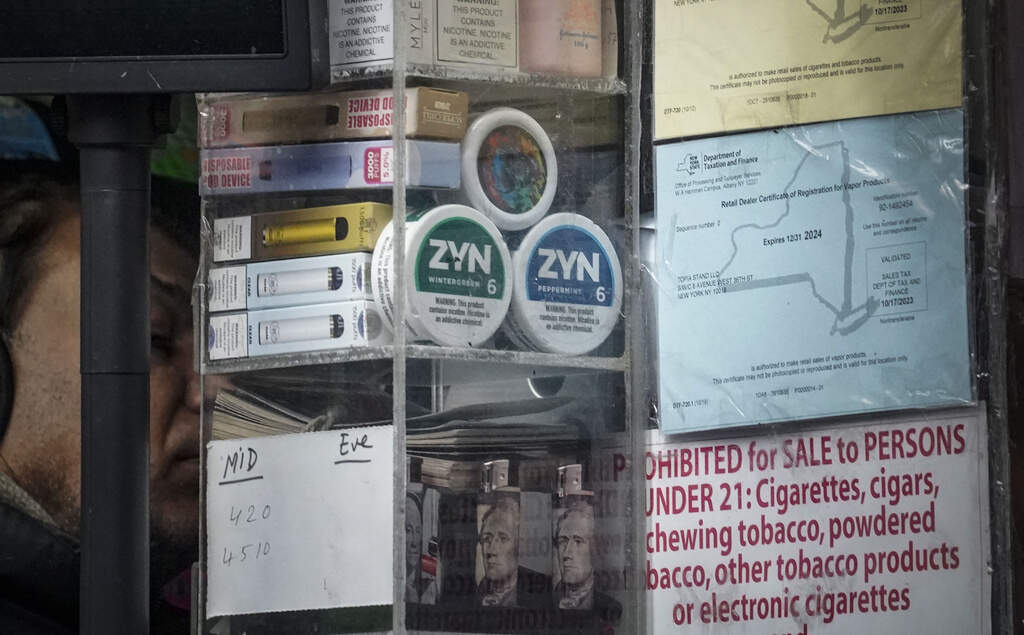
Zyn nicotine pouches have exploded in popularity, generating millions of dollars for tobacco giants — and a new subculture on the internet, or “Zynternet.”
Zyn has even found its way into national politics.
Today, On Point: What's behind the rise of Zyn?
Guests
Chad Jones, runs the website snubie.com, where he writes about and reviews nicotine pouches and snus. He’s written about snus since 2009.
Max Read, author of the Substack newsletter “Read Max."
Brittney Keller-Hamilton, assistant professor in the Division of Medical Oncology at The Ohio State University College of Medicine, where she researches oral nicotine pouches.
Also Featured
Conrad Cable, farmer in Monroe, Louisiana who has been using Zyn since 2019.
“John”, an 18-year-old in New York who says he purchased Zyn after seeing videos about it on social media.
Transcript
Part I
MEGHNA CHAKRABARTI: For the last four years, Conrad Cable has started many days the same way.
CONRAD CABLE: The bougiest things about me. I love bubbly water, single origin coffee, and Zyn pouches. Probably my favorite thing is in the morning on my drive to work, I get to enjoy a wonderful, delicious cup of coffee and at the same time I get my nicotine fix.
CHAKRABARTI: Conrad is 32 years old. He farms vegetables in Monroe, Louisiana, and Conrad smoked cigarettes for years. But now he likes his nicotine in a different form, a pouch from a brand called Zyn, spelled Z-Y-N.
CABLE: In the South, we call sodas Cokes for everything. And I feel like my term for nicotine pouches is just Zyn. Like, that's the default.
CHAKRABARTI: The Zyn pouches are like tiny pillows, and Conrad tucks his between his upper lip and gums. Zyn comes in 10 different flavors, including cinnamon, winter green, and citrus. Conrad's favorite flavor is called Zyn Smooth. The nicotine is absorbed into his bloodstream as he's driving to work.
CABLE: There's a term that folks use called double barreling, where you put two Zyn in at a time, and that is a little intense for me. If I'm driving a lot, I'll use more Zyn, but I use anywhere from seven to ten pouches per day.
CHAKRABARTI: Conrad says the Zyn pouches have helped him quit smoking cigarettes, and he likes that. He also feels like Zyn helps him focus and manage his stress working on the farm.
CABLE: We make our revenue off of vegetable subscriptions, and every Friday I have to pack up around 120 farm share boxes. Being able to have a Zyn or have a nicotine pouch while I'm in that time crunch, stressful situation where I need to be accurate and on time, it helps me, I feel like, get through that a little more smoothly.
CHAKRABARTI: This is On Point. I'm Meghna Chakrabarti.
And Conrad in Monroe, Louisiana is very far from alone because Zyn has exploded in popularity across the country. It pops up on TikTok, on Instagram, in podcasts. It's created an entire subculture — even an entirely new slang. People are adding the letters Z-Y-N to things, creating words like "Zynfluencer" and "Zynbabwe."
(MONTAGE)
TIKTOKER 1: Twelve Zyns! Eat ‘em, Rick! Swallow it! (LAUGHS)
TIKTOKER 2: Open the can, put the Zyn in. He’s my coaaaach!
TIKTOKER 3: The Zyndemic is here. I got about four pouches left.
TIKTOKER 4: Now this message is for my Zyn community and my Zyn community only. I found Zyns! We bought the whole damn pack.
TIKTOKER 5: We’re gonna be doing this from least favorite to most favorite. Starting off, bottom of the barrel, Cool Mint. Very gross. Not a fan. Don’t see the hype. Number 12, Apple Mint. This is a UK-based flavor. It is 9 milli but does not hit nearly as hard as the 6 millis in America.
TIKTOKER 6: How much wood could a woodchuck chuck if a woodchuck could chuck upperdecky Zynnies, upperdecky lit pillows?
CHAKRABARTI: So much from just a quick TikTok survey. All of this Zyn hype is generating some serious money for an already big tobacco company. It's a subsidiary of Philip Morris called Swedish Match, and it expects to sell as many as 580 million cans of Zyn this year alone.
In July, Philip Morris said what it calls its smoke free business accounted for 38% of its total net revenues in the second quarter. And those net revenues had increased by about 14%. Gross profits of its smoke free business increased by some 16%. So Philip Morris is planning to build a new $600 million plant in Colorado to help meet the demand.
Zyn has also become — almost predictably, in this day and age — a political flashpoint.
CHUCK SCHUMER: Pouch packed with problems. High levels of nicotine. So today I'm delivering a warning to parents. Because these nicotine pouches seem to lock their sights on young kids, teenagers and even lower, and then use the social media to hook them.
CHAKRABARTI: That's Senate Majority Leader Democrat Chuck Schumer of New York at a press conference back in January. He urged the U.S. Food and Drug Administration and the Federal Trade Commission to investigate Zyn for its marketing and health claims.
In response, Congresswoman Republican Marjorie Taylor Greene of Georgia tweeted "This calls for a Zynsurrection!" North Carolina Republican Senator Thom Tillis posted, "Come and take it, Chuck." Last year, right winger commentator Tucker Carlson professed his love for Zyn, earning him the nickname "Tucker Carl-zyn" among some nicotine pouch fans. But now, Carlson has denounced the brand — he says for political reasons.
TUCKER CARLSON: It's made by a huge company, huge donors to Kamala Harris. I'm not going to use that brand anymore. I think it's fine. It's good for like your girlfriend or whatever, but it's — I don't think men should use that brand. It starts with a Z.
CHAKRABARTI: Now, if Carlson is referring to Philip Morris, he is correct.
The company's PAC has given $18,500 to the Harris campaign so far. Now recall, Philip Morris owns Swedish Match. That's the subsidiary that actually makes Zyn. Swedish Match's PAC has donated $25,000 to a group called Kentuckians for Strong Leadership and $587 to the Trump campaign.
But if we're talking about the tobacco industry's actual influence, it's probably more useful to look at lobbying dollars. And there, Philip Morris is in the top 100 spenders in the United States, spending $5.38 million lobbying Democrats and Republicans last year. And this year, the company has already spent $2.9 million pushing its perspective across Capitol Hill.
Anyway, back to Zyn. What is driving America's Zyn obsession? What does it say about our culture, our politics, and our health? And that is what we want to learn about today.
So we're going to start with Chad Jones. He runs the website snubie.com where he's written about and reviewed nicotine pouches since 2009. Chad, welcome to On Point.
CHAD JONES: Hi, Meghna, thanks for having me.
CHAKRABARTI: It's great to have you. Now you also are the moderator of a subreddit, the nicotine pouch subreddit, which has exploded in recent years. So what do you think is the sudden boom around Zyn all about?
JONES: Yeah, absolutely. It's a fascinating thing to see compared to our snus subreddit. We've watched the nicotine pouch one take off almost exponentially. It's been a huge thing to see and a few things, there's a few different factors we could probably attribute to that.
One of which, of course, is the public's drive to be more health focused, and to cut out things that aren't as healthy. As you heard earlier, people talking about quitting smoking with these products, and the tobacco harm reduction movement, which is very important.
And also, of course, a lot of the media attention lately, there was a massive influx of members after the "Tucker Carl-zyn" and the "Zynsurrection" and all of that. There was a massive influx of people who weren't just coming to learn about these products, but people who were already using them. And wanted to get actively involved with discussion about these products with other people who use them and how they factor into their lifestyle.
CHAKRABARTI: I see. Okay, so let me just take a slight tangent here Chad, because I can't pretend to know what I don't know. Snus?
JONES: Yes. Correct.
CHAKRABARTI: What is that?
JONES: So nicotine pouches evolved out of snus. Snus is a smokeless tobacco product that originated in Sweden and has been around for a few hundred years now.
And nicotine pouches evolved out of that because a lot of people were saying, "Hey, we don't want to smoke, but we still want to enjoy nicotine." And a lot of people use snus for that. And then, not too long ago, people said, "Hey, we want to use nicotine, but we also want to cut out tobacco." So that's when products like Zyn originated. It's a way to put nicotine into a pouch, but without tobacco. And most of them have some form of cellulose or plant fiber in there as the filler material along with nicotine. So people can enjoy nicotine in much a similar way as it absorbs into the bloodstream, but without actually consuming any tobacco.
CHAKRABARTI: Understood. Okay, that helps a lot. So that, for people who don't know what these smokeless tobacco products are, that is the thing that is the thing that is the big differentiator between something like a Zyn or a nicotine pouch and like regular dipping tobacco.
JONES: Correct. Yeah. And in the U.S., Swedish Match's other brand is General Snus, which was widely available on the market prior to nicotine pouches coming about. And was the first product to get this modified risk tobacco product label from the FDA that allowed them to say, "Hey, this product poses less risk to your health than smoking." It's an interesting development that hopefully we'll see with nicotine pouches, as well, if the FDA will let them label them as less risky as smoking.
CHAKRABARTI: I see. Okay. How have you seen the nicotine pouch demographic change, grow? As I said, you've been following this closely since 2009.
JONES: For a very long time now, yeah. It's a very interesting demographic. And what I've noticed is it seems to be a young adult demographic — not an underage demographic, despite how certain politicians may choose to paint it that way — it's a young adult demographic, people in their 20s and 30s that are very active and have active lifestyles and are very focused on their health.
Yes, it can be a quote-unquote hipster thing. People who like craft coffee and things like that. But also, I live in Arkansas, and I can't tell you how many times I go into a local gas station in the mornings to get my morning Red Bull and I'll see construction workers coming in, people I primarily grew up with that I would see buying dipping tobacco products like Copenhagen. And now these guys are going in and buying Zyns. It's almost like it's a part of culture for almost any demographic now, but primarily it's this younger group of people that are active and health conscious. And they're starting to see the benefits of switching to something like this from smoking and the difference it can make in their life.
CHAKRABARTI: Do you use Zyn?
JONES: Yes.
CHAKRABARTI: So what does it feel like? Because we heard earlier from our farmer in Monroe, Louisiana, that it gives him a buzz pretty fast. So how does it feel once you put it in?
JONES: Here locally the ones that I like are the coffee and the wintergreen flavors. Wintergreen probably because I grew up in the South and it's just a part of our culture. But, for different people, it depends. If you haven't eaten that morning, you may feel a little quicker release. If you have, maybe not so fast. I'm partial to their six-milligram strength, which is a little bit stronger.
It's just for me, a very relaxing experience. If I've got a lot of paperwork on my desk that morning, it's great to help focus. It's a good driver for productivity for me personally, and I can feel healthier because I'm not smoking anymore.
Part II
CHAKRABARTI: Today, we're talking about the Zyn phenomenon across the United States. It's a smokeless tobacco — not tobacco, nicotine product. A little pillow that you put, if you use it, between your gums and your lip. And it is hugely popular and therefore it has also gotten somewhat political.
Chad Jones joins us. He's in Little Rock, Arkansas. He runs the website snubie.com where he's written about and reviewed nicotine pouches and snus since 2009. And Chad, I wanted to ask you specifically, what is it about Zyn that's driven this like recent skyrocketing popularity? Because I think it's the majority of the market, right?
JONES: Yeah, absolutely. Probably over, last I saw, 77% of the market. Maybe more by now. I'm not sure. But it's really interesting with Zyn, and I've never seen this with another product, the way it's latched on and had this kind of organic growth. A lot of it can probably be attributed to the fact that Zyn was one of the first in the United States that got any kind of market share, growing out of test market to nationwide insanely fast.
So I think people seeing this as much as they can in their local tobacco stores and convenience stores and gas stations probably helped a lot. The distribution machine probably helped to get that a lot more widespread across the U.S. So people saw it and grew from there. So I think that was probably a major factor in it.
But the cultural, organic growth, that's something that could be studied by marketing majors for years. This is something that wasn't even from the company itself. It just had this massive organic growth of people adopting it and putting it into their lingo. It's just — it's fascinating to see it.
CHAKRABARTI: So then what do you think about the, as I said, sadly predictable politicization that's happened around it recently?
JONES: It is unfortunate. And, one thing, we always talk about this term called the Swedish experience, and we look at Sweden, for example, which is where snus originated and nicotine pouches originated as well, and where a lot of them are made. And Sweden was one of the first countries to reach the World Health Organization's goal of having a certain percentage of their population being smokers. I think they were around 6% last I saw. And a lot of that is attributed to the Swedish experience.
If we look at snus, for example, they have a high percentage of people who use tobacco, but they use snus and they don't smoke. So the Swedish experience informs us that looking at products like nicotine pouches as a way to quit smoking actually do promote a better public health.
So as it becomes more politicized, in a way, it's good and bad because, it's bad because it's not the best attention, but it's also good because people are becoming more aware of these products. And in general, society should always try to adopt whatever is best for public health. And the tobacco harm reduction movement works very hard in the interest of public health. That's where products like Zyn come in and can actually help save lives.
CHAKRABARTI: Yeah, we're actually going to talk about public health and harm reduction a little bit later. But for right now, Chad Jones in Little Rock who runs the website snubie.com. Thank you so much for joining us today, Chad.
JONES: Absolutely. Thanks for having me.
CHAKRABARTI: All right. Let's turn to Max Read now. He's in New York and he's author of the newsletter Read Max. It's a Substack newsletter about all things in the future. Max, welcome to you.
MAX READ: Hi, Meghna, how are you?
CHAKRABARTI: Okay. So I understand that we have you to thank for the phrase "the Zynternet."
READ: (LAUGHS) It takes a particular kind of mind to come up with something that genius.
CHAKRABARTI: (LAUGHS) If we're talking about branding geniuses, yeah, you definitely caught lightning in the bottle there. Describe to me the Zynternet online culture.
READ: Yeah the Zynternet is a kind of loose subculture of, I guess you'd say fratty, horndog, provocative, college aged guys, mostly guys, though not entirely male, maybe a little bit older. It's a little bit, not to slice and dice demographic categories online too much, but it's adjacent to the sports internet that you might see talking about a football game. It's adjacent to the kind of crypto hustle internet.
But it's got its own set of personalities and its own set of cultural references. Among them, it's a lot of guys who are really into college football and college sports. It's a lot of gamblers, sports gamblers, who like to post their crazy parlay bets, light domestic beers is another, big uniting point.
And then, of course, Zyn.
CHAKRABARTI: And how did that happen? As you heard Chad say, it was this entire organic thing. Do you have more insight into that?
READ: In my head, there's sort of two, I guess you would call them structural factors, that have made this group so suddenly prominent online.
I feel like we should say, in some ways, this is a very familiar subculture for those of us who have lived in the world for a long time. It's frat guys, southern frat guys. But it's not a group of people that you really associate with the internet, or with memes, or being online.
And I think two things have happened in the last few years that have suddenly made the Zynternet a force that can create waves in internet culture, so to speak. One of them is Elon Musk buying Twitter and the kind of consequent de-emphasis on content moderation, and on trying to keep things relatively tame and safe for people, which is a natural attractor for all kinds of provocative jokesters. Also, a lot of really macho, performatively macho subcultures, of which this Zynternet sometimes is.
And then the other thing is the legalization of sports gambling in a number of states, which has created these sort of behemoth sports gambling concerns that are looking to advertise, not just in traditional ways, but also through editorial products. So they're paying, in some cases, they own entire products. They own entire sports webs, sports media websites. Barstool Sports, a sort of famously fratty sports publication used to be owned by the betting company William Hill. Deadspin, the former Gawker Media sports site, is now owned by, I believe, a Macanese gambling conglomerate.
And so there's a lot of money in paying influencers, paying journalists, you see this if you turn on ESPN or Monday Night Football, you'll see people setting lines and talking about sports gambling in a way that feels very foreign to anybody who grew up in an era when sports leagues are trying to keep as much distance between gambling and sports as possible.
So all this money flowing in is flowing in to create influencers and personalities who are members of the kinds of demographics that are most likely to put a lot of money into sports gambling, which I think is ultimately the Zynternet.
CHAKRABARTI: Okay. But are you saying that, help me explain that, understand a little bit more about the overlap in, or the tie-in between the growth of this sports gambling frat culture as you're talking about online and Zyn, though. I might have missed that.
READ: Yeah, no, I think it's all kind of part, it's really hard to untangle a bunch of these different threads. And it's easy to overthink it, let's say, too.
But look, like the way most of these gambling companies make a lot of money is off of parlay bets, where you try and take a bunch of different bets on a bunch of different games and have all of them hit. Now, these bets are traditionally really stupid bets. It's almost always impossible to beat the house. So what you want to go after are relatively young guys and relatively young guys who are into sports. And then for a bunch of cultural reasons that we've already been talking about and that we can talk more about, those guys also happen to be really into Zyn.
And I think there's a kind of cultural flywheel here where they get into Zyn, and Zyn becomes a kind of way of demonstrating who you are and what subculture you get into, and it attracts more people to put Zyn in their mouths and enjoying themselves in that way. And you get this kind of a certain sensibility, it's a little, I can't quite think of a great comparison point but it's like planting a flag and saying, "This is the kind of guy I am."
CHAKRABARTI: Yeah. Okay. Philip Morris and its subsidiary, Swedish Match, are riding that cultural flywheel all the way to the bank. But what's interesting to me is that we're in a world now where, of course, it makes complete sense, since the dawn of time, human beings have wanted to feel part of a larger group or a larger sensibility through the products they use. And in fact, Big Tobacco has been one of the greatest masterminds in creating those kinds of cultures through marketing in the past.
But with this whole Zyn phenom, we reached out to Philip Morris and said, "Hey, are you like deliberately marketing or reaching out and partnering with social media influencers, et cetera, to popularize Zyn?" And they, in a statement sent back to us. they say that “Swedish Match goes beyond legal requirements to ensure marketing is directed towards legal age nicotine users. We do not use social media influencers. We refuse requests for such partnerships. We age-gate our digital channels and only use adult-oriented flavors.” So that's according to Philip Morris and Swedish Match.
There's a lot of gray area there, right? They may be age-gating their own channels, but that doesn't mean they have any control over the rest of the internet. But is this kind of one of those, I don't know, Stanley thermos mug moments?
READ: (LAUGHS) I think so. I think that's a very good, that's the comparison point I should have grabbed onto. At some point you don't need to market to below age or to anybody if everybody's going to do your own marketing for you. And I think that the sort of, for the reasons that we can both describe and the reasons that are ineffable, Zyn having become a kind of cultural flashpoint and a way to — I hate to use the phrase virtue signal and it's absolutely not correct — but a way to signal belonging is, you know, I would say it's a double-edged sword for Philip Morris and Swedish Match, right?
Because they, it both means that people are aware of it, that you've got some really dedicated customers, but it has also meant, as we've been talking about, that inevitably, when it becomes a cultural flashpoint, or when it becomes an issue in the culture wars, that you then have to deal with the complications of that.
CHAKRABARTI: Yeah. So can you say that you believe Philip Morris's statement that they're not actively trying to market to young people? Because especially their claim about "we use only adult friendly oriented flavors," that doesn't really hold much water with me.
READ: I think that because the people we're talking about, the sort of college-aged kids are, they can market. As far as they're concerned, perhaps in their heads, they're marketing only to 19, 20, 21-year-olds. It's not like there's a huge difference between your average 17-year-old and your average 19-year-old. So at some point, the sort of the intent bleeds over, the marketing bleeds over.
And like I said, in some ways I feel like their marketing camp, their marketing team can probably take some time off. Like they don't need, it really doesn't feel like they need to do that much right now.
CHAKRABARTI: (LAUGHS) Okay. And this is a good time for us to ask those important questions about health and public health head on. So I want to bring in Brittney Keller-Hamilton into the conversation. She's in Columbus, Ohio, and she's an assistant professor in the Division of Medical Oncology at the Ohio State University College of Medicine, where she researches oral nicotine pouches.
Professor Keller-Hamilton, welcome to you.
BRITTNEY KELLER-HAMILTON: Hi, Meghna.
CHAKRABARTI: Okay, so first of all, I do actually want to understand exactly what's in these pouches. Chad said a little bit earlier about some of the substrates that might contain the nicotine. But it's not tobacco, correct?
KELLER-HAMILTON: Correct. The first distinction, and I'll say that Chad got it right for the most part. The different brands do have somewhat different ingredients in them, somewhat different levels of carcinogens.
But overall, when you look across several different brands, there really are not a lot of carcinogens. And actually in a lot of nicotine pouches, the burden of carcinogens in a pouch is similar to what you would find in nicotine replacement therapy. So for people who are smoking or using smokeless tobacco, switching to a nicotine pouch is expected to reduce their cancer risk.
CHAKRABARTI: Okay. And is that because — again, just going back to all the anti-smoking campaigns that I learned about when I was a kid — that the carcinogenic parts of, let's say, of cigarettes, comes from the combustion products of tobacco?
KELLER-HAMILTON: Yes. Absolutely. So there are carcinogens in the tobacco itself, and then in cigarettes it's even worse, because you're combusting it. So you're creating a bunch of additional chemicals that are really bad for you. And so the fact that nicotine pouches don't have tobacco leaf and they're not combusted makes them have that lower carcinogen burden.
CHAKRABARTI: Okay. And you said that it would, it's similar to wearing a patch.
KELLER-HAMILTON: Yeah. It would be similar — for a lot of brands, similar to using a nicotine lozenge.
CHAKRABARTI: A lozenge. Okay.
KELLER-HAMILTON: There are really low levels of carcinogens for most of these products. Not all of them are at the undetectable level, but a lot of them do have really low or almost undetectable levels of carcinogens that we look for in tobacco products, even though most pouches do get their nicotine from tobacco.
CHAKRABARTI: Yeah, I was just going to ask, how do they do that? How is the nicotine derived?
KELLER-HAMILTON: Yeah, so most patches on the market — Zyn, On, Rogue, the market leaders — they take tobacco leaf and they extract the nicotine from it. There are other pouches on the market that use nicotine that was synthesized in a lab. That is a newer process. It's only recently affordable for some companies to do it. But at the end of the day, when you compare the carcinogen burden, it's probably not going to be that different between these products.
CHAKRABARTI: Okay, so it's either synthetic or extracted from tobacco.
KELLER-HAMILTON: Right.
CHAKRABARTI: But nevertheless, it's nicotine. And if memory serves, nicotine was the addictive component, or is the addictive component, of cigarettes.
KELLER-HAMILTON: Absolutely. Nicotine is the primary thing we're focused on with pouches. There are some flavoring chemicals that can increase mouth irritation which is not new for anybody who's ever chewed cinnamon gum versus a cooler mint gum. Some things bother your gums more. But overall, for nicotine pouches, they are overall a little more healthy.
CHAKRABARTI: Okay. Max, let me just quickly turn back to you because I have to say these are really interesting innovations in the nicotine space, if I can call it that. And if I have the dates correctly, the pouches entered the U.S. market just in 2016. That is not all that long ago.
READ: Yeah. I remember I went to high school at the end of the ‘90s, beginning of the 2000s. And my strong memory is of baseball players and lacrosse players using actual dip, Copenhagen, and spitting it into these absolutely disgusting Gatorade bottles throughout the day. Just from a sanitation point of view, it's a huge leap forward.
CHAKRABARTI: Okay. Since you mentioned dip. I'm a little bit older than you, Max, and I have clear memories of people loving their dip so much that they would actually use razor blades to cut the insides of their cheeks to get the nicotine in even faster.
READ: Oof. Yeah, I don't think I could do that.
CHAKRABARTI: Actually, Professor Keller-Hamilton, let me come back to you on that because one of the advantages, "advantages" of either dip or these nicotine pouches is because it's in your mouth. And right up against your cheek and gums. Am I right in thinking that it just crosses the blood-brain barrier that much faster?
KELLER-HAMILTON: Yeah, so yes and no. So there are certain characteristics of oral tobacco products, especially related to their pH, that makes them cross through your oral membrane faster. Now, compared to a cigarette that you're inhaling, that is going to spike your plasma nicotine a lot faster than any oral tobacco product.
CHAKRABARTI: Ah.
KELLER-HAMILTON: But I know this show has talked a lot about why is Zyn so popular? I think Zyn is so popular because they have a big range of pH across their products. So they have some lower pH products that'll more slowly deliver nicotine. Those would be more fulfilling for people who are starting out on their tobacco use journey. And then more robust products that'll hit you a lot faster with a higher pH.
Part III
CHAKRABARTI: To go back to some of the questions that Philip Morris did answer when we emailed them to the company, they said that Philip Morris International and Swedish Match, its subsidiary, are "on a mission to improve public health in the U.S. by providing legal age nicotine consumers with better alternatives to help them leave cigarettes and other traditional tobacco products behind for good." And then the statement goes on to say that Philip Morris International Globally has spent $12.5 billion to develop what they call "science-backed, smoke-free products." So this is definitely big business.
And we've been circling around this question about whether the Zyn phenom is reaching ever younger ages. We spoke with John. He's an 18-year-old who lives in New York state. And he says he heard about Zyn through social media.
JOHN: I definitely saw a lot of memes pushed on TikTok, Instagram. They would just push things like that at me. "Oh, this is what they have for breakfast." And it's like coffee and Zyn. And I saw some, even some fitness creators would make videos about using Zyn to hit PRs and it's like, they would make the jokes, the Zynbabwe jokes.
CHAKRABARTI: Now, John is not his real name. He requested anonymity due to possible repercussions. Because he's not even supposed to be able to use Zyn given that he's under the legal tobacco age. Now, after watching so many videos, John decided he'd see what Zyn is all about. And he jokes that he's "an easily influenced teenager."
JOHN: I watched like a tier list review. I actually didn't even look for it. This guy does this like fitness stuff on TikTok. This one day made a Zyn flavor tier list. And he put peppermint or wintergreen, something like that. He put that at top two. And he put black cherry at number one. So I was like, oh, I'll just get whatever my store has.
CHAKRABARTI: John got the Zyn through someone he knows, since he's not old enough to buy it himself. And he got two flavors, one wintergreen and one peppermint. And one day, John stuck a tin in his pocket before work. He works in retail, fulfilling online orders for a home delivery company.
JOHN: First couple hours, I'm not really tired. I'm not like hating myself. I'm not like miserable. At the four-hour mark, I take my lunch break. I heard online that you shouldn't have it on an empty stomach.
After I had my lunch at work, I just popped one in, went on to do my job and stuff. And it really woke me up way better than caffeine ever would. It was, like, a six milligram. We basically have this measure of how fast you fulfill the order. I finished like a 60-item order that would usually take an hour, finished it in 35 minutes.
CHAKRABARTI: John says after sticking the Zyn pouch in his mouth, he was bouncing off the walls. He felt more social, more energized, and it honestly freaked him out, he says.
When John got home from work, he started doing some googling about Zyn and spent a lot of time thinking about it, and he says he decided, "If I keep using this, I'm going to get addicted and need it to feel normal." So he flushed two tins of Zyn down the toilet.
JOHN: I think like the way that it's pushed online on social media, it's just like way too casual, the way they push it around.
They like basically joke about it because they assume that everyone else that's going to see is already addicted. They're already into it. It's never, I've never seen a video of someone saying, Oh my god I'm [expletive] addicted, I need to quit. It's always in a joking, sarcastic, funny manner, that's pretty much like how the community talks about it.
CHAKRABARTI: Now, when John sees Zyn content online, he says he's no longer impressed. To him, it just looks like people trying to push their addiction onto others.
JOHN: One thing I do want to say is, obviously there's going to be a whole bunch of people that do, pouches that are gonna be like just watching this and cringing. But I'm sorry. I'm not into your addiction, bro. That's all I gotta say.
CHAKRABARTI: That's John, 18 years old, in New York State. Max, actually, what do you think about what John said there regarding the joking way he describes that a possible Zyn or nicotine addiction is talked about in these online spaces?
READ: Yeah, I think that he's absolutely right.
It's a meme, in addition to being all the other things we're talking about: an actual object that you put in your mouth and a sort of cultural flashpoint and everything else. It's a meme. And as a meme it has a kind of, it inserts itself into your feed. People like to make videos and posts about Zyn because they know that other people are also making them. Because they know that people are seeking them out.
And the kind of default voice for that sort of humor and that kind of content is this sort of joking, slightly self-aware and definitely negative is not quite the right word, but yeah, joking about addiction in that way, about one's self, one's own self being addicted, seems like the kind of default way of talking about it.
CHAKRABARTI: Huh. Okay. Professor Keller-Hamilton you may have said this earlier, but I want to be sure I understand it clearly. Okay. Are nicotine pouches like Zyn, more, potentially more or less addictive than conventional cigarettes? Does that pH that you were talking about, is that the determinative factor?
KELLER-HAMILTON: So it's hard to compare an oral tobacco product to a cigarette with respect to addiction. I do think that oral nicotine pouches, especially brands like Zyn and Rogue, if you look at their chemical properties, they are really more designed to have products that will appeal to people who don't already have a nicotine addiction. You put it in your mouth, and it doesn't make your head spin and it doesn't make you throw up.
But then over time, as those lower nicotine delivery products become less satisfying, there are pouches that pack way more of a punch. And so you can grow along with your nicotine dependence and stay in the Zyn brand or stay in the Rogue brand. And other brands have similar properties, but these are the two that really have a big variability.
And ultimately, my concern for young people who start off their nicotine journey with pouches is whether they will continue to find that pouches satisfy their symptoms of addiction, or whether they get to a point where they need a faster nicotine delivery and have to switch to a cigarette or a vape.
CHAKRABARTI: Okay. You told our producer Claire earlier that there's recent data from the National Youth Tobacco Survey that finds that, at this point in time, a little less than 2.5% of high school students report using nicotine pouches?
KELLER-HAMILTON: That's correct. It's still a pretty low prevalence among youth.
The relevant comparison there would be almost 8% of high school students use e-cigarettes, and then pouches are at 2.4%. And then we have lower percentages for other products like cigarettes. Pouches are growing, year after year. I wouldn't say they've exploded yet among youth, but they have had these incremental study increases each year that we survey youth.
CHAKRABARTI: Okay, so that's youth, but then amongst young, amongst, let's say, young adults, what in the 20, 25 range. Is it a higher percentage?
KELLER-HAMILTON: Definitely. And, hearing what Chad and Max have shared, it's definitely not a surprise, but we don't have quite as rigorous data among young adults as we do among youth. But it does look like it's around 14% of young adults, going up to age 24, report current use of nicotine pouches.
And a lot of those young adults, about 60% are actually men and also high prevalence of use among white, non-Hispanic, and then also Hispanic young adults.
CHAKRABARTI: Okay. Hey, Max, let me turn back to you on something because in thinking about who enjoys using Zyn, there's a lot of — how do I put this — seems like an adrenaline drive. And it seems very familiar to folks who drink 5-hour Energy or Red Bull, that there's this culture of finding ways to overcome fatigue or like always being maxed out in terms of energy. Is that part of this? Is that part of the attraction, especially for young men?
READ: Yeah, definitely. I think there's a couple ways you could think about this. One is, we keep talking about sort of college students or maybe guys like John who are working long hours who are also young and probably out partying a fair amount.
CHAKRABARTI: Yeah. Not sleeping enough.
READ: Yeah. And would like ways to generate energy for themselves. I think a lot about in college classes, you can just tuck a Zyn into your lip and nobody's gonna kick you out. It's not like smoking that's banned from the class. And maybe gain enough energy to make it through a seminar before you can go back and crash.
I also think there's just a general kind of cultural and the groups that are using it a lot. For example, Tucker Carlson was famously presented with Zyn on a podcast called Full Send, which is the name of the podcast itself is reflective of what we're talking about. It's extreme sports slang, ski slang for doing your utmost and like committing to a trick or a jump.
And the Full Send podcast is by this group of Canadian pranksters called Nelk. And like a lot of YouTube channels and a lot of sort of personalities associated with young men right now, the emphasis is always on kind of energy, goofiness, messing around. But nobody ever became a YouTube influencer by being really sleepy all the time, maybe is the best way to put it.
CHAKRABARTI: (LAUGHS) Good point. And I believe the Nelk brothers, I recently saw them at a Trump campaign rally, interestingly. And they only spoke for a few seconds, but one of the things they said was "Save our Zyn." But speaking of which, I think Tucker Carlson himself is an important part of the story in terms of the supercharged popularity or politicization of Zyn, Max?
READ: Yeah. It's funny, he's, I think in some ways he was a sort of lagging indicator. In the sense that let me put it this way, we're talking, I keep saying these sort of frat guys love Zyn, which is not the only people who love Zyn, but maybe the loudest people who love Zyn.
And I think that Carlson, who's a pretty canny media operator, recognized that a maybe conservative leaning group of young men would be a good group of people to appeal to, and so became himself a kind of conspicuous Zyn user. And then, of course, that continued the kind of polarization. Because, if you're a liberal, you're almost certainly not going to want to do what Tucker Carlson does or enjoy what Tucker Carlson enjoys.
And so I think, what was already happening was a kind of Zyn was maybe preferred by slightly more conservative leaning groups and then Tucker Carlson recognizing that was able to take it up. And then that just advanced this kind of polarization around it.
CHAKRABARTI: I see. And what's unfortunate with the hyperpolarization of any issue in the United States is it makes actually coming up with a sound policy that's good for everyone that much harder, right?
And so Professor Keller-Hamilton, let me ask you, do you think that there is the need for some kind of additional regulation around Zyn or nicotine pouches? Because in a sense we don't want to fall into the same trap as what happened with vaping, right? A lot of the action seemed to come retroactively after vaping had already become so popular.
KELLER-HAMILTON: I think vaping is a great comparator here. And I think we have a real opportunity having just gone through this vaping epidemic and seeing a product that both holds promise for people who are addicted to smoking and would like to reduce their cancer risk, but also holds a lot of appeal to youth. We can see what happened with vaping.
And the benefit of these two products being so close together in time is we're able to start thinking about nicotine pouches through that lens. And I do think that there are policy solutions that a lot of us in the scientific community are working really fast to try to provide. The biggest promise I think that nicotine pouches hold is if we could use a policy to make them so that they're only appealing to people who are already addicted to smoking or using smokeless tobacco, but maybe too strong, too harsh, too unpalatable for people to start their nicotine journey this way.
And it's not a perfect analogy, but I think more people might be familiar if I were to say, if we're talking about this from an alcohol perspective, would as many college students binge drink if scotch was the only product on the market? A lot of people start off with Bud Light or Natty Light and then work their way up. So approaching nicotine pouches that way. Can we have products that would make you sick if you started off using them but actually would meet your cravings if you're a cigarette smoker looking to reduce their cancer risk?
CHAKRABARTI: So that would produce or preserve, as you're saying, the harm reduction potential of nicotine pouches, but not make it the gateway for young people. The scotch example is really interesting to me.
But it sounds, and so you're working on this, but as with vaping, has doing that work and communicating with FDA, FTC become that much harder in the political world we're living in, professor?
KELLER-HAMILTON: So from my angle, myself and a lot of the scientists I work with, I would call us extremely offline. (LAUGHS)
CHAKRABARTI: (LAUGHS) Stay that way!
KELLER-HAMILTON: (LAUGHS) I try to stay away from all of these issues. I think it clouds your objectivity from both sides. We're really just trying to figure out what the scientific solution is here. And in my experience, politics hasn't really infused into the discussion yet.
CHAKRABARTI: And hopefully it shall not. So definitely keep pursuing your extremely offline life, Professor Keller-Hamilton. (LAUGHS)
CHAKRABARTI: Max, we've only got about one minute left here. I'm wondering, have, I didn't ever ask you if you've used Zyn...?
READ: No I feel too old, frankly. I'm a drunk cigarette kind of a guy. That's my tobacco use. (LAUGHS)
CHAKRABARTI: (LAUGHS) Wait, you were born in 1985? So what does that make me? Oh my god. I'm like the grandma in the corner in a wheelchair drinking her gin and tonics.
Okay but what do you think is the future for this? Because some of it, so much of the phenom is online. Does that also potentially have, make it have a limited lifespan when folks move on to something new?
READ: As a cultural item, I think absolutely. There will be something new this time next year that Tucker Carlson is doing or that YouTube influencers are doing. But one of the things we keep talking about is addiction. Addiction isn’t subject to the same laws that memes are, right? If you end up being addicted, you can't decide to quit just because Tucker Carlson is quitting, too.
This program aired on September 26, 2024.