Support WBUR
What Cambria County, Pennsylvania teaches us about voters in 2024
Every presidential path to victory in 2024 leads through Pennsylvania.
In Cambria County, voters flipped from blue to red in a few short election cycles.
Today, On Point: What clues does the county hold for 2024?
Guest
Ray Wrambley, Political Science Professor at the University of Pittsburgh Johnstown.
Also Featured
Heath Long, First Assistant District Attorney, Cambria County, Pawlowski Bilonick & Long Law Firm.
Charles Stewart III, Founder of the MIT Election Data and Science Lab. Co-author of Electing the Senate and The Measure of American Elections.
Transcript
Part I
MEGHNA CHAKRABARTI: I’m Meghna Chakrabarti. And this is On Point.
Steel built Cambria County. Steel built the foundry. Built offices. Built housing. Built the very idea of innovation in this coal-mining region of Western Pennsylvania. Steel built the local airport. And Steel built the county’s politics.
The Cambria Iron Company was founded in Johnstown, Pennsylvania in 1852 and was considered one of the greatest steelworks of its time. In 1922, the plant was bought by Bethlehem Steel - an historic and iconic giant of American manufacturing.
Bethlehem steel built the Golden Gate Bridge in San Francisco, and the skyscrapers that define New York City.
The Cambria County plant grew and workers flocked to Johnstown from across the globe. And organized labor grew with them.
By 1973, the plant employed almost 12,000 workers. And as the county entered the 1980’s the United Steelworkers union assured its members that steelworkers were some of the highest paid industrial workers in the world.
But soon, the American steel industry began to fade, as captured in a 1995 television report for Inquirer News Tonight.
STEELWORKER 1: Like every major steel maker before it, Bethlehem first fell and then to the advent of the mini-mill. Smaller companies discovered they could use scrap metal to produce a much cheaper, albeit less pure product.
STEELWORKER 2: I feel a little bad for the people who have nothing. Some of them are going to be 40 years old and gave 17 years of their life. And they don’t have a future as far as this company is concerned. But somehow we’ll cope. They always say there’s life after the steel.
CHAKRABARTI: The voices of two steelworkers there, on the day Bethlehem Steel closed its massive, flagship mill on the south bank of the Lehigh River in November 1995.
In Johnstown, the company had shuttered the Cambria County plant three years earlier – 1992.
Steel was dead in Cambria County, but the Johnstown airport that was built with that steel, remains.
The John Murtha Johnstown-Cambria county airport operates two departing and two arriving commercial flights a day, from DC and Chicago. Four total. The Johnstown airport is ninety miles from the Pittsburgh International airport which operates more than 170 daily flights to 50 domestic and international destinations.
Right inside the entryway hangs a large portrait of Congressman John Murtha Jr - of the man who kept the airport open despite such low traffic.
Murtha began his Congressional service in 1974 as the first Vietnam veteran to serve in the House of Representatives. He was a Democrat. And Steel was still in business. In 1989, Murtha became the powerful chair of the House appropriations defense subcommittee.
MURTHA: They do come to me, I do get calls from presidents, from secretaries of state, from secretary of defense about national defense and it's had a real impact.
CHAKRABARTI: Murtha served Pennsylvania’s 12th Congressional district well. He was known as a master of earmarks, bringing big appropriations to the district. But in 2009 ABC News reported that, over the course of a decade, Murtha had directed more than $150 million taxpayer dollars to the Johnstown airport. He was investigated on ethics violations and the subject of corruption charges.
He died in office in February 2010. He’d served in Congress for almost 40 years, the longest serving Congressman in Pennsylvania history. In 2011, Congress banned earmarks.
Then-Speaker of the House Nancy Pelosi spoke at Murtha’s funeral.
PELOSI: Every member of Congress believes that he or she represents the best congressional district in the country and that you have the best constituents. Jack Murtha was absolutely certain of that. He loved this district.
CHAKRABARTI: That district had historically voted for Democrats. But with the steel mills mothballed, and a powerful Congressman laid to rest, Cambria County has turned deep, dark red.
In 2008 Barack Obama and John McCain split Cambria County, each grabbing 49% of the vote.
Just four years later, and after Congressman Murtha’s death, Mitt Romney won 58.1% of the vote in Cambria County to Barack Obama's 40.1%.
And then Donald Trump came along.
TRUMP: We are going to bring prosperity back to Johnstown. We’re going to bring it back. (CHEERS)
CHAKRABARTI: Trump’s first ever trip to Cambria's largest city, Johnstown, took place Friday October 21, 2016. He held a rally at the Cambria County War memorial. Four thousand people were reportedly there.
TRUMP: They lived up to their duties as Americans, their duties to their families, to their communities, to their country. They fought in our wars. They paid their taxes. They powered this nation. But in return, our politicians failed you and betrayed you. They allowed foreign countries to dump cheap steel. into our markets and shut you down. Our politicians failed the workers of Johnstown and gave your jobs to foreign countries and foreign producers. We got the poverty. They got the factories, the jobs and the wealth.
CHAKRABARTI: Two weeks later on election day, Trump carried the county with 66.5 percent of the vote.
And he flies into and out of the John Murtha Cambria County airport. On October 13, 2020, Trump visited Johnstown again. Another push to get his voters in the crucial swing state of Pennsylvania out to the polls.
TRUMP: So if I don't always play by the rules of the Washington establishment it's because I was elected to fight for you. And I fought harder for you than any president has ever fought for their people.
CHAKRABARTI: In 2020, Joe Biden won the state of Pennsylvania as a whole, but Trump still carried Cambria County. His percentage of votes increased. Up to 68 percent of the vote.
Well, this time around in the 2024 presidential race, all paths to victory once again go through Pennsylvania. Mark Meredith is professor of Political Science at the University of Pennsylvania.
MARK MEREDITH: The most likely outcome is that the winner of Pennsylvania will be the winner of the presidential election.
Political Scientist and head of MIT’s Election Lab, Charles Stewart also says Pennsylvania’s voters are crucial to understand.
CHARLES STEWART: The different regions of Pennsylvania, the center and the west, are indicative of rural America, And of, kind of Rust Belt America, both of which, certainly in Pennsylvania have important political economic histories, but also can serve as a stand in for a lot of other parts of the country.
CHAKRABARTI: Which is why both Donald Trump and Kamala Harris are focusing efforts on key districts within Pennsylvania. Trump recently made his third visit to Johnstown, This time the message was less clear.
TRUMP: We're not doing so well with health. But we're going to solve a lot of those problems I think over the next short period of time. A lot of it's common, a lot of that's common sense too. It's all common sense when you get right down to it. But we're going to get toxic chemicals out of our environment and we're going to get them out of our food supply. We're going to get them out of our bodies, we'll get them out of our body right right?
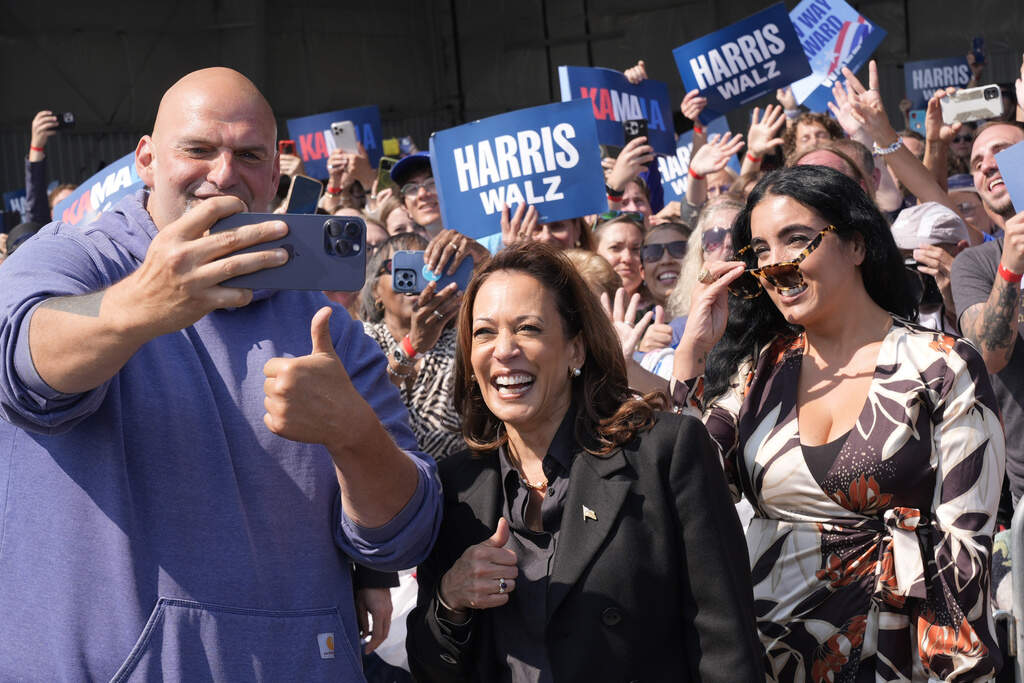
CHAKRABARTI: Vice President Kamala Harris has also been to Johnstown. She did not hold a massive rally but chose instead to tour the community and spend time with small business owners.
HARRIS: You’re creating a space that is a safe space. Where people are welcome and know that they’re encouraged to be with each other and feel a sense of belonging. And in the midst of so many forces that are trying to make people feel alone or divide us. I think that it’s really important that we’re intentional about trying to create these kinds of spaces.
CHAKRABARTI: So why are we focusing on Cambria County today? All indications say that Donald Trump is likely to take the county once again on election day this year.
The point is, once again, all roads to victory lie through Pennsylvania. And secondly, the people of Cambria County do actually represent any number of places across the United States, places where industry once thrived and now good living wages are gone, where young people are leaving, and where, interestingly, there's no Congressman John Murtha and no union to advocate for them anymore in Washington.
So we're going to take a look at Cambria County to understand its impact on voters across the country. And Professor Ray Wrambley joins us. He's a professor of political science at the University of Pittsburgh in Johnstown. Professor Wrambley, welcome.
RAY WRAMBLEY: Glad to be here, Meghna.
CHAKRABARTI: So tell me, is the politically, is the Cambria County that you know today the same that it was say in 1990?
WRAMBLEY: It's not, and it was interesting to hear Jack Murtha's voice. He used to be a regular guest speaker in classes here on our campus, and the Murtha Center is located here on our campus. He was a staunch defender of the of the region and its steel heritage and past. As your intro pointed out, Johnstown was a player.
Cambria County was a player. Nationally, Jack Murtha was a player. And I think there's a sense in the County and in the city that that past of Johnstown is something that's not respected and that has declined. And so I think there's a bit of nostalgia and a bit of resentment. And as you pointed out, Johnstown's an iconic Rust Belt steel town that's representative of Johnstown.
Not just of Southwestern Pennsylvania, but a good bit of the Northeast Rust Belt.
Part II
CHAKRABARTI: Today we're learning all about Cambria County, Pennsylvania. Why? Because all roads to victory in the 2024 presidential election run through Pennsylvania and particularly, interestingly, a handful of counties. So we're trying to learn what we can about the residents of places like Cambria County to understand the impact they'll have on all of the country in 2024.
And Ray Wrambley joins us today. He's a professor of political science at the University of Pittsburgh in Johnstown, and he's lived in Johnstown for more than 30 years. Professor Wrambley, I want to actually start talking by talking a little bit more about steel. Because I mentioned it as iconic and historic and you really cannot imagine the Rust Belt without steel companies, obviously.
But just as a little personal reflection, my first introduction to how critical Bethlehem Steel was, in particular to the backbone of this nation, was as a kid walking across the Golden Gate Bridge in San Francisco on a trip to California once. And seeing like the Bethlehem Steel imprint on the beams and girders of that bridge and then learning that the Bethlehem Steel Company, that the mills and the forges they had, were the best in the nation. And so good that they prefabbed a lot of that bridge in Bethlehem or in other factories that the Bethlehem Steel Company owned and floated those giant sections down the Lehigh River and then through the Panama Canal and up to California.
So it was just, it really drove home for me how this country cannot be separated. The infrastructure of this company cannot be separated for companies like Bethlehem Steel. So when Bethlehem Steel and other mills that were the lifeblood of places like Cambria County did close down in the mid-nineties.
What was the impact on the area?
WRAMBLEY: Sure. Bethlehem Steel and Steelmaking in Johnstown just go together in the late 1800s, Johnstown produced more steel rail than even Pittsburgh or Cleveland. So again, it was a city and an industry that powered the Industrial Revolution all the way.
Obviously, out to San Francisco. In the aftermath of the closures of the steel mills. Obviously, a lot of good paying jobs were lost. Congressman Murtha still carried a lot of weight. He was a powerful player in Washington, D.C., especially given his role on the Appropriations Committee. And for some period of time, using the earmarks that were mentioned previously, he was able to sustain a defense industry sector here in Johnstown.
So we still have a bit of a high-tech defense economy here that persisted after the steel mills closed. But with the passing of Congressman Murtha back in 2010, even that defense sector has declined a bit. And so you've had a steep population decline in the county, a steep population decline in the city.
After the 1940 census, the city of Johnstown had 60,000 people in the city limits, and after the most recent 2020 census, they had 19,000. So it's been a steep decline in the population, and that's meant an aging population, a poorer population, and one that I think feels especially vulnerable to the changes that are going on.
CHAKRABARTI: Has the, I don't know, median household income shifted over that same time period?
WRAMBLEY: Yes. And so the median income in Cambria County is lower than statewide median income. The age is higher. So it's again, an older population. The number of college graduates is especially low compared to the rest of Pennsylvania in the country.
But that doesn't mean there's not still a business sector here, because there is. And there still is that high tech sector. There still is a bit of steel making, specialized steel making. And so I think it's a little bit, it would be a little bit misleading to describe Cambria County as purely an older, whiter, poor city that's been left behind.
And I think one of the interesting parts of that is that Trump's support here and the fact that he won with 68% and you described it as a ruby red county. That's also due to the fact that he continues to get the support of well to do business leaders and business owners in Cambria County as well.
CHAKRABARTI: Okay, so I want to talk about that in a second, but in terms of trying to understand how, on average, the dynamics of the county have changed, I take your point about the business sector still there. And the diversity of incomes and folks in Cambria County. But was, before the closing of the steel mills, was the median income in the county more on par with the state?
Overall?
WRAMBLEY: It was. And those steel jobs allowed high school graduates to have single family homes and hunting camps and boats. And so it did provide the kind of living that gave a sense of pride, a sense of self sufficiency, a self of independence, a sense of an ability to provide for a family.
And so I think the closure of the mills and the closure of the coal mines, which provided the same type of living standards for coal miners, really did have an impact.
CHAKRABARTI: The reason why I wanted to check that is because, in trying to talk about places, and especially I'm highly conscientious that I am not of that place. We're trying to find a way to accurately describe it, but I'm also very sensitive to oversimplification.
And don't want to do that. But at the same time, I am hearing you say that this economic shift that came with the closures of major industry and coal, in addition to that, plus the passing of Congressman Murtha, who was a really effective congressman for the district, those things happened.
Time wise, relatively close together, like a couple of decades apart, or 15 years apart, really. Would you say that those two things did contribute to the change in how people voted?
WRAMBLEY: I do think they did. Now, back in the 1980s, back in the 1990s, Cambria County had a two to one democratic voter registration edge.
Republicans now have a majority of the voter, of the registered voters in the county. But even then in the heyday of the Democratic party, this was a conservative area and a kind of typical labor Democrat, even Congressman Murtha, if you saw his signs, it would be, pro life NRA endorsed.
And so the Democrat, the Democratic officials around here, they were pro union, they were hawkish, they were supportive of minimum wage, social security, but they were culturally conservative and typical of what labor Democrats in places like Cambria County and across the Rust Belt.
The type of Democrat that was attracted in a lot of ways to let's say a Ronald Reagan while they were still voting Democrat locally.
CHAKRABARTI: Okay. So that's really important then. And then, so then if those culturally conservative Democrats were largely still casting their ballots for Democratic candidates, was it because of organized labor?
WRAMBLEY: I think organized labor certainly had an impact and their ability to turn out voters made a difference. The political parties at the time also were strong. And so the democratic party, I used to tell my students that the party in Cambria County was a living museum of the old political machines. And so the county party chair would will rallies and actually hand out cash to precinct committee leaders and candidates for turning out voters.
The combination of an effective democratic party combined with the labor organizations helped to turn out democratic votes in this area.
CHAKRABARTI: Okay, so let's listen to someone who might actually be a pretty good example of what you're talking about, Professor Wrambley. This is Vic Kovalchik.
He's a Cambria County resident. And he comes from generations of Democrats, he says. And these were folks in his family with ties to the unions there and also local history. But Vic tells us that his values are no longer represented by the Democratic Party.
KOVALCHIK: I've lost touch with what they stand for and the values that they have don't line up with where I am in my life right now. There's some important issues. I do take the immigration issue to be a pretty strong issue. I've got problems with things like non citizens having the ability to vote. I don't agree with that ever happening. I have nothing against immigration into this country. My grandparents came over through New York, but they did it all legally and not pushed in.
And those kind of things stand very strongly in what I believe in.
CHAKRABARTI: Vic has lived in Cambria County for his entire life. He's raising his kids there. And this year, he expects to vote for Donald Trump, although he says it's not a vote he's casting with any great relish.
KOVALCHIK: I wish to the great God that there was another option in the Republican Party than Donald Trump.
But I do, at the same time, believe he's a businessman. And he knows how to lead a busines,s some of its values, some of the things he does, some of the things, I cringe, but it's not enough to make me vote Democratic. I'm not a MAGA crazy. I'm just a citizen of the United States of America. And I want this country to get back on its feet.
CHAKRABARTI: That's Vic Kovalchik, a long term resident of Cambria County. Professor Wrambley, what do you hear in what Vic says?
WRAMBLEY: I think what you hear there is common in this county and in counties, And one of the things that has happened in our politics is that the distinctions between Republicans and Democrats, which in many instances used to hinge on policy, one might be pro-labor or pro-business.
And I think it's become much more a matter of identity. And so the parties have, they wear different jerseys now and they stand for, Vic said, values, they represent different people in some ways. And so I think what you see now is the sense of who's on my side, who's on my team, what team am I on and the policies become deemphasized, even though something like immigration, an issue like that might stand in for my sense of identity.
And so I think what you're hearing there is the increasing split between the parties of one that is perceived as more cosmopolitan and more diverse and one that is more traditional. And as you heard there, stands up for my country and wants to get my country back on track. And I think you hear the pride of being somebody from Cambria County and a sense that perhaps what we had has been lost and it's been lost because of forces outside that don't respect or don't appreciate what was done here and who did it.
CHAKRABARTI: Let's dig in a little bit more to the numbers here, because we also talked to Charles Stewart, who runs the Election Lab and Data Center at MIT. And Professor Wrambley, he also mentioned to us what you had said a little bit earlier, that a decade ago, registered Democrats, even just a decade ago, outnumbered registered Republicans in Cambria County, 30,000.
But then came this flip that we've been talking about, and the county now has 45,000 voters registered as Republicans, 32,000 as Democrats.
CHARLES STEWART: It doesn't give them as much of an edge as you might imagine, because there's also the matter of who the candidates are themselves. And so it depends on what the election might be, but certainly compared to a decade ago, two decades ago, Republicans both in registration and in actual voting are really advantaged in the County.
CHAKRABARTI: But oddly enough, Stewart says that doesn't necessarily have translated into much, much higher turnout numbers. It's been relatively flat, he says, and that may be the result of campaigns already maximizing the turnout they're going to get, and that in turn decreases the margin between candidates during an election.
Part of it is the rise in campaign technologies over the last 20 years. And the continuing fact that Pennsylvania has been a battleground state for the last 20 years. Not only is it that national campaigns are really good about focusing. Everywhere in the state to turn out their voters, but the state campaigns have to be really good as well.
So my guess would be that the kind of the data science, which is in data analytics, which has become a core of major campaigns is finding more and more voters and sitting on them and making sure that people actually show up at the polls in these really tight races in Pennsylvania. But to be clear, it's unlikely that Cambria County will be a tight race.
There's every indication thus far that the county will go once again to Trump in November. But it's worth noting that national trends in campaign strategy and changes in the political arena over 20 years continue to be reflected in Cambria County. There's been a real skyrocketing of money in politics over the last couple of decades as well.
And one of the reasons for that has been a need to do more and a, yeah, I need to do more retail politics. To go door to get low propensity voters to turn out the high propensity voters, the people who really love politics, they're going to turn out anyway. But to get the people who are really hard to reach, you have to knock on their doors and talk to them.
I think that In a place like Cambria County people may know each other better. And so it may actually be a more efficient way to deploy these resources. Small towns can rely on friends and neighbors to go and knock on each other's doors. The technique is also likely to resonate with aging voters who are less online.
According to Stewart, age is the demographic that's most moved in the county in recent decades. The over 65 population is almost at about 25 percent, up from 19 percent. But Stewart says that's glacial aging. change. It's still notable in a population the size of Cambria County. But he does add this, that even the aging of the county doesn't fully explain the speed at which Cambria flipped red.
It's more useful to think about how things have changed over the last generation and how that's really begun to sink into the psyche and the political ethos of the area. The voting trends in Cambria County and how they've shifted from, being, in 2000 being a purple county to now being a deep red county.
That trend has moved much faster than any sort of demographic trend in that area. Charles Stewart, he runs the Election Lab and Data Center at MIT. We have to take a quick break, and Professor Ray Wrambley, when we come back, I want to hear a lot more. from you about politics in Cambria County, about the people in Cambria County and how we can understand what they say they want and need when they're thinking about how to cast their ballots in this year's election.
Part III
CHAKRABARTI: And Professor Wrambley, let's hear a little bit more from Vic Kovalchik, who we listened to earlier, lifelong resident of Cambria County, comes from a long line of Democrats, he says, although he is voting Republican now. And Vic tells us that one of the reasons why is that he thinks the Democratic party tries to solve problems by throwing money at those problems, and not necessarily because of better solutions.
KOVALCHIK: There's no reason to push yourself to try to obtain something. Because what I see and many see here with the Democratic Party is it's the handouts now, it just makes it possible here, let's just print some money and do this.
And I think that's where a little more on the Republican side, that's frowned upon and that's where I believe my shift is personally. Moving towards the Republican Party more than the Democratic Party.
CHAKRABARTI: Professor Wrambley, in your estimation, as also having lived in Cambria County, in Johnstown in particular, for more than 30 years, did the Democratic Party lose those voters in Cambria County, or did the Republican Party win over them?
WRAMBLEY: I think it's a combination of both. And as I said before, those who stayed registered as Democrats for a long time here in the county began to cast their votes for Republicans at the national level for reasons that you just heard from Vic. And Mitt Romney won the county here back in 2012, despite the Democratic voter registration edge.
I do think again, what you're hearing are some changes in the perceptions of the parties. It didn't happen overnight. It's been something that's been happening for a long time, but the sense that, you know, one party is favoring particular types of people, and I think you were hearing that compared to others.
And so the sense of the different teams who's for who and who's on my side, I think the perceptions of the parties have changed.
CHAKRABARTI: Yeah. So you mentioned this phrase a couple of times already. I think it's really important, the who's on my side, which is, let's be honest, like every voter wonders that, right?
Who's on my side in terms of helping me live the best life that I can as an American, or who's on my side in terms of who reflects my values the most. This is possibly the basic measure by which people decide who to vote for. But I wonder if, in thinking back to the kind of two major events that we talked about earlier, the collapse of the steel and coal industries, and also Congressman Murtha dying.
It was very clear that John Murtha was on the side of the residents in in Cambria County, in the district there. He was a champion of earmarks. Other people would have called it like, he knew how to bring the pork home. There was money flowing to the county through both jobs and politics that made it clear who was on the side of people in Cambria County. So that's why when I listen to Vic, and he says now the Democrats just print money and give it to other people and not necessarily to solve problems or to solve problems. It is, how am I trying to put this, Professor?
WRAMBLEY: So money flowed here from the government.
For certainly for the defense industry, for the airport that you mentioned, the earmarks for which Murtha was famous and for which he was criticized. I suspect if you look at the percentage of Cambria County residents who are on some type of government assistance, whether Social Security, Medicare, Medicaid or employed by the government is probably higher than counties statewide.
It's an interesting irony, because again, I think there's a perception that certain types of government programs and government spending are for me, are beneficial and that there are some that we can characterize as going to those who are getting a handout. And I think that's, I go back to the sense of identity and the sense of, one party being more cosmopolitan, diverse and being for the more cosmopolitan, diverse sectors of our population. What some describe as elitist. And I think here, and again, it's not just the voices that you heard from the longtime resident, but also the business leaders here who have Trump signs in their yards up in the well to do suburbs of Johnstown and whose sense is that the Democratic Party is not on the side of small town, rural America.
CHAKRABARTI: Can you tell me more about that in terms of the role that business leaders in Cambria County and Johnstown have played in terms of the political atmosphere in the county over time? I think you have a business community, of company CEOs, of business owners who have long been Republican and partly Republican for the reasons of the past association of the party with less regulation, lower taxes, lower spending, but I, again, I think what has happened is the shift toward the perception that this small town, that's got a lot of pride in his past as a player. And it's passed as a resilient community that overcame floods, that even the well to do have some sense that the decline is taken for granted or disrespected. And so those business leaders are important.
They're important part of the Cambria County Republican Party. And so they, I think they add some nuance that you mentioned before is sometimes overlooked when we stereotype.
CHAKRABARTI: I have to say, I'm amazed that we've gotten this far into the program before the first mention of flooding in Johnstown. Because a very major part of Johnstown history.
Hang on here for a second, Professor, because I want to turn back to listening to the voice of another Cambria County resident. This is Heath Long. And he's actually the first Assistant District Attorney of Cambria County and a lifelong Democrat. And Professor, as you've been describing, Heath Long has also watched the political identity of the county shift over the last couple of decades, but he believes that change is not permanent because he says Democratic roots in Cambria County go back for generations.
HEATH LONG: Those values growing up, hard work, dedication, loyalty. Those are the things that have stuck with me thick and thin. My father was running for office in 1975. I was nine at that time, and I remember that for the next every four years, actively standing outside of mill gates when the shift changes would happen and handing out literature. I also remember going to Democratic rallies, which were robust and some crazy affairs with great ethnic food and a lot of speakers.
People really let it fly on speeches. So it was a great experience, and fun learning, saw the good and the bad. And some of the disingenuousness of some politicians, saw that early on, went away to Philadelphia for college. And then when I came back, I was president of the Young Democrats in our area, and then ultimately became chairman of the Democratic Party for a number of years in the 2000s.
We were always, somewhere between 70% and 60% Democratic in Cambria, and mainly it was due to the unions, the steelworkers and the mineworkers. And oddly enough, when I went away to college, I realized that many of our holdings and our values here in Cambria County, we were very conservative Democrats.
I guess what they'd call blue dog Democrats. So socially conservative labor was usually the point that made people Democrats here. It was the old machine politics, get people jobs through the state, through the county, you name it, if you wanted a job, you had to pay tribute to the Democratic Party, the union jobs went away, quite a bit in the late '80 or middle '80s and all the way up into the '90s, where many of those mills and mines shut down.
Or became otherwise owned and no longer union shops. So there was a quite a bit of erosion of the party strength. And then I think it coincided with somewhere in the middle 2000, '15, '16, when Trump came on, I think Obama said, He gives short answers to complicated questions, but it worked here. People liked it because things were becoming very complicated with the world, with the economy.
So local politics soon became more about how you felt on national issues rather than on local issues. The thing that I think is very sad is oftentimes we'll be electing a controller or a coroner, a register of wills, things little jobs that take care of just the minutiae of life here, the living and dying and the in between.
And those people have to put a stance about the second amendment, about abortion. Do they have anything to do with that? Not at all. So it's disturbing that way that national platforms override local competence. So that's probably the saddest thing to me.
CHAKRABARTI: That's Heath Long. He's first assistant district attorney in Cambria County.
CHAKRABARTI: Professor Wrambley, reflect on what Long said there at the end. That the sort of national shift towards identity has trickled down into the actual sort of functioning of local politics in Cambria County.
WRAMBLEY: I think that's true. And I think what is the shift, so the local democratic officials, the row officers that Heath long mentioned, the state representatives who used to insulate themselves from national politics and survive in a place like Cambria County, the nationalization of the party identity has mattered.
And so we've seen over the last couple of election cycles, incumbent Democrats who were well regarded and had names that carried weight in this area who lost because of the straight ticket voting that you now see, it used to be more common that somebody would cast a vote locally for Democrats, cast a vote nationally for Republicans or the other way around.
And so what we've been talking about for a while now, the nationalization of the party identity and the casting of a straight ticket, even when it comes to the register of will or recorder of deeds or the County coroner. And that's something that he's long pointed out is unfortunate.
I want to just circle back quickly to Professor Stewart's comment about the efforts to turn people out. Because Heath Long is a former Democratic party chair, would recognize that the margins in the counties, these matter. So statewide Pennsylvania, as you've said, multiple times is going to determine the presidential winner.
The cities in Philadelphia and Pittsburgh and Harrisburg will make a huge difference to suburban counties, but these counties here, even if there's a 68% win, the margins by which these counties go will make a difference. You mentioned that Trump between 2016 and 2020 increased his percent in Cambria County by a percent, Joe Biden did better here than Hillary Clinton did. And so I think what you're seeing is a turnout effort by both parties, because they know that every single voter will matter.
CHAKRABARTI: Oh, absolutely. And that's what makes Pennsylvania matter. Overall point really well taken here.
Professor Wrambley, I keep coming back to this question and maybe it's unanswerable because it relies on a counterfactual. But it's so clear that the kind of Democrats that once were your typical, if I could say, Cambira County Democratic voters, as you've said, and Heath Long said, and everyone else has said here was a conservative blue dog Democrat.
And so I guess it's impossible for me not to wonder what would have happened If or would sort of national identity issues have rushed in if there had been no vacuum that was produced by the big economic shifts and the loss of the influence that Congressman Murtha had.
Again, I get it. It's a counterfactual. Maybe we can't answer it, but it's a question that I also can't quite let go.
WRAMBLEY: I think the flip side of that conservative Democrat disappearing is that Pennsylvania has a long history of liberal republicanism. And, our former Senator Arlen Specter being one example, some of the governors of Pennsylvania being other examples.
There were cases where we had a governor's election where the pro-choice governor was the Republican and the pro-life candidate, Bob Casey, the Democrat. And so I think what you've seen in Pennsylvania is that shift to the Republican party of those old conservative Democrats in our area, but a shift to the Democratic party of the liberal Republicans over in Chester County and Montgomery County and those suburban counties.
And so it's a long-term trend. And I think the question that you ask is a good one in the counterfactual hypothetical, had the steel mills not closed and had Congressman Murtha not passed away. Would we see some difference? I think those trends were happening all along.
They were long term trends.
CHAKRABARTI: So then that makes it even more incumbent, if I can use that phrase, upon the Democrats themselves to think about what can we do to win back those voters who were once reliably Democratic voters, even if conservative Democrats.
If a party official came to you, Professor Wrambley, and asked you that question, how would you answer it?
WRAMBLEY: Here's the trade offs that you see Democrats making and arguing among themselves. You have Senator Fetterman, who has argued to Democrats, go to Cambria County and try to win those people back, go to those counties in the rural parts of the state and try to win back those Democrats, whereas you have others who have said no, go turn out the new Democrats in the suburbs in Philadelphia or in Pittsburgh. And I think you see it in Ohio, you see it in the other industrial States, the issue of whether Democrats ought to be trying to win back voters who they've lost, or turning out new voters who they've gained. And I don't think they've settled on a strategy.
This program aired on October 1, 2024.