Support WBUR
Biden's FTC took on big tech, big pharma and more. What antitrust legacy will Biden leave behind?
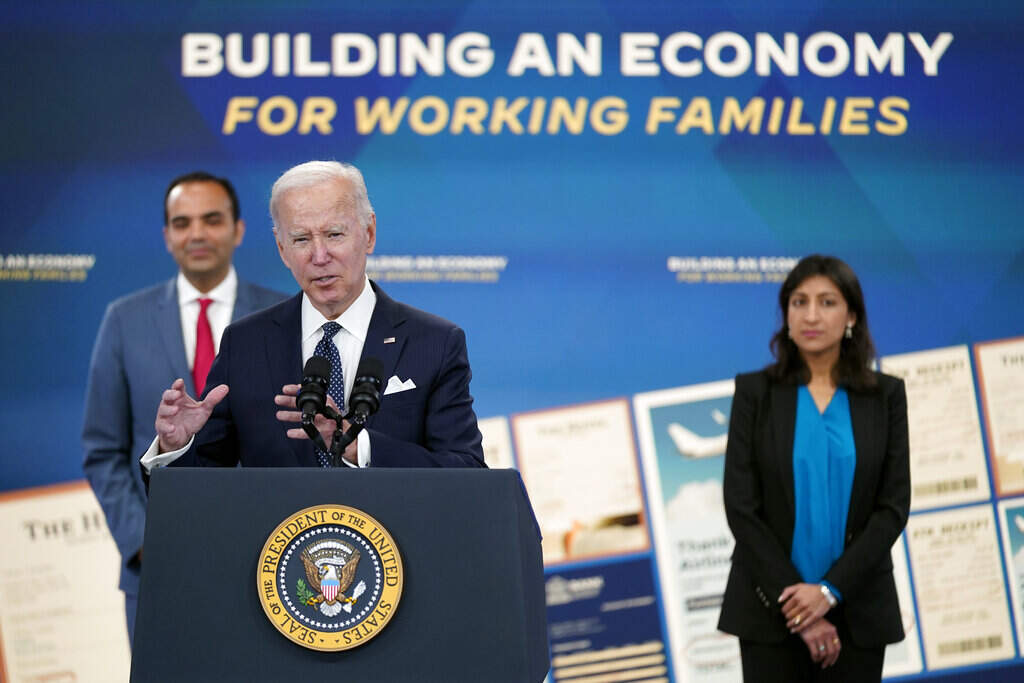
Under the Biden Administration, the FTC and DOJ significantly stepped-up antitrust enforcement. Last year alone Biden’s regulators filed a record 50 antitrust enforcement actions.
And mergers reached a 10-year low. Have Biden's antitrust actions helped consumers?
Guests
Aurelien Portuese, research professor at the George Washington University. He is an antitrust expert on U.S. antitrust law and EU competition laws. Antitrust lawyer.
Matt Stoller, director of research at the American Economic Liberties Project. Author of the newsletter BIG, about the politics of market power and antitrust. Author of Goliath: The Hundred Year War Between Monopoly Power and Democracy.
Transcript
Part I
MEGHNA CHAKRABARTI: Not long after taking office, President Joe Biden sent a strong signal that his administration would take a dramatically different track when it comes to consolidated corporate power. July 9th, 2021, Biden signed an executive order titled Promoting Competition in the American Economy.
JOE BIDEN: Forty years ago, we chose the wrong path, in my view, following the misguided philosophy of people like Robert Bork. And pull back on enforcing laws to promote competition. We are now 40 years into the experiment of letting giant corporations accumulate more and more power. And what have we gotten from it?
Less growth, weakened investment, fewer small businesses.
CHAKRABARTI: The executive order includes 72 initiatives, including calling on the FTC and DOJ to vigorously enforce the country's antitrust laws.
BIDEN: We see it in big agriculture, in big tech, in big pharma, the list goes on. Rather than competing for consumers, they are consuming their competitors.
Rather than competing for workers, they're finding ways to gain the upper hand on labor.
CHAKRABARTI: Biden had also shown that he'd style himself an antitrust enforcer by appointing Lina Khan to chair the federal trade commission. Khan had become a leader in a new generation of anti monopoly legal scholars. Same with Jonathan Cantor, the antitrust chief at the Department of Justice.
Cantor had private sector experience working for mega companies like Microsoft and has said that first hand view contributed to his concerns about huge corporations crushing competition. Under Khan and Cantor, the Biden administration has taken on some enormous antitrust cases, suing mega corporations like Apple, Amazon, CVS, Visa, and Ticketmaster, and blocking major mergers in the airline and publishing industries.
(MONTAGE)
The Department of Justice and more than a dozen states sued Apple today in a landmark antitrust case.
We allege Visa is a monopolist in the debit transaction markets, that is violating federal antitrust law and inflicting often hidden, but significant harm. On American consumers and businesses.
U.S. antitrust laws prohibit firms from using their monopoly power to punish or preclude or prevent competition. And that's what our lawsuit lays out that Amazon has done.
A big deal in the book world may not be happening. The Justice Department is suing to block a proposed acquisition of Simon and Schuster by Penguin Random House.
Tyler, we are looking at a decision in the JetBlue-Spirit merger case, and it is against JetBlue and Spirit merging. The DOJ victorious, judge has decided this merger will not go through.
We are not here today because Live Nation/Ticketmaster's conduct is inconvenient or frustrating. We are here because, as we allege, that conduct is anti competitive and illegal.
CHAKRABARTI: Just a few of the lawsuits and blocking of mergers under President Joe Biden, but his executive order called for much more than that.
It also required federal agencies across government to act. Things like banning non-compete agreements in order to allow more workers to change jobs, allowing hearing aids to be sold over the counter to slash costs, to making it easier for people to get refunds from airlines. The executive order also establishes a White House Competition Council to make sure these things are getting done.
BIDEN: Look, I'm a proud capitalist. I spent most of my career representing the corporate state of Delaware. I know America can't succeed unless American business succeeds. But let me be very clear, capitalism without competition isn't capitalism, it's exploitation. Without healthy competition, big players can change and charge whatever they want and treat you however they want.
And for too many Americans, that means accepting a bad deal for things that can't go, you can't go without.
CHAKRABARTI: As Joe Biden approaches the final months of his presidency, it's time to assess the impact and legacy of his administration's antitrust efforts. What has been accomplished? Where has the administration fallen short?
And have his policies actually helped citizens and the U.S. economy? We're going to kick off with Matt Stoller. He's the director of research at the American Economic Liberties Project. He also writes the newsletter, BIG, which is about the politics of market power and antitrust laws. He's also author of the book, Goliath: The Hundred Year War Between Monopoly Power and Democracy.
Matt, welcome back to the show.
MATT STOLLER: Hey, thanks for having me.
CHAKRABARTI: Okay. So if you could give a grade to the Biden administration on antitrust, what would it be?
STOLLER: I think it would be an A minus.
CHAKRABARTI: An A, that's pretty, that's higher than I thought you'd give, Matt.
STOLLER: Yeah, they've done an amazing job in this particular area of policymaking.
And to understand that, you have to recognize that since the late 1970s, early ' 80s, we've pursued a policy of consolidating economic power under the guise that would make things more efficient, right? It's redundant to have five firms doing something or six firms. So let's just bring that down to two or three.
And so in industries across the country, whatever it is, search engines or airlines or cable companies that are big markets, but even lots of small markets like mail sorting software, or I could go into lots of them, consolidation. And when you have just a few firms controlling a market, or even just one firm, then you have one entity that is setting prices and usually those prices are high or worse.
They're hidden and they also set wages. And so what is a whole series of social problems from inequality to shortages, I would think we saw this with baby formula, and what the Biden administration has done with antitrust, not with everything else, but with antitrust, is to try to address this problem by blocking mergers.
And by bringing cases against monopolists to reinvigorate the form of law that we have that disperses economic power, and that is antitrust.
CHAKRABARTI: So we're going to go through some of the bigger cases in just a minute here, but I wonder what you think about this, Matt. You were on our series that we did a while ago about monopolies in America.
And by the way, if you haven't heard that listeners, just go to onpointradio.org or look around in our podcast feed and you can find it, it's a really terrific series. And there we talked about the previous era's last big antitrust case, which was, of course, the Microsoft case from 1998. And to your point, we went through several decades of then not seeing major government action on this issue of corporate power or excessive corporate power. But as you also know, Matt, I think the things started building up a head of steam even before the Biden administration, though, right in the Trump administration with the Google case. So was the Biden administration, did they just pick up on what's actually been a broader change?
Across government and regulation that's not exclusive to him?
STOLLER: Yeah, I think that it's fair to say that the Biden administration shows some continuity with both the end of the Obama administration and then the Trump administration. So there's a critique of basically too big to fail institutions, right?
That caused the financial crisis in 2008, '09, '10. And it took a while to develop the legal arguments and the theories and to do the investigations. But that's basically what we've seen is there are too big to fail institutions across the economy. That's essentially what the antitrust agenda is. And that started to manifest in policy, 2015, '16.
You remember that Trump and Hillary Clinton would talk about AT&T/Time Warner, that merger. And then the Trump administration brought a challenge to that merger, which was pretty shocking. Largely, tended to consolidate economic power, but in 2020, they brought a case against Google, and they brought a case against Facebook.
And those were the first major cases against big tech firms in 20 years. So that was a big deal, but the Biden administration has supercharged it. They've brought it to another level. So the Trump administration kept most of the consolidation stuff going. And in a few areas, they broke with it, but the Biden administration on antitrust has really broken wholesale with the whole framework.
They brought a lot more monopolization cases. They won one of the cases against Google, which is a huge deal. And they've also really changed merger policy to say, okay, you really are not allowed to do large, anti-competitive mergers anymore and with really good impacts. So the policy shift has been remarkable.
CHAKRABARTI: The merger side is something I want to spend some time with you on, Matt, because it's really interesting. But let's talk about some of these really big cases. Pick up with the Google case. That's the one that has been decided. First of all, remind us what that was about and why you say it's like such a big deal.
STOLLER: Okay, sure. But first I want to mention that there's a lot of easy stuff, right, in the competition framework, like for example, inhalers cost $500 in the U.S. and they cost $7 in France and the Biden administration actually took that off. There's junk fees. There's a whole bunch of stuff people understand.
We're going into the hard stuff first. So the Google case, like why are we going up against this big company, Google, right? Which matters, but I want to make sure that people understand. This stuff is really popular and has tangible impacts for consumers and citizens. But to speak to Google, it's, Google is a multi-trillion-dollar company.
It's probably one of the most powerful institutions that we've ever seen. Its structures are information commons. In many ways, its structures, how we talk to each other, how we communicate with one another, and it's one company. And if the people at Google make a decision about what we're going to see or what we're not going to see, what gets ranked up and what gets ranked down, that's what we see and that's what we don't see.
And so that's a really important problem. Now, one, is that maybe that's just the way of the world? Is that just because they're better at creating search engines? Or there's economies of scale or something like that. That's the question that really antitrust law is set up to answer.
And when the Department of Justice did investigations and there were some private cases too, what they found is that no, in fact, Google is the dominant search engine. Because they engage in coercive behavior using contracts to lock potential rivals out of the market. So Google controls what we see and controls in many ways our democratic discourse and also, makes hundreds of billions of dollars of revenue, because of coercive arrangements that it pursues to undermine rivals.
And that's why when the DOJ brought the case, they did a whole trial. They brought out lots of evidence from what Google people are talking about internally from competitors. That's why the government won that case. And now we're in a remedy stage. But ultimately the idea is in the next five to 10 years, maybe we'll have multiple search engines and different deployments of AI.
Part II
CHAKRABARTI: Matt, since you mentioned some of the more tangible efforts of the Biden administration on antitrust, and you said inhalers specifically, let's see what FTC chair, Lina Khan, said when she sat down with 60 Minutes last month, she was speaking with Lesley Stahl and they were talking about some of the things that Khan did during her four, almost four years as FTC chair.
And one of them was going after the makers of inhalers for asthma. And this is not an uncommon practice in pharma, the makers extended their patents to keep low-cost generics off the shelves. And as you mentioned, Matt, similar inhalers cost seven bucks in France, in the U.S. $500. And here is what Khan said.
KHAN: We found that companies were listing patents for things like the inhaler cap or the strap on your inhaler. So nothing to do with the actual ingredients of the drug, or the formulation or composition of the drug.
STAHL: So this is an inhaler for asthma. Show us what the innovation was that they claimed allowed them to extend the patent.
KHAN: So it's this strap that they listed a patent for. This little piece of plastic.
STAHL: No. They were saying that they should be able to continue the patent. Generics can't come in for the medication because they put that strap on.
KHAN: That's right.
STAHL: To make sure you didn't lose the cap.
CHAKRABARTI: The FTC sent warning letters to major inhaler makers. And as a result, most of the companies dropped the price from hundreds of dollars to just $35. So Matt, talk about this example here for a minute.
STOLLER: So what has effectively happened, and it's hard to convey this because it sounds outlandish, but what you have in the last 40 years is an essential lawlessness on the part of monopolists and Wall Street. And you see it with inhalers. It's a really good example, because what they were effectively doing was committing a form of fraud, lying about the patents that they had so that they could block generic asthma inhalers from coming into the market. And this medicine was invented, the basic medicine was invented in the 1950s.
We're not talking about anything that's new or anything that they innovated. They're just gouging the American public and doing it by lying about the patents that they had. So what Lina Khan did there, and then the FTC, was to just say, you can't do that anymore. And if you think about what's going on across the economy, the various sort of junk fees that we all see, or the way that we get trapped into subscription services, or any of the really annoying things that we see in the economy.
A lot of it is actually illegal. It's just that we haven't really enforced the law against big business for so long that people just think, okay, that's just how our society is structured and what Lina Khan is doing and what Jonathan Cantor are doing is saying, no, actually a lot of this stuff that's been going on, that we take as a normal course of business, is actually unlawful. And we should enforce the law against the powerful when they violate it.
CHAKRABARTI: It's so interesting because it just took some warning letters to affect this massive change that is having a positive impact on the lives of millions of people who use those inhalers.
Now, to your point, Matt, about there are a lot of good laws on the books and perhaps previous administrations simply haven't had the motivation to enforce them. On the other hand, in all of these, this high number of cases that DOJ specifically has brought against companies, I don't want to just focus on the wins, right?
Because there were several significant, I would say, setbacks or losses. Like for example staying in the health care space for a second, when United Healthcare Group wanted to acquire Change Healthcare, it was a $13-billion acquisition, the DOJ argued that the deal would actually give UnitedHealth too much access to sensitive data.
UnitedHealth is already a massive company, but that case was ultimately dismissed, right? And then there's also the Microsoft-Activision merger, which the Biden administration tried to intercede on. Didn't succeed there. Those kinds of vertical mergers are usually really hard to stop anyway. So this hasn't been like a 100% hit rate for the administration.
STOLLER: Sure. And if you are winning all your cases, you're not bringing hard enough cases, but I guess let's just talk about UnitedHealth Group change. So that was a judge called Carl Nichols, was a Trump appointee, dismissed the DOJ's argument. DOJ said, change basically is like the Visa and MasterCard payment network for pharmacists.
And UnitedHealth Group is a huge health care conglomerate. It's a fortune 10 company. And they wanted to get access over the data so they could surveil their rivals and underprice them strategically. And the DOJ said that's unlawful, and Carl Nichols listened to the CEO of UnitedHealth Group say, Oh, we'd never do that.
We're going to protect the data. We're ethical people. And he said this guy says, that they would never cheat or lie. So they would never cheat or lie. Like I don't see any problem, and let it go through. Okay. A year later, turns out there's a giant hack of change, health and hospital systems are bleeding cash because they can't get their payments.
And pharmacies are bleeding cash because they can't get their payments. And it's a total catastrophe because UnitedHealth Group didn't take care of the data, because the CEO of UnitedHealth Group was lying. And the thing is judges like Carl Nichols often make really bad decisions because they trust corporate CEOs to do the right thing. What is happening? Judge Carl Nichols is embarrassed because of the choices that he made in that case. And we see this over and over.
CHAKRABARTI: He said he's embarrassed?
STOLLER: He said he is embarrassed. I emailed him, he didn't respond, but he knows what he did.
And I think what is the judiciary in general is starting to learn and realizing, oh, if we allow mergers. Generally bad things happen afterwards, not good things. And I'm going to look bad. And so they're more willing to say, Oh, if the government is bringing a case about a merger, it's cause the government, like 97% of mergers go through without even investigation and a very like 0.1% actually get challenged in court. They are only taking the most dangerous mergers to court. So when, if a judge, it used to be that a judge would get really scared to stop a merger because it just seemed uncool. Like, why are you interfering with free enterprise? And now it's flipped, because it's obviously such a disaster when these mergers happen.
And we've all seen the effects of mergers, they're terrible. CEO gets $50 million and then the company is crawling with consultants. And then, sometimes they monopolize and then sometimes they don't, but it just is a disaster anyway, like AT&T/Time Warner didn't work out.
So what that, UnitedHealth Group change, the DOJ was right to bring the case. The judge was wrong to toss the DOJ's case and we saw that very clearly. Now what's the alternative? The alternative is the DOJ just lets it go through. Instead, we actually know a lot about what happened with UnitedHealth change, because we had a trial and hopefully next time Carl Nichols will not make such a bad decision, right?
CHAKRABARTI: I take your point, but on the other hand, I think we, it's also fair to say that perhaps the DOJ didn't bring a strong enough case to convince Judge Nichols, right? Because as far as I understand, I don't want to necessarily go through a point-by-point detail about this one case, but I do have to ask, the DOJ's argument, wasn't it that that because UnitedHealth would have all this access to the data that Change Healthcare had, that it would be able to use that data against its own competitors, right?
And so that's why the DOJ was concerned about the use of the data, not necessarily like sensitivity to hacks though. And what they didn't prove to the judge was that the incentive to use the data against competitors would be stronger than the incentive to protect that data.
STOLLER: So what UnitedHealth Group said is that we are buying this company and we're going to take good care of it and we're going to have, it's going to be what they call a pro-competitive transaction. Like we're better together. And the DOJ made the argument, no, they're going to cause problems in lots of different areas.
And yeah, they're going to basically engage in surveillance and then underprice their rival. And the judge said, I don't believe you. And no, they didn't bring a case based on, okay, you're more likely to get hacked. And the reason is because the law doesn't allow it. That's not what antitrust law is supposed to do.
It's not a standard to say, Oh, I think you're just going to run the company badly. One of the reasons you don't want corporate concentration in general, and they did bring a general concentration argument here, is because when you pool corporate assets, you also pool risk. And that's just, this is an illustration of what happened here. But I think one of the things you have to realize about everything in policy, but it's just a lesson in life, is that if you try, sometimes you're not going to succeed. And sometimes you are. And I think the lesson here is not we shouldn't try. I think the lesson is, You should try and learn from it.
And I think it's a shame that DOJ didn't win that case because the world is worse off. A lot of doctor's practices went out of business or got acquired because they had serious cash problems. And moreover, there's a broad, we're dealing with a broad philosophical problem.
CHAKRABARTI: Right.
STOLLER: Which is, it's in the 1970s and eighties, the argument was bigger is just more efficient. And therefore we should presume that if companies want to get bigger, that's good. And good for society and will help inflation and will raise wages and all the rest of it. And what I think we're seeing with these kinds of cases, win or lose, is that philosophy leads to all sorts of unintended consequences and problems.
And with UnitedHealth is a good, it's a good example. It led to, it was a catastrophe, right? By any standard. So I think we can see, all right, they could have made different arguments. They could have made better arguments. It's too bad they lost, but I think the old kind of model is, has been discredited.
CHAKRABARTI: Yeah. By the way, I'm just giving like relentless plugs for previous shows that we've done here at On Point. If you go to onpointradio.org and look for health care hack, you will find an hour about exactly that. So Matt I do take your point though, about the Biden administration having tried more than previous administrations within terms of all the cases that DOJ brought the actions on the part of the FTC, the chilling effect on mergers, right? We've seen like what a 10 year low in even attempted mergers here. But I want to now bring in a another voice into the conversation.
Aurelien Portuese is a research professor at the George Washington University, also an antitrust lawyer and an expert on U.S. and E.U. Antitrust and competition laws. Professor Portuese, welcome to you.
AURELIEN PORTUESE: Thank you for having me.
CHAKRABARTI: Matt has taken us through in detail some of the cases and actions that the Biden administration has undertaken in the past three plus years.
I wanted to explore with you now the impact, right? Because as we mentioned earlier at the top of the show, that the executive order that the president signed in July of 2021 also established a White House competition council that was supposed to oversee the administration's efforts as a whole across agencies to make essentially life more fair for companies and for consumers.
How would you assess the efficacy of that competition council?
PORTUESE: Yeah, thank you for having me. I think it was a unique institutional feature to create this competition agenda inside the White House. It was very interesting to have this precisely cross disciplinary and whole of the government approach when it comes to competition.
The issue is mostly we don't really know what competition means. And sometimes we may have some different understanding and some different departments. May have different understanding of what competition means in specific industries.
And we've seen a number of efforts or number of sometimes repealing policy statements or changing policies.
But without giving a clear path for a new policy, we saw that on patents. We saw that when it comes to data, cross border data flows. We see that in a number of issues where we know what, I mean, the Biden seem to know what they didn't want, this, what President Biden say, like this 40 years of complete failure, we know, it seems like they know what they don't want, but we haven't really detailed what they do want and the path forward.
And therefore the legal clarity and the legal certainty that actually will help them implement or execute their own agenda. So I think what is most important is not so much criticizing the last 40 years, even though I think not everything can be thrown away. I think there was perhaps very radical statements and we have to be perhaps more moderate, but most importantly, we have to, we really have to think of the legal clarity we want to provide the business community because that's what they need.
They need legal clarity.
CHAKRABARTI: So can I ask you, is the inhaler example one that you would point to about, the FTC issued these letters saying, don't do that. But did they provide in return guidance on how far can a company go in stretching patent protection before it becomes truly unfair to consumers?
Or if that's not a good example, if you have another one, I'd be happy to hear it.
PORTUESE: That's a very good example. And to stay, because of my discussion earlier about patents, there was a policy statement about standard essential patents. These kind of very large patents that are used so widely in the industry so that it becomes standout.
It was during the 2021 statements, but now we still don't know the interactions between antitrust and standard essential patterns. So that when you have large patterns about, let's say, a cheap manufacturer wants to do something and to have some negotiations between the implementers, between we don't know how those discussions should take place, what is good faith and how those negotiations should take place.
And there's a threat of any policy or price that they will charge as a license of that patent can be seen as anti competitive. So there's a large amount of uncertainty about how you should negotiate the patents and let alone, Are those patterns valid, which sometimes needs to be better clarified as well.
CHAKRABARTI: Yeah. Can I just jump in here for a quick second? I know, Matt, you want to have your say, but let me offer you this, professor. Isn't it difficult for any administration, any government, to say specifically what new guidelines should be on what constitutes competition or not, because it almost seems like a case-by-case basis.
And then if the government were to issue very stringent sets of new rules, that could have the opposite effect and really chill the business environment.
PORTUESE: Totally. It's not easy, and that's why we have to criticize these soft law instruments such as policy statements to clarify legally binding laws.
But we really see in administrations to rescind policy statement without providing a new one. This took place for merger plans. This took place for patents. This took place for cross border data flows. We rescind, we say what we don't want, but say, okay, great. We know what you don't want, but can you please provide legal certainty, and they struggled with that.
Part III
CHAKRABARTI: Matt, I wanted to turn what the professor was saying to you, because I think he's making a very important point that to institutionalize, let's say, for the long run, this new view of what healthy competition should look like in America, or this new view on the robustness of antitrust regulation, he's saying that you need a new set of rules and that perhaps across the Biden administration, across different agencies, there wasn't enough of that, which could make the past three and a half years a flash in the pan in the long run. And I wonder what your thoughts are on that.
STOLLER: Okay. So let me start with where I agree. I think that, I started, I said, A minus, right? That was my initial grade. And it's really for the antitrust agencies, but the antitrust agencies are by budget, 0.2% of the whole government. And I think in many ways, the rest of the government, the Biden administration, there've been some exceptions, the Department of Transportation and some parts of the FDA, the consumer protect financial protection row, but most of the government has really continued the old pro concentration order. So there is incoherence there. And standard essential patents, a good example of where there isn't, there's not agreement within the administration about what to do. Okay. But I think that there's also a kind of fake nuance going on here. So the Federal Trade Commission, a good example would be.
A very clear rule. The Federal Trade Commission came out with a ban on non-competition agreements, right? Provisions that say that a worker can't leave and go and work for someone else. Those are pervasive in the economy. And the Federal Trade Commission did, had 300 pages of analysis, economic analysis, tens of thousands of comments, a lot of evidence that these are bad.
And they came out with a very simple rule. They said, you can't do it anymore. And all of the kind of defense lawyers that are, part of that, the professor's world said, Oh, we need more nuance. We need to go case by case. And so the point is that, when the FTC gives a really simple rule, they want, Oh, it's too simple.
But then when there's things that the Federal Trade Commission and the DOJ are doing to address power where you can't come up with a rule, like antitrust in general, every company is different. So you have to use basic values like don't lie, cheat and steal. They're like, Oh, we need more guidance.
But this administration has given extensive guidance on antitrust. The merger guidelines were extensive guidance on unfairness, extensive guidance on orange book policy, which is the patent piece I was talking about with inhalers, extensive guidance on non competes, simple rules.
Clear rules, don't merge if there's only five competitors in the market. And they're like, Oh you're not nuanced enough. And then you go really nuanced and they're like Oh, we need clear standards. And really what's happening is they don't like addressing consolidation, unlawful practices in big business. So I don't really accept the critique. I think it's fake nuance to allow a lot of the things we know are bad to continue going on.
CHAKRABARTI: So let me let Professor Portuese respond. Go ahead, professor.
PORTUESE: Yeah. I think there's one major distinction we have to make.
Sometimes you issue rules, legally binding rules. Sometimes these are policy statements or guidelines and are soft law instruments. And these are very different things. When it comes to the example of non competes, the main disagreement was not even about non compete. California bans non competes and a lot of people are totally fine with that.
The main disagreement is whether or not the FTC had authority under Section 6G of the FTC Act of 1914 to even intervene. Do we have a federal preemption that allows the FTC to prohibit non competes or is it questioned at the state level? I mean for since then it has always been at the state level, and there's this kind of like sometimes what Brandeis precisely will call the laboratory of democracy, where the state compete between themselves, whether you agree, you disagree, you ban it, you allow it, or you have a kind of rule of reason approach and people can vote with their feet and company can vote with their feet and move.
And that's the beauty of the 50 States of the U.S., where you don't have one rule, but you basically have 50 rules and that creates 50 different regulatory framework you can choose on. So the main discussion about non-compete was not even substantive. It was procedural. And when it comes to policy statements, I think there was some disagreements about the merger guidelines.
The draft merger guidelines, because they were pretty radical, but no one really challenged the fact that the FTC or DOJ were entitled to do that. So we can have substantive disagreement, but it was no discussion as to whether they have the authority or they have legitimacy. So I think when we need policies, we need policy statements or guidance or guidelines, which are non legally binding laws to explain the position of the administrations, whether or not we agree with it.
That's a different question. But when it comes to pushing the boundaries of what is legally possible and what is congressionally mandated when it comes to, for example, the non-competent Section 6 of the FTC Act. I think that's a totally different discussion and lawyers can have a strong stance and say that's not what is written in the FTC Act statute.
STOLLER: But it's always oh, it's super nuanced. The nuance always seems to work for the powerful. I mean, this is like a standard. I think this is a good illustration of the debates that are happening. Because for 40 years, dominant firms and wall street have been in charge, and they use any argument they can to stay in charge, whether they are saying, Oh, there's not enough standards.
Oh, the standards are too clear. Oh, there's a procedural issue. Oh, no, it's actually a policy problem. But what's happening now is there's a fight over whether we continue that basic framework. And I think that this argument's a good illustration of that actual dispute, right? But it's just a fight over power.
There's no actual legal arguments here. Like this is all just, it's just do you want to keep going with a search market where controlled by one firm that will generally shreds documents or not? It's not that complicated.
PORTUESE: But I think we're discussing about non competes here, but if you ask me --
STOLLER: No you started by saying, oh, we're just looking for standards.
And you started by talking about standard essential patents. There was a dispute over policy over non competes. It isn't just a question of whether the FTC has legal authority. There is an underlying policy dispute there.
CHAKRABARTI: Do you know what I'm going to do, gentlemen? Forgive me. I'm going to pull this conversation back in a slightly different direction. Because the thing that I hear both of you saying from different perspectives is that, what is the fight about?
And I keep thinking about right now we're talking about this fight, or this paradigm change regarding competition and antitrust as having an emerge from the executive branch, within the Biden administration. But from the point of view of a citizen slash consumer, for the long run, I don't necessarily want that to be at the whim of the executive.
So that makes me wonder about the role that other branches of government need to play here. Because, okay, look, the Supreme Court with the recent Chevron ruling has said rulemaking essentially from the federal agencies is going to become a lot harder in the very near future. Professor, I think you mentioned Congress.
Let's look to Congress for a second here. So we found this clip from Senator Amy Klobuchar, Democrat of Minnesota, because she's been for years trying to actually legislatively strengthen the United States antitrust laws, including bills that would give federal enforcers more resources to strengthen prohibitions on anti-competitive conduct and mergers.
But Shocker, America. Thus far, Congress has not actually passed any of these pieces of legislation. Here's Senator Klobuchar on CNBC talking about what she would like to see get done.
KLOBUCHAR: Let me be clear. I don't want to punish success. When we talk about structural remedies and breaking things up, those companies would then be unleashed to do even more.
And my concern is that while we're seeing really good things happening. We also know there's really bad things happening. And part of that is that we don't have the remedies in place. We don't have the resources I mentioned for the agencies. And some of the legal standards just don't fit the sophisticated marketplace we see today.
And you have court rulings where the courts have gotten more and more restrictive about antitrust cases. And this isn't just consumers coming to me. There's a bunch of businesses, big and small, that know this is unfair for them if they can't get their product advertised the way that they would, or they're unable to compete in a marketplace.
And all this is balancing things out again.
This program aired on October 2, 2024.