Support WBUR
Inside the growing Middle East conflict
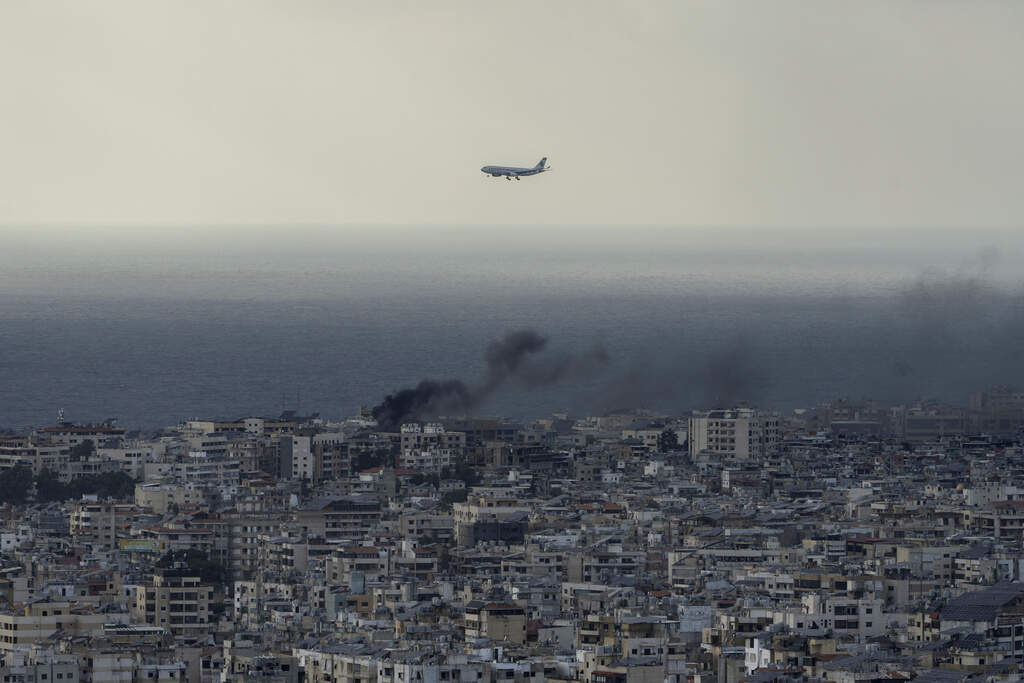
Israel. Hamas. Hezbollah. Iran. One year since Hamas's brutal attack on Israel, the Netanyahu government has expanded its war beyond Gaza. What’s next in the widening war — and what are the consequences?
Guests
Ehud Eiran, former assistant foreign policy advisor to Prime Minister Ehid Barak. Retired IDF Major. Professor of political science at Haifa University.
Ryan Crocker, former career diplomat who served as ambassador to Lebanon, Syria, Kuwait, Iraq, Pakistan and Afghanistan. He’s now a nonresident senior fellow at the Carnegie Endowment for International Peace.
Randa Slim, senior fellow at the Middle East Institute. Non-resident fellow at the Foreign Policy Institute at Johns Hopkins’ School of Advanced and International Studies.
Transcript
Part I
MEGHNA CHAKRABARTI: One year ago, on October 7th, 2023, Hamas militants kidnapped, killed, and brutalized more than 1,000 Israeli men, women, and children. It was the deadliest attack on Jews since the Holocaust. In response, Israel launched a devastating ongoing attack on Gaza.
To date, the Gaza Health Ministry says more than 40,000 Palestinians there have been killed, the majority women and children. A couple of weeks after the October 7th attack, on this show, we discussed the risk that the Israel-Hamas conflict could spill over and become a wider war in the Middle East.
Here's some of what our guests said back then.
(MONTAGE)
Some in Israel view this as a broader clash between the moderate axis, the U.S., Egypt, Saudi Arabia, us, maybe Cyprus and Greece, versus the more radical axis, the Muqawama, the resistance, Hamas, Hezbollah, Iran. And so maybe a clash like this will deal a blow to the Muqawama. But this is coupled with many risks, and Prime Minister Netanyahu, despite his alpha male type leadership, in reality was very cautious in using force.
The big issue, I think, is, one common factor, and that is Iran. Iran is now backing the main belligerents against Israel, both Hamas and Hezbollah. I have to think, as Israel's emergency government is looking at its options, in that potential target deck would be a strike on Iran.
I agree with Ambassador Crocker that definitely a hit on Iran is going to be part of the Netanyahu government thinking, not maybe the whole government, but definitely I think, and that will be catastrophic.
CHAKRABARTI: Again, that was almost exactly a year ago. And now the long feared wider war seems imminent, if not already here. Just this week, Iran launched around 180 missiles at Israel. As the time that we're airing this show, Friday, October 4th, our live broadcast is at 10 a.m. Eastern Time, Israel is still weighing on how to respond.
Iran says it launched the missiles in retaliation for Israel's escalating campaign in Lebanon against Iran backed Hezbollah, including an Israeli airstrike last week that killed Hezbollah leader Hassan Nasrallah. The Israeli military has also begun a ground invasion of Lebanon to destroy what it says is Hezbollah's military infrastructure in villages near the Israel Lebanon border.
And Yemen's Houthi militants, also backed by Iran, have repeatedly fired missiles and drones at Israel in what they say is solidarity with Palestinians in Gaza. So today, we've invited back those three guests from our October 2023 show. Ambassador Ryan Crocker, who served in Lebanon, Syria, Kuwait, Iraq, Pakistan, and Afghanistan, and Randa Slim, a senior fellow at the Middle East Institute.
Those two guests will join us in just a few minutes. But let's start with Ehud Eiran. He's a former assistant Foreign policy advisor to Israel's then prime minister, Ehud Barak. He's also a retired IDF major and current professor of political science at Haifa University. And he joins us from Harutzim, Israel.
Ehud Eiran, welcome back to On Point.
EHUD EIRAN: Thank you, Meghna. Hello.
CHAKRABARTI: So at this point now, again Friday morning on the east coast in the United States, we have several developments, right? We have as many as 250 Hezbollah fighters being killed during part of Israel's ground invasion in southern Lebanon.
Recently, we have Iran's supreme leader speaking this morning, which we'll talk about in a second. How would you assess the current situation regarding potential further escalation in the Middle East, Ehud?
EIRAN: Yeah, I think, obviously, compared to our meeting a year ago, we are much closer to a broader conflict.
But I think both Israel and Iran are still in a dilemma, how further to take this away. And I'll also add that we had another development. For the first time, I think, in many years, Israel used its planes in the West Bank. 18, what it described as militants, reminding us that there's a very close, another front that may open and when may affect the mindset of Israelis.
CHAKRABARTI: At this point in time, then how many fronts would you say Israel is engaged on?
EIRAN: So Israel counts seven fronts, Gaza, the West Bank, Lebanon, Iraq, because there were Iraqi militants were attacking UAVs, Syria, Yemen and Iran. So that adds up to seven, unfortunately.
CHAKRABARTI: And what do you think about that?
EIRAN: What do I think?
I have many thoughts. First of all, on a military level, of course, this is very challenging. These are very different fronts that require different capabilities. Israel historically preferred not to fight on multiple fronts, and even when it was forced to do in 1967, 1973, it had tried to deal with one front at a time.
The other interesting thing to me is that unlike our 1940s to 1980s realities, many of these actors, barring one, are not states. These are non-state actors, besides Iran. And the immediate states that are neighboring us, Jordan, Egypt, Are still formally in peace with us. So unlike the horrors of 1948 when we were literally invaded from all our neighbors, now, there's potential allies in the region. Because although we are so focused on our conflict, I also see, maybe my colleagues who speak later can speak more to it, but we are also, in a way, a sideshow in the broader conflict in the Arab world on political Islam.
All these non-state actors in Iran offer a certain model for the region. One which is driven by religion, whereas the states, Jordan, Egypt, the Gulf states, offer a moderate state-run version. And so I think the solution for us should be some combination of force, but also realizing these political opportunities and being very attuned to the drama unfolding in the Arab and Muslim world separate from us.
We are a wonderful front for this, this is not the only issue.
CHAKRABARTI: We're going to come back to that, because I think that's an extraordinarily interesting and important point. But Ehud for just a moment, can we take a step back here? Because I think developments have evolved so quickly that it's become a little challenging to keep all of the series of events in mind, in order to understand where we are right now.
Can you take us actually back to those pager explosions from not that long ago. What can you tell us about why Israel decided to do that? And what was that actually a preliminary event that then paved the way for this expansion of the front into attacks on Hezbollah?
EIRAN: So I think you're absolutely right to point there. I'll say maybe a day or two before the attacks, the cabinet added a new war goal, and that is to return Israel's citizens on its northern border to their homes. These are between 60 and 100,000 people who had left their houses. And as Hezbollah was attacking these northern communities.
So over this year, while we were fighting in Gaza, there was a lot of destruction to property and some civilians were killed as Hezbollah was attacking these civilian targets. For a reason we still don't know, in mid-September, the government, after 11 months of absorbing this fire, changed the goals of the war and added this northern goal.
Shortly afterwards, the pagers exploded and then Israel moved, as you mentioned, to these massive bombings, culminating in taking out Nasrallah and these limited ground operations in the north. I can offer three or four thoughts why I think this happened. One explanation is what we would call operational. So there's some indications that this pager thing was planned for a long time. And then Israel is close to a use it or lose it moment. And so it used it and then weaved all this broader strategy around it.
I hope it's not the case, but it's a possibility. The second reason is that there was growing pressure to a degree on the government, with all these internal refugees. And pressure to cut a ceasefire in Gaza to bring the hostages back. So this also served Prime Minister Netanyahu's political goals of easing these pressures, although he is fundamentally responding to a real need of tens of thousands of people who are relocated.
And then I would say also there's an institutional, excuse me, for using the political science jargon explanation, that's the military had been preparing for this war for a long time. Operations in Gaza are winding down. The military was severely hit. In terms of legitimacy, when it failed, essentially in October 7th. And so it wanted to resolve the Lebanon situation in a front they were well prepared for, but I think we'll have to wait a while to understand how come in the middle of September, the government suddenly took a much more assertive turn.
CHAKRABARTI: Okay. When we have to take a break in a couple of minutes and when we come back, I will be bringing Ambassador Crocker and Randa Slim into the conversation. But let's spend again that minute or two before the break, Ehud, returning to this question of Iran, right? Because as you pointed out, Iran is the one state actor here in this seven front war that Israel is now engaged in. But it is the most powerful actor. And I guess people want to know, is there a risk now of tipping into all-out war between Israel and Iran?
Or can these two countries step back from that abyss?
EIRAN: Thanks. Yeah some would say, I'm talking to you from Israel, where we're subjected to 181 ballistic missiles on Tuesday, so some would feel we are in a war. But again, I think your point is an interesting thing. These two countries are hostile ideologically for45 years if I'm counting correctly, and had managed to keep it below the threshold of war. Iran using its proxies here and we were using clandestine operations, but now for the first time starting in April, with the first Iranian barge, there's more direct exchanges. These are countries that are 15, depends how you measure, but 1,500 kilometers apart.
Even a war will have very specific features of maybe exchanges through the air. It's through the air and so on. So we have deteriorated towards this in a long time, maybe even a decade. And even now, I think, because these two states had preferred not to directly confront each other.
Maybe there's still hope that we will not go all the way, but we are already, more than halfway into it, if you will.
Part II
CHAKRABARTI: In a moment, we'll be bringing in two other voices, but let's listen to what has been said just today and in recent days by the leaders of both Israel and Iran.
Here's Israeli Prime Minister Benjamin Netanyahu, who posted a video on social media earlier this week. And in the video, he says he wants to speak directly to the people of Iran. And he tells Iranians in the video that their people deserve better than the current leadership.
NETANYAHU: Every day, you see a regime that subjugates you, make fiery speeches about defending Lebanon, defending Gaza.
Yet every day that regime plunges our region deeper into darkness and deeper into war. Every day their puppets are eliminated. Ask Mohammed Deif, ask Nasrallah. There is nowhere in the Middle East Israel cannot reach. There is nowhere we will not go to protect our people and protect our country. With every passing moment, the regime is bringing you, the noble Persian people, closer to the abyss.
CHAKRABARTI: Israeli Prime Minister Benjamin Netanyahu a little earlier this week. Today, Iran's Supreme Leader Ayatollah Ali Khamenei led Friday prayer for the first time in five years. He delivered a sermon during a memorial service in Tehran for Hezbollah's leader Hassan Nasrallah. His sermon railed against Israel and warned of further retaliation for its attacks on Iran's proxy forces.
And it's interesting to note, Khamenei switched to Arabic during part of the sermon in order to address Palestinians and people in Lebanon and potentially the wider Muslim world. And here's part of that sermon. We'll hear it through an interpreter.
(TRANSLATION)
KHAMENEI: This is the policies adopted by our enemy. To sow the seeds of division, to sow the seeds of sedition and to drive a wedge among all the Muslims, the enemies of the Muslim nation are the same enemies to the Palestinians, to the Lebanese, to the Egyptians.
And to the Iraqis, they are the enemies to the Yemeni people, to the Syrian people. Our enemy is one.
CHAKRABARTI: Once again, that's Iran's Supreme Leader Ayatollah Ali Khamenei, who led Friday prayer into Iran today for the first time in five years. Ryan Crocker joins us now. Former U.S. ambassador to Lebanon, Syria, Kuwait, Iraq, Pakistan, and Afghanistan.
He's now a non-resident senior fellow at the Carnegie Endowment for International Peace and a distinguished chair in Diplomacy and Security at RAND. Ambassador Crocker, welcome back.
RYAN CROCKER: Thank you, Meghna.
CHAKRABARTI: And Randa Slim also joins us as well. She's senior fellow at the Middle East Institute, and a non-resident fellow at the Foreign Policy Institute at Johns Hopkins School of Advanced and International Studies.
Randa Slim, welcome back to you.
RANDA SLIM: Good to be with you, Meghna.
CHAKRABARTI: So both of you heard Ehud in the first segment of the show, and Ambassador Crocker, let me just first turn to you. What is your assessment of the delicate moment that the Middle East, and in fact, I would say more broadly than the world finds itself in now regarding Israel and Iran.
CROCKER: I'll start with the good news. The good news is that I think that even as we look at a severe escalation, the 181 ballistic missiles that Iran launched at Israel, and I think the inevitability of a significant Israeli response, I don't see the danger of a vast escalation beyond where we are now.
Iran does not have allies, state allies, in the region. It is isolated, thanks largely to its own policies. And those forces that border Iran are already fully engaged and clearly back footed. Hamas in Gaza and Hezbollah in Lebanon. So I think that we clearly are in for another round or two, but I think that this is still containable.
I worry about the longer term. I think that the regime in Iran is learning that as it looks to its own situation vis a vis Israel and to the broader world, that I would imagine the debate is leaning toward acquiring a nuclear weapons capability sooner rather than later. They only have to look again at North Korea, which is able to fend off any action against it and play aggressively internationally, as we've seen in Ukraine.
And on the other hand, look at Libya and what happened to that regime when it gave up its nuclear weapons program. So I would see a grave danger long term. But short to medium term, I think we're going to have a containable situation. That's the good news. The bad news is that this resolves nothing.
We've seen this movie before. Ehud noted that Iran and Israel have been in a form of conflict since the creation of the Islamic Republic in 45 years ago. I was around in Lebanon. Randa, not old enough to remember it, but she knows the story. Of the 1982 invasion of Lebanon by Israel.
And we're seeing a remake of that movie. Except this time Hezbollah is playing the role of the PLO. Iran is playing the role of Syria. Syria lost its entire air force in June of 1982 against Israel. And Bibi Netanyahu is playing the role of Eric Harroun. And that bloody campaign, which lasted for 18 years, netted Israel nothing except 1,100 dead IDFs.
And a far more potent adversary than the one that entered Lebanon to eliminate in '82, Hezbollah replaced the PLO, and that operation was called Peace for Galilee. 42 years later, there is no Peace for Galilee with 60,000 Israelis displaced. And this conflict is not going to bring long term stability, not for Galilee, not for Lebanon, not for Gaza, and certainly not for the West Bank.
CHAKRABARTI: And netting Israel nothing, most specifically that long term security which the Israeli people so desperately desire. Okay. Randa, let me turn to you then. I have the same general question of your assessment of this moment, and also feel free to respond to what you heard Ambassador Crocker and Ehud say.
SLIM: Let me first contextualize a little bit what's going on in Lebanon. We have to date 1,970 people dead, including 127 children. We have major devastation has taken place in a major part of Beirut on the outskirts of the capital. Every night there are up to 10, 15 strikes against that neighborhood, which is pretty much now empty.
So these are strikes that are just there for the purpose of destroying people's homes, people's livelihoods. And they are not netting Israel anything but anger and more hatred, by a lot of people in Lebanon, who to start with, are not pro Hezbollah and what the invasion now, Israeli invasion of Southern Lebanon, has basically given Hezbollah a lifeline.
Hezbollah was severely weakened by this major attack ... by the assassination of its secretary general. Yesterday, there was also a targeted assassination against some of their leadership. I don't know if it has succeeded or not, but they have really weakened them. Pretty much wiped out most of their military command structure.
And then they decide to invade. And then the invasion, in my opinion, shifted the power equation between Hezbollah and Israel. And now Hezbollah is back into a position. It feels very comfortable with resistance, fighting the Israelis, bogging down. In the first three days of this invasion, we have already seen a significant number of dead Israeli soldiers.
And as Ambassador Crocker said, rockets are still being shot from Lebanon at northern Israel, and I don't see any, the objective, the strategic objective of Israel of returning their resident to the north being achieved anytime soon. Again, building on what Ambassador Crocker has said.
Whether it is in Gaza, whether it is in Hezbollah, in West Bank, whether it is now in Lebanon, whether it is going forward with Iran. Israel is very good at scoring tactical successes, is very good at having tactical victories, but it has, as Ambassador Crocker said, it has a very poor record until now, and I don't see how it's going to improve in translating these tactical military successes into sustainable, long term political solution that meet their own security objectives, whether it is in northern Israel or whether it is with the Palestinian, whether it is with Iran.
So we are now in the midst of a regional war. As Ambassador Crocker said, there is likelihood we will not go into this all-out war. But before we get to a stop in this Israeli Iranian confrontation, we are likely to see a couple or maybe three rounds of tit for tat between the two parties.
And during this tit for tat, given the absence of communication between the two warring sides, there is a whole, lots of room for miscalculation of the other side's intent, miscalculation of the other side's objective. So while the possibility or the likelihood of an all-out war, which is really a bit different, more severe than what we are in now, which is a regional war.
The likelihood of that kind of all-out war happening is limited. But it's not to be discounted.
CHAKRABARTI: Okay, Ehud, you've been patiently listening, and I appreciate this because I want to give, all three of you have such important things to say that I'm letting the conversation expand a little bit more than I would usually.
But let me pick up on something that Randa just pointed out. And as she was speaking, Ehud, I will be frank, my mind went straight to the United States experience in Iraq, because there's a major difference between leadership decapitation and then, between that, and then instituting long term sustainable political change, and look what happened.
Everybody knows what happened to the U.S. efforts in Iraq. So with that in mind, pick up where Randa left off about, about what is the long-term calculus here for Israel in this expansion across the region and can it, does it have a plan to institute some sort of longer term political shift at all?
Is that even realistic to think about?
EIRAN: I think that the change in the North stems from a real problem. And that is that Israel had tried a political solution for 11 months. The American mediator, Amos Hochstein, was traveling between Lebanon and Israel with an effort to end the Hezbollah attacks on Israel. So Israel gave it as much as it could, and it did not secure it. In the background.
There's a long history of political solutions going back to 1978. UN Resolutions, 425, 426 was then expanded in 2006 and UN Resolution 1701. Unfortunately, none of them really delivered security. So the starting point here is, of course, a desire to have a political solution, but also realizing its limitations both historically and in this current effort by the American administration.
The second question I think you pose is fascinating. And is there a broader vision here? Israel traditionally did not try to do any regime change, the one exception is the example Ambassador Crocker gave. In June 1982, the Israeli invasion was intended to lead to the election of a pro Israeli president.
This ended, as the ambassador pointed correctly, in a debacle. And as a result, Israel was very hesitant to offer modest goals. The cabinet decision doesn't even call for the destruction of Hezbollah, let alone a new order in Lebanon. It's really focused on allowing civilians to come back to their homes and that's my own view.
It will have to include the political element, because Hezbollah is a genuine, authentic manifestation of a portion of the public in Lebanon, as opposed to the Palestinians in the eighties, the incident the war ambassador Crocker mentioned, which the Palestinians were. If you will guess, to a degree in Lebanon. Having said that, what was viewed in the first few weeks in Israel is a success in Lebanon and Iran has given room for some people to say maybe we should do something bigger. The insert you gave from Netanyahu is one indication, and former Prime Minister Bennett, who currently has no position, also spoke to this effect. But my guess is that the mainstream of the policy community realizes these are bigger issues. And as Randa Slim mentioned correctly, there is no military solution for them.
And in fact, it's not Israel's, the role to decide who rules Iran.
CHAKRABARTI: But can I just be clear when you said there are some people that are speaking about potential bigger goals in Israel? Are they going so far as to say perhaps this is an opening for regime change in Iran?
EIRAN: I'm hesitant to say it because these are relatively marginal voices and I'm not sure exactly even how can that be achieved, but for example, the military name for the operation to attacking Nasrallah was called New Order.
So I don't know if that was chosen on purpose or not, but ideally, first of all, a new order will be in Lebanon. Some configuration which Hezbollah is weaker. But again, we are faced with the dilemma Randa pointed to. Any Israeli occupation actually strengthens Hezbollah. So that's one tension. And with Iran, it's very vague. Some people are saying it, but I don't think it's a realistic goal, I'm not even sure how you can achieve something like that.
CHAKRABARTI: Ambassador Crocker. We have about 45 seconds before we have to take a quick break, But I wanted to just give you a quick chance to comment on that.
CROCKER: I think that Ehud and Randa are both quite right on this. There are no good options here. We have to bear in mind that Israel did not start this phase of the conflict.
October 7th was a genocidal act in intent, if not in scope, and it has profoundly shaken Israelis and I think many of the rest of us around the world. And Hezbollah, of course, brought itself into the fight the following day. So again, this was a conflict that was brought to Israel, one that Israel brought to its neighbors.
All of that said, it is the Palestinian people that are paying the brunt of the price here, and now the Lebanese people, as Randa points out. And in terms of grandiose thinking, I would just echo Randa in saying, beware unintended consequences. With '82, brought us unintended consequences. It created Hezbollah.
Part III
CHAKRABARTI: Here is Israeli Prime Minister Benjamin Netanyahu once again on Tuesday or after Iran launched those more than 180 missiles at Israel on Tuesday.
And earlier that earlier this week, the prime minister responded by saying Iran will suffer the consequences.
(TRANSLATION)
Iran made a big mistake tonight, and will pay for it, Netanyahu said. The regime in Iran does not understand our determination to defend ourselves and our determination to retaliate against our enemies. We will stand by the rule we established. Whoever attacks us, we will attack them. This is true whenever we fight the axis of evil, end quote.
That is, once again, Israeli Prime Minister Benjamin Netanyahu earlier this week. The United Nations Secretary General António Guterres condemned the escalating Middle East conflict at a UN meeting this week as well. He condemned Iran's missile attack on Israel, saying it does not help ease Palestinian suffering.
Guterres also said, quote, it is high time for a ceasefire in Gaza.
GUTERRES: The raging fires in the Middle East are fast becoming an inferno. It is absolutely essential to avoid an all out war in Lebanon, which would have profound and devastating consequences. It's high time to stop the sickening cycle of escalation after escalation.
That is leading the people of the Middle East straight over the cliff.
CHAKRABARTI: UN Secretary General António Guterres a little earlier this week. Randa Slim, I wanted to hear more from you on this specific issue, because we've already talked about the political positions of the governments of neighboring states, Jordan, Egypt, Ehud mentioned the Gulf States, but I wonder amongst the people in those countries, the continued suffering of the Palestinian people and now a bombing of targets in Lebanon.
How does that, what impact does it have for popular support of any actions that governments in those nations might take?
SLIM: It's not helping improve people to people relations as far as Israel is concerned, and publics in these Arab countries. Many of these governments, especially in the Gulf, UAE, Saudi Arabia, have put some kind of limits on how much the citizens can express in terms of support for Palestinians, now in terms of support for Lebanese, but I talk with a lot of people in the region.
I attend meetings in the region. I attend conferences and at every level of the society, especially in places like Saudi Arabia, UAE, definitely Qatar. High level of support for the plight of the Palestinians. And as there are the Abrahamic Accords, which are government to government treaties or understandings between Israel and a number of Arab countries.
There is peace treaties between Egypt and Israel, Jordan and Israel. All of this has stayed at a level of cold peace. It has never taken deep roots into the Arab societies, and I think these wars, the numbers, a horrific number in Gaza, more than 40,000 people, the majority of whom children and women. Now we are starting to get into the thousands, in Lebanon, again, a lot of them are civilian.
These are pictures of destruction and killing by the Israeli forces that are being aired on an hourly basis. In Arab, in homes of people, and people are watching them, following them. And so long term, again, I get back to the political games. Long term, this is going, not going to lead to a sustained peace framework in the region.
In fact --
CHAKRABARTI: Randa?
SLIM: Actors.
CHAKRABARTI: Sorry, we just lost you there for a second. Randa, forgive me. Can you just repeat? You were saying it strengthens.
SLIM: It strengthened the arguments that is offered by these non states actors that diplomacy negotiations are not the way to deal with Israel. The only way to deal with Israel is fight.
And the only way to regain the lands is Islamic resistance. And it is the Hamas model. It's the Hezbollah model. It's not the Jordan-Israel peace model. It's not the Egypt-Israel peace model. And so this narrative of resistance, of not accepting Israel in the neighborhood is really gaining strength.
And a lot of it again, I agree with Ambassador Crocker. This was brought onto Israel by Hamas. This was brought onto Israel by Hezbollah. But it was brought onto Israel against the context of a long, many decades of occupation of Palestinian lands, of Palestinian people. And now, with the Israeli invasion of Lebanon, which, in my opinion, in my perspective, despite all that is being said by Israeli officials, it's going to be limited.
It's going to be in and out. I have news for them. It's not first. It's not limited. If you look at the orders of evacuation that are issued on a daily basis by the Israeli army in the south and southern suburbs, it means that plans go way beyond the litany river and It's not going to be cost free.
Already we are seeing the casualty toll increasing. And it's going to be protracted. Again, Hezbollah is gaining by bugging Israeli forces down in a long-term occupation of Southern Lebanon.
CHAKRABARTI: Ambassador Ehud, I'm going to hear you on this for sure, but Ambassador Crocker, let me turn back to you for a moment, because without a doubt, October 7th, 2023, that was a horrific attack brought on to Israel.
But from that day onward, there has also been acknowledgement, and I'll focus this on Washington here for just a minute, that Israel by virtue of it being a sovereign state and very focused on a security and by virtue of U.S. support, has a choice in terms of how it would retaliate. And now I wonder if President Biden a year ago did issue both his support for the Jewish people, for the Israeli people, and Netanyahu not to go too far.
I just wonder what you think about that because Randa's point I think is a strong one, that there's no better way to radicalize another generation of young Muslims than by the constant increase in body count in Gaza and now Lebanon.
CROCKER: I think that's right. And I do think that the Biden administration deserves credit for what it has tried to do since the onset of this conflict.
The president made it clear from the very beginning that he stood solidly with Israel. In the face of this horrific attack, but also from the beginning, in emphasizing Israel's right and responsibility to respond. Stress that the nature of that response would be very important. And the administration has tried subsequently for months to obtain a ceasefire in Gaza that has not materialized, I think, because neither side wants it.
Neither Netanyahu nor Yahya Sinwar. There is a limit to what the U.S. can do. But I do credit the administration for attempting to signal the human costs of this and the long term political cost, and that is certainly true in Lebanon. The one thing that could make a bad situation worse right now is what Randa describes, if Israel decides that it's going to expand, lengthen its boots on the ground phase of this operation, that will lead to horrific devastation and huge loss of life on the part of the Israelis, on the part of the Lebanese.
But it will also, as Randa points out, only embolden Hezbollah. It will play right into their hands. Their ground game is something they are expert at.
CHAKRABARTI: Ehud, I'm going to turn to you here, but let me set it up this way, that a lot of people are wondering whether one thing that could significantly justify an Israeli escalation, looking back to Iran now is, of course, the nuclear question, right?
And in fact, President Joe Biden took a question from reporters about this on Wednesday. Now he said at that time that he does not think Israel should target Iran's nuclear facilities. Now this tape is a little hard to hear, because the reporter asked him a question just before the president boarded Air Force One, and Biden said all of the countries in the G7 support sanctions on Iran.
But then he responded to a reporter, and I'll say the reporter's question because the airplane is loud, but the reporter asked the president, do you support an attack on Iran's nuclear sites by Israel?
BIDEN: The answer is no. And I think there's things, we'll be discussing with the Israelis, what they're going to do. But they, all seven of us agree that they have a right to respond. But they should respond in proportion.
CHAKRABARTI: So Biden there, saying he does not think Israel should strike Iran's nuclear facilities. He's also recently said he will quote, not negotiate in public with Israel over possible retaliatory targets in Iran.
So Ehud, what do you think about that? We haven't actually addressed the nuclear question head on yet.
EIRAN: Yeah. So it's interesting, for about 10 years, Israel's main concern, let's say from 2000 to 2012 or 13, Israel's main concern with Iran was, in fact, the nuclear project and not necessarily these regional things that we are dealing with now.
So what to do with the nuclear facilities has been on the agenda for a long time, including an episode, which still we don't know fully. Somewhere in 2009 to 2010, Israel considered an attack on the nuclear facilities, and there are a lot of reports on massive expenditure to develop the capabilities for that.
So it has always been latent. Israel tried various strategies to deal with the nuclear challenge presented as an international issue, clandestine efforts and so on. And then it took a bit of a backseat because of the regional issues, Hezbollah and so on. I would say that the current change of event had affected public opinion and potentially the decision makers in two ways.
First of all, the ballistic missile attack reminded everyone that Iran has the delivery capability. Just talking to neighbors here, many people say, even if they had two nuclear heads on out of these 181, that would be our end. So what happened here on Tuesday, I think, shifted people's mind. Although it was conventional, it was immediately translated to the nuclear thing.
And secondly, Iran used this current tension to air again its messages about the destruction of the Jewish state. I don't know if you saw it, but they rolled massive posters, even in Hebrew, in Iran, saying, this is your end. When I said earlier, when people are thinking of something bigger, in very vague sense, it's regime change, but the more immediate question is, again, should we attack the nuclear facilities?
Do we have the capabilities? I don't know. But it definitely brought it in the forefront in these various, through these various paths of what we have been experiencing here since April.
CHAKRABARTI: Ehud Eiran, former assistant foreign policy advisor to Prime Minister Ehud Barak and retired IDF major now at Haifa University.
Thank you so much for joining us.
EIRAN: Thank you, Meghna. Thank you, colleagues.
CHAKRABARTI: We just have just a handful of minutes left, less than four minutes, actually. And I wanted to give both you, Ambassador Crocker, and you, Randa Slim last words here. Ambassador, you're the one who brought up the nuclear question.
I just wonder, just briefly, what your assessment is on that potentially being a cause of further escalation.
CROCKER: I would hope, again, that Israel would not attempt a direct strike on Iran's nuclear facilities. This is a capability that is intellectual more than it is physical at this point.
Yet I think it would definitely accelerate the progress towards a nuclear weapon. An attack would not stop it, I think it would accelerate it. Look, best of bad options right now is a ceasefire for Israel to declare victory in the north, get its troops out, be prepared to weather the inevitable follow-on missile strikes by Hezbollah, which will be fewer. And make a push for the implementation of Resolution 1701, which was enacted unanimously by the Security Council after the 2006 Hezbollah-Israel war, that calls for a withdrawal of Hezbollah, a disarmament of Hezbollah.
Deployment of the Lebanese army, a strengthening of UNIFIL, and a withdrawal of Israeli forces. That is a long shot now, but the Lebanese government, such as it is, has said it is ready to deploy its army to the south. And it may be that Hezbollah and Iran are happy to have a breather in which they can declare at least a partial victory if Israel withdraws its forces.
So again, it's not, it's certainly not a long-term solution. But long-term solutions, as we've seen through the sad history of this conflict, are not in prospect.
CHAKRABARTI: Ambassador Ryan Crocker, thank you so much for coming back to the show today.
CROCKER: Thank you.
CHAKRABARTI: Randa, you're going to get the last word today because I hear everything that Ambassador Crocker is saying about the best solution now for the immediate term would be a ceasefire.
But also, I recall that Ehud at the beginning of the show said that one of the potential reasons for this escalation was that Netanyahu was feeling the pressure to achieve a ceasefire in Gaza and wanted relief from that pressure. And in addition, I think there are a lot of people who look at the Biden administration as though you're putting forth a lot of effort, but being rather impotent in the results of its effort in negotiating with Israel.
So with those two perspectives in mind, we have 30 seconds left, Randa. What do you think would be the best hope for the next steps in the region?
SLIM: I think a ceasefire in Gaza is definitely a goal and an objective. But at this time, as you pointed out, I don't think the prime minister, Israeli prime minister is interested in that.
However, I think a ceasefire in Lebanon, on the Lebanon Israel border between Hezbollah and Israel is achievable, primarily because to reorganize its ranks, to take care of its internal communication systems. And so the late secretary general of Hezbollah linked any ceasefire on the Lebanon Israel front to the ceasefire in Gaza.
I think now with a new leadership or a party in this array, there would be more likely to accept maybe a ceasefire only on the Lebanon Israel front. The implementation of 1701 in full is not possible, particularly the disarming of Hezbollah at this moment, but definitely with the withdrawal of Hezbollah forces to the Litani River as part of 1701 is achievable right now and the deployment of the Lebanese army to the border area.
This program aired on October 4, 2024.