Support WBUR
Is the media 'sanewashing' Trump?
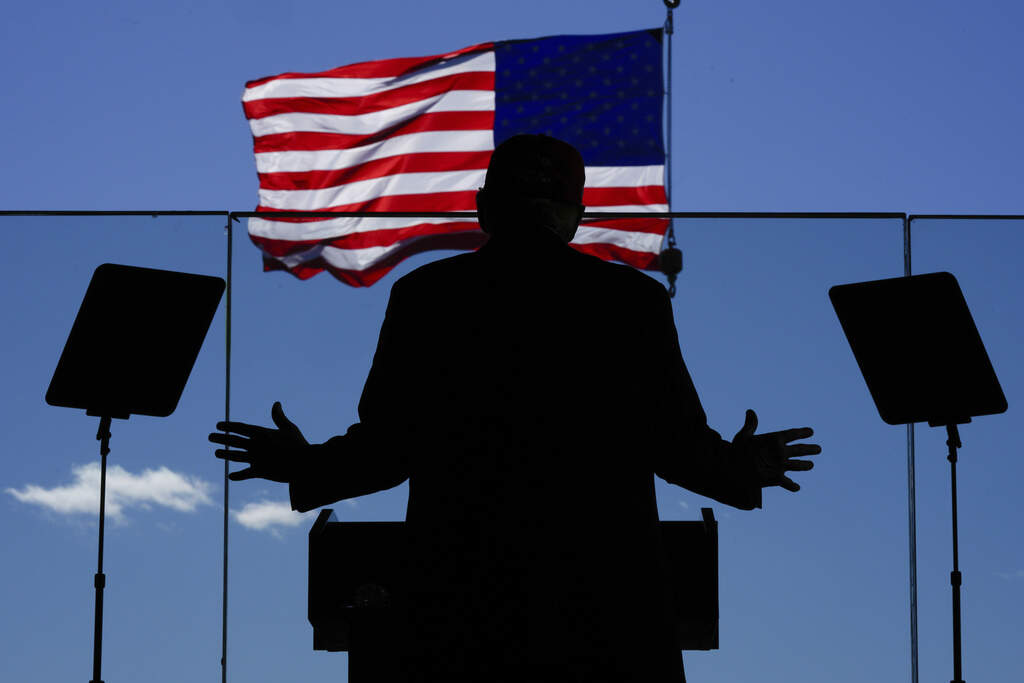
The media uses small soundbites and sensible summaries to make Donald Trump sound more coherent than he actually is.
But by doing so, some argue that the media ends up presenting a misleading picture of the former president that could misinform voters.
Today, On Point: Is the media 'sanewashing' Trump?
Guests
Michael Tomasky, editor of The New Republic. Editor in chief of the journal Democracy.
Transcript
Part I
MEGHNA CHAKRABARTI: One week ago, on October 1st, Donald Trump held a campaign event in Milwaukee, Wisconsin. It was supposedly about school choice. Now, if you heard about the event on television or radio, you probably heard a bite like this.
DONALD TRUMP: No parent should be forced to send their child to a failing government run school.
CHAKRABARTI: If you glanced over the print headlines, you probably saw something similar quote, former President Donald Trump appears at campaign events in Waunakee and Milwaukee, Wisconsin. Or during Milwaukee stops, Trump promotes taxpayer funded school vouchers. The only headline that comes close to what the actual speech was like is from the Washington Post.
That one goes like this. Quote, Trump mixes up words, swerves among subjects, in off topic speech. End quote. Because, though the speech was ostensibly about school choice, it took Trump more than half an hour of speaking to get there. He first meandered through a confusing, and confused stream of consciousness that touched on his belief that Kamala Harris is a Marxist, that for some reason he wants to meet her father.
He dropped a line about migrants being, quote, the real murderers, and a claim about how migrants are, quote, coming out of jails in the Congo. He talked about Elon Musk and Venezuelan tar. He even kicked off his speech by sending his, quote, love to the people suffering the aftermath of Hurricane Helene and then offered this observation.
TRUMP: Amazingly, this is one of the biggest hurricanes anyone's ever seen. It's late in the season, very unusual. I guess the water was 20 feet high and nobody expects that. People go up to the house and they think they're safe on the second floor and they weren't safe. This was one of the, they call it the waterfalls.
This was one of the biggest they've ever seen. So It's too bad. Very late in the season. You almost don't even think of it as hurricane season.
CHAKRABARTI: It is not actually that late in the hurricane season, which is considered to last from June 1st through November 30th. And this year, there are signs it could last even longer.
Now, why does none of that make it into news stories? Our guest today calls it 'sanewashing.' The media's habit of using soundbites and sensible summaries to make Donald Trump sound more coherent than he actually is. And our guest says that is bad journalism and bad for voters. He's Michael Tomasky, and he's editor of The New Republic and editor in chief of the journal Democracy, and he's written extensively in The New Republic about sanewashing, and he joins us today.
Michael, welcome to On Point.
MICHAEL TOMASKY: Thank you. Nice to be with you.
CHAKRABARTI: First of all, further define for us what you think of as sanewashing.
TOMASKY: I think you put it pretty well. It's a, and I should say, for a couple of things, first of all I didn't coin it. I don't know who coined it. It's a good phrase.
I wish I had. Second of all, I would say this it's, and this is an important point for people to understand. It's not a conspiracy. It's not an act of collusion, of knowing collusion between mainstream media outlets and the Trump campaign to clean him up. And to make him seem sane, more like, more what it is more a case of is journalism, journalists relying on the normal traditional conventions of campaign reporting that simply don't apply when it comes to Donald Trump.
What do I mean by that? I've covered a lot of campaigns. I've written up a lot of campaign speeches and appearances by candidates for Senate and president and governor and mayor and other things. What you usually do is that you know what their main point is, that they're trying to communicate, and you use probably the best representative quote from the speech or from the text that expresses their point. Hence those headlines that you mentioned about Trump talking about school vouchers. Yeah. He talks about school vouchers, but he does all the other things that you say. And that's completely unprecedented for political candidates in modern American campaigns. Usually political candidates, Democratic and Republican, liberal and conservative.
They have a text. They follow it. It makes sense. It's coherent. You may agree with it or not agree with it, it follows a certain pattern and a certain norm. Trump, of course, has nothing to do with that norm. And as you said, in your very good introduction, he goes off on all kinds of tangents.
Some of them just make no sense. Some of them are gibberish. Some of them are mean spirited. Some of them are racist. Some of them are ugly. Some of them are pernicious. And if you stick to the normal conventions of campaign journalism, you're not going to convey any of that.
CHAKRABARTI: Throughout the hour, Michael, our gratitude for having you on comes from the fact that we want to explore the impact that this sort of old habit of journalism is having on voters who are living through a new era of politics, as you said.
So we're going to do that. But I have to say, in trying to figure out how to best represent that tangentializing habit of Donald Trump, we even here in the context of this show ran into a challenge. And the first challenge is, we have a fixed amount of time, right?
So like, how do you best, and the same thing for print journalists, right? They have a fixed amount of space. It's like, how do you best represent the concoction that comes out of Trump's mouth in a fixed amount of time. And then, secondly, the other challenge is that in order to, I still, we still cling to this desire to have a, create an hour that has a kind of construct to it.
That we drift towards picking the cuts that have that same similar kind of construct in them. So I wanted to just be totally transparent about that, that this is a challenge that we face. Every day, and especially in this hour, but in order to partially overcome that, Michael, we did something a little bit different.
We pulled much longer cuts of Donald Trump this time than we usually do. And maybe we should just be doing that forever from now on. So I want to actually play through some of them. And this is all again from that Wisconsin speech from a week ago. And as I mentioned earlier, it took him, what, 33 minutes to get to the issue of school vouchers or school choice, and he went through all these other, I don't want to even call them tangents, because I think in his mind, he thinks it makes sense but subjects.
So here's one of them. He had been talking about climate change and claiming that he was the best environmental president of all time. Then, of course, he had moved to immigration, a favorite topic of his. He called immigration, quote, Kamala's mass migrant invasion. And he spoke about this aspect of it for six minutes.
Here's a little bit of it.
TRUMP: And for me to watch her the other night standing up at a television set saying, with a news conference, saying how she's going to all of a sudden get involved at the border. When she was the borders tzar she did a horrible job. She allowed 21 million plus people to come in. And many of them and you've heard me say this many times, they came from prisons and jails.
They came from mental institutions and insane asylums and they came from terrorist camps, where they trained them to come into the United States and they come into the United States. Many terrorists. We have more terrorists come into the United States in the last three years than we have had in the last 30 years.
And these are the real terrorists. These are the real ones.
CHAKRABARTI: He did not offer any proof as to where he got the numbers to back up that claim and in fact there have been no reported terrorist attacks in the U.S. during the past three years. Now, that section lasted for six minutes, we only pulled 45 seconds of it, and then he pivoted from immigration to COVID, and he once again talked about his self-victimizing view that he didn't get enough credit for doing, quote, a great job in the pandemic. Quote, an amazing job, and then he suddenly moved on to Afghanistan. And this was about 22 minutes into his supposed school choice speech, and here's what he said.
TRUMP: What I say is the most embarrassing moment in the history of the United States, that we took the soldiers out first. You're supposed to take the soldiers out last. A child would know that. I brought a child up to the dais once and I gave him the facts in front of a very big crowd of maybe 10,000 people, maybe more.
I gave him the facts. I said, so would you take the military out first or last? He said, I take the military out last, sir. He was five years old. I said, how old are you? He said, five. A lot of you saw that. As president, I will deliver gigantic tax cuts for working families and we will have no tax on tips, no tax on overtime and no tax on social security benefits for our seniors.
And that's a very big thing.
CHAKRABARTI: Moving from military advice from a five-year-old to tax cuts and then basically 10 minutes later, after veering through more speech about how he believes migrants are murderers and claiming that migrants are coming out of jails in Congo, which by the way, the Republic of Congo's ambassador to the U.S. said in an email, there is no truth or any sign or a single fact supporting such a claim. He talked about Air Force One, et cetera, et cetera, then half an hour in, finally, on the subject of school choice, he gets there, and this is what he says.
TRUMP: One of the things we'll be doing is moving education back into the states.
And if you think about it, like a state like this, I think we'd do fantastically well with education. I think that a state like Iowa, Idaho, Indiana, I think you'd end up, I was looking at him the other night, looking at him just from common sense, with a party of common sense. Then I said more than anything else now with a party of common sense, because that's more important than anything else.
We don't want men in women's sports. We want to have strong borders, and we want to have fair elections, not rigged elections. And we have a lot of problems in this country. But if you take a look at all of it, everything that we're doing, every single thing that we're doing is based on the structure and common sense.
I was looking at the various states. And I think 35 states could be the equivalent of Norway and Denmark. If you think about it, they'd run great. I think Iowa would do great. I think Idaho would do great. These are states that have no debt. They have low taxes. They've done great. And then you have the same, you have a guy like Gavin wouldn't do very well.
I don't think with it. He signed it, he signed a thing yesterday. Somebody told me I haven't, it's not confirmed, but he signed a document yesterday that said, you're not allowed to ask a voter for ID identification. And if you do, it's like a crime. Why would anybody do that? In other words, this was signed yesterday or the day before by Gavin Newsom. A failed governor.
CHAKRABARTI: He went on for quite a bit longer on that. Stream of consciousness and Michael, look, it took up our whole first segment. So I'm going to hear from you about what you think about how the media is not covering that truth of Trump in just a second. This is On Point.
Part II
CHAKRABARTI: Now, Michael, in that sort of series of longer segments of Trump's Milwaukee speech from last week, I have to tell you, maybe I'm just too rooted in old school journalism habits, but my initial urge was to the questions that were popping up in my head were, what does he mean by Idaho could be the equivalent of Norway or Denmark?
Those are European style social democracies, but I thought he hated socialism. What does he mean by the Republicans or the party of common sense? I'm actually quite curious about what he means by that. I'd love to hear him say more about that. And then he goes into this different thing about Gavin Newsom signed a thing.
What thing? Okay. He finally explains it has to do with voter ID, but the urge is still, I don't want to just call it exclusively fact checking, but sense seeking. And that's across journalism. I don't think I'm alone in that.
TOMASKY: No, you're not. And again, it goes back to the long-held conventions of campaign reporting that worked reasonably well before Donald Trump came along and started giving these kinds of speeches.
As you mentioned earlier, you have limited time on this show. Print journalists have limited space. If you're on the campaign trail, you have to work fast. You have to go file quickly. You have to compress and condense things into what you think conveys the gist of it. But with the way he speaks and the things he says, and the fantastical and false things he says, and often the allegations he makes, accusations he makes, those conventions just don't work.
And we've seen far worse examples in the last couple of days, even than the ones you cite, the lies about Hurricane Helene, notably, which are getting coverage. Now, a lot of these things get coverage. We should say that too, Meghna, they get picked up. They get mentioned sometimes, sometimes deep down in stories, they do get mentioned, but I've been looking at this pretty closely since the summer.
I would watch a Trump rally. And see the seven most outrageous things he said, and then go look in New York Times, in the Washington Post and the Associated Press to see what they quoted. And they usually quoted a couple of them, but really only a couple of them. And doing that, that's what sanewashing is in practice.
It doesn't convey the full craziness of the presentation. And then last point. This is not just about; this is not about picking on Donald Trump or anything. There's a very important point here that journalism ought to be raising. It's about his mental fitness for this office. And whether he's up to this job for four years, it's the hardest job in the world. It's the most demanding job in the world. We need somebody who thinks pretty clearly. And is this guy on the stump talking about Hannibal Lecter and sharks and electrocution and alleging that people eat dogs and cats, do we really want to put him in the Oval Office?
That's the question that media ought to be raising.
CHAKRABARTI: I want to just play another clip and then talk to you more about the impact on democracy that the style of coverage is happening. So this is actually still in Wisconsin, but not from that school vouchers, school choice speech. This is a campaign stop at Waunakee last week.
And he, for some reason, Trump decided to start talking about a Vietnam War movie. And here's a little bit of that.
TRUMP: One movie, what was that great movie that was made where a Full Metal Jacket, you know, that's, that's a very, they took somebody from the military, a top drill sergeant, right? Oh, that's good. Stand up. That's good. Full Metal Jacket. Right. He was supposed to get the Academy Award. He should have gotten it, but he actually, you know, honestly, he wasn't acting, but he was unbelievable in that movie. He, so he was teaching. I don't want to use the names, but big stars. (TRUMP TALKING)
CHAKRABARTI: So he goes on. The speech was supposed to center on his manufacturing agenda.
Gosh, even in just listening to these, even that was 30 seconds, and it was a smaller clip than the ones we heard earlier. But even 30 seconds makes him sound saner than he actually is. But Michael, I have to ask you, the point that you're raising is the most important one. And that is the media's overall reluctance.
Maybe with the exception of the past two weeks, to ask this question that you asked head on about Trump's mental fitness, because as you point out in your pieces, if he is elected back to the White House, he's 78 now, he'd finish his term at 82, being the oldest president in office. But yet it wasn't, it was like, what, just a couple of months ago or less than that, that there was this breathless coverage of Joe Biden's fitness for office. Was it the sort of, the overwhelming shadow that Biden's age cast that prevented the media from putting similar scrutiny on Trump until now?
TOMASKY: Yeah. Sure. And, in fairness, Biden, a couple of years older, a couple of years shouldn't make much of a difference. Biden did come across as more advanced in age. And it was mostly, Meghna, his voice.
CHAKRABARTI: Yes.
TOMASKY: He had an old man's voice and Trump doesn't. And to me, that was really like 90% of the difference.
CHAKRABARTI: I would agree. The frailty communicated by Biden's voice was what undid him.
TOMASKY: Yeah. And then of course the poor performance in the debate, obviously, put things over the top. But yes, that did obscure things. And I'd also say this, like with Biden, it was just a matter of age, it wasn't a matter of whether he was all there, he's mentally sound, he's just old. But with Trump, mental fitness, it's not just a function of age. It's like what kind of brain darts from Hannibal Lecter to how Cary Grant looks in a bathing suit in a speech that's supposed to be about whatever policy thing it's supposed to be about. And maybe that, I'm just speculating here, but maybe that's a harder thing to talk about and to speculate about.
So maybe that gave people some pause, but the New York Times did it Sunday.
CHAKRABARTI: Yep.
TOMASKY: And they showed that it can be done and it was done thoroughly. And judiciously and with evidence, and it raised all the right questions. And I think it was, I have been writing critically at times of the New York Times over these last couple of months on this topic, but I think they did a terrific job.
Peter Baker and Dylan Freedman were the writers with this long piece that they published Sunday.
CHAKRABARTI: And in that piece, the statistical analysis you talked about revealed some interesting things, right? That Trump's speeches are essentially twice as long now as they were back in 2016, from roughly a 40-ish minute average to an 82 minute average now?
And that they did some analysis of the actual content of the speech and found that he was more rambling. The quality of his vocabulary kind of still stuck at that fourth-grade level. What was really interesting to me, actually, was The Times noting that not only were the ideas that Trump talked about very disconnected, but that he swore more.
And I don't know why that took me aback. Because I thought there was nothing left about Donald Trump that would take me aback, but I hadn't actually seen that noted in any news story at all until Sunday. That Trump was swearing in his rallies.
TOMASKY: Yeah, I hadn't either. I thought I noticed this anecdotally, but I wasn't sure. So I was interested to see The Times confirm it. But as you're suggesting, that raises another question. Why did it take until the second week of October, a month before the election for this to be pointed out?
CHAKRABARTI: So let me circle back to something that you said earlier, and that is of late, there has been more focus on some of the things that Trump has been saying, in part, regarding Hurricane Helene.
I think I will give all credit to the people living through the aftermath there. Because elected officials like in North Carolina, for example, are saying that what the Trump campaign and Trump himself is saying is just not true. So it's hard for the media to ignore people on the ground saying no.
This is wrong, here's the truth about what we're living through. And the other thing is that occasionally Trump does say something that's so far outside the bounds of reality that it's impossible to ignore. So here's one of them. This is going back to his Milwaukee speech on school choice.
And he said this about transgender youth in public education.
TRUMP: Even as they fail to educate our youth, our opponents are using government schools to indoctrinate children, pushing radical transgender ideology on children, and changing the child's gender without even parental consent. Can you imagine that?
Your child leaves the school and comes home, and their gender has been changed. I don't want to get into the details, but it's not even believable, without parental consent, all of that's changing. It's changing immediately.
One of the things I wanted to mention with all of the people coming in, they're taking Black and Hispanic jobs. The Black population, their unemployment is way up over the last few months, and no, and the fake news isn't reporting it. And the reason they're way up is the illegal migrants are taking the Black population's jobs and the Hispanic population's jobs. And that's not fair. That's not a good thing.
CHAKRABARTI: Michael, what do you think about that passage there?
TOMASKY: The most striking thing, of course, is that crazy sentence about, your child goes off to school one morning and then comes back home with different sex or whatever it is. He exactly said, but that was the gist of it. I wrote about that at the time. And that was one that I noticed that most of the major outlets, I can't remember exactly, but most of the major outlets did not mention that passage.
And that really stunned me. I couldn't imagine, I imagine myself, as I said earlier, I've covered plenty of campaign rallies. I couldn't imagine myself as a reporter standing there listening to that and not putting that in my story. I just couldn't imagine it.
That was insane. That they perform sexual reassignment surgery at schools without telling parents, can't even say it without laughing. So how you don't put that into your story is unimaginable to me. By the way, I just Googled while you were playing that tape on the subject of Black unemployment.
Okay. The statistics I just got are only through 2023, but they've gone down. They went down from 2021 to 2022 to 2023. So that's probably another one. That he just doesn't care whether he has any factual basis, he just says it because it makes his case and makes him feel good.
CHAKRABARTI: So getting down to the fact that some of the fundamentals of political journalism simply are not constructed to meet this moment. I have a great deal of sympathy for people who are on the, reporters who are on the campaign trail, right? Like they're listening to whoever the candidate they're covering.
They're listening to these speeches, day in and day out. And again, traditionally their job is to report what is new, right? You talk about this in your pieces, that news is considered what is new. And to your point, Donald Trump saying fantastical things without evidence is not new.
So then you ask this very important question though, we need to expand as journalists, our definition of what is new. So how would you expand that, Michael?
TOMASKY: If something is repeated often enough that it is obviously thematically central to that candidate's self-presentation. And what passes for his vision for the country. Then it's news on a continuing basis, whether it's new or not, if a person keeps emphasizing a point and that they're going to do something. Over and over again, it's news. Rounding up 15 or 20 million people, he first said that many months ago. So it's no longer news. So I can see a reporter in one sense, sitting there and saying, Eh, I'm not going to put that in the story.
That's not news. That's not new. It's a pretty important thing that would turn this society upside down, and that he couldn't even do in four years. I've read a lot of accounts, by the way, that what he's talking about would take a force larger than the United States army, which is what?
Two and a half million people, three and a half. I forget the exact number, but it's a very, quite a large number. It would take a force larger than the United States army. And it would take 15 years. But that aside, the mere fact that somebody has said a kind of nonsensical or dangerous thing over and over again.
Doesn't mean that it shouldn't be news. Before I yield back my time, Madam Chair, I found from the Federal Reserve Bank of St. Louis, which is a very credible source, that Black unemployment in July was 6.3, in August was 6.1, and in September was 5.7. So in fact, it is going down.
CHAKRABARTI: Okay I appreciate the factcheck, there, Michael.
We can't fully let go of that impulse and I think that's the right thing.
TOMASKY: Of course not.
CHAKRABARTI: But so to get to put a sharper point on what you just said, we're at a moment, and this is straight from one of your pieces from The New Republic, where you ask, is the press justified in ignoring reality, just because it isn't new?
Of course, the inference being the reality of what Donald Trump is, represents and talks about, in, I'm guessing here, in your opinion is anathema to what a president of the United States should be, but the press has a problem in trying to figure out how to report on that reality. That there's always this fear of being painted as being utterly partisan.
And if you say Donald Trump is, he said this racist thing, he said that hateful thing, he said this lie, 50% of the country is likely to just write you off and say, of course you'd say that. You're the mainstream media and you're partisan.
TOMASKY: There's a great fear, I believe, among mainstream outlets, particularly editors, I think more than reporters, of being accused of having a liberal bias.
The roots of this go back to the 1970s when conservative media watchdog groups first formed and gained followings. And at that point in history, they probably had a point, liberal bias probably did creep in to a lot of mainstream news articles. And I think in fairness, it probably still does, in a certain kind of article, a certain kind of article about society.
Okay. Not about politics, capital P, but about society. If a mainstream outlet does an article or a segment about, I don't know, gay parents trying to adopt. That segment is likely to be sympathetic to the parents, because that's where we are as a society right now.
Part III
CHAKRABARTI: Michael, I just wanted to give you a chance to finish your thought about journalism editors being fearful of being accused of liberal bias.
TOMASKY: Thank you. Yeah, just very quickly. So as I was saying, I think when it comes to a certain kind of story about our culture and our society, I think there is sometimes a liberal bias in those pieces. But when it comes to straight politics, capital P politics, coverage, campaigns. Coverage of the White House, coverage of the Congress, I think those outlets police themselves very carefully for signs of bias about that, and I think there are many instances where they bend over backwards in the other direction. And it's not just campaigns, if you look at somebody like let's take James Comer, the House Chairman, who was on his little hunt after Hunter Biden and Joe Biden.
He was a clown. He had nothing. He had nothing. But he was taken seriously for many months by the mainstream media. In some sense, defensively, because he has the platform that he has. He's a chairman of an important House committee, but everything he said was a joke.
Just a joke. By the way, in the spirit of fact checking, I'll fact check myself. The U.S. military strength is 2.86 million. So I wasn't far off.
CHAKRABARTI: You were in the ballpark. So okay, so here's the thing. In reading your articles and going back and reviewing a lot of the things that Trump said, I think a really important point that you raise is what is not being discussed about Trump, both in terms of his fitness for the office of the president, and also for what he actually truly stands for.
When the sanewashing happens. So getting back to this fitness question, I want to play three different clips here. They are all from Trump visits to Johnstown, Pennsylvania. They're just from three different years. First of all, this is 2016, at a rally, and here's what Trump said, again, back in 2016.
TRUMP: They lived up to their duties as Americans. Their duties to their families, to their communities, to their country. They fought in our wars, they paid their taxes, they powered this nation. But in return, our politicians failed you and betrayed you. They allowed foreign countries to dump cheap steel into our markets and shut you down.
Our politicians failed the workers of Johnstown and gave your jobs to foreign countries and foreign producers. We got the poverty, they got the factories, the jobs, and the wealth.
CHAKRABARTI: Donald Trump in 2016. So eight years ago, talking about the economic situation in Johnstown. Four years later, 2020, came back to Johnstown and this is what he sounded like then.
TRUMP: So if I don't always play by the rules of the Washington establishment, it's because I was elected to fight for you and I fought harder for you than any president has ever fought for their people.
CHAKRABARTI: Okay so that's four years later. Now, here's Trump in 2024, once again, in Johnstown, and he talked about how women love Donald Trump and he did that by talking about a group of female superfans from North Carolina.
But once again, this is just this past August, Johnstown, Pennsylvania, 2024.
TRUMP: I spoke to the husbands one time, I say, how do you put up with this? Your husbands, your wives are traveling all over the place, do you mind? We trust our wives, sir. We trust them implicitly. I said you have great wives, let me tell you, but they've traveled, I think it's like 228, something like that.
But it is beautiful to have you here. We love to have you here. Always perfectly coiffed. (CHEERS) They're always perfectly coiffed. They're beautiful. They're great woman. Great women.
CHAKRABARTI: Michael upon hearing that and other sections of the Trump's various Johnstown speeches, it does occur to me that we haven't, the media hasn't talked a lot about how Trump's own, let's call it, not just ramblingness, but even just overall fitness has changed in the past eight years.
TOMASKY: Yeah. It's like when you're watching something happen, you don't really notice the change. And then you have to see or hear soundbites or see film clips in retrospect and say, Oh my God, I didn't realize things had changed that much. But this was interesting, and pretty good research by your staff, by the way.
But the 2016 clip, he was clearly reading from a teleprompter. So he was giving a more traditional speech. And yeah, it's within the ballpark of being a normal political speech. The process he's describing is a lot more complicated than just the politicians gave away your jobs.
That steel moved around the globe for complicated reasons.
CHAKRABARTI: Yeah, oversimplification is a hallmark of campaign speeches.
TOMASKY: It is. So that was like within, that was within the orbit of normal. But today it's just not. And I think he's just, I think he's doing a lot less reading from teleprompter and just a lot more whatever pops into his head.
And it's just a pinball moving from this, to that, to the other.
CHAKRABARTI: Now you mentioned earlier that what undid Biden, President Biden was the frailty of his voice. Trump in a lot of his speeches these days, if not frail, he does sound tired. And he does sound that he has less stamina. But that isn't being really pointed out in terms of if we have a candidate here or nominee who gets tired through giving a, a fifth, 82-minute speech, can he withstand the rigors required of the presidency?
That's not really pointed out as much or if at all about Trump. Michael?
TOMASKY: It's not, and I've noticed this too. He does sound tired, and he slurs a lot of words these days and mispronounces a lot of things. Minneapolis, I think it came out. There's enough of that, if that happened once in a while, because we all do that once in a while, and I forget words now and forget why I walked into the kitchen.
But there's enough of that, that we should start raising questions about what that means.
CHAKRABARTI: So there's another aspect of Trump that as you've written about extensively doesn't get pointed out when this state, the sanewashing happens. And I think it has a lot to do with the sort of, again, that sense seeking.
Impulse in political media. So what are your policies? How would you execute them, et cetera, et cetera. But then there's also, what do you actually stand for? What is your view of what this country should be under your leadership as president? And so to that point, I want to play three relatively recent clips of Trump where he's quite unvarnished in his belief about this country.
This first one is from September 29th at a rally in Erie, Pennsylvania. And this one did catch a lot of people's attention, because Trump said this about vice president Kamala Harris.
TRUMP: Crooked Joe Biden became mentally impaired. Sad. But lying Kamala Harris, honestly, I believe she was born that way. (AUDIENCE LAUGHS)
There's something wrong with Kamala. And I just don't know what it is, but there is definitely something missing. And you know what? Everybody knows it.
CHAKRABARTI: So Trump there on September 29th claiming that Kamala Harris was born with some kind of mental impairment. That's simply just not true. The day before, on September 28th, and you really noticed this one, Michael, this was in Prairie du Chien, Wisconsin. And Trump said this about immigrants coming into the United States.
TRUMP: They don't commit crimes like us. No, they make our criminals look like babies. These are stone cold killers. They'll walk into your kitchen, they'll cut your throat.
CHAKRABARTI: They'll walk into your kitchen and cut your throat. Then just yesterday on the Hugh Hewitt show, Michael Donald Trump added this.
Hewitt is, of course, a conservative American political commentator, and they talked about October 7th and the first anniversary of the Hamas attack on Israel. But then they quickly moved on to immigration. And Trump said this about what he thinks a potential Harris administration would bring to the country.
TRUMP: She wants to go into government housing. She wants to go into government feeding. She wants to feed people. She wants to feed people governmentally. She wants to go into a communist party type system. When you look at the things that she proposes, they're so far off, she has no clue. How about allowing people to come through an open border, 13,000 of which were murderers, many of them murdered far more than one person.
And they're now happily living in the United States. Now a murderer, I believe this, it's in their genes. And we got a lot of bad genes in our country right now.
CHAKRABARTI: That was Trump just yesterday. So Michael, claiming that your opponent was born with some kind of congenital defect, claiming that migrants will come into your kitchen.
And cut your throat, and claiming that there is a genetic propensity towards murder and criminality. What kind of political language is that?
TOMASKY: It's incendiary. It's irresponsible. It's fear mongering. It's designed to scare people into voting for him.
CHAKRABARTI: Now let me get, let me be more blunt.
What past regimes have used that kind of language?
TOMASKY: Okay. Sorry, I'm dense. I needed a little bit more guidance there.
CHAKRABARTI: You said it in one of your pieces.
TOMASKY: Yeah it's obvious. I, we've called him a fascist many times in the New Republic and I don't shy away from it. And yeah, there are elements of Nazi rhetoric there, for sure.
There are direct elements of Hitlerian rhetoric, when he's uses the word vermin, that's a word that Adolf Hitler used. If the comparison is apt, why not make it? And then, if you say, okay, Nazi Germany is a little too much. Okay. There's other examples of fascism in the past that can be drawn from, it's all there.
And it's all there in the historical record, particularly what he said yesterday to Hugh. But also the remark about people coming into your kitchen and slitting your throat, it's all built around a fascist idea of racial purity and blood and soil, and the racial purity of the superior race being poisoned.
He hasn't used the phrase superior race yet. That would be an interesting little benchmark if he ever gets there. But he implies it, he insinuates it, he seems to think it, and that's fascistic thinking throughout history.
CHAKRABARTI: And as you call them, they are defining comments of what he believes.
TOMASKY: Yeah. The one thing, we can say, you mentioned a few minutes ago, what's your vision of the country? We do know his vision for the country. We'll say that.
CHAKRABARTI: So I was thinking about you wrote that political journalism, it has a duty to accurately present the evidence about who a candidate is so that voters can be more informed in making the decision for themselves about who they wish for the next president of the United States to be.
And I came away wondering. Would it make a difference, because you know who already knows all of this about Donald Trump? It's the people who go to his rallies, Michael, his campaign staff, his surrogates that appear on cable news channels. It's voters who hang on every single word that he posts on Truth Social.
They know that he says these things. They celebrate them or they don't care about the details, because the details don't matter. I guess what I'm saying is we're in such a calcified, polarized environment that a very large group of people who support Trump will vote for him, no matter how accurately his beliefs are described in the media.
Because even when he's totally disconnected from reality and of questionable competence, he's saying things that people want to hear. The rest is just noise that entertains them. So what difference would it make if political journalism actually evolved its coverage to meet the moment that's demanded by a Trump like candidate?
TOMASKY: That's a good question. Part of the answer here has to do with the right-wing media that echoes everything he says. We actually have two medias in this country. We have the mainstream media networks, the New York Times and the Associated Press and so forth. And then we have the right-wing media, which is Fox News.
And now there's One American News Network and there's Newsmax and there's all kinds of websites and podcasts and so on. 30 years ago, let's say when Fox News first went on the air 28 years ago, the mainstream media was far larger. And the right-wing media was just a sort of boil off to the side that, you know, could be lanced, but now they're about the same size, I think.
And so the people who go to the rallies, if you ask them what is the news? Fox News is just the news to them. And, in certain parts of the country and hospital waiting rooms, Fox News is what's on, not CNN or anything else. So all that is reinforced to them. So they may well think it's all true because it's what they hear.
Now, as to your question and how much difference it would make to do a better job of reporting, I still think it would make a difference. Because I still think it would get through, because there still are voters who aren't people with heavy ideological commitments to one party or another.
Who may have voted for him in 2016 and then voted for Biden in 2020, who may have voted, if they're old enough, for George W. Bush, but then for Barack Obama. There are people like that. There aren't that many in the country these days, it's 6% of the electorate or something like that. Might be more in certain swing states, less in certain other states. But they're still out there and I think they still absorb and read and listen to and watch enough mainstream media that a more accurate representation of what's going on might make a difference with them.
This program aired on October 8, 2024.