Support WBUR
Raising revenue vs. protecting industry: A deep dive into America's use of tariffs
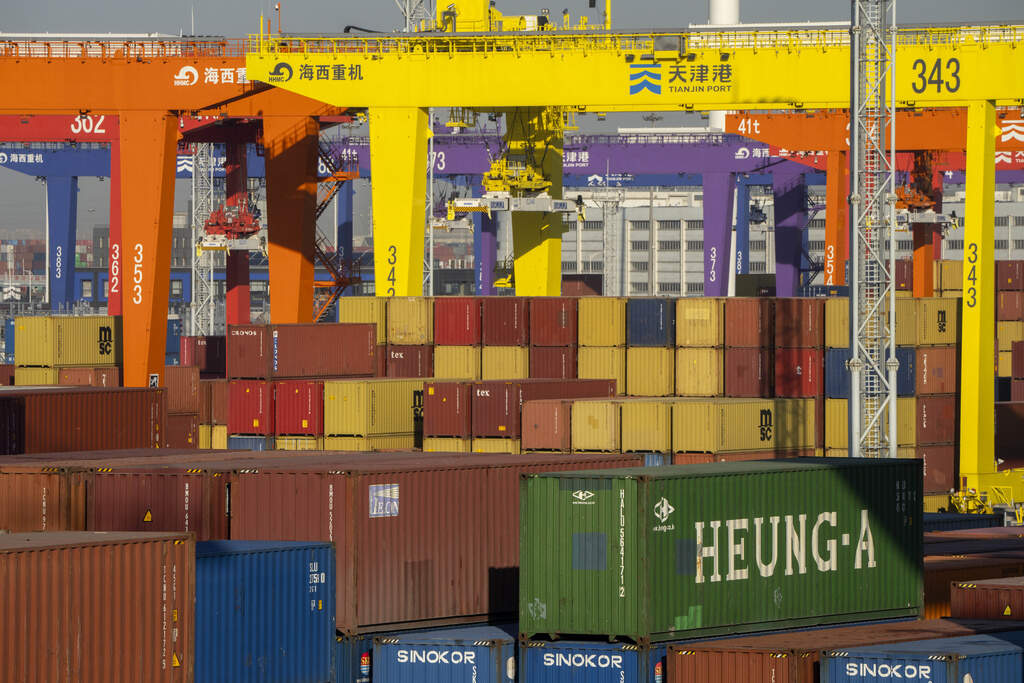
Former President Trump wants to build a tariff wall: 60% tariff on goods from China, 20% on imports from everywhere else in the world.
But what exactly are tariffs, and who do they help or hurt?
Today, On Point: A deep dive into America's use of tariffs.
Guests
Kimberly Clausing, Eric M. Zolt Chair in Tax Law and Policy at UCLA School of Law.
Douglas Irwin, John French Professor of Economics at Dartmouth College. Expert in the history of trade in the U.S.
Transcript
Part I
MEGHNA CHAKRABARTI: Former President Donald Trump spoke at the Economic Club of Chicago yesterday and said, of all the words in the English language, to me, the most beautiful word in the dictionary is tariff, and it's my favorite word. Trump is campaigning on a sweeping new tariff proposal.
If elected, he says he'd implement a 60% tariff on all imports from China and up to a 20% tariff on goods coming into the U.S. from everywhere else in the world. Trump claims the tariffs could accomplish two goals.
TRUMP: Number one is for protection of the companies that we have here and the new companies that will move in because we're going to have thousands of companies coming into this country. We're going to grow it like it's never grown before. And we're going to protect them when they come in, because we're not going to have somebody undercut them.
CHAKRABARTI: Trump implemented tariffs during his first presidency. Later in the show, we'll talk about exactly what those tariffs were and their impact on the U.S.
His new plan would go much further. Several economic analyses conclude that a tariff on all imports into the United States would amount to a, quote, national sales tax on U.S. consumers. Trump was pressed on this point in Chicago yesterday by Bloomberg editor in chief John Micklethwait.
TRUMP: The higher the tariff, the more likely it is to have them come into the country.
MICKLETHWAIT: The higher the tariff, the more you're going to put on the value of those goods, the higher people are going to pay in shops.
TRUMP: Ready? he higher the tariff, the more likely it is that the company will come into the United States and build a factory in the United States, so it doesn't have to pay the tariff.
MICKLETHWAIT: That would take many --
TRUMP: No, oh, it would go quickly.
CHAKRABARTI: Trump talks of a tariff wall as an absolute solution for American economic growth and for individual Americans' economic woes. Last month at the Economic Club of New York, he took a question on childcare and folded that into his claims about tariffs as well.
INTERVIEWER: If you win in November, can you commit to prioritizing legislation to make childcare affordable? And if so, what specific piece of legislation will you advance?
TRUMP: I would do that. And we're sitting down, I was somebody, we had Senator Monaco Rubio, and my daughter Ivanka was impactful on that issue.
It's a very important issue. But I think when you talk about the kind of numbers that I'm talking about, that, because child care is child care. Couldn't, there's something, you have to have it in this country. You have to have it. But when you talk about those numbers compared to the kind of numbers that I'm talking about, by taxing foreign nations at levels that they're not used to, but they'll get used to it very quickly. And it's not going to stop them from doing business with us, but they'll have a very substantial tax when they send product into our country.
Those numbers are so much bigger than any numbers that we're talking about, including child care, that it's going to take care of. We're going to have, I look forward to having no deficits within a fairly short period of time.
CHAKRABARTI: Americans spend more than $78 billion a year total on child care, according to a report put out last year by the nonpartisan group Ready Nation.
So what is the truth about tariffs? Because the U.S. has in fact used them selectively, even now, and also built a tariff wall in the past, what role have tariffs played in this country's economic history? That's what we're going to focus on today. And to do it I'm joined by Douglas Irwin, professor of economics at Dartmouth College. ... Professor Irwin, welcome.
DOUGLAS IRWIN: Pleasure to be here. Thanks for having me.
CHAKRABARTI: Also with us today is Professor Kimberly Clausing. She's the Chair of Tax Law and Policy at the UCLA School of Law and has served in the U. S. Department of the Treasury. She's also author of Open: the Progressive Case for Free Trade, Immigration, and Global Capital.
Professor Clausing, welcome to you.
KIMBERLY CLAUSING: Thanks so much for having me on the show.
CHAKRAARTI: Since former President Trump said that tariff is his favorite word in the dictionary, I thought I would just start by pulling the actual dictionary definition of tariff, which is simply a tax or duty to be paid on a particular class of imports or exports.
Professor Clausing, I'd like to just start with the 101. How would you define or describe what a tariff is?
CLAUSING: Yeah, if you were writing one sentence on a chalkboard, you would say a tariff is a tax on imports. That's how it's typically used. If you look at who remits the tariff, it's the importer. But the more interesting question is who pays the tariff.
And economic theory, as well as a lot of evidence, suggests that the consumers of imports pay tariffs, or those that are buying them from abroad.
CHAKRABARTI: Okay. So let's parse that a little bit more. You heard in the clips earlier that the former president interchanges the word tariffs with attacks on foreign nations.
Is it at all a tax on foreign nations?
CLAUSING: It really is not a tax on foreign nations, and one way to see that is to just look logically at the decisions of a foreign exporter. If they can sell their product to other countries, which many of them do, why would they sell it to the United States for less than what they can get on the world market, right?
If you're saying that foreigners are paying the tariff, you're saying that they're basically willing to eat that margin on the U.S. market, even though they can get the full price somewhere else. And we have a lot of evidence from the first round of Trump tariffs in 2018 and 2019 that U.S. buyers of imports paid 100% of the tariffs.
So none of it was really borne by foreigners. That can happen in theory if they lower their prices, but there's no real reason for them to lower their prices.
CHAKRABARTI: Okay. Again, you mentioned 2018, 2019. We're going to come back to those tariffs from the first Trump presidency a little bit later in the show, but they also give us some important data as you just said.
But so then it is a form of revenue, though, for the federal government, right? Because if the importers, U.S. based importers, I'm presuming, are paying this tax as these goods come into the United States, that tax is going to federal coffers, no?
CLAUSING: Absolutely. And all taxes do. So when you're analyzing taxes, we have them for a good reason.
We need to fund the government. What you want to do is compare different ways of funding the government. We, like many rich countries, rely primarily on income and payroll taxes. And not on tariffs. Tariffs were something that we used historically, which I'm sure you'll be talking about shortly. But there's a good reason to shift away from tariffs.
They're a very distortionary and inefficient and regressive source of tax revenue. When you have these other alternative tax instruments available, you might as well raise taxes in a more fair and efficient manner.
CHAKRABARTI: Okay, so let's use an actual hypothetical example, but with an actual good, okay? So say I'm interested in buying a new flat screen TV, right?
So that, and that TV is made in China. So it comes into the United States, the importer receives it, and what's the mechanics then? What happens? How does it act, how does that tariff actually make its way into the price of the television?
CLAUSING: Yes. So the importer who is ordering this TV pays the tariff to the U.S. government. But of course, importers don't have the kinds of margins that would allow them to just absorb this additional cost, which might be, today, maybe 20% or something. So they then raise the price they charge the store for this good. And then the store, in turn, because they too do not have the margins that would allow them to simply take a 20% hit on their goods, they also raise the price to consumers. So when you go and buy that TV, it's now more expensive than it would have been, absent the tariff. Now, you might say, Oh, I can just buy a domestic TV that won't be affected by the tariff. And two things get in the way of that one. We don't produce a lot of goods here in the United States.
But even if we did, part of the whole point of tariffs is to allow the domestic producers bigger margins, right? And when they see that the foreign competition is charging a higher price, they can charge a higher price, too. So when you go to the store, it's not just the imports that get more expensive.
It's any good that's competing with the imports also gets more expensive. And that shows up in lower purchasing power for Americans throughout the economy.
CHAKRABARTI: Okay. The narrow-ish margins that you talked about with both the importers and retailers is a big part of this story.
Is there a thing called a tariffs ledger? What is that?
CLAUSING: I'm not sure what you're referring to, to be honest.
CHAKRABARTI: Oh, okay. In my reading, there's a lot of, a little bit of, little bits of detail here and there, which sometimes I don't know the answer to, so I just throw them out there. But so, has there ever been any evidence that a tariff has not increased the price for end consumers in the United States?
CLAUSING: In recent evidence, we have run this experiment, and there have been nearly a dozen studies that have looked at the big increases in tariffs that happened in 2018 and 2019. And looked to answer that exact question that you asked, and all of them found that prices rose correspondingly. If you go back in history, there are mechanisms where you can find a somewhat smaller effect on prices.
For instance, let's say the exchange rate changes. The exchange rate is something that determines the price of all of your goods, relative to all foreign goods. And we think that tariffs might tend to appreciate the home currency that could act to countervail or to offset some of these impacts. But in general, analysis of recent tariffs and analysis that's most relevant to the experiment today indicates that those mediating factors would be quite small, and consumers would certainly expect prices to go up. And every analyst of the Trump tariff proposals has shown large costs in the thousands of dollars to median households from these proposals.
CHAKRABARTI: Professor Irwin, I appreciate your patience. I haven't forgotten about you. Maybe you can help me answer the question of what a tariff ledger is, because I don't want to leave that hanging.
IRWIN: I, too, have not heard of the term tariff ledger, but there is something known as the tariff schedule, which is a large book produced by the federal government that lists item by item what the specific tariff is on various items.
So when the importer brings in the good, customs officials look up in the book what product category this is, looks across and sees exactly what the tariff rate is, because the tariff rates differ across goods quite a bit. So I suspect that might be what the tariff ledger is.
It's just known as the tariff schedule of the United States.
Part II
CHAKRABARTI: What period of U.S. history would you point to as this country's first use of tariffs?
IRWIN: Actually the second piece of legislation passed by Congress in 1789 under the new constitution was tariff legislation. And that's because the federal government was desperate for a source of revenue.
We didn't have income taxes. We didn't have sales taxes or excise taxes. Federal government was broke, just starting out, needed to fund national debt, need to fund national defense, pay the president's salary. And so the easiest and quickest thing to do is to pass a tax on imports, which is the tariff bill, to start collecting some of that revenue.
CHAKRABARTI: Oh, tell me more about that. How effective was it? Did it accomplish what it was designed to?
IRWIN: You have to go to Secretary of Treasury at the time, Alexander Hamilton, and he was, and most members of Congress were a big proponent of the tariff. Once again, because there weren't really alternative sources of revenue that could be easily had.
Remember, we were back then a very agrarian nation. We had a few cities on the Eastern seaboard, but all sorts of alternative forms of taxation just wouldn't really work very well. You might've heard of the whiskey rebellion. And that didn't go over so well with the settlers in Pennsylvania.
Taxing imports as they came into Boston, Philadelphia, New York. And the other ports on the East Coast was just the easiest and best way to do things.
CHAKRABARTI: But even before the official formation of the United States, can we look to tariffs as being a factor in the American revolution itself?
IRWIN: Absolutely. Once again, we didn't have sovereignty. So it was the British parliament that was enacting those tariff acts or those taxes. And I'm sure you've heard of the Stamp Act and the Tea Act and the Sugar Act. And in fact, the Boston Tea Party was in part because of the taxation of British tea coming into the U.S., which is a big consumer item. We didn't like the fact that Britain was setting those taxes for us without our consent, and so it was one of the causes of the American Revolution.
CHAKRABARTI: Okay. So then what period of history would you then move to in terms of the next significant use of tariffs by the U.S. government?
IRWIN: We've had tariffs, as I said, right from the beginning. So the political tussle has been, should those tariffs be high or low? What is the purpose of those tariffs? Is it just for revenue as originally fought, or should we try to protect some domestic industries from foreign competition by raising the tariffs and maybe skewing them towards higher rates on manufactured goods and lower rates on other things that we don't produce ourselves.
And really, we've had more than 200 years of political history in the United States, where 2 political parties have different views on tariff policy. There are big battles in Congress over whether the tariffs should go up or down. And it's really part of the American fabric for some time.
And President Trump is just the latest chapter in this long running battle.
CHAKRABARTI: Okay. But then I think perhaps the period of time that people have recently been most interested in, because of former President Trump, is just after the Civil War, but take us right to maybe even, yeah, just after the Civil War, because this was a time where the U.S. government returned to using tariffs pretty heftily, right?
IRWIN: Exactly. So in my book, I talk about what I call the three R's, which are the purposes of levying tariffs. So the first one is, when we've been talking about revenue, it's a tax and so it'll raise revenue. It's very important for the federal government up to the Civil War in the United States, because, actually during that period, it raised about 90% of the revenue gained by the federal government.
The second R is restriction. You wanna restrict imports to help out domestic producers. And it was really after the Civil War that restriction purpose of tariffs came to the fore. Revenue wasn't quite as important. Because during the Civil War, we introduced other taxes. It reduced the dependence of the federal government on the tariff, per se.
And so now the political battle was, do we really want to restrict imports to help out domestic industries? Or should there be some other purpose? Then the final R is reciprocity. That is, if our tariffs are high and other countries have high tariffs, too, maybe we should negotiate with them where we'll reach an agreement where we'll reduce our tariff if other countries reduce their tariffs.
And we'll expand trade and hopefully increase mutual prosperity. And that's where we've been since World War Two in that reciprocity mode of trying to reach trade agreements with other countries.
CHAKRABARTI: Okay, but I'd like to understand in more detail the purpose of the tariffs post Civil War. You said a lot of that had to do with protecting nascent industries, which were what?
IRWIN: Exactly. As I mentioned before, we were, we started out as a very agrarian nation with a very small manufacturing sector. And during the Civil War, the political power shifted towards the North, where a lot of these industries were. So we're talking about the textile industry in New England.
We're talking about the steel industry in Pennsylvania and Ohio. We're talking about farm implements in Illinois and elsewhere. And a lot of these producers faced competition from Britain, which was the first country to have an industrial revolution. They had a head start in producing textiles and steel and iron and those sorts of goods.
And so there's a lot of pressure on Congress to enact higher tariffs to keep out British goods that were competing with American manufactured goods. And that's really the period after the Civil War, right up into the early 20th century, late 19th century. And that's the period that President Trump harkens back to, saying when we had these protective tariffs in place, we really became a manufacturing superpower.
CHAKRABARTI: And it helped us grow and become rich. He makes the claim that the United States was the richest country in the world in the late 19th, yeah, late 19th century. Is that true?
IRWIN: We were, but we've always been a very rich country. Even when you go back to the American revolution, we were a high wage country with a lot of land, obviously at our disposal, even though we didn't have a lot of manufacturing, we were attracting immigrants from around the world, because of the high standard of living and the high wages we offered.
And we've always been way up there in terms of the ranking of incomes across countries.
CHAKRABARTI: Okay. So in that case, massive tariffs post Civil War actually did seem to accomplish the goal of protecting, again, is it important to specify that these were either struggling or nascent industries versus well established ones in the United States, or do I have that wrong?
IRWIN: No, that's absolutely right, and that's a very good point. By the late 19th century, a lot of industries were really well established in the U.S. The steel industry. We had an abundance of iron ore, an abundance of coal, which are two of the ingredients to making steel.
So even if we had zero tariff, we still would have been producing a lot of iron and steel. And the same is true with clothing. We produced a lot of cotton. We had a lot of waterpower, and then later electricity to run our manufacturing plants. And just the skills and the technology we had, we would have had a textile industry, even without the tariff.
Now there's a debate about how big the industry would have been, but there's no doubt we would have been producing these manufactured goods. In fact, most economic historians are very skeptical of the claim that we became rich because of tariffs, or we had a much bigger manufacturing sector as a result of tariffs, because a lot of the tariffs were indiscriminate.
They were helping out already established industries, sometimes trying to help out new industries. But also putting taxes on intermediate goods that are required to produce manufactured goods as a downstream product. So when you tax a firm's inputs to production, such as steel, you raise the price, as Kimberly was saying, and that makes your say auto industry or your farm implements industry, much less price competitive because their costs are going to be higher.
So it's a mixed bag.
CHAKRABARTI: Okay. Let's just hit pause for a second on the historical analysis, because Professor Clausing, this allows me to go back to you and say, do you see similar or different, not factors, but is the economic environment at all similar to the economic environment post Civil War, in terms of the potential use of tariffs to protect smaller or nascent industries in the United States?
CLAUSING: I think, luckily for us all, the present year is very different from after the Civil War. The economy is far more sophisticated. The sources of federal revenue are much more various. We're not reliant on only raising taxes at the port. Since the 16th Amendment, we've had the ability to tax incomes, and that's a pretty efficient and direct way to get to adequate tax revenue, and that's been in place since 1913, which is roughly when the modern income tax took place.
So not only is the economy very different, but the sources of funding are very different. And one way in which the economy is different, that's particularly salient, is something that Professor Irwin just alluded to, which is the importance of imported intermediate goods. A lot of our products that we make here in the United States have very complicated supply chains, as we saw during the pandemic.
And when you insert tariffs in those very complicated supply chains, you introduce new shocks and new costs, that ultimately set the economy back, and that's going to be much more problematic in the modern economy than it would have been in the 19th century. So I think we need to make sure our policy tools are updated to the current state of the economy.
CHAKRABARTI: Okay, so I can hear how that applies with blanket tariffs, with a tariff wall. But it still leaves the door open for effective use of selective tariffs. What about, I don't know, electric vehicles or chip manufacturing? Wouldn't one way to help boost that manufacturing here in the United States be to raise tariffs on those types of goods coming into the U.S.?
CLAUSING: Certainly, governments can select key goods that they view as strategically important and then tailor policy towards production of those particular goods. So the first example, I would raise, is national security goods, right? You wouldn't want to rely on foreign countries for all of your national security goods, particularly ones that you're not getting along with.
So you'd certainly want some domestic production there. But as you point out, the case could be broader. Maybe you think chips are really important to have here in the United States, or electric vehicles, right? In those latter two cases, and it really, even in the first case, I think we can look at other tools too, and compare them to tariffs.
For instance, domestic subsidies can dramatically increase domestic production of goods, like electric vehicles or chips or national security products, right? The nice advantage of using a subsidy rather than a tariff is you're not simultaneously making those products more expensive for consumers. If you think about electric vehicles as an example, a tariff is combining two things, a consumption tax and a production subsidy. So it's encouraging domestic production, but it's also discouraging people from buying EVs or electric vehicles, because they're more expensive than they would be otherwise. So if you just rely on the subsidy tool, you're driving down the cost to consumers.
Whereas if you're relying on the tariff tool, you're making them more expensive. And not necessarily for a good reason, right? You might not want to rely on a particular country for electric vehicles, but you might want robust competition from throughout the world because that's part of how we get innovation and cost-effective production in any product.
CHAKRABARTI: Okay. So Professor Irwin, I just wanted to jump back and forth in time a little bit here, but going back now to post Civil War, I hear you clearly about why the U.S. wanted to use rather significant tariffs at that time, but as we approach the end of the 19th century, and the very beginning of the 20th century, the United States is a very different place.
And I read Heather Cox Richardson's Substack on this very, with a great amount of interest. And she points out that essentially by the end of the 19th century, those U.S. industries had turned into first informal organizations and then trusts that colluded in in price fixing and things like that, essentially in the middle of the gilded age now, right?
IRWIN: That's right. The U.S. had become a manufacturing power and because they didn't face a lot of foreign competition that gave them a domestic market power, and so you had the steel trust and the copper trust. That were really colluding, not competing with one another, raising prices.
And so a lot of progressives at the time became very upset with the tariff and thought it was just protecting big business against the interests of consumers and farmers, which were paying the price. And so they led a political attack on the tariff. So it was always controversial. And you just had different factions thinking that high tariffs were good or bad.
CHAKRABARTI: By the, what, mid 18, no, late 1880s, how much of the cost of goods was constituted by tariffs? Do you know?
IRWIN: The average tariff at that time was about 45% or so. It fluctuated a bit between 40% and 50%. On average, tariffs on imported goods were pretty high. Because, as I said, there's this pressure to help out consumers and reduce the cost of goods.
Congress did put certain goods on the duty-free list, where they just wouldn't be taxed at all, but they tended to put goods that the U.S. didn't produce on those lists. And so examples would be coffee, tea, banana, bananas, tin, and so it was a way of offering a lower price to consumers without really compromising the protection to domestic producers that were facing foreign competition.
CHAKRABARTI: And how does, in your estimation, McKinley play into all of this?
IRWIN: Ah, that's a great question because President Trump has invoked President William McKinley as his guru for all things tariff. And first thing to notice, McKinley came from Ohio and Ohio is the place where a lot of iron and steel was produced, and also wool. And both wool producers and iron and steel producers faced some foreign competition that they wanted to keep out.
So representing the interests of his constituents, he wanted high tariffs. And in 1890, as chair of the house ways and means committee, he helped usher through Congress a piece of legislation that became known as the McKinley tariff, and it raised tariffs to higher levels than it existed before. It's a marginal increase in some sense, because the average tariff was already pretty high, and it wasn't a revolution, it was just bumping them a little bit higher.
But what's interesting is that later in the decade, in the 1890s, he became president. And as president, he saw we were actually producing a lot of manufacturing goods now, and we would be pretty competitive on international markets. And yet we're stymied in terms of exporting our goods by high tariffs and other countries.
So maybe he thought as president, he should push for reciprocity agreements. That is, we would temper and begin to reduce our tariffs if other countries also agreed to reduce theirs. That would help us increase our market access for our manufacturers and farmers. And increased trade. So McKinley is interesting, because as a member of Congress, he wanted high tariffs.
As president, he was really ahead of his time and thinking about how can we begin to reduce tariffs and U.S. trade.
Part III
CHAKRABARTI: Now Professor Clausing, much earlier in the show, you mentioned more recent tariffs that were imposed by former President Trump during his first presidency. And I want to just take a minute or two to just quickly go through that more recent history as well, particularly regarding agriculture and the tariffs used by Trump, and the impact they had on the American soybean industry.
TRUMP: This is number one, but this is the first of many.
CHAKRABARTI: So that was former President Trump, March 2018, immediately before he signed a memorandum imposing new tariffs on China. Those tariffs covered about 10% of all Chinese imports into the United States, totaling approximately $50 billion. China retaliated, placing its own tariffs on U.S. goods, particularly targeting soybean exports or soybeans that would be imported into China.
That summer, Ray Ganser, a farmer in southern Iowa told NBC that he supported getting tough with China, but he was feeling the negative impacts of the tariff war because soybean prices in the U.S. had dropped 15%.
RAY: When our prices that we receive go down, so does our ability to support our family and continue with our farm.
CHAKRABARTI: By September 2018, the U. S. had targeted some 200 billion worth of imports from China with a 10% tariff. China responded with that 5% to 10% tariff on $60 billion worth of U. S. goods going into China. May the next year, May 2019, senior economist with the Illinois Farm Bureau, Michael Doherty, told Voice of America that the soybean farmers of America were still suffering.
DOHERTY: We have well over a billion bushels of soybeans in the United States. We're selling it at far less rapidly and in smaller volumes than we normally would, at this point in the year.
CHAKRABARTI: A report from the USDA indicates that soybeans lost more than 75% of their export value to China between 2018 and 2019.
And remember, in return, there was a tariff or an import tax on goods coming from China to the United States. And as Professor Clausing told us before, on almost every single circumstance, that pot, that cost was passed on to U.S. consumers. Now, in order to offset the effects of the trade war on American farmers, the Trump administration moved to bailing out farmers to the tune of billions of dollars from the federal government. And in fact, the numbers get more specific. According to the Council on Foreign Relations, tariffs raised, tariffs on Chinese goods, raised some $66 billion over several years in federal revenue, but to prop up farmers who were struggling due to that drop in soybean prices, the government handed American farmers roughly $61 billion or 92% of their revenue gathered by the U.S. government from tariffs on Chinese goods.
So very little money was left over to put into other aspects of the U.S. economy. Now, China did not pay for that tax. That bailout from American farmers came from higher prices paid by Americans on Chinese goods. Now, the countries eventually turned to the negotiating table and reached an agreement to halt further trade escalation.
China agreed to buy $200 billion worth of U.S. exports before December 31st of 2022. The country failed, buying only 57% of the goods it promised to buy before 2021. And as of 2022, soybean farmers in the U.S. were still feeling the effect of the tariff-based trade war. Coping with the reduced price for their product while having permanently lost some buyers.
And of course, in the midst of all this, there was the pandemic as well. But it's a very interesting example on the effects of tariffs in the modern era. So Professor Irwin, let me go back to you on that. And what lessons do you glean from what happened in this first Trump administration, U.S.-China trade?
IRWIN: The first thing is a very obvious point, that when we act to raise our tariffs, other countries don't just take it and stand still and do nothing. They retaliate. And that's another lesson from history. One of the biggest examples of that is the Smoot-Hawley Tariff of 1930. When Congress passed that, as the U.S. was beginning to go into the Great Depression, we thought, there's a domestic piece of legislation, we're going to raise tariffs a little bit, but the rest of the world really won't be affected or care very much. In fact, the rest of the world cared quite a bit. And they imposed higher tariffs on our exports, which hurt our farmers, which hurt our manufacturers.
And it started a trade war that led to a downward spiral of world trade during the Great Depression. And although those tariffs didn't cause the Great Depression, they certainly intensified it. And I think we saw a little microcosm of that recently, with the first Trump administration, where they imposed these tariffs.
A lot of other countries retaliated, not just China, but when we imposed tariffs on steel, the European Union and other countries retaliated against American blue jean exports and whiskey exports and other Harley Davidson motorcycles and things of that sort. And so you get into this tit for tat retaliation that just reduces trade overall and really doesn't bring a benefit to anyone.
CHAKRABARTI: Professor Clausing, your thoughts on that?
CLAUSING: Yes I agree with what Professor Irwin said, and I take three lessons from this recent episode. One is retaliation is inevitable, as Professor Irwin said. I would fully expect foreign countries to retaliate to the Trump proposed tariffs, and I know that some of them are already drawing up lists of goods that they would tariff.
In response, a second issue that you pointed out very clearly is that we can't necessarily rely on tariff revenue to be spent on goods like childcare or deficit reduction. Instead, we may end up spending a lot of that revenue bailing out exporters who've been harmed by the tariff and the trade wars that result.
But I think perhaps maybe the most important lesson from all of this is this distinction that we often see people make, between tariffs in your consumer role and tariffs in your producer role.
I've heard a lot of people say, okay, of course you're going to pay a little more at the store, but it's worth it because workers will have an industrial renaissance and see all of these benefits to U.S. production. But economists have also done studies of the recent tariff escalations in the United States, and they found that they actually have hurt workers, not helped them. And the mechanism is exactly the one that you described earlier, which is that there are these negative effects due to retaliation.
It hurts farmers in the upper Midwest who want to make soybeans, but it also hurts whiskey manufacturers, blue jean manufacturers, anyone who's on that list of retaliation, and it hurts manufacturers in general in the United States, right? Because their imported intermediate goods are getting more expensive.
And so analysts who've looked at this episode have concluded those negative effects. I just described to exporters and to manufacturing, outweigh the positive effects that you might get in the steel industry or in other protected industries, and tariffs actually end up being bad for workers, the very groups that we were hoping to help with the tariffs.
So they not just hurt you as consumers, but they hurt the entire economy. And I think that's a lesson that I hope your listeners will take seriously. Because I think people underestimate the negative effects on the macro economy as a whole and the potential for stagflation here, which is the combination of higher prices and reduced output.
CHAKRABARTI: So we're going to come back. We're going to, I want to wrap up this show in a few minutes, asking like, what would be a better path to actually helping American workers and growing business and industry here? We have been talking about this in the context of former president Trump's very extreme idea to slap tariffs on every single import coming into the United States.
That was the catalyst for this conversation, which has basically 100% agreement amongst economists that would essentially become quote unquote, a national sales tax on U.S. consumers. However, let's be clear. The Biden administration uses tariffs as well. I'm looking just from a May 2024 fact sheet that the Biden White House put out saying on May 14th, 2024, President Biden directed his trade representative to increase tariffs on $18 billion of imports from China.
And the reason why, to encourage China to eliminate its unfair trade practices regarding technology transfer, intellectual property, and innovation. Quote, the president is directing increases in tariffs across strategic sectors, such as steel and aluminum, semiconductors, electric vehicles, batteries, critical minerals, solar cells, ship to shore cranes, and medical products.
So there, he's clearly linking that to protecting American workers and American companies. Professor Irwin, your response to that.
IRWIN: The tariffs on against China are one thing because they're a geopolitical rival and we don't get along with them and there may be a national security threat.
But when we have tariffs on imports of steel from our allies, from Germany, from Japan and Korea. These are our friends. And as Professor Clausing was saying, that also raised the cost to American businesses that need that steel to be competitive in the international marketplace. So by raising the price of steel, we're not only hurting our relation with our allies who we need to cultivate.
But we're also hurting Ford and GM, which are paying a higher price domestically for steel, compared to their foreign rivals. So it really is not a good policy in my view. And when the Biden administration says this is a worker centered trade policy. My response is always, which workers? You might be helping out steel workers, but you're not helping out auto workers by that policy.
And you're certainly not helping out anyone who consumes those products.
CHAKRABARTI: Okay. So professor Clausing, just briefly, let me, again, going back to this announcement from the Biden white house, they're saying that China's own policies domestically subsidize their steel and aluminum industries. And the Biden administration says that means quote, high quality, low emissions U.S. products are undercut by Chinese alternatives. So in this May 2024 announcement, again, this is for Chinese steel and aluminum specifically. Biden raised the tariff rate from 7.5% to 25%, okay, this year. But I guess my question is there any evidence that this has changed China's behavior as the tariff is supposedly designed to do.
CLAUSING: Yes, I think there's two issues that your question raises. One is scale. As you point out, the Biden approach here is far more targeted. It's addressed at one country. It's addressed at a number of products. If you add up the total, we're talking about $18 billion. $18 billion is a much smaller number than $3.1 trillion, which is what the Trump tariffs target. But the second question, is this even an effective way to achieve the Biden administration goals here?
And I think, if we look at the Chinese tariffs writ large, I think it's hard to argue that they've been productive in changing Chinese behavior.
In reaching any of the stated objectives, so I think they're right for a reconsideration, and if I were advising the next administration, I would say one should look through those tariffs and find out which parts truly are strategic, which parts truly are effectively responding to trade practices that you might hope to alter.
And try to redesign that package of tariffs to be more effective and strategic.
CHAKRABARTI: Just recently, Biden's top trade official told Bloomberg, I believe that tariffs were a leverage against China, but that China hadn't made any fundamental systemic structural changes in how it does business in these particular industries.
And so Biden's trade representatives or head trade person said that that continues to mean that the U.S. should use tariffs as leverage to still try to affect that change. This sounds like a tail chasing kind of policy. But Professor Irwin, we have about a minute and a half left.
If our goal is to help grow U.S. industries and help U. S. workers, what would be a smarter balance? Tariffs may play a certain role, but what else could the government or should the government do?
IRWIN: First of all, the U. S. economy, compared to other major nations around the world, is doing pretty well. We have a low unemployment rate.
Obviously, we can always do better on certain sectors and on certain issues such as health care, child care and what have you. So we should be really thinking about those issues which are not related to trade. If you think about American people being upset about high costs of housing, health care, child care, those are not really related to international trade per se.
So we've got to get our domestic house in order and foster continued innovation and investment here. Rather than trying to fight these trade wars that are going to be unproductive negative sum, hurt both parties, and not really solve the underlying problems that we're facing as an economy and as a society.
CHAKRABARTI: Professor Clausing, I'm giving you the last 30 seconds. What would you do to help U.S. workers really? Because they're the ones, and U.S. industries, because they're the ones who keep getting mentioned when tariffs come up on the campaign trail.
CLAUSING: Yes, that's such a good question. I devote the final three chapters of my book Open to this, but I will say briefly that there are so many direct ways to help U.S. workers that are more effective. We can help through the tax system, which addresses not just trade shocks, but technological change and other shocks that change the distribution of income. We can undo that a little bit by helping those at the bottom through the tax system. But we can also make a lot of investments.
And people and communities through our education system, through the earned income tax credit, through infrastructure development, through basic research funding, those kinds of fundamental investments will be much more effective in helping us workers than the harmful and self destructive tariff policies that Trump is selling.
This program aired on October 16, 2024.