Support WBUR
Follow the money: The surprisingly legal way billionaires are shaping the 2024 election
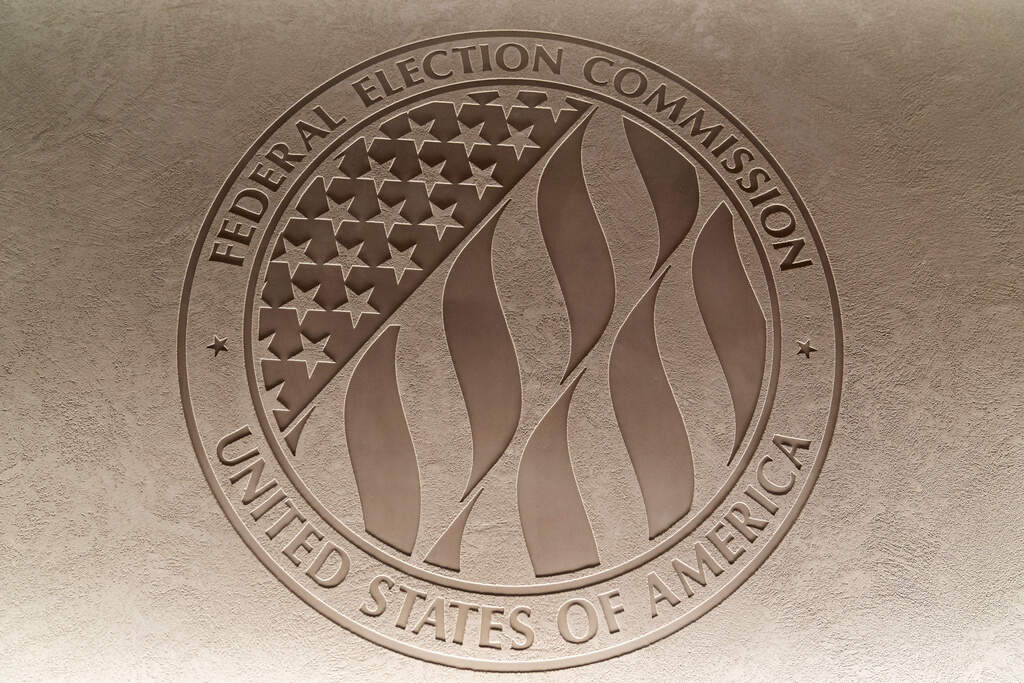
The Federal Elections Commission has issued rules that make coordination between campaigns and big donors legal and more direct. How's that shaping the 2024 election? We explore the connection between billionaires and the campaigns they're influencing.
Guest
Adav Noti, executive director of Campaign Legal Center.
Anna Massoglia, editorial and investigations manager at OpenSecrets.
Transcript
Part I
MEGHNA CHAKRABARTI: It's almost like an SNL skit that writes itself. Good natured swing state voter arrives home after a day's work. Beautiful sunset, kids playing baseball in the street, neighbor waves while mowing the lawn. Then, things turn dark. As the voter slowly drives up to her mailbox, something's wrong. The mailbox is bulging. Bursting at the seams.
Violent screech. Children's faces frozen in horror. The voter reaches out to open the mailbox. It's in slow mo now. And the mailbox pukes a tidal wave of political campaign mailers all over the voter's car. The closing shot? Her hand reaching up out of the heap. All she wanted to do was open the garage door.
Okay, I couldn't help it. Get a little punchy here at the end of this election season, having some fun, but art tends to imitate life, right? And swing state voters, we hear you.
LISTENER #1: I left my mail alone for two days. And in two days alone, I've got 12 pieces of garbage mail, these big sheets of paper that could have been used for something else.
LISTENER #2: I'm just annoyed at this point.
LISTENER #3: Of course, there is no shortage of political ads this season. Thankfully, there's a recycling bin right next to my mailbox.
CHAKRABARTI: This is On Point, I'm Meghna Chakrabarti, and mailboxes are being stuffed, perhaps more than ever, this campaign season. On Point listener Emily Van Valkenburg in Michigan describes what her daily life is like.
EMILY VAN VALKENBURG: I can tell you that the multiple texts and phone calls coming through every day are definitely being ignored. As are all of the flyers that are in the mailbox every day. They don't even make it into our house because I check the mailbox, put them in the recycling bin before I ever go in. My husband and I were talking about this the other day.
Both of us said we don't understand why they send so much of this stuff, because it doesn't really influence anybody. And you can't trust any of it to have accurate information anyway. So we get our information about candidates from elsewhere and all that political information that's sent to us by candidates goes right in the recycling bin.
CHAKRABARTI: It turns out there is a reason for the higher than usual number of political mailers this year. It has to do with money. No surprise there. We should always follow the money. But it also has to do with a wonky and little-known recent guidance issued by the Federal Elections Commission. And that guidance gives us a window into just how much legal coordination is now allowed between PACs and super PACs, often funded by just one or two billionaires, and presidential political campaigns.
Well, Adav Noti joins us now. He's executive director of the Campaign Legal Center, which works to tighten, works, I should say, to tighten campaign finance laws. And he's with us from Washington. Adav, welcome.
ADAV NOTI: Thanks for having me.
CHAKRABARTI: So my interest in this FEC guidance was peaked a couple of weeks ago, when I saw this tweet obviously on X slash Twitter from Hugo Lowell, who's a politics reporter for the Guardian.
And he had been looking at a recent, at September FEC filing, and he found this, he said, Elon Musk donated $75 million to AMERICA PAC, which is doing the bulk of the Trump campaign's ground game work across battleground states. Musk donated $15 million in July, $30 million in August, and $30 million in September, per FEC filings.
Notably, he's the PAC's only donor. Okay, billionaires putting a lot of money into campaign, into political cycle, no big deal there. But the words, doing the bulk of the Trump campaign's ground game work, really caught a lot of people's attention, because a lot of the replies were like, how is this even legal?
Adav, how is that even legal?
NOTI: Yeah, it's a continuation of, unfortunately, a long term trend that we've seen over several election cycles now where super PACs are able to take on more and more of what used to be traditional campaign activity that the candidates themselves actually ran. And the reason that is increasingly outsourced to super PACs is because the Federal Election Commission has steadily but surely eroded the rules and laws that are supposed to be prohibiting coordination between candidates and the super PACs that support them.
CHAKRABARTI: So this particular rule was issued, or guidance, I should say, was issued in March of this year and FEC responded to a request on behalf of Texas Majority PAC or TMP. And what exactly did the FEC issue as its guidance. How much coordination did they say can happen between a campaign and a PAC?
So the FEC ruled that although it is illegal for campaigns and super PACs to coordinate their activity or their spending, that prohibition doesn't apply to the canvassing activities, which is a pretty vague term. It can include going door to door, but it can also include things like direct mail and other activities that are intended to get people out to vote.
It's a massive category of activity that until this year was always viewed as something that the campaigns had to do themselves. Super PACs couldn't do it for the campaigns and the FEC shocked everybody by saying, Oh, actually, no, the coordination rules don't reach that sort of activity.
CHAKRABARTI: Now, before we get into more detail about why previously that kind of coordination was seen as a no, I do want to note that Texas Majority PAC is a Texas PAC, and the Texas Tribune in January reported on it. And it is a Democratic political action committee funded by George Soros. It had been keeping a pretty low profile in 2023.
But this year started spending a lot of money in in its efforts to turn Texas blue. So the idea that campaign coordination between PACs and campaigns is just something that one party wants to do is foolish, right? It seems like any campaign, Democratic or Republican, that can have greater coordination between its biggest donors and its ground games is something that they would take advantage of.
NOTI: And it's not at all uncommon in this area for one party or the other to pioneer a new way of getting big money into a campaign. And then for the other party to say, Oh if that's legal, then we want to do that, too. That happens a lot. And it's exactly what happened here.
Was, oh, sorry. Go ahead.
CHAKRABARTI: No. I'll let you finish your thought. Go ahead.
NOTI: Yeah, it was a democratic aligned super PAC that started this, that went to the FEC and got permission to do it. And then once the FEC issued that ruling, it was the Trump campaign that really jumped on it and said, we're a little low on money.
Our ground game isn't very well built up. So why don't we just let the super PACs handle that? And they were quite open about that. That structure and that strategy, and that's how it's been playing out for the last six months.
CHAKRABARTI: Okay, so let me ask you though, to get greater clarity, this has to do with a category of campaign outreach called public communications.
How are those public communications generally defined?
NOTI: Generally, and what would make sense intuitively just based on the term, is that it's illegal for a campaign and a super PAC to coordinate with regard to any activity that involves communicating to the public and that's a public communication. And there's a long legal definition of that term, but it's basically a list of everything that campaigns do, obviously, advertising and that sort of communication, but also if you're trying to get somebody to turn out to vote or to register to vote, those are communications also.
And historically, public communications were understood as communications that were public.
CHAKRABARTI: But the FEC guidance, the guidance letter says right in the second paragraph, I know you've read it, but just for the sake of listeners, it says, 'The commission concludes that canvassing literature and scripts are not public communications. And as a result, are not coordinated communications under FEC regulations.'
I don't know how that can be. How can that be?
NOTI: It can't, it doesn't make sense and it's not legally or even linguistically coherent. What's happening at the FEC is that for a long time, for a long time the FEC was just a non-functional body. It just did not do anything. Basically, it didn't enforce the law. It didn't interpret the law. And that was the way the FEC was for a good 12 years or so. But starting about two years ago, with some changes in who the members of the FEC are. And it's a six-member body with a majority needed to take any action. There were some changes, and now there are four out of the six commissioners on the FEC who, as a matter of ideology, do not believe in the enforcement or strengthening of campaign finance law.
It's just something that they believe should not be strengthened or be enforced. And so we've gone from an era where the FEC did nothing, to an era where the FEC is affirmatively reaching out to undermine or gut the rules that keep money and special interests from having undue influence in elections.
CHAKRABARTI: And the thing about this guidance in particular is the FEC says quite plainly, we know you're going to coordinate with the campaigns, right? It says, TMP or the Texas Majority PAC will consult with federal candidates, party committees, and their agents on the canvassing program. TMP anticipates it will come into possession of non-public plans, projects, activities, or the needs of candidates or political parties, and will engage in substantial discussion as defined in commission regulations.
They're completely okay with this.
NOTI: Right. The FEC was asked, is it okay for campaigns and super PACs to coordinate fully and openly on this sort of activity, these sorts of communications. And the FEC, I think much to the surprise of everybody who's worked in campaigns for the last few decades when this was not seen as legal, signed off on it and it's had significant effects.
Part II
CHAKRABARTI: Today we are following the money in politics, and a lot of that leads right to the Federal Elections Commission and recent sets of guidance or decisions that the FEC declined to take that have laid the groundwork for more coordination, legal coordination, between billionaire funded PACs and presidential political campaigns.
I'm joined today by Adav Noti. He's executive director of the Campaign Legal Center that works to tighten campaign finance laws. And we will hear in a moment from a member of the FEC. But Adav, before we do that, can you just remind us, let's do a little civics lesson here. What was the prior thinking that led to the commonsense notion that collaboration or coordination, I should say, between political action committees and campaigns was a bad thing for American elections, right?
NOTI: So the whole premise of a super PAC, the whole reason that they are allowed to exist by the courts, which really created super PACs, was that they are supposed to be completely independent, 100% independent of any candidates. And the theory is that if you are operating or spending money without any coordination whatsoever with the candidate, then that is less likely to buy influence over the candidate if they ultimately win.
Whereas if you allow coordination, if you have a group like a super PAC that's funded by a few super wealthy people or corporations or special interests, then they spend a whole bunch of money in coordination with that candidate to help the candidate get elected. Then when that candidate gets into office, they're going to be very grateful to the people who funded that super PAC and they will put the interest of those funders ahead of the interest of their own constituents. And that's why we don't allow, that's why we have limits on how much any person can give to a candidate, can give to a campaign.
And that's why we don't allow coordination between campaigns and groups like super PACs that are funded by these wealthy folks without limits.
CHAKRABARTI: So let's get back just quickly to the Elon Musk example, because as I said earlier, that AMERICA PAC, he's donated $75 million to it, which is doing much of the ground game work for the Trump campaign.
And obviously, there's not even a pretense anymore of independence, right? Elon Musk has been on stage standing right next to Donald Trump. He's constantly using X slash Twitter to advance the Trump campaign. It seems like we're long past the idea that independence and PACs is important for American democracy, but this ruling in particular flyers and mailers not qualifying as public communications.
You had said a little bit earlier that it's had an impact on this election cycle, and I didn't ask you to elaborate, but go ahead and elaborate now. What is that impact?
NOTI: Sure. So the campaigns, and particularly the Trump campaign jumped all over this the second that the FEC tore down this wall between campaigns and super PACs.
And the Trump campaign at the time was a little low on money. It had not really built up the same sort of ground infrastructure in key states that the Biden and then Harris campaign had. And so this FEC ruling really gave the Trump campaign a lifeline in that sense. To allow outside groups, meaning mostly super PACs, but also dark money groups and others, to come in and fulfill that role of building up the ground game that the campaign couldn't itself afford to do.
And that is exactly what has happened. And Musk is very public about this, right? He's on stage and he seems to be enjoying the attention. That's unusual. It's most of these funders, these wealthy funders or corporations, they go to great lengths to keep their identities out of the limelight.
But the fact of that funding is unfortunately not unusual. There are quite a few of these organizations and super PACs out there that are funded by one or two billionaires or corporations that are fulfilling these campaign functions.
CHAKRABARTI: Wow. Okay. Adav, hang on for just a second here, because we actually spoke with a current member of the Federal Elections Commission.
And by the way, the ruling that we're talking about, or the guidance, I should call it. I'll call it its formal name, Advisory Opinion. It's Advisory Opinion 24-1, dated March 20th, 2024. But Ellen Weintraub is a commissioner currently on the FEC and a longtime political lawyer before that. And she actually describes herself as not a fan of the ruling, and disagrees with what her fellow commissioners have approved. She calls herself a dissenter of that opinion. But she did speak to us to identify the rationale she sees behind the ruling made by the FEC. She says campaigns and candidates cannot collaborate directly on what's known as public communication. We talked about that a minute or two ago. That term legally means communications that are substantially similar and are communicated to 500 people or more.
Now, previously, public communication by a campaign could not be coordinated with the candidate. Yet, this ruling, as we've talked about, in March, says that canvassing materials, mailers, and essentially most written materials for a political ground game no longer qualify as public communications.
ELLEN WEINTRAUB: In this instance, my colleagues decided that this kind of grassroots canvassing activity, even though people go out with scripts and they go out with literature, and it is those scripts and literature are substantially similar in every conversation. But my colleagues decided that it was, that was enough to make it, take it out of the realms of a public communication. And therefore If it's not, if it doesn't fall into the category of a public communication, it can't be a coordinated communication.
And therefore, it's not an in-kind contribution. And all of that is a very complicated way of saying that since it can't, by under law, be a coordinated communication. It leaves it open for people to do what, I think, by any other standard, by any common sense meaning of the word, sure looks like coordination.
CHAKRABARTI: As we mentioned earlier, Commissioner Weintraub says she is a dissenter of this opinion, and here's her issue with the ruling.
WEINTRAUB: So the candidates and the super PACs, these groups that are funded by unlimited contributions from very wealthy individuals, as well as from corporations and potentially labor organizations.
All of that money that could not normally go to fund the campaign is now being spent in a way that is coordinated directly in the colloquial sense with the campaign, and it's a huge benefit to the campaign, obviously, so I find that inconsistent with our other laws and rules, and a bad policy as far as I'm concerned.
CHAKRABARTI: And Commissioner Weintraub now opens the door to the real concern, that a ruling or guidance like this opens the gates to all kinds of political corruption that campaign finance law is intended to protect against.
WEINTRAUB: We have seen a small number of billionaires who give millions of dollars every cycle.
Some give tens of millions and a few give hundreds of millions of dollars every cycle. And that money is largely run through super PACs. It is sometimes, but not always, disclosed to the public, depending on how they decide to give their money. Sometimes they route it through other organizations in order to avoid disclosure.
And those individuals obviously have huge influence. So I don't think it can fairly be said that there's no possible corruption, when you have billionaires giving millions of dollars, hundreds of millions of dollars, sometimes, directly in consultation with the candidates. And the candidates know exactly to whom they are indebted in order to get their message out through this medium.
I find this all very problematic.
CHAKRABARTI: Commissioner Weintraub believes the FEC ruling sets a precedent that future campaigns will cite in order to loosen other regulations against PAC and campaign collaboration. In order to prevent that, she says, the FEC would likely need to issue its own new ruling repealing this particular guidance.
WEINTRAUB: The odds that this same group of commissioners is going to suddenly say, Oh, nevermind, we changed our mind, and it would take four commissioners to overrule it. That doesn't seem very likely.
CHAKRABARTI: Once again, that's Ellen Weintraub, currently a commissioner on the Federal Elections Commission. Adav, hang on here for just a minute because this is a perfect opportunity for me to bring in another voice into this conversation.
Anna Massoglia is editorial and investigations manager at OpenSecrets, an organization that works to document and explain where and how money influences American politics. Anna, welcome to you.
ANNA MASSOGLIA: Thank you for having me.
CHAKRABARTI: Okay. First of all, give us a picture of how much money, how would you describe the amount of money that we're talking about here that's being used by PACs and super PACs to aid campaigns this time around?
MASSOGLIA: We're seeing billions of dollars pouring into the 2024 election cycle. We're setting new records for the sheer amount of money that is flowing in. We're on track to reach a new record. Even when adjusted for inflation. At this point, we've seen more than $3.7 billion just through groups like super PACs and other outside groups that are technically not supposed to be coordinating with campaigns.
But there are many ways these groups are working around those types of restrictions.
CHAKRABARTI: Okay, so talk about some of the other ways then.
MASSOGLIA: We're seeing candidates themselves attending events alongside super PACs. We're seeing activities like Red-boxing, where campaigns can effectively put instructions publicly on their website, put a red box around them, and effectively tell a super PAC what activities to engage in, provide them with b roll footage of the candidate. Basically providing all of the ingredients that group would need to create an effective advertisement, target that advertisement, and further what the campaign's needs are.
And because they are putting it publicly available, that is one of the different loopholes that we're seeing exploited. While they are not supposed to be coordinating, there is communication between these different individuals, as seen by candidates being special guests at the super PAC events, there's just so many different ways that they are engaging in these behaviors. That while technically might not trigger coordination, might not fit the letter of the book they are still engaging in these behaviors, and the FEC has not done much to rein this in.
CHAKRABARTI: You heard Adav earlier say the FEC is, in his opinion, has basically been a non entity for a while.
MASSOGLIA: For a while, the FEC did not even have enough commissioners for a quorum, which meant that they couldn't even vote on most meaningful enforcement action. Now that they do have enough commissioners to vote, the FEC is chronically deadlocked on even the most basic issues, of failing to agree on whether to even investigate certain issues, much less actually engage in more meaningful action.
You just reminded me of the fact that they didn't even have enough commissioners for a quorum for a while. I had forgotten about that. How long did that last? Anna, do you happen to remember?
MASSOGLIA: Years, if I'm not mistaken. At the very least, months, if not years.
CHAKRABARTI: Okay, Adav, do you remember that?
Cause I can look it up, but I just want to know if you guys know. Yeah, it's happened three different times. And once for a few months, and the other two times for over a year.
CHAKRABARTI: Wow. Okay. Now, Anna this record amount of spending, OpenSecrets has been tracking the money. And just again, put some more finer details on it.
OpenSecrets has found that in the last decade, the 10 most generous donors and their spouses have put what? $1.2 billion into federal elections?
MASSOGLIA: Yes, we're seeing huge sums of money coming from a very small pool of megadonors, that are accounting for a large chunk of the election related money that's pouring into these super PACs.
Unlike traditional campaign committees, super PACs can take unlimited sums from individuals. There's no contribution limits. They can take money from corporations and from dark money groups that don't even disclose their donors. And so we're seeing just huge sums of money going in. While we do also see an increase, to some extent, in grassroots donations from small donors, using platforms like ActBlue and WinRed Mega donors are not going anywhere where we're seeing hundreds of millions of dollars coming in from just a very small pool of donors.
CHAKRABARTI: Wow, okay, but on the side of corporations though, I'm a little confused because it seems like they're still putting a lot of money, but not as much, or proportionally as much as these individual mega donors?
MASSOGLIA: It depends on the corporation, but by and large, corporations tend to hedge their bets more than individual donors tend to, in many cases, at least, play both sides, giving to candidates on both sides of the aisle, either giving to super PACs supporting them directly or through corporate PACs giving to the candidates, but by and large, the biggest of the big mega donors are these wealthy billionaires who either have ideological interests or business interests.
CHAKRABARTI: Okay. Adav, now just for clarity's sake, because I know a lot of listeners are probably yelling at their phones if they're listening to the podcast or their radio right now, about Citizens United. Does this all date back to that Supreme Court ruling?
NOTI: More or less. Some of these areas predate the Supreme Court's ruling in Citizens United, but that was really the sea change. That was the moment when the Supreme Court said you can create this entire outside infrastructure, which we now call super PACs. And as long as it stays independent of campaigns, we're going to allow that with unlimited money, corporate money, all these things that were illegal for 100 years, to come into the federal election system. And the Supreme Court allowed that in 2010 in the Citizens United case.
CHAKRABARTI: Anna, let's go back to some of those loopholes and how these groups are using them in FEC regulation. We talked a lot about Elon Musk and his PAC funding the ground game for the Trump campaign. On the Democratic side, one of the biggest PACs is one called Future Forward PAC. It's the main group that's supporting the Harris campaign.
But it's really hard to track who's been putting money in there, for what reason? Can you walk us through that?
MASSOGLIA: Sure, while super PACs are legally required to disclose their donors to the Federal Election Commission, one of the big issues with transparency is they can just report a dark money group giving to them.
When I talk about dark money here, it is money from undisclosed sources to influence political outcomes. In many cases, these are either shell companies like a type of LLC, or in some cases, 501(c)(4) nonprofits that are not supposed to be existing for political purposes, but due to lax regulations on the IRS and FEC side, can spend unlimited sums on U.S. elections. One of the ways that they do that is giving money to super PACs that then spend on elections. And so when a super PAC gets money from a dark money group like a 501(c)(4), instead of reporting the ultimate source of funding. Whether it's a billionaire, a corporation, or even a foreign interest, potentially, they are just reporting these 501(c)(4) nonprofit names.
In the case of Future Forward, we have a particularly egregious case, because you have Future Forward PAC or FF PAC getting money from Future Forward USA Action. And the similarities between the name might strike people that is not a coincidence. These are groups run by many of the same operatives. And the biggest difference is that Future Forward just does not disclose its donors.
Part III
CHAKRABARTI: Adav, you had mentioned earlier that the ruling that we started off this conversation with about public communications, that's just the latest in many actions or lack of actions by the FEC that give you pause.
Let's go back to some of the others. For example, in 2020, there was something regarding the Trump campaign paying into contracting groups where expenditures made by those groups couldn't be traced. Can you talk about that a bit?
NOTI: Sure. And this is, again, part of the trend where every election we see more and more activity that used to be illegal.
Everybody thought it was illegal. And then the FEC doesn't enforce the law. So campaigns decide, I guess it's legal now. And so the development in the 2020 election was that the Trump campaign came up with this idea of they wanted to hide not the money that was coming into the campaign necessarily.
They wanted to hide where they were spending their money, which under federal law needs to be publicly disclosed. Basically every dollar that a campaign spends needs to be publicly disclosed. And what they did was they created a shell company, and they paid $750 million dollars, three quarters of a billion dollars into that shell company, which then dispersed the money on behalf of the campaign.
And all the campaign disclosed publicly was that it had paid $750 million to the shell company. And to this day, we don't know where most of that money went. Some of it eventually got tracked down by some great journalism. Turned out some of it had gone to the president's, children's spouses and significant others.
Some of it went to campaign folks who publicly had been fired, but it turned out were still on the payroll. But the vast majority of it we still don't know where it went.
CHAKRABARTI: And there's a lawsuit currently in place about this?
NOTI: So we, the Campaign Legal Center filed a complaint with the FEC over this non disclosure, which was pretty flagrantly illegal.
The FEC, as it usually does, failed to act and enforce the law. And so Campaign Legal Center has sued the FEC, challenging its failure to enforce the law, as to this spending that was never publicly disclosed. And more generally, to try to get a court to force the FEC to enforce the law that says that campaign spending needs to be publicly disclosed.
CHAKRABARTI: Now if the FEC had enforced this law, what would the actions that it would have taken? Would it just force the disclosure and that's it?
MASSOGLIA: No, I think there would have been a significant penalty, a monetary penalty. Usually in these sorts of matters, yes, you have to disclose the activity, but also there's a fine, and that fine is commensurate with the amount of the illegal spending.
$750 million is the biggest campaign finance violation in American history. So I think it actually would have been quite a significant penalty. Certainly, you know, in the millions of dollars if the FEC had enforced.
CHAKRABARTI: And I want to hear your thoughts on this particular. I mean you called it a loophole earlier. This is not just even a loophole, but it's a loophole along with a complete lack of enforcement.
MASSOGLIA: Exactly, where we're seeing money not disclosed, going into different political groups. But also going out, is something that deserves more scrutiny, is also a growing issue where we are seeing campaigns steering funds to different consulting firms and firms that don't really have much of an online presence.
And we don't really know where this money's going. In some cases, it could be going to pay lawyers that either don't want to be affiliated with a certain candidate, or where a candidate doesn't want to be affiliated with them. It can be going to pay people under the table, could be going to pay family members.
And there's just so much that we don't know about this and how different political groups are using donors' money.
CHAKRABARTI: Now, Adav, is it safe to say that until there is some kind of legal judgment in the case that Campaign Legal Center has brought, that even though the suit is specifically against what the Trump campaign did in 2020, that are Democratic campaigns doing this for as long as that loophole is still open?
NOTI: Yes, this is always the pattern. Somebody pushes the envelope and gets away with it, because the FEC doesn't enforce the law. And then other campaigns or PACs or other spenders in elections say then we're going to do that too. And yes, Since the Trump campaign pioneered this method of hiding spending, we've seen it adopted, to greater or lesser extent, not as much as the Trump campaign did, on both sides of the aisle.
CHAKRABARTI: Okay, so I want to look at the perhaps boring nuts and bolts about the FEC itself, because by law, right, we talked about this a little bit earlier. First of all, you need at least four votes required for any official commission action. And for a while, there wasn't even that quorum, as you said.
No more than three commissioners can represent the same political party. So an attempt at equanimity there, let's put it that way, for this ostensibly independent regulatory agency. The commissioners are also all still appointed by the president and confirmed by the Senate. So Anna, that is conventionally how things are supposed to work in the United States.
But given the billion dollar, multi-billion-dollar price tag of campaigns these days, especially presidential campaigns, is there not, have we not reached a point where there's a conflict of interest, because the very presidents naming these commissioners are, some of them are going to be running again in another campaign? And wouldn't they, is it outlandish to ask that there's now the possibility of wanting to appoint commissioners that would make it easier for campaigns to do what they want to do in the face of federal election law?
MASSOGLIA: It certainly raises questions, since we are already seeing the FEC not taking action on really important issues. And so being able to, hopefully, in an ideal world, we would see these commissioners either stepping back or at least taking into consideration their own biases, as they are making these decisions.
I think that there's a reason that they're being appointed, assuming that we trust in this process. But certainly, I think that it can raise questions about different conflicts of interest.
CHAKRABARTI: Okay, I'm still quite intrigued by the multiple examples of FEC ruling that have had a really strong impact on how voters are experiencing these campaigns.
There's another one from 2023, so just last year, where the FEC rules, it ruled it will not require disclosures regarding money paid to social media influencers. Adav, do you know about that?
NOTI: Yes, the FEC was asked to clarify how some of its rules about advertising disclosures apply to various kinds of social media activity, and other activity, that the rules are quite old.
They were written before social media was really a hotbed of political activity. So the question was, how could the FEC update its rules to account for that activity? And as usual, what they did was pretty halfhearted. Essentially, they said, yes, social media to the extent that you buy an ad on social media, that requires disclosure of who paid for the ad, but basically anything else the FEC said, we're not going to require disclosure.
So for influencers in particular, which was a real source of focus, and a lot of effort was spent to try to get the FEC to require disclosure of influencers who were being paid by campaigns. The FEC said, no that's not a traditional paid ad. And so we're just gonna let that go.
CHAKRABARTI: And I'm seeing here that with that social media influencers' decision, people who supported the FEC not putting guidance on that use of money were saying it's a win for free speech. Which of course, harkens back to Citizens United. Because that was like the fundamental argument that spending money on campaigns is a form of speech.
Do you hold any water for that argument? That we're in an era where we're seeing more and more successful arguments being made on speech grounds that are unwinding even the existing federal elections rules, or campaign finance rules that we have in place?
MASSOGLIA: As we see more and more money and new activities through online media.
In particular, it is posed so many different issues that the Federal Election Commission is still grappling with. We are still seeing a lack of parity to some extent with online advertisements, even basic online advertisements, by groups like dark money groups that avoid expressly advocating for or against a candidate.
And you can go pretty far without saying the words vote for, vote against, or the equivalent. While many of these ads do require disclaimers, so at least saying, this ad was paid for by this group, in many cases the spending doesn't need to be disclosed. And enforcing the disclaimer rules, the disclosure rules, becomes really difficult. Because there's so many different channels through which online media is engaging in political conversations.
Whether that's the release, more traditional ads, through payments to influencers, which it also raises that sub vendor issue that came up earlier, where you aren't even seeing the payments to influencers being reported in federal Election Commission filings. Many times, because they are going through a firm and sometimes many layers of different firms before reaching that influencer.
And so we're, I think that there is a struggle to address these issues, that, in many cases, people are still struggling to understand. There is a lack of disclosure around who is paying for these different messages to go out. And people may look to influencers that they follow as an authority on these issues.
They may be more inclined to believe them than they would messaging directly to them from a candidate. And so it's really important to know when a financial incentive is put in place for an influencer to be more favorable or disfavorable to a candidate or issue.
CHAKRABARTI: So I'm seeing here, Anna, that OpenSecrets has been going through, obviously, every quarterly report from the FEC.
And in one of the recent reports, you found something like three donors, just three donors accounted for a quarter of contributions to all of the groups supporting the Trump campaign. Is that right?
MASSOGLIA: That's correct. We're seeing, and that's not just the Trump campaign, just to clarify, is also including outside groups supporting Trump.
The Trump campaign is limited in how much it can take from each individual donor, to a few thousand dollars. But when it comes to these outside groups supporting Trump, like Make America Great Again Inc., like AMERICA PAC, these billionaire donors are pouring tens of millions and in some cases hundreds of millions of dollars to support this candidacy.
On the left, it's much harder to track, because you have the main super PAC supporting Harris funded in no small part by a dark, by the affiliated dark money group, so you don't necessarily even know who some of the big donors are behind that.
CHAKRABARTI: So they're using that extra layer to further obfuscate where the money's coming from.
Okay, Adav, I have a question for you. Obviously, legal action is one way to try to claw back some of the purpose and strength of campaign finance law, and I know that's exactly what the Campaign Legal Center does. But in terms of the way that this money is changing the shape and health of our elections and democracy, if I were to present to people the following story, that billionaire donates directly to a campaign or to campaign supporting groups, they coordinate in order to help get that candidate elected. And then candidate says, I want to put this billionaire in government, in order to have some kind of role on the economy, for example. Anywhere else in the world, we would say that's an example of corruption. But of course, that's exactly what's happening here, right?
Because Donald Trump has said recently that he would love to have Elon Musk in government to help cut the deficit. Are we at a place in the United States where we can't even call it corruption anymore, because these things, as we've been talking about, are legal.
NOTI: People see with their own eyes the corruptive effect in real time.
And again, with Elon Musk, it's particularly public right now. But this sort of thing happens behind the scenes all the time. The sorts of conflicts that Anna was talking about in terms of who is on the FEC, who is making these decisions. It's even worse than that.
These decisions are being made by the very congressional leaders who are regulated by this entity. So systemically, we have a real problem and it's manifesting in things like paying millions of dollars to get a government position, and we need to change structurally how we're making these decisions.
This program aired on October 29, 2024.