Support WBUR
How to get Americans excited about voting again
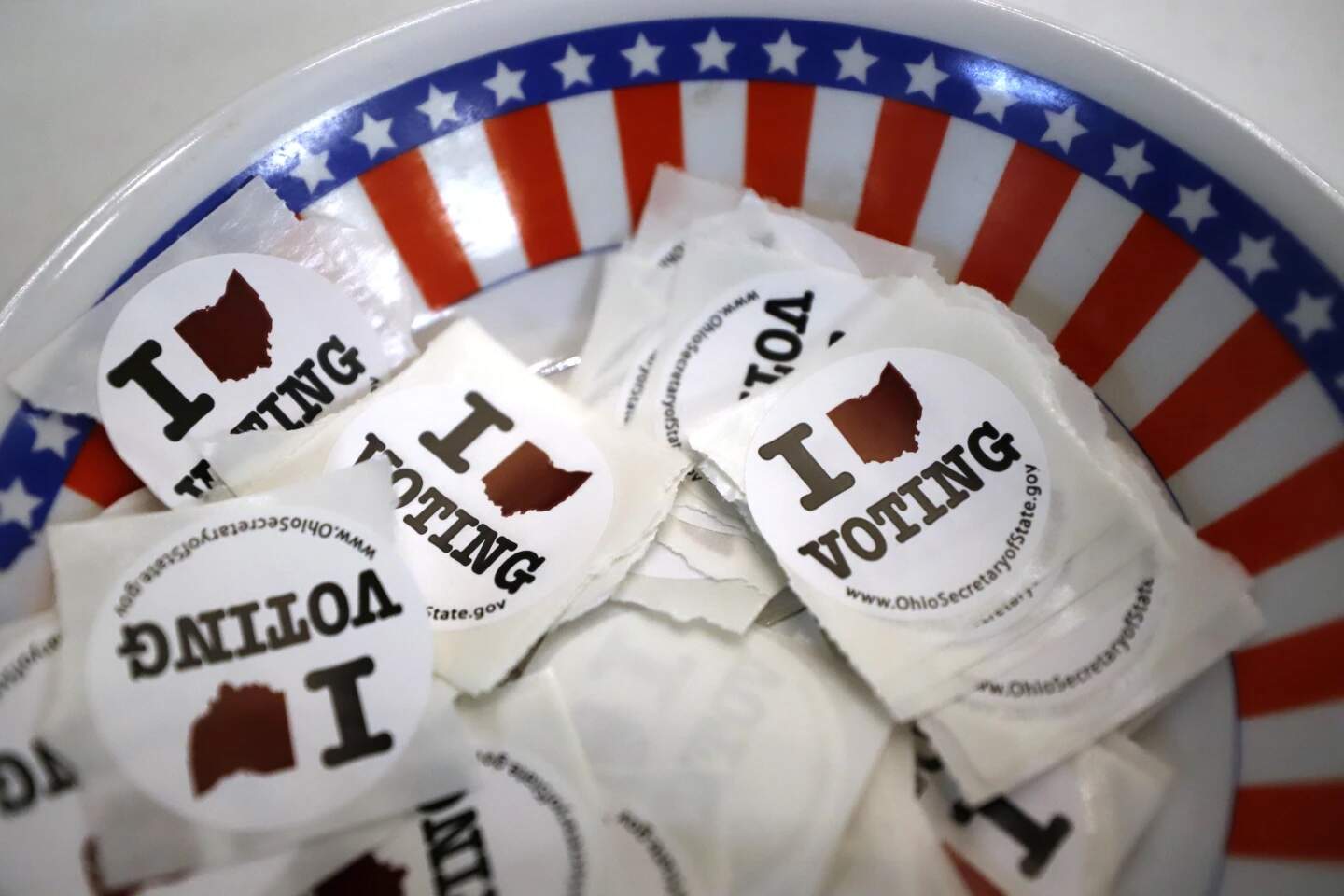
Millions of voters who turned out in 2020 didn't show up this year. Why they stayed home or left the top of the ticket blank -- and how we might reinvigorate Americans' belief in voting.
Guests
Tom Bonier, CEO of the TARA Group and a Senior Advisor to TargetSmart which provides data analysis and polling for left-leaning candidates.
Lee Drutman, senior fellow at New America. He’s a political scientist specializing in political reform. Author of "Breaking the Two-Party Doom Loop: The Case for Multiparty Democracy in America" and "The Business of America is Lobbying."
Also Featured
Anthony Zarate, construction project manager.
Part I
MEGHNA CHAKRABARTI: So far, the presidential vote count is like this. President elect Donald Trump won the Electoral College 312 to 226 no question there. But when it comes to the popular vote, there's an interesting story unfolding. By the way, as a little sidebar, there's this general rule.
In radio journalism, that listeners cannot process lots of numbers via your ears. That definitely cues my bombastic side eye at antiquated assumptions about your intelligence. So let's prove them wrong. As of today, more than 97% of all votes cast in the U.S. have been counted. There are still about 5 million remaining to be tabulated.
So as of now, Donald Trump has 50.2% of the 2024 popular vote. That's 76.06 million votes. In 2020, he got 74.2 million. Okay, so from 74.2 million four years ago to 76.06 million this year. Meaning this year, he won only 1.86 million more votes than he got in the last cycle, or just 2% more. Now given the way the electoral college works, that was more than enough to tip the EC balance to him.
But I'll leave it up to you to decide whether a 2% popular vote improvement is actually the sweeping mandate that the president elect says it is. Over on the Democratic side, things are even more interesting. Vice President Kamala Harris has 73.12 million votes this year so far. Now compare that to the 81.28 million votes Joe Biden won in 2020.
That's an 8.16 million vote deficit for the Democrats. Overall, across the popular vote. That's roughly 6 million votes less across all Americans cast this year than in 2020 and it's that delta that's worthy of close analysis. And let me just stop you right away before we get any further, this is not going to be an hour about Elon Musk/Starlink stole the votes conspiracy theory that you may be seeing on social media. Absolutely not, there's zero evidence of that so far. Honestly, the truth is much more important.
(VOTER MONTAGE)
This is the first time I've ever left any portion of my ballot blank.
I didn't vote in the election this year. I couldn't get behind either of the two major candidates.
I did not vote for president. I did not vote for U.S. Senate.
I am fed up with voting for the least undesirable.
I am not afraid of another Donald Trump presidency, but can't vote for him because of his glaring character issues, I wasn't motivated by Kamala Harris either.
CHAKRABARTI: So that's Mike in Minnesota, Omar in California, Mia in Minnesota, Adele in New York, and Andrew in Washington State. Just a few of the many On Point listeners who told us they blanked the presidential election on their ballots. They did not show up to vote for the top of the ticket and guys, I have to admit I'm bummed about this, because at heart I am a do your civic duty purist.
But I wanted to hear why so many of you passed on your presidential choice. So here's another On Pointer.
ANTHONY: My name is Anthony and I am 33 years old and I live in Washington State. I work in the construction industry. I started as an electrician, so I've been doing that for about seven years and then I just moved into the business side of things.
I vote more on issues. I don't marry myself to my political ideologies. If someone's supporting something that is going to benefit me hugely and benefit the country in a big way that's going to be something that I want to see.
Voting for Trump would have been really, it goes against my union interests, but at the same time, he really took on a political role of the anti-establishment candidate, which was something I was used to hearing from the Democratic Party. I was hoping that Kamala Harris would stand out and take a stand on some kind of issue, just really didn't feel she was willing to put her neck out, and it just was a little bit disappointing.
I think that someone should be fighting for universal health care. And I don't know why that wasn't a platform that was ran on this time around more strongly. Abortion is an issue that I think is a basic health care right that the Democrats did not have an answer for the Supreme Court's ruling on abortion.
I didn't see anything happening with that and that would have been something that could have motivated me to go to the polls pretty easily. And I just didn't see a good response for that. I also wasn't worried about Trump on that issue, because he made it clear that he was not going to ever sign a national abortion ban.
It was just, he nominated a Republican Supreme Court nominee his last term, and that's what really got it overturned. My entire time that I have been trying to build a career and really establish upwards economic mobility, it always felt like I was taking two steps forward and one step back. I was making pretty good money.
In the union, and just every time I would feel like I was going to get ahead with the raise or maybe I worked extra overtime for a year. It just felt like everything, the economy, just caught right up behind me, snuck up behind me, and kept me in that same kind of position for year after year.
I fall into the pattern; I think a lot of other millennials with this kind of struggle. I didn't think either candidate had a great solution, and I don't even know what the solution would be.
CHAKRABARTI: That's Anthony Zarate, who listens to On Point in Washington State. And by the way, I thank Anthony and all of you On Point listeners who did tell us honestly and thoughtfully why you did not vote in this presidential election.
And we want to dig much deeper into that. So Tom Bonier joins us now. He's senior advisor to TargetSmart, a leading progressive data services and voter file firm. And he joins us from Washington. Hello there, Tom.
TOM BONIER: Hello. Okay.
CHAKRABARTI: So let's dig in here. First of all, in terms of understanding this many millions vote reduction over 2020, let me just ask you, is 2020 a good comparison, right?
Because people, there's an argument that 2020 was actually the outlier vote and maybe have we gone back to an average voter turnout this year in 2024?
BONIER: Yeah, so much of what we're gonna look at here, and so much of what you heard in Anthony's response, which was amazing, by the way, goes back to the pandemic and that we're still not out of it, at least from a political sense.
And that in 2020, over 158 million people voted in the presidential election. And it was a record by far, you go back to 2016, it was about 135 million. So it was a massive increase in turnout, for a lot of reasons. One of the biggest reasons was it was the biggest expansion in ballot access that we have seen in this country in generations.
Local, state, county election officials, very heroically, by the way, did the work to make it easier and safer for people to vote in a pandemic. Also, the stakes were perceived as very high. Generally, because of the pandemic, because of the Black Lives Matter movement, that was happening at the same time, as well, and various other factors.
And so you saw everything to coalesce to set this record for turnout in terms of number of Americans who voted in a presidential election. And then we go into this year where generally the consensus was prior to President Biden withdrawing from the race, that we were actually headed towards a fairly low turnout election, at least relatively speaking.
One of the reasons was some of the states that expanded voting access substantially actually made it a little bit more difficult to vote in the intervening four years. And that was certainly a huge factor. And then the other factor was that a lot of Americans just frankly weren't that excited about a rematch of the 2020 election.
CHAKRABARTI: So let me just jump here, Tom, because I'm very glad that you laid out what you did, especially the past two or three election cycles, I should say, because I'm a big believer in checking our own hypotheses when we launch into these shows. So just to lay it out clearly, what you said was, okay, so this year we had 150, so far 151.4 million votes cast. There will be several, that number will go up a little bit as the last 3% or so get counted here.
So 151 million this year. In 2020, 158 plus million, right? That was the really large turnout. 2016, 135 million. So in that case, should we just stop the show right now and stop and not panic about all the people who didn't vote in 2024, especially if we compare it to 2016?
BONIER: There's actually a lot to learn from this turnout differential. And, important point is, even though some of these states did make it a little bit harder to vote, some states actually went further and made it even easier. States like Michigan, where they expanded early voting and that sort of thing.
There is an important caveat in this discussion, though, in that we have this dichotomy that is emerging as all the votes are counted. Where when you look at the battleground states and everyone was obsessively focused on these seven states that were considered to be decisive, they were the ones who were going to decide.
And in the end, they were, and we know that Donald Trump won all of them. When you look at the turnout in those states in 2020, it was 15.4 million votes cast. This year it was 15.3 million. So it was a eight tenths of a percent drop within those states.
CHAKRABARTI: Identical for all intents and purposes.
BONIER: Yes.
CHAKRABARTI: Yeah.
BONIER: Yes. And so in the end, what that tells us, if we're going to do some simple math here, is that the drop off was overwhelmingly, if not exclusively outside of the states where the campaigns were contesting the election. And in fact, in four of those battleground states, North Carolina, Georgia, Nevada, in Wisconsin, they actually had more people vote this year than voted in 2020, which I certainly didn't predict.
I don't think many people did predict based on everything that we're talking about, but some of those states dropped slightly. But in the end, again, the biggest drops, really all of the drops who are seen were happening outside, where perhaps they were impacted by more of these bigger trends. I think you heard from Anthony and some of your other listeners.
In what they were experiencing.
Part II
CHAKRABARTI: Tom, let me just keep giving voice to some of the listeners who shared with us why they didn't cast a vote in the presidential race. This is a listener in Rancho Cucamonga, California.
And his issue was his deep displeasure with both candidates positions on Israel's treatment of Gaza. And he told us that neither campaign really showed to him that they cared about his community abroad.
VOTER: As a Muslim American, I felt like neither party really cared what happened to me or any of my family members who may be overseas.
That was a direct result of seeing the way American Palestinians were forgotten about while they were stuck in Gaza. And it was really a harsh reminder that at the end of the day, neither party really cared.
CHAKRABARTI: To add some context to what he's saying there, in October of last year, NPR reported that an estimated 600 U.S. citizens were trapped in Gaza following the October 7th attacks by Hamas and Israel's military response. By May of this year, the New York Times has reported that more than 1,800 American citizens and their families left Gaza with help from the State Department.
Okay, here's another one. This is Mike, who is a registered Democrat from Minnesota and for him, 2024 was the first year he ever left any part of his ballot blank.
Mike says the top of the ticket weighed down other races as well, the race for one of the states on his state's Senate seats, and he gave us three reasons for his decision.
MIKE: The first reason. It's the ongoing genocide in Gaza. The Harris campaign couldn't even pay it lip service. They completely ignored it.
It's grotesque. Second reason, Medicare for All. She ran on it in 2020. It is the most popular policy item across the political spectrum. If either party ran on it, they would win handily. No mention of Medicare for All at all. Number three, it was Dick Cheney. Dick Cheney is the biggest monster of my lifetime, and anything he is for, I am against.
And that's also why I did not vote for Amy Klobuchar. I left that one blank too, because she was bragging about how they had Dick Cheney's support, and the man is a monster.
CHAKRABARTI: That's Mike, a Democrat in Minnesota, and by the way, again, a little more context, on the campaign trail, Vice President Harris made some proposals about expanding Medicare coverage for home health care aides and expanding the Medicare drug pricing negotiation program that was created by the Inflation Reduction Act, but no real enthusiasm or even mention of Medicare for All, as Mike says.
Tom, So let me ask you, before we get back to the data driven deconstruction of these quote-unquote missing voters, have you ever seen voters blank the top of the ticket for these very deeply thought through single issue reasons before?
BONIER: It's not that common. No, generally you see the opposite, generally you'll see people will go out there, coming out specifically to vote in the presidential election.
And then some number of people will fall off at each level of the ballot as you go down the ballot. When you get to local level races, unfortunately, because I agree with you, in terms of the civic mind and nature of this, it could be as much of a third of voters not voting in their local races.
So it is unusual.
CHAKRABARTI: Okay. So going back to this finding so far that this massive drop off basically happened in all non battleground states, which is the vast majority of states in this country. Are there any other sort of deeper trends that you're seeing in where the drop off was occurring.
BONIER: Yeah, especially when you look at Democratic support, because I think that's the key element of this, is that Vice President Harris actually performed fairly well, but not well enough in the battlegrounds. But to the extent that you see that bigger drop off in Democratic votes, you mentioned that about 8 million vote drop off from President Biden to Vice President Harris.
The fact that came more outside of the battlegrounds. Tells us something about the sort of currents that the campaigns were operating within. I think people think that campaigns control every element of this. In the end, they're like a whitewater rafter going down a raging river. They can make small changes and shifts.
They can't change the current. And there has been this global current. That has been very hostile to incumbent parties. This is actually the first year since 1905, which is an era of democracy and participation beginning then, globally, where the incumbent party has lost a vote share in every single developed country that held an election this year.
It's never happened before. So if Vice President Harris were to win, her campaign would stand out as the only campaign that was able to buck that global trend, which is generally based on everything you're hearing about here. It's just a general discontent with the establishment, with incumbents. Obviously, inflation is a huge part of that, but there are other elements too.
So I think all of that was at play. And then you see vote shifting going on the same time. We've seen that these counties that are overwhelmingly Hispanic counties shifted significantly, in many cases, from President Biden in 2020 to Donald Trump in 2024. Again, likely driven by a lot of the same factors and issues, but when you have that vote shifting, it's not just people who weren't coming out.
It's people who voted Democratic last time and voted Republican this time. That was also an element of this, that drove that 8 million vote gap.
CHAKRABARTI: Okay, so let me ask one more question about if there's any sort of demographic pattern in that 8 million vote gap, beyond the vote shifting as you mentioned, let's say, in the Latino community.
Did we have more, I don't know, younger voters? Blanking the top of the ticket, women, men, is there any way, any further meaningful way to parse this 8 million?
BONIER: So it's early at this point because in the end we'll get individual vote history. It tells us if someone voted, to be clear, not for whom.
We'll get that in every state, but it takes time. In the states where we have that, and we have that in some key states like Georgia already, and there is a pattern that's beginning to emerge where the youth turnout, perhaps wasn't where we expected it to be. It wasn't where it was in 2020.
There's sign that they were either not turning out or blanking the top of the ticket. When we talk about gender, we actually in the states where we have it, we were seeing bigger gender gaps, which was something we expected post Dobbs. We expected to see more women voting. And again, it appears that was happening, especially through the battleground.
So the trends are a little bit contradictory, but again, I think the youth vote element of this. It's something that is likely to emerge as we get more of this data in, and certainly bears much more discussion.
CHAKRABARTI: Okay, Tom Bonier, stand by for just a second. Let's listen to another On Point voter. This is Adele Cook in Brooklyn, New York, and she tells us that she was so frustrated with both party candidates, with both Vice President Harris and Donald Trump, that she went the third party route.
She voted for Jill Stein. And Adele says she usually votes for Democrats, but is very sick, in her words, of voting for the least undesirable candidate.
ADELE: Nobody was asking people what they wanted or did not want. All we heard was just vote for her, vote for him, vote for me. And the media talked about those two candidates and poll numbers.
Democrats and Republicans are both serving big businesses, not people. And we are surprised millions refuse to vote for Democrats. By the way, Dr. Jill Stein took home or won nearly 750,000 votes nationwide. No Electoral College votes. Tom, I want to bring in Lee Drutman into the conversation now. He's a senior fellow at New America, a nonpartisan think tank that's focused on all sorts of things, policy, tech, education, and the economy.
He's author of Breaking the two party doom loop: The case for multi party democracy in America. Lee, it's great to have you back. Welcome back to On Point.
LEE DRUTMAN: Great to be with you.
CHAKRABARTI: I'm making you choke and cough already. You all right?
DRUTMAN: I'm all right. Okay. It's just listening to all these voters not voting.
That's causing us to choke a little bit.
CHAKRABARTI: Do you need, I'm happy to give you a second.
DRUTMAN: I'm good.
CHAKRABARTI: You're good. Okay. Okay.
DRUTMAN: Just coughing on the, trying to demonstrate the anxiety that many Americans are feeling in this moment.
CHAKRABARTI: Fair enough. There is a, usually in most places, there's a sneaky little cough button, by the way which I tend to use a lot myself.
I want to actually just get your, I want to get your perspective on this sort of reality check that I started off in my conversation with Tom, because I imagine that at this point in the show, there are still a lot of people saying as Tom Bonier has just laid out for us, this eight, for the Democrats, this eight million vote deficit happened in non battleground states.
So even if all those people showed up for President, Vice President Kamala Harris, given what the electoral college is, it wouldn't have made a bit of difference, right? So who really cares that those voters didn't show up? And maybe it's understandable that they did, because all campaign long, folks in those states are telling, are being told their vote actually doesn't really matter because we know how that state's going to go anyway, Lee.
DRUTMAN: Yeah, and that is a pretty dispiriting thing for the vast majority of Americans, to live in states and in congressional districts as well, where their vote doesn't matter because it's entirely safe for one party or the other party. And it's not surprising that overwhelming majorities of Americans feel like the system is broken.
They feel like they want more than two options. About 70% of Americans say we ought to have two options. More than a quarter of Americans dislike both parties, which is at a record high. There is just this deep frustration with how Democracy is working in America. And every four years, it seems like there's some group of voters who say, let's have change because things aren't working.
And then four years later, they say maybe we want a different change. And then four years later, they say no, not that change, another change. And it's very hard to maintain a political system when for almost two decades, you have two thirds, three quarters of Americans say the country is going in the wrong direction.
Democracy is not working. And yet we keep doing the same thing over and over again. The same two parties competing and the same zero sum politics of demonization and negativity. And it's no wonder that our democracy continues to degrade and decline.
CHAKRABARTI: That's that doom loop that you wrote that whole book about.
DRUTMAN: That is the doom loop.
CHAKRABARTI: I'm gonna get back to that in a second, Lee, but just to be really rigorous, in our conversation here. If the vast majority of the voter drop off, not if, Tom laid out the numbers very well, happened on the Democratic side, isn't it more precise to say that right now the frustration is with the Democratic Party? Because not enough people thought it was even worth showing up for their candidate.
DRUTMAN: So there is a definite frustration with the Democratic Party. But as Tom laid out, this is this year of our collective distemper 2024. People are just frustrated with incumbents everywhere.
So I think you can segment out the electorate that there's some percentage of voters who will always vote for the Democratic Party ticket, because that's just what they do. Some percentage of voters who will always vote for the Republican ticket, because that's just what they do. And then a much larger part of the electorate that probably stay home.
Maybe if they really feel motivated, they're going to vote against the party in power. But there is just a very large part of the American electorate that is just tired, just exhausted, wants something different. And there is also a large part of the American electorate that feels like the stakes are so existential, and if the other side wins, it's the end of the world, it's the end of democracy.
So there is both disengagement, and existential demonization. And I think that's a pretty bad combination for a democracy. I don't know about you, Meghna.
CHAKRABARTI: Oh you're preaching to the choir here. The whole point of this hour is to try and help think through or offer reasons why people should believe in the importance of their vote and be part of this system, battleground state or not.
Tom, let me go back to you. What do you think about what Lee's talking about, regarding this doom loop that it seems like American voters are in?
BONIER: Yeah. No I couldn't agree more. I think it's a feature, not a bug when it comes to how Donald Trump campaigns in a way in that you have this asymmetrical reaction. Where supporters of Donald Trump, the sort of negativity that he tends to put in the forefront of his campaigning, it seems to mobilize his supporters, but it seems to have a demobilizing effect for everyone else.
And again, it's impossible to parse that out from the anti-incumbency elements that we've been discussing and the extent that has demobilized people. But again, you look at the difference between the battleground states where, by all accounts, the Harris campaign spent over a billion dollars in about three months, which is not just unprecedented, it's unprecedented by a factor of many.
And the Trump campaign obviously had substantial resources as well, and the stakes were perceived as higher. You did have states that were exceeding those record turnout levels. Perhaps people weren't excited about it. Perhaps they didn't feel great about it, but they did come out to vote.
The question is when you get outside of that battleground, that significant reduction, and as you said, it was asymmetrical as well. It was more Democrats staying home, just not seeing their vote mattering. I think it was interesting what you heard from Anthony earlier, where he talked about that in the context of abortion rights, where he didn't see a connection between voting for one presidential candidate or the other, and the future of abortion rights, which I think is a failure of communication.
In a way.
CHAKRABARTI: Tom Bonier, Senior Advisor to TargetSmart, a leading progressive data services and voter file firm. Tom, thank you so much. Would love to have you back when we over time, get that more granular data about exactly what type of voters didn't show up. Would you do that for us?
BONIER: I'd love to.
CHAKRABARTI: Okay. So we'll have you back then. Thank you so much for joining us today. Lee, let me turn back to you here, because Tom has twice now referred back to our listener Anthony at the top of the show. And I think that's very savvy, because Anthony said a lot. And one of the things regarding abortion, where he was like, I can't, he knows that there's a difference, but he didn't think that the Democrats provided a serious enough or detailed enough plan on how they would change the Supreme Court or protect abortion rights across the country.
I'm going to make a lot of listeners mad, and I'm sorry in advance, folks, but are voters a little spoiled? I don't know how much detail do they expect to hear from candidates, that does it have to exactly align with the perfect plan that the voter has in their mind before they feel they are adequately spoken to?
By candidates? Lee, when folks say no one spoke to me or spoke to my issues, I don't actually know what people mean sometimes, because there's a lot of talk in every campaign these days, in the times we're living in.
DRUTMAN: Yeah, I don't know what people mean either, and they're probably getting a very different media diet than you or me, or probably many of the listeners of this show are getting.
Often you have a lot of voters who are just not particularly engaged in following politics, and they're not hearing things, because they're not actually listening for them, or they're trying to justify how they feel with some reason when they are asked to give an answer.
CHAKRABARTI: Or to be generous or fair, as you said earlier, maybe they don't feel like it's worth listening because they feel like their vote doesn't matter anyway.
It's the same two parties always. When we come back, I want to look forward and say, OK, what can we do to break this doom loop. So that's in a moment.
Part III
This is 60 year old Andrew Mullen. He lives in St. Petersburg, Florida. He takes care of his 99 year old mother. And Andrew tells us that he voted a straight Democratic ticket, except for president. And for that race, he chose not to vote. And Andrew says that he was dissuaded from voting for Vice President Harris by reports of illegal border crossing and related crime.
ANDREW: I would have voted for her if they had more detailed plan addressing cartels and the migration, stopping the border, illegal border crossing and expanding the legal entry. I definitely would have voted for, but it just seemed to be a non event really. They were focused more on the women's rights, which I believe in also, but that seemed to be the keynote of their campaign.
That's Andrew Mullen, who listens to On Point in St. Petersburg, Florida.
CHAKRABARTI: Lee, we're going to talk more about what path having more viable parties might help the country down, but would even more parties solve this fundamental problem that so many voters were telling us, that they just didn't like how any party or the party they usually vote for stood on certain issues?
DRUTMAN: There was certainly a lot of frustration among a lot of long time Democratic voters with direction the country was going in and so I think it's important to distinguish this particular election and the sort of anti incumbency collective distemper with the larger trajectory of American democracy.
And the story over two decades, put this election aside, has been that growing number of Americans are choosing to identify as independent. When asked, do you identify as a Democrat, Republican or independent? That number is pushing 50 percent consistently. 60, 70 percent of Americans say we ought to have more than two parties for two decades.
People have, overwhelmingly, this country is going in the wrong direction. Democracy is going in the wrong direction. So there are a lot of reasons that people give in an election for how they vote. But the broader sweep of the last several decades has been increasing frustration with how American democracy is working, increasing dislike and distrust of the two major parties.
And increasing hyper partisan polarization, existential stakes, dehumanization of political enemies, and this ratcheting doom loop of political hardball. And, as Tom mentioned, certainly Trump is a conflict entrepreneur. He loves creating conflict. And that is the strategy of authoritarians around the world, is the polarizing strategy.
You draw people into this conflict and say, either you're with us or you're against us. And that is how our politics feels in this moment, is either you're with us or you're against us. And that is not a way to run a democracy, because democracy, fundamentally, it depends on mutual toleration and forbearance.
These are the master norms, and these master norms are eroding. So it's no wonder that majorities of Americans feel that our democracy is backsliding and at risk.
CHAKRABARTI: You mentioned independent identification. And I wanted to say that there's a lot of listeners, or at least some listeners, who told us they are independent voters and they feel like they are by virtue of the parties having such a lock on how the campaigns are run, that they feel like they just simply don't get attention from candidates because they don't have a party allegiance.
Is that, is there a meaningful number of folks like that, that are being ignored?
DRUtman: There are a lot of independents. They are all over the political map. But I do think if we had more political parties we would have more voters who feel like there's a party that represents them.
Both the Democratic Party and the Republican Party are these big parties. Broad, heterogeneous tents that are trying to appeal to a lot of different people and be a lot of different things to a lot of people. And frankly, if we had five or six parties, those parties could have clear identities and clear connections to different groups of voters.
It's a big country. It's a country of 335 million people. How can this incredible geographic, cultural, economic diversity just fit into two parties? It doesn't make any sense, and yet, here we are.
CHAKRABARTI: So that I think is a very important point, right? Our system, it was calcified two centuries ago in a way that is not reflective of the technological, political, and social economic realities of the country now.
Point well taken. Let's do a thought experiment though, Lee, because I know you know every argument that's ever been hurled against calls for more parties in this country. So in this thought experiment, say we did have five or six parties, and we still had the same system of presidential elections, it seems very plausible that we could have a candidate who gets elected with a very small minority of the votes.
How would that actually work in practice? It's all well and good to say, let's have more parties, but then how would it work?
DRUTMAN: In reality, we would, if we passed proportional representation, multi member districts for the U.S. Congress, we would have multiple parties represented in the U.S. Congress.
If we also made it possible for there to be fusion voting where multiple parties can endorse the same candidate for Senate elections, we would start to see more parties. We might see regionalization of parties, but you're right. The presidential election is inherently a single winner election. And there can only be one president at a time, and the Electoral College makes it really hard for third parties.
So what I expect we would see is what we see in presidential democracies around the world, which is you see pre election coalitions, multiple parties getting behind a single candidate. And what that means is that you could have different coalitions behind different candidates in different presidential elections.
So instead of having these same teams over and over again, locked in, you could have multiple, some parties that are a little off dimension, a little outside of the two block, two binary conflict realigning and you would see a more fluid political system. People wouldn't get locked in these binary identities that we have right now, which just really shuts down a lot of frankly thinking.
When you see the world as us versus them, you stop being open to different arguments, different ideas, different coalitions. Everything becomes a loyalty test. But when the coalitions are more fluid, people are more open. This is a subject of a growing number of political science studies around the world.
In countries with more parties, there is just less partisan hatred. Because parties have been in coalitions together, and people know people from other parties, because you don't have the same geographic division between two parties when you have five or six parties there, it's easier to go between.
Right now, for somebody to leave the Democratic Party and become a Republican, is to just go against everything you stood for. And vice versa, there are no off ramps there, there are no ways for people to reconsider things. So everybody just gets dug in, because every election is this existential fight for the soul of America.
CHAKRABARTI: Okay. And so with the idea of having sort of fluid coalitions from election cycle to election cycle, the hope would be then that would let candidates who are what less polarizing, less extreme, who have the same sort of fluidity of platforms emerge?
DRUTMAN: Right. And, frankly, that's what the U.S. system Looked like in the past where you had presidential candidates who really were trying to build these broad big majority coalitions in an era in which we used to have political landslides, because the coalitions were a little fluid. And in many ways, we had a multi party system with liberal Republicans and conservative Democrats.
And what's really happened over the last two to three decades is what used to be a four-party system has flattened into this binary two-party system. Given the nationalization of our politics in this moment, I think the way to create a system that works with the American system of institutions, that require broad compromise coalitions to get anything done, is to embrace proportional representation and fusion voting, to allow more fluid coalitions.
And we would see presidential candidates building cabinets of multiple parties, reaching out, building broader coalitions. And it's not going to be perfect, because democracy is not a system to perfect. It's not something to fix, but it would allow for the fluidity and dynamism that is inherent in any process of self-government to represent the diversity.
And of this great and big and sprawling country, rather than getting everybody locked into this same us versus them conflict election after election, that turned so many people off.
CHAKRABARTI: Can you give me the one line definition of fusion voting? You've mentioned that a couple of times.
DRUTMAN: Yeah, fusion voting, it's a system where you can have multiple parties.
Parties endorse the same candidates. So it's legal in New York, Connecticut. It used to be legal widely in the U.S. And you had populists endorsing Democrats and free-soil candidates, free soil parties endorsing Republicans. It was largely outlawed in the early 20th century as parties consolidated control over the ballots, but it's a way to bring more parties into the political system.
CHAKRABARTI: Okay, here's one last voice from an On Point listener.
This is Alexis, a Democrat from Detroit, Michigan. And she too left the top of her ballot blank. And for Alexis, the reason why is she says that coastal party politics was really what she felt Vice President Harris represented, and that didn't align with her own values.
ALEXIS: I'm not a California Democrat.
I'm a Midwestern Democrat, and there's a big difference. I'm an independent. I always vote with the Democrats, except for Hillary I did not vote for. And Kamala I did not vote for, did you not vote for people who think that male people with the X, Y chromosome should compete in athletics that are set up for female athletes, and I'm just not into California crazy Democrats.
They pushed the envelope way too far, and that's not what Midwestern Democrats believe in.
CHAKRABARTI: By the way, during the campaign, Vice President Harris said that if she had won the presidency, she would have followed the law regarding transgender health care, and she also expressed support for the Equality Act, which is a proposed bill intended to protect LGBTQ Americans from discrimination.
Now, Lee, Alexis actually does seem like exactly one of those kinds of voters who would find a home if we had more parties rather than just feeling frustrated with who the Democrats are offering. But again, a reality check here, you wrote about this in your Substack under current events.
We can talk about Ralph Nader having had an impact, but I don't actually think that's true. I think we have to look back to Ross Perot. For the last time another party was really a player in an election, and that's because he had money, right? In addition to the actual policy and political system that we're talking about, there is the political financial system.
And what, $16 billion were spent in this presidential campaign. The barrier to entry for other parties is massive. Realistically, how would that happen?
DRUTMAN: It wouldn't happen at the presidential level. Again, the presidential elections are winner take all. So we've got to start from state legislatures from House and even Senate races. Good example of a path forward is what happened in Nebraska, where Dan Osborn ran as an Independent candidate, not as a Democrat, and outperformed Harris tremendously, and almost won.
You can imagine, there are roughly 45% of districts where Democrats don't have a chance, roughly 45% of districts where Republicans don't have a chance. Even within those single winner districts, you could just imagine new parties emerging to challenge the dominant party. More broadly, we just changed the way that we vote.
The U.S. is one of a limited number of democracies that still use single winner, first past the post systems. Most advanced democracies use some form of proportional representation with multi member districts, where you can have multiple winnings, winners from multiple parties. But yeah, I think that is an act of imagination.
We are so stuck in the way that we do things in America that sometimes it's hard to get people to imagine what alternatives might look like. I often think of this Yiddish proverb, To a worm in horseradish, the whole world is horseradish. And, we just have a failure of imagination that there's more than the horseradish that we've been used to voting in, and I think this is really a moment to expand that imagination and explore the alternatives that could make more Americans feel better represented, like there's somebody who shares their values and somebody who is listening and competing for their votes.
CHAKRABARTI: That's exactly why millions of Americans voted for Donald Trump. Exactly what you just said. And in fact, in your Substack, you wrote, you quoted from a previous post that you'd made about complex systems, in order to really renew them that sometimes collapse is necessary for success for renewal. Lee, we've just got a minute left. Lots of people see Donald Trump as the catalyst for a healthy collapse, in order to fund, to generate a kind of renewal of our system. Is there another way though? Other than a Trumpism kind of authoritarianism to renew our system, realistically. And I've asked you this with 30 seconds left.
DRUTMAN: Realistically, we have to expand our sense of what is possible and embrace large scale structural democracy reform that allows more parties and more voices and more representation and gives people a way in, and doesn't tell people you have to vote for the lesser of two evils election after election.
This program aired on November 15, 2024.