Support WBUR
From vaccines to fluoride: How could RFK Jr. reshape American public health?
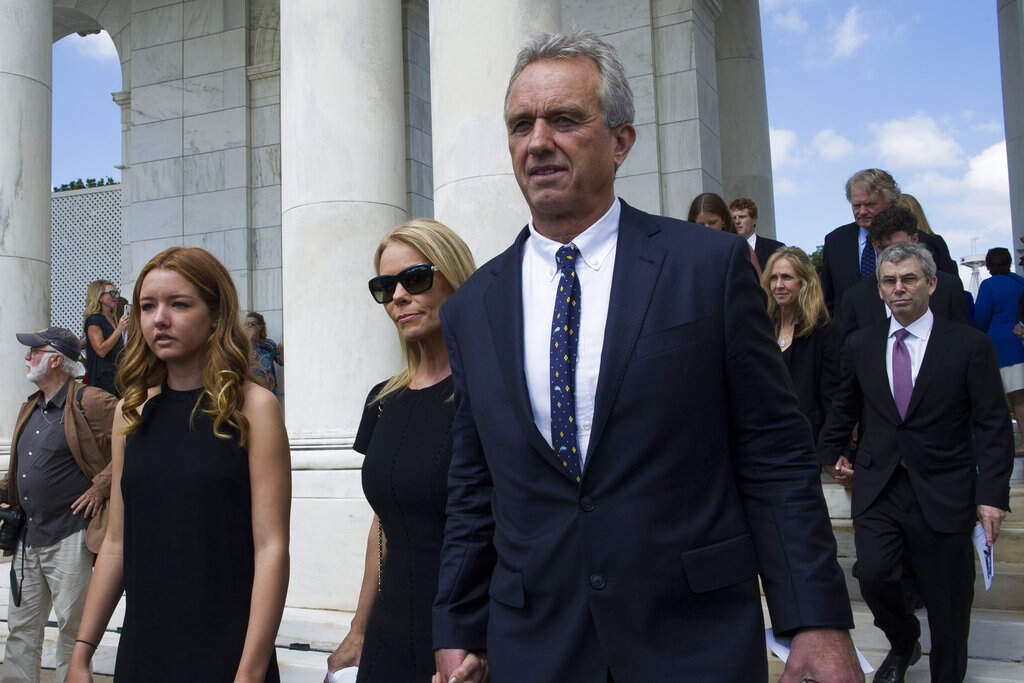
Robert F. Kennedy Jr. has been picked by Donald Trump to lead the Department of Health and Human Services. Kennedy has been critical of processed food, vaccines, and fluoride in water. What impact could he have on the nation’s health?
Guests
Christopher Gardner, food science researcher. Director of nutrition studies at the Stanford Prevention Research Center. Rehnborg Farquhar professor of medicine at Stanford University.
Jennifer Nuzzo, director of the Pandemic Center and professor of epidemiology at the Brown University School of Public Health.
Also Featured
Vani Hari, food health activist. Social media influencer known as Foodbabe.
Dr. Tom Frieden, former director of the Centers for Disease Control and Prevention. Currently president and CEO of Resolve to Save Lives, a public health nonprofit.
Transcript
Part I
(MONTAGE) Make America healthy again.
Make America healthy again.
Make America healthy again. Make America healthy again.
MEGHNA CHAKRABARTI: The Department of Health and Human Services is enormous. The agency oversees the Centers for Disease Control and Prevention, the National Institutes of Health, the Food and Drug Administration, the Centers for Medicare and Medicaid Services, toxins tracking, Head Start, and refugee resettlement, just to name a few.
In short, it is the most important federal agency influencing American public health policy. That's what makes Robert F. Kennedy Jr. a controversial nominee for HHS Secretary. Kennedy's views draw from a broad spectrum of views on what's causing things such as high rates of chronic disease in the U.S. For example, he's outspoken about the ubiquity of high fructose corn syrup in ultra processed foods, such as this moment from the Mark Hyman Show, January 2024.
KENNEDY, JR.: We know it's not genes. Genes do not cause epidemics. It can provide a vulnerability, but you need an environmental toxin. And so you have to figure out a toxin that was introduced, became ubiquitous in the 1989, the mid nineties.
One of them is high fructose corn syrup. Clearly our kids didn't suddenly get lazy. We are mass poisoning our children.
CHAKRABARTI: The negative health effects of a diet with excessive amounts of high fructose corn syrup are scientifically backed and well documented.
On the other end of the spectrum, though, and not backed by any legitimate science, is Kennedy's well-known opposition to childhood vaccination.
Here he is on the Health Freedom for Humanity podcast in 2022.
KENNEDY, Jr.: I see somebody on a hiking trail with a, carrying a little baby and I say that I'm better and I get him vaccinated. Maybe he will save that child. If you're one of 10 people that goes up to a guy, a man or a woman who's carrying a baby and says, don't vaccinate that baby.
When they hear that from 10 people, it'll make an impression on them. And we all kept our mouths shut. Don't keep your mouth shut anymore. Confront everybody on it.
CHAKRABARTI: The two ends of the spectrum are tied together by a deep distrust in corporate power, government agencies, and regulatory capture.
Vani Hari shares those concerns. She's known on social media as Food Babe.
VANI HARI: In my early twenties, I hit rock bottom and I experienced a lot of health issues. And it was that moment that I ended up in the hospital taking my appendix out that I decided to take a look at what I'd been eating. And I was shocked at how many man made chemicals I was eating.
And the majority of foods that I was eating was, it was coming out of a factory or lab and I wasn't eating real food.
CHAKRABARTI: After her early 20s, Hari changed her diet, stopped taking prescription drugs, and began blogging about the food industry. She's now a food justice influencer, and has close to 65,000 followers on TikTok, more than a million followers on Facebook, and 2 million on Instagram.
In September of this year, Hari spoke as part of a roundtable hosted by Senator Ron Johnson of Wisconsin, and she demanded answers from government officials attending the meeting.
HARI: Why aren't the government leaders in Washington holding these companies accountable for this? The fact that they can use a more poisonous, toxic ingredient in the food that they serve Americans, but take out those chemicals for other countries.
Why aren't we requiring our own American food companies to sell us and serve us the same safer products that they serve in so many other countries?
CHAKRABARTI: Kennedy was in the room. Earlier this month, he provided an answer to Hari's question. He told NBC News that if he becomes HHS secretary, he'd try to eliminate the nutrition department in the FDA.
KENNEDY, JR.: They're not protecting our kids. Why do we have Froot Loops in this country that have 18 or 19 ingredients and you go to Canada and it's got two or three?
CHAKRABARTI: Fruit Loops sold in Canada have 17 ingredients, not 2 or 3, according to the Washington Post. But those ingredients do not include some of the same dyes as Fruit Loops sold in the U.S. For Hari, that interview showed her RFK Jr. is on her side and the side of additive conscious parents.
HARI: I think RFK Jr. really saw the moment of Hey, if I'm put in this position, I'm going to hold them accountable. And that's really exciting and energizing for me. Because again, I have been working on this issue for a really long time, and it's about time these companies do the right thing.
ELYSE: RFK raises the critical reality of regulatory capture, where agencies designed to protect us like the FDA are instead engaged in a revolving door between government and private industry and back again. How can we possibly trust their word?
CHAKRABARTI: Now that second voice is On Point listener Elyse from Rockville, Maryland.
She's one of many listeners who sent us a huge variety of opinions on Kennedy. Elyse says she's a progressive who felt that she had to stay quiet during the COVID pandemic due to her doubts about the COVID vaccines. When it comes to food, criticism of regulatory capture is not a fringe belief. Marion Nestle is one of the nation's most respected nutritionists.
She's Professor Emerita and former Associate Dean of Human Biology at the University of California, San Francisco, and she has had national influence on food and nutrition. From 1986 to 1988, she served as Senior Nutrition Policy Advisor at the at HHS where she edited the Surgeon General's Report on Nutrition and Health and contributed to the Food and Nutrition Board's Report on How to Use Diet to Reduce Chronic Disease.
Those reports set out the scientific background for the 1990 Dietary Guides for Americans.
MARION NESTLE: I was told on my first day on the job that report would never say anything about eating less meat, because if it did, the Department of Agriculture, under pressure from the meat industry, would prevent the report from coming out.
So the idea that the food industry influences American food policy is an absolute given.
CHAKRABARTI: However, when it comes to Kennedy's views on vaccinations, food influencer Vani Hari isn't interested in discussing them, or at least wasn't when we asked her.
HARI: What I do have a opinion about is his ability to root out the corruption with within our health agencies, putting a stop to the rampant conflicts of interest with big food, pharma and chemical corporations, there is an opportunity right now to highlight the fact that close to 50% of the funding of the FDA comes from industry.
We need to stop that in order to get the real information out about our health to the public, and then we can make informed decisions about what we're doing.
CHAKRABARTI: Motley crew, unusual coalition, or the one area of American life where people can find a great deal of common ground, the Make America Healthy Again movement spearheaded by Kennedy stands for many things.
Today, we're going to look at what MAHA's goals are with food and vaccinations, and if Kennedy can realistically achieve them. Should he become Secretary of Health and Human Services? And we're going to start with food. Christopher Gardner is Director of Nutrition Studies at the Stanford Prevention Research Center.
He's also a professor of medicine at Stanford. Professor Gardner, welcome to On Point.
CHRISTOPHER GARDNER: Hi Meghna, happy to be here.
CHAKRABARTI: So let's get straight to this issue that Kennedy speaks a lot about, and you heard even some of our listeners talk about, is his concern about regulatory capture when it comes to the food industry's influence over guidelines put out by the federal government.
What's your take on that?
GARDNER: Absolutely. There's a lot of politics in that. Everybody eats food. There's a tremendous amount of money involved. It would be bizarre to think that politics wouldn't play a role.
CHAKRABARTI: When you say politics though, that can mean a lot of things. I'm specifically talking about the criticism about the fact that that food companies, agriculture industry, even chemical companies have a lot of say in terms of the decisions and guidelines that are coming out of departments within HHS's purview.
Is there legitimacy to that?
GARDNER: Sure. A lot of the studies that are out there get funded by industry and that's a challenging issue because the National Institutes of Health funds a lot of health research, but to be honest, not a lot of nutrition research. And if you have a company out there.
Making a food product, I would think the public would think, Hey, before you get that food product out there, it would be great if it would be researched to see if it's good or bad for us. However, if the NIH pays for those kinds of studies and they work, they're actually promoting the food companies. And really what happens is it comes down to the food companies to do the research on their own food, because the federal government isn't willing to fund research on all the different foods that come out. It's thousands of new products that come out every year. You can't possibly expect the objective, scientific, university driven health community to fund each one of those. And Meghna, part of the challenge here is when we do these studies, I do a lot of these studies.
I do human nutrition intervention trials. And my studies are typically a month, six months, or a year. I'm looking to see if we could affect something that you could measure in a clinic on a daily basis, which could be weight. Blood pressure, cholesterol, insulin, inflammatory markers. These are all what we call intermediate outcomes for health. And the health concerns we have, the most nutrition related diseases out there are heart disease, diabetes, stroke, cancer.
Those take decades to end up putting someone in a hospital or causing mortality. So I study risk factors. And even the risk factor studies can take a couple of years to design, a year or two to run, a year or two to publish. And all of a sudden there's 10 new questions. And I answered one of them. It's very hard to keep up with that and inform the public from a scientific basis.
And there's lots of us out there. We're doing it. But there are a lot of food products.
CHAKRABARTI: Okay, so when you said it's hard to keep the public informed this is actually something that Kennedy repeatedly talks about, because he says that under his leadership at HHS, should that happen, one of the things he wants to do is get better information about the science behind lots of additives or approved food products out to people.
Is that realistic? Is that something the HHS secretary could do?
GARDNER: It isn't realistic. There really aren't enough scientists, or enough studies, or enough research funding out there. There's some pretty basic questions that we would like to answer, and when we've put that to task and put together a budget proposal, it would bankrupt the NIH to answer some of these basic questions to see who lives or dies out there. So not realistic.
Part II
CHAKRABARTI: Professor Gardner, there's a bunch of like subheads under nutrition that I want to get your views on here. Kennedy talks a lot about toxins or specific additives to foods that he believes are directly related to a number of growing chronic health issues, not just metabolic, but even behavioral in the United States.
One that he talks a lot about are things like yellow dye No. 5 or tartrazine. Now this was first approved by the FDA in the United States in 19[31], it's currently banned in several countries. places like the EU. A warning label is actually required in products that contain this and other color additives.
But here's what Kennedy said about yellow dye No. 5 in an informational video released a little earlier this year.
KENNEDY, Jr.: In some countries, foods with tartrazine have a warning label that it may cause ADHD in children. Today, it's made from petroleum, not coal tar. Either way, it's crazy to add this to your kid's favorite foods.
It doesn't even change the flavor. This yellow dye isn't just in junk food. It's in the foods that we consider healthy. It's in everyday kid's snacks like popcorn, mac and cheese. Fruit snacks. It's in sports drinks like Gatorade and so called Vitamin Water. It's even added to chicken broth, to corn, to pickles, to mustard, and to yogurt.
And of course, our kids get sick. And we lovingly feed them chewable vitamins, which have, surprise, tartrazine.
CHAKRABARTI: Professor Gardner, When people hear things like that, they really understandably say, Why is this going on in the United States? And maybe it's about time that we had a Secretary of Health and Human Services who speaks plainly about the strange things that have been, that big food have allowed to get into our food system.
GARDNER: It is out of hand, it is crazy, and it would be a challenge to wrap your head around that. So Meghna, if I can introduce a term to your listeners, it's GRAS, generally recognized as safe. And back in the 1900s, there was a health organization that put together a list of these. There might have been 800 of these different chemicals, there's now over 10,000.
On that list and generally recognized as safe means these have not been proven to be health promoting. These have not actually been proven to be health harming, but we don't have any reason at this time to be confident and sure that they are health harming. And so somebody has asked. And yes, you can use this.
In your food, it's an alarmingly long list of natural, artificial and synthetic chemicals. And the way the health community has been approaching that recently is through the term called ultra processed. Which I'm sure many of your listeners have heard of, and let me just point out that ultra processed, even though it sounds like the processing part.
This is maybe the food industry tearing the food apart and ruining the food matrix. It used to be this whole food and now it's just parts of a food. That's actually not the main piece of information that goes into determining if something is ultra processed right now. So let me riff off a few categories for you that will probably sound familiar to some.
Colorants, flavorants, emulsifiers, bulking agents, gelling agents, thickeners, anti foaming, glazing, carbonating, sweeteners, and protein sources. This is the list of categories that was put forth by Carlos Monteiro from Brazil. Who has been suggesting that, oh my God, ultra processed foods are killing us. We really have to get these off the shelves of our grocery stores for the health sake of our population.
And if you looked across the globe, there are some countries where 5%, 10%, or 15% of their foods come from processed foods with some of those ingredients in them. In the U.S., it's 60% to 70% of the food.
CHAKRABARTI: This is why when people learn that, again, just sticking with the yellow dye No. 5 example, that, as I mentioned, in the European Union, there's warning labels that are required on products that contain tartrazine.
And I understand that in 2011, FDA voted against requiring a warning label. And I was doing some research in available studies on the potential health effects and of yellow dye No. 5 yesterday. So my examination is not exhaustive by any means, but I've seen that some studies suggest that maybe 50 milligrams of artificial food colorings as a whole per day could be enough to cause behavior changes in children.
And then I ran into a 2014 study that found that one serving of Kool Aid burst cherry contained 52.3 milligrams of artificial food colorants. What Kennedy is touching upon here is the assertion that organizations or agencies like FDA are not actually in the business of protecting Americans health.
Now, I'd love to hear what you think about that, and then secondly, what can a Secretary of Health and Human Services do to change what the content is of foods approved for consumption in the United States?
GARDNER: Sure. So look, looking at those health factors and the science behind it. Typically, what happens is somebody looks in a test tube or a petri dish, and then they look at a mouse or a rat. And then eventually they translate it to a human study, which is, it's a really long process to prove that this is harmful.
It goes along, actually, with dietary supplements, where, because of the DSHEA Act, the Dietary Supplement Health and Education Act, I think that was 1994, actually manufacturers don't have to prove that their products are safe or health promoting. And if someone believes they are health harming it actually takes the government quite an effort to prove that it would harm someone before you can take it off the shelf.
So doesn't that sound a little backwards? Shouldn't you prove that it's healthful? Not prove that it's harmful. And to be honest, proving that it's harmful is really challenging. You have to get people to sign up for a study where, Hey, I'm going to randomize you to one group and hopefully we won't harm you.
But if we do, that'll be super helpful. Cause then we can know to take it off the shelf. So that's the first part of your question. Was, yes, there are some products out there that could be harmful. If you started going one by one, Meghna, it would be quite a challenge to prove that these things are harmful, to take them off the shelf.
I want to point out California made an effort on this behalf. It didn't involve the yellow dye, but it's red dye No. 3, which is a colorant. It's potassium bromate, which is a leavening agent. It's propylparaben, which is just for preventative health. And it's brominated vegetable oil, which is a flavor stabilizer.
Those, as you mentioned, are all banned in some European countries, allowed in the U.S. And just recently, California banned those, not across the nation, just in the state of California. And even that move was considered controversial.
CHAKRABARTI: So this all once again leads me to wonder, though, in the world of food, you are describing, as others have, a world where industry is so profoundly intertwined with regulation, Kennedy's saying he wants to disentangle the two.
And again, just quickly what can an HHS secretary do to achieve that?
GARDNER: Many of us are welcoming this thinking this is fantastic. Many health professionals concerned about these. Something should be done, but I tell you in an initial step that's going to be wildly hugely, important. If 60% to 70% of the food supply contains these sorts of an instant ban, on these removing from the shelves, would require replacing them with healthier foods that are affordable.
Now, I'm not saying we should feed our population unhealthy foods because it's affordable, but from a practical perspective, right? As soon as you start saying, Okay, so let's go to all those stores, let's take them off the shelves, and somebody shows up and they've got to feed their kids. And they've got to feed themselves today and tomorrow.
And many of the straightforward things they were looking for. There's some yogurts that fall into this category. There's some whole wheat breads. There's some tomato sauces. There's sort of a range within this family of food substances called ultra processed. Some are healthier than others. And so one of the things that most of the health community would tremendously applaud is the science is there for saturated fat, added sugars and refined grains.
And so most of, sorry and salt. And so most of the foods that are ultra processed that have all these additives are also high in these specific components that for years we've been trying to say, please eat less sodium, less added sugar, less refined grain, less saturated fat. That evidence is stronger. That's not quite the same set of foods. But there's a tremendous overlap between the foods that are ultra processed and that fall into this category of those components that have been studied a lot.
So one of the quickest steps moving forward is to be more stringent addressing these ultra processed foods that have all those cosmetic additives that I was mentioning earlier, and are also high in salt, sugar, and fat, saturated fat in particular.
CHAKRABARTI: I'm going to move to vaccines here in just a second, but Professor Gardner, I guess I should just ask you the sort of thumbs up, thumbs down question.
Do you think Kennedy's a good pick for HHS?
GARDNER: Again, I love this idea, but the science, as a scientist, it's very sad to see my science distrusted or cast about as if, the good science isn't being done. Why aren't you doing more? It's quite frustrating. We're doing the best we can with science.
Science can be challenging. It's can be more challenging to communicate that science to the public so that they trust this. So my thumbs up would be if we could get more public trust in good objective science, that would help, but I feel like we're falling far short of that. I'm very concerned about Kennedy's opinions that are not scientifically based.
CHAKRABARTI: So that is the segue to the other major aspect of the beliefs he brings to the table. If he's secretary of Health and Human Services, and that of course has to do with vaccines. We heard from a lot of listeners about this. For example, this is Diane Walter. She's in Pittsburgh, Pennsylvania.
DIANE WALTER: When I look at the Make American Healthy Again plan and look at the folks in charge, RFK Jr, Dr. Oz, It just feels like a farce, putting the least qualified human beings in the most important positions of power. And I wonder how that will affect all of us.
CHAKRABARTI: And here's Laura Rangel in Lincoln, Nebraska. She works in public health and says there's a lot that she thinks could be admired about the Maha movement, but she has reservations about Kennedy.
LAURA RANGEL: Although I do worry with Kennedy being in charge of HHS, that this may or can lead to misinformation coming into this movement. So I do worry about that spilling over into public health.
CHAKRABARTI; So here's an example of that. This is from May of this year on the show Real Time with Bill Maher and Kennedy on the show says he believes there needs to be clear and better information about the vaccine approval process.
But in this specific exchange with Maher, Kennedy said that quote, we need to have more true, double blind placebo control trials from COVID vaccines.
KENNEDY, Jr.: If you look at the Pfizer vaccine, there was, there were 22,000 people in the placebo group, 22,000 people who got the actual vaccine and the people who got the vaccine had a 23% higher death rate from all causes at the end of that study.
MAHER: But that could not be the disease itself?
KENNEDY, Jr.: Oh, if it is, then the vaccine doesn't work, does it?
MAHER: But it does work. It all, I think it all --
KENNEDY, JR.: Wait a minute.
MAHER: Works in the sense that many people who would've died, because they were not in good health.
It killed mostly the obese and the very elderly. Okay. Those people are alive today, I think, because of the vaccine.
CHAKRABARTI: Joining us now is Jennifer Nuzzo. She's a professor of epidemiology and director of the Pandemic Center at the Brown University School of Public Health.
Professor Nuzzo, welcome back to On Point.
JENNIFER NUZZO: Thanks so much for having me.
CHAKRABARTI: Okay. So first of all, let's just check what Kennedy said in that clip there about the COVID, one of the COVID vaccines. He was implying some bad process in the testing. On the trialing of the Pfizer vaccine.
Your thoughts on that?
NUZZO: No, it's simply not true. Look, there's a lot of points in which we can have a fair disagreement, where I think reasonable people can look at the data and maybe come to different conclusions. I would say that now, four years later, whether people are deciding to get their seven year olds boosted against COVID after they've already just recently had COVID.
I think that's a very fair point in which we can disagree. But the data that we had for the approval of the vaccines was compelling in terms of not only the benefits that the vaccines offered in terms of preventing severe illness and death, but also the safety of the vaccines. We have to remember now at this point, there have been billions of people vaccinated and multiple safety systems, not just in the United States, but across the world, looking at the impact of those vaccines, and they have not identified anything that would suggest that the risks of the vaccines in some way are greater than the benefits that they provide.
CHAKRABARTI: Okay, but this gets right to the heart of what Kennedy has been consistently claiming for years now. That vaccine testing is inadequate and that negative health impacts are being hidden from the public, he says.
For example, here's something he said about his concerns about how vaccines are tested prior to FDA approval.
KENNEDY, Jr.: All I've said about vaccines, we should have good science. We should have the same kind of testing, placebo-controlled trials that we have for every other medication. Vaccines are exempt from pre licensing placebo-controlled trials, so that there's no way that anybody can tell the risk profile of those products, or even the relative benefits of those products, before they're mandated.
And we should have that kind of testing.
CHAKRABARTI: Professor Nuzzo, check that. First of all, the trials, the vaccines do undergo trials, and those data are made available at the time that not only does the FDA deliberate, but also the CDC advisory, independent advisory group deliberates in terms of the recommendations that they make for vaccine.
So that is quite clear, too, but this general assertion that we just don't have the data, that the data are being hidden, and this is one of the kind of long-time tropes that anti vaccine influencers like Robert F. Kennedy have used. They simply just want to raise questions and suggest that the data aren't there when in fact they very much are.
Part III
CHAKRABARTI: Let's quickly listen to, again, some of the many listeners who shared their views on RFK Jr. with us. This is Jack Nunberg in Kailua Kona, Hawaii. And he said, many of Kennedy's positions, to him, have some truth to them.
JACK NUNBERG: Big food is killing people, killing the planet. Big pharma, along with big insurance, big health executives, big drug purchasers, lots of people siphoning money out of the health system.
But like that broken clock that's right twice a day. Many of the things he advocates for are just crazy.
CHAKRABARTI: And here's Joanna Coleman. She's in Denver, Colorado, and she told us that her child was hospitalized twice very soon, both times after having just had the Hep B vaccine.
JOANNA COLEMAN: Overall, I think RFK Jr. is simply calling for a reevaluation of current health doctrine and practices.
Which I have gained the sense from spending the first four months of my child's life in a hospital that many professionals are intimidated to stray from the current beliefs and systems in place for fear of systemic repercussions and liabilities like losing their licenses, which they sacrifice so much hard work and money to obtain.
CHAKRABARTI: Alright, let's listen once again to things that Kennedy has said about vaccines. He's obviously been on the record and very clear about still, to this day, believing that vaccines cause autism. There's no scientific evidence that is true. But he's also recently tried to add some nuance to his views. For example, on the Bill Maher Show, he said that he claims he's always believed that if people want vaccines, they should be able to get them.
KENNEDY, Jr.: I'm not anti vaccine. What I say is that --
MAHER: People think you are.
KENNEDY, Jr.: I know, but that's because I'm called that, because it's a way of silencing me.
But I have said for 17 years, I'm not anti-vaccine. I just want good science. I want, people should be able to make informed choices. I am against vaccine mandates.
CHAKRABARTI: So Professor Nuzzo, this claim about wanting good science about vaccines is true. It can be read also as a flat-out rejection of the good science that exists.
We have evidence that his advocacy on this has actually had an impact on people. Specifically, about MMR, the measles, mumps, and rubella vaccine, and something that happened in American Samoa. Can you tell us about that?
NUZZO: Yes. This new talking point that, I'm not anti vaccines, I just want good data, it really, unfortunately, just is a talking point. It sounds like a very reasonable statement. Who wouldn't disagree with that? Of course, we all want data, but it really stands at odds with his historic stance on vaccines. And even the clip you played in which he bragged about telling people, not to vaccinate their children.
I think speak very clearly. I don't know how you interpret that other than the fact that he is in fact anti vaccine and the real deadly consequences of this can be seen in a very tragic outbreak of measles in American Samoa. So there was a very unfortunate incident in Samoa where two infants died after getting the MMR vaccine and the kind of safety systems that are in place to monitor vaccines to make sure they aren't causing harm snapped into place.
And there was a temporary pause on vaccination efforts in the country until they figured out what was going on. In fact, they found that it wasn't the vaccine itself, but that nurses had accidentally mixed it with something that they weren't supposed to. So something that actually harmed the children.
It was a medication that shouldn't have been given. And so it was really just clinical error, not the vaccine itself. And so once that was realized, there was an effort, of course, to resume the vaccination campaign. But, after that event, Robert F. Kennedy Jr. went to Samoa and met with prominent anti vaxxer there.
It was a pretty kind of publicized event on the channels of that, also wrote a letter to government agencies further calling into question the value, the safety of vaccines and what we then saw was a really explosive outbreak of measles that ultimately killed 83 people, most of whom were toddlers and babies. So as health authorities were desperately trying to make sure people were fully protected against the virus and trying to vaccinate, they were battling the kind of hesitation and fear about the vaccine that anti vaxxers had really spread. And it's really quite tragic and it's something they tried to distance themselves from.
There's a lot of documentation of this.
CHAKRABARTI: And so that outcome came just through his advocacy against vaccines, which brings us back to the question, Professor Nuzzo and Professor Gardner, about what happens when Kennedy's advocacy on vaccines, on food, as we talked about earlier, gels around a powerful position like the secretary of Health and Human Services.
For that, we reached out to Dr. Tom Frieden because he once served as the director of the Centers for Disease Control and Prevention between 2009 and 2017. And he told us that he thinks there are aspects of the Make America Healthy Again platform that make sense to him, like nutritional awareness, but he points to things that he thinks aren't so benign about vaccines, for example, and Kennedy's stated desire to overhaul CDC. Now, Frieden says that overhaul could include things like cutting funding and firing staff.
TOM FRIEDEN: One of the biggest risks is that government agencies will be less able to protect people. There are really important procedures that work pretty well.
There are other things that probably should be improved. But blowing things up doesn't usually improve functioning.
CHAKRABARTI: Now, Frieden tells us that overall, Kennedy's desire to shake up the Department of Health and Human Services doesn't acknowledge that there are already some mechanisms in place to address Kennedy's concerns, such as a lack of institutional transparency and overt industry influence. Frieden points to, for example, the Advisory Committee for Immunization Practices. He says this committee makes recommendations on what vaccines children should receive and when. And he says it's made up of parents, pediatricians, and researchers.
FRIEDEN: That committee is firewalled from industry. Industry does not influence it. The ACIP is completely transparent. Every meeting, every presentation, every background document is on the web. Every meeting is live streamed. Everyone can see what considerations are being used and what decisions are being made and why, but it's not very well known.
There are a lot of rumors or innuendos or claims about how vaccine policy is made, but that's actually how it's made. And when I was CDC director, we had public health. And medical leaders coming from all over the world to watch the ACIP proceedings because it's a best practice.
CHAKRABARTI: Now, Frieden says firing career public health administrators or reorganizing HHS or breaking up institutions like the CDC could result in real consequences for Americans.
FRIEDEN: A weaker CDC means a sicker USA. And there's a real possibility that recommendations to hollow out the CDC could get enacted.
This would cost lives, it would cost money, and it would undermine efforts to address chronic disease. We're already lagging all other wealthy countries in life expectancy and healthy life expectancy. A safe and healthy America requires a CDC. That works as the CDC does, through state and local public health departments, with communities to protect them from all health threats, not just some health threats.
CHAKRABARTI: But an agency that works is not the same as an agency that's working very well. And on this point, Frieden says he does believe that Health and Human Services has room for improvement. For example, HHS oversees the Centers for Medicare and Medicaid Services and Frieden says Medicare does not emphasize primary care enough. And he says improving that could be an effective way to support Kennedy's desire to address the epidemic of chronic disease in this country.
FRIEDEN: In fact, only about 5% of all Medicare spending is on primary care. And this is something that affects rural communities, which don't have clinics, urban communities.
About a hundred million Americans, nearly one in three, don't have a regular doctor, don't have a primary care physician. That's a terrible problem, and that's despite the fact that we spend $4.5 trillion dollars nearly on health care. That's almost one of every five dollars in our whole economy.
So the things that the Department of Health and Human Services does or can do are really important and getting them right is really a matter of life and death.
CHAKRABARTI: Now in a recent Wall Street Journal opinion piece, it was actually published the day before the election, Kennedy argued that the country is beset by an epidemic of chronic disease.
And then he wrote, quote, Americans with chronic conditions are often put on medications or treatments for the rest of their lives. And he inferred that taking medication for extended periods of time is a problem. Now, for Frieden, it's that aspect of Kennedy's belief that's concerning.
FRIEDEN: Some of the things that RFK Jr. says make sense. But if you look carefully, some of them are very concerning. He sometimes makes it sound as if treating chronic disease is a bad thing. Nobody wants to have to take medicines to stay healthy, but it's really dangerous to insinuate that medications are the problem. After all, we can walk and chew gum at the same time.
We can prevent chronic illness, and we can also treat them better. And the fact is, that even if we're really effective with prevention, millions of people are still going to need treatment.
CHAKRABARTI: So that's Dr. Tom Frieden, former head of the Centers for Disease Control and Prevention. So Professor Gardner and Professor Nuzzo, we've got about five minutes left here to arrive at a place of slightly deeper understanding.
And I want to ask you about what happens when ambition meets bureaucracy, right? Because for example, the reality is when people want to make sweeping changes to huge agencies like HHS. They meet some obstacles. Professor Gardner, for example, what happened with school lunches when former First Lady Michelle Obama wanted to really change how American children eat?
GARDNER: Yeah, absolutely. That Let's Move campaign of let's move and change the food out there ended up being let's exercise more. So that got, that message was shifted. It was a lot of people in the industry stepped up to say this is problematic. This is our bottom line. Politics and food industry influence came to play there.
Pretty powerful.
CHAKRABARTI: Do you think that under a Make America Healthier Again secretary combined with a Make America Great Again president which has, he has the full and unquestioning backing of the Republican Party now, that perhaps that could be the thing that breaks through, again, this industry influence, as you've been talking about?
GARDNER: It's really just got to be more faith in science, more funding going towards science. More transparency. I will say that in the nutrition world, dietary guidelines for Americans, there's a lot more transparency than there has been in the past. And that effort, I think, is largely successful. More transparency.
Better science. Don't blow it up and try to build it again.
CHAKRABARTI: Okay, so Professor Nuzzo, but for vaccines though, what impact do you think Kennedy could have directly on things like FDA, CDC as Secretary of Health and Human Services?
NUZZO: So there are a number of, I think, important impacts that he could have.
And, the clip that you played from Tom Frieden, I think speaks to it, that there could be an attempt to hollow out the civil servants that work to review the data, and to set up these independent advisory committees, et cetera, that have to do a lot of work to make vaccines available to us. For instance, every flu season, we get vaccines and there are decisions about what should go into those vaccines, et cetera.
But, even if that doesn't happen, damage can still be done. And by elevating to this national conversation, someone who had previously been considered really quite fringe in views, and giving them a platform. I fear that's really where some of this deep impact is going to be had, because people are busy.
People are going to, they don't have time to review the data like a scientist do, and they'll just hear headlines about things. And all people who are trying to turn people off of vaccines have to do is just simply raise enough question to make it perhaps not the thing that you prioritize in your busy schedule to do.
Whereas public health scientists and medical professionals. We have to do a lot in order to review the data and to convince you of the safety and the efficacy, and tell you what the data say. And at the end of the day to encourage you to get in your car and go somewhere, and get a vaccine that might involve a shot that a lot of people don't like getting.
All he simply has to do is raise enough questions in people's minds, such that they think that vaccines are not important, or worse, are going to harm them in some way.
CHAKRABARTI: And having the bully pulpit of being the Secretary of Health and Human Services would provide him quite a large bullhorn for that.
I want to wrap up with this because, again, this sort of deep skepticism, which I think is the thread that runs through all of Kennedy's beliefs, it comes up in a lot of different places. In 2022, he was on that Health Freedom for Humanity podcast, and there was a really interesting moment, because he was asked about the health impacts of the expansion of 5G wireless networks in this country. And he described it as the expansion of a totalitarian state intertwined with tech oligarchs.
KENNEDY, Jr.: Your car and your phone and your garage door opener and your baby monitor all telling Bill Gates what he can sell you.
And it's about allowing the government to surveil you, and to track and trace you. If you are disobedient, that they can punish you. They can starve you to death by cutting off the flow of your digital currency. And there's no way to run, there's no way to hide. They're going to be watching you 24 hours a day, and there's nothing you can do about it.
That's what 5G is.
CHAKRABARTI: And of course, just recently though, there's that photograph out there of Robert F. Kennedy, Jr. sitting across the table from perhaps now the nation's most influential tech oligarch, Elon Musk, and eating McDonald's fast food. So perhaps he's already having to make some compromises in his beliefs as he enters potentially the Trump administration.
This program aired on November 21, 2024.