Support WBUR
Historian Heather Cox Richardson makes sense of politics today by looking to the past
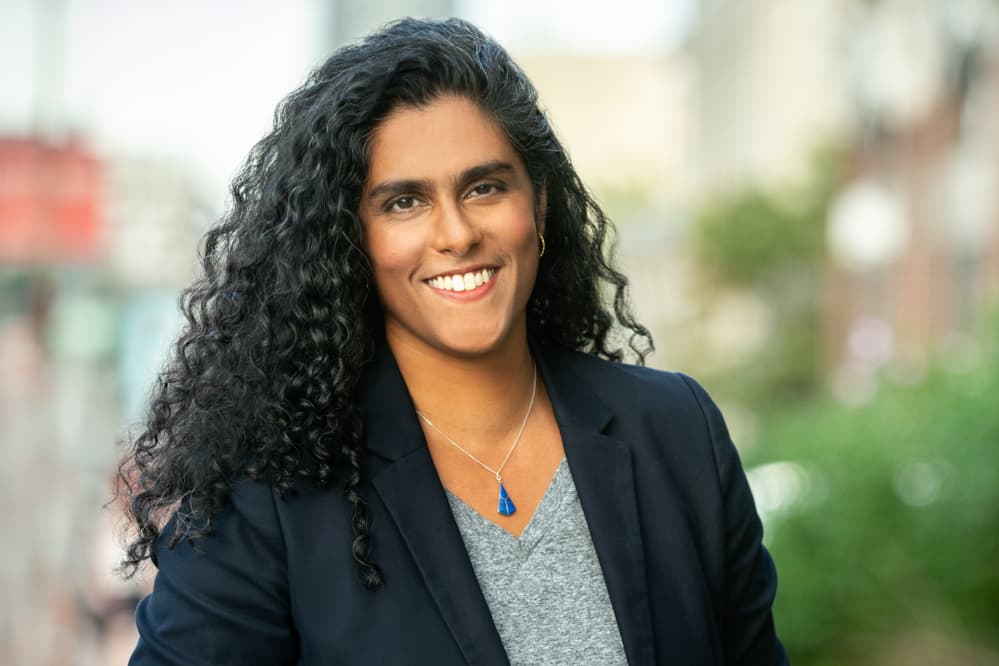
The political rehabilitation of William McKinley. A cabinet of TV stars. Heather Cox Richardson says she didn't have those things on her 2024 bingo card. The famed historian joins us to draw from the past to make sense of the future.
Guest
Heather Cox Richardson, historian. Author of the newsletter "Letters from an American."
Transcript
Part I
MEGHNA CHAKRABARTI: It's Friday and I've always felt like Fridays are a good day to take stock or to take the long view, and that's why today Historian Heather Cox Richardson is with us. She's author of the very popular Substack, Letters from an American. Her latest book is Democracy Awakening, and she's a professor of history at Boston College.
Professor Richardson, it's so good to have you across the table from me today.
HEATHER COX RICHARDSON: Isn't it fun, Meghna, thank you for having me.
CHAKRABARTI: You know that saying, you know it well about history doesn't repeat itself, but it rhymes. Is the rhyme right now, is it a haiku? Is it a sonnet? Is it a dirty limerick?
What's the rhyme?
RICHARDSON: We have to start with the idea that we are in uncharted territory in the United States of America. Because on November 5th, voters elected to put in place a politician who has been convicted of 34, on 34 counts. And has its long track record of calling for authoritarianism and getting rid of American democracy, etc.
And that's new. But there are a lot of ways in which the present echo things that have happened in other countries or that echo things that have happened in the United States of America. For example, what happened in the American South between 1874 and 1965, the idea of voters putting in place essentially a one party state.
So there's all kinds of different ways we could go with this.
CHAKRABARTI: Okay. Since you brought up 1874 to 1965, not dates that I have just rolling off the tip of my tongue, Heather, but so you're talking about post Civil War through Reconstruction and then I guess all the way till the Civil Rights Act.
RICHARDSON: So the period after the Civil War, in fact, there is a brief moment in the American South where Black men are welcome to the suffrage and are able to participate in the body politic. And by about 1874, Southern states have started to push back on the idea of Black voting, not on the idea of race, because that has become a real hot button issue in the wake of the establishment of the Department of Justice in 1870 to make sure that Black Americans are actually safe in the American South.
So they start to say, we don't really mind Black people voting based on their race. We were always cool with that, which of course they weren't. What we really are unhappy about is poor people voting, and these are people who are just in the fields and in the kitchens and now they have power over white people's tax dollars and they're voting for a redistribution of those tax dollars to themselves through things like schools and roads and hospitals.
And so what we're really opposed to is socialism. And with that argument, which really starts in about 1871, by 1874, there's a real effort to suppress the voting in the American South of Black Americans and also poor whites. And from that, we get the rise of the one party state throughout the American South from about 1874.
People usually look at the election of 1876, but that's only the last three states that have not yet given into what they call redemption. And that lasts, of course, until 1965, with the Voting Rights Act, when there is a move across the American South and across the country to make sure that everybody in America has at least, it's the right to vote, even if it's very hard for them still to do.
CHAKRABARTI: And that one party at that time was the Democratic Party.
RICHARDSON: That's correct. Yes. And it was not a complete reversal of the idea of anybody having any say in, in the South. There are splinter parties throughout the late 19th century that continue to have effects in elections.
But the thing that looks to me like the present at a national level is that there is this attempt to establish a one party state that represents only a small minority of the American South. And the idea is that although elections are always held, that there will only be one party who wins them.
And that party is in that period, the Democrats. But, one of the things that we tend to do when we look at that period of reconstruction in the early 20th century is to look at how badly people of color and Black Americans are treated in the American South and in the American West, which is a thousand percent true.
But most people who think that, who look at that era also don't realize that white Americans are actually terribly treated unless they are part of the cabal in their particular state or community that's running everything. So that lack of democracy is a huge problem for everybody.
CGAJRABATI: Okay. So I wanted to hear actually a lot more about this because you're exactly right.
It's never outside of historian circles. It's probably very rarely talked about. So what you're saying is that for white Americans who weren't part of the landed gentry, the political elite, what have you. The moneyed classes, essentially, for whatever reason, that this is not an era of America being great for them. No.
And who are we talking about here? Are we talking about poor whites? Are we talking about industrial revolution era whites who are like moving to places where there are new factory jobs? Give me a sense of who these folks are.
RICHARDSON: So let's start with the basics. When you get a one party state, you tend not to get a lot of capital there because there's really no protection for your capital.
That is, if somebody, if a cabal is in charge of making the laws and you're not part of that cabal, you have no guarantee that your community is going to be safe or that your investments are going to be safe. So if you think about the American South in the period I just talked about, it's a real backwater for a number of reasons, but largely because it can't get capital.
And at the same time, When it starts to grow, it really starts to do so because the federal government begins to invest in the 1930s and that money helps to bring the South out of this incredible backwater that it's gone into. First of all, you don't have capital. What you do have is the concentration of power in the hands of a very few wealthy people and of course, to the degree that they arranged state legislatures, and the laws that those legislatures pass, those laws benefit them, which is just a no brainer.
If you think about the way politics works, they create laws that benefit them. So that's going to hurt the vast majority of people in that region who are not people of wealth. So that's the overall picture. But again, think about a community where one group of people holds power, and if you are in their circle, then the law is going to be stretched for you.
Your kid accidentally shoots somebody out hunting. That was just an accident. But if you're not part of that group of people and something happens to you. You can't get justice. You can't make the law work for you, because it isn't really the rule of law. It's the rule of a very small group of people.
And if you extrapolate that to the larger scale of the United States right now, we do not want a society in which a very few people who represent a minority of Americans create the laws and then enforce or don't enforce the laws, depending on which part of that community you're in. Are you part of the in crowd or are you not part of the in crowd?
Because once you have done that, you have lost the rule of law and you get the rule of personalitiesm like we have in Russia with Vladimir Putin or in Hungary with Viktor Orban.
CHAKRABARTI: Yeah. Okay, so we're going to talk about the cult of personality in a little bit, Heather. Vut I've actually always wanted to ask you this question because, of course, race is a central part of the American story, right?
And American history. But what you're saying here also is that wealth. It's the other part. And that, and for me, it seems as if when we look at how race and racism has been leveraged, it's always been leveraged in favor of this cabal, as you're saying.
Is it plausible to say that perhaps the greater evil in this country has been this historic allergy to quote unquote socialism, that's been the thing that's been used to divide people with whatever the wedge issue of the moment is, and that's held the vast majority of Americans back from fulfilling this thing that I still believe in, which is the American ideal or the American dream.
RICHARDSON: That's a really wonderful way to put it, because you could almost say there is an entire industry of people fighting over whether the central issue in America has been race or the central issue in America has been class, and what I just described to you, what happens in the 1870s in the American South is the marriage of those two things.
Now, of course, it has much deeper roots all reaching all the way back to the first European who set foot in the North American continent. But it is [that] idea in the modern United States that it's either race or class, misses the fact that they have now been welded in the American psyche. And one of the things that really is interesting to me in this moment is the degree to which we are not talking about class.
In this country, because really, that language falls away in the 1960s, and we get a focus on the language of race. And if you think about somebody like FDR, or, or his ancestor, Teddy Roosevelt, talking about the malefactors of great wealth, the idea that we are not talking about the fact that Elon Musk, the richest man in the world, put $132 million in cash behind the Donald Trump candidacy, then also put the platform X behind him, and also had a dark money platform that ran misleading ads. And this idea somehow that now that Musk, who is, what are they calling him? The first buddy. And he is in charge of The Department of Governmental Efficiency, or in the American pronunciation, Doge.
CHAKRABARTI: (LAUGHS) You're not going with Doge, okay.
RICHARDSON:No that's the European pronunciation and we speak English here so the idea that this is not central to what we're talking about when we're looking at these laws that call for the gutting of the rules that ordinary Americans, 90 percent of us, in order to have larger tax cuts for the wealthy and corporations is just bizarre to me.
CHAKRABARTI: Let me push on that just a little bit, because let's, I want to, I want both of us to find more precise language than not talking about, we're not talking about class, because I would make the argument that actually, Donald Trump, he talks about class a lot. I'm just thinking back to his whole first campaign back in 2015, 2016 about the forgotten Americans.
That first inaugural address he gave, as dark as it was about American carnage, to many ears, he was speaking directly to, he was talking about gutted, the wasteland of America's great industrial cities. That is a class based message. Biden himself, very publicly the most pro union president we've had in, what, a couple of generations.
So class is being talked about, but that doesn't mean something's bein done about it.
RICHARDSON: Those are very different things you just laid out there. Yeah, so Trump talked a lot about it in 2016. He was the most progressive economic Republican on the Republican stage, and there's no doubt about that.
He called for bringing back manufacturing. He called for infrastructure. He called for closing tax loopholes and he called for cheaper and better health care. Of course, he didn't deliver any of those things, and I think that's where you see the overlap between the Trump voters and the Bernie brothers, the Bernie bros, because they're all talking about that.
Now what Biden did though, is he didn't talk about class as there is a group of very rich people who are changing our society. He said, we can all do this together. He took the language of sort of 1950s Republicanism and married it to that Democratic message. And he got zero traction for that in the legacy media.
Part II
CHAKRABARTI: You're back with On Point, I'm Meghna Chakrabarti, and today Heather Cox Richardson is sitting across from me at the On Point table. She is the author of the very well known story, Substack newsletter, Letters from an American. Her most recent book is Democracy Awakening: Notes on the State of America.
She's also a professor of history at Boston College. And we're just, I'm just trying to pick her brain for some perspective on this moment in American history. Here's another question, Heather, that I've always wanted to ask you. And that is, I'm sure you're familiar with, I don't know who first made this, but there's this interesting sort of quadrant in which economic conservatism to economic progressivism is on one axis of this map, and then social conservatism to social progressivism is the other axis, right?
It's separated into four. So if you're like, economically progressive and socially progressive, that makes you just super duper Democrat. Obviously, the other end of the spectrum makes you very conservative Republican. But the one quadrant that I think some folks were saying, Hey, Donald Trump really zeroed in on, especially in 2016, in terms of campaigning was the economically progressive, but socially conservative voters out there, which is an interesting combination in America.
First of all, who do you think those folks are? And is that the group you think that Trump capitalized on and have they always been a part of the American picture?
RICHARDSON: So I think it's really important to separate Donald Trump from 2016 out from Trump, Donald Trump in 2024. It's been an eight year difference.
He's a very different candidate. He's a very different man. He's mentally not nearly as acute as he was in 2016. And that even was a step down from where he was in the 1980s and you can see this. If you look at interviews he's done, he used to, in the '80s, he was sharp and he was funny and he was quick and that's just not who we saw in 2016 or in 2024.
But there's been a real change in the meaning, I think, of Trumpism. That is, in 2016, he really brought an economic message to a lot of people who were really disillusioned with the previous 40 years of neoliberalism, which had moved like 50 trillion from the bottom 90% of Americans up to the top 1% of Americans.
And he was saying, listen, you got a raw deal and I'm going to fix it. Now he didn't do that. When he got into office, he gave us the 2017 tax cuts and deregulation, but he also did something really interesting in 2017. And that was with the Unite the Right rally in Charlottesville, Virginia. He took the supporters that had come along with him based, I think, on pretty traditional Republican messaging.
The idea that America would be great if only it weren't for those other people. And that was a language that the Republicans had been embracing since the 1980s. The idea that Black Americans and brown Americans and women who wanted to work outside the home were all anti American, because they wanted some kind of a handout.
Again, language that looks very much like the same thing we saw in the 1870s in the American South, and that went on to the American North. And in 2017, after the Unite the Right rally, he ceased to use those people as his voters, and began to use them as a movement that would propel him to a different kind of presidency than previous Republicans had.
And it's really interesting, if you look at what he actually did, in his first year in 2016, he tries to be a pretty normal president. And then there's this really weird period after the Charlottesville United the Right rally where he goes quiet. That's when we get the genius, I'm the --
CHAKRABARTI: Oh yeah, very stable genius.
Very stable genius language.
RICHARDSON: And he stops holding events. He had held events before that, he stops holding events. And then we get the emergence of the 2019, 2020 president who seems very much trying simply to get re elected. And then, of course, we get the period from '22, 2024, where he is really deliberately trying to tear down the Biden administration and also the pieces of American democracy that he felt had persecuted him.
So now, in 2024, when he ran for office, he was not any longer, I think, trying to serve the Old Republican language, which I think you're seeing now in people like John Thune, the new Senate majority leader from South Dakota. He instead was bringing in a new right wing language that by the time he was running in 2024, had become fascism.
And the base that gravitated toward that, I think, is a very, there's some overlap with 2016, but he lost a lot of the 2016 economic voters who were like, we actually wanted something economic. We're not in with the neo Nazis, but he picked up a lot of neo Nazis and right wing people who previously had not been engaged in the political process.
And that was quite deliberately what they tried to do. They literally doubled down on the idea they were going to get people off their couches, remember all the time he's said, tell Jill to get the, and I'm not going to use the language, off his couch and get out there and vote.
So it's a mistake, I think, he's a really interesting political trajectory, but the last eight years have not been one man who ran one campaign to appeal to one group of people.
CHAKRABARTI: But you're not saying that, it's what, more than 74 million votes now that he got that, like that's a coalition of fascists and neo Nazis.
RICHARDSON: That is their base. I have absolutely no doubt about that. But what he really went for were the people who weren't paying good attention. And to whom he fed, they weren't paying any attention at all. We know people who self identified as not paying attention went 16 points for Trump. And we know that people who did not understand the realities of the economy or crime or immigration went three to one for Trump, versus those who did understand those things, who went two to one for Harris.
That was his coalition. And that's a huge national problem, I think.
CHAKRABARTI: Okay, so I want to talk to you in a second about sort of modern media and technology. But in order to do that, this question of the low information voter or the not paying attention voter, I'm not quite sure what the best language is to use, but has that always been a part of the American political process?
And maybe, I don't know how far back you'd look, because there wasn't the full enfranchisement of all Americans until 1965, as you pointed out, but.
RICHARDSON: And not even then. It's not till later, we're going to get ballots in different languages. And of course, we've had voter suppression and all kinds of things.
But that was when the game changed dramatically, with '65.
CHAKRABARTI: But I was wondering if it's possible to discern whether political parties and candidates have always tried to capitalize on a slice of the electorate that by virtue of either of having lives, don't have a chance to pay attention to it as closely as possible to everything that's happening.
RICHARDSON: Sure. That has always been the case. And so is disinformation. One of my favorite techniques that people used in the early republic to try and to Destroy their opponents was simply in a day before modern media, to tell the newspapers that the opponent was dead.
CHAKRABARTI: (LAUGHS)
RIHARDSON: Which is really hard to come back from not quite dead yet.
How do you prove that you're still alive in an era before? And before any kind of live media. So we've always had that. But I think what we've really seen since the rise of the Internet is the weaponization of that and the micro targeting of communities and the simple flooding of the zone with such disinformation that the fact you have, for example, such a high percentage of Republicans right now who believe that Donald Trump won the 2020 election when there is not only zero evidence that he did, but reams of evidence that he did not, or, the many ways in which people have a view of society that is now not based in reality.
And this is actually a reflection of a political theory that was really articulated by Russian political theorists, but I don't think it was unique to Russia at all. And in fact, I think you can see a lot of in the early days before this period in the United States. And that is that you can get people to vote away their democracy so long as you create a false world for them to believe in.
It's called virtual politics or political technology. As I say, it was theorized out of Russia. And there are five different ways you can do that. But the one that I think we, you and I are talking about is what Trump ally, Stephen Bannon has called flooding the zone with stuff. And that was a really deliberate attempt to throw so much stuff at people that they give up trying to figure out what's real and what's not.
And at the same time, flooding them with things that are not real so that they can cling to them. And that we are very much victims of, I think, because of modern technology.
CHAKRABARTI: Is there any rhyme or echo with the pre, like one, at least one era I can think of, a marriage between wealth and information in U.S. history. I was just looking, just keying in William Randolph Hearst, Joseph Pulitzer, the yellow journalism era, and all, the tabloids being owned by rich men who essentially used their publications not for the sake of actually covering the news. Is that anywhere close, not by virtue of scale, right?
Because like digital technology is a completely different world. So I'm not going to do a apples-to-apples comparison, but in terms of how money and information dance with each other in American politics.
RICHARDSON: So I'm going to say the opposite of what you expect. In fact, I do want to talk about that era, but you have to set it up with the 1850s in the American South, where in fact the elite enslavers, which made up less than 1% of the population, made sure that no information came into the American South that would contradict their version of why human enslavement was so important for the South's economy.
There were plenty of newspapers and abolitionists. And books that people were writing in the North and in the West that pertain to those issues and that did not echo the same line as the elite enslavers did. If a newspaper tried to come down South, they destroyed the press.
Sometimes they killed the editors. They made sure books couldn't come in. And there's this really famous book in the late 1850s, written by a North Carolinian. It's called the impending crisis and it's written by a guy named Hinton Rowan Helper. And he's a virulent racist, but the book says, listen, all you poor white Southerners, you don't want enslavement, because it's really destroying you. If you look at the statistics from the last census, you can see that the South is being held behind and you're losing your land, you're losing all your property, you're losing everything, which is true in the 1850s in the South. There's actually roving gangs of white workers who have no land any longer and really have to work to try and find wages somewhere. They're squatting on lands. They're stealing stuff.
CHAKRABARTI: So the land was being taken by plantation owners?
RICHARDSON: Yes, because there's a huge land boom and everything gets incredibly expensive. And so people just end up not being able to afford to farm their lands or to buy stuff.
And that book gets completely suppressed. There's, you know, they're burning books. They're banning the books. They're making sure nobody gets their hands on them, because it appeals to poor white racist unlanded men who might turn against those enslavers. So one of the things in the 1850s is this explosion of newspapers in other parts of the country to say, those guys are lying to you.
And we get the rise of things like the New York Tribune, like the Chicago Tribune comes up, like the New York Times. Those legacy media, the Philadelphia Inquirer had actually been around before that, but it changes in that period. And they start to base their mission in the distribution of facts, and in this idea of protecting American democracy.
Now the period you're talking about, in fact, coming out of that era, the newspapers split, they become very partisan, and we get the rise of the idea of independent media.
And the idea that there really are facts, and not just this crazy spin you're seeing, and you get the idea of independent media, which in many ways is a legacy that we're still grappling with nowadays, but what's interesting about that is as that legacy media, or what's supposed to be the independent media, begins to work with what are essentially the people we call robber barons, we get the rise of another new media.
And that new media, much of which is ephemeral and we don't have copies of it, the populist newspapers, for example, the hundreds of Black newspapers in the country and the rise of things like McClure's Magazine, which really takes off, starts in the late 19th century, but really takes off in the early 20th century, and they're muckrakers, they're investigative journalists. And they're people doing it by the bottom of their shoe leather, trying to tell people what's really going on in the world, and it's from that we get the rise of the progressive era, and I look around me in this moment at all the new newspapers, and the new podcasts, and the new everything we're seeing, and think, looks to me like the late 19th century.
CHAKRABARTI: You're part of that, right? Because people, I cannot tell you, Heather, how many people I've run into in different parts of the country who are like, you should have Heather Cox Richardson on. Her Substack is amazing. I'm like, you should listen to the show because we have had her on before. but your reach is broad and wide.
And you are one of many new people who have used different opportunities in technology to upend these sort of legacy presumptions of what journalism is. And in this 2024 election, we absolutely saw that in audio journalism, too, with Harris belatedly, but definitely Trump going on every podcast that he could get himself booked on.
And look, I guess I have to formally consider myself part of the legacy media, but I actually find this to be a good news story. Because there's nothing that says anything legacy does not deserve to be challenged, and especially if it's challenged by something better. So on that front, do you think that this is something to actually continue to be nurtured, even as it might be exploited, let's say, by savvy politicians, because the legacy standards or gatekeeping aren't there in this explosion of new media opportunities?
Not everyone's going to write like you, let's just put it that way.
RICHARDSON: I hope that's a good thing. And there are a lot of people doing really good work across this country. And I always hate to start calling out names because I always forget someone and I feel really bad about it, but there's a lot of really good people.
I will say there's something different about people like me, I think, and some of the other people who are challenging the old legacy media. First of all, I don't think we set out to challenge the legacy media. We set out, at least I set out, to explain American democracy. I am mission driven. I was never financially driven.
I was never intending to start a newspaper or anything at all. And that idea of being mission driven is one that speaks directly to what I was talking about, the Republican newspapers of the 1850s or the muckraking newspapers and the magazines and so on of the late 19th century or early 20th century.
That's very different I think, than a media that has become much more entertainment and the idea of making a profit by getting eyeballs. I don't care if I've got eyeballs or not. I'm writing really because I'm keeping a record of America. And that is, I think, a really important difference between where the legacy media has been in the last 20 years and these new startups, people who simply want to hold power to account, which is, of course, the actual role of the press in a democracy.
CHAKRABARTI: I think what you're proving, though, is that, to take it back to business terms, there's a market for people who want to hold power to account in, that is also the kind of journalism that there is a hunger for. The presumption for a long time has been that in order to get those eyeballs or those clicks, you have to veer towards entertainment.
And obviously, you and others are proving that's wrong.
RICHARDSON: I also think there's an issue of time. A quite young person said to me the other day they didn't watch TV because they did not have time for the filler. And there's a lot to that. So I think there's an issue of time. I also think that people want to be informed.
We are creatures who learn. The question is what are we learning? So yes, there is indeed a market, if you will, for people actually delivering what's really happening in one field or another.
Part III
CHAKRABARTI: Professor Richardson, originally, I'd planned to start this show, to this conversation today by asking you what rhymes with Matt Gaetz, historically, but he had this rare, a flash of good sense to step down from his nomination to be Donald Trump's attorney general.
But still, I'm going to ask it anyway. Has there been a similar period in U.S. history where the chief qualification to serve on a president's cabinet was blind loyalty or being a top-level entertainment figure? That does seem like all that, right, at this moment in time, that Trump was originally looking for.
RIHARDSON: Do you really need a historian to answer that?
CHAKRABARTI: I need you to answer that!
RICHARDSON: You want to talk about cabinets in history, I'd love to. There's some great characters. One of my favorite books has a title of something like The Whiskey Ring and My Ten Years in a Penitentiary, which was written by a cabinet member.
But I don't have that exactly right. But what makes this cabinet really different is and this presidency, this upcoming presidency, really different is this is the first time in American history we have elected somebody whose goal is to tear apart the American government.
And quite literally, and this is what the Doge group talks about, getting rid of at least 20 percent of the American rate of the American government, including agencies and the bureaucrats who run them, which are, of course, created by Congress.
CHAKRABARTI: It's also written in Project 2025, right? It's clearly laid out there.
RICHARDSON: And to replace the power of Congress with an extraordinarily strong executive. And one of the things about, not all of the cabinet officers, the Florida Senator Marco Rubio, that's a normal appointment.
CHAKRABARTI: And the new AG nominee, Pam Bondi, also, there's a Floridization of the cabinet as well.
RICHARDSON: Yeah, but she's really pretty deep with Trump in ways that are unusual certainly with his $25,000 donation to her in order, at least around the time she decided not to pursue a case against Trump University. And she's also a lobbyist a declared lobbyist for Cutter making about $115,000 a month on that, which is for an attorney general, what happened to the days when we actually had people divest of their other interests?
CHAKRABARTI: Those days exited the stage in 2016, right? Remember, I remember Donald Trump's big press conference where he made a show of the stacks of paper that he was going to create. I don't even think he created the blind trust, but saying, I'm not associated with anything related to Trump industries anymore, which just wasn't true.
RICHARDSON: And this year, no, this time around, nobody even seems to be trying that. But if you think about the kinds of nominations you're talking about, there was Matt Gaetz, a Republican representative from Florida for attorney general, Tulsi Gabbard, a former representative to head, to become the director of national intelligence, which oversees all of our intelligence agencies, Pete Hegseth, a weekend host on the Fox News channel, to become the secretary of defense, which oversees more than $800 billion dollars for our defense department and runs a department that has about three million people in it and has no experience at all.
Those appointments really were designed to take on the major pillars of American society and simply destroy them. That's new. And no, there's no precedent for this, but one of the things that's interesting that's coming out --
CHAKRABARTI: Wait, let me just jump in here. Okay, I'm not necessarily arguing this point, but I'm arguing a point that I've heard from many people who say, you say destroy, but the truth is that their belief is that the Trump admin, incoming Trump administration simply wants to make government more efficient.
That's the E technically in D O G E. And that because it's too big. You're talking about the Department of Defense. We are basically at a trillion-dollar budget for the Pentagon. And to think that can't actually be reduced in a good way, that seems crazy.
RICHARDSON: Oh for what it's worth, I have no problem with the Congress actually working to reduce in whatever ways, our elected representatives say that they want to do that, according to the terms of our constitution. That I think you and I could probably sit here and say, Hey, we don't need this.
Hey, we don't need that. But the point is, it's only the two of us. This is why we elect representatives and why the constitution gives that power to the U.S. Congress. What the Trump administration is talking about doing is handing that power to an extraordinarily strong president who, they argue, can simply cut those agencies based on the idea that the agencies live in the executive branch, as they have since the first presidency of George Washington, and because he is this extraordinarily powerful president, is the head of that executive branch.
He can simply say to Congress, I don't care if you want a Department of Energy or a Department of FEMA, or any of the agencies, not the Department of Energy, that's not an agency, but any of the agencies, the environmental protection agency is what I was thinking of. He can simply say, I don't think we should have that.
And I'm taking the advice of Vivek Ramaswamy and Elon Musk, these two billionaires, one of whom was not born in the United States, and as not being a natural born American, he can't be president himself, but he is certainly acting as if he has insight, at least into that presidency. That's a complete overturning of our constitutional system.
That's my objection. I'm not saying we have to have everything we already have.
CHAKRABARTI: Okay, point taken. But you did point out that these agencies have been under the executive since George Washington, right? It makes me wonder if we've always had the potential for a hidden king, then, in our system of government that just relied on not having a president with maniacal monarchical ambition.
RICHARDSON: There are a lot of things that we thought were laws, were actually norms, but I disagree with that. In fact, the Congress has put guardrails up around the president. For example, a president cannot simply kill a congressional initiative by refusing to disperse the monies that Congress appropriated for it.
In 1974, Congress stopped them from doing that after Nixon tried it with the Impoundment Control Act. And Trump has simply said he's going to challenge that and take it to the Supreme Court, which he has put three loyalists onto to give him a six-person majority. And he expects to be able simply to say, I don't care what the Congress does.
And the Congress, remember, is the first. Is it called first among equals? It's the first part of the three branches of government that the framers set up as reflecting the will of the people. Now we are saying, or they are saying, that a president can simply say, I don't care what Congress thinks we need to do.
I have decided that's not what we're going to do. And that is a very novel interpretation of what the U.S. president is supposed to be. And actually, if you think about, so funny, I was just this morning going over the constitutional debates, as one does on a Friday morning. And the piece that they are always on about is we must make sure that we never give one man too much power.
And the idea that we are now saying in the 21st century, we're going to do exactly that because that's the only way that we feel our country can run. That's a reflection of the ideology that you saw discussed by people like China's Xi Jinping and Vladimir Putin's in Vladimir Putin in Russia and Hungary's Viktor Orban, the idea that democracy can no longer function in the 21st century.
So we need strong men. I don't buy that. I still am very firmly a believer in the idea of self-determination and the idea that we should be able to elect our representatives. And if you think again about the extraordinary growth of the government and the idea that somehow we're spending way too much money.
It is worth knowing that if you look at the charts, the U.S. government spends about the same amount as part of GDP that it has since World War II, since the war. But what has changed, there's a spike during COVID, which has come back down, but what has changed is that the tax cuts of the George W. Bush administration and the Donald Trump administration are what has thrown us into the red.
And the idea that we have to have more cuts to things that are helping the majority of Americans in order to extend the tax cuts for the very wealthy and corporations is a shiv to me, because you know who invented the idea that Americans of wealth should pay for the government?
CHAKRABARTI: I don't actually.
RICHARDSON: it's the Republicans in 1861, invent the idea of national taxation, and it is predicated on the idea of a progressive income tax.
It's a Republican from Vermont, a guy named Justin Smith Morrill, who says in times of emergency, 99 percent of a man's wealth belongs to the federal government, because of the national government in those days, that's in the 1860s.
CHAKRABARTI: I, too, am a stalwart believer in self-determination. It's actually one of the greatest aspects of what I believe it means to be an American that I find endlessly inspiring, and I will till the day I die.
But this also means that Congress is not doomed, it's not fated to be hapless, it's put itself into that position of due to the endless thirst for power to be a virtually nonfunctional body, but it's technically co-equal, right? It doesn't have to be this way. Let's just do a mental experiment here.
You mentioned John Thune earlier, Senator Thune. He is in terms of, as far as we can say, a Republican of a pre-Trump kind.
RIHARDSON: I'm calling them establishment Republicans. Although again, they're not traditional Republicans. They are far to the right of traditional Republicans.
CHAKRABARTI: That's correct.
That's correct. But even given that though, is there not an opportunity here for those establishment Republicans to reassert?
RICAHRDSON: I'm so glad you asked that because I don't usually get to talk about Grover Cleveland.
CHAKRABARTI: (LAUGHS) You wait till I ask you about McKinley again.
RICHARDSON: Oh yeah, no, I can do McKinley too.
No yes, this is, there are different times in our history when either the executive branch and the president, or the people under him, or her step up and become the real determinants of what's happening in the country. So in the 1980s, the 1920s, for example, Congress really couldn't function. And when that happened, we got the rise of Herbert Hoover at commerce end, of Mellon at secretary of the treasury who really ran the government.
And, so you get these ebbs and flows and we have seen this period of the growth of a very strong president for a number of reasons that go all the way back to the Reagan administration. But in this moment, what Trump has tried to force through the Senate Republicans who will hold a majority in the new Senate, so theoretically he could do whatever he wants, if he's doing reasonable things, he's trying to force them to accept people like Matt Gaetz, right?
And they, of course, have the right and the duty to advise and consent the president, and he has tried to get them to give that up now. So far, they have not done so. But I'm telling you, I watched the ebbs and flows of political parties, and we have seen something very similar in the past to where we are now, in that the Republican Party in the late 19th century had become the party of the extraordinarily rich and so on and so forth, the robber barons and all that.
So what you get is the rise of a new Democratic Party that sheds the old Confederate leaders and turns to the urban cities and becomes a reform party. And that's represented by Grover Cleveland, who again, nobody knows right now, which is interesting for a number of reasons, but what he does is he pioneers a whole bunch of extraordinarily popular reforms.
He desegregates the New York City police force. He starts to pay attention to civil rights for Black Americans, but he also works for all kinds of economic stuff. He does lots of progressive stuff. And the Republicans go bonkers because they recognize that the Democrats are rising and getting incredibly powerful.
So one of the people that Cleveland has worked with very closely in New York is Teddy Roosevelt. So when Theodore Roosevelt starts to rise to political power, what does he do? He adopts all of Grover Cleveland's policies, and he becomes the face of progressivism and cements the Republican Party for generations.
They actually split in 1912 because there are so many Republican voters, they split into two different groups. And that's how we get Woodrow Wilson, who's a Democrat, but it becomes this incredibly popular wave. So it is possible. I'm not saying it's probable, but the establishment Republicans could in fact hold the line against Trump and adopt some of those extraordinarily popular Democratic platforms and say, we're the party of common-sense gun safety legislation.
We're the party that is protecting, which is more than 80% of Americans want that.
CHAKRABARTI: We just did a bunch of shows about how, for example, we did a whole hour on Missouri and how this deep red presidential state just this month passed a whole slew of voter referendums that would have been tagged as progressive ones, the higher minimum wage, paid family leave, protecting abortion rights.
There seems to be a true opening here, but I think, no, I want, I'm an American optimist and I think that it's possible, but we do have, as we talked about earlier, the technology issue. We have the money issue. I think Washington is very separated from the reality of what most Americans actually want.
RICHARDSON: I agree with that. So I'm not saying this is going to happen. I'm saying that we are in flux. I think it's worth remembering that there's been an unusual amount of attention paid to the Democratic loss, which was quite minor. Trump didn't get 50% of the votes, when the real thing that's going on right now is a fight in the Republican Party between the MAGA Republicans who are not putting on a very good show in the last two weeks and the more establishment Republicans who actually would like to retain the rule of law, if for nothing else, that's what protects their own finances.
And would also like to protect the international rules-based order, because without that, we do not have freedom of the seas, and without freedom of the seas, we do not have world trade on which their finances depend. So that fight in the Republican Party is what I'm watching these days.
CHAKRABARTI: Okay, so tell me what one, we have 30 seconds left, Heather.
RICHARDSON: No pressure.
CHAKRABARTI: What is one thing that you're hopeful for in the next four years.
RICHARDSON: It's always the same. It's that the American people will wake up and recognize how freaking lucky we are to live in a country where we have a right to be heard, where we have a right to be treated equally before the law, and that they will step up and defend this democracy as it deserves to be defended.
This program aired on November 22, 2024.