Support WBUR
Why sociologist Musa al-Gharbi says social justice elites value performance over progress
In 'We Have Never Been Woke,' sociologist Musa al-Gharbi argues the so-called “woke elite” pursue two conflicting desires – to be elite and egalitarian. But the desire to be elite always wins, hurting the communities they vow to help.
Guests
Musa al-Gharbi, sociologist and assistant professor of communication and journalism at Stony Brook University. His Substack is Symbolic Capital(ism). Author of "We Have Never Been Woke: The Cultural Contradictions of a New Elite."
Book Excerpt
Excerpted from WE HAVE NEVER BEEN WOKE. Copyright © 2024 by Musa al-Gharbi. Reprinted by permission of Princeton University Press.”
Transcript
Part I
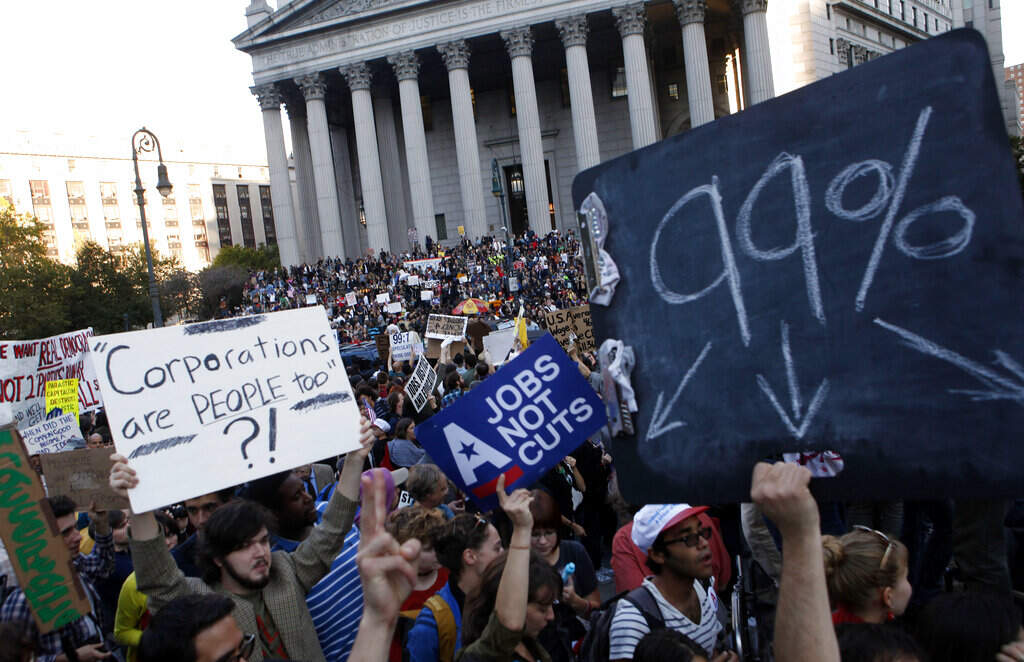
MEGHNA CHAKRABARTI: Some of the most high-profile social movements in the past decade began as impassioned calls for elemental change in this country. Think Occupy Wall Street, Black Lives Matter. The images you recall, nationwide protests, online campaigns and messaging, so many yard signs.
But what were the tangible, the concrete changes that these movements produced? Did income inequality shrink in the U.S.? Did homicide rates for Black Americans meaningfully drop? Did the billions of dollars spent on workplace anti-harassment training create cultures where powerful men think twice? Author and sociologist Musa al-Gharbi argues, no.
More pointedly, he said, these social movements, once co-opted by what he calls the woke elite, these social movements were actually doomed to fail. Because the woke elite transform these efforts into mass movements to make themselves feel good about themselves. al-Gharbi says the woke elite go even further than that, in fact.
They build social status for a small size of Americans while actively, if unconsciously, making life materially worse for the genuinely disadvantaged. al-Gharbi is a sociologist and assistant professor of communication and journalism at Stony Brook University. He lays out this argument in his new book, "We Have Never Been Woke: The Cultural Contradictions of a New Elite."
And he joins us now. Professor al-Gharbi, welcome to On Point.
MUSA AL-GHARBI: Thanks so much for having me.
CHAKRABARTI: Okay. Let's start with an example. It's one that you lay out in the book, where you witnessed a Black Lives Matter protest in New York. Tell us about that day, what you saw and what happened.
AL-GHARBI: So after George Floyd was murdered, on Fridays in the medians of Broadway Boulevard, they, as long as the weather was good, there were these demonstrations that would occur where professionals, who were associated with the knowledge economy, it looked like most of them were probably college professors and so on, would stand in the medians of Broadway Boulevard and wave signs that said things like, Black Lives Matter, and the cars that were passing by would honk at the signs, and then the people holding the signs would cheer, Woohoo!
And this was the demonstration, and again, they would happen basically weekly. And there were a few things about these demonstrations, as I was observing them, that stood out to me in a strong way. First, the people taking part in the demonstrations, were almost exclusively relatively affluent whites.
There were a lot of working-class Black and Hispanic people. The Upper West Side of Manhattan is right next to Harlem. Those were not the people taking part in the protests. They weren't taking part in these demonstrations. It was near exclusively affluent people associated with Columbia, typically older whites.
Okay. Another thing that stood out to me, is that in many cases, people were taking part in these demonstrations, sharing the median with homeless Black people who didn't even have shoes, in some cases. And they would step over these homeless people to wave their signs, to make sure that they didn't fall down, as they were shaking their signs, they would have to look and try to not step on these folks and their stuff.
And there were two things about that were striking to me. The first being that in the quest to fight this kind of, and to engage in this cosmic struggle against an abstraction like racism, or to help an abstract entity like Black people, in the abstract. They were ignoring the concrete individuals who are right in front of them, who had actual problems, that they actually could do something to help in principle. And then the last thing that struck me about these scenes that, again, replayed weekly, was that there didn't seem to be any tight correspondence between what people were actually doing, and what it was they wanted to accomplish.
Which is to say, I couldn't tell a plausible story about how people shaking the signs in the media and at Broadway Boulevard and going, Ooh, when cars honked, I couldn't tell a meaningful story about how that would say, get anyone released from prison or save anyone's life from police violence.
There didn't seem to be a correspondence between what people were doing, what they wanted to accomplish, between the gravity of the problem that they were concerned with, in the ways that they were conducting themselves. And so this led me to ask a question that started haunting me, as I started seeing these demonstrations every week. Was, who are these demonstrations for?
What purpose are they actually serving? Because the purpose, again, that there didn't seem to be serving, was saving anyone's life from police violence, get anyone released from prison and so on. It wasn't for people in prison, because people in prison couldn't see this and also couldn't, weren't standing to benefit from it in any practical sense.
So who was it for? Questions like these, you know, once I started wrestling with them, they haunted me. Haunted a lot of my interactions, haunted my own plans for life. Because I was also there at this Ivy League University to take part in these knowledge professions with the goal of helping promote various forms of social good and so on and so forth.
And so these weren't just empirical questions, or like interesting mental puzzles. They were also really existential questions about what am I doing here? And what am I, what do I want out of my life?
CHAKRABARTI: Yeah. In a couple of minutes, I will, I want to dive deep into how you define the woke elite, right?
You use the phrase symbolic capitalists, and we will talk about that in a second, but I'm very engaged by this example of yours. Okay, so first of all, the example of these protesters stepping over people who are homeless at that moment, don't even have shoes on, is quite jarring.
What would you have had them do instead that would have been more effective?
AL-GHARBI: I'll say two things to that first, as a bit of a spoiler for people who pick up the book. The book ends on a kind of willfully unsatisfying note, because what I don't do, usually at the end of the book, it's five chapters laying out a problem. And then the sixth one is, here's my 12 steps. Here's my advice for how to solve this problem. And I just willfully declined to do that. At the end of the book, in part, because I wanted readers to sit with the weight of some of these problems. And because I also am just not interested in becoming some kind of secular priest.
But that said, the bit of advice that I would give folks, in general, is to really take seriously this question of, is there a tight correspondence between what I'm doing, and what I want to accomplish? If I can't tell a story about how what I'm doing will actually advance the cause that I want to advance, will actually do something in a practical way, then you should maybe consider doing something else.
And you should really ask yourself this question of okay, who am I doing this for? Any social justice movement worth its salt would need to help real, concrete people. In the world, in real circumstances, deal with actual problems. If your social justice movement isn't doing that, then it's not clear, then it's not really a social justice movement.
It's, again, it might be accomplishing other things. For the people taking part, but what it's not doing is helping people who actually need help.
CHAKRABARTI: I have to say, I wanted to love your book. And I, because I am very sympathetic to this, essentially shining a bright light on the profound hypocrisies that elite in any society dwell in.
Okay, and so that's why I'm going to let you lay out your argument in detail as we discuss more. But I'm also quite excited for our vigorous intellectual debate with you, Professor, if I may. Because I actually have to say I was disappointed that you fell short. You willfully fell short of saying, actually, what those folks should have done is instead of stepping over a homeless person who has no shoes, they should have put down their signs.
Put their hands down, lifted that person up, and said, Come with me to the store. I want to buy you a pair of shoes. I want to buy you a meal. I want to get to know who you are and what you need. Why can't you just say, do that? Focus on the problems right in front of you. And even if it's just giving one person a meal, or showing one person a moment of human empathy, that is more meaningful than getting other people in their BMWs driving down an avenue to honk at you.
AL-GHARBI: Yeah, I agree that it's more meaningful, and in fact --
CHAKRABARTI: Or purposeful, or concrete, even. It's not about personal meaning. Maybe meaning was the wrong word for me to use, but effective.
AL-GHARBI: And even, one of the things that people sometimes say is that even if some of these kinds of protest gestures don't change anything in a practical sense for the people, being that we're supposed to be representing and supporting, at least they help them feel seen or validated or something like that.
But in this case, in the case of this example that I just described, for instance, that homeless person didn't feel seen. That homeless person was literally not seen. or was seen only in a peripheral sense. in order to avoid stepping on them, while you're waving your sign. And actually. one of the things that I argue in the book is that there are a lot of cases like this. Where we purport to represent or to stand for various populations, but the things that we are trying to do in their name and on their behavior, on their behalf, are just demonstrably out of sync with what those people actually want, what they perceive, their interests and values to be, and so on and so forth.
Now, the reason why I stopped short of providing this kind of advice, one reason, it's because in a deep sense, the project of the book is to study the kind of the history and the political economy of the knowledge profession. Which is to say, how the changing role of people who take part in fields like journalism and education and consulting and finance and so on, how our changing social position relates to our changing political alignments and our changing moral narratives, and so on.
So that's what the book is. It's a study of these kinds of nerdy things.
CHAKRABARTI: Look, I appreciate the project. I think it's an important one, but you are putting the project within the context of the very thing that you're studying and critiquing, and therefore limiting, I believe, the potential impact of that project.
AL-GHARBI: (LAUGHS)
I'm asking you to be more courageous with your fundamental analysis. We have to take a quick break here for about a minute Professor al-Gharbi. And when we come back, instead of needling you with my little responses, I'll let you lay out what the fundamentals of your project are a little more, in your analysis of this hypocrisy and this actually damaging hypocrisy, that you say, the so called woke elite have, in this country.
So we'll do all that when we come back. This is On Point.
Part II
CHAKRABARTI: The phrase symbolic capitalist plays a central role in your book. So what is symbolic capitalism? Who are symbolic capitalists?
AL-GHARBI: Yeah, so the we in 'We Have Never Been Woke' is this constellation of elites that I call symbolic capitalists. So the nutshell version of them, the nutshell definition is that they're people who make a living, whose elite position is defined by what they know, who they know, and how they're known, which is by producing and leveraging what Pierre Bourdieu called symbolic capital, which is why I call them that.
But a nutshell version is that there are people who work in fields like journalism, arts and entertainment, consulting, finance, science and technology. And so on and so forth, people who make a living by manipulating symbols and data and images and rhetoric and things like this, instead of providing physical goods and services to people.
And one of the things that's interesting about symbolic capitalists, and about the professions that we belong to, is that we tend to have much higher pay than most other workers in America. We tend to have much more autonomy in how we structure our times and the way we pursue our goals. We tend to have a lot more social prestige.
And from the beginning of a lot of our professions, the way we've justified these things, we've said, you should give us these things. You should give us this pay, this prestige, this autonomy, and so on, not for our own sake. But because if you give us these things, it will be to the benefit of everyone in society, including and especially the marginalized and the disadvantaged. And a lot of our fields are explicitly defined in terms of altruism and serving the common good.
So journalists, for instance, are supposed to speak truth to power and be a voice for the voiceless, or academics are supposed to follow the truth wherever it leads, and to tell the truth without regard to anyone's political and economic interests, and so on and so forth.
And if you look at, even in the contemporary context, if you look at which slice of America is most likely to self-identify as anti-racist, as feminist, as allies to LGBTQ people, as environmentalists, and so on, it's the same slice of America that tends to dominate the symbolic professions, highly educated, relatively affluent, urban and suburban folks, especially whites.
And so what you might expect, and what we pledged would happen, is that as more resources and influence and power were consolidated in our hands, in the hands of symbolic capitalists, what you might expect is that a lot of inequalities would be shrinking, other social problems would be ameliorated, we would have growing trust in institutions, because of all the great work that we're doing, and so on and so forth.
Instead, over the last 50 years, as the global economy has shifted away from industry and towards the symbolic professions, what we've seen instead is actually growing inequalities, increasing institutional dysfunction, reduced trust in institutions, reduced trust in each other, growing affective polarization and so on.
And so one of the core puzzles that the book is trying to wrestle with is, why is that? Why do we see what we actually see, instead of what we had maybe hoped or expected or promised, that we would see, if people like us had more power and influence over society, because we do, in fact, have more power and influence over society.
It is the case that influence and affluence have been concentrated into our hands over the last 50 years. It's just the outcomes of that have not been what we had promised.
CHAKRABARTI: Yeah. Yeah. I suppose I should speak now saying I, Meghna Chakrabarti, symbolic capitalist, have a question, have another question for you. No, I do take your point, right?
About the people in the knowledge elite, the knowledge economy, whatever you want to call it. I think that argument is very well laid out in your book. I just want to acknowledge that I'm aware of my role in that world that you're talking about. You do actually spend a few pages, and I was very grateful for this, in when you're describing symbolic capitalists, it's pretty easy to gather the data to show that this slice of America that you're talking about tends fairly strongly towards identifying with a Democratic party or having purportedly progressive beliefs.
However, you also talk about the fact that it's not exclusively that, right? When you're looking at some of the engineering professions, finance, I'd say is also a big one, that there is a more, let's say, politically conservative strain of knowledge elites who are also symbolic capitalists. You say that they also behave with that same hypocrisy, though, that presumption that their behavior, their beliefs, their choices, their knowledge superiority is what would guide folks to have better lives. If only they were, their ideas were followed, which turns out to not be true. I wanted you to talk about that a little bit, as well.
AL-GHARBI: Yeah, absolutely. So one of the things that the book stresses, in a way, like one of the important points of the book, is that what matters for understanding a lot of these social phenomena is how people behave is what their lifestyles are, how they interrelate with other people, with allocations of resources and opportunities and so on, rather than focusing on people's hearts and minds and beliefs and things like this.
And an argument that I make in the book is that when you look at conservative, symbolic capitalists or anti woke symbolic capitalists and so on, they tend to live similar lifestyles. In similar communities, they take part in similar institutions, and so on and so forth. And so there's not really any reason to analyze them in a systematically different way.
Everything that I say in the book, about how mainstream symbolic capitalists benefit from, and perpetuate and exacerbate many of the social problems that they condemn. All of these realities hold just as true for a conservative or anti woke people, believing something different in your heart or mind doesn't change any of these empirical realities.
And on top of that, even if you look at things like our psychological dispositions and so on, so people who take part in the symbolic professions, for instance, because we make our lives and our livelihoods around symbols and data and rhetoric and so on, we tend to take symbols very seriously, to the point where engaging in these cosmic struggles over abstractions and so on ends up often crowding out, addressing more practical material concerns that motivate a lot of other people to participate in politics, to the extent that they participate at all.
CHAKRABARTI: Right? But this is just the luxury. You have the luxury of narrowing your focus that way.
AL-GHARBI: Absolutely. Yeah, and critically though. This is just as true of folks on the right who also, who, for instance, even as it relates to wokeness, who view wokeness as some kind of major threat to Western civilization that must be stopped, even to the point of, again, putting on the back burner, the real problems that ordinary people have to deal with in their lives and things like this.
And even, last thing I'll say on this. Even when you look at political engagement, so one thing that I highlight in the book is that in a lot of, for instance, anti-woke spaces, you'll hear things like Ibram X. Kendi and those people, Black Lives Matter and so on, they have it all wrong.
I prefer the Martin Luther King style approach to social justice and racial equality and so on. And it's great. Okay, cool. Are you organizing or taking part in any Martin Luther King style, ecumenical, social justice movements, to address income inequality, war, any of the kinds of things that Martin Luther King was advocating for over the course of his life.
And the answer to this, of course, is no. Is they're sitting in their armchairs, just like mainstream symbolic capitalists, and they're substituting, criticizing how other people are doing it wrong, instead of actually doing anything themselves, which is to say, they're participating in politics in this purely symbolic, discursive way.
At the expense of actually doing things in the world. In this, they're no different than the people that they're criticizing.
CHAKRABARTI: Totally, but professor, they're collecting likes. They're collecting honks, right? They're able to say, don't say that. By saying, whatever, XYZ, you are a racist, you are supporting systemic racism or systemic sexism or whatever, have you.
I want to get straight to your very profound criticism, that this is purely, it becomes, whether consciously or not, an act of self-aggrandizement. It becomes very much about making oneself feel good about supposedly having this special knowledge about how to live, versus actually living.
AL-GHARBI: Yeah, and part of what generates this impulse, is that again, because a lot of our professions are oriented around serving the common good and helping the least among us, that creates this kind of unique moral culture within our professions and this unique mode of status competition. Where people seem especially worthy of status and of well-paying careers and so on, to the extent that they really effectively model themselves as the kind of people who hold the right views or have the right motives.
Or are oriented and committed towards helping the right people and so on, and if you're successfully painted as not having the right motives or as being too cozy with the rich and powerful, or of having the wrong kind of thoughts about the wrong kind of people, you can find your position in these professions really precarious or can even lose your job.
And this has been true for a century now, as I show in the book, it's not something that started with Twitter. This is something that's baked deep into how our professions and the ways that we engage in politics and things like this. And I think one of the ways that the discourse about these issues sometimes goes awry, as there's a tendency in some circles, to say, if you can show that someone has an interest in believing or articulating something, if you can show that it in some way improves their status, improves their material well-being or so on, then you go, aha, see, I have exposed you, you're cynical.
And I think that's actually a bad way to think about thinking as I illustrate in the book. And as I show on my Substack, in my latest article on my Substack. In fact, humans, cognition and perception seems to be fundamentally geared towards helping us advance our goals and further our interests.
There's just a ton of empirical literature that shows that the ways that we perceive the world, in a very fundamental way, and the ways we think about the world, in a very fundamental way, are oriented this way. And if we take that literature seriously. And we should, then there actually isn't a deep contradiction between believing something sincerely and using it instrumentally.
If you have an interest in believing something, you would actually be more likely to believe it sincerely. And be more likely to try to get other people to believe it, too.
CHAKRABARTI: Yeah, none of this is, frankly, none of this is surprising, right? All we have to do is observe our own behavior, or the people around us.
What you're talking about is what it means to fundamentally be human. To, the more you believe in something, the more you're going to act on it. Especially if it makes your life better! That is human selfishness, that is what you're talking about here.
AL-GHARBI: And one of the things that's interesting and maybe counterintuitive for some of us, is that we, these general tendencies of human psychology are actually more pronounced with us in some ways.
Precisely because we're actually, we have more knowledge at our disposal, because we're better at arguing and we're more cognitively sophisticated and so on, we're actually much, much better at sticking to our guns and defiance of the facts, of telling ourselves these kind of rationalizing stories about how what we're doing is actually fine and okay. And how we're actually good people, regardless of what we're doing and so on. As I show in, as I argue in the book, and as I show in that Substack article I mentioned, we're actually some of the people who are most prone to motivated reasoning and bias and things like this.
And we often have a conception of ourselves that's the exact opposite of that. We think that in virtue of our education, in virtue of our intellectual acumen and so on. That we're especially likely to be unbiased and that we make our decisions on the basis of the facts. And if the facts weren't on our side, then we change our minds and so on and so forth.
In fact, in reality, the opposite is true. If we, again, if we take seriously the ways that our brains are functioned, what they're geared to or what they're good at, then if our brains are actually better at doing the thing that they're designed to do, then we would be better, motivated reasoning and things like this.
CHAKRABARTI: What you just said reminded me. There's a fabulous YouTube channel that me and my kids love. It's called Veritasium, and they dive deep on all things science. And they have a video that shows that the more educated someone is, because they just did these experiments, the more their preconceived biases are actually measurable.
They did this experiment with relative amounts of higher education versus how people interpreted data on gun control, for example. It was absolutely fascinating. It was just so well done. Folks, Google it. Veritasium and I think it's like, Google Veritasium and bias on YouTube. One of my favorite channels.
Look, we have two minutes before we have to get to our next break. I wanted to just give you a second to, you rightly said that in your book, you talk about the past century. And how there have been four 'Great Awokenings,' as you call them, going all the way back to the Great Depression.
And the current one, and you say, argued, began with the Occupy Wall Street movement. Talk about that just for a second here, and then also tell me briefly why you think it failed?
AL-GHARBI: Yeah, so Occupy is often talked about as being in contrast with the social justice movements like #MeToo and Black Lives Matter and so on and so forth.
But as I show in the book, they're actually comprised of the same kinds of people. Occupy was not a class-based movement. It was comprised primarily of relatively affluent, highly educated people and knowledge economy hubs.
CHAKRABARTI: People who could afford to camp out.
AL-GHARBI: Absolutely. And even the narratives of, we are the 99%.
That's not a real class-based analysis. As Richard Reeves points out, in some ways, that allows people who have healthy six figure incomes to just say, Oh, I'm just an ordinary Joe. I'm just a regular guy. It's just the millionaires and the billionaires are the problem. I don't have anything to do with any of these social issues.
But as he shows in the work, as Richard Reeves shows in his book, Dream Hoarders and other work, actually, you can't explain declining social mobility, growing inequality, a lot of these other problems, by just focusing at the top 1%. And I unpacked this point more in the book. And I'd be happy to after the break.
But the part of the reason that the movement failed, in fact, was because it was dominated by these modes of politics that are really common among people like us, but that alienate normie people. So for instance, there was this norm called the progressive stack that governed who was able to speak and under what circumstances, and in what order and so on.
So the creation of these kinds of bureaucratic rules and the insistence on these kind of niche norms and so on. This isn't a way that normal people participate in politics. This is a kind of thing that knowledge economy professionals get really excited about, or even the [Occupy movement's] willful refusal to come up with policy platforms or endorse candidates or things like this ... was expressly anti political.
Part III
CHAKRABARTI: I hope you'll allow me to push back a little bit on this sense that most, if not all, of the so called woke elite are behaving in a way that's simply to amplify their own self-importance.
So let's stick with the Occupy example for a moment. Definitely a lot of people out there had time and money to protest. Others didn't. Maybe they were out there because they did not have a job. They could not get a job, or they were crushed under the weight of their debt. Or they felt so economically vulnerable that they had no other choices left.
I point that out because I also think we're living in a time where the actual political power to make the structural changes, the kind of concrete changes that we talked about at the beginning of this show, the actual financial power to do is so concentrated, that truly 99% of people feel utterly powerless.
We have been centering our criticism on the cultural elite. But when it comes to politically changing this country, a lot of people feel all they have left is to go out in the street. Okay. ... Very few of these culturally elites that you're talking about can call up the White House or can call up JP Morgan, the CEO office, and say, let's deflate that asset bubble a little.
Or, call the Speaker of the House and say, let's pass a law that increases the capital gains tax. They just can't do that. So all they have left is the kind of protest that you're criticizing.
AL-GHARBI: So I think that, so there are a few interesting things here. ... So one, it actually is the case that there's a lot of empirical research that shows that policymakers and other stakeholders actually do care a lot about the views of people like us, actually do exert a disproportionate influence over what policymakers actually do.
So you can look, over the course of the Great Awokening, for instance, this period of rapid shift and how knowledge economy professionals talk and think about social justice.
CHAKRABARTI: In that case, the protests give voice and public awareness of those views to those very policymakers, do they not?
AL-GHARBI: But critically, they give voice to the views of elites to these policy makers, and you do see them shifting the Democratic. You can see, for instance, as I show an essay on my Substack after the election, the views of highly educated, relatively affluent white people shifted radically after 2010.
The views of the Democratic Party shifted in tandem. But this, I wouldn't describe that as justice oriented, in part because you can look, the very people who we view ourselves as advocates for, or allies of, they've shifted aggressively towards the Republican Party. The entire time the shift has been underway, less affluent, working class, less educated voters, racial and ethnic minorities, religious folks.
They've all been moving aggressively towards the Republican Party, over the decade, over the last, since 2010, at the very time the Democratic Party has been seeing gains with relatively affluent, highly educated white people and has shifted their policies and priorities to cater to symbolic capitalist preferences.
So this is one of the problems with understanding these protests as being oriented towards the marginalized and the disadvantaged, and so on and so forth. Is that the very populations that we view ourselves as advocates for, or champions of, they're the people who have been driving a lot of the backlash we're seeing.
And I think it's also important to note that, so I subscribed, before I started on this project, I subscribed to a lot of these same ideas. For instance, I thought that if you had asked me who's responsible for various social problems, I would have been like, Oh, it's the Republicans. It's the millionaires and billionaires and so on, multinational corporations.
The problem was one of the things I realized when I was on the Upper West Side of Manhattan is that in places like Manhattan and in other knowledge economy hubs. But I'll just stick with New York City, for now, if you look at New York City, some of the highest, huge concentrations of wealth, some of the largest concentrations of millionaires and billionaires and so on, but you also have really high inequality, huge poverty rates, some of the most racially segregated school systems in the country.
It's one of the places that folks are fleeing at the highest levels, because a lot of people who live there find it unaffordable or unsustainable to live there, and so on and so forth. And who should we blame for this? We can't blame those darn Republicans. If you look at the city council of New York City, it's overwhelmingly Democrats, the governor is a Democrat, the mayor is a Democrat, the state assembly is Democrats, two to one, almost all are.
If you look at our delegation to the federal Congress, both of our senators are Democrat, Democrats, our House representatives are Democrats, at more than two to one and so on and so forth. So we can't actually plausibly explain any of these problems which are more pronounced in places like New York and other knowledge economy hubs, that Democrats control with nearly one-party rule.
We can't explain a lot of this stuff by appealing to Republicans, just aren't in power in these areas. And there are areas where, with vast amounts of wealth and where we could, if we allocated the resources that are under our control.
In areas that Democrats control with one party rule, and the institutions that are under our control, that are dominated nearly exclusively by Democrats, and so on, it actually is within our capacity to radically change a lot of things about how wealth and opportunity are allocated in the country. So that's the first issue. And then the second issue, the millionaires and the billionaires. So there's this great book by Anand Giridharadas called "Winner's Take All."
And in that book, Anand Giridharadas describes how the millionaires and the billionaires, they create all of these social, they and their corporations create all of these social problems, and this kind of myopic pursuit of enhancing, maximizing the bottom line. And then they use philanthropy.
Donating to starting nonprofits, making these big donations and so on, to paint themselves as the solutions to the problems that they themselves created. It's a great book, recommend it. But then what's interesting is when you really just take a step back and think about, oh, okay how is it that the millionaires and the billionaires do this?
It becomes clear that every single step in that process, symbolic capitalists are the ones who actually make the thing happen. So who is it that runs the PR firms through which they launder their reputations? Oh, that would be symbolic capitalists. Oh, okay. Who are the journalists that write these fawning profiles after they make these donations, that help them launder their reputations?
Oh, that would be symbolic capitalists. Oh, okay. Who administers the nonprofits that allow them to do? Oh, that would be us too. Oh, who are the finance gurus who help them avoid taxes and move their money around through these nonprofits and so on? Oh, that would be us too.
Almost anything that we want to describe about the millionaires and the billionaires and multinational corporations and so on. It's us who are actually making things happen. These things that happen, they happen with us and through us, and they couldn't happen without us. And so if we only look at the CEOs, if we only look at, then we're actually missing how things actually happen, and who actually drives a lot of the things that happen.
CHAKRABARTI: Yeah. Yeah, no, your point is well taken on that. I could quibble with some details about, talking with the rest of the On Point staff yesterday about the asymptotic nature of income inequality, the closer you get to that 1% and then the .001%, but that's for another day.
But you'll have to forgive me, but I hear you falling into the very same trap that you say symbolic capitalists have encased themselves in, which is just levying criticism after criticism, but then falling short of saying, and here's what we actually should do to make a real difference.
And perhaps I am embodying the very frustration you wanted readers to have. So Bravo. You accomplished that. (LAUGHS) But also look, my background is actually in engineering, and I just want to fix stuff. And over the past 15 years or so, I'm going to be perfectly frank. I just feel like, yeah, maybe symbolic capitalists, whether they're left leaning or right leaning, God, we just got to get over ourselves.
It's a commonsense issue. People since time immemorial have been both selfish and hypocritical. We could name faith leaders from 2,000 years ago who professed to have the one true way to salvation, but then lived completely amoral, immoral lives themselves. It's just as human can be.
But I'm also tired of just talking about the obvious. Do you understand what I mean? It's like one of the great benefits of the particular form of journalism, or the particular job I have, is I actually get to talk to a lot of normal people. And they're all saying the same things. Get over yourself, folks!
We just have to fix stuff. So I really want to push you. If the heads of the PR firms, if the leadership teams of the not for profits, if the deans of the colleges and universities, all of these folks are actively contributing to this world in which self-aggrandizement of symbolic capitalists is the center of their energies.
There has to be something that you would recommend to them to do right now, to change that.
AL-GHARBI: Sure. I think there are a lot of practical things that people can do. A lot of them are, some of them are institutional dependent. So for instance, in higher ed. Higher ed is a space where you have almost all of us, Democrats ... outnumber Republicans, like five to one overall, 10 to one in a lot of fields, like my own field, sociology. But higher ed institutions are also, are often extremely parochial and they're some of the most hierarchical spaces.
In the economy, we basically have a two-tiered system, for instance, for faculty, where we have tenure stream faculty who get a lot of pay, a lot of prestige and so on, relative to contingent faculty who have basically no academic freedom, much more precarious contracts and so on and so forth. I should emphasize that even full time precarious, that even full-time contingent faculty, as I show in the book, they tend to be better off than a lot of other workers in the economy, which is part of why people stick in these roles.
So sometimes people who are in these less advantaged positions within the symbolic professions overdo it by pointing out how they're less well off than, say, tenure stream professors, and ignoring how much better off they are than a lot of other workers in the economy. But let's set that to the side.
CHAKRABARTI: Actually, can I just push you on something specific? Because you actually do have some ideas that are even more concrete. I want to take it out of the institutional ether and put it hard on the ground. Because we started off with this example that you had, of people protesting on the street for Black Lives Matter, but ignoring the homeless Black person suffering at their feet, right?
And so one of the things that leads from that is this simple action of, or thought, that if what one is doing, protesting on behalf of some belief and it isn't actually making any positive change, the null option is always an option, right? Stop doing that thing.
AL-GHARBI: Yeah. Yeah. In some ways, the things that we're doing actually make problems worse. And we could just refrain from doing those things. And that would be good, as an example. There's a lot of empirical literature that shows that many programs and policies designed to improve diversity, equity and inclusion in institutions.
Not only do they not work, but they actually make things worse. They can increase turnover. They can, in these cases, and in many cases, companies continue to do them, even though there's a lot of evidence they don't work, because they feel like they need to do something, but in some cases, actually doing nothing is better than doing something, if what you're doing is actually counterproductive, and it's creating harm. And also blinding people, in some cases.
If engaging in this action that doesn't help, leads the people who are benefiting from these social problems to be convinced that they're the good guys and blinds them to the rules, that they're then, in some cases, it's actually counterproductive.
It would actually be better to just not do that thing at all. But there are other, another thing that we could do. But again, like there are also things that we could do. I think one way in which we could change our orientation, in some cases, is rather than looking at how we can blame or expropriate things from other people, we can look at how we can give of ourselves.
I'll give one quick concrete example. If you look at public schools on the Upper West Side of Columbia, where I went to school, there were a number of public schools close by the campus. One of them, P.S. 165, is where I sent my own children. It's overwhelmingly Black and Hispanic, overwhelmingly low income.
Almost everyone at Columbia supports public schools in principle but that's not where they choose to send their own kids. They don't send their own kids to public schools. They send their kids to private schools, which you often pay tens of thousands of dollars per year to get a really aggressive social justice curriculum, even though the whole point of these schools is to help reproduce inequalities, which is to say, to help their own children do better in the knowledge economy and get into Harvard and also to help segregate them from the poors and the browns.
So what people could do, that would have no opposition to overcome, there's nothing. There's no Republicans to blame. There's no, you could just send your kid to your zone public school. And there's a lot of research that shows that this would actually be game changing for a lot of the students in these schools, not just because they'd get a few more tax dollars for the extra butts and seats.
But because, as Raj Chetty showed in some of his work, these bridging ties with people across class backgrounds, they can impart new forms of cultural capital to less advantaged students. They can give them other models to draw from, other social networks that can help them gain different influences and so on. And so this is something that's really easy on paper, but it's also hard for a lot of people, because it involves investing your own children.
And even though there's actually a lot of research that shows it doesn't make as much difference as you think, whether if you're already someone from a relatively affluent educated background, if you send your kid to the zone public school versus a private school, it actually doesn't make as much change as people assume.
These kinds of schools are really important and useful for people from non-traditional, elite backgrounds.
CHAKRABARTI: Separately, I would also eliminate the cult of victimhood.
AL-GHARBI: Yeah.
CHAKRABARTI: Most people, there are genuine people, there's genuine suffering in this country. Absolutely. But you write about this in the book.
Oh, I'm asking this question now with a minute to go. My apologies, but that the adoption of a victimhood mentality for people who are not victims isn't helping anybody.
AL-GHARBI: It's more pronounced among elites. Actually, it's people who are relatively affluent, highly educated and so on who are most likely to think of and talk about themselves as marginalized and disadvantaged.
A lot of people in non-elite backgrounds just don't see themselves that way. Don't talk about that way. Don't foreground this in every interaction they have with people, about how victimized they are. Yeah, and I agree, that could actually help us perceive the world more accurately. And maybe move us to doing things that are more useful to people who really need help.
This program aired on December 10, 2024.