Support WBUR
Trump's 2017 tax cuts: Who's better off, who's not?
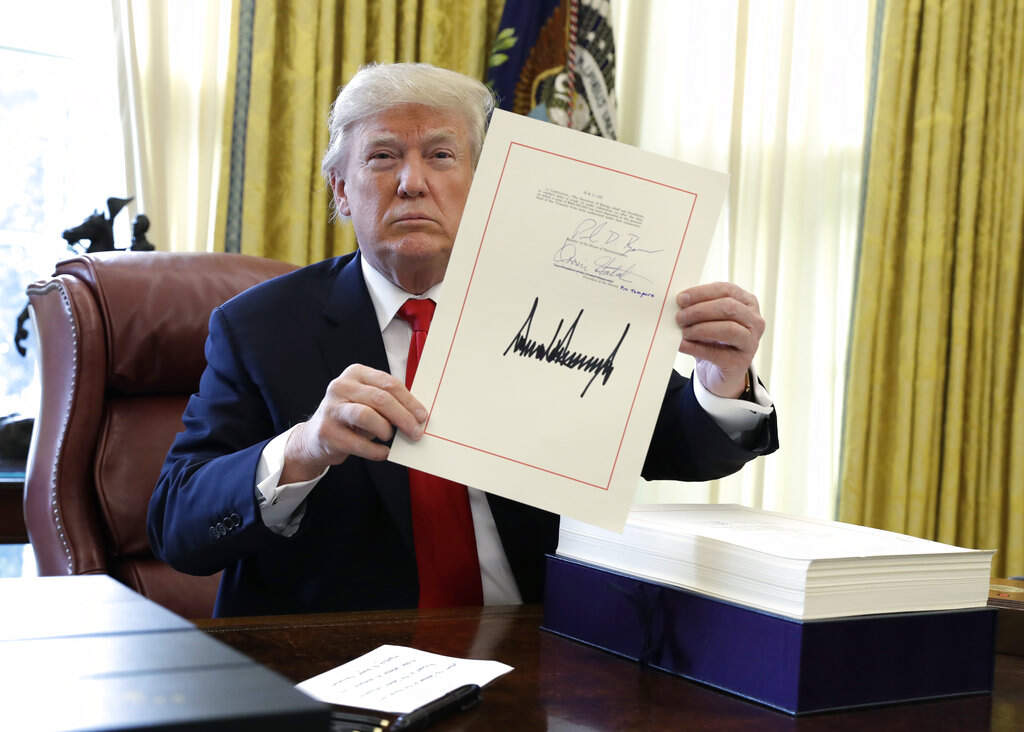
The House has passed a budget resolution, and a plan to extend President Trump's 2017 tax cuts. What’s known about the impact of those cuts on American taxpayers and the economy?
Guests
Joseph Rosenberg, senior fellow at the Urban Brookings Tax Policy Center.
Richard Rubin, U.S. tax policy reporter for the Wall Street Journal.
Transcript
Part I
MEGHNA CHAKRABARTI: On December 20th, 2017, President Donald Trump held a celebration at the White House. It was just a short time after the Republican controlled Congress passed the 2017 Tax Cuts and Jobs Act.
DONALD TRUMP: It's been an amazing experience; I have to tell you. It hasn't been done in 34 years, but actually, it really hasn't been done, because we broke every record.
It's the largest, I always say the most massive, but it's the largest tax cut in the history of our country. And reform, but tax cut. Really something special.
CHAKRABARTI: The 2017 tax cut did a lot of things. It slashed the corporate tax rate down to 21%. It capped deductions for state and local taxes at $10,000. We'll talk a little bit more about what else it did, but President Trump touted how the new tax cut reform was also going to help American families.
TRUMP: $3.2 trillion, just think of it, in tax cuts for American families, including doubling the standard deduction and doubling the child tax credit. The typical family of four earning $75,000 will see an income tax cut of more than $2,000. They're going to have $2,000, and that's, in my opinion, going to be less than the average. You're going to have a lot more than that.
CHAKRABARTI: The 2017 tax law nearly doubled the standard deduction for individuals and families from $6,500 to $12,000 for individuals and $13,000 to $24,000 for families. As Trump stated, it also doubled the child tax credit from $1,000 to $2,000. Here's then House Speaker Paul Ryan at the same White House event in 2017.
PAUL RYAN: The message to the hardworking taxpayers of America is your tax relief is on its way.
CHAKRABARTI: The 2017 law also had the effect of putting more stress on the deficit. According to estimates from the Congressional Budget Office, the cuts added about $2.5 trillion to the nation's debt. Just a couple of weeks ago, the Republican led House took a major step forward in preserving cuts.
MIKE JOHNSON: We are going to deliver the America First agenda. We're going to deliver all of it, not just parts of it. And this was the first step in that process.
CHAKRABARTI: That was House Speaker Mike Johnson on February 25th of this year, when the House passed a budget resolution that included extending the 2017 cuts. The resolution passed along a party line vote. Interestingly, it was 217 Republicans for, and 214 Democrats against. But the total number of nays was 215. Because one Republican voted against the resolution, Kentucky Representative Thomas Massie, who rebelled against the estimated $4 trillion this new round of tax cuts could add to the deficit.
Democratic Senator Chuck Schumer and House Representative Nancy Pelosi criticized the GOP's claims that more tax cuts would lead to a better economy.
CHUCK SCHUMER: Tax breaks don't lead to job creation. They lead to big CEO salaries and money for the very, very wealthy.
NANCY PELOSI: Now, the Republicans are taking their cruel victory lap, toasting it with champagne with their donors and the wealthiest, but they didn't do what they promised.
CHAKRABARTI: Okay, so how do we make sense of these claims and counterclaims? We're going to take a very focused look at what actually happened with the 2017 tax cuts, because now we have almost eight years of hard data and evidence.
So that'll help us better understand what might happen in the next decade or so, if those tuck cuts are indeed extended. So joining us now is Joseph Rosenberg. He's a senior fellow at the Urban Brookings Tax Policy Center, and he joins us from Washington. Joe, welcome to On Point.
JOSEPH ROSENBERG: Thanks Meghna. It's great to be here.
CHAKRABARTI: Okay, so I know that taxes are a difficult thing to summarize. Because it really depends on what your goals are. So can you just first of all remind us what the GOP said in 2017, its overall goals were in passing that big tax cut?
ROSENBERG: Yeah, so put yourself back in 2017. And as the bill that eventually became the Tax Cuts and Jobs Act came together. Really, the focal point was to reduce the corporate income tax rate. And there was fairly broad consensus that the way the United States taxed corporations was in need of reform.
So in addition to lowering the corporate income tax rate from 35% down to 21%, it also reformed the international tax rules that affect multinational corporations and affected how businesses can claim various deductions for investment.
On the individual side, the 2017 Act made a number of changes. And you can think of that as first being a set of across-the-board reductions in income tax rates for individuals. And then along with that was a number of partially offsetting some tax cuts, some tax increases, some of which you mentioned, including sharply increasing the so-called standard deduction, doubling the child tax credit, offering a new deduction for small and non-corporate businesses, and on the take side, eliminating so called personal exemptions.
And limiting other itemized deductions, including the one for state and local taxes.
CHAKRABARTI: Okay, so let's go back to the corporate tax cut issue because you're right. Yes, it was 35% in the United States. This cut it in 2017, it got cut to 21%. So really big drop in the corporate tax rate. Just check me on this.
That part was made permanent by the 2017 Act, correct?
ROSENBERG: Yes. There are complicated rules that Congress needs to follow when it enacts legislation that did not allow for everything to be permanent, but importantly, the reduction in the corporate tax rate and a number of the other corporate tax changes were made permanent.
CHAKRABARTI: A lot of progressive critics of the 2017 tax cut would say that it's all window dressing anyway, because so many corporations, or a lot of the country's biggest corporations, pay effectively, zero. We've had a lot of reporting on that over the past several years, that due to tax tricks and loopholes, that they're not even paying anything as it is.
Complaining about that high 35% rate is theater.
ROSENBERG: So certainly, there are a few issues in tax that attract more diversity of opinion than taxes on corporations. But the fact that corporations did not in fact pay that 35% rate prior to the 2017 changes was part of the impetus for change.
So there was a high headline rate, but not very many corporations paid it. And that's led us to where we ended up.
CHAKRABARTI: Oh, interesting. Okay. Just to underscore this point because I think it matters. There's been a lot of analysis on, let's say, how much the effective rate is for the biggest some of the biggest companies in the country.
For example, if you took GE, General Motors, Meta and T-Mobile, for example. We have one report here for Americans for Tax Fairness, who say that their, on average, their effective tax rate was 6.9% does that mean that they're all paying 21% now, Joseph, because the 35% rate was dropped?
ROSENBERG: No, no, it does not mean everyone's paying 21%. It's important to recognize that sometimes, these low effective tax rates are for legitimate reasons and are just byproducts of tax laws that we've chosen to enact. Including the ability to deduct expenses related to investment and hiring.
At the same time, on the other end, especially again, one of the other impetuses for the corporate changes were with multinational corporations, there's a lot of incentive to relocate where they record their profits so that they can pay a lower tax rate. And there's legitimate reasons for that tax rate to be low, and then there's more problematic reasons, as well.
CHAKRABARTI: Similarly, deductions apply to individuals as well, right? Can you take me into a little bit of more detail of we talked about the child tax credit, et cetera. But overall, what was the impact of the 2017 cuts on individuals who benefited the most.
ROSENBERG: Sure. To be clear, these were fairly broad-based tax cuts.
It was a mix of tax cuts and tax increases, but on net, a tax cut for most Americans. The estimates that my group did, and consistent with others, including official congressional estimators, on average reduced taxes somewhere around $2,000 to $3,000. But because the underlying income distribution is skewed to higher income people, and by and large, the 2017 tax cuts were through the individual income tax, which is a progressive tax structure, meaning higher income people pay higher tax rates.
It is the case that the benefits were larger. Even as a percentage of their income for a higher income of folks than they were for lower income folks. So just to try to put that in a little bit of perspective, roughly on average, we're talking about maybe a percent and a half in terms of an increase in disposable income.
So their taxes went down by about a percent and a half on average for everybody, that's lower for middle- and lower-income Americans, more like a half a percent to a percent, whereas at the upper income, it's much larger, 3% to 4% of their income.
Part II
CHAKRABARTI: Today we're taking a close look at what actually happened to the federal government's finances and to the economy after the 2017 tax cuts under the first Trump administration. And we're taking a look at that in order to understand what might happen if those tax cuts are extended as the current Republican controlled Congress wishes to do.
Here's some views on the ways that the tax cuts did, in fact, benefit some people. This is Howard Turner of Elkhart, Indiana. He listens to On Point, and he works in manufacturing. And he told us that because of the 2017 tax cuts, his refund check was, in fact, a little bigger, which allowed him to do things like buy Christmas presents and pay bills.
HOWARD TURNER: For me, when tax rates change, my payroll deductions, that just gets absorbed into my weekly spending, because it's not a big enough chunk of money to really change anything. And tiny changes when you don't have any money doesn't really amount to anything. Ooh, I get to go to McDonald's once this month.
That's something that seems a little special when you don't have any money, but does it change your financial outlook? No, not at all.
CHAKRABARTI: That's Howard Turner in Elkhart, Indiana. Joseph Rosenberg joins us. He's a senior fellow at the Urban Brookings Tax Policy Center, and he's helping us dig through the 2017 Tax Cuts and Jobs Act.
Joe, let me, let's talk a little bit about what Howard just said there, because there's always this debate between absolute dollars and percents, depending on how people want to advocate for or against tax cuts. And what Howard's saying there is, for low income Americans, even though they did receive a percentage cut in their taxes, I'm seeing here that if you made, according, these are according to your numbers, Howard, that if you made up to $77,000 a year and you're married, filing jointly your tax rate went down from 15% to 12%.
That sounds good. And I'm not saying that it's nothing, but on the other hand, as Howard's saying, if you're really low income, that small percentage just translates to a small amount of dollars. So it didn't make a meaningful impact in his life, a positive impact in his life. Whereas if you're earning $600,000 or more, having your tax cut by even a percentage and a half leads to a lot of dollars coming back to you, Joseph.
ROSENBERG: Yeah, no, that's absolutely correct. Another way to put that is again, using those numbers, consider a household making around $50,000 a year, their tax cut might be about $500. And again, that's real money, but you're still talking about roughly $10 a week. So that does provide a little bit additional disposable income for spending.
But it's for a lot of lower middle-income Americans, it was not the big change in taxes that they may have been led to believe.
CHAKRABARTI: But on the other hand, again, arguing the other side of this issue, many people say it's the top earners in the United States who are paying the vast bulk of federal income taxes, right?
I'm seeing that the top 1%, according to the Tax Foundation, say that the top 1% of American earners pay more than 40% of all federal income taxes. So if there's going to be a cut, it makes sense that it would redound the most on them.
ROSENBERG: Yeah, and that is also true, right? So again, for both because the federal income tax is progressive and because the underlying income distribution in the U.S. is highly concentrated at the top. It is the case that higher income Americans pay the bulk of federal income taxes. Now, of course, the decision to cut federal income taxes as opposed to, say, payroll taxes is a policy choice, and there would be different effects on households at different incomes depending on which route you take.
CHAKRABARTI: Okay, you need to talk more about that, Joseph, because it's very important. I'm in a repeating important points mood, Joseph. So you said the decision to cut income taxes, which are subject to all the deductions, et cetera, that we talked about earlier, versus payroll taxes, which just come straight out of a person's paycheck, is a policy choice.
What? Tell me more about why that matters.
ROSENBERG: Yeah, and these taxes do play different roles in the federal system, so individual income taxes are roughly 50% of revenue and is the major single source of revenue for the federal government. Payroll taxes are assessed on wages and other earnings.
The bulk of those are specifically designated to fund major social insurance programs, including social security and Medicare. There is a functional difference between those taxes, but it is also the case that they affect people in much different ways.
CHAKRABARTI: Yeah, so let's put it this way. If you are a working American who doesn't have a lot of other real estate or doesn't have a lot of other assets, stocks, bonds, et cetera, the vast majority of taxes you're paying are coming out of your pay stub, right?
Those payroll taxes. Whereas for overall income taxes, that includes for people who have those other assets. Yes?
ROSENBERG: Yeah, wages are also subject to income taxes. Depending on your income, you're likely paying both payroll and income taxes. It's just that income taxes are much larger and much more significant for higher income workers and for income such that you mentioned, like investment income and business income.
How much is the current capital gains rate? I can't remember.
ROSENBERG: The top tax rate on capital, on long term capital gains is 20%. There's basically another tax, a 3.8% tax that was enacted as part of the health care reform. Effectively it's 23.8%. But that's in, compare that to the 37% top rate that applies to other forms of income.
CHAKRABARTI: Exactly. Okay, so I've always believed that taxes aren't just financial instruments to fund a government. They are, in a sense, a statement of values by that government about, like you said, how do we want to pay for the things that we think are important to pay for as a country? With that in mind, the Republican controlled Congress in 2017 in issuing these tax cuts didn't just say, Oh, it's going to bring you individual relief.
There's constantly the claim when a tax cut comes that it's going to improve the economy, it's going to lead to more investment in manufacturing, more investment in increasing the number of jobs, that's how it's going to benefit everyone, if most or many working Americans didn't actually see a big change in their actual income.
Did that happen, Joseph?
ROSENBERG: Yeah. So that's a great question, because when you're talking about the reduction in the corporate tax rate or the reduction in individual tax rates on business owners, and investment income, you're correct. The idea there, the economic logic, is that you reduce the tax rate or increase the incentive to engage in investment, in hiring and to grow the economy.
And all the consensus estimates at the time that 2017 Tax Act was passed was that it would help the economy, and it would have some effect. The estimates varied a little bit, but the consensus was between a half a percent and a percent increase in the size of the economy, and that's significant, and that's real.
When you go back and try to estimate what have we seen since 2018 when these tax rates took effect, despite what some economists may like to claim, it's a hard question to tease out what performance you can attribute to the tax changes versus other things. And a lot obviously else has happened since 2018. We've had rounds of tariffs. We've had a major pandemic and the economic disruptions from that. And so there's nothing to suggest that the expected effects of the tax changes played out much differently.
And while there was certainly some increase in business investment and economic activity; it was not enough to pay for the tax cuts or significantly affect the wages of the average American.
CHAKRABARTI: Here's why I love numbers, Joe. Because the numbers don't lie, right? I'm speaking about that corporate tax cut.
Again, from 35% to 21% on the corporate rate. And the idea was, hey, that 14% windfall corporations would use to make big investments in the United States. To grow the number of jobs. We actually do know exactly what they did with it, right? In 2018, when that tax cut was put into effect, companies on the S&P spent $806 billion in stock buybacks.
They juiced their stock price. The previous record I'm seeing here on stock buybacks was $590 billion, all the way back in 2007. There was a very famous event where some CEOs of big corporations, I can't remember exactly who they were, but they all sat together on the dais and they were asked, what are they going to do with the windfall from the tax cut?
And they all said, we're going to do stock buybacks. That's not an investment back in the country, Joseph. And again, like I'm saying, the numbers don't lie. We know what they did with the money.
ROSENBERG: No. You're right. And the evidence we have on buybacks, on dividends, on executive compensation, certainly cut against the more optimistic trickle-down arguments, that is not to say that they are necessarily bad.
Part of it may have been related to the change in behavioral multinational companies needing to bring profits home. Some of it, you could be recycled back into the economy and argue it put to a more productive use, but certainly the promised or the stated direct sort of line of cause and effect was the windfall from tax would increase investment and that would increase productivity and wages.
And certainly, devoting those funds to buybacks and executive compensation go against that.
CHAKRABARTI: Yeah, it does not do it. Let me just play a little clip here. And this is from a recent, I think, yes, this is from last year. Sorry, I'm talking so much about numbers. I need to get my years right.
This is from last year, and according to the Congressional Research Service, the 2017 tax law increased economic output. As you had mentioned earlier, Joseph, by 0.2%, the year it was enacted, which was 2018 and that, by the way, was the year in which the effect would be the largest, the first one where the cut was immediately implemented.
But that 0.2% was below the expectations, which had been 0.3% to 0.9% of increased economic activity. And here's the rub. In order to pay for itself. This tax cut needed to generate 7% growth in the U. S. economy. So here's labor economist Katherine Anne Edwards, who testified at a congressional hearing last year, saying she was not surprised by the lack of economic growth.
KATHERINE ANNE EDWARDS: It's not a mystery why it didn't increase growth the way that you perhaps wanted. Tax cuts are but an arrow in the economic policy quiver, a way to boost aggregate demand to work effectively. They must be limited in scope, well targeted, and perfectly timed. Short term relief that goes to the people who are most likely to spend it at a time when demand is faltering, like during a recession.
The law is off on all three marks.
CHAKRABARTI: So that is Katherine Anne Edwards testifying before Congress just last year. Joseph, I'm looking at a paper that was written by, I think, one of your colleagues, Howard Gleckman, in terms of the cost of extending the tax cuts now. And the headline is, No matter how Congress labels it, it'll cost $4 trillion.
With that in mind, there's no way to possibly say that the 2017 initial implementation even paid for itself back then, right?
ROSENBERG: No, certainly. You mentioned the $2.3 trillion in total deficit increase from the original 2017 Act and extending the expiring tax cuts going forward is another $4 to $5 trillion in terms of additional deficits. And so another estimate from us, even with estimated growth in the economy, that might be expected to offset 6% of that cost. 6% is less than 100% where it fully pays for itself.
CHAKRABARTI: By 94%.
ROSENBERG: Correct.
CHAKRABARTI: So then, okay let's pretend for a moment that there's an actual goal here of reducing the cost of the tax cut. What you're saying is that what it means is spending would have to be cut.
ROSENBERG: Yeah, there's a couple different ways Congress can go. They can look for other tax increases or so-called offsets from the tax code, either by repealing tax preferences or increasing taxes in other areas, or they can offset the deficit effects on the spending or outlay side of the budget. That appears to be the path that Congress is going down is put into place in the House passed budget resolution.
Part III
CHAKRABARTI: Let's listen to a little bit of what at least one small business owner said about preserving the tax cuts. This is Michael Ervin. He's founder of Coal River Coffee Company in St. Alban's, West Virginia. And he says because of the small business deductions that were included in that 2017 act, he was able to pursue a lifelong dream and open a business in 2018. And here he is testifying at a congressional hearing last April.
MICHAEL ERVIN: This provision has allowed me to deduct up to 20% of my business income, which has let me invest in my business, my employees and in my community, we've been able to increase my employees hourly wages, invest in equipment, grow from a single location to four iterations, create a mobile location, and sell my main street roasted coffee internationally.
CHAKRABARTI: And here is why Michael Ervin pleaded with Congress to extend those deductions.
ERVIN: These tax increases do not exist in a vacuum, down the street from my location is a larger co-competitor, Tim Horton's. In two years, if my taxes go up, the corporate rate will remain 21%. Tim Hortons will be paying a 21% federal rate and a 6.5% state corporate rate for a total combined of 27.5%, while my total combined rate will be closer to 45%. This disparity will make it extremely difficult for me to complete our mission. I'm not asking for special treatment, but I am asking that small businesses get treated equally with big businesses and not be placed at a competitive disadvantage by the tax code.
CHAKRABARTI: That's Michael Ervin, a small business owner from West Virginia testifying before Congress last spring. I'd like to bring Richard Rubin into the conversation. Now he's the U.S. tax policy reporter for the Wall Street Journal. Richard, welcome to On Point.
RICHARD RUBIN: Hi. Thanks for having me.
CHAKRABARTI: Okay, I want to go first straight to this question of how much will the tax cuts cost? In passing that budget resolution a couple of weeks ago, Thomas Massie was the only person, the only Republican who said, Hey, this is going to add too much to the deficit.
Was that a point of concern for the other 214 or 214 plus Republicans who voted for the extension?
RUBIN: So it was certainly concerned for some of them, and you saw that in the way that the budget resolution was put together. They put in an allowance for $4.5 trillion of tax cuts over a decade, but they also tied that to spending cuts.
So the resolution calls for at least $1.5 trillion of spending cuts, to what we call mandatory spending over the next decade. And if those spending cuts don't get up to $2 trillion, that $4.5 trillion tax cut allowance starts coming down. So they, what House Republicans really did is they, okay, we're willing to extend tax cuts.
And we're going to make ourselves some space to do that, but we're gonna count on some economic growth to generate revenue and fill the gap and we're going to require ourselves to cut spending in order to do the tax cuts.
CHAKRABARTI: We just heard Joseph Rosenberg say that even if the economic growth maxed out under what was possible with these tax cuts, it would only be 6% of what was needed to cover the cost, but Richard, after how many years does that trigger gets set off of bringing down the tax cuts if the $2 trillion in spending cuts aren't achieved.
RUBIN: So the triggers is actually set up in the budget resolution itself, so it will prevent them from actually passing the tax cuts. Legislatively. Now that won't happen until the Senate also agrees on the same kind of trigger.
And so we're still waiting for Senate Republicans to figure out what they want to do, how large tax cuts they want, and what sort of spending cuts they're willing to do. But the House resolution doesn't wait down the road. It caps the size of the tax cuts and ties it to spending right now.
CHAKRABARTI: Okay. I got it. But it doesn't say that there will be no tax cuts if those spending cuts can't be achieved.
RUBIN: So it requires still at least a trillion and a half of spending cuts in order to get the $4 trillion of tax cuts, they locked themselves into requiring themselves to do spending cuts. Because there are a number of Republicans who are concerned about those deficits and want to start reshaping federal spending.
CHAKRABARTI: But I'm still seeing a large delta, though, between the cost of the tax cuts and the efficiency of this column that the House Republicans hope to achieve by spending cuts. Joseph Rosenberg, with that in mind, again, is there any way to close that delta to zero through pure economic growth, which is what I'm hearing Richard say that Republicans in Congress are saying will happen?
ROSENBERG: Yeah no, as Richard explained, so there is this sort of, roughly $2.5 trillion increase in the deficit. That is contemplated under the House passed budget resolution, and some of that could be made up through economic growth or other means, I think advocates would point not just to the tax changes, but also to the spending reforms and regulatory changes.
I think that is even more optimistic in terms of counting savings there. But yes, there is that, the gap.
CHAKRABARTI: Even more optimistic. You hear me writing this down because we're going to come back to that. But let's let the chairman of the House Ways and Means Committee speak for himself. This is Republican Congressman Jason Smith.
And on March 5th, so just a few days ago, he spoke at the American Enterprise Institute along with former House Speaker Paul Ryan about extending the 2017 cuts.
JASON SMITH: Failure is not an option when we're looking at the tax bill before us. Every individual tax rate goes up. So that affects 207 million taxpayers.
That's a pretty big hit to the economy. When Americans have seen inflation go up 21% in the last four years, the last thing they need is on average, a 22% tax increase.
RYAN: 22% tax.
SMITH: 22% tax increase on average for every American across the board.
CHAKRABARTI: Richard Rubin check that. Do those numbers make sense to you?
RUBIN: Directionally, yes. It's not every American, so the estimates we've seen is that if the tax cuts expire as currently scheduled under law, about 62% of households would see a tax increase. About 9% of households would actually get a tax cut and the other 30ish or so percent would basically come out even.
Directionally, yeah, there would be, there is a significant tax increase scheduled for January of 2026 if Congress does nothing this year. And the chairman's view that failure is not an option is very widely held among Republicans. We don't quite see what the exact path is to preventing that tax increase, but Republicans are very determined to do that.
CHAKRABARTI: Okay. And Joseph Rosenberg, I think Congressman Smith brings up a really important point, actually, in that clip that we played, which is inflation is also a major economic issue whose shadow is falling across the door of these tax cuts, that inflation has been perhaps one of the things that has stymied economic growth.
And in the face of that, continuing the tax cut might be one way to aid the economy along. What do you think?
ROSENBERG: Yeah, so he's certainly touching on the issue that is very important to most Americans. And that is simply, is their income keeping up with the cost of their expenses.
And it is unquestionably the case that, you know, absent Congressional action next January, tax rates will rise, and people will be paying higher taxes and seeing slightly smaller paychecks from withholding. But again, on average you're talking about roughly $2,000 and something more like $500 a year for households around that $50,000 income level.
That is real money that buys groceries, that buys other necessities, and nobody should question that. But it is a question of magnitude and how large of an effect that will feel given where prices are.
CHAKRABARTI: Okay. And here's a little bit more from House Ways and Means Chair, Jason Smith, again, from that same AEI event last week.
Former House Speaker Paul Ryan asked Smith to respond to claims that tax cuts only benefit the rich. And here's what Smith said.
SMITH: It's just not factual. When you look at what's expiring from the 2017 Trump tax cuts, two thirds of it is just on the individual side. And over $2 trillion worth of the expiring provisions are directly on people making less than $400,000 a year.
When you look at the child tax credit, that affects 40 million families. To qualify for the child tax credit, you have to make below an income level. And it's the same way with the 199A deduction. That's mainly the small businesses that will be affected on 199A whether they're going to be at that top tax bracket of 43.4%. Or whether they have the benefits of 199A.
That's a big impact.
CHAKRABARTI: Richard Rubin, I really hear what Chairman Smith is saying there when he says, Okay, just on the individual side, $2 trillion of the expiring provisions have an impact on people making less than $400,000 a year. But in the United States, from what I understand, 50% of Americans, half of Americans, have an annual income less than $75,000, right?
When we're talking about the less than $400,000 a year, put that in context. What does that really mean?
RUBIN: He chose that $400,000 threshold in part because that's the income threshold that Democrats have used for years now to say people below that will be protected from tax increases. And he's making a very accurate point, which is that there is broad bipartisan agreement to extend tax cuts below $400,000.
Now, yes, a big chunk of that money would go to people between $75,000 and $400,000. And it goes back to a point that Joe made earlier, is that people, if you're doing income tax cuts, if you're working within the income tax system, largely, the bottom 40-ish percent don't pay income taxes. They either get, are retirees who don't pay.
There are people, lower income people who get net income tax credits and still have payroll taxes. They're, for a variety of reasons, like not paying. So this income tax cutting exercise or cut extension exercise is going at the people who pay income taxes, the people in between $75,000 and $400,000, who both parties want to protect from tax increases and the people above $400,000 who Republicans want to make sure their taxes also stay lower, and Democrats have some mixed views on.
CHAKRABARTI: Okay. So speaking of. Sort of the, let's say the bottom half of the income bracket, the income scale in the United States. There are some other things currently at play, right? No new, proposal for no new taxes on tips, no taxes on overtime pay, potentially some tax relief for seniors. Richard, can you talk about those things?
RUBIN: Yeah, so those are all things that President Trump talked about during his campaign last year. Things that go beyond the extension and offer something additional to households. Depending on how they structure, those are again going to be for, largely for people who are paying income taxes and depending on how they structure them.
Will go to a fair number of middle-income households with tipped workers, people making overtime, seniors in some fashion. So those are things that are definitely on the table. Republicans are going to try, are going to struggle to try to squeeze all those in, right? When we talk about $4, $4.5 trillion, most of that gets consumed with a full extension of everything that's expiring.
So again, depending on where the Senate lands. It's going to be a struggle for them to do the extensions they're talking about, some business tax cut extensions, estate tax cut extensions, and also these new Trump proposals.
CHAKRABARTI: Okay Joseph Rosenberg, I have one more quick question on, let's say, a card game.
That seems like sometimes members of Congress want to play with taxes. I'm hearing that there are some proposals, maybe from some senators, who are claiming, like Mike Crapo, I'm thinking, who are claiming that there's no cost at all to extending the 2017 tax cuts. How is he claiming that?
ROSENBERG: Oh you're really ending on a high note.
So this is the concept of a budget baseline for scoring or considering legislative changes. And the argument here is that these tax cuts have been in place for eight years. So simply extending them is just a continuation of current tax policy and should not carry a cost for budgeting purposes.
That doesn't affect what people pay in taxes. It doesn't affect the amount of revenue or debt that the federal government would need to issue to offset the cost of the tax changes. But it does mean that for sort of budgetary scoring purposes, that $4.5 trillion dollars that it would cost to extend the tax cuts would be essentially treated as a zero because it is simply just extending the tax cuts that we already have.
CHAKRABARTI: Do you buy that Joe?
ROSENBERG: Again, the argument does not change the fundamental reality of what people's taxes will be or what federal revenue spending and the deficit will be, this is largely about the rules that Congress imposes upon itself, of what legislation it can pass. And to be clear, the rules are in place because of concerns about Congress enacting legislation that significantly increases deficits in the debt.
This program aired on March 11, 2025.