Support WBUR
The most powerful tech mogul you’ve never heard of
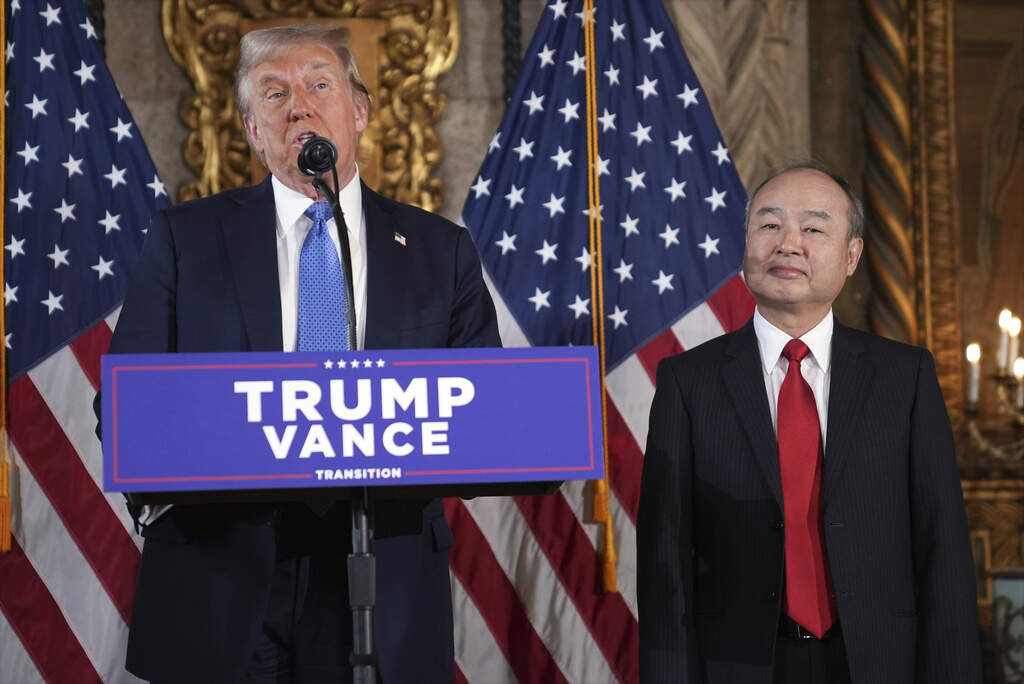
Masayoshi Son is pouring billions of dollars into U.S. artificial intelligence and flexing his ties to President Donald Trump. Who is this Japanese billionaire and what does he want?
Guest
Lionel Barber, former editor of the Financial Times. Author of the book “Gambling Man: The Secret Story of the World's Greatest Disruptor, Masayoshi Son."
Transcript
Part I
MEGHNA CHAKRABARTI: On the first full day of Donald Trump's second term, the President stood in the Oval Office flanked by three men. One, Sam Altman, the CEO of OpenAI, maker of ChatGPT, the second, Larry Ellison, founder and chairman of the computer tech giant Oracle, and a third man.
The most powerful tech mogul you've probably never heard of. When this third man stepped to the podium to speak, staffer set up a stool so he could reach the microphone. He's around 5 feet, 6 inches.
MASAYOSHI SON: Thank you. That’s good. That’s great. (LAUGHS) I feel tall now. (LAUGHS) Well, Mr. President, last month I came to celebrate your winning and promised that we would invest $100 billion. And you told me, “Oh Masa, go for $200!” Now I came back with $500.
CHAKRABARTI: This is Masayoshi Son, often just called Masa. He is the CEO of SoftBank, a Japanese investment company, and he's a multi-billionaire.
His net worth was some $33 billion in 2024, making him the 51st richest person in the world and the $500 billion Masa is promising the U.S. are for a big new artificial intelligence project called Stargate. It's a partnership between SoftBank, Oracle, and OpenAI to build AI data centers across the country.
SON: We would immediately start deploying $100 billion, with the goal of making $500 billion within next four years, within your term. This will help people’s life, solving many, many issues with the power of AI. AGI is coming very, very soon. After that, artificial superintelligence to solve the issues that mankind would never, ever have thought that we could solve.
CHAKRABARTI: So who exactly is Masayoshi Son? How did he come to have so much money, power, and connections to the White House? Why is he investing so much in the United States and what might his investments mean for the future of AI in America and beyond? Joining us to answer all these questions is Lionel Barber.
He's former editor of The Financial Times and author of the book Gambling Man: The Secret Story of the World's Greatest Disruptor, Masayoshi Son. Lionel Barber. Welcome back to On Point.
LIONEL BARBER: Great to be with you Meghna.
CHAKRABARTI: Let's actually first start with Stargate because for most Americans who have heard of Masayoshi Son, this was probably the moment, can you remind us what Stargate is and why was it so important that President Trump decided to use his second day in office to make the announcement about it?
BARBER: This has been a project in the works for at least two years. Masayoshi Son has talked about artificial intelligence and artificial general intelligence for at least 20 years. So he was looking for the right partners and the right moment, he found that moment in January with Donald Trump and he found the key partners.
One was Larry Ellison, the software giant in California. He's known him for well over 30 years. Larry Ellison, by the way, introduced him to Steve Jobs. The famed founder of Apple, and the other is Sam Altman, and I'm sure we'll talk much more about him. The founder of OpenAI whose ChatGPT product is sensational, the bestselling app of all time.
Now, Masa has recognized that the opportunity is to invest in America, which is engaged in an arms race with China to develop artificial general intelligence. And the opportunities are, first of all, in Texas and laterally across the country.
And what's needed are these giant data centers that can provide the computing power for models like ChatGPT, which consume lots and lots of energy as they're being trained, large language models, they need that energy, and these data centers can provide it. So he sees an opportunity. And perhaps the last point is that Masayoshi Son has been a great investor in AI related companies, just as he was being an investor in internet related companies for many years.
So he is bringing things together, data centers, energy, which he's also into. And AI related companies.
CHAKRABARTI: Let's listen to a little bit more of what he has to say about AI. This is at a recent future Investment Institute Summit in Miami, and Masayoshi Son argued that people are underestimating how quickly AI will improve.
SON: If you think, oh, Gen AI still has, you know, some mistake in understanding blah blah. “Oh, I am smarter than you.” You know, you are looking from downward from yourself into Gen AI, but that little thing is becoming a billion x smarter, and it's exponential. It's not — people, most people think linear. The reality coming exponential. And when you discover, “wow,” most of you too late.
CHAKRABARTI: Lionel Barber. Honestly, as we continue to learn about AI in doing shows on this program, I don't, I think exponential isn't even the right thing. I think the progression is likely geometric. But how did Masayoshi Son become interested in AI in particular?
BARBER: He's used a word, Meghna, which I hadn't actually heard about till I started writing this book, which is called singularity, and that was popularized by a writer called Ray Kurzweil. And singularity is the moment when artificial intelligence, that is the robot, surpasses the capacity of the human brain.
In terms of intelligence and reasoning, it's a big moment, and he's talked about that for well over 20 years. Now, in terms of context, Masayoshi Son has always been fascinated by technology. He claims to have had a sort of a great moment when he first saw the microchip, an Intel processor, back in the '70s, and experienced a similar sensation to Bill Gates, who also saw it in a magazine.
So he is gone from the microchip to the internet and now to artificial intelligence. This great arc of technology progress. And he's riding this new wave.
CHAKRABARTI: Ah, interesting.
BARBER: And that's where it comes from.
CHAKRABARTI: We'll talk obviously a little bit later in the show in much, much more detail about his journey, if I can put it roughly, that way as becoming one of the world's richest men.
But as an aside, Lionel regarding Kurzweil and the singularity, for several years now on my iPhone, whenever I send emails from my iPhone, my signature line that I put in there is sent from a device that proves the singularity is near. You got a big fan in me of this kind of crazy futuristic thinking from Ray Kurzweil.
But on the other hand, there's also obviously a big financial imperative here or financial boon that Masayoshi Son sees in AI, not just that it's technologically developing in leaps and bounds virtually every week. So here he is again at the Future Investment Institute Summit in Miami, and people have criticized him for perhaps overspending, with that half a trillion-dollar pledge to the Stargate Project in the U.S.
And Son says they're all wrong.
SON: I think you are looking at the wrong way. How much percent of GDP will be replaced by a billion X smarter thing? I would say at least 5% within 10 years. And that 5% is $9 trillion. If that's the amount of return. You shouldn't be scared of spending a few trillion dollars.
If retire is $9 to $18 trillion per year, why should you save, for what? I don't get it.
CHAKRABARTI: His billionaire's optimism there, Lionel, is quite apparent, but a little later, I'm going to talk to you about what's been the fate of his previous promises regarding investment in the United States.
But he immediately actually got, he and Sam Altman were almost immediately criticized by the most rich, the richest man in the world Elon Musk. Right after this, the SoftBank OpenAI announcement came out. Musk sent out this very terse post on X/Twitter saying, they don't have the money for a $500 billion investment.
Can you tell me about that?
BARBER: He's a great talker, isn't he, Meghna? He's also a great futurist. So it's all about the future and the potential growth rather than the actual returns in the short term. But there is a bit of personal, as we say in London, between Elon Musk and Sam Altman.
CHAKRABARTI: It's got beef. Beef is what we say here in the U.S.
BARBER: Okay, that's good. Two nations united by a common language. But Musk was a partner in the OpenAI company in its early days. And Musk is now doing his own thing in terms of AI, and he also has a beef with Sam Altman saying, he said it was for non-for-profit and actually now he's going for big time profits.
So how's he gonna sort out that in terms of governance? I think there's a big personal rivalry between the two. Now what Masa has done is he's chosen Sam Altman. He's not gone with Elon Musk as a partner. And the other point is that Masa is not looking at getting a return in inside four years.
He's quite right that the potential for artificial intelligence to play a bigger part in the economy is certainly there, but when the prophets come is another matter.
Part II
CHAKRABARTI: Now Lionel, I just wanna put a little coda on this personal as you said, or beef as I said, between Sam Altman and Elon Musk and thereby Masayoshi Son.
Let's hear them speaking about it in their own words. This is just last month, Son and Sam Altman were in Tokyo, where they were talking about AI for businesses. And Masa joked that Elon Musk, as we talked about, had been saying they don't have the money for the Stargate AI infrastructure project.
So you're get about to hear his voice. Plus, Sam Altman's.
MASAYOSHI SON: Our mutual friend, Elon Musk, says –
SAM ALTMAN: Your mutual friend.
SON: (LAUGHS) You know, he says, Masa, do you have enough money? I will. I will tell you, we will make it happen. We are not the bank, but we are SoftBank.
CHAKRABARTI: What you heard there was Sam Altman very pointedly jumping in and saying, your mutual friend, AKA, not mine.
Lionel Barber. Tell us about Son's earliest years, he grew up in Japan. He was the son of Korean immigrants to Japan. Tell us about his boyhood.
BARBER: It's really important to understand Masa is an outsider. He's Korean Japanese, and in Japan that means you're a second-class citizen. His grandparents came over at the turn of the century, and at that time, Korea was a part of Imperial Japan.
They were a colony. After the war, the family actually went back to Korea because they were seen as Japanese. They were rejected. So they then went back to Japan in 1947, and they lived in a slum. And Masa was born on the edge of a slum in a large family. His father who left school at 14 was initially a bootlegger and then a loan shark, and then went into pachinko gambling, which is this sort of semi underworld underground economy where it accounts for a huge amount of money.
In the Japanese economy, but there's essentially slot machine gambling. And Masa, therefore, was no longer living in poverty, actually his parents were quite wealthy. But he decided to go a different course. He wanted to be speak English, learn about the future. And he went to California, went to high school in California.
And then college. And he spent did three years at Berkeley at UC Berkeley, Lionel, we're gonna get to that venture in economics.
CHAKRABARTI: Lionel, we're going to get to that in a second, but can I just ask you a quick follow up about his family's please venture into gambling and Pachinko, as you said.
I was just thinking the title of your book is Gambling Man. Is there a connect, even though he went a different direction in terms of the businesses that he pursued? Is there a connection there in terms of his obviously high tolerance for outlandish risks that most people probably wouldn't take?
BARBER: You nailed it, Meghna. He learned the art of the hustle, but he also learned, and I discovered this because I actually interviewed his father. His father described buying a large Pachinko parlor called The Golden Lion, and this was the biggest Pachinko slot machine parlor in town. And because he needed to have very high turnover, lots of people, he fixed the machines, he fixed the pins, so everybody would win.
But of course, that meant running up very big losses. So his father gambled that. As long as I get the volume through, then people will come back, even if I've run up large losses. So he fixed the pins after a month, then he went back again to let people win again. This is how Masa has pursued his career.
He's delighted in running up big loss leading companies in order to get the bigger prize. The bigger market share, later.
CHAKRABARI: Oh, interesting. That's a really, so there's multiple conclusions we can draw from that early experience. I'm gonna obviously defer to you because the other one that comes to mind is, oh, market fixing.
So it's --
BARBER: I wouldn't dream of saying that.
CHAKRABARTI: I would. But I take your point about the loss leader, but then there's also this idea that, the big risk for the potentially big payoff. You also have to have the sort of, let's say, emotional fortitude to withstand things when they don't pay off.
Did he have like early failures in his career?
BARBER: One reason is, and he described to me how the Korean immigrants in the ghetto. Every night, during the week, the Japanese railway employers, they would actually dismantle the shacks and knock them over, and next day the Koreans would build them back up again.
And that's how he looked at life. I'll come back, even if I've lost anything, and there's a phrase or a saying, which is, if you started with nothing, losing everything, you just go back to where you were, you having nothing in a funny way that describes Masa's mentality. He has a giant, giant appetite for risk.
CHAKRABARTI: I would say that yes, his risk tolerance is on steroids practically. But also to your point about understanding his family's Korean history and how that was seen in Japan, I think more broadly what Masayoshi Son seems to have an outsized ability for is something that actually, if I might say, we see in a lot of immigrants, who have the risk tolerance to leave their own countries to go to somewhere else, sometimes with nothing to try and make a new life.
I think it's that, a similar mindset, but perhaps orders of magnitude more intense. Now, you had said that he came to the United States for high school, went to the University of California-Berkeley.
Now, we have a clip of tape here of Masayoshi Son speaking with a lawyer and businessman David Rubenstein back in 2017, and Son here is describing to Rubenstein how when he was a college student, he was thinking about how he could make some money on the side by only working, as he tells it, for five minutes a day.
SON: So I asked my friends, isn't there a good job that I can earn $10,000 in five minutes a day? (LAUGHTER) My friend said, “You're crazy. It's impossible. Nothing like that. Do you wanna sell drugs?” (LAUGHTER) So I said no, no, I don't wanna do that. So I said, okay, what is the best, most efficient use of my time? It's an invention, and I have to file patent. If I get the patent, five minutes, if I focus, I can make some idea. So I set alarm clock, five minutes, and tick tick tick. I said, “Come, invention! Come! Come!” Right? (LAUGHTER) It worked. That one was the electric dictionary.
DAVID RUBENSTEIN: And you sold it to Sharp?
SON: To Sharp.
RUBENSTEIN: And you made a lot of money.
SON: Yeah. Uh, $1.7 million.
CHAKRABARTI: Now Lionel Barber, I believe Son, when he says he set a clock and said, in five minutes I have to come up with an idea.
But with his showman's flare, he seemed to skip all the rest of the work that had to happen after that, to actually create his electric dictionary or at least enough so that he could file a patent for it. But tell us more about these years in the United States in college and thereafter and how it accrued so that he started making more and more money.
BARBER: Well, Meghna, I need to choose my words carefully here because I'd hate to get involved in any kind of litigation, liable. And I've obviously put this to Masa himself. But what you just heard with Masa, talking to David Rubenstein is, shall we say, very elastic with the interpretation of events.
CHAKRABARTI: Okay.
BARBER: And the reason I know that is that when I went to Berkeley, California in 2022, I tracked down the Berkeley professor, who's a nuclear particle physicist and innovator, a man called Professor Forrest Mozer, who was the true inventor of the electronic dictionary.
CHAKRABARTI: Oh my.
BARBER: And Forrest Mozer was 92 years old.
When I met him and I rang him up at home, went and spent breakfast with him, and then we've been in touch, and in fact he was in touch with me only the other day after the publication of the book in the U.S. And I'll leave our listeners to read the full account in the book. But essentially, Forrest Mozer was the inventor of that device.
Masa, very cleverly to give him his credit, understood that electronic dictionary, speaking dictionary could be, have a great application in places like an airport where foreign travelers could come and ask for directions, and they could speak into the device and outward come answers. But also, Masa, and he claims it was a misunderstanding.
He sold that technology to Sharp, without the knowledge of the then important distributor, National Semiconductor. And there was a big row about it, and he had to undo the deal, but he did make his million dollars. And by the way, Forrest Mozer didn't receive a red cent.
CHAKRABARTI: Huh.
BARBER: Just saying, but let's be, just so we can --
CHAKRABARTI: He's pretty clear in that tape though, Lionel, he says he thought for five hard minutes and invented the electric dictionary.
BARBER: Yeah, I did hear that tape. And I was slightly gagging, as we say in England. But Meghna, the thing is to be fair to Masa and we'll try to be, because Forrest Mozer is still sore about this. Masa was young. He was barely 21 years old. He was a young entrepreneur. He wanted to make things happen. He was determined to be a success.
And he brilliantly understood how that device could be, could work. And by the way, just so you know, I also tracked down the 88-year-old other computer scientist who worked on the project, and he gave me the same account, rock solid reporting here.
CHAKRABARTI: Oh, I do not doubt at all your reporting. What I'm beginning to doubt is the integrity of Masayoshi Son.
BARBER: We need to be careful, because he is done many other things. He's been a great entrepreneur, and I give him huge amounts of credit. It's just he does tend to embellish things. The one true thing, by the way, is that he is unbelievably ruthless about the division of his time, and he does divide it into five minutes segments.
And he also, and we need to say this on the program, he really does insist that this was just a big misunderstanding between him, Forrest Mozer and he did the right thing in the end.
CHAKRABARTI: He did the right thing in the end. By what? Doing what?
BARBER: By unscrambling the deal.
CHAKRABARTI: Ah, got it.
BARBER: Whereby he was distributing the product. In Japan without the knowledge of National Semiconductor.
CHAKRABARTI: Understood. Okay. Fair enough. But to your point about Professor Mozer not having received a red cent, Masayoshi Son being the 51st richest man in the world right now, he could probably sneeze and a million dollars would fall out of his pocket.
He probably, perhaps a good thing to do would be to give it to the inventor of the, actual inventor of the electronic dictionary, but from this early, even if somewhat qualified success at Berkeley. What else? What were some of his big investments later that really propelled him into the ranks of global billionaire-hood?
BARBER: He went back to Japan and created a totally new business of software distribution. Which is the company that he then took public and on paper in Japan by 1995, having launched the company in 1981 called SoftBank. He was on paper, a small billionaire, but then what he did was invest in Yahoo, the premier search engine company at the time.
And then crucially, the Chinese e-commerce giant Alibaba, which was his most successful bet by far, where he initially put in $20 million and $80 million, which turned into $125 and $130 billion. The Yahoo investment as well. He took 40% of Yahoo, or formed a joint venture in Japan called Yahoo Japan.
That, again, was phenomenally successful. So he's been a brilliant if somewhat mercurial tech investor.
CHAKRABARTI: So this--
BARBER: but it's more than luck.
CHAKRABATI: Yes. He seems to have an eye for, instead of standalone apps or businesses companies that you would, I think you used this word earlier, that were more structural to the digital age.
BARBER: Indeed, he heard that Yahoo was the coming force in Silicon Valley, the brightest light, if you like, and got in there pretty early, just ahead of, just after Sequoia, the venture VC business. On Alibaba, Goldman Sachs was ahead of Masa, but then sold Masa stayed with it. You have to give him credit for that.
Part III
CHAKRABARTI: Lionel, you had been telling us about those big and very successful investments that Son had made into Yahoo, and more importantly Alibaba.
Thereafter came what I think is perhaps the most important part of Son's current importance in the United States. And that's the SoftBank Vision Fund, which is a VC fund. He created, I believe, in 2017. It's got $100 billion in assets and capital. Perhaps the world's largest VC fund, and it includes investors like Saudi Arabia's crown Prince Mohammed bin Salman.
So here's Masayoshi Son on the David Rubenstein Show in 2017.
DAVID RUBENSTEIN: In one hour, you convinced him to invest $45 billion.
MASAYOSHI SON: 45 minutes. $45 billion.
RUBENSTEIN: Okay. Sorry. Okay, I apologize.
SON: $1 billion per minute.
RUBENSTEIN: What could you have said that was that persuasion To get $45 billion in one meeting?
SON: Uh, I said I wanna give you a gift. I wanna give you a Masa gift. A Tokyo gift. You invest $100 billion to my fund. And give you a trillion dollars.
CHAKRABARTI: Lionel Barber, tell us about the SoftBank Vision Fund.
BARBER: After those investments in the internet, companies like Yahoo and Alibaba. The dotcom bubble burst. And Masa lost 97% of his wealth.
So he came back 15 years later and there he is with $100 billion Vision Fund. He has always been a gambler, and he decided to go for a model where he is essentially flood the zone. He'd wipe out the competition just by throwing money. At the problem. And where would he get that money?
In the middle teens, the country that was most eager to get an entree into the tech ecosystem and also engage in a long-term project to reduce dependence on oil was Saudi Arabia, crown Prince Mohammed bin Salman, a young man, I've actually interviewed him by the way. I spent nearly two hours with him in Riyadh in 2015.
And even then, I saw the burning light in his eyes. This was a guy wanting to modernize Saudi Arabia. So he teamed up with Masa to give Masa $45 billion, not a $100 billion by the way. That's another slight exaggeration. He gave him $45 billion of $100, and it was actually $98.6 billion in this vision fund, which was to invest in AI related companies in the future.
It didn't work out so well, partly because Masa had promised a guaranteed 7% return and then he made some wild bets, notably on a company called WeWork that we all know about, with Adam Neumann, this real estate leasing company, office leasing company. And it ended up having to be rescued. And then finally after COVID went bankrupt. That was the biggest, highest profile.
CHAKRABARTI: Yeah. So Lionel, I'm gonna talk about that in detail. Because it's also linked to Masayoshi Son's previous promise of investing in the United States. But I want to just go back to something that's just, that's nagging me a little bit. And perhaps this has to do with all multi-billionaires, I hear Masayoshi Son with his now it seems like typical bombast approaching the Saudi Crown Prince and saying, I will give you a tenfold return on your investment. And I just feel like we're talking about a group of men who live on a completely different plane, right?
Including the Crown Prince, because of course, whenever I hear his name, honestly, the first thing I think of is the death of Jamal Khashoggi. But the journalist who died in the Saudi consulate in Turkey. Or was killed there, I should say. And it just, Masayoshi Son, the Crown Prince of Saudi Arabia, Elon Musk, these are all people of such fantastic wealth, unimaginable wealth that, you know, for the rest of us, the great unwashed back here on Planet Earth, it seems like they have, they've reached a point where there is no consequence when those men actually bet wrong or fail, there's no consequence for them.
Did you come away in your conversations with these men feeling that they had any sense of that whatsoever?
BARBER: Yes, because Masa has regularly done penance in public and said, I screwed up, or I dared to dream too big and in laterally after COVID, he actually disappeared from the public view for a year. Of course, he was plotting his next comeback, but I came at the end of this book, and it took me three years to research and write, with a little bit more sympathy for the great visionaries. These are the people who think of the future and make it happen.
Somebody, when I asked them to explain the mentality, they went back to Ronald Reagan. His Star Wars vision of having a space-based missile defense against the Soviets. Actually, it's happened 40 years later, if you see what Israel's done with its iron dome defense. There are things, you need to have dreamers, if they fail, okay, the shareholders suffer.
They suffer to a degree on their reputations, but I'm rooting for the dreamers on this one, Meghna.
CHAKRABARTI: Yeah, no, fair enough. I think history is rife with examples when, where someone with the kind of personality profile of Masa with a very high tolerance for risk, a single-minded devotion to a dream, like history turns on those people.
I completely agree with you, but at the same time, I think it's worth scrutinizing what happens when promises are made with a showman's flair. I'm starting to warm to the showman's flair part of Son. With the rest of us who sometimes have to carry the consequences of the failures of those promise, like the rest of us deserve to have a chance to measure what success is. Okay.
BARBER: It's true. It depends, Meghna, if you've invested in SoftBank or not. And if you had, you would've made reasonable returns, but certainly nothing like the returns that Masa has promised. But do you know something? He has made so many people rich, a lot of it, we haven't talked enough about it, is borrowed money.
He's borrowed from the banks. Remember, Japan had record low interest rates for more than 20 years because of the crash that happened in 1989. So he's borrowed money. He's then invested, he's spread a lot of money around and he's made a lot of people rich.
CHAKRABARTI: Yeah, no, completely. That's a fundamental truism of smart investment, is OPM.
Other people's money, use that as leverage to make even more money. Completely. Take your point. But I think where my skepticism starts creeping in more forcefully is when billionaires like this become entangled with politics, because then the cost of failure is truly spread out amongst more people, I'd say, than simply shareholders.
So let's use a particular example to scrutinize this a little bit. As Lionel, back in Donald Trump's first administration, Masayoshi Son met Trump after his 2016 victory at Trump Tower, and Masa promised Trump that SoftBank, this is again in December 2016, would invest $50 billion in U.S. tech companies.
And, now here's the thing. He actually gave us a way to measure whether or not this promise would be successful because he also committed to creating 50,000 new jobs. And after the meeting, Son spoke to reporters.
SON: I just came to celebrate his new job. Right? And we were talking about it. And then I said I would like to celebrate his presidential job and commit, you know? Because he would do a lot of deregulation. I said this is great, United States, U.S. will become great again.
CHAKRABARTI: So that's Masayoshi Son in December of 2016, after his meeting with Donald Trump, following Trump's first election win. Now Lionel, just for the sake of our listeners, I want to go over what happens to that $50 billion investment, as far as I can see, SoftBank actually, and the vision fund did make almost that the entirety of that $50 billion investment in the U.S. economies.
What they did was invested in a bunch of companies, lots of them from Silicon Valley, Slack, DoorDash almost half of it, as you pointed out earlier, went to WeWork, which then subsequently completely collapsed and failed.
The question about the jobs though. Which is what I think matters to more American, the 50,000 jobs, I'm not sure if it was ever determined that promise was fulfilled, because the majority of the investments went to private companies, so there was no public data available to say, this money translated into this many jobs.
So it was almost impossible to hold Son to account on that promise. And so therefore, does it give us perhaps a little incentive to remain, retain a healthy skepticism about this half a trillion-dollar promise, the investment promise that he's making.
BARBER: The number of jobs, I've asked SoftBank about that, and what they say is some of them were construction jobs, so they didn't necessarily last all the way through to today.
Then other companies failed during COVID. So it was true at a certain point of time in 50,000, the 50,000 figure, but then maybe there was some slippage thereafter what we're now talking about, which is $500 billion. That I think is something we really do need to look closely at, whether you can really do that inside four years. And does he have the money?
He's certainly gonna borrow, he's certainly gonna get institutional money, like pension funds. But I think that, to my view, is something of a stretch. But they do claim that they got to 50,000 by about 2021.
CHAKRABARTI: That's their claim.
BARBER: I'm trying to be fair here.
I'm no pussycat. Indeed, you tracked down a decades-old inventor of the electronic dictionary, so I'm speaking, let's say, on behalf of the listener. But okay. So with all of this in mind, how would you, in the last few minutes that we have, Lionel, how would you describe why you say that he is the world's greatest disruptor as you put in, we talked about the Gambling Man part of your title, but what is it actually that makes him this global disruptor?
BARBER: Look, at home, in Japan at first. First of all, he got into software distribution. A black box in Japan. He managed to insert himself between the manufacturer and the retail distributor.
Amazing insight there. Then he took on NTT Docomo, which was one of the world's most valuable companies at the turn of the century, and created his own mobile phone company. And then he went into the mobile internet. This is disruption on a huge scale, taking on incumbents. He mobilized not just one vision, funded $100 billion, but then $38 billion of his own money and put that to work in the area of venture capital and tech.
That true, inflated valuations overall, but it was a serious disruptive force in Silicon Valley, and now he's doing the same in artificial intelligence. I give him a lot of credit for that. And for being a truly consequential investor.
CHAKRABARTI: You've written also that at one time, at least, and correct me if I'm wrong, that Son played a role of being a bridge between the U.S. and China, but there's an article that you have in the FT I think, that says now he's picked sides.
BARBER: Yeah. He told me that in the last interview that I did with him. I asked him, you've been investing in the likes of Alibaba and some of the other tech companies. He's in ByteDance, by the way, which is TikTok. He's invested in all these companies, but he's also invested in America.
And he do that at a time when us and China in an arms race, technology arms race, and also decoupling. And he said, look, I had to choose and we'd chosen the west, we'd chosen America. So I think he's still got some legacy investments in China, but clearly his major push is the United States.
CHAKRABARTI: What's he like in person?
BARBER: Charming. Cautious. He speaks fluent English, but he is a great salesman. You have to look past that and get to the man. And the man is somebody who's just on edge of sadness because he's never satisfied. He always wants to go onto the next big thing. A bit like Sisyphus pushing a boulder up a hill.
CHAKRABARTI: It's a half trillion-dollar boulder now, Lionel.
BARBER: Yeah, it is. Large boulder.
This program aired on March 24, 2025.