Support WBUR
The dirty truth about the global waste trade
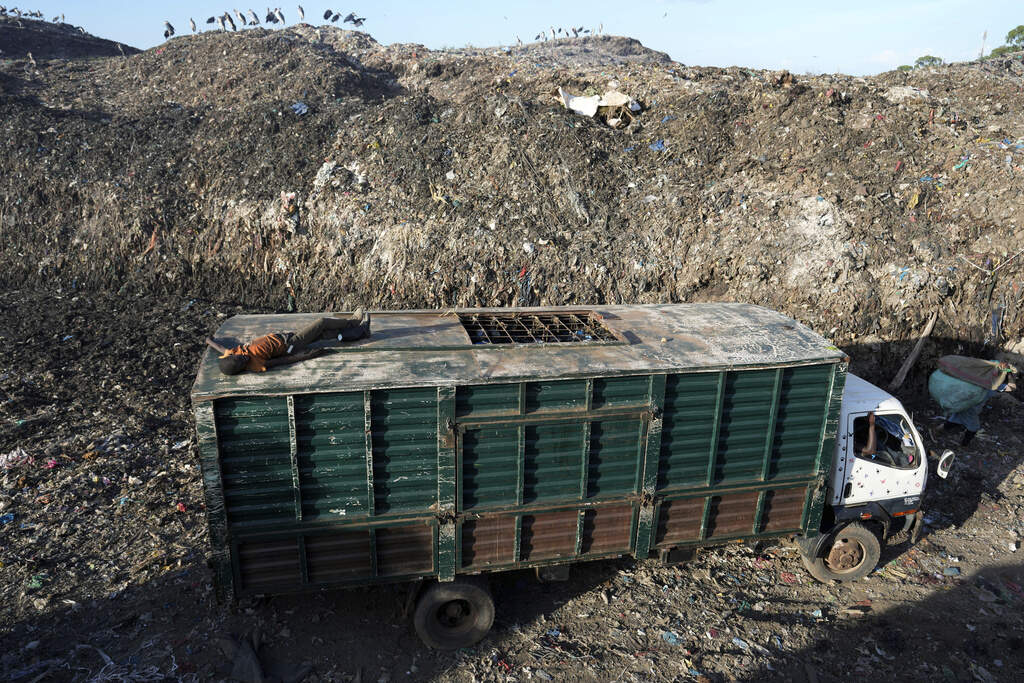
Americans throw away more than 15 billion pounds of electronic waste every year. In his new book 'Waste Wars,' Alexander Clapp reveals how millions of pounds of our trash gets shipped around the world, making a few people rich, and many people sick.
Guests
Alexander Clapp, author of “Waste Wars: The Wild Afterlife of Your Trash."
Book Excerpt
Excerpt from “Waste Wars: The Wild Afterlife of Your Trash" by Alexander Clapp. Not to be reprinted without permission of the publisher. All rights reserved.
Transcript
Part I
MEGHNA CHAKRABARTI: The numbers are staggering and difficult to comprehend. Human beings around the world are on track to produce more than 81 million tons of electronic waste annually by 2030. That's according to the World Economic Forum. We're talking about smartphones, laptops, TVs, and other devices.
So how much is 81 million tons? It's 162 billion pounds. Unfathomable, right? So here's a way to imagine it. A mere four years ago, in 2021, humanity threw away 57.4 million tons of electronic waste. That outweighs the entire length of the Great Wall of China, all 13,171 miles of it. And every year we are producing more.
The United States is the second largest producer of e-waste in the world. China is number one. Only 15% of the e-waste we throw away is recycled. The vast majority of it is thrown into the landfill, incinerated or shipped overseas, injected into the bloodstream of the global waste trade. You know that idea?
That one man's trash is another man's treasure, right? Waste brokers buy and sell our detritus for workers in other countries to dismantle, dissect, and extract whatever value they can. The problem is when it comes to modern waste, that old aphorism is a lie. Alexander Clapp explains why in his new book, Waste Wars: The Wild Afterlife of Your Trash.
And he joins us now. Alexander, welcome to On Point.
ALEXANDER CLAPP: Meghna, thank you so much for having me.
CHAKRABARTI: So start by telling us who are the burner boys?
CLAPP: The burner boys. Funny question. The burner boys are a group of young men, young migrants in Accra, Ghana, the capital of Ghana, Accra, and they spend almost all their hours of the day, probably a good 10 to 12 hours at least, of their working day, burning many of our electronics, which end up in Ghana.
In the 1990s, Ghana was on, became on the receiving end of many of the electronics you might've thrown away this week or this month, or this year. Old TVs, old laptops, old DVD players, stuff that while it might've worked, there's a reason why you're throwing it away in the first place. It probably doesn't work or doesn't work very well, or it might not work for very much longer.
A lot of this stuff for reasons that are complicated but interesting, ended up in Ghana or does end up in Ghana, and when it arrives in Ghana. There's a slum in the Capitol Accra called Agbogbloshie, where some 60,000 people are employed either directly or indirectly in the processing of your old electronics.
Now sometimes they try to get this stuff to work again. They'll jerry rig it, they'll fix it back up. But a lot of this stuff just can't be fixed. So what do you do with it? What do you do with an old DVD player that ends up in your slum? You try to extract value from it however you can. Now, a lot of our electronics have copper on the inside.
The problem is that, that copper is often in placed, encased in plastic wiring, plastic encasing, sorry. And so the easiest way to access that copper to make use of it is to burn it. This is where the burner boys come in. It's groups of men who spend 10 to 12 hours a day burning piles of our old electronics to get the copper.
CHAKRABARTI: Most of us never really think about what happens when we throw our electronics away. Or even give them to another group that says they're gonna do something with them. And so what I found to be like, just really challenging but in a good way in your book, is being able to like, almost see and feel these places. So let's do that in this conversation.
CLAPP: Sure.
CHAKRABARTI: What does Agbogbloshie look like when you visited it.
CLAPP: Agbogbloshie is this huge slum that's built on a peninsular headland. In this estuary in Accra. It's some 60,000 people piled and crammed into a space of land that's probably no bigger than, I don't know, 10 or 12 football fields.
CHAKRABARTI: Wow.
CLAPP: Yeah, it's full of people who don't actually come from Accra. They've come from hundreds, even maybe a thousand miles away from the Sahel, from the deserts of Northern Ghana.
CHAKRABARTI: And why have they come all this way to Accra?
CLAPP: They come because they're in the business of processing our old electronics, of burning many of the things, many of the electronics that you or I might throw away this month or this year, Agbogbloshie is a feted, squalid place. There's a lagoon that runs through it, which you cannot actually see. You cannot see the water because it's just a congealed mass of plastic.
It's not unusual to see cows chewing through last meals of television wiring or old VCR tape before heading to the slaughterhouse. It's a really stunning, viscerally, visceral, almost physically penetrating place to be. And it smells and it has all this sort of, all of your senses are on alarm when you get there.
CHAKRABARTI: Can I just ask, do you, how did you feel like physically being there.
CLAPP: It was strange. Agbogbloshie has been known for probably 10 to 15 years among Western journalists, so there is a sort of element of a white person coming to Agbogbloshie, walking in. You stand out. And there is an element among people there that, you know, you are coming to examine their misery and their poverty, and you have to do your sort of best to dissuade them of that notion.
And you want to make it clear that you're attempting to understand the work that they did, that they do, and how they got into a place where they've moved hundreds of miles to burn your old electronics. But it is a jarring place to be, for sure.
CHAKRABARTI: When, so the image of a cow chewing on a last meal of old VCR tapes is really something.
But like I said, the whole, I appreciated one of the purposes of your book is to disturb us into a state of higher awareness about what happens to this stuff. For the Burner boys, when they're actually incinerating or torching some of these things, like you said, in some cases to extract copper, where are they doing this and how?
CLAPP: That's one of the interesting things about Agbogbloshie. So for 10 to 15, even 20 years, this place was a huge embarrassment for the Ghanaian government. As I mentioned earlier, there were journalists who would come, who would photograph. If you Google this place, there are really stunning photographs of the work that is done there.
In 2021, the Ghanaian government said, enough is enough. This place is an embarrassment. We don't want it tainting our image anymore. And so there was a huge scrapyard at Agbogbloshie, which they razed to the ground without warning anyone there. Residents woke up one morning and there were bulldozers which came and destroyed their homes, destroyed their workplaces, destroyed their mosques.
The irony is that the Ghanaian government now has announced that they're gonna build a hospital on this ground, this extremely polluted, toxic ground. They want to build the largest medical infrastructure in Ghanaian history. They want to build it right there, but with places like this, it's extremely hard to get people who, this is the only work that they've ever known. They, as I mentioned, migrated hundreds of miles to do this, and so they kept doing this work. They kept doing the work of burning electronics in order to get the copper wiring out of them. They simply did this closer to their actual homes. There's another segment of Agbogbloshie.
Which is called the Korle Lagoon, and they now do this around the banks of the Korle Lagoon. So again, we're stuck with a contradiction here, in an attempt to clean this place up, in an attempt to build a hospital there. All that the Ghanaian government has actually done is moved a ton of the pollution, a lot of the carcinogenic flames that come from the burning of electronics, they've moved it closer to residences.
In terms of how toxic it is, as well, you've got some really chilling facts, for example. And this also was in your piece in The New York Times about, if you eat an egg in a Agbogbloshie, you're getting 220 times the tolerable daily intake of chlorinated dioxin, which comes from electronic waste.
But how are these being burned in some kind of controlled incinerator? Are they being burned in the open air? I really wanna get a deep understanding of what people are being forced to experience. Because we're throwing away so much stuff.
CLAPP: Yeah. They are not being burned in an incinerator.
What happens is every day, clumps of wires, these great rat nest of wires. So consider the stuff around you, whether it's a cell phone charger, whether it's the TV cord, for instance. All of this stuff gets gathered and then it gets moved on bicycles to the banks of the Korle Lagoon, which I mentioned earlier.
Now, the problem with this wiring is that it's not, it's flammable, but it's not very flammable. So you need to find kindling. You need to find stuff that will set this stuff a light, and you can burn it quickly, and you can make more money as quickly as possible. So what do you find? You have to gather plastic.
Now, a lot of our electronics are actually encased in plastic. A TV is just a big plastic box, for instance, or an old computer, an old laptop, or you have, say, Styrofoam, refrigerator, from refrigerator foam. And this is the stuff that's being gathered and put into piles and then being set alight.
This is what's used as kindling in order to extract that copper. So it's a really astonishing thing to witness that close hand. All of these electronics, which, you know, you have in your house, for instance, they're effectively being set a light. And it's producing this really disgusting, acrid, black smog smoke, which is billowing up into the sky, and then it's heading directly towards the slum where 60,000 people live.
At any given time, you have, 10 to 15 of these fires being burned. This is happening all day, every day. It's a really astonishing thing to witness.
CHAKRABARTI: Okay. And as you write the burner boys who are doing this are just, the money they're making is a pittance.
CLAPP: It might be $2 or $3 a day.
CHAKRABARTI: And to what cost to them though in their health?
CLAPP: Well, a lot of this remains to be seen. This really only began 20 years ago, but burner boys that I met complained about coughing up blood at night. They complained that their limbs would lock in a sort of icy sensation. They didn't quite understand why. They have effectively no access to any kind of health care whatsoever.
They live in a slum that is poor sanitation, which has enormous numbers of mosquitoes everywhere, which, as you mentioned, the food itself is some of the most poisonous food you can possibly imagine. It's, again I hate to paint such an image, but it's an incredibly bleak place to be.
Part II
CHAKRABARTI: Alexander, I can almost smell the acrid smoke right and feel the grease and the dirt that is generated by these toxic electronic waste fires in Accra and Ghana.
But then of course, the obvious question is how do these mountains of electronic waste from everywhere? But let's talk about from the United States, even get to Agbogbloshie.
CLAPP: It's a really good question, and I think it gets at the fundamental story of the waste trade here. The truth is that we do not send our electronic waste to Ghana and just dump it in a landfill without them knowing. They're knowingly on the receiving end of this material, and in fact, they are importing it and sometimes even paying for it.
In the 1990s, something really interesting happened in Ghana. Its leaders looked around and they saw a new kind of globalization opening up. This was a globalization in which the primary dichotomy was not between states of the north, the global north, for instance, and states of the global South, for instance, as it historically had been.
This was between countries that could get on the internet and countries which could not. We have plenty of testimony in the 1990s of Ghanaian leaders saying, look, we really need to become the cyber economy of Africa. We are English speaking. We don't have many tribal conflicts. This is a place that's safer for an investment.
How do we do this? How do we get our people on the internet? The problem is that in Ghana, the average wage is a dollar a day or less. So what did Ghana do? It incentivized, began incentivizing the import of secondhand electronics, however it could. Slashed import duties. It lowered taxes, for instance. And the idea was that, if we bring in all these secondhand electronics, we're gonna get Ghanaians on the internet and we're gonna become this great cyber economy of Africa.
Now, there was only one problem with that logic, which is, as I mentioned earlier, the stuff, the electronics that we throw away, we're generally doing that for a reason. The battery is broken, the screen is broken, there's activation locks, there's all sorts of things, and there's plenty that's been written about this, all sorts of things within our modern electronics that make them work for less and less time.
And so the stuff that was getting into Ghana, that was being sent to Ghana. Either by Ghanaians themselves, or by Western waste brokers in the 1990s and the 2000s, as much of a quarter of this stuff doesn't work now. Now, I think one thing that's very interesting about the waste trade is that we tend to think of this stuff that we surround ourselves with, whether that's a computer or whether that's a television remote as these inanimate inert objects that aren't really very dangerous.
But when waste travels to a poor country, when it heads to a developing country. It stops being a solid object. As I mentioned earlier, you have these groups of burner boys, for instance, who are trying to extract some value from these electronics. What do they do? They begin processing that. Processing is just a fancy word for, they're setting a lot of this stuff on fire.
And that's when all of the contaminants, all the toxins, all the additives, all the flame retardants, everything that goes into what we surround ourselves with every day. It's really dangerous. This is when this stuff starts leaking out, it goes into local ecosystems, it goes into water systems, it goes into the air, it goes into the food supply, as you mentioned.
The problem with these contaminants is that this stuff is effectively eternal. This stuff will never get out of these places.
CHAKRABARTI: It's exactly the reason why that they're not disposed of here in the United States.
CLAPP: Exactly. It would be far too dangerous, not profitable. A lot of this stuff, especially plastic, cannot be recycled effectively.
The answer for the last 30 years has been to send this stuff to a poor country and forget about it.
CHAKRABARTI: The story that you tell about why so much, so many secondhand electronics come into Ghana makes a lot of sense, right? A nation wanting to become part of the information age. But even now, when it's known, as you said, that, what, 25% of it at least is unusable.
Why is it still coming into Ghana? Who's making the money off of it? Because these systems don't persist unless someone is doing well from it. For example, who are the waste brokers that you talked about?
CLAPP: It's a really good question, and I think the most, one of the most important things to understand about the waste trade is that the dichotomy isn't between rich countries and poor countries per se.
You also have importers in these poor countries who are every bit a part of the problem, as the people on the exporting end of this stuff. Now in a place like Ghana, why can you do this at profit? Why can you do this at, how can you make money off of this? If you know a quarter of the stuff you're being sent doesn't effectively work?
You do it at scale. If you have lax import restrictions. If you have customs brokers or inspectors who can be paid off, if you can pay your labor effectively nothing. If you have environmental regulations, which are effectively recommendations, this stuff, if you keep doing it at scale, eventually there's enough money to be made.
In the case of electronics, for instance, you can extract large amounts of copper from our electronics. Now what happens to that copper when it gets extracted by the burner boys, when that plastic encasing gets burned off, this stuff gets shipped out of Ghana. It'll probably be sold to maybe Nigerian middlemen, and then it'll be sold off to, almost certainly, to Asia.
What gets left behind in Ghana, it's just this haze of pollution, the most polluted eggs you can ever imagine. Eternal contamination in the water and the air. And so I think one of the great tragedies of Ghana's attempt to become this kind of cyber economy of Africa is that in some ways it circled back into this older colonial era economy in which it acted almost exclusively as a sort of exporter of raw material to rich countries.
Whose benefits it did not ultimately see.
CHAKRABARTI: And the colonial analogy goes even further that what really what Ghanaians themselves are adding to this market is their labor.
CLAPP: That's right. And I would even add, there's a further twist here, right? What is Ghana historically known for? It's been historically known for gold, right? One of the really striking things when you see these electronics, there's tiny little bits of gold and smartphones, for instance, it's not inconceivable that some of that gold actually came from Ghana first, right?
And so you have this gold, which is returning to Ghana in the form of old electronics, and then it's getting exported out again. So Ghana's kind of not at the center of a globalized figure eight, where all this stuff is getting moved in and out of Ghana, but very few people seem to actually be benefiting from it.
And all that's left behind is this massive pollution.
CHAKRABARTI: Wow. And just I wanted to be clear to listeners that when I said they're adding their labor, I didn't mean as like a receiving positive return from that labor. The colonial model here is you're forced to give your labor, and then you get, you receive none of the benefit. Because that gets exported elsewhere. We've been focusing a lot on Ghana just because it was such a compelling example in your book, but it's one of many, so I wanted to go through a couple of others and maybe we can do it in somewhat like of a lightning round style.
Because the thing is that, as you said, this isn't necessary, the lines about who sends the waste and who receives it isn't actually that easily drawn. Okay. So for example, here's one. Everything from computers, as we talk to, all the way up to cruise ships.
So when a cruise ship is decommissioned. And no longer usable in any sort of secondary way. Where does that old cruise ship go?
CLAPP: Cruise ships will disproportionately go to Turkey. Now, I spent a month in Turkey investigating this. This was a really wild industry because there's a little port on the western coast of Turkey, just north of the port of Izmir.
Where Carnival Cruise or any number of cruise ship companies, based out of Florida for instance, will send their old cruise ships after five or 10 years, whenever they decide that these things are no longer seaworthy or no longer appealing to a new generation of cruise goers.
Now, this is a industry that's called shipbreaking. Statistically, it's the most dangerous industry on earth. Worse, more statistically deadlier than mining because ship braking is done almost entirely by hand. When you go to Turkey, when you see these huge behemoth cruise ships being deconstructed, it's a really surreal site.
You stand on top of a mountain overlooking the otherwise beautiful Aegean Sea, and hundreds, even thousands of these Turks who are filing into these cruise ships, which are the size of city blocks. And there are no big machines. There are no, you wonder how does, how exactly does this work?
And then you realize this is all done by hand. It's like a monstrous, huge construction project done rapidly in reverse where these men carry these sort of lightsabers and they're taking apart the steel from these ships deck by deck and the steel falls. As many as 10 stories from the top of a cruise ship into the sea.
It's extremely dangerous. The other sort of astonishing thing that I thought was that many of these Turks had never seen the sea before in their lives. They come from the middle of Anatolia, bust out to this port on the Aegean, and before they even really understand what's happening to them, they're filed into these huge cruise ships for dismantling.
That's what I mean by there are tiers of exploitation here. It's not simply north, rich countries versus poor countries. Within these developing countries, you have people who are making tremendous profits off the stuff we throw away at the expense of the poorest people in the poorest countries.
CHAKRABARTI: Maybe the cruise ship example is even, is one even easier to understand about the profit incentive here, right? Because you're talking about, I don't know, hundreds and thousands of tons of steel carpet, wood, whatever. Like you said. It's several floating city blocks and everything that comes with it, which some of it I guess has a high reuse value.
CLAPP: Steel is a genuinely recyclable material. So yeah, in a country like Bangladesh, which is one of the major destinations of old ships in the world, I think as much as a quarter of the steel that they generate actually comes from these ships which have been floating around the world for the last 10 or 15 years.
Now, again, this is a genuinely circular economy and on the face of things, this is good for the planet, but it comes at huge human cost.
CHAKRABARTI: Yeah. Okay. Here's another one. Car batteries. And batteries in general, but car batteries in this case, because, in the United States people are always told, there's very specific ways to dispose of your batteries.
You're not supposed to just toss it into the landfill because of the chemicals that can leach out of them. So what happens to car batteries in general when they leave the United States?
CLAPP: This is one of those examples of how a certain form of trash becomes like a kind of barometer of global inequalities.
In the 1970s and 1980s, we sent a lot of our old car batteries to Taiwan, for instance, for processing. And again, there's that word processing, which implies a kind of efficient way of extracting material, but it's often extremely messy, extremely toxic spewing in the 1990s and 2000s, as Taiwan became more prosperous, it says, it said, we don't need to take this stuff anymore.
So where did this stuff start going disproportionately to Latin America, to countries like Peru, as well as countries like Mexico. Many of our car batteries end up in Mexico. And again, why is this done? This is done because we could never safely, efficiently or profitably recycle those car batteries within the United States itself.
CHAKRABARTI: Okay. There's another one, a big one. And that's plastics, of course, of all kinds. You know what was interesting in is that for a while, and correct me if I'm wrong, because I was under the impression that a lot of supposedly recycled plastics were going to China, which had a big sort of processing, as you say, market for plastics until the Chinese decided they didn't want specifically like American's garbage anymore.
So where is all of this plastic going now?
CLAPP: Yeah, exactly. So for almost 30 years, China was the recipient of the overwhelming amount of plastic waste intended for recycling on Earth. In 2016, the Chinese Communist Party said, we're not doing this anymore. They cited the exorbitant amount of pollution, air pollution, water pollution, the microplastics problem, the toxics, the contaminants.
They cited all of this and said, look, we're not gonna be in this business anymore. And so the carpet was pulled out from this huge billion-dollar business, which was reliant on sending our plastics to a poorer country and insisting that all of this stuff was getting recycled. Now, what happens after 2017 when that law goes into effect is really interesting.
You have this kind of mad scramble where all of these rich countries, the United States, Canada, Germany, which for the last 30 years have been exporting the bulk of their plastics abroad, suddenly need a new place to send this stuff. And so they begin trying to find that new place. The United States starts sending huge quantities of plastic to Malaysia, for instance, as well as to Mexico.
Turkey on the edge of the European Union becomes the biggest recipient of British and European plastic waste in the world, plastic exports to Africa, for instance, quadruple. So there's this huge sort of rush to find the new place that's willing to accept this stuff. One of the things that's interesting about this sort of change in the plastic waste trade is that who are the importers of this stuff?
It actually happens to be a lot of the Chinese who were formerly doing this in places like Guangdong after 2017. What they did is they packed up their operations and they moved to other countries. So now you have this kind of Chinese diaspora of plastic waste importers operating in places like, Tijuana or Port Klang, who have basically just moved their operations abroad.
They're doing what they were doing for 30 years only. They're doing it outside of China, which will no longer permit this pollution.
CHAKRABARTI: Now I'm going to presume that some of it actually does get recycled, but a lot of it doesn't. So what happens to that?
CLAPP: A lot of it doesn't get recycled. As much as 30 to 50% of this stuff will get dumped in a field or torched in a cement kiln.
And I think one thing that's important to recognize about even the process of recycling, even when this process allegedly works, it's the process of recycling where the dangers come out in plastic. The process of mechanically or even chemically reducing our plastic. This is what is sending all of those toxins, all of those contaminants, all of those additives, the thousands of stuffs, things that go into modern plastics, which are very poorly regulated.
This is what comes out during the recycling process. It gets added into new plastic that's being created. It goes into local water systems. It goes into the air. This is in addition to the microplastics problem. There was a recent study in Vietnam, for instance, that found that as much as 10% of plastic that you even attempt to recycle is actually lost in the process to microplastics.
Now all of that stuff is just going into the water. It's making its way into the oceans. We will never get this stuff out. There's a reason why by some estimates, there's more plastic than plankton in the Pacific Ocean right now.
CHAKRABARTI: Yeah. And this is, we're talking about plastic waste imports, that's in addition to the domestic plastic use in all the countries that you've mentioned, right?
CLAPP: So I think there's three very important things to understand about the waste trade. The first is that especially with respect to our plastic, this stuff is not very valuable. Think about how much plastic there is out there. What is valuable is in being able to move this stuff, into being able to divert it.
That's where the money is in this industry. The second is, as I just mentioned, all of this waste, when it goes to a poor country, it gets broken down. It gets processed, it's getting melted down. It's almost better to think of the waste trade as the toxins trade. That's what's really getting moved here.
And the third thing is that the waste trade is fundamentally illogical. Tell me in what world it makes sense that in a country like Malaysia, for instance, where a piece of plastic, a domestically consumed piece of plastic, is as liable to ending up in the ocean as it is in a landfill or a recycling center, why on earth should this place be the biggest importer of American plastic waste in the world. This makes absolutely no sense. We send our garbage to those very countries that cannot handle their own waste outputs.
Part III
CHAKRABARTI: Alexander as I was reading through your book, and you know, how you're describing, I guess particularly in, what, Indonesia, these, you say hellscapes, right?
Of imported western waste where there's like plastic up to, I don't know, your knees, your waist, of every possible thing you could imagine. Do you know what popped into my mind as I was reading that?
CLAPP: No.
CHAKRABARTI: How could, but WALL-E, the movie.
CLAPP: Okay.
CHAKRABARTI: Have you seen it?
CLAPP: I have not, no.
CHAKRABARTI: Oh, okay. Okay. So it's a brilliant, animated film from many years ago, and it's about a little robot, a trash robot, essentially, on future planet Earth. And what has happened on future planet Earth is human beings have created so much trash that we have to decamp the planet.
CLAPP: Oh my God.
CHAKRABARTI: And jet off into the outer edges of the solar system.
And all that's left behind is one little, the only last functioning little trash robot. His name is WALL-E and he continues to do his job every day. He like powers up in the morning and putters around cities that are nothing but skyscraper sized piles of waste and he makes little waste cubes and organizes them.
It's a really beautiful and touching movie and a warning also, I think, to everyone about like that future is not only, not impossible to imagine. But you've already described it as being present now in some of the places that you visited, right?
CHAKRABARTI: Just like being, almost drowning, human beings almost drowning in trash that's imported into their countries.
So here's my question. You've used the word toxics a couple of times. You also write about in the book how most, if not all other forms of toxic waste are highly regulated in terms of how they can move around the world. Why do you think that's not true for these kinds of waste that you've been talking about?
That we know there are toxins within them. For example.
CLAPP: One thing that's really interesting about the waste trade is that in the 1980s, for instance, the United States was in the habit of sending huge quantities of toxic waste and steel drums to Latin American countries. We've effectively bribed these countries to take our waste. Western European countries were approaching former African colonies and saying, look, if you take our toxic waste, we'll reduce your debt. We'll build you a school. We'll build you a hospital, we'll give you hundreds of millions of dollars. That's how the waste trade actually began in the 1980s, with these outlandishly toxic forms of waste that were being sent to the global south.
What's interesting is that in 1989, developing countries, dozens of them, they band together, and they say, enough is enough. We're not gonna be on the receiving end of this stuff. We don't see any real benefit from it. This has to end. In 1992, something gets ratified, called the Basel Convention, and eventually gets signed in 1994 by every country, every major country on earth, with the exception of the United States.
The Basel Convention says that you can no longer send toxic waste from a developed country to a developing country. This becomes illegal. At the same time that people are talking about Basel and it's being passed, you have this other waste trade that begins developing. And this isn't really industrial waste.
This is actually post-consumer waste. So this is the stuff that you and I would throw away on any given day. A plastic bag, a plastic fork, a television remote, whatever. I think what's striking is that there was very little recognition at the time of just how toxic this stuff was. The petrochemical industry at just this time was telling us that all of this stuff was perfectly recyclable.
The problem is, if you broke plastic down, if you took all the additives of the flame retardants within plastic and you put it into steel drums, you could never ship that stuff to a developing country. But if it's in the form of a plastic fork or whatever it is, you can send that stuff. That's fine.
And so that's what's really striking and even ironic and tragic about the waste trade is that we knew this was wrong in the 1980s and there was a robust conversation in the United States about how this was very undermining, even from a foreign policy angle, to send our waste to foreign countries.
And yet it never stopped. It actually exploded in value.
CHAKRABARTI: Is that what you're talking about in the book when you write about as long as there's some seeming hope that there is a future use for even a portion of the compounds that make up, say, I don't know, a plastic milk bottle, that that's one of the reasons why this international waste trade is going to persist.
CLAPP: Exactly. Waste brokers are extremely clever with the language they use, and they don't operate in the world of trash. What they send are recyclable materials or reusable materials. There's this kind of rhetorical gymnastics that happens where the stuff you throw away is no longer garbage, and even if it's known that this stuff is gonna end up in a country where that cannot handle its own domestic waste outputs, where the likely fate of this stuff is to be torched, to be dumped, even if all of that is known.
They still do it. This still persists.
CHAKRABARTI: The China example is really interesting here because, and thank you for adding the details about when, you know, the Chinese government, which it was relatively recently decided to stop taking Western waste.
That makes me wonder about other countries now that are continuing to import this garbage, essentially, we talked about the incentives that the waste brokers have and maybe even the meager incentives that the human beings, the people who are quote unquote processing this stuff may have. But given the tremendous costs that you've been outlining, to the country and its people, when this stuff comes in, what's stopping Ghana or Indonesia or Bangladesh, as you're saying, from just saying, No, like China, we too will no longer be the receptacle for the stuff that Western countries don't want.
CLAPP: I would offer two answers. The first is these countries generally have other problems which they're concentrating on, they're attempting to build healthcare or they're attempting to build roads, or they're attempting to, on the sort of hierarchy of even environmental problems, trash tends to get relegated pretty low.
The second is that what you see increasingly is that countries that have actually even banned plastic waste import are still on the receiving end of huge quantities of this stuff. Now, how is that? I'll give the example of Indonesia where I spent a month. You go into the middle of Java, into these beautiful mountains, and before you are these huge plantations of Western plastic waste.
Now this is strange because in 2019, I believe, Indonesia said, look, we're not taking this stuff anymore. We learned from China. This stuff is dangerous. It's bad, it's toxic. We're not accepting it anymore. So how is all this plastic waste from the United States getting to Indonesia? Indonesia is still the recipient of huge quantities of secondhand paper.
We send a ton of our old junk mail, for instance, to Indonesia. This is a genuinely circular economy. It gets sent to Indonesia, it gets pulped down, it produces new paper. This is on the face of things good for the planet. The problem, and this maybe goes back to your WALL-E example, is that plastic is now so ubiquitous.
It's just everywhere. We need a place to put all this stuff. That increasingly our secondhand paper shipments to Indonesia are as much as 30 to 50% plastic. So the stuff that we're sending to Indonesia, which is a genuine circular economy, which should be helping the planet, is now full of all of this stuff that is actually just destroying the planet.
Now what happens when it gets to Java? It's way too voluminous to even attempt to recycle. So what do you do with it? These towns and Java, which specialize in taking this secondhand plastic, this American plastic, these dog food bags, meat packaging, you name it. They then send this, sell this to towns that are in the business of producing tofu, manufacturing tofu.
They use it as fuel in their furnaces. This is extremely toxic. The most proximate levels of toxicity ever recorded on the continent of Asia, or Agent Orange loading sites stating to the Vietnam War. So you have all this tofu, which is getting sold in markets across the world's most populous island.
All of these factories are producing this tofu and it's being made with incinerated American plastic waste. And that's an example of a country that attempted to outlaw this industry, and yet it still finds its way in.
CHAKRABARTI: Geez, wow. Obviously, the source of this problem is just this sheer enormous volume of stuff.
But you also issue, I'd say, a challenge in the book, and the challenge is for those of us in affluent countries who are not only producing, but the consumers who are driving the constant generation of more and more waste, to as you say, get real. With ourselves, because part of the hypocrisy here, as you point out, is that we actually, as nations, we know how bad the waste is, which is exactly why we send it away, because we don't wanna have to live with the realities of what that waste does, what it means, and how it could have an impact on our own environments.
CLAPP: Exactly. Yeah. A lot of people point to, you need to use plastic less in your day-to-day life, all of which is true, I think. We should be avoiding avoidable plastic at all costs. But I think the real onus, I think the way to really solve this problem is to start at the production level, we need to produce less plastic.
You have these beach cleanups, or you have these ocean cleanups which are going around and finding the stuff and, which is fine, but we're forever gonna be a dog chasing its own tail unless we actually stop producing so much plastic in the first place.
CHAKRABARTI: But what are people supposed to do though?
In the interim, like you said, it's impossible. Plastics are impossible to fully eliminate from your lives, right? When even for someone who tries to say they're use their cell phone for as long as they possibly can until it simply just won't get updated anymore, and it has to go somewhere.
I feel like people, consumers are also almost trapped within this same giant system that you've been describing.
CLAPP: Exactly, and if you look at the history of plastic, how this stuff actually was sold to us, no one in 1950 was sitting around saying, I really wish that this fork, this steel fork was made out of plastic.
This stuff was imposed on us. I think there's a few reasons for hope, though. The first is that many people listening to this probably have lived in a world where plastic was not nearly so ubiquitous.
You only have to really go back to the 1950s, to see a world in which plastic wasn't constantly everywhere. Everywhere around us. The second thing is, again, even if you don't care about the planet, that's fine, but presumably you care about ourselves, and what plastic is doing to ourselves is also really dangerous. I think the statistics now show that we have a teaspoon of plastic in our brains at any given moment.
Plastic is in our bone marrow, it's in our blood, it's in our reproductive systems. You really want to avoid this stuff at personal cost, no matter what you can do, no matter what you do. I'm not one of these people who proposes getting rid of all forms of plastic. I think the medical industry has a lot of really important forms of plastic that it uses.
The automobile and the aviation industry also use important forms of plastic. The point is to really try to avoid single use, avoidable plastic. I think single use is something like 50% of all plastic production right now, and most of this stuff is gratuitous. We don't need it. There's a perfectly fine substitute, paper.
Paper, you can roll up and toss into a river and eventually degrade and you'll never see it again. But plastic, this stuff sticks around for thousands, even tens of thousands of years.
CHAKRABARTI: I wanted to have you close the hour, Alexander, with the story of the people that you met in these different countries who are also trying to fight back against it or to raise awareness of the impact that the flood of Western waste into their countries is having.
Can you tell us the story of the Museum of Foreign Garbage?
CLAPP: Yeah, this is in Java. It relates to the story that I just mentioned with all of this Western plastic that gets sent to Java and much of which, Western paper that gets sent to Java, much of which is just useless plastic and deep in the Highlands of Java where you would never expect to see such a thing.
There's a Museum, of all things, and it is a museum that showcases all of the western plastic waste that keeps getting sent to Java. It's run by an extraordinary environmentalist named Prigi Arisandi, who has made it his personal crusade to really stop this, to stop this awful plastic importation, which is destroying his island.
And you go into this museum and hanging from the ceiling, there's this huge fish. And its guts are open and its rib cage is open, and out of that rib cage is poured, is coming all of this western plastic waste. And it's all the things that, you know, you might throw away today. Whether it's a package of candy or dog food or whatever it is, and it's leaking onto the floor.
It's this huge mass on the floor and it's this really startling example of, this stuff that was tossed away into a paper recycling bin 5,000 miles away, has ended up in Indonesia and in all places. It's now in a museum and it's a testament to how the stuff we throw away lives a kind of strange secret afterlife that is often very damaging to unsuspecting populations.
CHAKRABARTI: As you write, it's coming out of that fish is everything from old packaging from Sour Patch Kids Candy right to Amazon envelopes. We could, we have spent multiple hours before on this show talking about how online shopping has made an extant problem even worse. But what really got me and this is actually near what, one of the last chapters of your book, is that in order to create this Museum of Foreign Garbage, Prigi Arisandi got the Pringles cans, et cetera from the local paper factory.
CLAPP: Yep. And he had to buy them. They made him buy them. And it just goes to show that people will go to every length possible to make money off your trash.
CHAKRABARTI: Even if it's forcing an environmentalist to buy it in order to make a point about how dangerous the trash is.
CLAPP: Precisely. I am curious, has seeing all this stuff firsthand, right? And then, and talking to the people who are living with or wading through these lagoons of trash that we send out around the planet. Has it changed how you live, Alexander?
CLAPP: I definitely attempt to use far less plastic than I ever did.
And again, this relates to personal health, but also, I think I have a clear understanding of the ramifications that, you know, the stuff you throw away, there is no way one man's trash really isn't another man's treasure. That the Sour Patch kids, the Amazon envelope that you throw away is very likely to undergo extremely arduous carbon spewing journey from one end of the earth to another.
And as soon as I realized through my travels that I was this progenitor of this huge process that was hurting or damaging someone on the other end of the earth and certainly doing huge environmental damage, I attempted to reign in as much plastic use as possible.
This program aired on March 25, 2025.