Support WBUR
What does China make of the chaos in the U.S.?
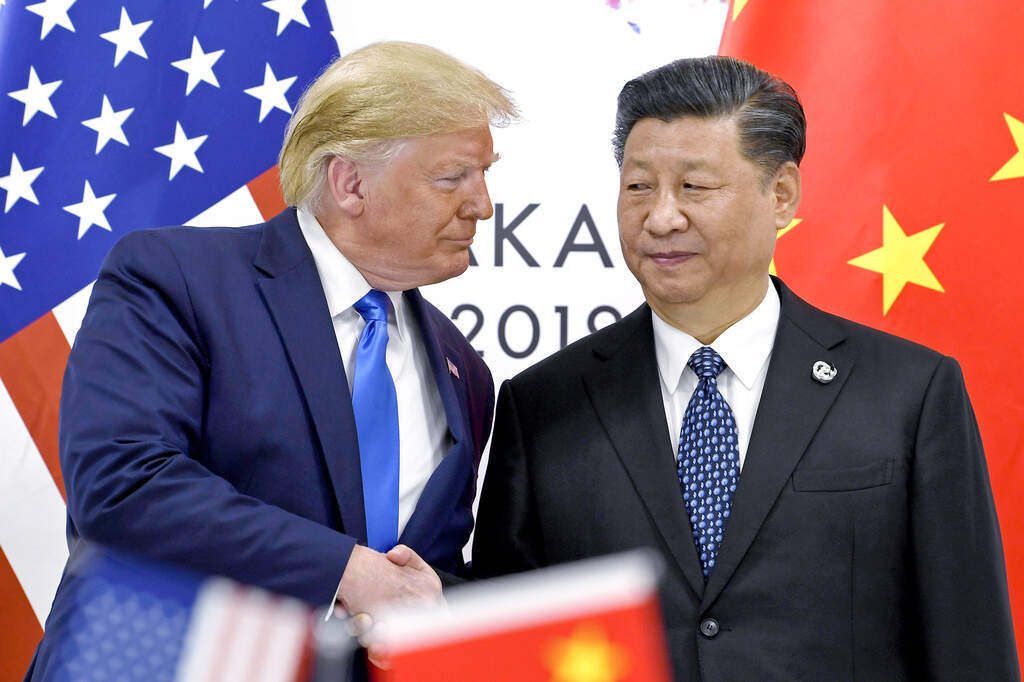
Escalating trade wars, disputes with allies, group chats with top U.S. officials' attack plans. What does the second Trump administration look like from China?
Guests
Yangyang Cheng, fellow and research scholar at Yale Law School's Paul Tsai China Center. Frequent columnist on Chinese politics and U.S.-China relations.
Julian Gewirtz, former senior director for China and Taiwan affairs at the White House National Security Council.
Transcript
Part I
MEGHNA CHAKRABARTI: On March 4th, Lin Jian, spokesperson for the Chinese foreign ministry in Beijing, said this.
LIN JIAN (TRANSLATION): Quote, "If war is what the U.S. wants, be it a tariff war, a trade war, or any other type of war, we're ready to fight till the end," quote.
CHAKRABARTI: That remark came just after President Donald Trump had hiked tariffs on Chinese imports by 10%. On top of the 10% he imposed in February. China retaliated with a 15% tariff on U.S. grown chicken, wheat, corn, and cotton.
It also added a 10% tariff on products like U.S. soybeans, pork, and beef. Then on March 20th, the New York Times reported the Pentagon plan to brief Elon Musk on the military's plan if the U.S. were to go to war with China, Trump and defense secretary Pete Hegseth denied the story at a briefing the next day.
DONALD TRUMP: You're talking about a potential war with China. Now, I deal with these people all the time, and I'm dealing with Pete. I'm dealing with these gentlemen on numerous different airplane purchases, and I think they're all going to be great. But I don't want other people seeing, anybody seeing potential war with China.
We don't wanna have a potential war with China, but I can tell you if we did, we're very well equipped to handle it.
CHAKRABARTI: Roughly one week later, Chinese President Xi Jinping met in Beijing with a group of multinational CEOs from companies like AstraZeneca, FedEx, and Toyota.
XI JINPING (TRANSLATION): We have always believed that the stable, healthy, and sustainable developments of China-U.S. relations is in the fundamental interests of the two peoples, the essence of China-U.S. economic and trade relations is mutually beneficial and win-win. And economic and trade frictions should be properly resolved through equal dialogue and consultation.
China will handle the broad future of Chinese-U.S. relations in accordance with the principles of mutual respect, peaceful coexistence, and win-win cooperation.
CHAKRABARTI: So today we're going to look at the view from China during this second Trump administration. What does the world's second largest economy make of a radical U.S. foreign policy shift?
And the dismantling of American government. So to talk about that, Yangyang Cheng joins us. She is a fellow and research scholar at Yale's Law School's Paul Tsai China Center, and a frequent columnist on Chinese politics and U.S.-China relations. Yangyang, welcome back to On Point.
YANGYANG CHENG: Thanks so much for having me.
CHAKRABARTI: Okay. So first and foremost, it's not unusual at all for a head of state and a spokesperson to say two different things in two different tones, right? Like the good cop, bad cop routine is very frequent in global geopolitics in the United States, it's oftentimes the head of state, aka Donald Trump, saying somewhat outlandish things.
And then spokespeople trying to tamp that down. But can you explain to me, Yangyang, this statement from the Chinese foreign minister about, we are ready for any kind of war in China, be it trade, tariff, or actual war? It seemed more pointed than we usually hear it.
CHENG: I'm not particularly surprised by this kind of rhetoric, and I think it needs to be seen in different dimensions. First of all, the Chinese leadership is in some ways prepared for a hostile U.S.-China relations. And that is regardless of how the election last year turned out and it is in anticipation of U.S.-China relations to continue to deteriorate for the foreseeable future.
And that is the position of the U.S. government, as well. If we go to the State Department, for example, it says, strategic competition is the basic framework of governing U.S.-China relations. So it's very important for the Chinese government in terms of its domestic legitimacy, as well as its geopolitical positioning, to adopt this kind of tough rhetoric.
On the other hand, of course, the Chinese government has a host of issues, including domestic, economic issues and such, and so it's also seeking opportunities in terms of finding other allies and countries and also foreign investments as well as domestic, private businesses and such.
CHARABARTI: I recall the last time you were on the show, Yangyang, you said that no matter who's in office in the White House in the United States. China is looking upon the United States from an adversarial point of view, right? Because the Biden administration wasn't friendly to China either. And I thought that was a really important point to hear. However, with this second Trump administration and the chaos that he brings back to the White House, and also the sort of U.S. domestic chaos that he and Elon Musk are unleashing. Has that made China even more wary of the United States?
CHENG: I think wary is a way to describe it. And I would say this, first of all, is that the Chinese government governs primarily by, its self-interests, with a host of domestic and geopolitical considerations. So it's not simply reactionary to the U.S., however, it is indeed like seeing different types of policies that's coming out from the U.S. government.
First of all, with regards to policies directed towards China, like in terms of the tariffs and some of the rhetoric. And that is the part where the Chinese government is least caught by surprise. And it has a host of measures, both rhetorically and policy wise, to counter it or to mitigate some of the facts.
And the second part is the U.S. government's policies and sometimes drastic actions towards its traditional allies in other countries. And I think this is a part where on one hand, Beijing may be seeking opportunities to build and foster new alliances. And it's also very important to note here that a lot of, for example, the sanctions on technologies and such, the U.S. government has placed on China, is implemented unilaterally, but it needs cooperation from other countries. So some of these breakdowns of traditional U.S. alliances may create opportunities for Beijing, as well. However, it also creates a lot of volatility and uncertainty in geopolitics. So in that sense, it's not as like Beijing is simply celebrating what the U.S. government is doing.
And then finally, when we come to domestic policy, with regards to the U.S. and on one hand, even though we may see some like hints of schadenfreude from Southern Chinese nationalistic outlets, but those were mostly like focused on very specific things. For example, like discrediting electoral systems or celebrating like the defunding of human rights organizations, or Radio Free Asia, Voice of America.
However, one also needs to understand that economic, like potential economic recessions or institutional breakdowns in the U.S. are not necessarily good for Beijing. And also, Beijing also looks to certain areas, for example, like climate monitoring, like global public health that really needs U.S. effort and U.S. input as well.
So I think it is, like, where is one word, like caution, like it is an uncertain, perilous terrain and it creates certain opportunities, but it also creates a lot of potential problems, and that is all these things that the Chinese leadership needs to take into account.
CHAKRABARTI: Okay. So let's talk about a couple of things within that then.
First of all, you said, and I hope I'm interpreting this correctly, but you said that when it came to the Trump administration's trade war and raising of tariffs, that Beijing had policy plans ready or already in place in order to cope with that? Are you talking about policies other than the retaliatory tariffs that China raised?
CHENG: Yes. So I think, again, like what might put these into three buckets, right? The first is in terms of Beijing, like China's trade with United States and its policies towards United States. And these, we are seeing retaliatory tariffs, as well as like Beijing also implement some sanctions and extra scrutiny on U.S. companies, and U.S. investment.
And these are broadly being seen as like retaliatory actions. The second part is with regards to Beijing's relationship with other countries and foreign capitals and foreign companies. And as you mentioned earlier, right, there is this summit of global multinational companies, where it is really interesting to see the Chinese leadership position itself as a defender of free and fair trade of WTO rules and things like that.
And emphasizing the importance of foreign investments to China and Chinese economic development. And the third part, I think, is also very important, is that the Chinese government has been aware of this potential vulnerability in geopolitics, and out of a host of political economy reasons, has been trying to boost on domestic spending and domestic consumption.
The Chinese government has recently released a 30-point plan to boost domestic consumption. Right after the February tariffs, one of the first things Beijing did is to host this workshop or this symposium with leading domestic, private entrepreneurs. And very interestingly, this is the same thing Beijing did back in 2018 during the first trade war during Trump 1.0.
And that was also Xi Jinping summoned a number of leading domestic entrepreneurs, and that is an important domestic signal as well.
CHAKRABARTI: Yangyang, you're one of our favorite China analysts. That's why I keep, we keep inviting you back, because I don't know if you remember, but we did an hour about China's determination to increase domestic consumption.
That was, you shined a lot of light in that hour as well. We're gonna talk a little bit more about why China as a nation, but specifically President Xi Jinping actually seeks a kind of reduction in volatility a little bit later in the hour. But the fact is that President Donald Trump is simply a volatile leader.
We know that for a fact. And you had talked about, with our producer, Claire, that the Chinese people, I guess, they have some nicknames for President Trump. Can you tell us what those are?
CHENG: Yes. So one of the nicknames that came about, during the first Trump administration, or even during the election, because Donald Trump's name is transliterated two ways in Chinese. One is Chuan Pu, the other is Te Lang Pu. And so on one hand, Donald Trump has been known as Chuan Jian Guo or "Trump Makes China Great Again." And this has come up again, more recently, for example, because of the domestic volatility, there was a brief rallying of like Chinese stock prices have been rising and saying that Donald Trump is making Chinese stock great again, even just briefly.
And on the other hand, because of the Te Lang Pu transliteration there has also been this new nickname is called Te Mei Pu, or like super, super clueless and you'll see some social media posts asking about whether or not Te Mei Pu, super clueless, could save Chairman Xi, and things like that.
CHAKRABARTI: So Trump Makes China Great Again and Super Clueless.
Wow. I think that actually also says a lot, too. But I'm gonna, I wanna hear from you a little bit later about where these nicknames are coming from. You said Chinese social media, so we'll hear more about that in just a moment.
Part II
CHAKRABARTI: Yangyang, I just have to follow up with these nicknames that are going around for President Trump in China. Can you clarify a little bit, are these sort of being organically developed from Chinese social media, or is it more, is it not so organic?
CHENG: I believe they're quite organic and the Chinese people are very creative, especially on social media. And I should also mention the name is a very traditional Chinese name that hearkens back to the Mao era. And that I think came out during the 2016 election cycle.
And that is a direct reference to Make America Great Again. And then later it moved into make China Great Again. In a way, because of some of Donald Trump's policies. But there is a hint here is also because Donald Trump's strongman style, to some ways, is familiar to the Chinese public. That it reminds them of traditional, like strongman Chinese leaders and some of these elements in Chinese history and Chinese society.
And so that is our, like, I guess some of the incentives. In addition to just like the way it sounds. How these nicknames came up.
CHAKRABARTI: That is so fascinating because every time I speak with you, I'm constantly reminded that, we obviously, I keep saying what does Beijing want, right?
What does President Xi Jinping want? But we're talking about China, which is a vast nation. So for these nicknames to have come up organically from the Chinese people on social media, is really interesting to me. Do you, can you get a sense as to why or what exactly it is about President Trump that has engendered the super clueless nickname?
What are the Chinese people saying that makes him deserve that nickname?
CHENG: I think a lot of these are not so much about Trump's own China policies per se. But it's really like in the two areas, on one hand is the domestic policy with the attempted dismantling of lot of the traditional federal bureaucracies and targets on like issues like public health and education.
That really creates a lot of domestic turmoil and downside effects. On the other hand, it's really these seemingly very puzzling actions towards traditional U.S. allies. And also these attempts to like annex Canada, annex Greenland. And so these are actions that do catch a certain segment of the Chinese public by surprise, but also catches their fascination.
And that's how these clueless names might come about.
CHAKRABARTI: Okay. So just to put it, I'm gonna put a fine point on it. Even the Chinese people on social media are looking askance at the decisions that Donald Trump and the Trump administration are making. Okay. That should be quite a wake up call for Americans.
Yangyang, hold on for just a moment here, because I wanna bring in Julian Gewirtz into the conversation. Julian is former senior Director for China and Taiwan affairs at the White House National Security Council, a position that he served in during the Biden administration. Julian, welcome to On Point.
JULIAN GEWIRTZ: Thank you. It's great to be with you both.
CHAKRABARTI: Okay. So you heard Yangyang talk about how while the Chinese people may be scratching their heads about Donald Trump's super clueless management of the United States, at the same time, the volatility isn't necessarily celebrated by President Xi. What's your take on that?
GEWIRTZ: I thought that you had a great conversation about some of the potential upsides that President Xi sees from the Trump administration's actions at the moment. China sees upsides in its relationships, that it can leverage more effectively in Europe and Asia and elsewhere in the world. But I also do think they see a period of tremendous risk for the Chinese economy coming ahead. And while President Xi believes that he can lead China, I think, through almost any challenge. It's certainly choppy waters. And finally, I think they don't yet have a sense of what the Trump administration's strategy toward China is going to be, whether they're going to pursue the kind of intense confrontation.
That we saw in the final year of the first Trump administration several years ago, or whether as President Trump has indicated, they're going to pursue some sort of wide-ranging deal. So I think Beijing is worried, confident and confused all at once.
CHAKRABARTI: Yangyang, can you pick up on that because I know you've talked about how I mean you mentioned Mao earlier, that President Xi doesn't necessarily thrive off the same kind of chaos and instability that Mao did.
CHENG: That is correct. And I think I not every dictator is a revolutionary. Mao was a revolutionary and Xi Jinping very much is not, and he had seen the personally suffered and seeing from the downsides of chaos. And so he's someone who really seeks control. And this is a situation where a lot of things are out of his control, or beyond his control.
And I do think that I agree with Julian's points here, that the Chinese leadership are cautious. There are potential opportunities it could seize, but it is a very volatile environment, both in the context of domestic economy and social development on the other hand, in terms of geopolitics.
CHAKRABARTI: Yangyang, can you clarify something? When you said that President Xi personally suffered under, are you saying under Mao's rule?
CHENG: Xi Jinping's family background. Of course someone who personally suffered and his family were persecuted during the cultural revolution, and I do think that was a formative experience for him. And, of course, different people take away different lessons from that. And I think one of the lessons he took away was the importance of seizing and maintaining control.
CHAKRABARTI: Fascinating.
Okay. So Julian, you and Yangyang also actually shared an important point of analysis that I'd like to hear more about, and that is that the potential economic break, let's not call it breakdown, even possible recession in the United States is not that President Xi and the Chinese government doesn't necessarily see that as a good thing for China. Is it simply from the fact that we are still the world's largest market?
Is that it or is there something more to it? Julian?
GEWIRTZ: I do think that's really what it boils down to. From Beijing's perspective, while it has been pursuing a really state-led path in recent years for economic growth with complex position for the Chinese private sector.
Critically important for innovation, but also under tremendous political pressure at home. Their view really of trade with the United States is that they want to reap as much benefit as they can from it, while also favoring Chinese businesses and Chinese industries to the maximum extent possible.
And so there is still a tremendous degree of interdependence between the Chinese and American economies. And a slowdown in the U.S. economy or even a recession would have negative effects on the Chinese economy, as well.
Of course, the reverse is also true, meaning that the slowdown in the Chinese economy has created challenges for certain segments of the United States that sell and do business with China. And so you take those dynamics, you take the tariffs and a range of other economic policies, and it's a very challenging picture on the economic front.
CHAKRABARTI: Yangyang, do you wanna add to that?
CHENG: I think Julian summed it up really well, and I think there is one thing that I might denote here, is that if we look at the gathering of leading private entrepreneurs that Xi Jinping did a few weeks ago after this round of tariffs, and compared with 2018, after that round of tariffs, during trade war 1.0 and during the first Trump administration, there are some over overlaps in times of who attended, but there is also significant shifts that last time in 2018 the representation was more diverse in terms of industries, and there is more emphasis on traditional industries such as agriculture and manufacturing. In addition to some of the high-tech businesses.
However, in this February gathering, it is overwhelmingly, in particular, if we see the seating arrangements, as well as these speaking arrangements, the private entrepreneurs were being highlighted and given a prominent role are overwhelmingly in these high-tech sectors and these emerging technologies.
And I think that is an also an interesting area. The Chinese leadership has been placing a lot of emphasis on, and that is partly out of domestic considerations and but partly also in the context of this kind of strategic competition with the U.S. in these high tech sectors.
CHAKRABARTI: I see. Okay.
Julian, can we, I just wanna take a little side road here for a second because thinking about your experience as former senior director on China and Taiwan affairs. I imagine that you went to China somewhat frequently or at least had many, did you have meetings with Chinese leadership during that time?
GEWIRTZ: Definitely. Yeah.
CHAKRABARTI: What's it like to work with them?
GEWIRTZ: I think there are a few things that come across. The first is, this is a very different system, very different political system, very different context. And that is something that you feel when you engage with officials who've come up through the Chinese Communist Party, which is a very different thing than coming up through a system in the U.S. Foreign Service or in my case, as a China scholar and expert who went into government.
And they're tough in trying to assert their interests, just like we're tough in trying to assert our interests. So it's quite a interesting dynamic. It makes for quite a back and forth sometimes, but candidly, at the end of the day, you hope that everybody's a professional diplomat and can get done what you need to get done.
CHAKRABARTI: Do you have any stories about times where there were talks about anything go going on and maybe it didn't quite go as the U.S. had hoped and what happened and how maybe those times were smoothed over?
GEWIRTZ: One rule of being a professional diplomat is that what happens inside that closed door room, you let stay inside that closed door room.
But there certainly are moments, some of which were fortunately or unfortunately captured on cameras, where things have not gone quite as planned, including some early interactions in 2021 that were quite tense in public, but the reality is that at the end of the day, both sides, both the U.S. and China, do, I think, have an interest in preventing the intense competition between our two countries from veering into conflict.
And even if those interactions, sometimes bumpy and often tough, it's still worth the effort of doing it.
CHAKRABARTI: While I appreciate your diplomatic discretion, Julian, and I really do, it's also piqued my interest. So I'm gonna try one more time here. Let me put the question to you this way.
When you, yourself, have been part of conversations about highly sensitive matters, such as, let's say, Taiwan, right? I can't think of a more sensitive matter when discussing things with China, how did you prepare yourself to enter the room or the sort of mindset or thinking that you had during those moments.
GEWIRTZ: Sure. First Meghna, let me say, that you've demonstrated the key quality of success and diplomacy, which is tenacity in the face of a stonewalling interlocutor.
CHAKRABARTI: (LAUGHS)
GEWIRTZ: And, for me, in terms of preparing for those interactions or preparing even more senior folks for those interactions, I'm a historian by training and you wanna bring to the interaction that you're having, the meeting, even if you know it's gonna be quite tense and hard-edged, a deep and nuanced understanding of the history of how U.S.-China relations has treated this issue.
How the Chinese counterparts have seen it, and how we in the United States have stood up for our interests and values around that issue. And so you want that deep historical understanding.
You wanna marry it with an up to the minute sense of where tensions are. So on Taiwan, this is an area where Beijing has increased, steadily, the pressure on Taiwan, military pressure, economic coercion, political pressure, and the like. And so you want to have that up to the minute sense of the details, so that you can push back, you can call out where you need to.
And then third, and maybe most importantly, you want to have a sense of what you're trying to get done. The point of these interactions, these meetings, is not just to have a meeting. Say you've done that, put out a release and move on. It's ideally to get something done. And so in our interactions in the Biden administration, with Chinese counterparts, we were talking about some of the toughest issues in the relationship.
For instance, China support for Russia. And its war against Ukraine. But we were also talking about specific things that could benefit the American people, like getting the Chinese to crack down on some of the exports of fentanyl precursors. Which is a really important area.
CHAKRABARTI: Julian, unfortunately it's just the clock that is preventing me from continuing to try to worm my way into the room here with your diplomatic experience. But Yangyang, let me try to pull some threads together here, because in listening to what Julian's talking about regarding the kind of preparation approach and thinking that American diplomats need to have when discussing any matter with Chinese leadership. It's the kind of careful thought process that I don't think President Trump is known for. At all. His current envoys to China might be practicing the kind of diplomacy that Julian's talking about, but President Trump simply does not do that.
He is volatile, he is unpredictable, he's emotional, what have you. I'm actually wondering, given what you said earlier about President Xi's dislike for that kind of chaos. And you can tell me I'm full of it, Yangyang. But could this actually potentially be to the advantage of the United States, that Trump's unpredictability, could it be making it a little difficult for President Xi to really decide how to handle Trump?
CHENG: This is interesting. I think, I would say, first of all, I think we should give the Chinese leadership and also its people working in Chinese government, and in a sense was they can prepare for a number of different scenarios in response to the potential volatility.
And also, some of these things are not that unpredictable. A lot of what has been carried, a lot of the policies, both domestic and foreign, that has been carried out by the current U.S. leadership were outlined in Project 2025. And so I think sometimes one just needs to take the people in power at their word, as well.
And that comes to my second point, is I think the Chinese leadership actually has a lot of experience dealing with potentially volatile leaders, or people who are not necessarily so competent, but came into positions of power, because they pledge fealty to the leader. And I think these are things that people who came out of an authoritarian system, and who came out of an authoritarian bureaucracy are actually very adept at.
Part III
CHAKRABARTI: Now, Yangyang, a little bit earlier, you had mentioned domestic actions taken by the Trump administration, such as the attempted shuttering of Voice of America.
So I want to just play a little tape related to that. You're about to hear Kari Lake. Before we describe what her current position is in the White House, I think it's just worth remembering that she began her career as a television news anchor. She was the Republican party nominee in the 2022 Arizona gubernatorial election, and the 2024 U.S. Senate election in Arizona.
She lost both those races. President Trump then later said he wanted to appoint her as the next Director of the Voice of America. That position is not legally appointed and nominated by the president. So Lake was then later sworn in as her current position, which is special advisor to the United States Agency for Global Media, which oversees via VOA, Radio Free Asia and other news entities.
Okay. So Lake and the Trump administration have been working to dismantle these news agencies. They accuse Voice of America and radio Free Asia, of anti-American bias. Here's Kari Lake on Steve Bannon's War Room Podcast, March 17th.
KARI LAKE: Unfortunately, the product is not pro-American. It's not pro-American at all.
And that's really a symptom though of a bigger problem. The disease is that the people who've been leading the umbrella agency that oversees all of that, many of these are, the Obama and the Biden people that came into this agency have committed absolute, in my opinion, waste, fraud, abuse of the American taxpayer.
CHAKRABARTI: Now Kari Lake attempted to shut down Voice of America, or they did shut down, I should say, operations two weeks ago. But last week, federal judges set back Lake's drive to dismantle the broadcasters saying Lake could take no additional steps to close via VOA, Julian Gewirtz. Look, I can't point you to exactly what Kari Lake thinks is anti-American about Voice of America. But what's your response to this move by the Trump administration to shut down these broadcasters?
GEWIRTZ: I think in this area, as in foreign assistance, with the efforts to shut down the U.S. Agency for International Development, and a number of these areas, one way to think about it, vis-a-vis competition with China, is that the United States is unilaterally disarming, we are laying down tools that are very important for asserting U.S. influence in parts of the world.
And that is something that China benefits from. These are organizations, voice of America, USAID, that the Chinese Communist Party loves to denounce. They regularly take on these entities. Because, for instance, voice of America has provided a platform to a really diverse range of voices that are sometimes critical of the government in Beijing, sometimes highlight minority groups like Uyghurs or Tibetans. Beijing doesn't like that, and I think is candidly quite pleased to see these thorns in their side get pulled out by the United States itself, under the Trump administration.
CHAKRABARTI: Yangyang, it's fascinating to me that Kari Lake and Donald Trump see VOA as anti-American, because of course for a lot of the history of Voice of America, many Americans have called it pro-American propaganda. Does the Chinese government have similar kind of like international broadcasting programs? Like the Voice of America? Is there a Chinese equivalent?
CHENG: First of all, I thought I would mention it was really ironic as a Chinese person who grew up in China to hear this kind of rhetoric saying VOA is anti-American.
Because for as long as there has been a VOA, it's being called anti-China by the Chinese government, and back in the Mao era, right? Tuning into VOA is a highly dangerous act. It is called listening to the enemy's radio station, secret. On the other hand, like even as for myself when I was learning English in middle school in the early 2000's, I used VOA to help me learn English and a lot of Chinese people across generations who grew up.
After the reform era listen to VOA, not just as a window to know the outside world, but also just like to learn the language and some of the culture and the news. And so it is really sad. And on the other hand, the Chinese government, it has been pushing some of these global media outreach initiatives.
Probably most notably through CGTN, the China Global Television Network, as well as Xinhua, it's a Newswire service. And they have some reach, they have made some inroads, especially with the developing countries, partly is because there are twofold of the reasons. The newswire service actually is much cheaper. And compared with another Newswire service, such as like AP or Reuters.
So there is economic advantage. On the other hand, it also has a lot of like really great Chinese journalists. Who can work on these foreign assignments, and that is a way for them to practice journalism in a way that is a step removed from the most stringent censorship from Beijing.
And so it has made some inroads, but it's certainly not to the reach or the type of unestablished institution as VOA or Radio Free Asia are. And so it is a really sad thing to see these institutions being dismantled. Not that they're without fault, they have their problems.
However, I think I should also mention here that a lot of journalists who work at VOA and Radio Free Asia have come from these countries with authoritarian governments, have taken a lot of personal risks and their family members have taken a lot of personal risks. And so this is something to denote here, that there is a human cost to a lot of these policies in the current U.S. administration have been implementing.
CHAKRABARTI: Absolutely. Julian, I know that you can't answer this because I'm asking you to look into the minds of the members of the Trump administration, but I just wanna ask it out loud anyway.
Because we do request interviews with them and they say no, but I just wonder if any single one of them, does Kari, does Donald Trump, do they know of stories like Yangyang just told us. That something like VOA was actually, let's say, let's call it successful from the U.S. point of view, that it was considered a subversive act to listen to it in China for so many years. Why would you wanna shudder that if it's actually that effective in terms of advancing a U.S. message? I just do not understand it.
GEWIRTZ: Yeah, I don't either. And I think there's, in many of these areas, there are clearly, not what we would call complete information, but I also have to say, I'm not sure they care. I think there's an effort to take on parts of the U.S. government.
That is, seems like that's the end in itself and it's irresponsible to my mind, but I'm not sure that even if they heard that incredibly powerful history, that they would care all that much, unfortunately.
CHAKRABARTI: Okay. So let's turn to things that have happened regarding the Pentagon and China recently.
And Julian, I'm gonna stick with you here for a second, because not that long ago there was this New York Times report that said that Elon Musk was gonna go to the Pentagon to get briefed on I guess a document regarding possible responses from the U.S. if there were to be a war with China.
That then was denied by the Trump administration and the Secretary of Defense, Pete Hegseth. I'm just wondering what you think about that.
GEWIRTZ: Well, I don't know exactly in that case what happened, and I would say though, stepping back, it is really important to remember that one of Beijing's main goals strategically is to, everywhere it can raise doubts about U.S. credibility and to raise doubts with countries around the world about the reliability of the United States as a partner. And I think stories like this, along with many others that we've seen, that are about very unorthodox and deeply concerning ways of handling the most sensitive information.
I'm obviously also thinking here of the Signal chat incident, which maybe we'll come to. I think in these areas, we know that Beijing is pushing out a message, that as one commentator I saw over the weekend said, it is evident in his words that the highest levels of U.S. security decision making suffer from a significant lack of discipline.
That's his words, and they're pushing out that message, not just internally, but to audiences around the world. And why are they doing that? It's because they believe that they can contrast this dynamic in the United States with China being a better, more reliable partner. And that's very concerning.
CHAKRABARTI: But it's entirely believable because of these very actions, or missteps is too light a word, that have been happening in the United States. Julian?
GEWIRTZ: That's right. It's one of the reasons why having responsible national security leadership is so important and why this irresponsibility that we've seen from these folks is concerning to so many. Is that something like countries trusting the United States as a partner wanting to do more with us.
It's, there are a lot of intangibles. It's not just raw power. It's not just the ability to get your will, it's respect, it's credibility, it's the sense that you follow through as a partner. And the United States at its best does that, and that's certainly what we work toward in the administration I worked in. But it doesn't seem to be as much of a priority for these folks, to put it mildly.
CHAKRABARTI: Yangyang. I just wanna stick with the Elon Musk story here for a second, because he has no formal position in the Pentagon. The White House insists that he's not even the head of DOGE, right?
They just named some random person a while ago as the head of DOGE, even though obviously functionally, he is. I think the reason why the New York Times piece was so concerning, is not only because of Musk's relationship with the president or his lack of a role in the Pentagon, here's a person who has actual business interests in China.
So I'm wondering if you want, can you talk about the little bit or maybe, you know, more broadly, what Chinese leadership or the Chinese people even think of Elon Musk.
CHENG: It's not just Elon Musk has unsignificant business interest, both in terms of the consumer market as well and also the labor supplies with regards to China, but also like even his mother is a, like a social media influencer and a well-known spokesperson for Chinese, a number of Chinese private businesses in China.
And however, I think this is a wild card and a good degree of uncertainty here, but I do want to note here that I found that interesting, with regards to the Chinese reactions to this alleged Pentagon briefing, is that it tried to downplay it, right?
It didn't highlight it in central media, a number of the nationalist outlets and provincial papers that reported on it. The headline was overwhelmingly Donald Trump says it does not want a war with China. Donald Trump claims that the New York Times is fear, rumor mongering, and then I think there is an interesting data point in terms of seeing how the Chinese government is taking a cautious attitude towards some kind of explosive news like this. And the most, the safest way to approach it is to discredit the New York Times, which plays into its long-time rhetoric and attitude towards foreign media, as well.
And then also the Chinese leadership does not want to inflame, cause public panic or inflame certain kinds of nationalistic attitudes among the Chinese public beyond what they can control.
CHAKRABARTI: Yeah. No point well taken. And also to be fair, we played that clip at the top of the show of President Trump actually saying, I don't want war with China. And at the same time, it's not unusual at all for the United States military to have war plans for various countries. That didn't surprise me at all, but to your point, the sort of diplomatic handling around that is what was interesting. Julian, we just have about a minute left with you.
I'm wondering if you have some final thoughts on what you see potentially in the future, just even over the next six months with the U.S.-China relations.
GEWIRTZ: I think the big question is going to be whether the Trump administration decides that it wants to get into some sort of negotiation with Beijing about a deal, as the president would call it, and what the boundaries of that will be.
Will this just be economics or will they put other topics, security and technology on the table, in a negotiation. And I think as we've seen in this administration's dealings with Russia, a negotiation that has no boundaries around it can be very bad for U.S. interests, because it allows the negotiating partner to claim all sorts of things are being discussed.
And it's hard to push back on that effectively or to say, no, it isn't. Especially when you've damaged your own credibility. So I think that question is top of mind, and I think the biggest predictor of it will be whether we see President Trump and President Xi Jinping meet at some point in the next few months. Or if reports are to be believed, as recently as today, whether they may not meet for quite some time because as Yangyang was alluding to, Xi Jinping does not want to end up in a situation that he feels is tremendously uncertain and volatile.
And his staff wouldn't let that happen.
CHAKRABARTI: Julian Gewirtz, thank you so much for joining us today.
GEWIRTZ: It's a pleasure. Thank you.
CHAKRABARTI: Yangyang, I'm gonna give you the last word here too. What do you see coming potentially, or what do you, what will you be keeping your eye on over the next six months, let's say?
CHENG: And I should say here that since we talked a lot about high level policies here between the two countries' leadership, one thing that I really want to keep an eye on is the human cost and the social cost. Including how do people in China, like Chinese students, how do they navigate this environment who are like myself from 15 years ago, and if they had planned their entire lives to come study in the U.S. and pursue a career in the sciences, how would they change their life plans? And so I think that human dimension is something that I'll focus on.
CHAKRABARTI: Really appreciate you mentioning that because policy is one thing, but it has an impact on actual people.
This program aired on March 31, 2025.