Support WBUR
How groceries are priced
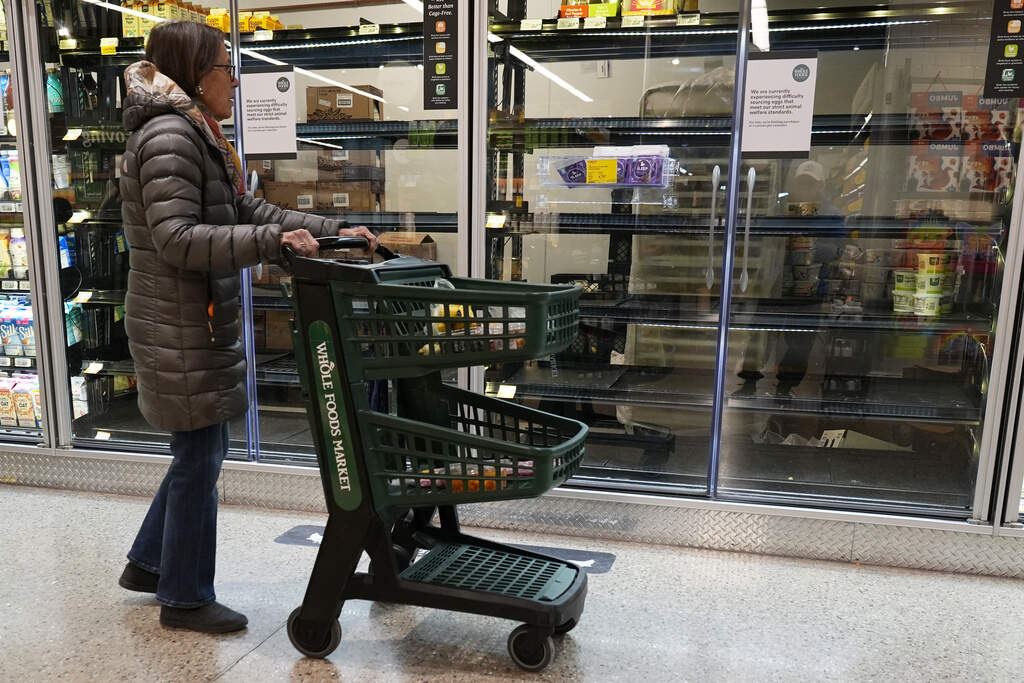
From pandemic inflation to the impact of tariffs the price of groceries is getting a lot of attention. But who decides what we pay — and why?
Guests
Lauren Chenarides, assistant professor of agricultural and resource economics at Colorado State University.
Ted Jaenicke, professor of agricultural economics at Penn State University.
Also Featured
David Ortega, professor of food economics & policy at Michigan State University.
Transcript
Part I
DEBORAH BECKER: Many people are grappling with financial uncertainty. Some might say anxiety, that not only involves investing in the fluctuating stock market, but also the basics, such as groceries. Statistics show in the past four years, the average price of groceries has gone up by more than 23%. That's no surprise to many of our On Point listeners.
(MONTAGE)
I think the thing that was hardest for me to swallow, no pun intended, was the prices for bread at Wegmans.
There's a three pack of hamburger that I get often that has gone from $14.99 to $23.99.
I buy the seeded bread there and it went from $5 to $5.50. And then from $5.50 to $6 and $6 to $6.50, I'd say all in the space of around 45 days, all the way up to $7 within literally maybe 10 days.
Until COVID hit in December of 2019, our grocery budget had been around $100 a week. That $100 a week grocery bill is now $200 a week.
I do not know how families of four or five, with small children, I don't know how they're managing to feed themselves.
BECKER: That was Elizabeth in Doylestown, Pennsylvania. Mary from Northboro, Massachusetts, and Howard in Elkhart, Indiana.
Now one of President Trump's campaign promises was to deal with those rising food prices.
DONALD TRUMP: A vote for Trump means your groceries will be cheaper.
BECKER: And in fact, after the election, during an appearance on NBC's Meet the Press in December, Trump attributed some of his win to that populist promise.
TRUMP: I won on groceries.
It's a very simple word, groceries, like almost, who uses the word? I started using the word, the groceries. When you buy apples, when you buy bacon, when you buy eggs, they would double and triple the price. Over a short period of time. And I won an election based on that.
BECKER: Yet the president has taken steps that could increase food prices.
David Ortega, who's a professor of food economics and policy at Michigan State University, says the food industry is grappling with some Trump administration policies such as higher tariffs.
DAVID ORTEGA: U.S. companies are scrambling to make sense of what this announcement means and where they might be sourcing products.
There are other policies such as the mass deportations that can have inflationary pressures. Further upstream, that can translate into higher food prices for consumers at the grocery store.
BECKER: But he says, there are many factors that increase our food bills, and most of them are outside of president's control. We wanna spend this hour looking at some of the reasons why our groceries cost so much and what's on the table to potentially change that. Joining us for this conversation first is Lauren Chenarides. She is assistant professor of Agricultural and Resource Economics at Colorado State University.
Welcome to On Point, professor.
LAUREN CHENARIDES: Hi Deborah. Thank you for having me.
BECKER: Yeah, thanks for being with us. So food prices have gone up now, we should say not as much in this past year as in the past few years, but we have seen a more than 23% increase over the past four years. What's the main reason that prices have risen so much, so fast?
LAUREN CHENARIDES: It's a great question and I think that David really just summed up some of the really great points about some of the factors that contribute to these prices. For the most part, when we break down food prices, we have to think about the food price as being a construct of the cost of goods sold.
So what does it cost to produce those items? We have to think about the actual transportation costs. When we go to the grocery store, there were a lot of steps along the way that got those products to the store. And then we have to think about all the operating expenses that retailers have to cover, which includes anything from keeping their lights on, employing people, and covering for things that maybe people don't understand as intimately, like spoilage.
A lot of perishable items can't last on the shelf that long, so retailers that are keeping those items in stock have to think about, if I don't sell this, what am I going to do with it? And when we break down that kind of equation, not to mention all the external factors that are going on in the market, which were happening between 2020 and 2023 that were not only the pandemic, the war in Ukraine, all these external factors that were contributing to these short-term supply shocks, which affected various parts of that food supply chain.
So those are the thematic and holistic components of it. But really the major driver was the cost of the inputs was increasing rapidly due to the labor shortages where some foods were being produced. And then also thinking about our reliance on, we need certain things from countries that we can't produce here in the United States, that go into making the food products. So thinking about the inputs for certain items like cereal. We can't necessarily produce all those items here in the U.S. and we rely on importing those ingredients from other places.
And when there's bottlenecks there that can increase the cost of food, ultimately that the consumer has to pay.
BECKER: So cost of the inputs means cost of the food product.
CHENARIDES: Exactly.
BECKER: Okay. And so do we know on average, when we look at the overall price of a food product, how much of that is actually for that food input, and how much might be representing all of these other things that you mentioned, like transportation and operating costs and other things?
What are we really paying for? For just the food?
CHENARIDES: That's a great question. And the way that economists really break it down is called the food dollar. So the food dollar is looking at how much of one's dollar goes to what you're referring to is called the farm share. And the farm share is what's the cost of the inputs, which is about 15%.
Historically, it may be 15% to 16% of what a single dollar spends on food, actually goes back to the farm. And then about 85% is left for marketing costs. So everything that follows from downstream after the farm.
BECKER: Wow. So we could save a lot of money if we could reduce those marketing costs.
CHENARIDES: In theory.
Yes, definitely. And those costs include everything from transportation to the managerial expenses to keep these retail organizations operating and HR, all that. And not to mention, too, there are some positives with those marketing expenses that I think consumers can really experience, with respect to promotional programs or loyalty programs. So when a shopper has their loyalty card for a certain retail chain, they can accrue a certain number of points. But to operate that loyalty program is another expense that retailers undertake.
BECKER: You said in theory that reducing those marketing costs in theory might help, but why not in practice?
Is it because it's a lot more complicated than just looking at that 85% and trying to make a cut?
CHENARIDES: It's complicated because of market structures and when we break down this food supply chain into producers, wholesalers, distributors, processors, prior to that, ultimately to the food retailer.
There are different number of players at those different sectors, and the market structure, meaning how many companies exist within each level of that supply chain, will determine the pricing strategies that happen at those specific points in the supply chain. And because retailers are so far downstream, the costs that they're facing are the byproduct of the way that those upstream channels compete with each other.
So if it's difficult, they're what we call barriers to entry, at any of those points upstream, then it becomes harder for new companies to enter. And therefore, those different channels are less competitive. And the good thing about competition is that competition tends to drive prices down. If we look at the meat sector, one of the topics that was really relevant around the pandemic, and around the pandemic, we learned a lot about the meat processing facilities, that there are so few.
And so when a lot of the labor force got sick and we couldn't process the raw inputs, the meat, into something that could be a consumable good, we saw that those prices increased and that was one of the major drivers of that, is there are not many alternative processors to fill in when one shuts down.
BECKER: I wonder how much does it matter where people are purchasing their food? If we stick with that, just a competition idea, for a moment. We know there are food deserts, right? Where there are very few grocery stores. So if you are in an area where you don't have many options, are you, is it automatic that you're going to be paying more?
CHENARIDES: Competition is a great thing. And when you're in an area where you have a lot of options, it's important for the retailers in a highly competitive area to make sure that they're pricing so they don't lose their customers. And exactly, in food deserts, or probably I would say more in areas where you only have one or maybe two supermarkets, they have, it's more concentrated, so they have more, they occupy more market share.
So their ability to potentially price over costs in a way where it looks like they could, yeah, be charging higher prices, is more likely to happen in markets where there are fewer supermarkets there.
BECKER: And where are, or what are the food products where we're seeing the biggest increases?
We heard from our listeners about certain items, but you mentioned meat during the pandemic, and that was very specific, right? To processing facilities and what was going on. But where are we seeing the biggest increases right now?
CHENARIDES: Certainly eggs, I think they've been getting a lot of attention.
So that's definitely going to be, I think, probably the number one seed for increased prices, and a lot of that had to do with the bird flu, the avian influenza. So that had certainly. --
BECKER: And that seems like a bit of an outlier, right?
CHENARIDES: It is. Yeah. Yeah.
BECKER: What about other areas?
Meat, fruit, is there one that stands out in particular, or is it just a higher overall price point for most groceries?
CHENARIDES: I think it's a higher overall price point for most items. To actually look at individual price increases across different products.
I would say maybe the BLS, they're putting together these price series that could be helpful. But I'd say for the most part, it's going to be across all categories.
Part II
BECKER: One thing we didn't mention, and I'd like to ask you about, I wonder about regulation. Do we know how much regulation might be adding to the cost of food? Of course, we all welcome regulation. We want our food supply to be very safe, and we also know it's highly regulated in the U.S. What do we know about what that does to costs?
CHENARIDES: So I think what you mentioned about food safety is probably the most important. And when we think about, when I think about our food system, the U.S., our global food system is one of the safest. And partly, here in the United States, it's because of the organization or agencies like the FDA, USDA, who are ensuring that the food that we ultimately consume is not contaminated in any way.
The food industry itself is one of the most regulated industries, if not the most. In the sense that at each point, again, I'm gonna go back to that supply chain, at each point in the supply chain, there are certain level of regulations that each, any company operating at that level of the supply chain must comply to or comply with.
And so regarding food prices and how they're set, I think that's something that's been baked into the business model, that I don't think in the recent years it has changed dramatically. That would be a major driver of the price increases that we're seeing right now.
BECKER: Yeah. Because of course, most of us would probably say we will pay more to know that our food is safe.
But that's not really an issue here, is what you're saying.
CHENARIDES: I don't think that's an issue here. And I think the other component of this too is that we put so much trust in our food system. And the agencies that we are relying on to maintain that safe food system. So that to me is really just something that is inherent in how our food is priced at the end of the day.
BECKER: I wanna bring another voice into the conversation now. Ted Jaenicke, who's a professor of agricultural economics at Penn State University. Ted, I wonder what you might say about why we're seeing some of these increases right now, and what do you think some of the big factors are for rising or behind rising grocery prices?
TED JAENICKE: Hi Deborah. Yeah, I think that the sources that Lauren already identified and David Ortega, labor costs, especially for particular items in the supermarket, that is a real driving factor. And then supply chain fragilities. How sensitive of the supply chain is to disruption.
That's something that got exposed during COVID, and that's continuing. And then I think the third factor is reliance on imports for certain parts of the food system. That's getting to be, of course with the coming tariffs that could become more unstable and more dicey.
These are really big factors and I don't think there's a single one that's really responsible for this increase in the grocery prices that everybody's facing.
BECKER: Let's get to the elephant in the room here. President Trump's proposed tariffs. And I wonder when we look at what might be coming from some of these tariffs, and I know it's hard to say right now, things are shifting.
There are uncertain, one day there are tariffs. The next day there are not, or they're on hold for a little while. And which countries are supplying us with what and how those tariffs might be imposed. So there are, let's just say a lot of uncertainties right now. But let's assume that a 10% tariff does, in fact, go into effect.
Does that mean then that the product from that country where the tariff is imposed would increase by 10%? Could we assume that it's apples to apples, if you will, comparison there? That 10% tariff means 10% price increase. Ted, what do you say?
JAENICKE: The short answer is probably yes, or very close to that 10%.
That's what economists would call the pass through of attacks, or in this case a tariff. And everybody's curious to know about what the new tariffs. How much are gonna be passed through. And economists are just beginning to look at some of the new stuff. And I think I just saw a report, not about food, but about cell phones and the components of cell phones.
And there, the pass through looks to be very close to 100%. So that is, if the tariff is 25% on some of those components, then the extra increase in some of those costs is gonna be very close to 25%.
BECKER: Now, Ted, I'm told that you have your students look at three specific food products, some that have been mentioned in this tariff debate, such as the avocado, which we've heard a lot about costs and potential tariffs on Mexico.
So I'm wondering why are your students studying that? What are you asking them to look at in terms of understanding food pricing?
JAENICKE: Yeah, so more generally, so I teach this course about our food system and the sort of the underlying main questions are, where's our food coming from, what are all the implications?
What are the factors? How are they, and how are they produced? And I do some case studies. I actually don't do a case study on avocados, but I'm a huge avocado fan. So I'm really, I would, definitely keep my eye on avocados. And I'll just mention a couple really big picture things first, before we can get into things.
One of the really interesting things about this question of where our food's coming from is that there are, in fact, country of origin requirements for a number of our food, the food in our supermarkets. All fresh and frozen fruits and vegetables have to have a country-of-origin sticker or a label to them, some other products as well.
And so you can go and look at avocados in the supermarket and see where they're coming from. Are they in the coming from the U.S. or are they coming from somewhere else? And to be honest, almost all, I'm in Pennsylvania, but almost all of the avocados in the U.S. now are coming from Mexico or maybe one or two other countries, and very little is being produced in California.
And that's been a big change since the 1990s. And I think that trade, free trade agreements with Mexico have been a real big driver for that, it's allowed us to buy avocados very cheaply from Mexico.
BECKER: Yeah, so what else do those stickers tell us? Do they give us any other information that we should be aware of as consumers?
If we do know the country of origin?
JAENICKE: No, I wish they did provide more information, but unfortunately, it's just the country. So consumers might have their own perceptions about different countries. But in general, I'll say that you talked about regulation, all fresh produce coming into this country is inspected at the border for food safety, like pesticide residues and other things like that.
So as Lauren said, our food is safe and that's true no matter whether it's produced in the U.S. or somewhere else.
BECKER: But you also have your students look at things like bananas. What does the story of bananas coming into the food supply and the price of bananas, which has remained stable for quite some time?
What does that tell us about food prices?
JAENICKE: Yeah, so it's hard to draw a overall giant conclusion, but bananas are a really incredible case study of efficiency of the supply chain. And so almost all our bananas in the U.S. are coming from Central America. And some South American countries.
But the supply chain has gotten extremely efficient and there's a number of factors there that have driven down the costs of goods sold. And Lauren mentioned the cost of goods sold is maybe one major part of the general price. So when it comes to the banana production in Guatemala or Costa Rica or Ecuador.
Number one, labor costs are very low, and land costs are very low. And third, this transportation cost. You'd think that transportation would be very costly, but these bananas are coming in on these giant container ships and they're so big that the actual cost per pound, per banana is really low, so it's an extremely efficient supply chain, and so far, even with COVID, there haven't been very many disruptions to that very efficient supply chain.
BECKER: Lauren, I wanna ask you about tariffs, and I wanna play a piece of tape here that we have from a listener, and we'll go back a bit to avocados, but this is an interesting point. We heard from Nancy in Buffalo, New York, and she says that she's seen price changes in the grocery store after President Trump's recent tariff announcement.
And she specifically talks about avocados. So let's listen.
NANCY: I was shopping at the big main supermarket around here, and I looked at avocados, which the week before had been 89 cents and all of a sudden, they were $1.79 each. And I said to my niece who was shopping with me, Wegmans is not stupid.
They heard gonna be tariffs. They thought, why wait, let's just raise the price on the avocados now.
BECKER: Lauren, could that be happening, that some stores are saying, we could preemptively impose higher prices in anticipation of tariffs rising them at some point? Yes?
CHENARIDES: I think it's more complicated than that. I think take an item like avocados, which is a perishable good. Likely more, probably more likely, is that there's going to be the retailers inventory decisions that they're accommodating, but perhaps there's some anticipatory inventory management optimization that they're trying to understand, or at least affect in the short run, but the tariffs haven't gone into place yet. So really when the retailers pricing their items, they're doing so in real time.
BECKER: So what do you expect if, say, we go back to the example of a 10% tariff? Would we, do you think then it's safe to assume that we would see a 10% price increase that would immediately be passed on to the consumer?
CHENARIDES: At the retail level, at the food retail level. I think food retailers are really sensitive to all of the factors that are going into the markets, prior to them deciding how to price an item. So what I mean by that is that retailers, especially in these highly competitive markets, they're competing against other retailers for your business.
And the worst thing that can happen to a food retailer is that you don't shop there anymore, that they lose you as a customer. So retailers, to a large extent, they try to absorb as much of the cost increases as they can. And until a certain point, so you know, until a certain point, meaning that until the point where they are going to lose margin, or lose revenue on their items sold.
Retailers are operating in an industry where their own margins are estimated to be anywhere from 1% to 3%. So retailers are going to try their best to absorb those costs that are coming in, that are increasing on their end. But in a case like tariffs and this example here of 10%, those increases are so large that we're going to see those prices increase.
BECKER: So prices will go up, and then, also, during the presidential campaign, if we go back to the political end of this, President Trump feels that his promises to lower grocery prices actually helped him get elected. And we did hear from in November or before November, former Vice President Kamala Harris, his Democratic opponent, say that she would like to ban price gouging in the food industry, because grocery prices were so high.
So everyone knew that this was a very emotional issue for a lot of voters. And I just wonder how much is price gouging then going on, and how much can federal policies really have an impact here? What do you say, Lauren?
CHENARIDES: So I definitely agree there's a lot of emotional frustration from consumers about how food prices are set and perhaps the lack of transparency that goes into it. Regarding price gouging, if I could just be technical for a moment here, too, is that price gouging itself is a term that does have a technical definition.
Regarding the regulations around it, and where and when retailers are engaging in price gouging and generally, it's around emergency situations. So there are about 34 states across the U.S. right now that have what's called anti price gouging laws, that if a price increases very significantly within a certain timeframe, that does not correspond with the increase in the cost for that retailer, then that retailer would be violating this anti price gouging law.
BECKER: Do we define what very significantly is or what the timeframe is like?
CHENARIDES: Yes. 10%, a 10% increase from a base period, which is usually 30 days prior to a state of emergency going into effect.
And generally, though price gouging, it can correlate with this feeling of, I don't understand the market power that retailers are putting in or are exerting in a market. I think this question of what is the markup and then how does that markup breakdown into the retailer covering their costs.
And then the retailer themselves making profit. And I think with the two political campaigns claiming that they have much to do in terms of enforcing that retailers keep those prices, those profit margins down. I think it's really difficult for them to do, if at all possible. We have the FTC in place, which is the Federal Trade Commission, that has different departments that help to ensure that consumers are protected against these profit seeking behaviors that would put too much cost on the consumers.
That's an important part of our government, to protect consumers. So I think that would be the source where we would lean on to ensure that the prices, specifically, at the food retailers are not increasing too drastically.
Part III
BECKER: We talked earlier in the show about tariffs and how those might affect food prices, and you mentioned, Ted, the workforce and what might happen here, especially if there's a crackdown on immigration. What do we know about the number of workers who are working in the food industry, particularly on farms right now, who may not be authorized to work in the U.S., and if there is a big disruption in that workforce, which it seems likely at this point, what that might do to food prices, what would you say?
JAENICKE: Yeah, that's a huge issue. I would say that where, in industries and agricultural industries, where, like, fresh fruits and produce, for example, where labor requirements are vast.
Many fresh fruits and vegetables are still picked by hand. In those instances, the workforce is by far majority immigrant and is hard to do, get good estimates of what percentage might not have the proper documents, but it could easily be 50% that is not properly documented.
One of the big changes that's been happening over the last 10 years or so is the increased use of authorized guest workers H-2A visas. So that's been going up and up, so that's perfectly documented and legal. But it's also very costly for producers, because there's a lot of requirements that go along with that.
So that's a big trouble spot in the supply chain, for fresh fruits and vegetables.
BECKER: And has anyone looked at whether, if it really is 50% of the workforce that may have trouble working on farms, to help with the food supply. What might that do to prices? Do we have any idea?
JAENICKE: No, it's not the easiest topic to study, because of the undocumented nature of the workers. But I think almost everybody believes that if there was a massive crackdown, like a mass of deportations, that would be a huge disruption. And I'll just give you one little anecdote, without naming company names, but in the prior Trump administration, there was also some immigration crackdowns. And here in Pennsylvania, Pennsylvania is a big mushroom producing state, and we have mushroom packing plants.
And one of those big mushroom companies did get raided by ICE. And what happened in that particular case is even though many of those workers were documented and legal, just the threat of a raid, kept workers away for weeks. Because even if they were legal, they knew people who might not have the right documents. And either not just a raid itself, but the threat of a raid can be very disruptive.
BECKER: Lauren, do you have anything to add to that, or my question that would follow that would be, so then will we see more automation, and can our farms actually afford that, if they can't get enough workers?
CHENARIDES: I think Ted summarized it very well regarding automation. Agtech is certainly an industry where there is ripe for innovation and continues to be funded heavily.
Here in Colorado, we've seen a lot of investment going into Agtech regarding automation and precision agricultural tools, to help with making farm operations more efficient and identifying opportunities for technology to exist. But like Ted said, fresh fruits and vegetables, it's such a tricky situation. Because, and it's tricky product, because blueberries, strawberries, tomatoes, to create something that can, some kind of machinery, without damaging the product is very difficult.
And also the lack of, or the amount of variety or variation at the crop level, regarding, is this blueberry ready to be picked, or is this strawberry not ripe enough, et cetera. It's really easy for a human to discern that, but how really can technology do that? At this point.
BECKER: I wonder, are other countries facing similar increases or is this really a United States problem?
You mentioned the war in Ukraine affecting food prices and we know that Ukraine was well known as the bread box. And we know that tariffs are going into effect against the European Union. So I wonder, when we look at more globally, what's happening here, how do you expect food prices to be affected by that and what are other countries doing?
Are there any interesting ideas there? What would you say to that, Lauren?
CHENARIDES: So the question I'm hearing too is more about what's maybe happening in other countries regarding their food prices.
BECKER: Yes.
CHENARIDES: Okay. Yeah, so I think this whole idea of retaliatory tariffs as well could be interesting.
Again, maybe Ted has some more insights, given his case studies in his class, regarding specific items in their prices. But the thing that comes to mind is that other countries do rely on our exports. So you take a country, we produce a lot of soy, and the fact that there's retaliatory tariffs from China that were just being set, I think is coming up maybe in the 20% or so, over 20%.
What I think of when we hear about retaliatory tariffs is that China is going to look for other suppliers for that input, like soybeans, and Brazil is one of the alternatives to, as a supplier, for that product. So for Brazil it might actually really help their economy, especially specifically regarding that particular commodity.
And since the first Trump administration, when these tariff conversations were emerging, Brazil was quick to think about, okay, what's the long-term consequence of this if we were to experience tariffs again in the future? And so they realized that they had an opportunity to put more investment into their soybean market, and we see that now they're positioned really well to serve as a supplier for this particular situation.
Yeah, so that's just one of, I think, one aspect of the complexities and the dynamics and how this works with regarding the international scope.
BECKER: And Ted, what would you say about the international scope, Lauren suggested that you might be able to add to this? But what would you say about the international scope and what's happening in other countries and how it compares to what happens here?
JAENICKE: I'll just say, maybe this isn't what you're looking for, but I'll say that one thing that drove economists crazy during the time leading up to the last election was that when people talked about inflation which was happening at a quick pace. Here in the U.S. If you look globally, inflation rates around the world were higher than they were here.
It's not just something that's happening here in the U.S. It's happening, it was happening all over. Because that's one point. And Lauren is correct about other countries are strategizing on how to play this sort of trade war game, as Lauren said. And during the last trade wars, during the first Trump administration, China just stopped buying all of our soybeans and they looked to other places and that certainly could happen again.
If we keep antagonizing Canada, the same thing might, it seems to be happening at a smaller scale there. The only other thing I'll add, that internationally there are some countries that are a little bit ahead of us on the automation, the sort of a mechanical harvesting automation kind of game.
So some parts of Europe like the Netherlands in particular, has decades of really advanced, intense technologies. It's a small country, but it's a really productive country when it comes to agriculture. They, and like Israel and some other places are a little bit ahead of us on the automation game, so they might be a little bit better prepared when it comes to some of the labor, the coming labor troubles.
BECKER: And there may be lessons from them that we could take to deal with some of these issues.
JAENICKE: Yes. Yes, if some of those technologies are coming from overseas, you have to also worry about tariffs on those technologies too. So it's a double-edged sword. There's benefits, but there could be costs.
BECKER: I wonder what do we know about how people's eating habits change when food becomes expensive and what that does to health costs, right? What do we know about things like health disease, obesity related things, is there any research to suggest that there is some sort of a causal relationship there?
What do we know, Lauren?
CHENARIDES: That's a great question. I --
BECKER: It's okay if you don't know. I just wonder if --
CHENARIDES: Yeah. I don't know about the research.
Maybe I'm gonna also ping this back over to Ted who might be a little bit more close to the health side of things.
JAENICKE: Yeah and maybe I can tell you a couple things about this.
So if we go back to the Great Recession for your listeners, that's way back in 2008, 2009, when prices went way up on food, as well. What economists saw there is people did change their buying habits. To the extent that they really did search for cheaper priced goods in the supermarket.
And often that meant switching to a store brand, for example, instead of a name brand. The diet quality at that point didn't change very much. Oh, and also, they switched their restaurant. Shopping from a more higher end to more cheaper, I shouldn't say cheaper, but lower end, like fast food places like McDonald's and other places like that.
So that's what we saw the last time that prices went really up. I'll just say one other thing, because I do have a study that came, a published piece of research on what happened to our shopping habits during the COVID-19 lockdown. It was interesting because during COVID lockdown, a lot of restaurants were temporarily closed for months maybe.
And what happened there? According to the data that I looked at, that was one of the few times when we did see a small uptake uptick in diet quality of what people were buying. So I think the short lesson there is when you're cooking at home and eating, making that more of a focus. There is a possibility of improving diet quality.
So that's a few lessons that we've seen. But the last thing I'll say is that we have also found that in general, it takes a huge shock to get any sort of change in diet quality or health habits.
BECKER: Okay. So it'd have to be really big price increases for anybody to change their eating habits or perhaps really change their diets if overpricing.
JAENICKE: Yeah. Really big shock.
Yeah.
BECKER: Okay. Okay. And then I guess what can policy makers do then, to mitigate some of this? Is there anything really that policy makers might look at or that you've seen and you think are interesting ideas here?
That could affect pricing of groceries, Lauren?
CHENARIDES: The biggest thing I would say is more in the sense of who our representatives are, to really call them, talk to them. And as constituents, and let them know about the troubles that we could be facing with these increased prices, given the administration's tariff trajectory.
And just show them the research, that this is not going to have positive outcomes for the shopper, within the food sector and different, along the supply channel and specific regulations. I'm not sure if there's too much we can do at this point, other than just really rely on the food retailers to give, maintain their loyalty programs.
Hopefully, take use of the promotional campaigns that go on within the retail channel that you shop at, as a shopper, look for what's on promotion. Look for those deals, look for the 'Buy 10, get one free.' Try to take use of those price discounts as a shopper.
But regarding, yeah, policy-wise, it's probably at this point, less, more out of our control than as we can be as shoppers.
BECKER: Do you think the industry will respond in such a way that we might see mergers or grocery stores perhaps not being able to survive?
CHENARIDES: Definitely mergers are a way that two businesses can learn to economize, that if we look at mergers between different brands, store brands, that's certainly a way that they can reduce their cost, because they have more buying power. So they can, if they merge, they can look to their suppliers and pay lower costs for those things that they're stocking in their stores.
That being said, it depends on which markets those retailers operate in, which could have these unintended consequences regarding, like we just saw with Kroger-Albertsons proposed merger that got shut down, that it would result in what was found to be maybe monopolistic markets where they would occupy the entire market.
So mergers and acquisitions can be a way for retailers to offset those cost increases, however, we have to consider, okay which, what is the size of those two businesses that are potentially going to merge?
BECKER: And Ted, in the last few seconds, what do you think is the main thing that policymakers could do?
And seconds here.
JAENICKE: I'll say, I'll mention immigration, even though I don't really, I'm not very optimistic that policy makers are gonna tackle it, but finding a long-term solution to immigration and the workforce and agriculture is a policy question. But I'm not optimistic that it's gonna really get solved.
This program aired on April 8, 2025.