Support WBUR
The new war on words
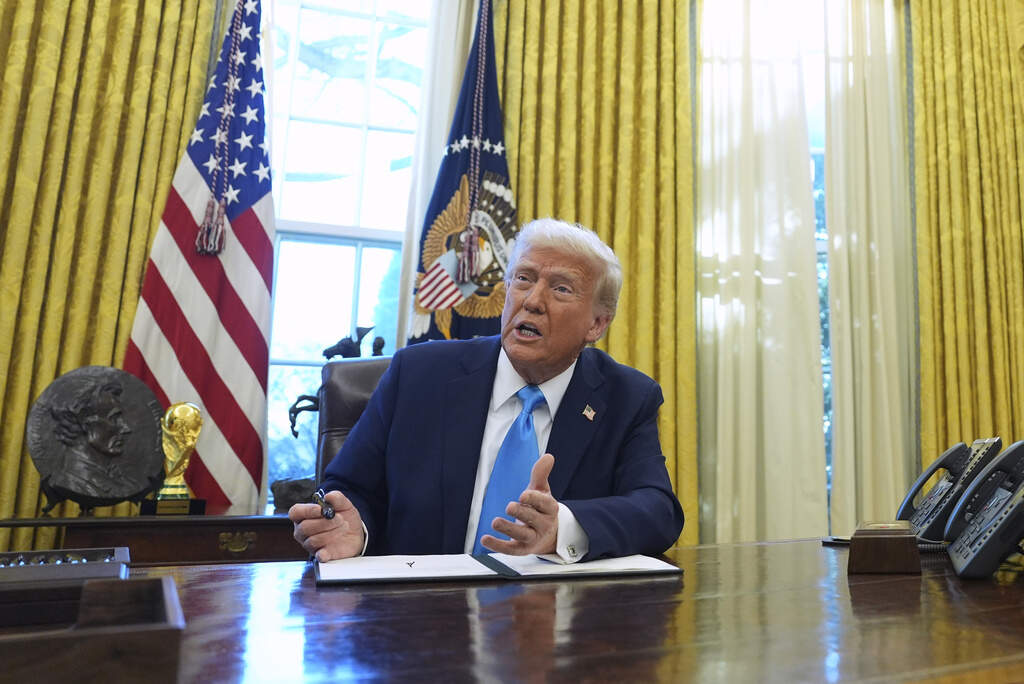
Many on the political right accuse the left of policing what people can and can't say.
Now, the Trump administration is cracking down on words related to diversity and inclusion.
Has a so-called 'woke right' replaced the so-called 'woke left?'
Guests
Thomas Chatterton Williams, staff writer at The Atlantic. Hannah Arendt Center Senior Fellow at Bard College. Author of the recent piece “How the Woke Right Replaced the Woke Left.”
Jason Stanley, professor of philosophy at Yale University. Author of seven books, including “The Politics of Language” and “Erasing History: How Fascists Rewrite the Past to Control the Future.”
Transcript
Part I
DEBORAH BECKER: The fight over the power of language seems to have taken a twist. Many conservatives have long accused the left of policing language, saying that liberals are trying to dictate speech.
SHAPIRO: Midwives have been told to say chest feeding instead of breastfeeding, and to replace the term mother with mother or birthing parent.
WATTERS: The left says you can identify as anything, a tree, six genders. You cannot identify as a Black conservative.
VANCE: This whole crazy left-wing idea that we're not allowed to debate ideas, that we're not allowed to discuss things, that we have to silence people, censor them.
WATTERS: What's next? The Ninja Turtles apologize for appropriating karate. Are the X-Men now the Latinx-Men?
BECKER: That was conservative commentator, Ben Shapiro, Fox News host Jesse Watters and Vice President JD Vance. Conservatives say this speech policing is pushing a quote, woke ideology. Indeed, there has been a push, particularly on the progressive left to reconsider certain words.
AMBER MILLER: Owner suite. It's a term many people have never heard of, but as of late is gaining traction. The better-known term, master suite being frowned upon in some circles looked at as racist and sexist.
@MEI.FAE: Nibbling is just a gender-neutral term for niece or nephew. So if your siblings' child is gender non-conforming or non-binary, nibbling a great term for them.
JONATHAN JAYS-GREEN: This conversation around Latinx has been to be able to make sure that we have language that is inclusive to queer, trans, and gender non-conforming people like myself.
BECKER: That was reporter Amber Miller, TikTok, creator Mei Fae and activist Jonathan Jays-Green. Now, President Trump is taking on language speaking at the Justice Department last month, he touted his order, which is titled Restoring Freedom of Speech and Ending Federal Censorship.
DONALD TRUMP: On day one, I signed an executive order banning all government censorship and directing the removal of every bureaucrat who conspired to attack free speech and many other things and values in America.
BECKER: Yet the same day, Trump also issued an executive order declaring the policy of the United States is that there were only two genders, male and female.
TRUMP: For four long years, we had an administration that tried to abolish the very concept of womanhood and replace it with radical gender ideology. Maybe you heard something about that.
They destroyed women's spaces and even tried to replace the word mother with the term birther person.
BECKER: As a result of Trump's executive orders, agencies are scrubbing or trying to avoid using certain words on government websites and documents. Those words include female, gender identity, race, and DEI. Is the Trump administration changing language to reflect its policies or is it engaging in the same language policing that conservatives accuse the left of perpetrating? This hour we wanna talk about this War on Words. Joining us is Thomas Chatterton Williams. He's a staff writer at the Atlantic. ... He wrote a recent piece in the Atlantic titled "How the Woke Right Replaced The Woke Left."
Thomas, welcome to On Point.
THOMAS CHATTERTON WILLIAMS: Hi, Deborah. Thanks for having me.
BECKER: So let's start with your piece. This is why we asked you to be on today. "How the Woke Right Replaced The Woke Left," and you start off by describing a sort of social justice orthodoxy that swept through the culture during a specific time.
So explain for our listeners who may not have read your piece what you think woke means and how it began.
CHATTERTON WILLIAMS: That's such a great place to start. Because I think that this is one of those words that everybody at this point has heard, but it means different things to different people. Wokeness is not even a term that I necessarily would choose myself.
But it's the one that has stuck. And it really describes what I think is this idea that the world is controlled by some sort of systemic power, whether that's white supremacy, systemic racism, or patriarchy or whatever. And that you need to be awakened to be able to see all the ways in which this kind of power inequality creates classes of victims and oppressors.
And then it inspires a kind of politics of grievance in which everything, specifically institutions, but also norms must be dismantled, and society has to be wholly restructured from the ground up. This paranoid style has, it certainly was ascendant on the left. I would say from definitely the second term of the Obama administration.
It peaked during COVID and the racial reckoning of 2020. And then I would say that it came precipitously down after the attacks in Israel on October 7th and the campus protests that created quite a backlash. But now we're in the phase of a backlash that has fully become woke from the right.
We didn't just recenter things in the middle. We have a kind of paranoid style from the right that wants to dismantle everything, but it's fully fastened to the power of the government now. So I think it's much more horrifying than what preceded it.
BECKER: Yeah. I have to say the title made me uncomfortable, right?
Because woke is now really a pejorative term. It reminded me of when folks used to say someone was PC, or politically correct. But the ideas behind being politically correct, the initial ideas, it just is the initial ideas behind looking at society and seeing where the power dynamics are and perhaps speaking up against them.
Those initial ideas are not bad. Those are very positive things. It's just how they then become culturally or socially enforced. And, as you said, it became almost paranoid, right? So explain that a little bit, of how we went to something that was really a call to activism, to something that's now negative.
CHATTERTON WILLIAMS: That's a great point and I think it's important that you take the moment to specify that. Yes. The reason why wokeness has been so appealing and has really been an animating energy on both the left and the right is because there really are inequalities and power imbalances and forms of oppression that we do notice, and that do disturb people of good conscience in this society.
And you start by saying that, look, it looks Black people are discriminated against, or Latinos are discriminated against, or women are not fully represented in this area. And it gets taken to a kind of all-encompassing extreme at the worst, in the worst excesses, where then that becomes the only lens through which you perceive any interaction.
And every single aspect of reality has to be reformatted to address this one single discrepancy. And I think on the right too, if what the left was concerned with was systemic power imbalances from racism and patriarchy. You could say that the right is really concerned with what we could call like the post-war liberal order. And all of the kind of imbalances that come through globalization and all these different ways in which there really are some problems that should be addressed.
But the bad aspect of this kind of activist inspired politics of grievance is that it loses all sense of proportion, and it makes things so intense that there's no ability anymore to compromise.
BECKER: Do you have an example that comes to mind right away of how you think wokeness went awry and what you think maybe may have been a touchstone for when things turned?
CHATTERTON WILLIAMS: I've got a book coming out this summer on this subject.
BECKER: Tell us all about it.
CHATTERTON WILLIAMS: It's called Summer of Our Discontent, and I've got some examples that really stuck out in my mind. But this is not gonna be news to many of your listeners, but in the summer of 2020, many people in America, especially some people in the media and other institutions of some influence, became so concerned about criminal justice reform and police brutality that the idea of, for instance, dismantling or abolishing the police actually got serious consideration.
I would say that's an extraordinary loss of proportion that started from a good place, being concerned about a man dying on video and taking it to an extreme that actually warps and distorts our social fabric and our politics and creates the very backlash that it purports to want to address.
There were so many situations like this. If you look at a place like, if you look at the media, people were scapegoated and fired oftentimes for things that were not considered wrong even in the previous day. So you look at James Bennet at the New York Times opinion pages, he was fired, ultimately scapegoated by a kind of incensed mob of his junior staffers who demanded his resignation because he published a sitting U.S. Senator, Tom Cotton.
On an opinion that was certainly charged, that the president should consider sending in the National Guard to stop the looting and rioting that was happening in the wake of George Floyd's death. But that was an opinion that the majority of Americans did agree with, whether we like it or not.
And the idea that made minorities unsafe to hear the opinion was an idea that was pushed rather forcefully and had real consequences for people's lives. I think that's a moment where you have to step back and say, what are we doing and have we become so awakened or awoken to all forms of injustice that we are creating new forms of injustice in turn?
BECKER: And so of course those questions and what happened there have really now been taken over and became really a campaign rally for President Trump.
CHATTERTON WILLIAMS: Yes. So one of my main issues with the kind of great awokening that the ascendant left enjoyed for the past decade and change is that it simply is ineffective on a pragmatic level.
It created the very Trump revolution that swept him back into office, because he was able to make some valid points about where institutional elites abused their cultural dominance. Now I think he's instituting things that are far worse, far less concerned with actually fixing what's genuinely wrong in society and much more a kind of camouflage for acquiring power and exploiting it.
But that cannot be addressed, I don't think. And it cannot be combated without seeing the ways in which the left made possible the conditions for this abuse from the right.
Part II
BECKER: Before the break, Thomas, you were making some points about why or how you think the woke left really set the stage for the woke. And I'm wondering if you would just expand on that a little bit. I know you talked about what you felt were perhaps some extremes of what the left did and what Progressives did right around the time of 2020. And how that may have really set the stage for a second Trump administration.
Can you just expand on that a bit?
CHATTERTON WILLIAMS: Sure. The thing that was so disturbing about Trump's second win was that he had expanded the multicultural coalition that was voting for him. He had grown the support among non-white voters to a higher level than had been than the Republicans had enjoyed since the Nixon administration.
So he really found some issues that connected. And we can't just dismiss it as a kind of white backlash or racism, but one of the issues that he hit upon that seems to have really resonated was this ad that was extraordinarily effective last fall about Kamala Harris being for they/them, and Donald Trump being for you.
This was a kind of self-imposed own goal that the left never had, the Democrats never had to make. It was a kind of niche issue that starts from a place of caring about a marginalized group, but actually ballooning the care for that group to such an extent that it alienates the mainstream. And you really, what we have to contend with now is the realization that you really can't help anybody if you concede all power to somebody that would oppress them.
So it doesn't matter really where your heart is in these issues. As the left often tried to signal through activism and through forced language and forced virtue signaling, it doesn't matter how pure the signals you virtue, the virtues you signal are if you can't exercise political power.
BECKER: So it's not so much the specific issue that is really what people should be faithful to? Is that what you're saying?
CHATTERTON WILLIAMS: I think that you have to have values and principles, but you cannot be completely divorced from the reality of where the country is. People often compare these kind of issues to the civil rights movement in the previous century. But the fact is that that took getting the majority of Americans on board, it took a long campaign of exercising real political power through the electorate and the courts, but not just imposing from the top down, a kind of worldview that alienated the rest of the country.
BECKER: I wanna bring another voice into the conversation now. Jason Stanley, as a professor of philosophy at Yale University, he's written seven books, including one titled The Politics of Language, another titled Erasing History, how Fascists Rewrite the Past to Control the Future. Jason, welcome to On Point.
JASON STANLEY: Thank you, Deborah. And hello, Thomas.
CHATTERTON WILLIAMS: Hi, Jason.
BECKER: So what I wanna ask you, Jason, is I'm wondering what your thoughts are about all of this, about language policing on the right, and I'm assuming you know that Thomas just wrote a recent piece in the Atlantic titled how the Woke Right Replaced the Woke Left.
And we've been talking about some of these ideas here and I'm wondering if you could just give us maybe a broad overview of your thoughts about language and the woke, if you will, Jason.
STANLEY: Yeah, so Thomas and I co-authored the New York Times piece a while back about the woke really attacking their bans on critical, their sort of legalized bans on critical race theory.
So I really applaud his standing up for this issue on when the right does it though Thomas and I have strongly differing views on issues like backlash. For example, I think it's really problematic to say this is the fault of whatever came before Trump. Because Elizabeth Hinton has a book called America On Fire and one of the chapters is called The Cycle, and she talks, she documents how in small city after small city in the United States, for decades, there's a Black, there's police violence against a Black person, and then there's a response by the Black population, and then everyone agrees to do something about it, and then there's a harsh white backlash. I think Hinton demonstrates that this is just the structure of American life and has been for many decades.
Now coming to the issue of banning speech, what you're really doing here is you're banning perspectives. You're banning ideologies. So ideologies are perspectives on the world. And central to an ideology is a way of talking about the world. Each perspective on the world comes with a way of talking about the world.
So for example, if you want trans acceptance of trans people, you're gonna have to alter language a bit. And these alterings of language or debates about language are nothing new. Carter G. Woodson in his 1933 book, Miseducation of the Negro, has an appendix called What we Call Ourselves, where he's 'Grumpy old manning' about the arguments about what Black Americans call themselves.
So this is an age-old issue. So now what the Trump administration is doing, and Thomas rightly calls our attention to it, is they're using the government, the state power, rather than social shaming. To ban perspectives, by targeting the characteristic words in the speech practices of those perspectives.
BECKER: So they've got the power of the government to do this, whereas before it was maybe you were canceled on social media or perhaps you lost your job, or there were other institutions that kind of enforced some of what was considered acceptable at that time. But now it's very different.
STANLEY: That's right.
BECKER: Go ahead. I'm sorry.
STANLEY: Yeah. When the government does it, as Thomas said, it's always going to be the case that a democratic society is gonna involve contestation of perspectives. And as a philosopher of language who follows J.L. Austin, speech is a way of doing and when you speak, it's a way of behaving in the world.
And so people are always going to struggle to argue about that, just like they argue about ways of, other ways of behaving in the world.
BECKER: I wanna go back to what you said about backlash just for a moment, because I do think it's interesting. You think that this is a natural backlash to what happened.
What we're seeing now from the right and from government is a natural backlash to what happened, say starting pre 2020 and then through the pandemic.
STANLEY: This is for Thomas or for me?
BECKER: This is for you, Jason.
STANLEY: Oh. I don't think it's a natural backlash at all. I think it's the different societies have different historical patterns, and what Hinton's work shows is that our historical pattern is this pattern of Black struggle and white response.
I think, BLM, it's always been the case that Black protests are described in terms of looting and rioting. This is all the way back to the 1960s. So no matter what you do in Black protests, it's gonna be described. They're gonna focus on some instances and generalize it to looting and rioting. Tom Cotton's piece called all Black Lives Matter protests looting and rioting.
And it was a general sort of, so I don't think, I think like the goal is, there were certain aspects of Black Lives Matter, like defunding the police that I think were problematic in the ways that Tom, in much the ways that Thomas said. But I think the ultimate thing is that just a larger version of what, as Hinton has demonstrated, happened in city, after city.
And it's a struggle not against the police specifically, but against the entire criminal legal system where the United States incarcerates until El Salvador, Bukele, the highest, has the highest rate of incarceration of any country in the world. And in 2015, the last time I spun those numbers, almost10% of the world's prison population came from the tiny group of Black Americans, which suggests that something is structurally off about the United States. So as long as those numbers stay the same, there's going to be, as long as there's radical structural inequality, there's gonna be protest against that radical structural inequality.
And as long as there are protests, as we know from history, there's gonna be backlashes to those protests.
BECKER: When we talk about policing language and what we're seeing now and this coalescing around President Trump and the White House and a more conservative viewpoint.
I wonder, Thomas, how much of this is is human behavior in a way that's tribal, like-minded people are gathering around an ideology. And now I know that certainly Jason has mentioned that now, and you have mentioned as well that now that you have the government behind this and enforcing some of these ideas, it takes a very different tone.
But what would you say, what are some of the other differences if there are any, that are evident right now?
CHATTERTON WILLIAMS: That's a great question. One thing that just jumps out to me is the fact that yes, this is human nature. The urge to scapegoat, mob justice, polarization, tribalism. These are things as old as time.
But what we have to contend with now is the complete breakdown in the trust of expertise in institutional, influence and the kind of fractured, fragmented media environment we all have to navigate with people having not just different views or political inclinations, but actual different sets of facts.
We have a kind of epistemological crisis, to use more philosophical language with Professor Stanley, that I think is really exacerbating all of these problems and making, also it's allowing us to interact at scale in a way that was unprecedented in human history. So I don't really think that we're all supposed to be constantly arguing with each other and all in forms where we can weigh in on each other's linguistic choices every day, in a way that kind of heightens tension and pushes us further apart.
I think that we can't separate the political crisis we're in from the kind of technological changes that have swept the country and the globe in the past decade and a half.
BECKER: To your point here we have the example of changing even historical words, right? In the Trump administration, perhaps most notably the name of the Gulf of Mexico to the Gulf of America. And in February, at a White House press briefing, a reporter asked press Secretary Karoline Leavitt, whether it was retaliatory for the White House to limit the Associated Press' access to some White House events because the AP was continuing to call the Gulf of America, the Gulf of Mexico.
We have a little bit of how Leavitt responded. Let's listen.
KAROLINE LEAVITT: If we feel that there are lies being pushed by outlets in this room, we are going to hold those lies accountable. And it is a fact that the body of water off the coast of Louisiana is called the Gulf of America. And I'm not sure why news outlets don't want to call it that, but that is what it is.
The Secretary of Interior has made that the official designation in the geographical identification name server. And Apple has recognized that. Google has recognized that. Pretty much every other outlet in this room has recognized that body of water as the Gulf of America, and it's very important to this administration that we get that right, not just for people here at home, but also for the rest of the world.
BECKER: And we should note that yesterday a judge ordered the White House to allow the AP to cover the Oval Office saying that it was unlawful to block the AP because of its choice of words. But I think this is a very telling example here, not only in the choice of changing the name of something that was historically called something else, but also the mention there from Karoline Leavitt, that Apple, Google, big companies were immediately going along with this name change. Jason Stanley. What do you take from this example of what's happening with the language in the Trump White House?
STANLEY: This is a great example of what Thomas pointed out earlier, his insight that this has to do with power and domination.
This language, using the government in this way to police language serves the purpose centrally of expressing domination. And here what the White House Press Secretary is doing is expressing domination. She's saying, we decided we made this nonsensical choice. This is like far, the extreme nationalist choice.
That's silly. But the fact that we made it shows that we dominate Google, Apple. The media and we're telling the media that you better do what we say. And this is just a loyalty oath. A lot of what happens in authoritarian societies is there's a lot of silly loyalty oaths, you swear allegiance to them that the 2020 election was stolen as federal workers are being asked now, and this is another one. What she's literally saying is as Thomas intuited earlier, is media, you better step in line. And this is for us, we don't care about the issue. This is just about you expressing subservience to us.
BECKER: And Thomas, I wonder what are your thoughts about this debate, this controversy, I guess is a better word, over the renaming of the Gulf of Mexico?
CHATTERTON WILLIAMS: I couldn't agree more with Jason's remarks here, it is about dominance. It's also about who gets to control how we perceive reality. And here, I think whether we like it or not, we do have to go back further and see the ways in which people on the left open the door to this kind of very cynical exploitation that the Trump administration seems bent on constantly using.
There were many people I think, who are not paying attention to politics every day who are just low information voters who are very persuaded by the argument that the left told you that there are 112 genders or whatever, and force you to say words that don't exist and that the left force you to say Latinx and all these things.
And so we're just giving them a taste of their own medicine. I can't tell you how many times people I've seen on Twitter and also in real life have brought that up as a persuasive point. So I think that this is worse. It's deeply cynical. I think I agree with Jason, that it does tend towards real authoritarianism, but I think that there are many Americans who are not nearly as offended by it as they should be, and we have to look in the mirror and understand how we got in a kind of situation where this is even plausible in the first place.
BECKER: Why such a focus on race and gender? What are your thoughts about that?
Who?
Thomas? Sorry, I was still talking to Thomas.
CHATTERTON WILLIAMS: A focus from the Trump administration.
BECKER: Why are we seeing such a focus on race and gender in words that specifically deal with race and gender? Why do you think that is so important to the White House?
CHATTERTON WILLIAMS: Here I also really agree with what I believe Jason's point of view would be, which is that those are just very easy and salient ways to divide. And this administration and the kind of reactionary political movement that brought it, swept it back into power is benefiting from our social and political divisions.
And that's the simplest answer I can think of.
Part III
BECKER: We're talking about policing language and how the right is now policing and even changing language and in fact borrowing some of what the left had done earlier and perhaps reacting in some ways to what the left had done earlier, but I wonder, we also have social media now that's been such a big player in all of this, on both the left and the right.
What are your thoughts about how social media affects the policing of language?
STANLEY: I'm gonna begin by challenging a little bit of the premise of your question. Okay. Which is at the right is borrowing from the left. I view things globally. I'm also a professor at the Kyiv School of Economics, where I spend several weeks, every six months teaching.
And it's worth, so I see things globally and what you're seeing in the United States is just an instance of a global strategy. It's a boring authoritarian playbook. Putin justified the Ukraine War by appealing to a war against gender ideology, he said on the eve of the full-scale invasion that one of the reasons they're invading is because of the parent one, parent two, civilization destroying ideology.
So this, now in the United States, it's not just gonna be the scapegoats, as Thomas pointed out, are not just gonna be LGBTQ citizens or trans citizens particularly. The international attack focuses on gender. It focuses on women being somehow oppressed by trans women or something like that.
But in United States, of course, you're gonna add race to it. In Germany, adds Nazis and the Holocaust to it. So there's local things, but all over it's the same thing. And I just don't think that gender ideology is in any sense to be blamed for Putin's full-scale invasion of Ukraine.
And all of these leaders are just doing the same thing. So I think it's too local to look to talk about borrowing from the left. It doesn't respond to the global facts. Now as social, as far as social media goes, I think this is going back to a point, Thomas, also correct, rightly made the social media.
These arguments about language, as I pointed out from Carter G. Woodson, 1933, he's reporting on big arguments between Black Americans about what they should call themselves. So in other words, all of this is old. The Nazis were responding to Magnus Hirschfeld who was a gay, Jewish man who had an institute who was investigating gender variability.
So all of this is just really old, and we have to ask ourselves, as Thomas put it, what do you do when you add these new technologies to the kind of debates between perspectives? Should we accept certain perspectives, should be reject certain perspectives that are just part of human culture and society.
BECKER: But if I just wanna go back to something you said. Yes. This has been happening for forever really. Political leaders have done this for a very long time, so what's interesting to me here is the psychology, right? What happens when folks who may be looking for that sort of certainty and that this assertion, this confidence assertion of a truth from a political leader, and that may provide them with some reassurance, right?
But in this case, it looks like the truth keeps shifting, right? The foundation keeps shifting, right? You're completely devoted to this position one day, but it changes 180 degrees the next day, and yet that person needs to remain loyal to the personality and not necessarily the ideology. So what psychology is happening there and is that different from what we've seen throughout history?
STANLEY: I wouldn't say political leaders have done this for a long time. Using the government, as both Thomas and I have been urging, using the government rather than civil society. Civil society will always respond to these pressures in the way civil society has. But when it's mandated top down from the government, that's an authoritarian move.
And there can be left authoritarianism, there can be right authoritarianism, but it's generally an authoritarian move. So now when you switch it up, like Putin does or Trump is doing, and you just introduce nonsensical, like the Gulf of America and people have to speak one way one day, and one way another day. That's again, the theme that we've both been urging of expressing dominance. You're trying to say, okay, what the official state ideology is today, it's just whatever the leader wants.
BECKER: So it's deliberate.
STANLEY: Yeah, it's one of the questions we always, that always comes up when I'm talking to people about authoritarianism is how much is deliberate and how much is just the natural way, if you're a natural authoritarian, the way you act.
BECKER: And what do you say, you've written, I know, extensively about this, but how would you describe changes and language changes even if they're shifting, as affecting society and our history? What do you tell folks? What's the main, we only have an hour for this entire program, but what's your main point about how this has long lasting real effects on other things, besides just what we're seeing in perhaps an executive order at the moment?
STANLEY: If you think, if you wanna understand how central speech is to culture, think of Denazification in Germany. Denazificationwas the targeting of Nazi ways of speaking. So they weren't illegalized, though some words were illegalized, but they were strong social sanctions about speaking in the way that Nazis did. And Nazism introduced ways of speaking. That's why one of the great books on Nazism by Victor Klemperer is called Language of the Third Reich. And that's why Alternative für Deutschland. And so what happened post-World War II, this is the post-World War II era in Germany, is you had this strong reaction to Nazi ideology.
And the way that was implemented is by banning and social sanctions against ways of speaking. Now the reason you find Elon Musk and others focused so much on Alternative für Deutschland, JD Vance meeting with its head when he went there, is because they're pushing back on Denazification.
They want to speak the way the Nazis spoke as part of their mission to say, Germans shouldn't feel so guilty about the past. And if you can change the way Germans think about the past and note that changing the way people think about the past here goes with changing the way they talk. So the ways we talk are not separate from the perspectives we have.
And the focus on Germany is if you can reverse Germany's struggle with the past, that's like the top case. And so then you can do it everywhere.
BECKER: I wanna point out that you have been at Yale for more than a decade but in the fall, you'll be going to the University of Toronto.
Partly because of some of the things we're talking about today. Is that right?
STANLEY: Yeah. The attack on freedoms, the attack on our institutions and universities, the attack, the scooping up. Yeah. Solely because of this.
BECKER: And why is it better to be at the University of Toronto?
What is there in Canada that might be more beneficial than maybe continuing to fight at Yale?
STANLEY: I don't, I think that I'm going to want to be participating in the defense of the people being attacked in America wherever I am. But I don't hear the elite institutions, all the Democratic institutions are being attacked.
The media, the law firms, the universities, the K-12 education. They're all being attacked. And so there's a lot of work that my colleagues are doing and the administration at Yale is doing, trying to figure out how to defend the particular institutions, but in a way, I'd rather go, it also has to do with my kids and raising them outside of this kind of culture.
What happens under authoritarianism is you're always worried about whether or not you are safe. You're like, oh, they're only going after non-citizens now, phew, or they're only going after the people in the pro-Palestinian protests, phew, and having that lifted off you. Like authoritarianism does that to everybody.
So everyone is oh, phew, I'm safe. But it would be nice not to have that pressure. And also, the University of Toronto is creating a center with funding where we'll be able to bring journalists from democratically backsliding countries and civil society workers to strategize together. So that's pretty exciting for me.
BECKER: It reminds me of the quote from former President Reagan. I think he's quoted as saying, freedom is never more than a generation away from extinction. Am I quoting that correctly? I believe so. And many people say that we are watching, right, democracy go extinct. And Thomas, let's bring you back into this conversation here. Is that, it sounds dire Jason, quite honestly. And I'll get your thoughts on that in a minute, but I wanna hear from Thomas first. Is it that dire?
CHATTERTON WILLIAMS: I think it's a very serious moment in this country's history.
I think that we are, depending on how the next four years ago, next two years with midterm elections, we are deciding whether we're gonna remain the open society, or whether we're going to turn the page into something that's much darker and that really does restrict the kind of freedoms that we thought were our birthright here.
I think it's very serious. And I think that also at the same time, many people's lives will more or less continue undisturbed, so they may not take it as seriously as it needs to be taken or address it and respond with the urgency that the moment demands.
BECKER: Do you think it's a moment of urgency, Jason?
STANLEY: Oh my God. Yeah. Yes. And I should say that Thomas recognized this early on when we were writing against the critical race theory, anti-critical race theory laws. We both recognized, once you move to the legal aspect of firing people legally for their ideologies. But yeah, I view myself in a long tradition of intellectuals who have fled a country, declining early, on when the democracy was being eroded or eradicated by an authoritarian movement. My father, my grandmother, when my father fled Berlin, but they fled really late, but plenty of intellectuals fled in '31, '32, '33.
I'm not saying the future is determined. But I looked at the expected utilities and did a calculation, and they were high enough that this society will turn completely into something like a fascist dictatorship that I thought, may as well follow history and just in case.
BECKER: What do you say to people who aren't leaving and who are, is there hope there? How do you give them hope?
STANLEY: Oh absolutely. And I have an incredible opportunity. I'm so lucky and privileged and I think I would be safe if I stayed, because Yale has done a great job protecting its scholars, unlike other universities that I won't mention.
And so generally, Yale has been great. And I think that I have, I know I have a position of immense privilege. So I feel guilty in that sense. But I have kids and I have to take this opportunity. But what I would say is just, Thomas talked earlier about patriarchy and racism being ways to exploit people.
And we're seeing patriarchy very much being a way. But this is why it's so confused to think of patriarchy and racism as dividing oppressors and oppressed. Patriarchy targets all of us. Racism targets all of us. Du Bois and Black Reconstruction argued that race was a way to divide poor whites and poor Blacks from each other.
So they couldn't unify to fight for their material interests. And what I would say is so it's not patriarchy and racism, don't divide oppressors and oppressed because white people are the victims of racism and men are the victims of patriarchy too. So we have to hopefully see that as we go forward.
And if we can overcome those ways of dividing us, I think we can fight back effectively.
BECKER: Thomas last word to you in terms of hope in the future when language is being changed, and ideas are being changed and our perspectives really are at risk here. What is your final message to folks?
CHATTERTON WILLIAMS: I would say that we have to take seriously the truth that ideas matter, that language matters, that culture matters, that politics really matters. And resist the urge to simply soothe ourselves with our phones and with kind of our creature comforts.
And to allow ourselves to be entertained to death and amused to death, and to not take things seriously because we see that this kind of political moment is also somewhat entertaining. I think we're really, we have to fight to remain serious and to stay optimistic, finally. I think that nothing can happen if you acquiesce to the kind of cynicism that this administration and the learned helplessness, this administration hopes to impose.
We have to be serious, but we also have to be vigilant and optimistic.
This program aired on April 9, 2025.