Support WBUR
Trump takes aim at the Smithsonian
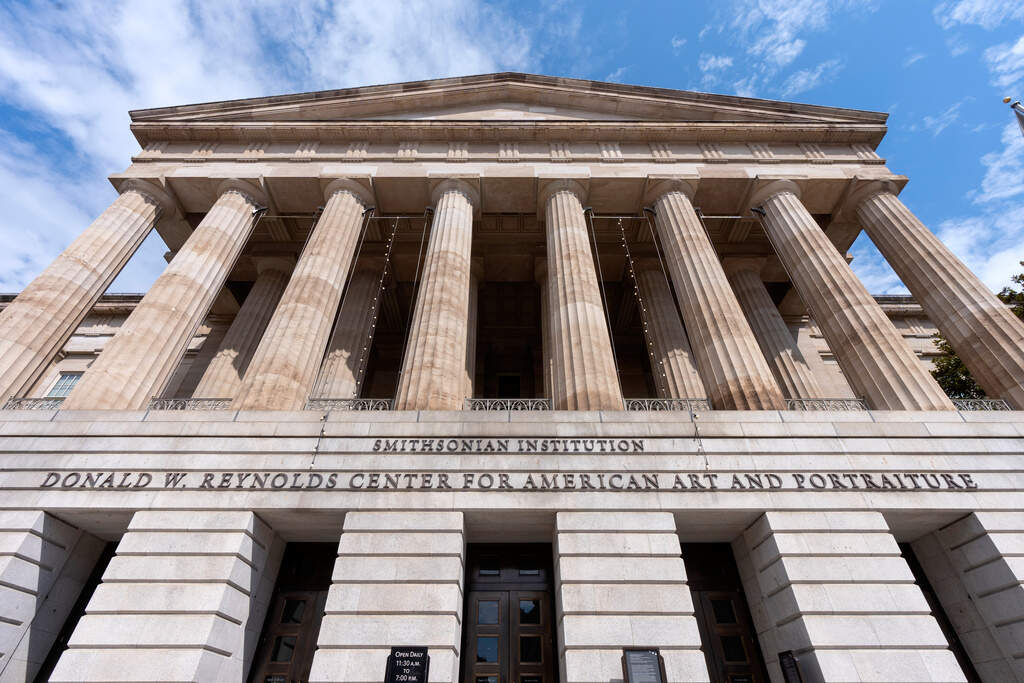
A White House executive order seeks to eliminate “improper anti-American ideology” and promote "American greatness" at the nation’s museums. What Trump's recent attacks on the Smithsonian mean for how Americans understand their shared history.
Guests
Jennifer Schuessler, reporter at the New York Times who covers scholarship, history and ideas.
Mike Gonzalez, senior fellow at the Heritage Foundation, a conservative think tank in Washington, D.C.
Daina Ramey Berry, professor of history and Michael Douglas Dean of Humanities and Fine Arts at the University of California, Santa Barbara.
Richard Cohen, author of Making History: The Storytellers Who Shaped the Past.
Transcript
Part I
ANTHONY BROOKS: We're talking about one of President Trump's many executive orders. This one entitled Restoring Truth and Sanity to American History. In it, Trump targets the Smithsonian Institution and its sprawling collection of museums, which he says promote a divisive race centered ideology.
He says the Smithsonian needs to be restored to its rightful place as a symbol of inspiration and American greatness. The President claims that over the past decade, there's been a concerted effort to rewrite our nation's history in a way that makes America look bad. But as critics say, the executive order does just that, that it's an effort to rewrite history in the service of his political ideology.
So what happens when politics collide with our effort to understand our shared history? Joining us now is Jennifer Schuessler. She's a reporter of the New York Times who covers scholarship history and ideas. She's been writing a lot lately about this particular executive order and the Smithsonian.
She joins us from New York City and Jennifer, welcome to On Point. It's great to have you.
JENNIFER SCHUESSLER: Great to be here.
BROOKS: So I think it might be useful just to kick off this show with just a brief description of what the Smithsonian Institution is, for listeners who might not have had a chance to visit these wonderful museums in Washington.
Tell us just a little bit about what the Smithsonian is.
SCHUESSLER: The Smithsonian was founded in 1848 with a bequest from an Englishman who wanted there to be created in Washington D.C. a museum that would disseminate, promote and disseminate knowledge. And today, the Smithsonian, I believe it's the largest museum complex in the world.
They have 21 museums, most of which are in Washington on the mall. They include the Air and Space Museum, the Museum of American History, the American Natural History Museum. There are a few, a couple of them are in New York and it also, the system also includes the National Zoo, some scientific research centers, and a bunch of libraries.
BROOKS: So the President's executive order, which targets the Smithsonian, I'll just read a little bit of it. "Once widely respected as a symbol of American excellence and a global icon of cultural achievement. The Smithsonian Institution has in recent years come under the influence of a divisive race-centered ideology."
I'll read a couple more sentences.
"This shift has prompted narratives that portray American and Western values as inherently harmful and oppressive."
So say a little more about this executive order, what it says and what it wants to do with the Smithsonian.
SCHUESSLER: I think one thing that's very interesting about this order is it's very consistent with things that President Trump has said.
Both in his first term and since and early in his second term, about how he believes American history should be portrayed, how it should be taught, how it should be written about, and some people may remember in the first term he called for return to patriotic education. He created the 1776 commission.
So he's very interested in this. He's been interested in this for a long time, and is quite critical of the way that scholars, museums, the radical left as he puts it, portrays American history. So this executive order, it takes aim at the Smithsonian, and it doesn't really have a lot of very specific directives, but it does ask vice President Vance, who is a member of the 17-person Board of Regents to try to push the institution in a more, you could say patriotic direction, and this does, even though he's not named, this does seem to be a shot across the bow at Lonnie Bunch, who is the secretary, the Smithsonian, the leader of the institution and has been since 2019.
BROOKS: And I wanna talk a little more about Lonnie Bunch in a minute.
But what are some of the examples that the president cites in his executive order? Examples of divisive race centered ideology? What's he talking about in particular here?
SCHUESSLER: There are three things that are cited specifically. One of them is a graphic that appeared on the website of the Smithsonian's National Museum of African American History and Culture.
Early in the summer of 2020, they had a whole sort of portal of educational resources that they were presenting to help Americans talk about race. This was in the wake of the killing of George Floyd. It included this graphic about quote-unquote white culture, which, among other things, said that the Protestant work ethic and belief in the value of hard work was a marker of quote, whiteness.
The nuclear family was part of white culture. This drew a lot of criticism from people on the, figures on the right, including Donald Trump Jr. And I think from other people as well. And very quickly, the museum apologized for it and removed it, but it has come up over and over again.
It's been off the site for five years. But the president cites this again here. He also cites an exhibit that's at the Smithsonian's Museum of American Art that I believe is called the Shape of Power. And it's about looking at the way that sculpture has advanced ideas about race and racial superiority, inferiority.
So it criticizes some language in that exhibit, and it also cites, it criticizes the planned America Women's History Museum, which doesn't physically exist yet for planning to celebrate, this is the president's claim, the achievements of biological men in women's sports.
BROOKS: I see.
SCHUESSLER: So those are the three examples, it's just three things.
BROOKS: Got it. Okay. So how have critics, how are the critics responding to this executive order? What are they saying? What's their concern?
SCHUESSLER: Critics of the order, you mean?
BROOKS: Yes.
SCHUESSLER: I think you've seen statements from a lot of historians, a lot of museum professionals, saying that basically this order caricatures and misrepresents what the Smithsonian is, what it does, and also how historians do their work. There was a forceful statement from the American Historical Association that was joined by I think a couple of dozen, a couple dozen other smaller groups, saying, look, the Smithsonian is one of the premier research institutions in the world.
They're widely respected for the integrity of their research across all fields. Science, history and also, the role of a history museum isn't to celebrate, it isn't to blame. And in fact, what these museums do, what this Smithsonian does very well in the eyes of the historical association is present all of our history and just let Americans and others who go there learn and think.
BROOKS: Yeah. I'm looking at that statement right now from the American Historical Association. Part of it says, our goal is neither criticism nor celebration. It is to understand, to increase our knowledge of the past in ways that can help Americans to shape the future. So they're basically saying, we don't have ideology, we're just dealing with facts.
We're just trying to tell the story. And let the story fall where it does and help Americans make their decisions about the, make their own judgements about the past. Is that sort of fair what they're saying?
SCHUESSLER: I think so, yes. And I think, as you stated in your intro today, some, the people who are critical of this order see it as the president himself trying to dictate how the American story should be told.
How we should understand our history, what information we should have access to, what information we should not have access to.
BROOKS: And about that, about what the president's trying to do here. I wanna ask you, how is the Smithsonian governed? You mentioned Vice President Vance has a role here, I gather, along with the Chief Justice of the United States.
He's a member of the board by law, but does the executive branch have authority over this institution? Can the president just say, change the way you do business?
SCHUESSLER: No I don't think that anyway.
BROOKS: In a word no. Anyway.
SCHUESSLER: Yeah, I would say no. Obviously this is all up for interpretation and debate.
We'll see what happens. But the Smithsonian is independent. It's an independent agency. It's effectively a public-private partnership. I think about a third of its $1 billion budget does come from Congress, has authority over it. Congress makes the appropriation, and it's governed by a 17-member board.
By law, the chief justice of the Supreme Court and the Vice President, whoever those people are at any moment, are on the board. There are also three senators, three members of the House of Representatives from both parties and then that group selects, I believe, it's nine. I might have bad math here.
Nine citizen members. So these are distinguished people from academia, business, government, just the public world more broadly. And it's a very mixed group, I think politically, and they are charged with oversight. And one thing the president does in this order, in this executive order is direct Vice President Vance to work with Congress to defund any exhibitions or programs that promote divisive racial ideology as the president defines it.
And also, to appoint citizen members that are in sympathy with and will further the spirit of this executive order. So they want to gain greater influence on the board. And I should say that I believe the board members serve for six-year terms that are staggered. So it's a little bit unclear when people are next up, their vacant seats coming up. So how this will all unfold is unclear.
BROOKS: Now you mentioned Lonnie Bunch, a moment ago, the Secretary of the Smithsonian. Tell us how he has responded to this executive order, what he's saying about it.
SCHUESSLER: I, to my knowledge, he has not said anything publicly. He has not directly responded to the order.
He has not commented to any reporters as far as I know. The day after the order came out, which was two weeks ago today, he did send an email to employees at the Smithsonian, which basically states, we've received this order, by the way, they seemed to have been taken by surprise by this order, which arrived on a Thursday evening.
And anyway Dr. Bunch in his email to staff, said, and I'll read from it here, we remain steadfast in our mission to bring history, science, education, research, and the arts to all Americans. We will continue to showcase world class exhibits, collections, and objects rooted in expertise and accuracy.
We will continue to employ internal review processes, which keep us accountable to the public. When we air, we adjust, pivot, and learn as needed. But basically, he's saying, we will keep doing the things we always do, and we are accountable to criticism and questioning as we always have been.
But he doesn't seem to be saying, we're gonna do anything different. We're gonna do what the president wants. So that's all he said so far, as far as I know.
BROOKS: One last question before we get to the break, which is coming up in about 30 seconds or so. Is anyone challenging this executive order? Is this the kind of executive order that some folks are challenging in court, for example, what's the status of that?
SCHUESSLER: I'm not aware of it. There has been criticism. We just talked about the American Historical Association statement, but I don't, the thing is the order itself doesn't say anything that's that specific, like it doesn't say I defund the Smithsonian or fire Lonnie Bunch or anything like that.
It just says, let's move it in this direction. But I expect it may be that there will be challenges to actions that flow from this order.
Part II
BROOKS: Joining us now is Mike Gonzalez. He's senior fellow at the Conservative think tank, the Heritage Foundation, and the author of an opinion piece in the Washington Examiner today, which is entitled Trump's Righteous Smithsonian Reforms. And Mike Gonzalez, it's great to have you. Thank you for joining us today.
MIKE GONZALEZ: Oh, very happy to be here, Anthony.
BROOKS: And let me begin this way. So three weeks after Donald Trump's election, you co-authored a piece in the Wall Street Journal with Christopher Rufo that said, in order to put a spike through the heart of woke. And then you went on, The White House must retake control of the museums, starting with the Smithsonian Institution.
So why, what's your best argument for the White House to retake control of these museums and get them to bend this administration's political view of the world and history?
GONZALEZ: Sure. Just a small correction. It was the piece was with Armen Tooloee, chief of Staff to Christopher Rufo.
BROOKS: Oh, I'm sorry about that.
Thank you for that correction.
GONZALEZ: Sure. No, of course. We all make mistakes. Look, what we were saying from the very start, right after the election was that Trump had to go on the offensive, on the culture, on the culture side. And that is actually what he's done from the very start of his second term.
He's been very engaged in the important effort to recapture what I would say the cultural ground that the left has occupied in the past few decades, certainly in the last 10 years. And that process accelerated rapidly, after the BLM riots that rocked the country in 2020. So Trump has been and what we said was, let's start with the Smithsonian. Because the Smithsonian is an American institution, is everything that Jennifer described, it's huge.
It's not just 21 museums, 21 libraries, but it also has learning tools for children. It's visited by 30 million people, and I'm sorry to say that it has become a completely signed up partner in this rewriting of history. I was listening to your conversation with Jennifer and there was a back and forth on who was rewriting history.
Look, all that is happening here with this order, I'm gonna quote from Brian T. Allen, who's been writing about museums for years. It's the restoration of curatorial standards that existed before the 1619 Project and the Black Lives Matter, mass hypnosis. This is how Brian T. Allen puts it, and I agree with that.
Now I can go on with you. I don't know how long you want me to speak, but I can go on with you.
BROOKS: No, that's fine there. I want you to speak more obviously --
GONZALEZ: Yeah, go ahead.
BROOKS: ... No I've got some follow up questions, obviously, but please continue. But I wanna just ask this basic question.
Shouldn't the presentation of history be left in the hands of historians rather than politicians because they have such different aims, a political organization, be it the Trump administration or any administration obviously has political ends that it's interested in. Historians have educational ends that they're thinking about.
Aren't those two in conflict? And when it comes to presenting American history in American museums, shouldn't that be left in the hands of historians?
GONZALEZ: But it was, I had to chuckle when I heard before, I think it was Jennifer who said this museum association said, we don't have any ideology.
We just deal with facts. That's just not the case.
BROOKS: Gimme a case in point. Jennifer talked about one or two of the cases in point that were mentioned in the executive order. What are you concerned about specifically?
GONZALEZ: Let's just talk about how Lonnie Bunch, the Secretary of the Smithsonian from, he was appointed in 2019.
And immediately he embraced the 1619 Project. Now, I want you to understand and your listeners to understand.
BROOKS: Wait, can I just to help our listeners remember, the 1619 Project was a project that was first published in the New York Times, and it was all about the roots of slavery and --
GONZALEZ: It said that the beginning of the country was not the Declaration of Independence or the arrival of the Mayflower. But it was the arrival in 1619 of a Portuguese ship with slaves.
BROOKS: And fair to say, it was controversial, and it provoked a lot of debate. And the
GONZALEZ: And the New York Times was crystal clear that what they wanted to do was to quote-unquote reframe the country's history.
Nikole Hannah-Jones, the founder of the 1619 Project, she said herself that she wanted her presentation of slavery to quote corrupt and corrode and shape everything about the United States.
BROOKS: Okay let's not get too deeply to the 1619 Project, because I wanna keep it focused on the Smithsonian here.
GONZALEZ: But you asked me for a specific.
BROOKS: Yeah. Okay, go ahead.
GONZALEZ: What Lonnie Bunch did is he said immediately he wanted to legitimize the 1619 Project. He wanted quote, everybody that thought about the 1619 Project to see that the Smithsonian had fingerprints on it, unquote. So he created a collection using elements from the 1619 Project to be used in class curriculum, that was used by K-12 students.
And then the 1619 Project itself included a section with documents and artifacts curated by Mary Elliot, who was then the curator at the Smithsonian National Museum of African American History and Culture. So indeed, the 1619 Project, which was mendacious and was attacked from the left and the right as having, as making incredible allegations about the country, which we know from the founders has said they wanted to rewrite and reframe the history of the country.
The Smithsonian was all around it. I think that's a very clear example of how the Smithsonian in the last five years, the last six years in this case, has participated in this effort to rewrite the country's history.
BROOKS: Let me, speaking of Lonnie Bunch. So in 2023, he wrote about an exhibition entitled In Slavery's Wake, and he said, among other things, a strong current of political leaders wants to prevent the public from engaging with Black history, which they deemed too divisive and create a culture of silence. Respond to that concern, Mike, that executive orders like this are an effort to suppress a discussion in a deeper understanding about our past, even if it's an uncomfortable part of our past.
GONZALEZ: Yeah. And that is not the case. Nobody, the fact that we had slavery for centuries and that slavery is heinous and disgusting. That's a fact. The fact that we had Jim Crow, that's a fact. The fact that we had lynchings, that's a fact. What we're talking about is the promotion of this idea that America is systemically racist, that America has a history of oppression, I tell you, Anthony, I have lived overseas many years.
I was a foreign correspondent. I'm sure you can hear that I was not born in this country. I have lived at least a year in seven countries, reported from all over the world. America is by no means systemically oppressive, that is just a, not just a lie, but a damn lie. And America, it's not systemically racist either, which is a very, another damn lie that is trying to be promoted.
BROOKS: But isn't it fair to say that it's both? The history is --
GONZALEZ: I'm sorry, I didn't hear that.
BROOKS: No, I'm just saying isn't it fair to say that it's both? Of course, there have been periods of American history that are defined by racism. But that doesn't mean that's the whole story. So it just seems like you're cherry picking here and looking at particular bits of history and saying, this is defining the whole story when I'm not sure that's happening.
GONZALEZ: No. That is exactly what is happening. In fact, one of the Washington Post correspondents, one of the Washington Post critics of this executive order. One of the things that she, one of the holes that she thought she found in the executive order was, and I'm trying to find the executive order here, was that Trump had said that America was a beacon for freedom.
That's, I'm paraphrasing here. And what she asked was, for whom, actually, she said, for who? But that's ungrammatical. She said, whose happiness did we advance? Whose happiness did we overlook? So nobody can claim that America is a beacon of freedom, which it is. And the evidence for that is 100 million immigrants have come here since 1840.
And one fifth of the Black American population today has either immigrated here freely or are the children of these immigrants, because, so America is to the world a beacon of freedom. We cannot say that because we had slavery? The whole world had slavery. I can tell you, countries in the Caribbean, Brazil had slavery.
But we have this belief somehow that we create. Tim Caine, Senator Tim Caine took to the floor of the Senate about two years ago and said, we created slavery. No, slavery has been around since biblical times. It's awful, but that doesn't mean that we should stop celebrating America's great history and great past.
BROOKS: So Mike, I want to, before I let you go, what would you like to see happen? Because this executive order doesn't talk specifically about what needs to happen in a big way. Are you talking about different direction at the Smithsonian? What has to happen in your view?
GONZALEZ: One thing that I would like to see right away is the defunding immediately of the Latino Museum, which presents this whole segment of the population as victims.
It's a complete retelling of who Hispanics, Americans, Spanish surnamed Americans are. It should never get built. I would like to see this Smithsonian in general just be restored, as Alan said, to the standards that existed a mere five years ago. Let's stop the Smithsonian from being an activist institution that wants to rewrite who we are. We are, we have to present our faults. We have to present the problems with our history, but we also have to present all the things that have been achieved by this country. The critics say no. The fact that we had these faults means that you cannot talk about these achievements.
No, we have to really go back to presenting facts without the ideology.
BROOKS: All right. Mike Gonzalez, senior fellow at the Heritage Foundation in Washington, D.C. Thank you so much for joining us today. We really appreciate it.
GONZALEZ: Thank you, Anthony.
And let me introduce Daina Ramey Berry.
She's joining us from Santa Barbara. She's professor of history and the Michael Douglas Dean of Humanities and Fine Arts at the University of California in Santa Barbara and Daina, great to have you. Thank you for joining us.
DAINA RAMEY BERRY: Thank you.
BROOKS: So give us your quick reaction to the President's executive order and what you just heard from Mike Gonzalez.
RAMEY BERRY: Thank you. One, the executive order talks about restoring truth to American history. And the sanity piece, it's difficult for me to even address that, because we cannot control how people respond and receive history. The history that we teach. And historians, everything that we do is about teaching the truth and teaching history based on historical facts, based on historical research and also based on the ethics that govern our profession. And so I think that is what's missing from this, is that seems like there's a lot of information that claims that historians have not done this.
Have not presented history in a very truthful way, based on the documents that we have available to us, based on the records and also based on new information. We revise history. We don't revise the facts of history, but we revise it when we get new information. So if somebody donates papers and family records about a particular battle that we didn't have, 10 years ago, 20 years ago, then we think about how does that change what the narrative has been about this particular battle?
And that is our job as professionals.
BROOKS: There seems to be an assumption in this executive order that historians like you are partisan, that you're bringing a partisan point of view to your work, that you bring a political point of view to the work you do. Is that fair? Is that unfair? Respond to that idea.
RAMEY BERRY: I think it's absolutely unfair because if you look at what governs, as I mentioned, what governs our profession, many of us are members of the American Historical Association, or the Organization of American Historians, and we have a code of conduct. We have ethics that we have to adhere to, and it's our job to interpret history, regardless of how we feel about it and how we think about it.
But we just provide an interpretation of the past. So I think it's not fair to say that. In our classrooms, we teach students, we show them multiple perspectives. We write textbooks and books about multiple perspectives of the American past, and we ask the students to come away with that with their own interpretations.
We're not trying to indoctrinate people, we're saying, who are all the people that were involved in American history, who were all the physical people who were there at a particular moment, and let's tell those stories. And for a long time, those stories of all the people that were present were not included.
And so that's the work of historians and how historians, how history has been rewritten over time.
BROOKS: I'm glad you mentioned that you teach history, because I wanted to ask you about that. We're seeing states pass laws or expressing concern about the idea that the way history is taught in some areas makes people feel bad or guilty.
What do you make of that? And I'm just wondering how you think about that when you teach difficult subjects about America's difficult history to your students.
RAMEY BERRY: Absolutely. That's a great question. When I teach the history of slavery, so I often open my classes and say to students, we're gonna cover material that some of you may have heard before.
Some of you may not have heard before. You don't know how you're gonna respond to it. It might be sad, it might make you, it might generate feelings of anger. It might generate feelings of shame, but it's part of our history. We're gonna learn it based on the documents and the records that we have, and we also make sure that we have space in our classrooms for students to feel however they feel and to respect how people receive that material.
We don't shame folks. We don't do that in the classroom. We don't, we respect, I've been in the classroom where students are angry. I've been in the classrooms, we're talking about joyful moments of history. And also, very painful moments of history, because that is what history is.
It's not a one story that has a consensus leading to progress and success.
BROOKS: We heard Mike Gonzalez a moment ago talking about the 1619 Project, and I want to ask you about that. Because that was criticized by some as trying to rewrite history and it fueled a big debate. I don't wanna get into that debate right now, but I'm just wondering.
Is there valid concern that the efforts to rewrite history according to a political point of view is a problem on both the left and the right, or how would you think about that question?
RAMEY BERRY: One thing I would say is that part of projects like the 1619 Project and a number of other studies have been that when you look at, if you go back to the history books that were written in the 1910s and the 1920s and the 1930s, you won't find stories of various groups of people, including African Americans.
Textbooks, even in the 1950s and '60s, rarely incorporated or talked or addressed slavery. So the 1619 Project was a project built on research and interviews, and all kinds of artifacts and historical records that Nikole Hannah-Jones did with a number of scholars and trained historians.
Artists and so forth, to uncover aspects of American history that had never been told. And I think what made people uncomfortable is that it didn't always paint America in a beautiful light. And that wasn't the agenda. It was just how can you, it's difficult for one to say, if you know the history of slavery and you look at the laws that govern slavery and the kinds of restrictions placed upon African Americans and other groups of people since then, you'll understand that this was not something that's as celebratory as one might wanna see.
Part III
BROOKS: Daina, before I let you go. I wanna ask you one more question about the Smithsonian, specifically the African American Museum, which has come under attack by critics who say museums like this contribute to the idea that it makes Americans, that it makes America look bad and makes Americans feel bad.
Can you respond to those kinds of concerns and your reaction to that.
RAMEY BERRY: As I was saying earlier, we have to make sure that the history that we're presenting is accurate based on records and artifacts, and that is absolutely what the National Museum of African American and History and Culture has done.
The artifacts, the years it took to find material for that museum and to tell a story that had not been told on a national stage. We have to be comfortable with understanding that history is filled with both triumph and tragedy, and I believe that the museum did a wonderful job at displaying this difficult history at some periods, and very celebratory and triumphant aspects of our history. They also offer space there to reflect on that.
But one thing we cannot control is how people respond to the history. And we shouldn't try to. We should just understand that we have a national narrative that is complex like any piece of history, in any place of history, it's always complex and we need to be more comfortable with that.
BROOKS: Alright, that's Daina Ramey Berry. She is Professor of History and Michael Douglas Dean of Humanities and Fine Arts at the University of California and Santa Barbara. Thank you so much for joining us today.
Very grateful to have you.
RAMEY BERRY: Thank you.
BROOKS: And Jennifer Schuessler with the New York Times. You've been listening for the last 40 minutes or so. What do you make of, what are you taking away from the debate today? From the different points of view we're hearing about this subject?
SCHUESSLER: I think for me it really just underlines the degree to which we're a huge country, very diverse country, and with many different opinions about our history, many criticisms. And I should say as a point of clarification, the 1619 Project was brought up a lot, and that was a product specifically of the New York Times magazine. I work on the news side, so I was not involved with that, although I obviously read it and have followed all of the conversation about it over many years.
I think, basically, I think there's a real debate here. That what everyone thinks of it, that the president is putting his finger on something that's very politically charged, but I think also very intellectually complicated.
BROOKS: I'm curious if you can talk a little bit about past controversies at the Smithsonian that have followed a similar script here.
Can you give us a little bit of history about, yeah, and I'm thinking of a couple of different things in particular. But I wanted to just tee them up for you. This isn't the first time the Smithsonian has faced something like this, right?
SCHUESSLER: Yes. I do think that among historians I've spoken to, and museum people, nobody could really think of a time when the president himself, or the executive branch harshly criticized, attacked, whatever word you wanna use the Smithsonian, directly challenged it, seemed to wanna push out the director.
Things, exhibits that have been there have sometimes stirred controversy. There's a very, I'm old enough to remember this, but there was a very famous thing that happened in 1994 when the Air and Space Museum, one of the most popular museums in the system, was going to do an exhibit about the Enola Gay, the bomber that dropped the atomic bomb on Hiroshima. So if you go to that museum, one thing is all of these amazing aircraft and spacecraft. Like it's very, you get to see the actual planes.
BROOKS: Yeah, it's a pretty exciting place, I have to admit.
SCHUESSLER: Yeah. Haven't been there in a while, but I need to go back. But anyway, so they were gonna show the Enola Gay itself or part of it. And then, these exhibits don't just bring out of the head of one curator and then go up. There's very complex processes that go for years, of consulting with curators, historians, writing scripts, sending them out for peer review.
So maybe about a year before this exhibit was gonna go up, on the 50th anniversary of the bombing, a script was circulating. It came under strong criticism from some veterans groups, some members of Congress saying, this exhibit puts too much weight on the suffering of Japanese victims on the ground. There was gonna be a lot of stuff talking about the arms race, the nuclear arms race, that following World War II, up into the present.
And this came under intense criticism. It was pared down, revised. Ultimately the show went up in a very stripped down form that was just part of the plane with super minimal text, which then was criticized for ignoring the human impact of this bomb. So that, and I think the thing that's striking here is the criticism came from members of Congress.
I don't think that President Clinton was president at the time. I don't think the White House was weighing in on this or trying to tell the Smithsonian what to do.
BROOKS: Really interesting. Let me introduce Richard Cohen. He's author of Making History: The Storytellers Who Shaped the Past. He joins us from New York City right now.
Richard Cohen. Great to have you. Thanks for joining us.
RICHARD COHEN: Glad to be with you, Anthony.
BROOKS: So I'm interested in your take. I was reading something that you wrote and that Trump's efforts to rewrite history is nothing new, that lots of leaders have done this in the past. So walk us through what you're thinking about when you say that?
COHEN: It's been with us forever really. The emperor, Augustus, Caesar, banned the writings of Julius Caesar and of Ovid because he felt they didn't fit in with his worldview. And ever since, people who lead their countries, who wanted to make sure that their national past story has heroes and that the history of which people have celebrates the nation, rather than criticizes it.
BROOKS: A good example of that, elsewhere in the world today, Vladimir Putin of Russia, what has Putin done to rewrite the history of his country?
COHEN: I would say that the context of the current debate over the Smithsonian is a very broad and important one. Because I think our understanding of history and the presentation and writing of history is under attack.
And it's not just Putin who has dismantled research places like Memorial, The Sakharov Institute, the Gorbachev Foundation and their taking in the historical documents, has banned, really, any kind of dissent or different teaching.
His minister of Culture said that having alternative versions of history should be a crime. But that extends to the Chinese view on how history should be taught and not just those great autocracies, but at a time when autocracies are having increased impact on life in the world.
You've got other countries, India, Brazil, Turkey, who are, to use a phrase that a Spanish newspaper, El País use the criminalization of opinion. It says only one view of the past, and that is view of the controlling government should be heard or be able to be read about.
BROOKS: That's a heavy thought.
The criminalization of opinion. Is that where you fear that these, this kind of executive order is leading toward?
COHEN: The wonderful historian Anne Applebaum wrote in her book Autocracy, Inc., sometimes the point isn't to make people believe a lie. It's to make people fear the liar. And I think that's a danger in what's happening in America right now.
And you've got, if you mentioned JD Vance's being on the board of the Smithsonian in 2021, he said, We have to attack the universities in this country.
BROOKS: Will you respond to this idea though that to what extent historians might be influenced by ideological assumptions? Is that a danger?
History can be influenced by ideological assumptions. They can be, it can become sort of argument driven. So how do we deal with that? And does that pose, does that suggest that the criticisms, and not necessarily the specific criticism of the Smithsonian, but any criticism of any sort of historical effort to tell the history, that it might be flawed because of these ideological assumptions.
COHEN: I was thinking you are an expert on urban violence and have produced programs on that. I'm wondering if you did a new version of that, whether people would say you were being ideologically unsound.
The truth, is that --
BROOKS: What you mean, your point is that as people accumulate new evidence, they might change their conclusions.
Is that the idea there?
COHEN: Absolutely. History is really, the history that comes down to us is a continuing dialogue between the past and the present. And we're continually changing our views. Who built Stonehenge and why did they build it? Even in the last few years, that ancient debate has continued to find new evidence.
But to go back to your first question, historians have always had an agenda. Some of our best historical writing has been by people with very fierce prejudices. Edward Gibbon, for instance, or Eric Hobsbawm, wherever you look, historians put their own views consciously or unconsciously, putting their words to really putting their thumb on the balance to put across what they believe the path should be about and how we should interpret it.
BROOKS: What's your biggest concern about where executive orders like this lead, are you concerned? For example, they could lead to, I don't know, popular museums being shut down or that their exhibits are just weakened? What? What's the biggest concern here?
COHEN: It's not just museums. It's archives, libraries, research establishments.
I think it's part of the current administration's plan to really change the way history is presented throughout the United States and the Smithsonian. Controversy is just one aspect of that. And one's got to remember that first that Trump himself has little respect for history. In five recorded meetings between himself and Vladimir Putin, there are, in fact, no actual records.
They were destroyed. Trump deletes tweets, tears up documents, even though as I understand it, that's a criminal activity. He's not interested in the past being properly recorded. And if you look at the way that we are treating history at present over the last decade, we've torn down 160 monuments rightly.
And we're now seeing new ones being put up. And it's also, I think, as I say, the larger context. Not only are Autocracies throughout the world trying to affect how history is recorded and written, it's the interest in history itself is under attack. So it really is a crisis in the importance of history in our lives, 13- to 14-year-olds in America.
Have seen a huge drop in the amount of time that they study history. That particular age group was, in 2022, marked below basic levels of understanding of history. People who study history at university, people who took degrees in history or allied subjects are over a third down from six years ago.
BROOKS: It's, troubling, troubling statistics there. Richard Cohen, author of Making History, the Storytellers Who Shaped the Past. Richard, thank you so much for joining us today. We really appreciate your perspective.
COHEN Thank you. It's really good to have you.
BROOKS: And Jennifer Schuessler, the New York Times.
Let's wrap it up with you. What should we expect from this order going forward? What do you expect? Will exhibits be changed, leadership changed, funding rescinded? Any idea what we should be expecting?
That's a great question, and that's something I and colleagues are trying to find out. I don't know.
I do think that it's easy to edit, delete, revise stuff that's online. And the Washington Post had a great story last weekend about changes to websites maintained by the National Park Service, on subjects relating to slavery, the Civil War, the underground Railroad, changing actual physical museum exhibits, that kind of thing is much harder and much more complicated. So it's a little unclear whether the goal of the administration is to push out Lonnie Bunch, to actually revise exhibits, to encourage people to self-censor, like very unclear. So I don't really know. I would like to flag one thing, not to raise a whole other topic, but it's been much less noted.
BROOKS: Please.
SCHUESSLER: But the second half of this executive order concerned the Department of the Interior, basically the National Park Service, the president directed the secretary of Interior Doug Burgum to look at all changes to markers, monuments, exhibits on federal land. So basically, you're talking about the National Park Service, and get rid of things.
I don't have the language in front of me, that denigrate people from the past. Provide a negative view.
BROOKS: So we're talking about, for example, civil War Generals. Are you talking about that? Everything.
SCHUESSLER: Everything, yeah. Everything. Yeah. And again, this is something I think, what is it? 17 million people go to the Smithsonian every year. Maybe 5 million of those go to the history museums. Tens of millions of people visit national park sites. Whether you're talking about the Lincoln Memorial, the Jefferson Memorial, Gettysburg. So these are really places where people who are not in school, who are no longer in school are absorbing historical information.
So one thing I am very interested in and is what the impact will be there. And unlike the Smithsonian, the Department of the Interior and the National Park Service is under the control of the president.
This program aired on April 10, 2025.