Support WBUR
Falling Behind: The opportunity gap

This is part three of our series "Falling Behind: The miseducation of America's boys."
Data show boys are falling behind in school. Black boys are falling behind the most. What’s happening in classrooms that are bucking that trend? On Point’s weeklong series exploring boys and education continues.
Guests
Pedro Noguera, Dean of the University of Southern California Rossier School of Education. Author, co-author and editor of many books, including
The Trouble with Black Boys: ...And Other Reflections on Race, Equity, and the Future of Public Education."
Joseph Derrick Nelson, Associate professor of educational studies and chair of the Department of Black studies at Swarthmore College. Research director of the School Participatory Action Research Collaborative (SPARC) at the University of Pennsylvania. SPARC is a school partnership organization that facilitates youth-led research to address race and gender equity in K-12 education.
Also Featured
William Hayes, CEO of Boys’ Latin of Philadelphia.
Keegan Marion, 6th grader at Boys’ Latin of Philadelphia.
Jayden Casey, 8th grader at Boys’ Latin of Philadelphia.
Isaiah Scott, 8th grader at Boys’ Latin of Philadelphia.
Michael Sanford, Principal at Boys’ Latin of Philadelphia Middle School.
Imere Williams, 8th grade teacher at Boys’ Latin Philadelphia Middle School.
David Peterson, Athletic director and physical education teacher at Boys’ Latin of Philadelphia Middle School.
David Miller, Father of Jihad Miller, who went to school in Baltimore County.
Dana Duckworth, mother of twin Black boys in Chesapeake, Virginia.
Jerome Woods, Principal at Mattie T. Blount High School in Mobile County, Alabama.
Ron Walker, Founder of the Coalition of Schools Educating Boys of Color.
Tyrone Howard, Chair and professor of education in the School of Education and Information Studies at the University of California Los Angeles.
Transcript
Part I
MEGHNA CHAKRABARTI: I'm sitting in a conference room at a middle school in West Philadelphia, and around the table with me are three Black boys.
KEEGAN MARION [Tape]: My name’s Keegan Marion. I’m in sixth grade, and I’m 12.
JAYDEN CASEY: My name’s Jayden Casey. I’m in eighth grade, and I’m 14.
ISAIAH SCOTT: My name is Isaiah Scott. I’m in eighth grade, and I’m 14.
CHAKRABARTI: We talk about what they love about school, what they don't love, who their favorite teachers are, and how they see school as a major part of fulfilling their life dreams. Isaiah, Jayden and Keegan are thoughtful, sensitive, and so captivating, I forget to point the mic at myself.
CHAKRABARTI: [Tape] Lots of people have certain things they just assume about Black young men. What do you think some of those things are that are just assumed about who you are as a young Black man?
CASEY: Um, some of them things are like, they think like, just 'cause your skin color, think like you, um, condone violence, certain violence. Because they see other Black children on the news condone violence, killing, robbery, and stuff like that.
CHAKRABARTI: How does it feel that someone just makes that presumption about you?
CASEY: Like, it don't feel good, like, it brings you down.
SCOTT: Even to add on, uh, with Jayden, our race and like the whole, like, it got better. Like, most people are starting to understand us more, but I feel like we shouldn't be getting accused for certain stuff and getting, and like they just all think that all Black people are in the streets, mostly.
MARION: A lot of things that, like some people would think about like Black people is that they're just like, ghetto. They're disrespectful. And I think that's wrong because some people they can be like that, but there's another side. There's always two sides of a story.
And I think that really side matters because you can see a bunch of nice Black people who actually care about school and education. Why it is just, it's just Black people that are basically getting assumed for any of this, because there's many different races. So I just don't understand why it's always just Black people that usually come to the case.
CHAKRABARTI: William Hayes is seated at the end of the conference room table and he watches over the boys protectively. Hayes is CEO of their school, the Boys' Latin School of Philadelphia, a public charter school. And after the boys leave to get back to class, Hayes sits down next to us.
WILLIAM HAYES: Everything somewhat goes back to the physicality of the Black boy.
CHAKRABARTI: Hayes has a lot of experience in education, including as a teacher, and he sees a field that does not prioritize growing a Black boy's mind because, he says, it's focused on controlling their bodies.
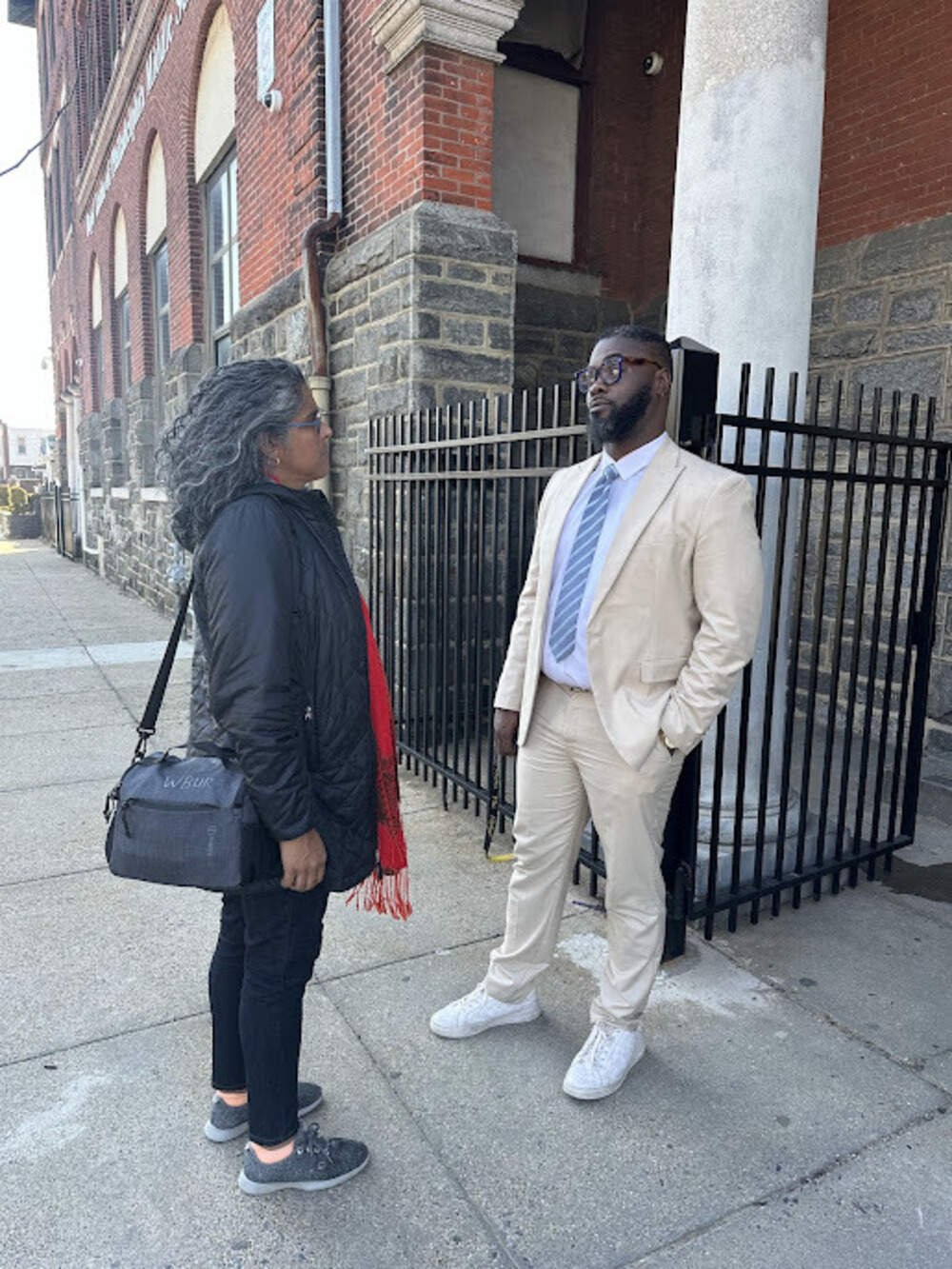
HAYES: Our behavior management strategies are designed to ensure that he's physically controlled and we are physically safe.
CHAKRABARTI: The "we" Hayes talks about is all of education and the world at large.
HAYES: What we celebrate and value is related to his ability to physically perform in athletics. Those are the ones who make the most money, and so we kind of create a continuum that prioritize the physicality of the Black boy. Not to get too deep, but this goes back to like why Black men were enslaved, right? The body is the currency.
CHAKRABARTI: Hayes says it's one of the most pernicious reasons why when we see that boys are falling behind, it's Black boys who are falling behind the most.
I'm Meghna Chakrabarti. This is an On Point special series, "Falling Behind: The Miseducation of America's Boys." Episode three: The Opportunity Gap.
When analyzing academic achievement gaps by race, boys and girls are usually lumped together. And on average, there are indeed persistent gaps between Asian and white children and Black children. But that average is hiding something. When disaggregated by gender, in some measures, Black girls are doing as well as white boys.
For example, Black girls are graduating from high school at the same rate as white boys. However, the graduation rate for Black boys is approximately 10% lower than the national average, meaning the so-called achievement gap isn't just driven by race, it's driven by race and gender. And Black boys are hurting the most.
Pedro Noguera is the dean of the School of Education at the University of Southern California. He knows the data better than anyone.
PEDRO NOGUERA: Well, the disparities are profound and consistent and troubling. You know, on every indicator that we associate with success in school, from graduation rates, from who's in honors, who's in gifted classes, Black males are underrepresented, and in the rates that we associate with failure, such as who's in special education, who's being suspended, who's being expelled, which kids are in remedial classes, which kids are dropping out, Black males are overrepresented.
CHAKRABARTI: But some other numbers — I'm seeing here that by the time students reach third grade, in some places at least, less than 15% of Black boys are reading at grade level. I mean, that's such a shocking number that I have a hard time wrapping my head around it.
NOGUERA: It's not just reading, it's math. But it's also suspension rates. A few years ago, the Office of Civil Rights documented that one out of four Black males in preschool was being suspended from school. Imagine that. Children under four being suspended.
And that, I think, speaks to the real troubling pattern, the way in which Black males are more likely to be labeled and marginalized and denied real important opportunities, including the opportunity to learn to read.
CHAKRABARTI: So this takes us back to Boys' Latin School in Philadelphia.
Boys' Latin has a middle and high school. We are at the middle school, which opened its doors in 2013. And right off the bat you notice that it's a rare place for three reasons. One, it's a charter school.
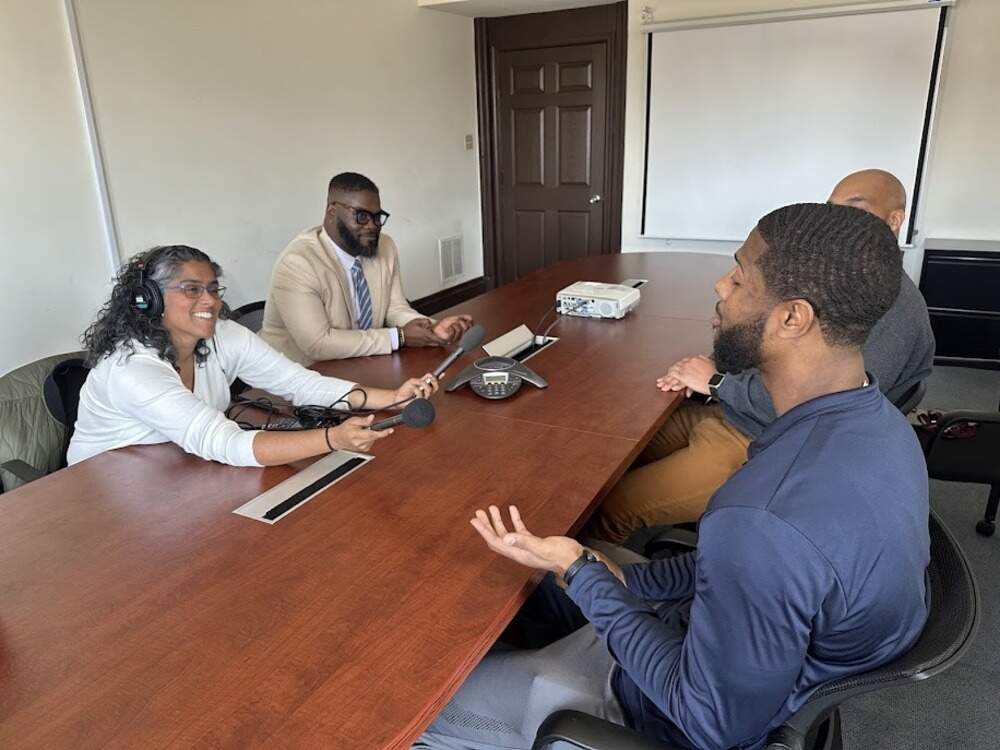
HAYES: It's different.
CHAKRABARTI: Two, it follows a Latin school model. William Hayes, Boys' Latin CEO, explains.
HAYES: From a cultural standpoint, a space that represented the elite aristocracy and Black people were blocked out of having access to that.
CHAKRABARTI: This is an important point because it underpins everything the school tries to signal to the boys from the moment they arrive, that this is a place of opportunity, of high expectation, of belief that you can achieve the things you thought you couldn't. And the third thing that makes it different? It is a public school, but all boys.
HAYES: I think the goal for the all boys was to really be more specific and targeted in terms of the full experience that we were able to offer boys. And to push boys outside of their comfort zone socially, both to engage with one another, but to also try new experiences where I think socially when you have mixed gender groups, boys tend to fall to the background in some areas, specifically like the arts or more social, emotional intelligence and conversations there.
CHAKRABARTI: We see how the school pushes the boys on a visit to a sixth grade English class.
TEACHER [Tape]: How would you eliminate wordiness and redundancy in the sentence below?
CHAKRABARTI: About 20 boys dressed in their maroon school uniforms are hunched over their desks. Boys' Latin is a public school, so it is still required to administer the state of Pennsylvania's standardized tests, and the class is practicing.
TEACHER: "On the occasion of taking a shopping trip to the mall, I may buy two shirts."
CHAKRABARTI: A bunch of hands shoot up.
TEACHER: Go ahead, Niquan.
STUDENT: You would say like, "Some days I will go to the mall and buy multiple shirts?"
UNIDENTIFIED TEACHER: Mm. Does that eliminate our wordiness and redundancy there?
STUDENT: Nope.
TEACHER: So all you did is put on "some days." Right? So what you wanna do is make it less wordy, make it clear, but still communicate that same idea. Ibrahim, go ahead.
CHAKRABARTI: William Hayes says the teacher is pushing these Black boys in a completely different way than they might have experienced before. Hayes describes the thinking in typical schools as --
HAYES: We really just want boys to be managed in the class behaviorally, and so as long as the boy is sitting quiet and following directions, we won't probe him or engage him because we don't want to disrupt this like, calm, positive presence, right? We don't want to poke and push to the point of frustration because we are fearful that if he gets frustrated, we won't be able to control the behavior to get him back to there.
And so what you find is teachers unconsciously won't ask the third question of the kid. Right? And if a kid doesn't get it right the first time, they won't say, try it again a second time. And that's where the learning takes place. Like, the learning is kind of this zone of proximal frustration. Like, you want to get them to the point of frustration. But I don't think we as a school or a system know what to do when kids are frustrated.
CHAKRABARTI: That's not what's happening here. The teacher keeps putting the question to the boys.
TEACHER: Okay, so now we're seeing with that. So you can take away words, rearrange words, anything. Sicari, you're next.
STUDENT: (INAUDIBLE)
CHAKRABARTI: Over and over again.
TEACHER: Okay, we're getting closer. But then that takes away "on the occasion," right? So you are now, you're making "today" as the occasion. Kaim and Tair.
CHAKRABARTI: She asks them to refine their answers every time.
TEACHER: That's better, but I still think we can do even better than that.
CHAKRABARTI: She doesn't stop and just give the boys the answer so the class can move on. We leave the classroom as the sixth boy is further chipping away at those extraneous words.
TEACHER: You are adding words to the original sentence, but remember, we're trying to eliminate redundancy and wordiness. Make it clearer. Trevor.
MEGHNA: (LAUGHS) Literally, what most adults can't do.
HAYES: (LAUGHS) Yes!
CHAKRABARTI: There's something else. These are sixth grade boys, right? So you'd expect some boyish ribbing. But I heard none. None of the boys laughed or mocked when their classmates got the answer wrong. William Hayes says it's taken Boys Latin time to build that supportive culture.
HAYES: Image is important for boys, and how you look amongst your peers is equally important. And so I think there's a comfort that kids have to feel both in the environment that's there and also in the confidence in the adult to get me to right if I step out there and take a risk.
Part II
CHAKRABARTI: We're in the middle of the series. And already, we've learned that changing the relationship that boys have with school — and that schools have with boys — lies at the heart of any meaningful effort to improve long-term outcomes for boys. And that's especially true for Black boys.
David Miller is the father of three. They went to the Baltimore County Public Schools. And his middle son, Jihad, was diagnosed with ADHD, and apraxia which made it difficult for him to speak. David says Jihad had a lot of energy and a pattern emerged as early as kindergarten.
DAVID MILLER: Always in timeout. Coming to the school, and he's sitting in the corner in tears, not having a good day. And every day the teacher was like, "Oh, he got a sad face today. He wasn't listening." It wasn't good for his self-esteem at a very young age to always being told that you're doing something wrong at six. I mean, it was, it was killing, it was killing me slowly.
CHAKRABARTI: David says Jihad's kindergarten teacher was trying her best. But he believes that as a white woman, she didn't know how to educate boys of color.
MILLER: The teacher told us that he would be in special education for the rest of his life. "Don't have a lot of high hopes, you know, for college." I remember one day we went to go pick my son up. She had actually put a weighted vest on him because her rationale was, "If I put this on him, this probably will slow this little guy's energy down." And for us, you know, that was the absolute, you know, last straw for us.
CHAKRABARTI: David and his wife transferred Jihad to a Black-owned and operated private school. And there, he could do things like work while standing up. Jihad's now 22, and he's graduated with honors from college.
Dana Duckworth is a mom in Chesapeake, Virginia. Her twin sons are in the 11th grade at their local public high school, and here's what she wants for her sons.
DANA DUCKWORTH: They are well on their way to being six feet tall. They have beards. They have locks. I know the way that the world will view them. But it's important for me that they have kept that innocence and they are treated like a child in our home and in school. Like, I think the childhood aspect is so important because the world is so hard for Black men. So give them more time to be in their innocence, in their childhood.
CHAKRABARTI: So Professor Noguera, as I was listening to those parents, it made me suddenly wonder what was your experience like in school when you were a boy?
NOGUERA: Yes. I also want to just pick up on something that that parent said. She said she just wants her sons to be treated like boys.
CHAKRABARTI: Mm-hmm.
NOGUERA: Just like kids. She wasn't asking for preferential treatment and that's the point. Right? You know, that too often they're being labeled and scrutinized early.
My brother and I were assumed when we moved from New York City to Long Island, they assumed we couldn't speak English because we have Spanish names. We could speak English fine, but they put us in special ed because they assumed not speaking English was like a disability. Fortunately, my parents found out and insisted that we be moved and they said, "Well, they'll have to be tested first." We were tested and we went from being special ed students to gifted students on the same day.
CHAKRABARTI: (GASPS) (LAUGHS)
NOGUERA: But what would've happened if our parents hadn't intervened? And too many cases, the parents don't know how schools work, don't understand. They want to trust the educators.
CHAKRABARTI: Will you forgive me if I say that sounds crazy?! Like, how is it even possible that a school just presumes a child doesn't speak English? Did they even speak with you and your brother?
NOGUERA: (LAUGHS) No, no, they just looked at our names, saw that we had Spanish names. And this is not an uncommon experience to assume that not speaking English is a kind of disability.
CHAKRABARTI: Mm. Well, Professor Noguera, hang on for just a moment. This is a perfect opportunity to bring in Joseph Derrick Nelson. He's an associate professor of educational studies and chair of the Department of Black Studies at Swarthmore College. Professor Nelson, welcome to the show.
JOSEPH DERRICK NELSON: Thank you for the opportunity. I'm excited to be here with you.
CHAKRABARTI: You know, both you and Professor Noguera, another aspect of your experience in this area is that you were both classroom teachers as well. And I'd love to lean on that. Remind me, what grade did you teach, Professor Nelson?
NELSON: So I began my career in education as a first grade teacher on the north side of Milwaukee, Wisconsin, which is where I grew up. And it was in a co-ed elementary school that had a single-sex intervention by default for a group of primarily Black and Latino boys. And then I became the embodiment of an intervention for a group of boys that already at the age of six — as we're hearing what the story with Jihad — had been labeled at the time "at-risk."
My principal said on my very first day of teaching, "You are their last chance." So the stakes were high. And it was clumsily, being a novice first-year teacher, it was relationships with the boys, leading with curiosity, asking questions, seeking to understand their perspective. I quickly learned that in many cases, many of them were actually high performing and actually just disengaged from the rote memorization, drill and skill test prep that was so prominent in their kindergarten classroom.
CHAKRABARTI: It sounds like when you were assigned to work with these boys, the presumption was that you would just be doing behavioral management.
NELSON: Absolutely. So there was a clear expectation of who I was to be as their classroom teacher, which was authoritative. The desks were in rows, and the room was quiet. It was perceived that they would be on task. So there was definitely more of an emphasis on quarantine, control and management of their bodies rather than teaching and learning and development as children.
CHAKRABARTI: Because it sounds like there was also a presumption there that the disengagement that some of those boys showed was due to some kind of cognitive deficit, versus disengagement simply because they weren't being challenged or engaged properly.
NELSON: Yeah. So much of how teachers view Black boys are through these rigid set of race and gender stereotypes that are often associated with adult Black men. And you know, I argue in my own work as well, that there's a need for a re-imagining of Black boyhood.
CHAKRABARTI: Professor Noguera, your thoughts?
NOGUERA: It sounds trite, but it's true. Children learn through relationships. They can sense if the adult who's teaching them cares about them, believes in them. And when Black boys are taught by teachers of any kind, who possess those qualities, who see the value in those children, Black boys can do extremely well.
So if we locate the problem in the child, then we're more likely to see those children in deficit. If we see instead the challenges, how do we put these kids in a setting where they can grow and develop? We're more likely to approach the challenge of educating them in a very different way. And there are schools that are showing us we can do that right now.
IMERE WILLIAMS [Tape]: 1, 2, 3! (CLAPPING)
STUDENTS: (CLAPPING)
WILLIAMS: Alright, number five. "Which of the following should be left out of the summary of a passage?" You should kill this one.
WILLIAMS: My name is Imere Williams. I am an eighth grade English teacher at Boys' Latin. I'm also an alum of Boys Latin, class of 2020.
WILLIAMS: I don't think so. I don't think A. Someone give me another one. Mr. Dickerson?
STUDENT: B.
WILLAMS: B. I agree.
CHAKRABARTI: Mr. Williams is one of several teachers we spoke with on our visit to Boys' Latin Middle School in Philadelphia. When reflecting on the most important parts of their jobs, they all said two things: relationships and accountability.
WILLIAMS: Yeah, so I'm really big on high standards and academic excellence. I try to make sure that my boys know that that's a priority in life. This is critical for access to this world.
CHAKRABARTI: How does he get the message through?
WILLIAMS: Continuously reminding them that they're brilliant. I think that along the way they've lost like some sort of like a confidence in themselves. So just reminding them that they're brilliant and that they can do it, and showing them the actual data that they can do it.
CHAKRABARTI: Boys' Latin is a charter school. Students are admitted by lottery, but families have to apply to get into that lottery. Critics of charter schools say that's why it may be easier to motivate those boys academically, because their parents are already motivated. And in a sense, Imere Williams is an example of that. He's a Boys' Latin alum. His mother worked two jobs, but on the day applications were first available, she risked missing work to get her son into that lottery.
WILLIAMS: My mother never calls off of work because, you know, she can't afford to call off her work. But that day, you know, we needed to do that because that was before all the electronic forms and all that stuff. She had to pick up a physical application. So she drove, you know, so that's how much of a decision it was, yeah. It was really important to us that that education was being afforded to me.
CHAKRABARTI: Williams believes that's missing the point. He says he has to really work at creating relationships with his students to strengthen the bonds of — and this word comes up over and over again in the school — of brotherhood.
WILLIAMS: Brotherhood to me means that the boys are holding each other accountable for the things that they're doing and wanting to see each other succeed. Like, my success is your success. And that's how I define it in my classroom.
CHAKRABARTI: He also does something else.
WILLIAMS: I tell them all the time that you can say, "I love you." I love you. I say that all the time. You can say I love you to your brother as well. And then you know, they're boys. They're gonna tell me like, no, they don't. Like, try to hide it. But they love it. I can tell they do.
CHAKRABARTI: I wanna test the relationships and accountability theory of education at Boys' Latin. So I ask eighth grader Isaiah Scott, "what's your favorite part of school?"
SCOTT [Tape]: Um, I would say the discipline.
CHAKRABARTI: Not what I was expecting from a 14-year-old.
SCOTT: They might not like, make you be in trouble, but they gonna actually talk to you to make you fix your actions. Because even if like, failing here, like a failing type of grade, they don't really take it as, we're dumb, we're stupid. They, we take it as you got time to learn, you got time to pick up on it.
CHAKRABARTI: How does that make you feel about school?
SCOTT: It kind of make me feel like I wouldn't, I wouldn't want to drop out.
DAVID PETERSON: So I feel like holding the kid accountable that you have a relationship with, like you mentioned, is a lot easier.
CHAKRABARTI: David Peterson is Boys' Latin athletic director and a P.E. teacher.
PETERSON: You'll get a kid, say for example, he's talking to one of his friends and you say, Hey Khalil, can you stop talking? "Oh my bad, Mr. Peterson, I got you." Again, when you have that relationship, they're a lot more prone to be honest with you. They're a lot more prone to just, when you're holding 'em accountable, a lot more likely to take it and not get defensive towards you.
CHAKRABARTI: Mr. Peterson knows the impact of this firsthand. He's also an alum.
PETERSON: Just the love, too. I feel like when I went to the high school, the teacher actually loves you like you're their child. And that's kind of how I like to implement things with the boys now. I had a kid actually calling me his dad last year. He was, "Dad, Dad!" Every time he would see me, he would be calling call me his dad.
CHAKRABARTI: But all this good news takes hard work that often takes place well outside the classroom and outside of school hours. Michael Sanford is the middle school principal.
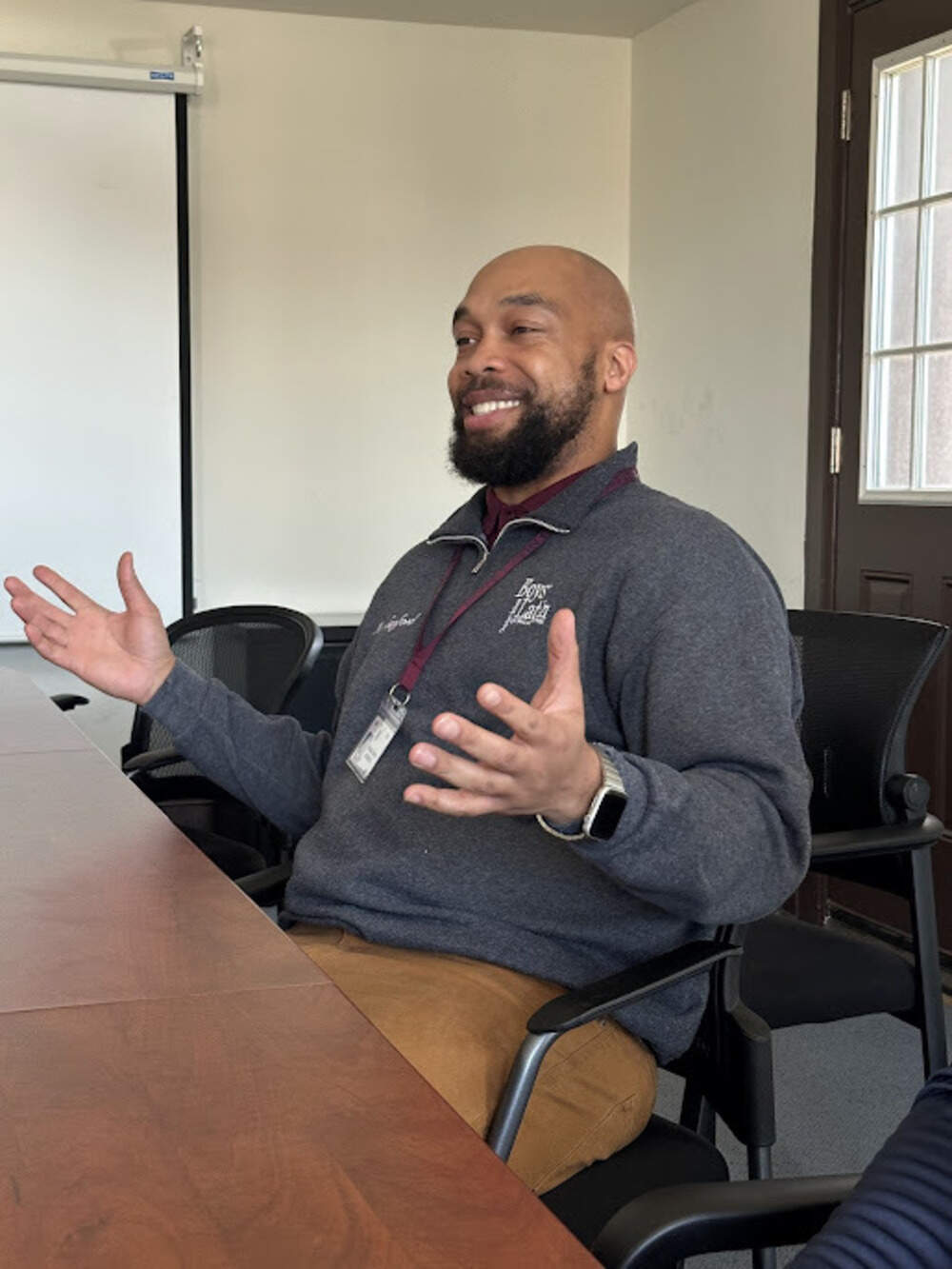
MICHAEL SANFORD: Got close to one of my other kids during PSSCs. He was late every day. I said, you know what, I'm just go pick him up every single morning. Literally. Twelve years old. Kid's now like 22. Still calls my phone to this day.
CHAKRABARTI: Can all public schools afford to spend so much time building such deep relationships with boys? Principal Sanford understands that teacher labor contracts or financial strain may stand in the way. But he says it's worth every effort, especially for the most difficult students.
SANFORD: Because there is something there that maybe someone else has not tapped into yet, or maybe they haven't even tapped into yet. And if we could find that thing, you start to see change. And you start to even see how they respond to other people because of you. That's what you saw today.
CHAKRABARTI: So Professor Nelson, I love the example of what we saw at Boys' Latin in Philly because it really shows in practice something you called for earlier, and that's reimagining Black boyhood. But Boys' Latin is also the exception, right? I mean, it's all boys. It's a charter school. The student body is almost 100% Black.
And I can think of other public schools where the students are almost all Black. And the concern there is essentially what advocates call the resegregation of America's schools. This is all to say, what do you think the things are that educators can do for Black male students, no matter what kind of school they're in?
NELSON: So the relational teaching strategies for Black boys that I've kind of discovered through my own research is first reaching out, going beyond. You know, boys wanna sense from their teachers that their personhood is more important to them in many ways to a school policy or procedure.
And the example I always give there quickly is a boy needs homework help after school. You stay with them after school, but then maybe you drive them to the bus stop so that then their commute home is quicker. Or if you know, if a young boy has a food insecurity issue at home, that then maybe you have snacks in your classroom. Simple gestures, but then when you open up a faculty handbook in most school districts, usually those types of behaviors are framed as inappropriate or we should steer away from them.
And then the second one is around personal advocacy, but this is just a strategy that encourages teachers to find a context or setting where Black boys are achieving, where they're doing well, and going to them in those settings and seeing them flourish in that context. Maybe they're a really talented musician. They play drums for their church choir. Or they're a strong athlete, or they're big in theater or mock trial. Just an effort on the part of the teacher to see a context where the boy is doing well and use that knowledge to then kind of be creative about how to reengage them in the learning within their own classroom.
And then the third strategy is just establishing common ground. Pretty straightforward. It could be having the same Timberland boots. It could be also having the same favorite television show. These simple gestures, you know, boys communicate it, help them be able to see themselves within their teachers, but also the teachers help them see themselves within the boys.
And the last one is just around accommodating opposition. Problems emerge. Maybe they have, there's difficulty with handing in their homework completely or consistently, or there's maybe some, you know, arriving a little bit late to class that instead of leading with a stiff consequence from a place of, you know, punishment, beginning to kind of just be curious and just ask questions about what might be happening for that young boy that's contributing to their actions or behaviors. Their actions are communicating an unmet need oftentimes.
So it's, it's encouraging teachers to be curious, ask questions, seek to understand what might be happening in the boy's life, either at school or home that then will help you kind of tweak an intervention, tweak a support that you provide. That then doesn't cause a rift in the relationship, which is key to keep intact in terms of boys continuing to kind of show up for you in your class as the teacher.
CHAKRABARTI: Well, these things make so much sense when laid out like that. But taking them from theory into practice is another thing, right? I mean, we talked about how things like budgets and testing requirements and teacher contracts, you name it. Those things can be barriers to developing the kinds of relationships we're talking about.
But we also got this message from a mom in Hartford, Connecticut. Christina Christian has a doctorate in education herself. Nevertheless, she says one of her son's experiences in school was quote, "nothing short of traumatic."
CHRISTINA CHRISTIAN [Tape]: Not only was his teacher aloof, but her expectations of him and what he was capable of was so, so, so low that she was essentially, and maybe inadvertently, but definitely undermining my husband and I's concerted efforts to raise him to excel.
While going through these experiences, I was pursuing my doctorate degree in education. Research is clear. It shows that Black parents who attempt to participate in their child's education and collaborate with their sons' teachers are often dismissed, patronized and treated as if we are unable to understand how to properly raise our own children. I would say in closing, for Black parents and Black boys matriculating through the public school system, that experience is one that you survive. It's one that you survive.
CHAKRABARTI: Professor Noguera, your response?
NOGUERA: I think if there are stereotypes, the assumptions, the biases that educators will bring to the classroom. And I should say all of us are susceptible to those stereotypes, including Black teachers. If you see Black children as small versions of the adults, you fear, then you're more likely to be scrutinizing those children more likely than you are other children.
The sad thing, and this is very important I think for the listeners to understand, is that what's happening in schools then becomes important of what's gonna happen to adults in society. Black males as adults are more likely to be incarcerated, less likely to be employed, less likely to be able to contribute to their families and communities, because of these early experiences in schools.
That is, the kids we don't serve well in school are more likely to be the people who end up in our nation's prisons. And it's a lot more expensive to incarcerate someone than it is to educate them. So the work we need to do is to provide the kind of support Joseph described at Latin High School there in Philadelphia, and make that more common in more schools. It should not be an exceptional school. We should be able to say there are many schools like this that are promoting this kind of developmental success and academic achievement amongst Black male students.
Part III
CHAKRABARTI: Throughout this episode, we've been hearing about the Boys' Latin School of Philadelphia, and the ways it’s raising achievement levels for middle school boys. Now, we know that this example comes with an asterisk. As an all-boys public charter school, Boys' Latin is unlike virtually every other public school in the country.
But that doesn't mean that what they're doing in Philly can't be replicated elsewhere. In fact, there are schools that have been doing some similar things even longer than Boys' Latin. Take a look at what's happening in Pritchard, Alabama.
JEROME WOODS: Pritchard, Alabama is a tough, tough city.
CHAKRABARTI: Jerome Woods is the principal at Mattie T. Blount High. It's a co-ed public school in Mobile County, Alabama.
WOODS: Most of our kids are inner city, low socioeconomic kids, tough kids from the neighborhood.
CHAKRABARTI: National median household income in the US is about $80,000. In Pritchard, it's $35,000, even less than the 43,000 median in West Philadelphia where Boys' Latin is located. I stress these numbers because in every single measure of educational attainment for boys and girls, the strongest correlations come from family income or its close relative, zip code.
Principal Woods arrived at Blount High School 16 years ago. Back then the graduation rate was very low.
WOODS: Blount High School has been as low as 59% graduation rate during my tenure here.
CHAKRABARTI: The national average is 87%, according to the National Center for Education Statistics.
WOODS: So what we wanted in the building was a change for that.
CHAKRABARTI: Woods wanted to change everything about how students even think about the school.
WOODS: So we wanted a better academic feel for the student and for the building. You know, I truly believe that when you walk through the front door, you can feel what's happening in the building. You can hear it. There's a thought process to what teaching and learning sounds like and looks like, and we wanted our culture to change into that.
CHAKRABARTI: A cultural change. Even though they're more than a thousand miles apart, this is where Blount High School in Alabama and Boys' Latin in Philadelphia are almost identical.
On our visit to Boys Latin, creating a culture of academic ambition was one of the first things CEO William Hayes talked about. He says it's integrated into the physical building itself. The walls were repainted in a more professional color. The boys wear maroon uniforms, large college flags hang in the cafeteria.
HAYES: The flags and decorations of art there, our intention was to just create a vibrant space.
CHAKRABARTI: So too, at Blount High School. Principal Woods says they've draped the walls in school colors, purple and white. The kids wear uniforms and college flags hang in every classroom.
WOODS: When they get to the school and they feel safe, when they have some trust in the teachers that teach them, when they feel comfortable enough to come to you and talk to you about what they think would be good for the school, that's a culture shift.
CHAKRABARTI: Here's how Boys' Latin principal Michael Sanford puts it.
SANFORD: When a kid is able, they know they could come to you, talk to you about something if they need it. You are consistent. You are that figure that sometimes is lacking in their lives and that really causes them to go in the wrong path.
But if we could show up every day and let them know, you know what? Our school might be right here, but this is not where your life has to stop.
CHAKRABARTI: Sanford sees Boys' Latin as a place where students are given the chance to connect to a world beyond their neighborhoods.
SANFORD: To different opportunities, different people, different organizations comes in. So you can see, "Oh man, like I can actually do this," or, "Hmm, I didn't know I liked this. Well, maybe I do like this. I could participate in this. Perhaps this could gimme a full ride scholarship to college." You know what I mean?
CHAKRABARTI: At Blount High School in Alabama, Principal Woods works with the national mentorship organization, 100 Black Men.
WOODS: Some character building there. The thought process of how to interview, what to wear, and then obviously we have some partners in ed that we partner with as well. Bishop State Community College does our dual enrollment. And there's a push there to increase the number of young Black males that get into their programs.
CHAKRABARTI: The hope is that students immersed in this culture start believing that college is a plausible next step on the road to achieving their dreams.
CASEY: I wanna be an NFL player.
CHAKRABARTI: Jayden Casey is an eighth grader at Boys' Latin. You heard him before.
CASEY: Boys' Latin can help me like that from starting here, going up from high school to college. They could get me to college.
HAYES: All of these kids wanna play sports or be a music entertainer, which in some cases is stereotypical to Black boys. But they all saw themselves going through college to get there.
CHAKRABARTI: Boys' Latin CEO William Hayes there. Now, success in school is a prerequisite to success in college, but how do you measure that success? Well, one way is through testing.
On Pennsylvania state standardized tests, students at Boys' Latin score well below state averages. In 2024, 52% of eighth graders statewide scored proficient or above on the English language test. At Boys' Latin, it was 25%. In math, the Pennsylvania State average for eighth graders scoring proficient and above was 26%. At Boys' Latin, it was 7%.
Hayes is aware how far they still have to go, and he says a critical part of that is celebrating even the smallest successes the boys have along the way.
HAYES: And so I think it's about diversifying what we celebrate. And so one of the things we did was we started buying trophies for the Honor Roll Banquet, which were the same size as the athletic trophies.
CHAKRABARTI: How'd the kids respond to that?
HAYES: They loved it.
CHAKRABARTI: Blount High School principal Jerome Woods also talks a lot about the importance of accountability, just like you heard from Boys' Latin earlier in this episode. And here's how he celebrates the academic success that comes with it.
WOODS: Understanding that as juniors in your high school, you represent the academic achievement in the building. You will take the ACT, you will be a part of the school report card. So when you require a lot, you have to give a lot. So the kids say, "Hey, we've done great for so long. Can we have this? Can we have a pep rally?" When they see it, they wanna be a part of it. And I think that's helped us a lot.
CHAKRABARTI: Now I wanna be crystal clear about something. None of the educators we spoke with for this episode, and I mean none of them were naive about the challenges facing Black boys.
No one said, "Oh, just a few tweaks here and there with relationships and culture, and boom, you've solved the educational attainment problem." They all know it will take much more than that.
Going back to graduation rates for a moment. On average, Black girls are graduating high school at roughly the same rate as white boys, but for Black boys, the rate drops precipitously down to 76%. That's more than 10% below the national average for all students.
WOODS: It is true that, that the young Black male is at risk. We know that. So we've, you know, tried to, uh, surround them with good people, nourish them with good education. Give them the thought process of what it takes to graduate, graduate on time.
CHAKRABARTI: But being realistic about the challenges does not mean these educators are ignoring the successes. Remember the graduation rate at Blunt High School once stood at a dismal 59%? A little more than 15 years later, other indicators like median household income have barely budged in Pritchard, Alabama, but the high school graduation rate for all students, girls and boys, has skyrocketed.
WOODS: So we've been able to move to around 94% graduation rate. We've obviously done pretty good and we're proud of that.
CHAKRABARTI: So Professor Noguera, I wanna turn back to you. Do you believe these kinds of things can be scaled across the country?
NOGUERA: I think it can. But I wanna really emphasize, you can't just focus on the test scores. Test scores are indicators that tell us whether or not kids are learning, but you've also gotta focus on the culture. Hetalked about prep rallies at the school that, to make kids want to be in school, feel good about being there. Those are things we often take for granted in many suburban schools.
And I think it's important to point out that Alabama still has deeply segregated schools that are very unequal. But when you have leaders like a Principal Woods in place, you can do great things. And they should be applauded for what they've accomplished there. It's really extraordinary.
CHAKRABARTI: Professor Nelson, I'd love to hear your response.
NELSON: It was just exciting to hear and a wonderful illustration of just being creative about how to serve all children and youth well. You know, their emphasis on, you know, Black male teachers and then also re-imagining aspects of their discipline policy. Celebrating all kids, love pedagogy being a part of how they describe what they do within the school, I think are all just, again, wonderful examples that other school leaders could benefit from.
CHAKRABARTI: Mm-hmm.
NOGUERA: Meghna, can I share another Alabama story while we're on?
CHAKRABARTI: Absolutely.
NOGUERA: Because not too long ago I was in, uh, Tuscaloosa visiting a high school there, I won't name it. And was asked to speak to the teachers about how to raise achievement. And as I was speaking to them, I could just look at their faces and I could tell they were kind of cynical about me coming in as an outsider speaking to them.
And I said, "How many of you have ever been to a school where Black children are successful?" And no one raised their hands. I said, "So then you probably don't think it's possible, do you?" And several said, "No, it's not." And I said, "Why not?" They said, "Because these kids don't care about education."
CHAKRABARTI: Mm.
NOGUERA: And I challenged them. I said, "I could take you to schools right now where black children are thriving and succeeding. Are you willing to come?" And they sent eight teachers with me to visit a school in New York City, Medgar Evers Prep. And they were blown away by what they saw with the kids, boys and girls.
And so I think taking other teachers to see schools like the one we just heard about in Mobile is so important for letting them know the problem is not the children. The problem is our inability to create environments that give kids a chance to thrive and grow and develop. And that's what the, the real issue is. How do we do that in more schools?
CHAKRABARTI: Well, this leads me to what may be an uncomfortable question because, professors, when we visited Boys' Latin in Philly and just like we heard from Prichard, Alabama, this cultural transformation is really at the heart of their efforts. But it also implies that perhaps those boys aren't getting that same kind of signaling outside of school.
And I bring this up because of something Tyrone Howard told us. You both know him. He's a professor of education at UCLA. He's a former classroom teacher himself, author of many books including Why Race and Culture Matters in Schools. And he's also founder and director of the Black Male Institute at UCLA. And here's what Professor Howard told us.
TYRONE HOWARD: There's a saying in Black communities that I hear all too often that as much as I don't wanna believe it, I have to believe there could be a kernel of truth to it. And that statement is that in many households, especially those where there are single parent households led by women, many Black mothers tend to raise their daughters and love their sons. Meaning that there is a greater set of expectations on Black girls.
They're more demanding on Black girls. Black girls are expected to do better at home with work chores, do better at school with education responsibilities, and boys get loved upon and are not being held to the same standard as girls are. And I think that can be a factor as well.
CHAKRABARTI: Do one of you wanna respond to that?
NOGUERA: I'll go first. I think it's a mistake to blame single moms or mothers for these issues. You know, is it true that in some households that girls do more chores, for example, than boys? That might be true in many homes. But I think it's a mistake to blame mothers for this. We're talking about societal issues that ways in which stereotypes throughout our society reinforce the idea that black males can excel at sports but can't excel academically.
NELSON: And I would just add that schools should be places where Black boys can go and explore and experiment and reflect and be curious about who they are. And schools shouldn't just be another context or environment in their lives where they're a rigid set of stereotypes are imposed upon them. And I think we as educators should be challenged to think creatively about how to create and nurture spaces for Black boys where they can just be.
CHAKRABARTI: Well, I wanna just add another quick voice. It's Ron Walker, former teacher and principal and founder of the Coalition of Schools Educating Boys of Color. They created seven core standards that every school could follow to help better educate Black boys.
RON WALKER: It doesn't take a lot of money. It takes will. The will of people who say, we want to educate all students well so that they'll go into a society equipped with discernment, with the ability to be a critical thinker, to understand the difference between being schooled and being educated. Too many times when students have been schooled, it's been for compliance, not to advance the gifts and skills that students have when they're being educated. So I see now it's even more important now than ever.
CHAKRABARTI: So my last question to both of you is how do we get closer to this vision? To expanding these opportunities for all Black boys? Professor Nelson, go ahead.
NELSON: Teachers developing their own communities, their own networks to share resources, many of which are provided by the Coalition of Schools Educating Boys of Color and just being a sounding board in terms of even thinking about how they're building positive learning relationships with the Black boys within their schools. I'm a advocate of teachers coming together, school leaders coming together to share resources around a commitment and concern for Black boys from preschool all the way to post-secondary education.
CHAKRABARTI: Professor Noguera, go ahead.
NOGUERA: Yeah, so I want to give some credit to the Obama administration. Toward the end, President Obama launched something called My Brother's Keeper, and it was an attempt to draw attention to the particular challenges facing young Black males.
And I had some criticisms of what they were doing. But for the most part, what I really appreciated is an attempt to bring a cross-section of educators and nonprofits and foundations together to say, "Let's work on this throughout the country." And they did. Because the last 20 years we've seen significant improvements in many states and including places like Alabama, but it also in many cities like New York and Los Angeles. And it's because of this concerted effort.
So leadership matters. Leadership at the highest level matters. From the president down to governors, down to superintendents and mayors. We have to see this as an American issue, not as a Black issue. As Ron said there in the interview, it's about the will, generating the will to realize that we can do much better as a nation to serving our students, particularly our Black male students.
We love them when they're playing football and basketball. We should love them when they're doing art and reading and science and everything else, too.
CHAKRABARTI: Joseph Derrick Nelson is an associate professor of educational studies and chair of the Department of Black Studies at Swarthmore College and a fellow with the Boys Club of New York. Professor Nelson, thank you so much.
NELSON: Thank you for having me. It was wonderful to be here.
CHAKRABARTI: And Pedro Noguera, Dean of the University of Southern California Rossier School of Education, author of many books, including The Trouble with Black Boys: ...And Other Reflections on Race Equity and the Future of Public Education. Professor Noguera, thank you so very much.
NOGUERA: Thank you for your attention on this very important topic.
This program aired on April 16, 2025.