Support WBUR
'U.S. let go of my hand that it had extended to help': Afghan refugees on promises broken under Trump
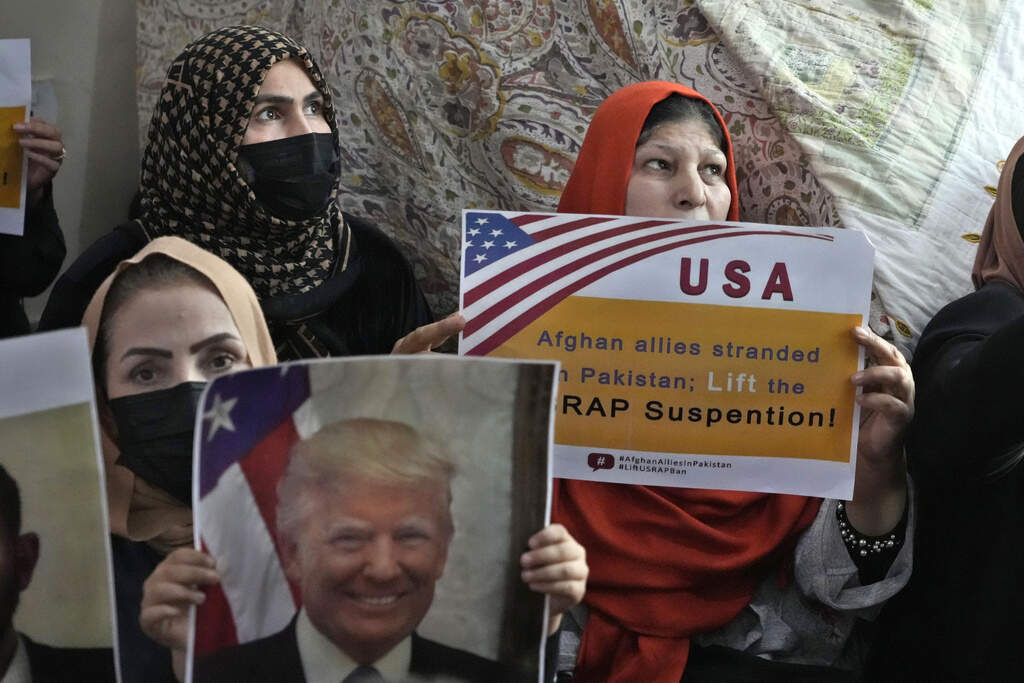
The immigration status of Afghans who helped the U.S. government is in jeopardy under the latest Trump crackdowns. How that impacts Afghan refugees and their families already in the U.S. and those stuck abroad.
Guests
Shawn VanDiver, founder and president of #AfghanEvac, a nonprofit organization helping to relocate and resettle eligible Afghan allies who helped the U.S. government and military in Afghanistan.
Jessica Bradley Rushing, former staffer at the State Department’s Coordinator for Afghan Relocation Efforts (CARE). She left in March. A Defense Council member of The Truman National Security Project.
Also Featured
Taiba Nawabi, an Afghan woman living in Pakistan awaiting a U.S. visa for her NGO work with the U.S. government.
Tamim Naseh, an Afghan man in Kabul, Afghanistan awaiting a U.S. visa for his NGO work with the U.S. government.
Transcript
Part I
DEBORAH BECKER: We have a warning now, what you're about to hear is quite graphic and violent, so take caution. Taiba Nawabi remembers being in Kabul, Afghanistan on August 16th, 2021, like it was yesterday.
TAIBA NAWABI: It's been four years, but whenever I began to tell the tale I can feel that day, I just get the feeling that it's still happening to me.
I can feel everything that I felt on that day. It was horrific. No one should experience that.
BECKER: The previous day, the Taliban toppled the Afghan government and regained control of the entire country.
NAWABI: We were all together sitting in our house minding our own business when suddenly our door was knocked.
When we opened the door, they hit the person that opened the door. They separated women in one room, men in other, and started torturing us.
BECKER: Taiba and her family were targeted because for years they worked with the US government during its two decades long war in Afghanistan. Taiba worked at an NGO that her father started in 2006.
It focused on women's issues and was mostly funded by the U.S. And now with the Taliban in power, working with the U.S. government made her a target.
NAWABI: My brain had frozen, stopped working. I didn't, I had my hands and legs weren't moving. I thought this is the end. I'm just going to die today. When they slid open my face, it just ripped apart.
And my sister and husband, they almost fainted seeing that. It was just too barbaric to experience that. I have an inch of a scar that can't be hidden, and my husband has his whole neck. They were trying to behead him.
BECKER: Taiba was saved by her neighbors who intervened and persuaded the Taliban men to leave.
Given her work with the us she and her family were immediately sent to a U.S. safe house nearby where they lived for six months until they were flown to Pakistan. They were told they would be evacuated to the U.S. in two weeks.
NAWABI: The time we were attacked I had already considered my end. But having having been to the U.S. safe house and being promised evacuation we felt at ease.
We felt everything's gonna be fine now. We will be facing the fruits of our deeds.
BECKER: But after more than three years, Taiba and her family are still stuck in Pakistan. And on January 20th of this year, President Trump signed an executive order that paused Afghan refugee visas. So Taiba has no idea when or if she'll get out.
NAWABI: I was feeling as if I have been cheated, as if all those words were nothing. U.S. was my last hope. And after I heard that news, I felt as if U.S. let go of my hand that it had extended to help me. It's devastating.
BECKER: Although Taiba is no longer in Afghanistan, where under Taliban rule, women can't leave their houses without a male guardian and are not allowed to speak in public. Taiba's not safe in Pakistan either.
NAWABI: We are being treated as equally bad by the Pakistani government. As a matter of neighborhood hate, they would barge in our house threaten to arrest us, and we would usually just have to bribe them to let us go, even though we have a letter from the embassy that says we are about to get evacuated, and they shouldn't bother us.
But they don't seem to follow the rules. Of course.
BECKER: Taiba, who's 27 years old, says she hasn't been able to work because employers are reluctant to hire people from Afghanistan. She only leaves the house to get groceries.
NAWABI: It's not a normal life in Pakistan at all. It's like we are living in a prison. We are imprisoned over here. We are not allowed to walk by, go wherever we want or work. We just have to sit in our home, pray and watch the news for new updates. Make some calls and try different routes.
BECKER: Taiba, her husband and sister applied for Visas, but everything has been put on hold since January and Taiba and her family are running out of time.
Pakistan recently denied their Visa applications, so now they're living illegally and could be deported anytime. If that happens, Taiba says she will not survive.
NAWABI: We cannot afford to go back. We are not scared of death itself, but more of humiliation. Of women who were raped, ripped apart into pieces and killed, that's a scary destiny to face.
I just request U.S. government that we didn't let go of you when you needed our help. We kept you safe, helped you in any way we could. Please help us now when we need you.
BECKER: That was Taiba Nawabi, an Afghan refugee in Pakistan, who after more than three years is still waiting for a Visa to come to the United States. Joining us to talk about this is Shawn VanDiver. He's founder and president of #AfghanEvac, a nonprofit helping to resettle eligible Afghans who helped the United States and Afghanistan.
He's also a Navy vet. He served from 2001 to 2013. He joins us from San Diego. Welcome Shawn, to On Point.
SHAWN VANDIVER: Thank you so much for having me. Hello.
BECKER: Hello. You know the story we just heard, Taiba's story, horrifying. I wonder how common are stories like this? How many Afghans who helped the U.S. are in limbo?
VANDIVER: Thank you so much for asking me that. Look, Taiba's story is tragically common. Women like her risk their lives for the United States government, working for our military diplomats and legal services and all sorts of aid programs, and now we've left them in limbo. She's one of tens of thousands stuck in Pakistan.
After we made a deal with their government to process these cases, we promised those people a path, we promised the government a path to what they were looking for. And now those folks are being told that they might have to self deport from Pakistan, the path is now blocked and it's unconscionable.
BECKER: So let's just go back a little bit. Folks who worked and helped the U.S. during two decades of war in Afghanistan, they were promised that they would be, and this was everyone who worked for the U.S., would be granted a U.S. visa in exchange for their help, or how did it work? Their families were included?
What exactly happened there? Let's understand what the promise was.
VANDIVER: Sure. So I want to take a step back and say that there's two different categories of folks. There's special immigrant visa holders in the consular path, so people who worked for the United States government as drivers, as interpreters, as cultural advisors, folks like that.
And then there's the refugee pathway. Those are people like people who worked in aid programs, people who worked as lawyers and prosecutors, putting the Taliban in jail. These are partner forces that trained, fought in blood alongside our U.S. military. And these are family of active-duty U.S. military.
Each group that's in both of these pathways is somebody that because of their relationship with us, is now at risk. And each of those people in the Enduring Welcome pathway, and we can talk about Enduring Welcome later, each of these people in these pathways. It was promised very recently by the United States government that they would, if they passed security vetting and all of the other checks, they would be able to come here and start their American dream.
BECKER: And what about temporary protected status, because that's been in the news most recently with what Homeland Security Secretary Kristi Noem said about discontinuing that for folks from Afghanistan. What about, how did that figure into all of this?
VANDIVER: Sure. We've got folks abroad, and then you've got folks who we already brought here, right?
So either we brought 'em here or they were here already as students or for some other reason. They've already passed security checks. They have kids in school, they're paying taxes. These are great, wonderful members of our communities and there's about 9,000 Afghans who had TPS, temporary protected status. And Secretary Noem, it seems like unilaterally decided that the conditions in Afghanistan are all better now.
I'm here to tell you they are not all better now, and especially for women and girls. It's not a pleasant place to be in Afghanistan, and it does seem odd that we would pull this rug out from under them. And the good news is though, if they have immigration proceedings whether it's a USCIS case pending, or a case in the immigration courts, they should be okay.
They need to contact a lawyer. They need to make sure they have legal representation. But if you have an ongoing case, then you should not be impacted by that expiration. You should be able to see that through.
BECKER: We did get a statement from the Department of Homeland Security when we reached out, to try to understand what exactly happened with temporary protected status or TPS and the statement we got back said that the termination of TPS for folks from Afghanistan was because of the country's improved security situation.
Which is what you said, and its stabilizing economy. It also says TPS, just like its name suggests, was only supposed to be temporary. And the statement also continues to say, additionally, DHS records indicate that there are Afghan nationals who are TPS recipients who have been the subject of investigations for fraud, public safety, and national security.
What do you say to that?
VANDIVER: I say that we need to make sure that every Afghan who's here under some sort of legal status, gets their opportunity to pass the security vetting and all of that and to normalize their status. Now, if there are people who are national security threats, which if there are people who are national security threats, then yeah, obviously we don't want people who are national security threats here.
However, we know that the vast majority of Afghans that are here are hardworking, wonderful humans in our communities. And this sort of unilateral action without putting it in the federal register, without communicating what it means for folks, is just causing chaos and uncertainty.
Part II
BECKER: We're joined by Shawn VanDiver, founder and president of #AfghanEvac. That's a nonprofit helping to resettle Afghan allies who helped the U.S. government. Also with us is Jessica Bradley Rushing, a former staffer at the State Department's office of the Coordinator for Afghan Relocation Efforts or CARE.
It's quite a mouthful. She's also a defense council member of the Truman National Security Project and she's in studio with us. Thanks for being with us.
JESSICA BRADLEY RUSHING: Thank you for having me.
BECKER: Shawn, I just want to go back to something you mentioned before we took a break and that was enduring welcome. Can you explain what that effort is in terms of the immigration of Afghans to the United States?
VANDIVER: Absolutely. Before I do that, I do want to just make another statement about the DHS statement. Look, the claim that Afghanistan is safer now is detached from reality. The Taliban are systematically erasing women and girls from public life, persecuting minorities and retaliating against anyone who worked with the U.S.
That's not stability. It's state sponsored oppression, and exactly the reasons why we have things like TPS. Now Enduring Welcome is the first time in our country's history that we are keeping our promise to our wartime allies. And we did it because we built it through engagement with the last administration.
The last administration worked with civil society and veterans to ask the question, what does right look like? And what we came up with was we needed to be moving about 5,000 people a month in both the refugee and consular pathways, people who stood with us after vetting, after exhaustive security vetting, in fact, the most secure legal pathway our country's ever seen into our immigration system.
And it was working, right? We were getting 28 flights a month out of Kabul, two third countries in Albania, Qatar, the Philippines, Germany, et cetera. And folks were coming here after exhaustive security vetting. And they were, it was working, and it was working really well, and it was built because of civic engagement and a willing government partner.
BECKER: But clearly there's a lot of anti-immigration sentiment in this country, right? So you may think it was working really well, but there are a lot of people who don't think that works well, and those people helped President Trump get elected. So how do you deal with that?
VANDIVER: Well, look, I'll say absolutely that's true, except in the case of Afghans.
In the case of Afghans, 90% of the American public support their ongoing relocation, resettlement. This population enjoys broad, bipartisan support. In fact, we've had incredible support from folks like Senator Lindsey Graham and representative Michael McCall, the former chairman of the House of Foreign Affairs Committee, even Congressman Darrell Issa has committed to me personally that he wants to see this through.
I just, I agree that there's broad anti-immigrant sentiment except on this issue.
BECKER: Okay. We're gonna talk a little bit about the politics later. I want to get into sort of the nuts and bolts of how the process works. Jessica, I want to ask you, you were working for the State Department up until March of this year, right?
BRADLEY RUSHING: Yes.
BECKER: And regarding helping Afghan refugees resettle here. So how does the process work now? And for many folks, it may seem people, the U.S., left the country almost four years ago. Why does it take so long? Is four years not really that long? Or what's to be expected in the process?
BRADLEY RUSHING: Sure. So in the wake of the U.S. withdrawal from Afghanistan in August of 2021, there was an effort to continue these relocation and resettlement efforts, because there were a lot of individuals who were eligible for this pathway, who were left behind when we left the country in the end of that summer.
Within the State Department and across the interagency, the White House DHS, DOD, there was an effort to ensure that we put together some sort of operation to ensure that these folks had a pathway here. That evolved over the last three and a half years from, how are we going to do this question in the early fall of 2021, to a really stable routine operation where we were at our peak moving about 5,000 individuals per month, they would leave Afghanistan.
BECKER: Just from Afghanistan.
BRADLEY RUSHING: Yes.
They would leave Afghanistan, go to a third country where they would complete their immigration processing, undergo really rigorous security and background checks, and then eventually come here to the U.S. to resettle. So it was a slow build, but within the three and a half years since the withdrawal, we had created this really robust program and that's Enduring Welcome.
BECKER: And how many Afghans have resettled here? Who were in that situation? Do you know? Do you have a rough estimate?
BRADLEY RUSHING: Since the summer of 2021, and this includes the withdrawal, the evacuation in August about just under 200,000 Afghans have been resettled here.
BECKER: And how many still in limbo according to, is it still the same as what Shawn suggested? Maybe like 9,000?
BRADLEY RUSHING: Oh, no. Far more.
BECKER: Far more.
BRADLEY RUSHING: There's probably about 200,000 still in the pathway.
BECKER: 200,000 waiting.
BRADLEY RUSHING: Yes.
BECKER: And 200,000 here.
BRADLEY RUSHING: Yes.
BECKER: That's a lot.
VANDIVER: There were 9,000 under TPS.
BECKER: Under TPS. Okay. All right.
VANDIVER: And that's just here.
BECKER: And so the program was working well.
BRADLEY RUSHING: Yes.
BECKER: And so what do you make of these changes then of what's happened since President Trump took office, and his decision to suspend really refugee admissions from Afghanistan.
BRADLEY RUSHING: So it's been a tough few months. On day one of the Trump administration, there were a few executive orders that were signed that had an immediate impact on our ability to continue operations. The first one was obviously the suspension of the U.S. refugee admissions program, which means that everyone, all the Afghans who are in that pathway, in the USRAP pathway, all of their processing is paused, and all of their travel is paused.
So that entire column in the Enduring Welcome Program was put on hold. There was another executive order that paused for an assistance that had what we assumed was not an intended consequence, but a second order consequence of halting the funding for travel for folks in the SIV pathway.
So the way that it works is the SIV processing.
BECKER: Special immigrant visa.
BRADLEY RUSHING: Yes. Special immigrant visa processing can continue, but we are no longer able to fund their travel to get here to the United States. And even if they're able to self fund their own travel. Once they arrive here, there's no longer any resettlement benefit available.
So as a result of these two specific executive orders, Enduring Welcome operations essentially paused, and we have not had any relocation flights leave Afghanistan since then.
BECKER: And so what do you do to help folks then who are in this situation, the hundreds of thousands apparently, who are in this situation and need this help?
BRADLEY RUSHING: The response from the U.S. government hasn't been overwhelmingly proactive.
There are a lot of folks still working to get the program back up and running, but I think one thing that we've seen is that organizations like #AfghanEvac have stepped in to continue the communications piece that is so critical, so that Afghans who are awaiting relocation know what's happening.
The folks who were left behind and still looking for answers, wondering if their case processing will be picked back up, wondering if travel will start back up. They need answers on a fairly quick basis and the U.S. government isn't really able to provide those answers. Because it's unclear whether those operations are gonna continue.
BECKER: What's happening with your former office at the State Department of the coordinator for Afghan relocation efforts? Do you know?
BRADLEY RUSHING: The coordinator for Afghan relocation efforts' office is still functional and operational, but there are no flights running and there's been a suspension essentially of a lot of the operational pieces.
We don't know what's going to happen going forward, whether the operations will be turned back on and the office can get back to work, or whether we're looking at a case where the administration has decided to wind this program down and close it out.
BECKER: Some other things that are complicating all of this is a potential travel ban on folks from Afghanistan. We've heard that Afghanistan may be on a list from the White House and residents of Afghanistan would not be allowed to come to the U.S.
And then of course there are actions in Pakistan where many Afghan refugees were sent, that they may expel Afghan nationals. And in fact, have started repatriating some, I'm told this month alone about 80,000 Afghan nationals were sent back.
BECKER: Shawn, I wanna go to you on that first and can you explain how these international events are affecting this issue particularly?
VANDIVER: Sure. I would actually flip the script on that. I would say that President Trump's executive orders have caused chaos with our international partners, right?
Like in Pakistan, the processing was working. Now the United States government was not housing people fast enough, was not assuring them, bringing them to the United States fast enough. They were processing them, and when he put a full stop to it, that inherent protection for those folks dissipated. And Pakistan was left wondering, what are we gonna do here?
And I think what Pakistan is doing to Afghans is unconscionable. It's unreasonable. They shouldn't be doing that. And I also think that if President Trump was acting as a better partner to them, then we would probably not see that happening. Look, the wide-ranging impacts, the inhumanity of cutting aid to Afghanistan, of cutting these programs after people were promised over and over.
CARE is still doing everything but the flights, they're still running people's medical checks. They're still doing security checks. They're still doing all of these things, even as OMB sent a letter to state saying, or sent the budget request over saying, Hey, why don't you spend the last $600 million in the Enduring Welcome fund to shut down operations by September?
That's a pretty clear message. Now, hopefully State is pushing back on that, but I just, these folks deserve better, and they deserve clear communications about it.
BECKER: And you have recently sent a letter about that, which again, we'll get to in just a moment. You sent a letter to federal officials asking for more clarity, but I wanna get back to this question of how long this takes, because I don't think we finished answering that.
VANDIVER: Oh, sure.
BECKER: Why does it seem to take such an extended period of time? Now, I know you've mentioned that Afghan refugees in particular in this program are well vetted. Is that, the hold up. Jessica, what would you say?
BRADLEY RUSHING: Certainly, three and a half, four years is a long time, but we built these operations from scratch essentially in terms of the relocation piece, since the fall of 2021.
And that inherently is something that takes some time, to get all these pieces in place and get this moving at a scale that enabled us to move around 5,000 per month. In the summer and fall of 2021, when it became clear that Afghanistan was going to fall, that the U.S. was withdrawing. There were also, there was a huge surge in applications for special immigrant visas and in referrals for refugees.
So there was an enormous backlog that was created at that time as well. And the U.S. government had to scramble really to try and address that backlog as best they could. Over the course of the next year to 18 months, there were a lot of efficiencies that were put in place to speed up the processing on the SIV applications, on the refugee referrals, but it was still at a scale that was really not seen before.
There are also complications in certain cases, right? So if you apply for a special immigration visa, a special immigrant visa, it is on the applicant to provide a significant amount of paperwork and proof of who they are, that they worked for the U.S. government, proof of employment, a reference letter from a former employer.
And in many instances, it's very difficult for the Afghans in question to pull all that paperwork together. So in some cases, people will start an application, and it may take a very long time for that application to become complete. I do think that it's a fair thing to say, that years is certainly not a short timeframe.
But there were a lot of pieces that had to be put into place to get this moving at scale. And it was finally moving at scale over the course of the last year or so, and now it's all stopped.
VANDIVER: A absolutely and look, the underlying truth here is that it's a longstanding bipartisan tradition to fail our allies.
They did not resource this in any administration, until the last administration, they didn't resource this well enough.
BECKER: I wonder what about humanitarian parole? What's happened with that? Is that, there any changes there, Shawn? What do we know about that? Are there other avenues?
Is what I'm wondering here, maybe that won't move as quickly, maybe that are a little bit different, but are there other avenues or no?
VANDIVER: So there's a lot of different types of humanitarian parole. There's humanitarian parole that you can apply for outside the country and give a good reason why you need to come here, somebody's sick, et cetera.
There's humanitarian parole that you get when you show up at the border, and there's humanitarian parole that you can get when you are flown by the United States government here, during an evacuation, for example. Humanitarian parole is not a good option right now. The folks that are currently running DHS and the Republicans in Congress, they're not big fans of parole and it's not a durable status.
So you run into these problems where folks are here and they're in limbo. And they're just not processing it very fast.
BECKER: Jessica, you mentioned that you started this really from scratch, to be able to do this process, but I wonder if we look at history, maybe the Vietnam War and things like, are there, were there any templates or things to follow, or lessons even that you could take from that, that would apply in this situation?
BRADLEY RUSHING: Certainly. I think the best comparison is the way that we handled Vietnamese resettlements after the Vietnam War, but there wasn't really a template that could be used. And to be frank, the U.S. government isn't the best at learning lessons from their own history.
So I think when we were looking at how to build this, it was not a question of what have we done before, but what can we do better this time, and what can we do that hasn't been done before? So this was a wholesale effort to move at scale those individuals who we had promised an immigration pathway to. I think history shows us that when we don't stand with our allies, there are consequences.
And I think there was a real effort and a real desire within the U.S. government in the last administration not to make that same mistake.
BECKER: Shawn, what would you say to that? Has there been a lesson from past experience that the U.S. has taken from a similar situation to help folks who helped it in foreign disputes? I guess.
VANDIVER: Well look, actually what happened in Vietnam is it took veterans making a bunch of noise to get visas moving, and it took a long time. It took a lot shorter time, this last evacuation scenario. However, the Biden administration did learn a lot of lessons as they were ongoing.
And we think they applied them. We think that they were afraid to talk about Afghanistan, but they weren't afraid to apply the lessons learned at Tony Blinken's State Department. And look, I just worry about the backslide that we're having now at this State Department, especially with the lack of engagement with outside groups, right? The civic engagement is what changed the course of history on this.
Part III
BECKER: Now the White House has said that one of the reasons it's terminating temporary protected status or TPS for Afghan refugees is because conditions have improved in Afghanistan, so Afghans can safely return to their home country. We spoke with Tamim Naseh, who is in Kabul, Afghanistan, and he disputes that.
TAMIM NASEH: It has been the darkest time of my whole life after the fall of the regime.
I had never gone in so much of uncertainty, so much of a mess, so much of a confinement that I cannot tell what I want. I cannot go where I want. I just, it's just like somebody has turned the lights of this country off.
BECKER: Tamim worked for a handful of U.S. agencies in Afghanistan, and he believes he's being watched by the Taliban.
He says his phone has been tapped. He's been told that the Taliban has collected information about him, so he's been trying to leave his home country, and he qualifies for a Visa because of his work with the U.S. government. In October of 2021, he applied and since then he has waited and waited.
NASEH: We don't know how the process goes.
The process was slow, extremely slow. And also, how they prioritize, how they move it forward, who they move forward. Is there a sequence? Is there a category? Is it first come? I mean, just we did not know, and this wasn't happening, that was what was very much troublesome, and it caused me a lot of unease.
BECKER: Four months ago in December, he got a call saying he was granted an interview that would've put Tamim in the final stages of getting a Visa. But after President Trump's executive order in January, his application is now on hold.
NASEH: And the amount of pain it has caused is just, it's far beyond the words.
It's made everything bleak for me. I got so much anxious. It's just like I lost everything. Honestly, it's just, like, I lost everything. This was the hope.
BECKER: That was Tamim Naseh of Afghanistan who worked for the U.S. government there. He and his wife and two children are waiting for their Visas.
... And I wonder, Shawn, you had mentioned this about the U.S. department of Homeland Security saying that conditions had improved in Afghanistan and that was why it could suspend the temporary protected status criteria for Afghans trying to come to the U.S.
But I wonder, of course, we heard a different story just now from Tamim, I wonder what you hear from Afghans who are still in their home country.
VANDIVER: Sure. Thank you for asking that. Look, I think Tamim's story is pretty common, right? I have heard people go back and they're safe and they're fine, but it's not the norm.
We also know that people have been retaliated against, people have been hunted down and killed. There have been a family member of one of our active-duty service members was killed over the Christmas holiday. If Secretary Noem thinks Afghanistan is safe, I would invite her to go visit and see how she fares as a woman in Afghanistan, I got news for you, it's not gonna be great.
BECKER: Jessica, what do you hear about conditions in Afghanistan?
I just don't see any evidence that anything has improved. To me, there's just no basis in fact there. We know that things are immeasurably worse for women particularly, and I don't see any way that there's a realistic vasis for saying that conditions have improved.
BECKER: Before the break, we were talking about civic engagement, right? And how that has changed things and affected policy going forward. And I wonder, Shawn, I want to go to you first. I wonder how does the veteran community feel about this?
Because you did acknowledge at the start of the show that yes, there is some strong anti-immigrant sentiment in the country right now, but it's different, you said, for Afghan refugees, and I wonder how the veteran community fits in with all of that.
VANDIVER: Sure. Look, I didn't serve in Afghanistan. I served, Iraq was my war. To a person, if you served in the Iraq or Afghanistan wars or Vietnam, or anywhere, veterans across this country, conservative and progressive alike are furious. We've been in this fight together. This is personal for so many of us. Leaving people behind dishonors our service and the service of the folks to our left and to our right, our brothers and sisters in arms.
And we consider these interpreters, these folks, these wartime allies, whether they were in the refugee path or consular path, they're equal in value. We consider them our brothers and sisters in arms. They're every bit the veterans that we are, and we're pissed. It's just unconscionable.
BECKER: And Jessica, what do you say to that? You're also a veteran.
BRADLEY RUSHING: Yes, and actually the way that I was initially involved in this work in August of 2021 was because I was working in veteran services for a congressman in Massachusetts. And there's a huge overlap between veteran services and folks who have a very vested interest in ensuring that Afghan relocation and resettlement continues.
When I got to work on the Monday after the fall of Kabul, I opened my laptop and we had been inundated with requests from veterans in our district, looking for assistance for their interpreters, for their drivers, for the folks who they had worked with over the course of 20 years of war. The veterans overlap on this issue is massive, and we also see that it crosses party lines.
It doesn't matter if you are a Republican or a Democrat. Veterans, writ large, believe that this is an important issue and that we owe it to our wartime allies to keep our promises.
BECKER: What about the foreign policy implications? What do you see there? What do you think happens if all of this goes through as scheduled?
BRADLEY RUSHING: We made a promise to our wartime allies that if they stood alongside the U.S. mission, they would have a pathway to immigration here.
If we break that promise, our global standing is immeasurably diminished, and it calls into question why anyone would want to ally with us in the future.
VANDIVER: I agree with that. And with our bilateral agreements, we made a commitment to Pakistan. We've made commitments to other countries surrounding this.
We spent tens of millions of dollars building out a base in the Philippines to continue this work for several years, at a more cost-efficient mechanism. Only 165 Afghans went through that, because the Trump administration shut it down.
BECKER: I'm sure that you both, because the process, you've heard from members of Congress about this, or other lawmakers, what are they saying? Shawn, you first.
VANDIVER: Sure. Look, there is bipartisan. I was at the House Foreign Affairs Committee markup just recently. I spoke with Chairman Brian Mast, former chairman Michael McCaul. We've talked with Seth Moulton, Jason Crow, Sydney Kamlager-Dove. Our congressman here in San Diego, Congressman Scott Peters, has been a leader on this.
There is broad, bipartisan support in both the House and the Senate. They know this is about America keeping its word. They need the administration to meet them halfway. They need the administration to listen to their will. They voted, they passed a bill in December of last year in the National Defense Authorization Act, that authorized care through 2027.
This, there's no question where Congress stands on this.
BECKER: What do you hear, anything different, Jessica?
BRADLEY RUSHING: I hear the same, and I heard it both from when I was working on the Hill and when I was working in the State Department. So there are members of Congress on both sides of the aisle who are heavily invested in this issue, who believe that we must continue relocation operations.
The congressman who I worked for, Bill Keating was heavily involved in this, during the evacuation. He's on House Foreign Affairs and House Armed Services committees and there are many other members on both sides of the aisle who were staunch supporters of the CARE operation while I was at the State Department and who actively sought updates.
Supported our work, and vocally stood up for the relocation operations publicly.
BECKER: Shawn, you mentioned the letter that you sent and that was to the Secretaries of State, right? Defense, Homeland Security, the National Security Council, and asking, really, to continue a legal immigration path for Afghan nationals.
And you also included an open letter that was signed by hundreds of veterans, showing that there's a lot of support in the veteran community for what you're asking for, which is clarity and continuation, I believe. What was the point of that letter, and what do you hope, if you had any reaction yet, what do you hope happens?
VANDIVER: We just sent it last night, so we haven't heard any reaction yet. But I've been communicating with these folks since before the inauguration. And I think the main point of our letter was that this is about national security, not charity, right? This is the system is breaking down. We thought it was unintended.
We're demanding action. We want to see the Trump administration clarify. Because we've seen, since January, we've seen parole terminations, TPS expirations CARE flights grounded, refugee processing frozen, even as they campaigned on how bad the withdrawal was and how we need to stand with our allies.
Veterans, Republicans, Democrats, we're united in this. The American people are united in this, and we are demanding leadership from the current administration. We just want them to clarify their position and make sure that amidst all the chaos, Afghans know where they stand with the current administration, what the administration is going to do with regard to their future.
These folks deserve certainty.
BECKER: And to what do you attribute the seeming difference between when Donald Trump was in office the first time and now Shawn?
VANDIVER: I think that, I don't, I actually don't think that there's that much of a difference. I think President Trump, if he knew what was going on, I think he would make sure that these changes were, that positive changes were happening.
We think it's actually Stephen Miller who is in the way and doesn't care a lot about Afghans and it's really unfortunate. Because Stephen Miller is squandering President Trump's relationship with veterans. And, but we hope that the folks around the administration who care deeply about this, like National Security Advisor, Mike Waltz, like Secretary Rubio, like we understand Secretary Hegseth will.
We'll be able to push through those barriers. But we haven't seen, we've seen DOGE breaking things down, breaking, moving fast, and breaking things very quickly. We haven't seen anybody in the federal government moving fast to fix things when they discovered that they're broken. So we're left to conclude that they must just be okay with this.
BECKER: I wanna take the last few minutes here to hear from both of you on this, because I think folks who are Afghan refugees, folks who are here from Afghanistan, and might be concerned, even if they're green card holders, because of what we're seeing on the immigration front right now.
What's the advice that each of you would give to them? What do you say to them if they're trying to get families here or if they're worried about their own immigration status? Jessica, what would you say?
BRADLEY RUSHING: First and foremost, I think, keep trying. Don't give up. The more that we talk about this, the more we advocate for turning the relocation efforts back on.
The more attention we bring to this issue, the better. I know that it's very difficult for folks. I know many individuals who are here already, who are separated from their families, who are waiting family reunification, who feel hopeless, and it's hard to tell people day after day, chin up, we're gonna get through this.
Because there's a possibility that this may not get turned back on, at least during this administration. But I think the work that we are doing right now to try and advocate for this program, and try and get the American people to understand as well what has happened over the course of the last three and a half years, is a critical piece to hopefully getting it turned back on.
BECKER: Would you say folks should make sure that they have good immigration advice? A good lawyer, contact?
BRADLEY RUSHING: I certainly think that if you are in this pathway, you need an immigration lawyer, right? There are questions about, what happens next? We know that folks have been, TPS has been suspended.
Parole is being revoked. We don't know what's gonna happen, as you go down the line. So certainly, having the advice of an immigration lawyer is a good idea.
BECKER: Shawn, what would you say?
VANDIVER: If I could speak directly to Afghans, I would say first, you are not alone. We see you. We're fighting for you.
Keep your documents updated, stay connected to legal support, and know that there are Americans, thousands of us, who haven't given up. What Jessica said about legal representation is absolutely true.
If you are an Afghan in the United States and you're receiving scary notices from DHS, your first step should be to go to afghan evac.org/resources and find immigration support. The American Association, the American Immigration Lawyers Association, AILA is a really good resource. And you should take advice from a qualified immigration attorney, not a random advocate, but a qualified immigration attorney.
If you're receiving these notices and you have asylum approved, or you have some sort of reason to believe that you have an immigration case either in the courts or at USCIS. You should be able to stay here, but you have to, you should absolutely get qualified immigration legal support.
BECKER: And time is very important here. Because we're looking at potential deadlines coming up next month. Can you explain that a little bit, Shawn?
VANDIVER: Sure there are, the TPS expiration deadline is reportedly May 20th. But they haven't put anything in the Federal Register yet, so we don't know what the actual timeline is going to look like.
And I expect there will be litigation. And litigation has worked, litigation on TPS, litigation on parole, litigation on all sorts of things. And again, the underlying advice here is if you're getting notices that you should leave, your first step should be to call an attorney, and your attorney will help you navigate it.
But there's a lot of uncertainty out there, and that's why we wrote that letter. We need clarity. Folks just don't deserve to be stuck in limbo and be receiving these messages. You gotta go, you gotta go. That's what they're counting on. They're counting on you being afraid and self-deporting, but you don't have to go, make sure that you talk to a lawyer to determine what the next step is.
BECKER: So you're optimistic.
VANDIVER: I'm optimistic. I think that whether or not we can convince the administration that this is the right path to go down, Congress has spoken, and the courts are speaking, the courts have already ordered that refugee processing must resume. They've ordered that if you have conditional approval, you should still be able to come here. I am optimistic.
This program aired on April 24, 2025.