Support WBUR
The challenges facing the first-ever American pope
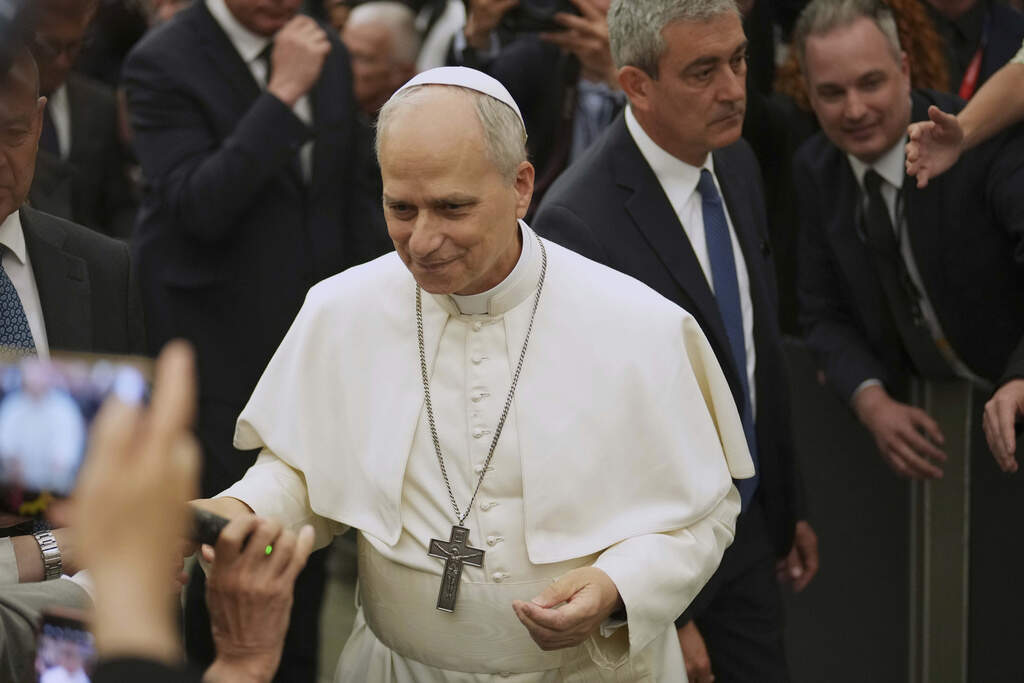
The world's 1.4 billion Catholics have a new pope, Leo XIV. But the church he now leads is far from unified. What does the global Catholic Church want from a new pope — and can he deliver it?
Guest
Anthea Butler, Geraldine R. Segal Professor in American Social Thought in the department of Religious Studies at the University of Pennsylvania.
Rev. Agbonkhianmeghe Orobator, dean of the Jesuit School of Theology at Santa Clara University
Also Featured
Sister Roselyne Sophie Wafula, nun with the Daughters of St. Paul in Nairobi, Kenya.
Transcript
Part I
MEGHNA CHAKRABARTI: Sister Roselyne Sophie Wafula has been a Catholic nun with the Daughters of St. Paul in Nairobi, Kenya for 25 years. Right now, she’s living in Rome, preparing to celebrate what’s called her silver jubilee – a recognition of her quarter-century of religious service.
That’s why she was at the Vatican, crowded into St. Peter’s Square with thousands of others from all over the world, on May 8, when a cardinal announced a new pope had been elected. A new leader for the world’s 1.4 billion Catholics.
SISTER ROSELYNE SOPHIE WAFULA: Somebody was like, “Oh no, it can't be the second day. No, for sure it'll be the next day.” And I was like, “Ooh, I feel like it's today! Something tells me it will be today.” Sure enough, it came to be.
CARDINAL: (SPEAKING LATIN) Annuncio … Habemus papam!
(CHEERING)
WAFULA: When there was that, “Habemus papam!” I just – I was filled with joy. And in my culture, when you are full of joy, there is this thing we do like this. (TRILLING) You can't hold it. It just comes out. And everybody was like, "Where is this sound from?"
CARDINAL: (SPEAKING LATIN)
WAFULA: Some were surprised, of course. And I could hear the Italians asking, “Chi e? Chi e lui?” It means, "Who is it? Who is it?" The name was not very popular. Not many of us knew who is Leo.
CHAKRABARTI: Then, Cardinal Robert Francis Prevost – now Pope Leo XIV – stepped out onto the balcony. His first words: “Peace be with you!”
POPE LEO XIV: (SPEAKING ITALIAN) La pace sia con tutti voi!
WAFULA: My one prayer was whoever it will be, it will be God's chosen instrument for the world.
POPE LEO XIV: (SPEAKING ITALIAN)
WAFULA: At the end of it all, the Pope is really not usually meant just for us Catholics. Never. We’ve heard witnesses from all walks of life talking about how they were touched by the life of Pope Francis.
And at the moment, the talk of the day is, 'Will Pope Leo XIV walk in the footsteps of Pope Francis?' And I think, in his first address the other day, on Sunday, he spoke, and I sensed Pope Francis in him. The whole idea of unity, no more war.
POPE LEO XIV: (ITALIAN) Mai più la guerra!
WAFULA: We must walk together, including everyone that is on this earth because at the end of it all, it’s not what I profess as my creed but that we all belong to this common home.
CHAKRABARTI: Sister Roselyne says Pope Leo XIV seems to possess a humility she admires. To her, his choice of shoes is a symbol. Like Pope Francis, Leo chose to wear black shoes for his first mass, rather than red ones favored by earlier popes.
WAFULA: He values the fact that holiness begins in the margins, not on the marble walls. He would rather walk bare with the poor than be in that red pair of shoe.
I think we look forward to greater things happening in and through our first American pope in 2,000 years of the church. I'm very optimistic that our church is going to grow, deepen our understanding, value more interfaith dialogue, promote greater unity, engage with marginalized communities that are mostly affected by conflict.
And above everything else, also deal with the internal challenges in our church. That's my desire. That's my wish for our church today.
CHAKRABARTI: That was Sister Roselyne Sophie Wafula, a Catholic nun with the Daughters of St. Paul. She’s based in Nairobi, Kenya but currently living in Rome.
So today we are going to talk about the global Catholic Church that Leo XIV will now lead and the challenges facing him as such.
And joining us is Anthea Butler. She's the Geraldine R. Segal Professor in American Social Thought in the Department of Religious Studies at the University of Pennsylvania, and she joins us from Philadelphia. Professor Butler, welcome to On Point.
ANTHEA BUTLER: Thank you so much, Meghna.
CHAKRABARTI: So I was just looking at some general statistics about who comprises the global Catholic Church.
And we have, what, some 40% of all Catholics in the world are in Latin America, roughly a quarter of them in Europe, 16% to 18% in Sub-Saharan Africa. Got some other numbers here because they fascinate me. That the number one or the most populous country in the world, or with the greatest number of Catholics, Brazil with 140 million, then Mexico, then the Philippines, and only then the United States.
And I wanted to lay those numbers out before us all to start, because I wonder if even focusing on the fact that Leo is the first "American" pope is missing the entire point.
BUTLER: It is missing the entire point, Meghna. Let me tell you why.
What has rankled a lot of people, especially in Latin America, is that we tend to forget that he actually has dual citizenship. He was born in the U.S., and he also has Peruvian citizenship. So the way that I've been referring to him as the pope from America, but from the Americas. Because I think that's a really important distinction.
He lived in Peru for 20 years. He has a very interesting Creole background, which we have to deal with and discuss in a certain sort of way. Just labeling him as American quote-unquote misses the point about how people can be global. And the Catholic Church is global, and it touches different spaces, and I think that's something that people really do miss about Catholicism when we talk about it.
CHAKRABARTI: The fact that in the U.S. media, including us here, yes, it's been referred to, he's been referred to as the first American pope, seems to me to be an act of American hubris.
Talk to me more about sort of the dynamics of the worldwide Catholic Church. As a leader of 1.4 billion Catholics, where would any pope cast his gaze in terms of where, perhaps the most, I don't wanna say important, the forefront of his flock would be.
BUTLER: I think you have to think about this in a totally different way. And this is where I'm gonna be the religious studies professor.
CHAKRABARTI: Please do.
BUTLER: When you have a religious leader, he has to think about the entire religious group. And we're talking about 1.4 billion Catholics. That's the world. And the Catholic Church has always been holding ecumenical dialogues with lots of different religious groups across the world.
And I think people don't see that when you talk about Catholicism, you think, oh, there's Catholicism in Brazil. There's Catholicism in the Philippines; there's Catholicism in Africa. But all of these places happen through missionary activity. That's number one. And I think that's really important.
There's a word that Catholics use called enculturation, which, you know, is an old term, but I wanna use it here to help people to understand that when the Catholic Church goes into a space, it tries to not only impose theological things, but it also tries to inhabit the cultures of the people that are there.
And so that's why you're gonna have a different Catholicism that may arise in Brazil or in Mexico with fiestas and different kinds of Passion Plays, as opposed to what happens in Nigeria or what happens in the Philippines, or what happens even in Korea. The pope has to pay attention to everything, not just one space, not just one particular place crying out. And so I think what we need to talk about are issues that face the church rather than just this particular locale.
CHAKRABARTI: Yes. Okay. So that is what we will talk about. But Professor Butler, can I lean even more into the religious studies professor here?
BUTLER: Sure.
CHAKRABARTI: Because this enculturation is really interesting to me.
I, frankly, I'd never heard that term and I wonder if the truth of enculturation is more to grease the wheels of spreading the church's power, versus making the teachings of Catholicism more relevant to the places the missionaries were going...?
BUTLER: Absolutely. There's a lot of different discussions about this and those of us who are religious studies professors who look at Catholicism and others would say, this is both good and bad. Okay?
And so what you wanna try to do is especially think about the cultures that are in that space. I always think about the movie The Mission, which is an old movie, but is a great movie to watch about how do you enter into a culture and try to put the Catholicism on top of it? Sometimes it works, sometimes it doesn't work, right? If we think about French Jesuits who got murdered, right?
So it can be very difficult, but it could also be very rewarding. I'll use this way to think about this. There's a great picture of Pope Francis on his last trip down to Papua New Guinea, and there's a young girl that goes to put a hat on top of his head with feathers and everything.
And one level it's this is ridiculous for the pope to have this hat on, but in another way it's not. Because he was honoring the culture that was there and allowing himself to be open, even though he was the Holy Father. To make a connection between the people that were there. And so I think of that as being a moment of enculturation that's really important, but also says the gospel is open to you.
This is open to everyone to receive. Now there are going to be some people who will always say, this is bad. This is just imposing a Western ideal upon everything else. But I think what you have to understand about the Catholic Church is that because it's a global church and because it has different people, there are gonna be different cultures.
One great example of this was just this morning in Rome where Pope Leo XIV welcomed the Eastern Rite churches. And that was a very important part of, the beginning of his papacy because people don't even know that we have these kind of Eastern Rite churches in places like Lebanon and other spaces that have a whole different liturgy and a whole different rite. And that speaks to the history of the church.
Part II
CHAKRABARTI: Professor Butler, before I introduce our next guest here, I just want to echo what you said and give a nod to the movie The Mission. I saw it in ninth grade, and it stayed with me all this time, starring Robert De Niro, Jeremy Irons, and I believe Liam Neeson, as well.
BUTLER: Yes.
CHAKRABARTI: So definitely a movie worth watching, a very complex examination of colonialism, missionary work in South America. Okay. So Professor Butler, hang on here for a second because I'd love to bring Father Agbonkhianmeghe Orobator into the conversation. He is the Dean of the Jesuit School of Theology at Santa Clara University. Father Agbonkhianmeghe Orobator, welcome to On Point.
REV. AGBONKHIANMEGHE OROBATOR: Thank you. Thank you, Meghna.
CHAKRABARTI: And Father, I want to admit that I did practice saying your first name multiple times, and I still feel like I didn't quite pull it off. Agbonkhianmeghe.
OROBATOR: Agbonkhianmeghe. That's great. Thank you so much.
CHAKRABARTI: Okay. Thank you. Thank you for your offering me your grace with that.
I wanna pick up on what Professor Butler talked with about with us in the previous segment. When we look at perhaps the different dynamics of the Catholic Church worldwide, in the United States, we tend to try to put it into two buckets, which is the liberal wing of the church versus a more conservative type of Catholicism.
Is that the right dichotomy to think about the global Catholic Church, Father?
OROBATOR: I think not. I think the Catholic Church is a diverse community across the world, and however and wherever you look at it, you realize that the local cultures, the local communities, basically define their own priorities, their own interests, and it's really not accurate to try to fit them into those boxes of liberal or conservative.
CHAKRABARTI: And yet we do that because again, through the American lens, which Professor Butler, I promise you I'm trying to shed here. But let's interrogate it a little bit first. Issues such as the church's stance on ordaining women or on the LGBTQ community, even its handling of the clergy sex abuse crisis in the minds of Americans and American Catholics. It seems to fall within those two buckets.
So if that's not the best way to understand it, what's a better way, Father?
OROBATOR: I think you have to look at it from this perspective. Sometimes when we think about issues that relates to sexual ethics, we want to define a particular way. When we look at issues relating to social ethics, we want to define them in a particular way.
I think for me, the way to look at it is to, as I said previously, what is it that matters to particular communities. What's their interest? What's their interest, what are their challenges and how do we respond to this drawing on the assets of Christian tradition, Catholic tradition, rather than trying to box them into categories that become quite clearly antagonistic.
CHAKRABARTI: I would say that the church though, has been antagonistic to certain groups of people for quite some time. Professor Butler, chime in here. Your thoughts on this question?
BUTLER: I want to — hello, Father. I want to put it in a certain kind of way that Father will definitely understand.
When Pope Francis said that same sex blessings were okay, what happened in Africa? They were mad about Fiducia Supplicans because they were like, "Listen, we are not doing same-sex blessings." And they took time to write a letter and complain, and they had to work this out with the Vatican, so they're not doing them. Okay?
And I think that's one way to talk about this. And Father, you could interject, but I think if we just talk about this through a political lens, it's very difficult to understand that the Catholic Church is talking about what is theological, right? And how do people think about that both theologically and culturally?
And I'll let Father speak to this. Because I know he knows this better than I do, but it's also a point of something that's really important to say.
OROBATOR: I think this's why I think it's important to emphasize what I previously mentioned. We have to pay attention to particular context. When you think of the example you just brought up, Africa is not a single story. And when you look at the way that the continent reacted to this whole question of blessing of same-sex union, it was not universally, as you might say, conservative.
Yes, there was a letter written by the president of the Symposium of Episcopal Conferences of Africa and Madagascar, Cardinal Fridolin Ambongo. But then the bishops in South Africa came up and said, "This is not our position. This does not represent our position." The bishops in North Africa came out and said, "This does not represent our position." So I think it's very — it's not accurate to, again, use these categories to define very broadly, the ways of a geography of ecclesial communities. Because Africa is not a single story.
And the story that people sometimes miss on this question, like the example you just raised, is that there was not a unified response. Maybe there was a loud response from one particular section of the continent, but there were other voices who made it very clear that this is not representative of where we stand on this issue.
CHAKRABARTI: Professor Butler, before I go back to you, I just wanna play a little bit more from Sister Roselyne Wafula. She is the Kenyan nun we heard from at the top of the show. Because she also had a thought about the question of same-sex marriage and she told us that she believes the Catholic Church needs to accommodate all people, but accommodation doesn't necessarily mean condoning things like gay marriage.
WAFULA: Including everyone, does not mean that we condone what they do, but at least that everybody feels they belong is important not to discriminate or sideline or marginalized some at the expense of the others. And I think that had always been the thought of the late Pop Francis.
Even he said it. Yes, we will bless when they come for blessings. But it's not that we are saying same sex marriage should be encouraged. It has never been the teaching of the church, and it will not be.
CHAKRABARTI: Professor Butler. Go ahead. If you wanna comment on what Sister Roselyne said there, please go ahead. But I'd also love to hear from you a little bit more about why those leaders of parts of the church in Africa, if you could explain to us why they took it upon themselves to write the, as you said, these letters objecting to what Francis had said.
BUTLER: Let me take the last part first. I think it's always the case that if you're looking from the outside, you think that there's not a discussion about issues in the Catholic Church. People tend to think that the pope says something, it's gonna happen. That's it, nothing else. But there always is a discussion. There's always ways in which people speak back and forth theologically about things.
And I think it's really important to understand that there are a myriad of opinions about different levels of what to do about certain things in the Catholic Church, especially about whether that's issues of same sex marriage, or we're talking about abortion, or we're talking about the issue of a personal pet peeve of mine, which is sexual abuse. How do you deal with all of this?
And I think, I'm always gonna say, sisters usually generally get it right. And she had a very elegant way of putting how this works out in practice. And I think it's the difference between what you think doctrine is versus what practice is. And, while obviously no place, whether we're talking about Africa and the various countries, or Brazil or anywhere else in the Catholic world is going to be the same, one of the things that's important to think about when we talk about Catholicism is that it's not a monolith, even if it is a global Catholic Church.
CHAKRABARTI: So Father, help me understand something though. And again, I am asking these questions from the point of view of, clearly, I'm not a Catholic. But these are questions just out of sheer desire to understand better. One could see just the concept of doctrine, as being doctrinal, right?
It's supposed to be unbreakable. It's supposed to be the rules by which any group, let alone the global church, operates by. And yet both of you are saying clearly, and it's obvious on the face of it, that there's regional differences. In practice, things are often not totally aligned with doctrine. Does that sort of tell us a little bit about the actual power the modern-day power of a pope? If practice can be so varied around the world today?
OROBATOR: Let me put it this way. Yes, there are doctrines and there are doctrinal position, but also in the Catholic tradition, we have this understanding that doctrines develop in time and across space. So again, as my colleague just mentioned, it's not a monolithic, static understanding. It's rather dynamic. As contexts change, as times change, we find that we, our doctrines, change.
It's interesting you mention the movie Mission. There was a time in Catholic tradition when we condoned slavery. And that was a matter of Catholic teaching and that evolved over time. And that's something that we will not condone, teach or accept today. So doctrines change.
And again, the second element I like to introduce you is that even when the pope exercises power, we have also this understanding that he exercises power in collegiality, that is with his fellow bishops. And so this idea that the pope has absolute power is something that comes to us from tradition. But that evolves.
If I could reference here Pope Francis' approach to dealing with issues of contention or division or controversies, he introduced and he championed the concept and the practice of synodality. And what is synodality about? Basically, it's creating that space where we are able to hold all our tensions, our disagreements, our controversies together and try to work through them, through listening, through dialogue, through discernment.
I was privileged to be a member of the synod in 2023, 2024, and I heard and saw those issues that we're just talking about, brought to the table, different voices, trying to walk through them, in a way that brings everybody along. And Pope Francis sat through all these conversations. Sometimes not saying a word, just listening. Other times, interjecting to clarify or to offer his own personal opinion. And that, for me, is an example of how the power of the pope is exercised. Not in an absolute form, but in a collegial synod.
CHAKRABARTI: Point well taken. Professor Butler, let me ask you, I absolutely hear that the church is not a monolith, something that spans the lives of 1.4 billion people simply cannot be. But on the other hand, I feel like in order to have any kind of truly honest analysis, are we able to identify where there are certain tensions or divisions between sort of regions or branches of the church.
Correct me if I'm wrong, but my understanding was, for example, in Latin America, which is profoundly Catholic, there's also some competition there from Pentecost — The growth of Pentecostalism there, is that something that Leo would have to think about?
BUTLER: Yes, he will have to think about that. Because if you have a global church, there's issues that pop up in certain regions.
So I think about Brazil in part, because I've studied that particular part of the world, first of all. And I do actually write about Pentecostalism a lot. And I know that was a bone of contention in a lot of the ecumenical dialogues that have happened over the last 20 or 30 years, is about the growth of Pentecostalism and what has happened in Latin America, but specifically in Brazil. So that's one thing. I think that there are areas where things have cropped up differently.
So let me shift this and make it a different thing. Let's think about a space that was very Catholic. Ireland, right? And is not so much anymore. What was one of the biggest things that Pope Francis had to deal with there? The issue of sexual abuse. I was in Ireland when all the things about tomb came out, and that's a whole 'nother ballgame about all the children's bodies that were buried, right? And how do you think about that? How do you have to deal with that? He also had to deal with that when he came to Canada.
If we want to think about the United States, what's the issue that they've had to deal with? The 200-plus Catholics who were sold from Georgetown into slavery. And the fact that, apology has happened, but no money has still been raised. I'm picking on the order here, right now, Father, so I wanna tell you that right now. I love my Jesuits, but I'm gonna say, they did not do what they said they were gonna do. So I think that --
OROBATOR: I'll accept, I'll accept that.
BUTLER: Yeah. I know you might, but I think that one of the things that's really important here. Is that you want to think about this is because this has been a papal election, as this is the church.
But think about it this way: Pope Leo XIV is leading one-point-whatever billion Catholics it is, and he has a lot of issues to deal with and there are many people that are working with him in the Vatican. Whether we're talking about cardinals or bishops or other people who are assigned to bring these issues to the forefront to try to help prepare him.
And he will have already been very well prepared as being part of the Augustinians and being over that order of priests. So I think that we can't just look at this as he's just walking into a job. He doesn't know what he's doing. He's someone who's prepared, because he's been the head of an order already, of a worldwide order.
CHAKRABARTI: Father --
OROBATOR: I think that's an important critical point that you just mentioned. Because I think, as I look at Leo XIV, he's probably the one pope in modern times who was already well known in so many different parts of the world, even though discreetly. As Professor Butler just mentioned, being the head of the Augustinian community, he would've had opportunities to travel the world, be in places where the Augustinians minister, and sometimes in very rural, remote areas, urban centers.
And so he would've been known quite across the world. And I think that's one of the special gifts he brings, in terms of his leadership. That is not only that he knows these areas, these issues, this context. He's also known there. And there's credibility there that it certainly would work to his advantage.
Part III
CHAKRABARTI: We did hear from many On Point listeners who are Catholics. For example, this is Joe in Worcester, and he had some thoughts about whether or not the Catholic church is even divided.
JOE: As far as division in the Catholic church, look at what comprised Jesus' 12 apostles: fishermen, a tax collector, at least one zealot. A motley crew if there ever was one.
CHAKRABARTI: That's Joe in Worcester, Massachusetts. I should have said.
Here's Patrick. He is a Catholic who lives in Los Angeles, and he shared his hopes for Pope Leo XIV.
PATRICK: As an American, I'm living in a governmental era that only encourages its citizens to prioritize capitalism, solipsism, and to hero worship the super-rich.
I hope and pray that, as a midwesterner, Pope Leo reminds America and the world that as Catholics, our duty is to take care of the poor and enrich the working class.
CHAKRABARTI: And one more. This is Michael. He listens to On Point and says he hopes the new pope will help bring people back into the church.
MICHAEL: I'm hopeful that Pope Leo can focus on growing the Catholic church, bringing people back into the pews and into the parishes.
For many years, the Catholic Church has become increasingly conservative, increasingly small tent, and done less and less on issues of social justice and community impact. I am hopeful that Pope Leo can turn those things around.
CHAKRABARTI: Professor Butler, I know we're trying to avoid the U.S. lens and the sort of liberal-conservative dichotomy here, but in the minds of many American Catholics, as you just heard, they do see Leo as a potential hopeful move, because of the discontent they're feeling in the U.S. with the Catholic Church. I'm wondering what you think about that.
BUTLER: Yeah, I think that's true. I'm going to do a little inside baseball here and tell you that the thing that everybody was really impressed with when he came out on the loggia was that he had on the traditional liturgical vestments. So for conservatives, that was a moment to think, "Oh, maybe he's going to be on our side."
And, other people were just like, "Oh he's already picked a name that is in the tradition of Leo XIII." He's Leo XIV. Leo the XIII was the author of the encyclical Rerum Novarum, which is where Catholic social teaching is based, which define much of the 20th century and hopefully beyond.
So I think that there's something that he brings to — if we have to think about this as a binary, which I don't like — I think he brings something that everyone will find to be hopeful about. And that for me is really important.
CHAKRABARTI: Pretty savvy for day one as a leader, right?
BUTLER: Yes.
CHAKRABARTI: Because there's just a very human element of a leader saying, "Hey, I can connect with you all." But I want to ask both of you about what we actually know about Leo's Catholicism. For example, back in October of 2024, he was then Cardinal Robert Prevost, and he gave an interview to the Vatican News.
And at the time, he was the prefect of the Dicastery for Bishops, meaning he oversaw the selection of bishops, a very powerful role in the church. And here's how he described his view of a bishop's role.
ROBERT PREVOST: As Pope Francis has reminded us many times, the bishop is called to serve. His authority is service. The bishop is not supposed to be a little prince sitting in his kingdom, but rather called authentically to be humble, to be close to the people he serves, to walk with them, to suffer with them, and to look for ways that he can better live the gospel message in the midst of his people.
CHAKRABARTI: Father Orobator, how would you describe, if we could, what Leo's Catholicism is?
OROBATOR: For me, I look at it not only from the perspective of what he has said, but also from the way he has lived. I think when we look at his experience of leading the church as a bishop in Peru, Maria de Chiclayo, we realize that this is a person who lives his Catholicism in closeness, in solidarity with marginalized, the exuded, the powerless, who sees the church from the perspective of the margins and realizes as a church we are called to bring the gospel, as he says, to bring Jesus Christ to these spaces.
And not focus on what makes us grand or powerful as an institution. That's how I would read his Catholicism, not from what he said, but from what he's done and how he's lived his life. And that gives me a lot of hope.
CHAKRABARTI: Professor Butler, your thoughts on that question?
BUTLER: I have to agree with Father, but I want to go one step further. I think in that statement that he made, we have some bishops who are, how shall I put this? Very, very much in the public eye and have positioned themselves in certain ways that, "I'm a king maker. I've done this, I've done that. " And they have not paid attention to their flocks. And they have not been attentive to the kinds of issues, in the American context, that we have to deal with. And so I'm thinking about, some of the more recent appointments of Cardinals to Washington, D.C. to Detroit.
It's very pointed about the people who have gotten appointed in the American context. Because right now we're dealing with the issue of immigration. And I think that I don't, I'm not paying attention to any bishop, honestly — and I'll have to go to confession for this — that doesn't have a care for what's happening right now in the U.S. with the issue of immigration right now.
Because we could stand to lose, as one of the polling has put out, 11 million Catholics if this deportation continues. And I think that's a really important part of what we need to care for those who are marginalized within the church and those who are being persecuted right now.
CHAKRABARTI: So this leads, I have to ask you then what you think about people have been resurfacing tweets or retweets from the pope when he was Robert Prevost, that seemingly are rebukes to the Trump administration. Most pointedly on immigration policy. This is the world that we're living in now.
These aren't tweets from the Pontifex account, right? These are things that he himself put out there into the world. Can we read anything into them? How much of that, that spirit or political view can he take into the actual papacy?
BUTLER: Again, I want to say this really clearly: I think those tweets, and I've read them, follow through to me from Catholic social teaching. I don't think that he's saying anything that's political. I think he's saying something that any Catholic who pays attention to social teaching would say. Now whether that points a finger in the chest of this current administration is another thing.
And I think that's what we need to be thinking about, is that we clearly have a pope who has a very clear idea about what Catholic social teaching is, where the preferential option for the poor is, where he should be thinking about how we deal with immigration and these social justice issues and where he stands on that.
And I think that's, to me, that's the important part. Whether or not that reads as political is because of the people who make it political and people who make it their point to not be for people who are marginalized. I think, to me, that's very clear and so you can read it how you want, but I would say that in line with Catholic social teaching and in line with what I understand and what many of Catholics would understand, that is right in line with the teachings of the church.
CHAKRABARTI: This, in a way, it gets us back to — Father, I'll come back to you in a second — but it gets us back to this tension between church edicts, if I can put it that way, versus how it's actually practiced on the ground. But Father, go ahead. I heard you wanted to say something.
OROBATOR: I wanted to just agree with Professor Butler and say that this can be read out of context or within particular context. But the reality is when you look at where he's coming from, even as he's explained his choice of name, he stands within a tradition of Catholic social teaching that emphasizes these key principles, the dignity of the human person, a preferential option for the poor, solidarity with people who are marginalized.
And all of this really shouldn't be sensational, because they are middle of the road Catholic social teaching. That's what Pope Francis taught, and that's what it seems, now, Leo XIV is embracing.
CHAKRABARTI: I want to just play quickly a piece of tape from the current vice president, JD Vance, who converted to Catholicism. He was baptized in 2019. And he spoke at the National Catholic Prayer Breakfast February of this year where he specifically said that he believes the Trump administration's policies are in line with Catholic values.
JD VANCE: Catholicism, Christianity, at its root, I think teaches our public officials to care about the deep things, the important things, the protection of the unborn, the flourishing of our children, and the health and the sanctity of our marriages.
And yes, we care about prosperity, but we care about prosperity so that we can promote the common good of every citizen in the United States of America.
CHAKRABARTI: So I know we could probably do three or four hours on that.
BUTLER: Yes, we could. Yes, we could.
CHAKRABARTI: But go ahead. Is that you taking a deep sigh, Professor Butler?
BUTLER: Yes, it is. And let me just be as point and blunt as I can. This is a man who was rebuked by Pope Francis because he did not understand the Ordo Amoris. All right?
And in his statement, let me be very clear, and all the Catholics out here are going to understand what I'm going to say. His whole framing of that statement was framed like an evangelical. It was not Catholic social teaching. It was not Catholic theology.
One of the things that people don't understand and know about our vice president is that he did not even come into Catholicism in a traditional way. He got taught by a bishop. He was baptized by a bishop. He never went through the rite of Christian initiation, like everybody else does. So he doesn't even know what the Baltimore Catechism is.
So I take a lot of issue with this man, and I'm sorry, I just do. I'm probably going to never be able to leave the country again. But I really don't think that what he said was Catholic teaching, period. And if he thinks that this administration is in line with Catholic teaching, I got a bridge to sell you somewhere over a swamp.
CHAKRABARTI: Father, go ahead.
OROBATOR: Speaking as someone who is a convert to Catholicism and who actually was brought into Catholicism, the Baltimore Catechism, I would have to say, I would have to say I disagree with the vice president. That's not the Catholicism that I know, that I live, and that does not represent the tradition of Catholic social teaching, which is inclusive, which pays attention to the dignity of the human person, broadly conceded, but also espouses the notion of preferential option for the poor, the marginalized, excluded. Solidarity. That's the Catholic tradition that I embraced when I converted.
BUTLER: I like the way Father said that so nicely. That's why he's the priest and I'm just a professor.
CHAKRABARTI: (LAUGHS) I have to say that I'm hearing definitely more than a note of hope in both of you in terms of Leo's papacy. But I'm also remembering that when Pope Francis began his time as Pope of the global Catholic Church, people were espousing that same kind of hopeful feeling.
But I'm wondering if the very institution of the church and its millennia long history, the various interests and focuses that we talked about in this hour globally, whether that's a natural dampener on any significant change or refocusing that a pope can actually bring to the global Catholic Church.
And I say this because, okay, Professor Butler you had mentioned the clergy sex abuse crisis. Francis himself is, was still open to, I think, criticism for not doing as much as potentially he possibly could, especially in places where there has not yet been a reckoning on clergy sex abuse.
BUTLER: Yeah, I think this is gonna be the issue for me personally that will continue to trail this papacy. It's trailed every papacy. And it's one of those things in which I think we're still dealing with a reckoning in a certain way.
But I also think, and I think this is really important to say, that we have to give Pope Leo the time to begin to work out how he's going to deal with all this. And I think one of the issues is for us is to see, in America, how this continues to pan out. We still have cases. We still have things that have not been adjudicated. There's also a sense in which it will, it hasn't blown up in some parts of the world. Like it probably could and probably will at some point. And so I think that will be something.
Do I think that keeps people away from the church? Absolutely. It always keeps people away from the church, but there's other things that keep people away from the church too. But I do think this is a moment of revitalization and I think that we'll see a different kind of church, but the church that remains in continuity in the next few years under Pope Leo XIV.
The first draft of this transcript was created by Descript, an AI transcription tool. An On Point producer then thoroughly reviewed, corrected, and reformatted the transcript before publication. The use of this AI tool creates the capacity to provide these transcripts.
This program aired on May 14, 2025.