Support WBUR
India and Pakistan on the brink of war. Again.
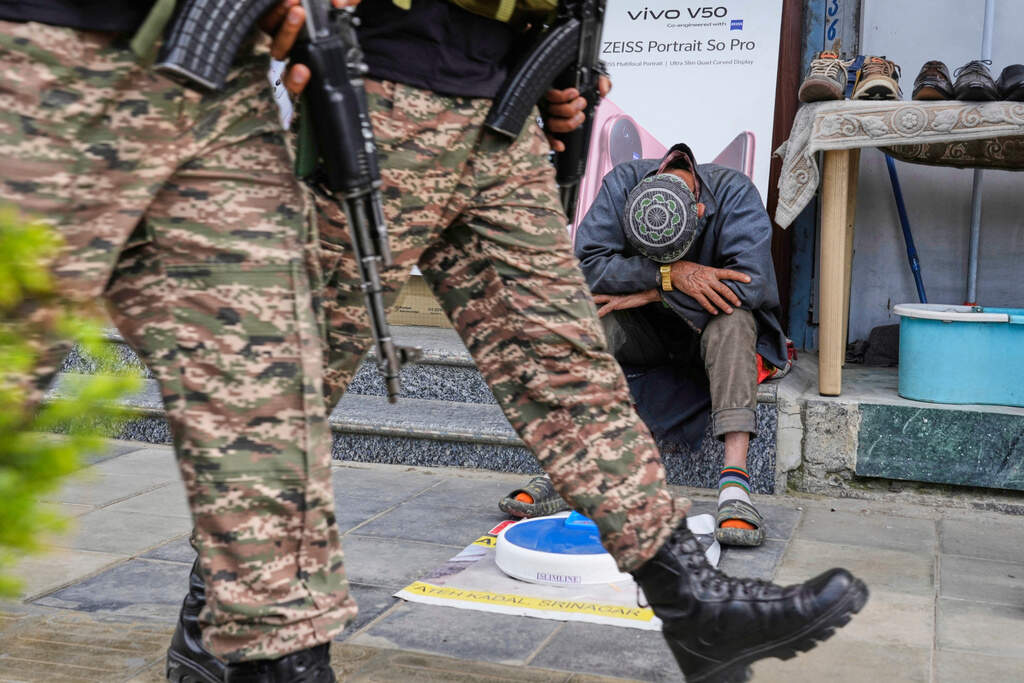
A ceasefire deal has put a pause on conflict between India and Pakistan. But experts say the two nuclear powers have a lot to work out if the Kashmir region is to move toward long-term peace.
Guest
Salimah Shivji, South Asia correspondent for the Canadian Broadcasting Corporation.
Asfandyar Mir, senior fellow for South Asia at the Stimson Center. Previously a senior expert at the United States Institute of Peace, where he focused on South Asia and U.S. counterterrorism policy.
Also Featured
Fahaad Bhat, a social justice activist for the J&K Peace Foundation in Srinagar, which is in the Indian-controlled side of the Kashmir region.
Raja Faisal, an Islamabad-based journalist and geopolitical analyst.
Transcript
Part I
MEGHNA CHAKRABARTI: Kashmir is a land of extremes. It has deep valleys, big flowing rivers and jagged peaks. The second-tallest mountain in the world, K2, is located here. Plus, a large population of snow-leopards. If that was all you knew about Kashmir, it would sound like paradise.
But of course, Kashmir is known for another extreme. It’s become the most militarized region on Earth. And in the past couple of weeks, it was the center of yet another conflict between two nuclear powers. India and Pakistan. Both claim all of Kashmir should be theirs. Locals on the ground endured drone strikes, sirens and civilian deaths. Fahaad Bhat is with the Jammu and Kashmir Peace foundation, an NGO on the Indian-controlled side of the region.
FAHAAD BHAT: The air was thick with tension and blackouts covered our homes in silence. We sat in darkness literally and emotionally and not knowing what the next moment would bring. Every sound outside felt like a threat. That something is coming. Something is going to blast.
CHAKRABARTI: The conflict started on April 22nd, when gunman shot and killed 26 men in a meadow in Kashmir front of their families – the deadliest attack on civilians in India since the 2008 Mumbai terrorist attacks. The gunmen asked the men what religions they practiced. They shot Hindu and Christian tourists, and one Muslim worker. Muslims make up the majority in Kashmir, but they’re a minority in India. Bhat is Muslim. He says he abhors what happened that day.
BHAT: According to me, a person who is killing any innocent, he or she doesn't belong to any religion because religion doesn't teach anybody to kill any innocent person. So, according to me, I believe that a terrorist has no religion.
CHAKRABARTI: India claimed Pakistan was responsible for backing the gunmen, which Pakistan denies. India then closed the only land border between the two countries and suspended a critical water-sharing treaty. The two countries began exchanging fire along the line of control in Kashmir.
On May 7, India began what it called “Operation Sindoor,” symbolically named after an orange-red pigment that married Hindi women traditionally wear along their hair parting. It launched missiles into Pakistan-administered Kashmir, killing at least 31 people, including some women and children. And Pakistan struck back, hitting military infrastructure like fighter jets. Then, for the first time in years, violence spread beyond Kashmir. Raja Faisal is a journalist based in Pakistan’s capital Islamabad. He says he saw Indian missiles targeting an air strip near his apartment.
RAJA FAISAL: It was early hours of the morning when I heard the first boom. The building I'm in, it actually, I felt that in the building as well. But when I was in my balcony, when the second one took place, and I could actually see it. It was in the air when it was countered by Pakistan's Air Defense.
CHAKRABARTI: Schools closed in parts of India and Pakistan, flights grounded, and thousands of people evacuated their homes. Faisal says at least in Pakistan, many people are used to situations like this. The country has struggled to control militant groups within its borders for decades.
FAISAL: The generation I belong to and the generation that is younger to me, you know, all of them, they have seen bombs. They have seen bombs getting exploded and how it feeds after that. And it's, it is not something new, though it is sad to talk about. It shouldn't be like this. A society shouldn't be persistent like this should, society should be persisting while seeing peace all the time.
CHAKRABARTI: The two nuclear powers seemed closer to the brink of all-out war than they had in years. Then, this past weekend, all of a sudden – they reached a ceasefire deal with the help of the United States. Yet both countries are claiming victory. For both Bhat and Faisal, this conflict did nothing to bring lasting peace, and has only further eroded relations on either side of the border.
BHAT: There is no connection indirectly or directly with Pakistan because Pakistan itself is not a great nation. They have problems in their country as well. So there is no use to get connected with Pakistani people.
FAISAL: Right after five minutes of this attack that took place in Pahalgam. Indian media started bursting out loud that we need to attack Pakistan. Why? Why need to attack to Pakistan? Pakistan is a country that has been fighting against terrorism since more than 20 years. Why are you blaming for everything against Pakistan?
CHAKRABARTI: And yet, both men want the same thing for Kashmir and the wider region. And they actually agree about the way to get there.
FAISAL: There should be people to people engagement from all of the countries, journalists to journalists, engagement from both of the countries. Then of course, the government to. That's the way forward. That's the way forward. We don't want war.
BHAT: We want dialogue. Real, sustained, human-centered dialogue, not just talks between government, but healing between peoples. We don't want another pause. We want a pathway.
CHAKRABARTI: This hour we're gonna talk about what to make about this most recent conflict between India and Pakistan. Why it matters to the U.S. and the world more broadly, and what exactly are the forces holding back a lasting peace in Kashmir.
So let's start with Salimah Shivji. She's the South Asia correspondent for the Canadian Broadcasting Corporation. She's been following this story closely. She's based in Mumbai, India. Salimah, welcome to On Point.
SALIMAH SHIVJI: Thank you.
CHAKRABARTI: Can we first start with what more we know about the details of the April 22nd attack?
Initially there were some reports that a group associated with Lashkar-e-Taiba, a Pakistani terrorist group was taking responsibility for the attacks, but then that was later denied. What do we know?
SHIVJI: Yeah, the initial reports were that they were taking responsibility for the attack that was then rescinded in terms of the responsibility.
What we know from what Indian police have told us was that it was three gunmen who initiated this militant attack in Pahalgam. Obviously a very popular tourist town on the Indian administered side of Kashmir. It was April 22nd. New Delhi launched a large manhunt for those three gunmen. And New Delhi has repeatedly said that terror attack was Pakistan's fault.
As you've been saying, India blames its neighbor and rival for fostering and backing terrorism in the area to promote instability. A claim that Islamabad has repeatedly denied. In terms of the details of what we saw in the terror attack. As you mentioned, it was the deadliest against civilians in more than two decades in the contested region. Gunman targeted a tourist group and killed 26 men.
And when you talk about the details of the attack that we heard from survivors, it was really that shocked and angered so many people in India, you heard it over and over again, from people talking about the terrorist attacks and their response to it. Just ordinary people on the street.
Basically, saying how upset they were about the details that came out of that attack. On April 22nd we had survivors, widows explaining that the Hindu men out of that group were singled out. Many were summarily shot in the head. You saw photos from that moment as well. There was one photo that kind of exploded online and really provoked a lot of reaction here in India of one widow sitting listlessly beside the dead body of her husband shot by one of the gunmen. So all of that, those details and the fact that this appeared to be targeting Hindu group of tourists, that fueled so much anger here in India over the attack, with many kind of spilling into calling for blood, for Pakistan to be punished.
CHAKRABARTI: So that helps explain the radical escalation that we saw in the days following that. But is there any conclusive evidence now about who actually the gunmen were or who were supporting them?
Or is there still a lot of differing assertions from across the border between India and Pakistan?
SHIVJI: There's so many differing assertions, and that kind of characterized pretty much all, most of this battle here. In terms of even what we saw over those four days of very intense military tactic, intense shelling across that line of control, which is the de facto border that separates the Indian controlled Kashmir side from the Pakistan controlled side.
In terms of when it was unfolding, there was a cloud of disinformation and misinformation that, you know, was perpetrated basically along the lines of social media, in the media as well. They were, it was hard to pinpoint exactly what the movements were and what the military strikes were as we were going through those four intense days of escalating military strikes and blame being tossed from side to side about from the Indian officials versus the Pakistani officials, as to what exactly their armed forces were doing as this conflict just escalated really so rapidly over those four brief, intense days.
CHAKRABARTI: So then that, so that's still an open question and I guess we'll just have to wait and see what happens in terms of if we ever ultimately discover who was responsible for this attack, but the responses, as you said, from India and then later Pakistan, were sharp and severe.
I had briefly mentioned the suspension of a major water treaty between India and Pakistan, which is quite something. We can talk about the military response in a second, but can you discuss the Indus Waters Treaty and why India decided to do that?
SHIVJI: Absolutely. This is one of the major non-military tit-for-tat escalations that happened in the wake of the militant attack on, on April 22nd in Pahalgam.
And this was a really big deal particularly for the Pakistan side. First of all, in all of the conflicts that India and Pakistan have had over Kashmir in their previous wars, this Indus Waters Treaty was not touched at all. It was never part of the equation, because it is just so important.
It basically controls how river waters are divided between the two countries. The headwaters are on the Indian side and Pakistan really desperately needs the water down, they're downstream. So they need that water from those rivers. It was controlled by this treaty that was mediated by the United Nations way back in the '60s.
And Pakistan needs that water for basically about 80% of its agricultural output, for a third of its hydropower. So this is a big deal for Pakistan. The fact that India took the step to suspend that treaty, they didn't withdraw from it completely, but it is in advance, and it remains in advance even after the ceasefire that was brokered.
Part II
CHAKRABARTI: I'm sorry I had to interrupt you there, but you were talking about the significance of India suspending the Indus Waters Treaty in the immediate aftermath of the April 22nd attack. I just wanna let you finish that.
SHIVJI: That's right. Yeah. So like I was saying, it was, it's a very important treaty for, I would say, in particular, Pakistan downstream, to get the water that they very desperately need.
And the fact is that it is still suspended and there are signs from India that they will keep it suspended, even though this, of course, fragile ceasefire has been brokered. So basically, we heard from India's Prime Minister Narendra Modi just a couple of days ago, and his main message, obviously, he was speaking to a domestic audience as well and claiming victory and speaking about the military strikes against Pakistan.
But his main message coming out of that was basically terror and talks don't go together. Water and blood don't, cannot flow together. So that's an indication speaking about the Indus Waters Treaty that India does want to renegotiate this. They do not want to release the suspension; they'll keep it on hold until India says they get some sort of assurances that Pakistan is doing more to combat terrorism on their territory. And in Indian controlled Kashmir, of course, Islamabad denies that they're fostering terrorism there.
CHAKRABARTI: So the speed at which things escalated I think is one of the things that really caught the world off guard because we talked about the water treaty, India almost immediately expelled Pakistani diplomats from India, suspended visas for Pakistani nationals. Pakistan basically did something similar, what, two days later, closed airspace to Indian operated aircraft around Kashmir. And then Pakistan also suspended the similar agreement, which I understand is an important framework for attempts at peace and cooperation.
Between the two countries. And then we get to India's decision to launch Operation Sindoor on May 6th. But before that, I wanna hear a little bit of what leaders from both countries were saying. Here's India's Prime Minister Narendra Modi on April the 24th. And here's what he said.
NARENDRA MODI: I say to the whole world, India will identify, track and punish every terrorist and their backers. We will pursue them to the ends of the earth.
CHAKRABARTI: So that's India's Prime Minister Narendra Modi. On April 24th, last Friday before the ceasefire was announced, Pakistan's military spokesman Lieutenant General Ahmed Sharif Chaudhry reiterated Pakistan's resolve to respond to India's alleged aggression. He said, quote, at a time, place, and means of its choosing, and here's what he said.
AHMED SHARIF CHAUDHRY: Whatever they may do, we are prepared for eventuality. They want to continue it, fine. But what they have started, I'll tell you, we'll finish it.
CHAKRABARTI: Salimah, let me ask you something. You hear Chaudhry there speaking in English and not Urdu, and perhaps even more notably, Prime Minister Modi in India speaking to an Indian audience and choosing to speak for at least part of the time in English.
He almost never does that right? When he is in India, he'll speak exclusively in Hindi. Is there any significance to that?
SHIVJI: Absolutely. Yeah. It was very significant that Narendra Modi chose to speak in English and in English for such a long time. He does resist this, like you say, he speaks in Hindi to his domestic audience, that speech, that statement was made at a rally, with his supporters.
So it was a place where it's usually completely a message communicated in Hindi, the fact that he spoke in English was important. He wanted that message to be heard far and wide. Like you said, it was just a couple of days after the militant attack in Pahalgam. That message from India was that there's nothing that's gonna, we will retaliate on this.
We will track these, as he says, terrorists and their backers down. And that was a message that he really wanted heard far and wide. We saw as well on the Pakistan side speaking in English. And Pakistan has historically always encouraged international involvement in the whole Kashmir issue, which has been obviously a very extremely long-standing acrimonious dispute for decades between the two countries. So that's a little bit less unusual that Pakistan was hoping for international involvement here. But for India, it was a really strong message from Narendra Modi saying, we have to respond to this.
And that was a feeling pretty much everywhere in India, that India couldn't not retaliate against what it saw as a massive terrorist attack in Indian controlled Kashmir, after decades of insurgency in the region and the same sort of thing on the Pakistan side.
Which, of course, is not also entirely surprising, that it was always the message of, we'll retaliate, we will have corresponding action to whatever India does. That is the refrain. And then you saw that kind of boiling and simmering and the tension rising day after day, even as the military strikes had already began. Once India decided to send strikes into Pakistan, and then day by day as well an escalation and a dangerous escalation with every step on each side.
CHAKRABARTI: Okay, so Salimah Shivji, with the CBC in Mumbai. Hang on here for just a minute because I want to bring Asfandyar Mir into the conversation. A senior fellow for South Asia at the Stimson Center and previously served as a senior expert at the United States Institute of Peace where he focused on South Asia and U.S. counter-terrorism policy.
Asfandyar Mir, welcome to On Point.
ASFANDYAR MIR: Thanks for having me on, Meghna.
CHAKRABARTI: Can we just actually take a step back here? Because the tensions, to put it mildly, between India and Pakistan and Kashmir have been going on for so long, what, 70 plus years now, that I actually think we would serve us all if we got just a little bit of a primer on why this is a disputed region. So can you just remind us how we got to this place where two nuclear powers are essentially at each other's throats about this beautiful mountainous area between the countries.
MIR: Sure. So it starts at the formative moment of these two nations. At the end of the second World War, the British Empire decided to withdraw from their colonial possessions across the world.
In particular places where political demand for the British exit was considerable. And the Indian subcontinent was one of those very important places. And the British, as they retrenched, they partitioned the Indian subcontinent into the two countries that we know about today, India and Pakistan, and this partition, I think it's really important to remember that it was a seismic event. It was a massive geopolitical, even humanitarian event of the kind. The world has basically never seen.
CHAKRABARTI: A million people died.
MIR: A million people died. 15 million people moved across the two borders, in both directions.
It's known as one of the greatest migration flows in human history. And communities that had coexisted for almost a millennia attacked each other in a devastating outbreak of sectarian violence. Hindus and Sikhs on one side, Muslims on the other.
The carnage was intense, and it was in this backdrop, the trauma, the worst kind of violence this region has seen, a big dispute over this territory that we now know as Kashmir emerged. And the dispute was around the fact that Kashmir was one of those regions to which the Brits gave the option of deciding whether it wanted to go with Pakistan or India, or perhaps, there was a third option of some kind of independent neutral status as well.
And Kashmir had a Hindu ruler and a Muslim majority population. The history of 1947 is deeply contested on both sides. But safe to say that the Hindu ruler exceeded to India. And then there was this first war between the two countries over Kashmir as early as 1947. Which continued until 1948.
Following that, the United Nations got involved, and since then, in the decades that have passed, both sides have basically stuck to their claims and counterclaims on the territory of this region. I think it is notable that the two countries have fought several wars. After 1948, they fought three other wars.
And if we add the conflict from the last week, consider it to be a war, which I do. The two have now fought five wars in total, four of which have been squarely around or related to events in Kashmir. And I guess the question you might ask, or your audience might be wondering about, is, what is the big deal about Kashmir?
Why would you go to war with the other, over this particular territory? Why do these two countries want it so bad? Is it about religious amity with the people of Kashmir, especially for, say, Muslim majority Pakistan? Or is it about, is there some kind of strategic value in this territory?
Or as you were referencing, is it just nice, beautiful, gorgeous? It is a paradise. And therefore, the two countries want it. And I think there is something to all of those explanations. It is strategic, it's certainly very gorgeous. But as I see this region, given the events of this foundational moment in 1947, '48, the trauma of partition and the trajectories of both countries since, Kashmir has really become central, but I'd say a big part of the nationalism and national identity of both countries.
So India has controlled a big part of it since 1947. And I would make the case that it has come to see its nationhood as being tied to preserving Kashmir as part of the Indian Union, of the great Indian Union. Multi-ethnic, secular, multi-religious. Indians want to hold on to Kashmir, never compromise on it in any way and therefore have become completely closed off to any conversation.
Pakistan for its part has sought a change in borders. It wants to absorb the part of Kashmir that is controlled by India, has even used military force, coercive tools such as militancy. And as Salimah was mentioning, international diplomatic pressure, when it's been able to mount it, to loosen India's grip on the region.
Because Pakistan sees Kashmir as being central to the Pakistani national project, Kashmir is now central to Pakistani identity and nationalism as well.
CHAKRABARTI: So first of all, the beauty of Kashmir. I'll put that aside. I don't actually, I personally do not think that's the heart of the conflict.
Human beings fight over the ugliest land on planet Earth as well. But your point is very important here, because with that context in mind, this conflict then has a lot of echoes with other decades-long, even century long conflicts that we've seen between peoples elsewhere in the world.
So let me then just ask Salimah, let me turn back to you here. More recently then, especially with the rise of say, the BJP and Prime Minister Modi's leadership of India. And then I'll ask the same thing about what's happening on the Pakistani side. Has this question of the primacy of nationalism really driven India's attitude towards the risks it's willing to take to maintain control over its region, its part of Kashmir?
SHIVJI: Absolutely. As we've been saying, for India, Kashmir is central to its idea, its nationalist narrative that we are hearing from the BJP, the Prime Minister Modi's party. Of course, a Hindu nationalist party. Very often speeches along religious lines here.
Kashmir is the only Muslim majority area of India. But we've seen Modi, especially when he has received a very strong, when he received his very strong second mandate back in 2019. We saw him move to control more of Kashmir, more of Indian controlled Kashmir. For so many years, Kashmir, the Indian side of Kashmir, enjoyed a little bit of special autonomy.
They had special status that was protected in the constitution of India. Several degrees of self-rule, a little bit more autonomy than other states or other regions in India. And that was revoked in 2019 when Modi repealed what was called Article 370, provoked a lot of protests, a severe crackdown in the area of Kashmir, but it was extremely indicative of basically what Modi and his party, the BJP, want, which is the fold Kashmir more into India.
As a result of revoking that special status in the Constitution, New Delhi had direct rule over what was happening in the Indian controlled side of Kashmir. A lot of people in Kashmir saw that as an attempt to control the demography of the region, the only Muslim majority state. It was also the fulfillment of a longstanding promise that the BJP had made, bringing rebellious Kashmir back into the fold.
So that very much been a part of the narrative for the last 10 years of Modi's rule, basically that he is the strong leader that is fulfilling a dream that a lot of Indians have, that this is central to India's identity in this region.
CHAKRABARTI: Salimah Shivji, South Asia correspondent for the CBC joining us today from Mumbai.
Thank you so much, Salimah.
SHIVJI: My pleasure.
CHAKRABARTI: Asfandyar, same question about the Pakistan's side of the border. Has Pakistan become less willing, to put it roughly, to engage in any kind of talks that would reduce the likelihood of, I don't know, it gaining more control over Kashmir or has it reduced its support for the groups operate?
That's a better question. Operating within Kashmir.
MIR: Look, traditionally Pakistan has been more interested in some kind of a dialogue with India on Kashmir, because that then opens the prospect of changing the current status of Kashmir. That's the direction Pakistan wants this particular conflict to move in.
However, Pakistan has had a certain trajectory over the last two decades. It's been mired in various challenges, economic issues, political problems, and other internal security problems adjacent to its border with Afghanistan. And as a result, it's been harder for Pakistan to engage India in a meaningful conversation. Especially as India has risen, become more powerful, India's tolerance for an interest in meaningful political diplomatic dialogue with Pakistan, especially as Pakistan has somewhat weakened and has been in this decline, Indian interest has gone down.
Nevertheless, despite being beleaguered, Pakistan still very much retains its own ambitions to be, certainly can't be India, but it wants to be a middle power, regional power, and it's unwilling to back down against India on Kashmir. As I noted, because it's central to its national identity.
Part III
CHAKRABARTI: I want to talk a little bit about what the U.S. actual role was in this temporary, hopefully long term, but cooling off in the form of the ceasefire that was reached this weekend. Because it actually caught a lot of people by surprise given the very different message that was coming from the Trump administration prior to the weekend.
For example, Vice President JD Vance on May 9th was on Fox News and there was footage of drone strikes playing in the background behind him. And he said on that day that the conflict had nothing to do with U.S. national interests.
JD VANCE: We want this thing to deescalate as quickly as possible. We can't control these countries, though. Fundamentally India has its gripes with Pakistan.
Pakistan has responded to India. What we can do is try to encourage these folks to deescalate a little bit, but we're not gonna get involved in the middle of war. That's fundamentally none of our business.
CHAKRABARTI: Fundamentally none of our business, but apparently President Trump felt differently. Because just two days later, Trump announced the ceasefire deal on Truth Social, and while on his trip to Saudi Arabia this week on Tuesday, Trump said the U.S. was instrumental in those peace talks,
TRUMP: And I used trade to a large extent to do it.
I said, fellas, come on, let's make a deal. Let's do some trading. Let's not trade nuclear missiles. Let's trade the things that you make so beautifully. And they both have very powerful leaders, very strong leaders, good leaders, smart leaders. And it all stopped. Hopefully it'll remain that way.
CHAKRABARTI: Asfandyar, help us with an actual reality check on what the details of the U.S. actual involvement was here.
MIR: Sure. So I think there was, it was some ambivalence initially, but ultimately the United States played a vital role. And having tracked it very carefully, literally hour by hour, minute by minute over the last week, I am convinced that this war would've escalated perhaps even to the unthinkable.
Without the forceful intervention of President Trump and other senior leaders in the administration, and by the way, I think we should understand the history here. There is a history of U.S. involvement in South Asia. In South Asian crises, the United States has been a crisis manager of South Asia.
Since the late 1980s, once India and Pakistan became nuclear in 1990, the administration of President George H. W. Bush intervened in a similar sort of standoff, much less intense, much less violent. President Clinton stepped in the war in 1999 and enabled a ceasefire, again, as things were escalating towards a nuclear standoff.
And then after terrorist attacks in both 2001 and 2008, there was some escalation as well. These terrorist attacks were by Pakistan based terrorist groups. The Bush administration intervened.
CHAKRABARTI: Can I just jump in here for a second?
MIR: Sure.
CHAKRABARTI: Because that was the last time that I remember the U.S. being deeply involved. Because Secretary Powell was involved. Colin Powell at the time was involved in that, I remember. What is one of the, a U.S. senator had been there, it's going to come back to me. Senator Shelby, I believe Richard Shelby, who went and visited the region. He was the one who said that he believes it was the most dangerous place on Earth at the time.
MIR: And that's President Clinton also characterized the region in similar ways. And then in 2008, Secretary Rice was involved at the very end of the second Bush administration. So, all to say, President Trump follows a long-standing American tradition of trying to keep things calm.
In South Asia, but a few things have changed, which I think partly explains why the U.S. intervention maybe came a little late in the game. Whereas much of the Cold War, the United States was very close to Pakistan.
And then in the 1990s and 2000s, the U.S. had a more even handed approach to the region.
Kind of saw Pakistan and India on an equal footing. But in recent years, the U.S.-India relationship has grown tremendously especially as U.S.-China tensions have mounted, and India is seen extremely useful and important in Asian geopolitics as a counterbalance counterweight that America needs in Asia.
And concurrently American frustration with Pakistan, the U.S.-Pakistan relationship has taken a bit of a beating. In the policy world, most see Pakistan as having undermined the U.S. war effort in Afghanistan. Pakistan's relationship with various terrorist groups also raise questions.
It was in this backdrop, or that was the mood behind the scenes. And I think that the U.S. may have been more sympathetic to India, and in theory may have been inclined to even support India, especially given that it was a terrorist attack killing 26 innocent civilians. Let's be real.
If Americans were killed in America, Americans would want justice, and all options would be on the table. So I think there was some of that buildup, but then as the conflict escalated and the two countries began to make all these military moves, things began to develop pretty rapidly, uncontrollably.
And at one point, as the two sides were exchanging missiles, it seemed that we were measurable steps away from where one or both of the countries may bring in nuclear weapons. And I think that appears to have finally catalyzed decisive action.
CHAKRABARTI: Asfandyar, can I just jump in here?
MIR: Sure, sure.
CHAKRABARTI: What were those measurable steps?
How can you say that with the certainty that you did?
MIR: I think on Friday, May 9th so overnight May 9th, and it was the morning of May 10th, the Indians struck a Pakistani military base which is extremely close to Pakistan's nuclear Command and Control Headquarters. And one of Pakistan's stated nuclear red lines.
As per its doctrine of nuclear first-use is that if India threatens or actually attacks Pakistan's strategic assets, which is code for its nuclear assets, nuclear command and control, or actual weapon systems, then Pakistan is going to use nuclear weapons. So once India struck that particular base, it was assessed widely in the community.
And I assume inside, in the government as well, that this was now very close. And Pakistan may perceive that India has tried to take out its Nuclear Command and Control.
CHAKRABARTI: So that was Friday, right?
MIR: That was late on Friday. Yeah.
CHAKRABARTI: And so this is why we see, I was looking at reports that over the weekend that said some flurry of calls began, what, on Saturday?
MIR: It was late on Friday. Right after that strike I think they were catalyzing to action. They started working the phones. Vice President Vance was, I think, in the lead, spoke to Prime Minister Modi, Secretary Rubio was speaking to Pakistani interlocutors as well as Indian ones.
Secretary Rubio had an important call with Pakistan's Army chief, who is a very important decision maker in the Pakistani system. And as a result, over a period of maybe four to five hours, six hours, they were able to hammer out this particular ceasefire. And it seems like President Trump is incredibly pleased with this.
With this outcome. So it is a difficult, complex dispute, which affects a fifth of the humanity. So President Trump clearly seems to understand that. And it's interesting. He has a sense of history here. Perhaps not extremely precise, but a rough and important sense of history.
And he's been saying and tweeting in jest that the two sides have been fighting each other for a thousand years. So you know that there is a sense that maybe there is some kind of an age-old animosity over religion and territory at play, that there's something more fundamental. And the president now wants to do something positive, maybe get to the bottom of it, which is nice, but also, I would warn, incredibly ambitious.
CHAKRABARTI: Yes.
MIR: But nevertheless, I think it does bolster [President Trump's] peacemaking credentials undoubtedly. And he is a uniquely powerful American president approaching this issue after a long time.
CHAKRABARTI: And he seems to have some simpatico feelings with Prime Minister Modi, which I think is part of what you're saying, of the change in relationships between the U.S. and India.
But I'm thinking back to what Vice President Vance said on Friday, May 9th. We played that tape here when he was on Fox News. Where the last part was, we're not going to get involved in the middle of a war that is fundamentally none of our business, which made everyone think the U.S. doesn't care.
But now that I'm looking back at it, he did also say what we can do is try to encourage these folks to deescalate a little bit. It does, I'll just ask this rhetorically, I'm not sure why he wasn't more clear in saying, we want to be heavily involved in stopping this from turning into a war, but we'll leave it at that.
I do want to actually ask you about another thing regarding India's point of view, because it's not just the nationalism part of it. When we talked about how the April 22nd attack was the deadliest one since 2008, and that Mumbai terrorist attack, which was horrific, right? India has, I think, legitimately, said, look, Pakistan, whether it is directly supporting terrorist groups or turning a blind eye. In the wake of the 2008 attack, there was some evidence that some support for Lashkar-e-Taiba is coming from the Pakistani government, or at least the intelligence services.
This is one of the reasons why I think we see some of the incredible bellicose language that comes out of India at times, for example this is at a military press briefing from Monday. This is Air Marshal AK Bharti, and he said India's goal was to destroy terrorism infrastructure within Pakistan.
AK BHARTI: We also iterated that our fight was with terrorists and their support infrastructure. And not with Pakistan military.
However, it is a pity that the Pakistan military chose to intervene and bat for the terrorist, which compelled us to respond in kind.
CHAKRABARTI: Respond to that.
MIR: Look, I think you already discussed nationalism in India. I take it a step further and situate where India is at as a nation in the international system.
India really has emerged as a geopolitical and economic powerhouse. And that has happened amidst this rising tide of nationalism in the country. And so Prime Minister Modi is casting India not only as a great nation, but this ascendant great civilization whose moment on the global stage is here.
And he has instilled in his people and the country at large, incredible confidence. And I think this has really crystallized into an uncompromising, strident mindset in which New Delhi views Pakistan not just as an occasional disruption, but as the kind of threat that they have to put down forcefully.
Partly to secure India's rightful rise. So there is basically no patience now with Pakistan's claim on the Indian held half of Kashmir and certainly on any kind of actual or perceived support of anti-India terrorism by Pakistan. The Indian mood is unrelenting.
But I think the danger here is that the Indian position on what India should do to punish Pakistan is starting to become absolutist. Which I would argue goes even beyond what India is for now capable of doing to Pakistan. I think there is a nationalistic mood which trends toward, or seeks emulation with, say, Israeli campaigning, in, say, the Middle East.
You know how Israel goes about navigating and neutralizing its adversaries. Which again, not realistic, because Pakistan has nuclear weapons. But even if there are nuclear weapons in play, I think there's a question of the aftermath of a major Indian campaign to neutralize or remake Pakistan. And the question is, then what? Yeah, it's a country of 250 million people.
Can you really remake it in a way that keeps the peace? And amidst this sort of loss of Indian patience, its global rise, nationalism. I worry the pressures on what India should seek to do and achieved against Pakistan have mounted to a point where they're not realistic.
CHAKRABARTI: I do wanna make one quick note about the ceasefire deal and the U.S.' role. India does dispute one thing. That we heard the president say in that clip that we played, that trade deals were involved in reaching the ceasefire.
And the Indian governments spokespeople say there's no, there was no conversation about trade whatsoever. There's gonna be a lot of more like statements from the various governments, but ... we have sadly just one minute left. This to me seems like some other places in the world.
And that is it's a potential, I don't wanna call it this, but I will, a forever conflict given its genesis, and as you said, the calcified positions that both, especially India, but also Pakistan are taking about Kashmir. Am I being too pessimistic?
MIR: No, I agree with you. I think the battle lines are drawn.
Nationalism is entrenched on both sides. The mood has hardened, the space of compromise has shrunk. And as a result, I think this can go on for a very long time. And so what I'd like to see is an equilibrium that is, you know, marked by less hostility, right?
Realistic resolution is incredibly challenging, but we can have more in terms of guardrails and diplomatic channels so that most dangerous of global hotspots doesn't see another major bout of conflict that risks nuclear Armageddon.
The first draft of this transcript was created by Descript, an AI transcription tool. An On Point producer then thoroughly reviewed, corrected, and reformatted the transcript before publication. The use of this AI tool creates the capacity to provide these transcripts.
This program aired on May 15, 2025.