Support WBUR
Protecting from harm or censorship? Policing educational material in Texas
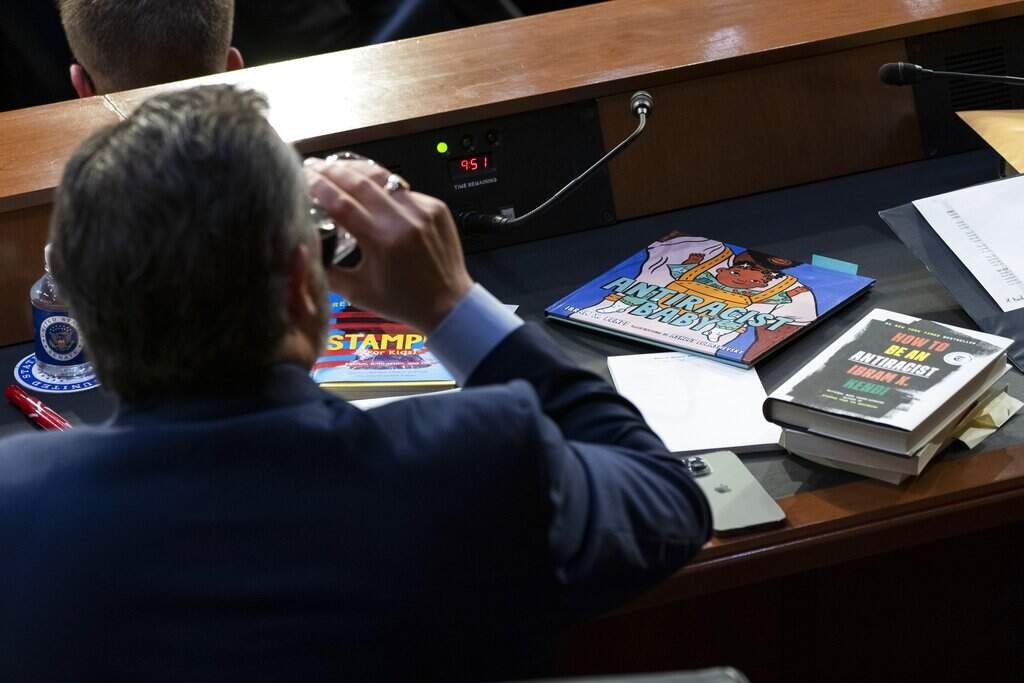
Texas state legislature just passed a bill that would send doctors, teachers, librarians and more to jail if they provide kids with "harmful" materials. But who decides what's harmful, and what's not?
Guest
Bayliss Wagner, state politics reporter at the Austin-American Statesman.
Mary Elizabeth Castle, director of Government Relations for Texas Values, a statewide policy organization that describes itself as dedicated to the Judeo-Christian faith, family and freedom.
Becky Calzada, president for the American Association of School Librarians. District library coordinator in central Texas.
Catherine Ross, Lyle T. Alverson professor of law at the George Washington University Law School. She specializes in constitutional law. Author of "Lessons in Censorship: How Schools and Courts Subvert Students’ First Amendment Rights."
Also Featured
Frank Strong, an English teacher in Austin, Texas.
Transcript
Part I
JARED PATTERSON [TAPE]: I can't possibly see anything that contains harmful material that would have any quote, serious literary value to a child. I just can't. I don't care if it's a coming-of-age story. I don't care if it's a graphic novel. I don't care if it's one page out of 500. I cannot, for the life of me, understand how anyone would take that as a serious literary value for a child.
MEGHNA CHAKRABARTI: There’s long been general agreement in this country that some materials – be it books, TV, movies – are inappropriate for children. The debate, of course, has been over differing opinions over exactly what constitutes “inappropriate." Or in Texas this legislative session, what constitutes “harmful.” You just heard Republican Representative Jared Patterson of Frisco, Texas. He sponsored a bill that would criminalize providing “harmful” materials to children.
The bill sailed through the Texas house, by a vote of 92 to 39. And then passed the Senate, 22 to 9. SB 412 is now on Governor Gregg Abbott’s desk. He is expected to sign it into law. Meaning doctors, teachers, librarians and parents could go to jail if they give “harmful materials” to kids, as deemed by the state of Texas.
How would the state determine what’s “harmful?” Representative Patterson explained on the state house floor on May 2nd.
PATTERSON: In Miller vs. California in 1973, the Supreme Court ruled that a lack of value is evaluated from the lens of the work taken as a whole, lacks serious, literary, artistic, political, or scientific value that is the existing Supreme Court precedent.
ZWIENER: So, it is your understanding under this statue that they would have to look at the work as a whole and could not pull out one thing and have that one thing outweigh everything else in the work.
PATTERSON: Well, I mean, my belief is that one single thing could outweigh the work as a whole.
CHAKRABARTI: You also heard there, Democratic Representative Erin Zwiener of Driftwood. We will talk in detail about what’s actually in the Miller standard later in the show. Zwiener went on to question Representative Patterson on HIS interpretation of his proposed law:
ZWIENER: Representative Patterson, I'm struggling here because on one hand you're basically answering my questions with a yes, and then at the same time you're answering with a no. I'm trying to understand how you actually understand this harmful material definition.
Well, 'cause on one hand you're saying yes, you believe it's controlled by the Supreme Court decision, which says that 200 pages of material with social value can outbalance five pages that are maybe more challenging, but then you're verbally saying you don't think that could work that way.
PATTERSON: Well, I don't sit on the Supreme Court, so which is it? Are we following the Supreme Court or not? Well, the law, the laws of this state, the laws of the United States follow the Supreme Court. Until they're challenged and overturned.
ZWIENER: I sure wish they always did. (LAUGHS)
CHAKRABARTI: Representative Zwiener raises some specific examples, such as Gender Queer by Maia Kobabe, or The Bluest Eye by the late Pulitzer Prize, and Nobel prize winning author Toni Morrison. Patterson responds.
PATTERSON: That should have been never allowed on the shelves in a public school with children to have access to it. Just like many of these books should have never been allowed to be in a public school representative Paterson, which to have access to them.
ZWIENER: This bill is not about library standards, correct?
PATTERSON: You're making it about library standards? No, I'm not. I'm asking about this you're asking me about both criminal standards.
(GAVEL) Members please refrain from talking over one another so everybody can hear your debate.
CHAKRABARTI: When SB 412 is signed by Governor Abbott, the only groups who will be immune from prosecution if they provide “harmful” content to children are law enforcement, judges, and politicians.
ZWIENER: Do you believe parents should be prosecuted for handing pieces of literature to their children that they believe are appropriate for them?
PATTERSON: If any person shows harmful materials as defined under this law to a child, they should be prosecuted. If a parent wants to abuse their child, they should be prosecuted. If a priest wants to abuse their child, they should be prosecuted. If a teacher or a school bus driver or the guy at the filling station, they should be prosecuted. Gentleman’s time has expired.
As Republican Representative Mitch Little puts it:
MITCH LITTLE: Representative Zwiener expressed concerns that this is going to put teachers or librarians in fear. And ladies and gentlemen, I would submit to you humbly, teachers and librarians that intentionally, knowingly, or recklessly expose children to harmful content should be in fear in the state of Texas. (APPLAUSE)
CHAKRABARTI: There are already laws prohibiting the dissemination of obscene material to children. SB 412, however, extends the state’s reach into schools, libraries, doctor’s offices, and family homes. Is it protecting children? Or big government thought policing?
Bayliss Wagner. She’s the state politics reporter at the Austin-American Statesman. She joins us from KUT in Austin. Bayliss, welcome to On Point.
BAYLISS WAGNER: Hi Meghna. Thanks for having me.
CHAKRABARTI: So first of all, those were just a few moments, from what I understand, was some pretty testy debate over this bill. You were in the State House when it happened, yeah? Can you tell us a little bit more about what that was like?
WAGNER: It was a lot of debates get pretty heated on the Texas House floor. But it was quite interesting listening to the Democrats really trying to pull out which books would this apply to, what are the standards? And listening to getting a little more information on the intent, which is really, it is very closely tied to books and not just what some would call pornography or other kinds of traditionally harmful, inappropriate materials for kids.
CHAKRABARTI: Okay. So this all rests on, what, until I guess Governor Abbott signs SB412. It all rests on something called the, what? The affirmative defense, if I have that right. Correct me if I'm wrong. Which currently exists in places like Texas. Can you explain that a little bit?
WAGNER: Yeah, so an affirmative defense is something you can use in a courtroom to argue that you're not guilty of a crime. So currently in Texas law, you can be arrested for a Class A misdemeanor if you show harmful materials to minors.
But there's an affirmative defense that says you can argue in court, I had an educational justification or a scientific justification, that's going to be gone once Governor Abbott signs his bill.
CHAKRABARTI: Okay. And so that is why people oppose to this bill are concerned about the impact it could have on schools, libraries.
It's the scientific party, doctor's offices, even in the home. Even if parents were brought up in the debate, can you talk more about that?
WAGNER: Yeah, if they show harmful material as defined under the law, they would also be liable. So it's interesting because technically the law has been around since the '70s, and it's applied to everyone and the ideas that they could argue for an educational or scientific justification.
But there's clearly what they're announcing here is we have an intent to enforce this. More strictly.
CHAKRABARTI: I see. Okay. So that leads us to the sort of deeper background here that this isn't the first bill to be debated in the Texas State legislature that has to do with materials for children. Can you give us some of that background?
WAGNER: Yeah, so this has been a big kind of political lightning rod in Texas. So I think you might go back to 2021 when a state representative Matt Krause, put out a list of 850 books. He wanted to know which schools had these books. His opinion was that they shouldn't be in schools. They range from books on race, abortion, LGBTQ issues and books he considered sexually explicit.
And then in 2023, the same representative we heard earlier on the show, Jared Patterson, he filed a bill, the READER Act, HB 900 that would require book vendors to rate any book sexually explicit and then school libraries to remove those books. And so that actually is tied up in court mostly, but this session, there's been a whole slate of new bills still trying to address the same problem that Republicans are concerned about.
CHAKRABARTI: And can you talk about some of the other bills in that slate?
WAGNER: Yeah, absolutely. So apart from SB 412, there's SB 13 which would require school boards to appoint parental councils of five or more parents. Mostly they could have a couple other people, but mostly parents to review any new purchases that the school library wants to make, and also to review any books in the collections that meet a set of standards.
So the standards they'd be looking for are, is the book profane, indecent? Does it meet prevailing community values? That one is a one that drew a lot of kind of controversy during hearings, because it's a little bit vague. And then it would also require that schools make library checkout histories available to parents.
There's another one, HB 3225, which would target public libraries. So this is a new expansion of this legal sort of strategy. And it would require public libraries to keep minors from checking out books that are, quote, sexually explicit. And so librarians would need to check the ages of any minor who wants to check out books that have this rating and they would have to vet the children's section for these books.
So it could be a huge change for public libraries and school libraries in how they operate.
So obviously the biggest question is how are these sort of problematic books gonna be determined? And is there, exactly, do the supporters of the bill have an answer to that or the bills, I should say, since there's multiple ones?
WAGNER: Yeah. Yeah, in each bill it's different. So SB 412, the one you were talking about earlier with harmful materials, that's a pretty high bar. It's a three-prong test. Where the book would need to appeal to the prurient interest of a minor in sex, nudity or excretion. Be patently offensive to adult standards in regards to what is appropriate for minors and also be utterly without redeeming social value for minors.
So that requires looking at the book as a whole, the law actually says that it's not just the Supreme Court precedent, but for the other bills, which are not criminal, they don't have criminal penalties attached, but they have civil penalties that could be very steep for libraries.
SB-13, for example, it's parents who decide and then HB 3225, it's librarians.
Part II
CHAKRABARTI: In a few minutes we'll hear from the president of the American Association of School Librarians. But I'd like to speak with Mary Elizabeth Castle. First of all, she's director of Government Relations for Texas Values, a statewide policy organization that describes itself as dedicated to the Judeo-Christian faith, family, and freedom.
And she's also with us from Austin, Mary Elizabeth Castle. Welcome to On Point.
MARY ELIZABETH CASTLE: Hello, Meghna. Thank you for having me.
CHAKRABARTI: Can you describe to me what you believe is the potential, the threat to children with some of the, with the books that are, would be considered harmful? What's the basic problem here?
CASTLE: Certainly, it's very clear and there's been research over the years that when children are exposed to sexually explicit content, that it has a devastating effect on their mental health, their ability to have relationships and even to sometimes be subject to abuse and predation themselves. So making sure that children can have a healthy view of relationships and their bodies is very important.
And that's why we wanna make sure that we have laws in Texas that protects them from these sexual explicit materials.
CHAKRABARTI: Now removing that affirmative defense, is there any data that's available about how often that affirmative defense has been used when an adult, be it a teacher, librarian, or doctor has been suspected of disseminating harmful materials?
Is it a rampant problem in Texas?
CASTLE: Yes, absolutely. And what most people don't realize now is there's been a lot of conversation around library books and their explicit contents, but SB412 has been years in the making. I started doing this work in 2018. Even back then, and even before that year we were seeing a lot of parents coming to the Texas Capitol.
Appealing for a law that would actually remove the affirmative defense from the criminal code because they saw that it was being used in order to have sexually explicit sex education materials. So this has been something for a long time that has existed even outside the library book issue. And so this is something that has been used basically as a way for schools to introduce these topics in the classroom through library books, through sex education.
And so it has been used in the past, and so we're very grateful that we can remove this exception for education to make sure it's not used as a gateway for these explicit materials in the classroom.
CHAKRABARTI: Okay. So for sex education materials, I'm thinking about the fact that we are live on the radio.
Can you generally describe like what some of the issues were with those materials that parents had? Was it the grades that they were being introduced or you mean what was explicit about it?
CASTLE: Certainly. One example was the sex education program in 2019 with Austin ISD.
And I'll try my best to refrain from too many details that aren't friendly for radio, but there are definitely images of different acts, or images on how to put on different prophylactics and different things that parents felt were not appropriate for children. And that was one of the ways or examples that a school used, the education part of the affirmative defense to introduce that type of topic and material into the classroom.
CHAKRABARTI: Okay. Understood. And this is an issue that is actually is being dealt with in states across the country, but I wonder why take the step that goes so far as to say we're removing the affirmative defense for literally everybody. If the primary concern were specific materials for sex education in schools.
Parents, especially in Texas, can be very persuasive in removing specific curricula. Why not just do that? Instead of opening the door to this criticism of you're going to be criminalizing librarians for having Toni Morrison on the shelves.
CASTLE: It is our hope that parents are successful in addressing curriculum that's inappropriate or explicit, but through the years, even in the work that I've done, I've seen that sometimes parents aren't listened to and it's really the control of the school boards a lot of times of whether or not these materials are adopted or used in the classroom.
And so having legislation that makes it clear of what is appropriate and what's not will really help us set the standard and make sure parents' voices are listened to and that the commonsense standard of what's appropriate for children is followed.
CHAKRABARTI: Yeah. Parents can run for school board, and they've been really, parents have, with similar sets of values as Texas values, have been really successful in running for school board.
I just I guess what I'm struggling with Ms. Castle is like, why criminal? Why open? Why criminalize potentially everything in a school or a library, or perhaps even more pointedly in a doctor's office? I can imagine there are situations where a doctor actually does need to provide some materials that under the definition you provided, could seem to be explicit, but are actually to truly help a young person in need of medical advice.
CASTLE: Certainly. And yes, I will say in the last couple of years, parents have been successful at running for school board, but that hasn't always been the case and that's definitely not the case here in Austin, Texas where I am. And so very thankful that those parents are winning. But in the past, we've even seen organizations like Planned Parenthood have contracts with school boards.
So that's been a problem as well. When it comes to making sure that these schools follow the law when it comes to the affirmative defense. If you look at some of the content of these materials it really is plain and simple, inappropriate, and should not be in a classroom or in front of a child.
And the reason why we have these laws, even criminal laws, is to protect children especially from predation. And just like I said, there are very harmful effects if children are exposed to this material. So it's simply just basically saying that if you expose children to something that is against the law, then you will have the correct punishment for that.
CHAKRABARTI: Who would you like to see being in charge of determining if materials violate that Miller standard?
CASTLE: We definitely want to see parents be able to have a say on what is appropriate for their children. And that's why there are several laws out there like SB 13, but a parent should be able to make that determination for their child.
CHAKRABARTI: 'Cause what I wanna know is like, how would whoever's in charge of that determine the violation? Because you heard, of the examples that were raised by Democrats in the Texas State House, others might point to the Bible, which has adultery, it has incest in it.
It has, essentially, child sex abuse. It has all sorts of, I would say, materially inappropriate aspects to it, that if there's a fair reading of SB 412, even the Bible shouldn't be allowed in schools, libraries, people's homes.
CASTLE: Meghna, that's I guess where we make the distinction and the difference between what is being put in schools right now that parents are in opposition to, and examples like the Bible. Some of the books that are in school libraries that have raised a lot of opposition, have pictorial images.
Of certain acts and certain body parts and descriptions on how to do things, which is very different from a reference to something that happened. Like for instance, people bring up a passage in the Bible about a reference to maybe incest. When you read that actual text, it may reference it, but it's written in a way that is very sanitized.
When we're talking about some of the books like Gender Queer, or. All boys Aren't Blue. Those are very descriptive passages about different sexual experiences, sexual acts, and a lot of these books in the libraries and even the sex education materials have pictures, which would make it basically what people would consider pornography, because it has a pictorial reference.
So that is the difference between those two things, and I think it's very clear. But it needs to be made clear also in the media, the difference between what these parents are seeing in school libraries, which is very descriptive, very pictorial. People could easily see as pornography and some of the other things that are sometimes brought up in debate on the House floor.
CHAKRABARTI: Okay. Speaking of the debate on the House floor you heard a little bit earlier, we played a bit of tape from Representative Patterson in responding to questions about that Miller standard, which does explicitly say that the whole of the material in question has to have literary value.
And Patterson said he thinks one single thing in a book, let's say, could outweigh the value of the work as a whole. And again, I think, I'm wondering about, I don't know Shakespeare's full of crossdressing. It's full of teen suicide. It's full of sex, but there's also 99% of it is the greatest in English literature since the 15th century or 16th century.
So how do we deter, if five pages can overrule a whole book, aren't we at the risk of emptying out a lot of the greatest classics of English literature, for example?
CASTLE: I hear your argument, but let's be clear. Again, we're not talking about parents protesting Shakespeare and that hasn't been the issue the past few years.
Parents protesting anything in Shakespeare. What we're talking about are works like Gender Queer, where the entire book is about a young kid going through a gender transition and talking in detail about the medical procedure, talking in detail about cutting off the breasts, talking in detail about engaging in sexual acts.
Those are very clearly inappropriate, sexually explicit pornographic books. And those are the books being challenged. And those are the books that are the impetus for this law.
CHAKRABARTI: I wonder. If we can just imagine forward a little bit, and this is the last question for you and I appreciate your time by the way, a lot today.
Do you ever have a concern that if, I don't know, if the political pendulum swings in Texas or in other states that laws like this will have established a precedent for other groups to come in and say we don't want any content in schools that has anything to do with religion.
Because the first amendment to the Constitution of the United States guarantees that everybody has freedom of religion, which means that no religion should be taught in schools at all. Because some of it we find questionable. I do wonder if there's a potential like tit-for-tat here that we're setting up with having laws that are overwhelming in their potential impact.
CASTLE: First of all, with that example, I don't think that would be a possibility because that's a complete misinterpretation of the First Amendment. The First Amendment does allow for people to, especially students and teachers, express their religious beliefs in the classroom. That's what you saw with the recent U.S. Supreme Court, Kennedy v. Bremerton.
So if that were ever opinion to come up, then it would automatically be dismissed by the actual intent of the First Amendment in regards to religion.
CHAKRABARTI: Mary Elizabeth Castle, director of Government Relations for Texas Values, thank you so much for joining us.
CASTLE: All right. Thank you so much for having me.
CHAKRABARTI: We're gonna hear from a librarian in just a second, but Bayliss Wagner, you've been listening along with me. Can you just take a second to respond from what you've heard from other sources about Mary Elizabeth there was talking about, it's really just a small number of books that are, they're primarily concerned with, but the choice was to pass a bill that could potentially have an impact on a larger number.
She doesn't see that impact as happening.
WAGNER: Yeah, I think from what I heard what she's saying about books that some parents have objections to, that's not Shakespeare. But yeah, a lot of people who testified in hearings of these bills did express concerns that books like, I don't know, the Grapes of Wrath, where there's a woman breastfeeding a starving man could be targeted.
I know that in one county in Texas, a local police officer started gathering information on the series A Court of Thorns and Roses that was in a school library. Because he thought that should fall under this definition. But that didn't go anywhere. And so I guess one thing I wanted to emphasize is that the people who will be prosecuting this are local DAs.
So somewhere like Austin, politically it would be very hard to imagine our DA wanting to go after anyone for any librarians, any teachers under this law. Except for something, I guess, very flagrant. But in more rural communities where there may be more conservative sheriffs and other law enforcement officers, it could be different.
But, yeah, I still emphasize it's a fairly high bar. But it depends on who's going after the materials.
CHAKRABARTI: It's always in the execution of the law, exactly where all the details are. Let's hear now from a librarian. Becky Calzada joins us from Leander, Texas. She's District Library coordinator in Central Texas, and also president of the American Association of School Librarians. Becky Calzada, welcome to On Point.
BECKY CALZADA: Thank you for having me.
CHAKRABARTI: So you heard Mary Elizabeth Castle there saying this isn't gonna have an impact on the Grapes of Wrath, on Romeo and Juliet. It's really just a small number of books which don't belong in schools or libraries. So don't worry.
What's your response to that?
CALZADA: So there is much to worry because when you think about the reader or whoever's deciding that action or what is either obscene or not, that is so subjective and what we know about the state of Texas is we're so big and communities look different. And when we talk about the Miller test, a big part of that is the community standard.
And so we have to think about how that rule has to be applied, because it talks about applying the community standards. And using that work as a whole and as far as the Miller test goes, you have to apply all three prongs. It can't be just one prong, and it decides that we take the book out.
So you have to consider the whole entire three prongs. It has to pass three prongs.
CHAKRABARTI: Yes. And that's what gets me back to what Representative Patterson says. That maybe he wouldn't be on any sort of committee that decides what books, but he said five pages should overrule the entirety of the literary content of a book if he finds five pages objectionable to that.
We have to take a quick break here. Becky, please do stick with me. But before we take that break, in your role as the president of the American Association of School Librarians, are you aware of any other time or any other law in Texas that could, that poses the threat of jail time to librarians for simply having material, certain materials in the library?
CALZADA: No, never. I've been in education for 38 years and it's shocking that we've got to this point.
Part III
CHAKRABARTI: Becky Calzada, let me ask you. What kind of systems are already in place in school libraries to keep kids away from obscene, harmful, inappropriate materials.
CALZADA: That's a great question. So what we have in Texas is that we have locally elected school boards that approve policies, and one of those policies has to deal with the selection of library materials and instructional materials. They lay down very clear procedures about what is allowed and what is not allowed.
And there's a lot of training also that goes on behind the scene with librarians. And so we also have very clear designations in how our libraries are set up. And so what we often hear right now is like the children are being affected, and what people don't recognize is that some of the titles that we're talking about are not at elementary libraries, but they're in high school libraries.
And when we think about the books that are coming into question, many don't realize that these are available only to students that are in ninth, 10th, 11th, and 12th grades. And so we're talking about college bound students that need to have access to materials, whether it's fiction or nonfiction, for the research that they do.
And we as librarians follow those policies very strictly. And if we have questions, we talk amongst one another and make decisions so that we are calibrated across in the work that we do.
CHAKRABARTI: You heard Mary Elizabeth Castle. I think she was pretty clear and saying she doesn't think that those materials should be in any school library, even in high school libraries.
CALZADA: Sure. And I think the one thing that doesn't, isn't said often is that any library and in any school, a parent reserves the right to decide what their reader gets to read. And so all they have to do is come in, make their request, explain what they want. And we abide by those wishes. That even happens in lessons that are happening.
If a parent doesn't want a student to be part of a certain lesson or be part of that sex education class, they have reserved the right to take them out of there too. So a lot of that is about communication. And again, when you think of what I think about laws like this. That takes out the opportunity for the conversation to happen at the local level.
At the campus level. And at that point, even if there's a question at the campus level, there are ways to move on and go to the administrative level and even to the school board level so that we can have these conversations.
CHAKRABARTI: Also just thinking on a practical level in some of these cities, towns, and school districts, we're talking about potentially thousands of new materials a year.
To go through that every year with some sort of state level board, to decide what's appropriate, what's not, seems logistically challenging. But Becky calls out there's one more thing I want to talk to you about. And it's echoed in a comment that we received from Frank Strong, who's an English teacher in Austin, and here's what he told us.
FRANK STRONG: In a perfect world, SB 412 would not be that big of a problem or that big of a concern because there just aren't teachers or librarians giving students material that reaches the level of harmful to minors according to the law.
The problem is that not everybody understands that, and so I'm concerned that this law will be used to intimidate teachers, which is what we've seen happening in places like Granbury ISD, where police were called on librarians for certain books that they had in their library.
I do worry that the teachers could be harassed as a result of this, that this could increase criminal complaints, which even if it doesn't amount to anything, legally, can still be a real pain for a teacher to deal with.
CHAKRABARTI: There's a chilling effect I think that Frank is talking about there. Becky Calzada, what do you think?
CALZADA: He's absolutely right and I think when laws like this are put in place, there is a tendency to overcorrect and then let's not forget that what the reality is there are librarians that are being harassed, that are being threatened, and teachers are too. And those kinds of actions cause professionals to question what they're doing.
And then they overcorrect and remove things that are probably fine. And so again, when I think about the ultimate impact on educators, it is heavy. But then I also think that the readers are the ones that ultimately take the hit because they aren't gonna have access to the materials that they need.
And for so many students, the school library is the only place that students can access books to read and to learn and to explore the world that they live in. Not everybody lives by a public library, and it's a state as big as Texas. There's so many rural areas, and so the school library is so important, and we just need to trust the professionals that are making those purchases.
CHAKRABARTI: Well, Becky Calzada is a district library coordinator in central Texas and also president of the American Association of School Librarians, thank you so much for joining us today.
CALZADA: Thank you.
CHAKRABARTI: Let's get a legal view here. I wanna turn to Catherine Ross, who is a professor of law at the George Washington University School of Law, and she specializes in constitutional law, author of Lessons in Censorship: How Schools and Courts Subvert Students First Amendment Rights.
Professor Ross, welcome to On Point.
CATHERINE ROSS: Thank you for inviting me.
CHAKRABARTI: I appreciate your patience in listening to the sort of discussion we had about Texas specifically, because the core question here that we keep coming up against is, how do you determine what's harmful? Who gets to determine that? And I've mentioned the Miller test over and over again.
So a little background. This comes from Miller v. California, the Supreme Court case from 1973, and to be clear, the Miller test is these three parts. That something would be determined harmful or obscene if the average person applying contemporary community standards would find the work taken as a whole, appeals to the prurient interest.
Then, whether the work depicts or describes in a patently offensive way, sexual conduct, specifically defined by the applicable state law. And number three, whether the work taken as a whole lacks serious literary, artistic, political, or scientific value.
I wanted to read those three things in detail, Professor Ross, because supporters of SB 412 would say this presents such a high bar that people need not worry about any kind of slippery slope of Shakespeare or Salinger being banned from schools and libraries, Professor Ross, what do you think?
ROSS: Thank you for going over those three components, and it's important to understand that Miller itself doesn't apply when we're talking about minors.
We have something called a variable obscenity standard, and so that is adjusted for people under the age of 18, so that it would appeal to the prurient interests of people under that age. And it must have the serious value taken as a whole for people that age.
So it is a little more easy to satisfy than Miller being applied to adults, and it is a definition that is used to define what is obscene, and obscene materials are not protected by the First Amendment. But a lot of other things that the sponsors of these bills and the parent you were just talking to, refer to as harmful or protected for adults. If we're talking about pornography as opposed to obscenity, pornography does not rise to the level of obscenity, indecent material, inappropriate material, harmful material.
Miller would not reach those categories. When we talk about students and young people, we also have something that is a very malleable standard, from a case that isn't entirely binding, because there was not a majority, it's the only case involving school libraries. It's the Island Trees case from Long Island.
Also very old, and it talks about educational suitability. So it says you can remove a library book if it is educationally unsuitable, but not if your motive is, for example, political or to enforce intellectual conformity. And that is one of the problems when we talk about community standards, with respect to selecting and removing materials from in class libraries chosen by teachers, from the public library and from the school libraries.
CHAKRABARTI: I guess I'm wondering, is the concern still overblown? Because what you just described, I'm thinking about some of the books that Mary Elizabeth Castle referenced. Gender Queer comes up over and over again in these debates, and I will say, she's not wrong about some of the, it's a graphic novel and she's not wrong, or graphic memoir, I should say. And Mary Elizabeth Castle isn't wrong about some of the imagery in the book. ... Could that not be actually determined as being obscene or indecent?
ROSS: It could be deemed educationally unsuitable for children of certain ages, and one of the things that really bothers me about the Texas statutes is they don't distinguish based on grade level or age.
They embrace everybody from the preschool student to the 18-year-old. And all of these are framed as people under 18. In many other states, they've tried to distinguish based on grade level or age, and obviously if you want to eliminate, take off the shelves, everything that's inappropriate for a 5-year-old, 18-year-olds will be deprived of materials that they arguably need or have a right to receive information from.
And we're talking both about nonfiction books and fiction. So there are definitions like this from other states that talk about things like explicit sexual material that have resulted in dictionaries being banned because of the definition of sexual intercourse.
I also want, so a lot remains to be seen about, as you said, who interprets these laws, and who decides what books to flag?
CHAKRABARTI: That's the crux of the matter, isn't it? And that came up repeatedly in the debate in the Texas State legislature. I just wanna play a little clip of that.
Here is Democratic State Senator Roland Gutierrez who is questioning Republican State Senator Mayes Middleton, who is one of the SB 412's main sponsors about who would decide in Texas what's considered harmful material.
GUTIERREZ: I see. I see. So we're gonna have law enforcement read a bunch of books and tell us which is which?
MIDDLETON: So law enforcement works with probable cause, as you know, so they have to have probable cause. Senator Gutierrez. That’s why law enforcement supports this bill by the way.
GUTIERREZ: Are we gonna tell cops to go start reading books in particular, the perks of a wallflower, and they can decide they can be the harmful material police, police, if you will.
MIDDLETON: No, no, no.
GUTIERREZ: Well then how do we determine what's a crime in your, in this statute?
MIDDLETON: As with any other crime.
CHAKRABARTI: Okay, Professor Ross, before I get back to Bayliss Wagner, can you quickly clarify what's going on here? Can you remind us who's actually supposed to determine what's harmful?
You said it earlier, but remind us.
WAGNER: Yeah, so cops make arrests, right? But it's going to be the district attorney that prosecutes a case. If that helps at all.
CHAKRABARTI: Got it. So someone would actually tip off the cops and then the cops would decide whether or not to make arrest, and then a DA would decide, the local DA would decide whether or not to prosecute.
WAGNER: Exactly.
CHAKRABARTI: Okay. Professor Ross, go ahead and chime in on this, it seems like it's very open-ended on how such cases could actually end up in court in Texas.
ROSS: Yes, it's vague. It's open-ended and a lot would depend on how it's applied. But if we use the history, particularly in recent years, of how books, specific book titles are attacked in schools, it's usually a concerned citizen.
Sometimes it's an organized group. Sometimes it's a national group that has published list of books they want removed. And when I say that, I'm also saying, if they hear that a doctor is sharing that book in the doctor's office under this incredibly broad new statute. And so they go to the authorities who have decision making power and they make noise.
It is very likely that the DA or the local police officers, the school board, will be pressured by politically motivated. Often perhaps they would say morally motivated, but from their own particular perspective. And so it won't be somebody stumbled upon a kid who was upset after seeing something.
And we have to worry a lot about that. That we also have a problem of going into the home. Because all this talk has been about parents want this, parents want that. Parents aren't all made in the same mold. Some parents want to censor and limit access to information, and other parents want to share information with their children.
And they have a broader view of more confidence in their children's ability to process information. To ask questions. So not only are we seeing in the public sphere, in the school board elections and so forth.
CHAKRABARTI: But in the private sphere as well.
ROSS: But going into your home and saying it's not enough, you can't go to the library and say, could you set up a shelf where my kid could have access to these things? But you can't show it to your own child in your home.
CHAKRABARTI: In your own home.
The first draft of this transcript was created by Descript, an AI transcription tool. An On Point producer then thoroughly reviewed, corrected, and reformatted the transcript before publication. The use of this AI tool creates the capacity to provide these transcripts.
This program aired on May 16, 2025.