Support WBUR
What life is really like in El Salvador under Bukele’s 'iron fist'
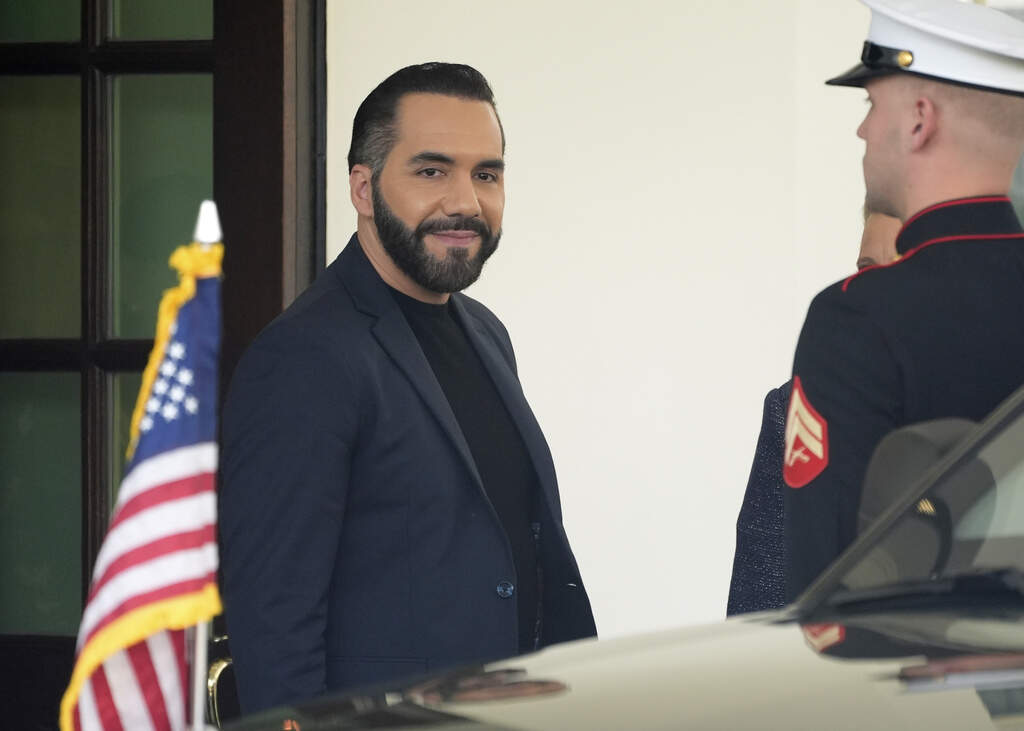
El Salvador was once the murder capital of the world. Now under President Nayib Bukele, it’s safer than Canada. But with 2% of its population locked up — what is the real cost of this newfound safety?
Guests
Nelson Rauda Zablah, digital editor at El Faro, a digital news outlet in El Salvador. He has covered politics in El Salvador since 2013.
Mneesha Gellman, associate professor of political science at Emerson College. The founder and Director of the Emerson Prison Initiative.
Transcript
Part I
BUKELE: We didn't tolerate being told what to do. In doing so, we did the unthinkable. Against all adversity, we transform El Salvador from the most dangerous country in the world to the safest in the Western Hemisphere.
CHAKRABARTI: This is On Point. I'm Meghna Chakrabarti. And that is El Salvador's president Nayib Bukele. He was speaking at the Conservative Political Action Conference in Washington, D.C. on February 22nd, 2024.
Prior to Bukele's presidency, El Salvador was the murder capital of the world. In 2015, the country suffered 6,656 homicides. That translates to a murder rate of 104 per 100,000 Salvadorans. Compare that to the U.S. which had a 2015 murder rate of just under five per 100,000 people, according to the FBI.
Bukele took office in 2019. Three years later, 2022, the number of homicides dropped to just 495. The next year in 2023, it was down to 214. And in 2024, it was a record low of 114 or just 1.9 murders per 100,000 people, much lower than the U.S. rate last year, which hovered around five, or actually above five murders per 100,000 people.
So El Salvador is now safer from homicides than is the U.S. or even Canada. Bukele took bold and dramatic action to make this happen. Some say he's even turned El Salvador into an authoritarian state.
In 2020, when the legislative assembly would not approve a $109 million loan request from the United States to fund his security plan, Bukele proposed sending police and military into gang-controlled situations. That was the security plan. But upon not getting approval from it, he protested outside the National Parliament to change the vote.
(TRANSLATION)
"These criminals in the legislative assembly don't even want to approve money that doesn't belong to them," he said, "but rather to the Salvador and people to guarantee the security of the Salvadoran people."
But Bukele didn't stop at peaceful protest. When lawmakers continued to refuse his security plan, Bukele ordered police and military to storm the parliament.
NEWS BRIEF: In other news, soldiers entered El Salvador's parliament as the president demanded lawmakers approve a $109 million loan to equip the military and police to fight against violent gangs. Called an extraordinary weekend session of Parliament to ask it to approve a loan that has pitted the executive against lawmakers in a country with one of the world's highest murder rates. Now before his entry, armed police and soldiers with rifles and wearing body armor entered the chamber and stood guard, a move not seen since the end of the country civil War in 1992.
CHAKRABARTI: Despite that move, the loan wasn't approved.
But in 2021, after Bukele's party won a super majority in the midterm elections in El Salvador, the security loan sailed through. Bukele also replaced five Supreme Court justices with justices aligned with his party and convinced the legislative assembly to purge one third of El Salvador's judges consolidating his party's control.
Then in 2022, President Bukele declared a 30-day national state of exception to crack down on gang violence. This empowered security forces to arrest people without a warrant if they were suspected of supporting or belonging to a gang. It eliminated due process or the right to an attorney and allowed law enforcement to freely tap communications.
Remember, this was in 2022. That 30-day exception is still in place today, and to date, more than 83,000 Salvadorans have been imprisoned, which results in a 2% of the population being locked up, the highest incarceration rate in the world. So here's President Bukele touting his iron fist policies at the White House in April.
BUKELE: They sometimes, they say that we imprison thousands. I like to say that we liberate millions.
CHAKRABARTI: According to his own administration, some 8,000 innocent people have been arrested but released since 2022. Now, the Iron Fist policy has been looked at worldwide as the Bukele model. And countries like Argentina, Ecuador, Honduras, even the United States look on it very positively.
Just this March, the United States, the Trump administration sent roughly 300 alleged Venezuelan gang members to El Salvador to one of the mega prisons there, and President Trump is hoping to send even more people. Here's Trump during a press conference at the White House during Bukele's recent visit.
REPORTER: How many illegal criminals are you planning on exporting to El Salvador? And President Bukele, how many are you willing to take from the U.S.?
TRUMP: As many as possible, and I just asked the president, it's this massive complex that he built, jail complex. I said, can you build some more of that, please?
As many as we can get out of our country.
CHAKRABARTI: In 2024, President Bukele was reelected with 84% of the vote in El Salvador, and according to a Gallup poll from January, he has an approval rating of 83%, the highest in Latin America. But as we said, many see Bukele's rule as authoritarian. So how accurate are these numbers?
What impact has the iron fist policies really had on life for everyday Salvadorans? What can the U.S. learn or maybe shouldn't learn from El Salvador's example? So let's begin today with Nelson Rauda Zablah. He's the digital editor at El Faro, a digital news outlet in El Salvador, and he's covered politics there since 2013.
In late April, he had to flee to the United States after an arrest warrant was issued for him in El Salvador because of his reporting on the Bukele administration. Nelson, welcome to On Point.
NELSON RAUDA ZABLAH: Hi, Meghna. Thank you so much for the invitation and for having me on the show.
CHAKRABARTI: Can you first please tell me a little bit more about the warrant that's out for your arrest and why?
ZABLAH: Yeah, absolutely. So in May 1st we started a series of publications. We published a three-part video series that details the part that many don't know about the Bukele model for security, which is his secret dealings with the gangs that control the country. In El Faro, in this January, a team mobilized to different cities to interview gang leaders that fled from El Salvador with the help of the government of Bukele, and we published the interviews.
The three videos. El Salvador is a country of 6 million people, and three weeks later, the videos have been watched by some 2 million people. So it's fair to say this created headlines throughout El Salvador and elsewhere where people saw them.
The third day, in the final day of the publication, some of us have already left the country preventively to wait for the reaction. And we received notice that the Attorney General's office, which is put in place by Bukele, in control by Bukele, had issued seven arrest warrants for those of us, for journalists of El Faro that are involved in the publication, such as my case.
Yeah, we went away from El Salvador. We don't know when will it be safe to come back. We don't want to be in a Salvadoran prison or mega prison. And that means that a good chunk of the staff of El Faro is nowadays relocated with, I don't like the word exile, but I guess every exile is temporary at first.
And the government is accusing us of collaborating with gangs because we interviewed gang leaders that they released.
CHAKRABARTI: That they'd released and that your reporting found that they had collaborated with.
ZABLAH: Yes. So the idea of the collaboration with gangs is not something that we reveal in this report.
We have been revealing that since 2020. And it's not only us, it's also the U.S. Treasury Department. The U.S. State Department, the director of prisons in El Salvador is currently under sanction by the U.S. administration. Because of his role in collaboration with the gangs and so are other officials in the administration.
CHAKRABARTI: I see. For people who have only heard those headlines that I was reflecting on from 2015, when El Salvador was called quote-unquote the murder capital of the world, can you take us back to that time and describe a little bit of what day-to-day life, again, for just everyday Salvadorans was like.
ZABLAH: It was terrible.
So the gangs controlled, there are two main gangs in El Salvador, MS-13, and Barrio 18. I should note that those two gangs have a U.S. origin. Barrio had been in the California gang ecosystem since the '40s. And the MS-13 is a gang that formed in Los Angeles after a number of Salvadorans fled the country during our civil war in the '80s.
So they started being deported in the '90s to a country that had recently become a democracy with the signature of the Peace Accords in 1992. And then became this massive security problem. By 2009 already, El Salvador was one of the most violent countries of the world, life was very difficult for a lot of people, because gangs have so much territorial control.
They extorted small businesses and large businesses, and they accepted the power through violence and in imaginable ways. If you had a daughter, you had to fear that some gang member would want to be in a relationship with her or just take her away.
And if she denied or you denied, you could be a victim of violence. People were murdered just for walking into the wrong part of town because they believe they control territory. So this was El Salvador and of course there was a lot of violence in between gangs. So that's what caused El Salvador, and this, they tried many solutions, in fact the Bukele government is not the first that negotiated with gangs.
There was a truce in place in 2012, when that truth broke down, the government went into repression and that's what made, in 2015, what you had was an open war between police and military and gangs.
Part II
CHAKRABARTI: Nelson, I just wanna play a little bit of tape from Bukele back in 2019 when he was elected. Because from the beginning, he's tried to change the image of El Salvador, obviously not just to the Salvadoran people, but even around the world. And one of the ways he's tried to do that is through talking about surf tourism or surfing tourism to El Salvador. So here he is addressing the International Surfing Association in November of 2019.
BUKELE: We're very happy to be hosting this tournament, this worldwide tournament. El Salvador, some of you knew of El Salvador already, but I bet most of you didn't know about El Salvador before.
So we're trying to, we're trying to become prime surfing destination. That's gonna take a couple of years, but of course that's gonna take your help. Because you are our ambassadors all over the world. When you post something on your Instagram account or your Twitter and your Facebook, everybody that follows you, everybody that admires you, everybody that wants to be like you will be seeing our country.
And will be seeing our waves and our beaches. And will see all the things we have to offer.
CHAKRABARTI: So Nelson, President Bukele is saying this as El Salvador is continued to be in the grip of this massive spasm of violence and to, I have to say, to my years, this sounds so odd, but he's also talked about himself as the coolest dictator in the world.
Can you tell me a little bit more about his background and even his embrace of things like social media?
ZABLAH: Yeah. The first thing to understand about Bukele is that he's an ad man, right? He's a publicist and that's how he entered politics. He was running publicity ads for the left party for FMLN, which was the former guerilla in Salvador.
He became mayor of a really small town and then he became mayor of San Salvador. And that ended in 2019, 2018, and that's how he started to campaign for the presidency. Image is very important for him. And what I think is missing from the narrative ... is his dealings with the gangs because as he was talking in 2019, a deal with the gangs was in place.
We just didn't know about it at the time. We started publishing about it in 2020. Because we published documents that showed that Bukele officials had entered prisons with masked men to talk to gang leaders, to imprison gang leaders. We now know who some of those masked men were, because some of them confess to it in the video that we publish.
The whole idea that he pacified the place or that he was doing some sort of security model, even pressuring legislators. The reality of what he was doing was dealing with the secret organizations. And that's how murders in El Salvador have been going down the rate since 2015.
But they started really going down in his presidency due to this secret deal with the gangs.
CHAKRABARTI: Nelson, can I just jump in here? What was the deal or the deals, the nature of the deals that he struck with the gangs?
ZABLAH: So at first, he gave them better prison conditions to leaders. The gang leader that we talked to, Carlos Cartagena, aka Charli, he said that Bukele's party in that time, FMLN had given a quarter of a million dollars to the gangs for political support.
And that money was taken by the leaders of the gang, was not given to every single member, or every single criminal of this organization, but was given to leaders of the gang. And the idea, eventually, the negotiation of the gang included liberating some of those leaders.
And some of them were even escorted out of the country by Bukele officials.
CHAKRABARTI: And this was in exchange for the gangs agreement to stop arbitrarily killing people.
ZABLAH: So what the gangs did was that they lower homicides in their territory, controls, the territory that they controlled.
And they also stopped disputing the extortion fields that they were into, and they were also, the deal eventually included liberation of some of them. But that's at first what lowered the homicides in El Salvador. However, at the very first years, the extortion and other related crimes had not been reduced.
CHAKRABARTI: Okay. Nelson, hang on here for just a second. Because this is opening up, I think, an avenue of understanding what's happening in El Salvador that is almost never discussed in the United States, so I would love to bring Mneesha Gellman into the conversation now. She's an associate professor of political science at Emerson College, and founder and director of the Emerson Prison Initiative.
And author of a lot of writing about El Salvador, including one that's recently appeared in The Conversation. It's headlined "Beatings, overcrowding, and food deprivation: U.S. deportees face distressing human rights conditions in El Salvador's mega prisons." Professor Gellman, welcome to On Point.
MNEESHA GELLMAN: Thanks for having me.
CHAKRABARTI: So we'll talk about the U.S.' role here in just a second.
But first, I know you're deeply familiar with Nelson's reporting. Help explain this to us because we never hear about these deals struck with the gangs. It seems to imply, and correct me if I'm wrong, that the contemporary crackdown on civil rights in El Salvador, perhaps, is not the central thing that helped reduce the murder rate.
GELLMAN: The crackdown on gangs is one of many factors that reduce the murder rate. But I think to put some of Nelson's comments in context, the United States has never reckoned with the way that it shattered El Salvador through U.S. intervention in El Salvador and Civil War from 1980 to 1992, the U.S. was heavily involved, funding the military, training the military.
And many scholars, myself included, see that the U.S. influence tipped the inability of the FMLM, the leftist party to come to victory in that war. So there's deep implications of U.S. responsibility there. Since the signing of the Peace Accords in 1992, the U.S. has gone on through USAID and other international funding, to provide so-called funding for democracy-based initiatives.
But the way that the U.S. has engaged El Salvador has continued to perpetuate social inequality, economic inequality, and really been willing to rubber stamp what political scientists think of as procedural democracy. Putting votes in the ballot box and calling that democracy, rather than looking at the everyday experience of people to access their civil liberties and the larger platform of the rights.
CHAKRABARTI: So can you tell me a little bit more, you said the ways the U.S. has been continuing, continued to be involved in El Salvador. Give me some examples.
GELLMAN: The U.S. has funded a whole range of things from training the military and police and saying, Oh, there's a human rights-based curriculum now that the police and military are being trained in.
What does that look like? Does that look like a 30-minute PowerPoint in a training? And then here are lots and lots of U.S. dollars going for those trainings? Those same police and military people go out on the street and perpetuate human rights abuses of Salvadorans. But we call that democracy promotion.
CHAKRABARTI: Nelson, first of all, Professor Gellman. Let me just say, I'm very glad and grateful that you brought up the U.S.' historic involvement in El Salvador, let alone all of Central America. But Nelson, help me still continue to understand like the deals with the gangs are new news for American ears.
How much importance then do you also give to the civil rights changes or crackdowns that I'd mentioned at the very top of the show, the ability to arrest people without a warrant, the wiretapping, the, as you said, the highest incarceration rate in the world now in El Salvador.
Did those things at all contribute to the reduction in homicides there?
ZABLAH: Yeah, of course. So the Bukele security model has two parts. The first was dealing with the gangs as secret, dealing with the criminals that control the country. When that broke down in 2022, we had, the world's most homicides after the Civil War, the most violent day of the century, there were 76, 67 people killed in a spree by one of the gangs, 87 in total during a weekend.
So that's when the state of exception started. Since then, over 80,000 people have been arrested in El Salvador without warrants and with constitutional rights suspended. So when the deal with the gangs broke and asked, okay, officials were helping some of the leaders of the gang flee the country, the government cracked down not just on gang members, but on everybody.
Some civil rights groups estimate that at least 30,000 people oppressed in this ... are innocent and a lot of them were talking about things that cannot be replaced. Many people, hundreds of people, have died in prisons without being ever convicted. How do you correct that? There's no way of coming back from that.
So this is, and the state of exception became not only a tool for security, but a tool of social control. Because the state of exception has been applied to street vendors, has been applied to teachers who protest, has been applied to whoever in El Salvador, because El Salvador is a dictatorship.
And Bukele is a dictator.
CHAKRABARTI: So now the pieces are falling into place for me and for people who don't have the detailed understanding of what's actually happened in El Salvador the past few years, as you said, Nelson. There's just a recap a little bit. There's some deals initially between the Bukele administration and Salvadoran gangs for a few years. That breaks down, leading to this terrible, like very sharp spasm of murder and violence.
And then we have the second part of the Bukele security plan coming into play in 2022, that state of exception, which is still in place. So Professor Gellman, you were just, you were in El Salvador last year. Can you tell me what you saw and heard from people about what everyday life is like there now with the state of exception?
I guess we'd kinda more colloquially call it a state of emergency here in the U.S., but like still in place.
GELLMAN: Sure. People related to me that there was an initial euphoria in the beginning of the state of exception. So it is important to note that after the Civil War, El Salvador continued to have these very high rates of violence and people have become exhausted from living with gang violence and with state violence and with just a tremendous amount of social and economic inequality.
So that was what was going on in the lead up to 2022. Initially, when the state of exception went into effect, there was a sense of liberation. There were photographs of people playing soccer and soccer fields that previously were gang controlled, and they couldn't go to, that quickly came to an end when the mass arrests meant that so many Salvadorans had loved ones who were detained.
And incarcerated with all communication cut off. So one of the provisions of the state, under the state of exception is that people who are incarcerated in El Salvador have no contact with family members. So no phone calls, no visits, no letters, which means it's really impossible for family members on the outside to verify the wellbeing of their loved ones inside.
So a couple things that have stuck with me from this was in the lead up to the 2024 election when I was in the country doing interviews with a bunch of different kinds of people to try to better understand what was going on there. One person who related a story that the woman who sells tortillas on her street came to her, a few weeks after the state of exception went into effect, saying, this is amazing.
I'm taking home so many more dollars than I was before, because previously I would have to pay a quarter to the gangs at each street. Every time I crossed the street to sell tortillas on another block, I'd have to pay a quarter as part of the gang tax. I haven't had to do that. I'm taking home more money.
It's better for me. A month later, she shows up at that same person's door and says, do you have a contact with anyone at a human rights organization? Because my grandson was just arrested. I know he's not gang involved, and I don't know what to do. So those kinds of stories of people who initially feel this buoyed sense of security, it then devolves because they become directly impacted in some way by these arbitrary arrests.
CHAKRABARTI: I'm reading here that, what, more than a third of Salvadorans say they know someone who's been imprisoned and perhaps unfairly without established connections to gang involvement?
GELLMAN: Yeah. I did interview after interview with people, with family members who had loved ones that were detained, and in most of those cases people said there was no gang affiliation whatsoever.
And a few of them, they said, yeah, our whole neighborhood was MS-13 or Barrio 18 controlled. So yeah, my grandson or my cousin or my whoever, might have hung out with them. They weren't a member. So the state of exception affects everyone. Some people who are gang members have been arrested and detained.
Other people who live in gang-controlled neighborhoods, but are not themselves gang members have been arrested and detained, and other people who have nothing whatsoever to do with gangs have been arrested and detained.
CHAKRABARTI: So simply by virtue of living in a neighborhood that's controlled by one of the gangs is enough.
It's more than enough for the government to say, we're gonna round you up.
GELLMAN: Absolutely. That has happened over and over again. And one thing that I have really tried to bring attention to is the fact that neighborhoods that previously were gang controlled before the state of exception, now are police and military controlled.
Some of those police and military members are perpetrating the same kind of violence. Extortion, sexual abuse, forced relationships with women, all sorts of human rights abuses, the same way, and often targeting the same people that were targeted by gang. So they're perpetuating these human rights violations under the name of bringing a sense of safety and security to the country.
CHAKRABARTI: Nelson, even with the drop in the homicide rate. We're keeping that in mind. But in terms of the day-to-day life and the pressures that regular Salvadorans feel, is it all that different than it was prior to 2015?
ZABLAH: Well, at first ... it meant all the difference in the world.
I walked into neighborhoods that I had never walked in, or that I would never walk in, in the circumstances that I just drove in, and I would've never done it before. So for the people who lived in this territories, it meant all the difference in the world, and that's what cemented Bukele's popularity at those years.
Things have seem to be changing, especially over the last month. And there's a polling that says that his popularity levels have dropped to even 55% now from last year, which was over 80%, but first there was all the difference in the world. People who have led lives under the iron fist of the gangs were solely free to take their kids to the park and that people really appreciated that.
Part III
CHAKRABARTI: We've been discussing the actions that President Bukele took after he was first elected. Then he got reelected. And so here is a speech that he gave, a moment from that in February of 2024 at the Conservative Political Action Conference or CPAC in Washington. And President Bukele touted his reelection, saying it was fair and free.
BUKELE: We just had free and fair elections. And we won in a landslide with more than 84% of the vote. (CHEERS)
Let that sink in. More than 84% of the people voted to continue our policies, our victory is unprecedented in the history of modern democracies in the world. They also gave us a super majority in Congress. More than that. 54 seats out of 60. 57 if we count our allies.
AUDIENCE MEMBER: We love you.
BUKELE: That's 95% of Congress. Let that also sink in. The people of El Salvador have woken up. And so can you.
CHAKRABARTI: Nelson, was it a free and fair election?
ZABLAH: Of course not. He shouldn't have been able to run in the first place. The constitution of El Salvador right now prohibits a second term. In fact, it is unprecedented in modern history because the last president who reelected El Salvador was in 1935 and was a dictator Maximiliano Hernández Martínez, who did a genocide of the indigenous population.
It's not fair. He controls every institution. He changed the justices, so they will interpret the Constitution in a way that allows him to run. He had threatened the people in the electoral tribunal so that they wouldn't impede his candidacy. They changed the rules of the game.
The assembly was essentially gerrymandered and from 84 seats, they went to 60 seats at Congress, months before the election, which was also prohibited by the laws. They withheld financing for the opposition parties. Bukele was very popular.
I'm not saying he wasn't, but he would've lost a lot of power in Congress. And in the municipalities if they hadn't changed the rules and that's why they changed them. Yeah, it's not free and fair at all.
CHAKRABARTI: Nelson, just to be sure I understand correctly, is it that Salvador and law says a president cannot run for a second consecutive term or just cannot run again at all?
ZABLAH: Cannot run for a second consecutive term. And it hadn't happened in 85 years.
CHAKRABARTI: And so I heard that he got around that in a kind of strange and interesting way.
ZABLAH: Yeah. So what happened is that when he got, when first got the legislative majority in 2021, they dismissed basically five of the Supreme Justices and they replaced them with loyalists, even including people who had been working at the presidential, at the executive branch at that point.
Two months later in September of 2021, those same justices issued a decision that allowed President Bukele to run for a second term. And that's also when they dismissed a third of the judges, which allowed them effectively to rearrange all the judges in the country.
So they would control three branches of the state. What do you call a political system where a single person controls all three branches? You couldn't call that a democracy.
CHAKRABARTI: What do you call it, Nelson?
ZABLAH: A dictatorship. He's a dictator. We don't mince words about it. We've said it since 2024 and in the last weeks, the control he exerts over all institutions has been made clear, not only by our arrest warrants, by the arrest, the actual arrest of an evangelical pastor, a human rights defender, prominent human rights defender, the lawyer of a of a campesino community.
The control is getting more and more harsh and yeah, Bukele's a dictator. There's no other way to call it.
CHAKRABARTI: Professor Gellman. Go ahead. What do you think?
GELLMAN: Yeah, I wanted to bring in the example of Ruth López's arrest. So on May 19th she was arrested and detained. Ruth López was the head of the anti-corruption unit an attorney at Cristosal, which is a Salvadoran based human rights NGO.
They've been doing much of the reporting on the qualitative conditions that people have faced both in detainment and in Salvadoran society since the state of exception began. She was one of the attorneys that brought the constitutionality of Bukele running again to the inner American court on human rights and has filed a number of lawsuits against the administration for everything from real estate corruption, financial corruption to things having to do with elections.
So it's an indicator that Nelson's described many of the indicators of the erosion of democracy, to where we are now, with an authoritarian regime in place.
CHAKRABARTI: Earlier you had mentioned the phrase performative democracy. To begin with, right? This is making me wonder.
Because honestly, we are facing some similar questions here in the United States. Insofar as when an executive or president breaks norms, stretches the limits of executive power, consolidates power with the support of his party, democracies aren't necessarily set up to stop that, unless the institutions within that democracy are willing to stand up.
Like who is there to stop President Bukele from continuing to harden his grasp on power?
GELLMAN: In theory, democracies are characterized by systems that maintain the rules of the game, the norms that make democracy function. So what we see, both with Bukele and with Trump in the United States is an erosion of the democratic systems that are supposed to do that work.
The judicial level is a great example. So the replacement of judges, the forced retirements, the intimidation of judges in both countries, and the way that they have been pushed out of ruling on cases that directly impact the power of the executive branch.
CHAKRABARTI: What we're seeing perhaps just a little further ahead of the United States in El Salvador is it seems like Bukele is also trying to change the very perception of what is allowable within a, quote-unquote, democracy, right?
So try to create new norms about what people should expect regarding their own rights. Because here's a clip again from the CPAC conference, February of last year where President Bukele said that nations should not defend institutions within their countries.
Everything from the police to the judicial system or the press. If, he says, those institutions have moved away from what he sees as their core mission, so here's what he said.
BUKELE: If the police was created to bring law and order. Let them bring law and order. If the judicial system was created to bring justice, let them bring justice.
Let them, protect their purpose at all costs. Same goes with the press. Let them be free. A democracy needs a free press. But to enjoy that membership, you must adhere to their duty as a reporter. Report the facts. Don't be a puppet of those who finance you or finance the organizations that you work for.
CHAKRABARTI: Now, Nelson, I hear those words, and I look at them and I think I agree, right? There should be a free and independent press, but is there subtext here to what he's saying?
ZABLAH: Yeah, the text is that he gets to decide who is a good reporter or bad.
CHAKRABARTI: I guess it's an obvious question since you had to flee for your own safety out of El Salvador, but continue.
ZABLAH: Yeah.
But there is a free and independent press in El Salvador. We are and not only El Faro, but many brave colleagues who are still in El Salvador doing the work every single day. The fact is that the free and independent press exists despite Bukele's intention and not because of him, and not because he has done anything to defend us.
We have been spy with Pegasus, so we have been intimidated. We have been, this is not the first time that the Attorney General's office investigates us for fake crimes under Bukele's tenure. So there is a free press, but the subtext here is that he wants to decide. There was a new foreign agent's law approved in El Salvador yesterday, that was modeled after Russia, Nicaragua, and Venezuela.
And what does Russia, Nicaragua, and Venezuela have in common with El Salvador? We're not talking about democracy because he wants to control NGOs that investigate the corruption in his government. He wants to control every civil aspect in society. Essentially what Salvadoran have done and what I think people are slowly waking up is that we exchange the crimes of our mafia, of the gangs, for the crimes of a state.
And if people is happy now that they were liberated from the gangs, they are so until the government inflict their rights in some way, until they are dismissed from their fight, governmental jobs. Until they are in a court and they don't have independent judge to go to, until you need the government to defend.
Democracy is not a popularity contest. That's not what makes democracy. Democracy is above all the limits of powers, the limits to people who exert power. And right now, El Salvador, there's no authority, no one that can limit the power Bukele exerts. So you cannot call that a democracy,
CHAKRABARTI: Right. This is the heart of the matter, right?
Because it's completely understandable that Salvadorans, Professor Gellman, as you said, were just utterly exhausted, not just for over a few years, but decades of violence. And that there comes a point where they say, we do want someone with a different plan, stronger, but then Nelson's saying, if there's no limits to the exertion of that power, the democracy itself fails.
I'm just wondering, again, thinking in the United States, we're not immune to this either. After 9/11 with the Patriot Act, there was a complete, not just resurrection, but mass empowerment of a security state in the United States.
And it's still with us to this day, quarter of century, almost later. So in that sense, it's understandable, but do you see what's happening? Or tell me what you think the relationship between President Trump and President Bukele says about what the U.S. needs to learn from El Salvador's example, if I can put it that way.
GELLMAN: Democracy is just a word. Anybody can use it. So in order to actually protect it as a regime type, as a system for ruling a given territory, people need to express that is their preferred system and they need to create and maintain the institutions that uphold actual democracy.
So those opinion polls in El Salvador, like the early opinion polls, no longer opinion polls, but early opinion polls in the United States, that showed Trump's popularity are indicators that people are willing to trade their votes for a sense of safety or a novelty or a spectacle or a promise of some kind of future.
Economic prosperity that may or may not actually come to exist. So the institutions of democracy are vulnerable to erosion if we don't be vigilant about maintaining them. That is one thing that I think El Salvador has to teach the U.S. We can very swiftly have that kind of regime here as well.
We are moving towards it. We see the arbitrary ICE raids, the targeting of union organizers in Oregon and Washington and a whole range of arbitrary arrests and detentions in the U.S. already. So we need to pay very careful attention and keep in mind the long game of what kind of regime do we actually wanna live under in this country, and what kind of regimes do we wanna be supporting.
Both with dollars and other kinds of ties in other countries.
CHAKRABARTI: And then perhaps there's also another similarity between Bukele's leadership of El Salvador and President Trump's. Because I'm also seeing that this security state that President Bukele has created has made the nation's debt skyrocket.
84% of El Salvador's GDP is, public debt makes up 84% of the equivalent of the GDP, $30 billion. So it's costing in terms of actual money as well. Nelson, what's the one thing you want American listeners to know better or understand better about El Salvador that you don't think we quite understand right now?
ZABLAH: I think U.S. taxpayer money is being sent to a dictatorship. And this has happened before in the history of the U.S. and other Latin American countries. And I think people should do something, take action, call their congressmen to stop this from happening. And I also think I agree with Professor Gellman.
I tell my U.S. friends that what I saw in El Salvador in 2019 I'm seeing signs of it in the U.S.
The dismissal of public servants, the attack to the judiciary, the fact that a man wants to have complete power and no limits. That's very concerning to see in a democracy that has such a long history, as this one.
The first draft of this transcript was created by Descript, an AI transcription tool. An On Point producer then thoroughly reviewed, corrected, and reformatted the transcript before publication. The use of this AI tool creates the capacity to provide these transcripts.
This program aired on May 22, 2025.