Support WBUR
The struggle to update America's aging air traffic control system
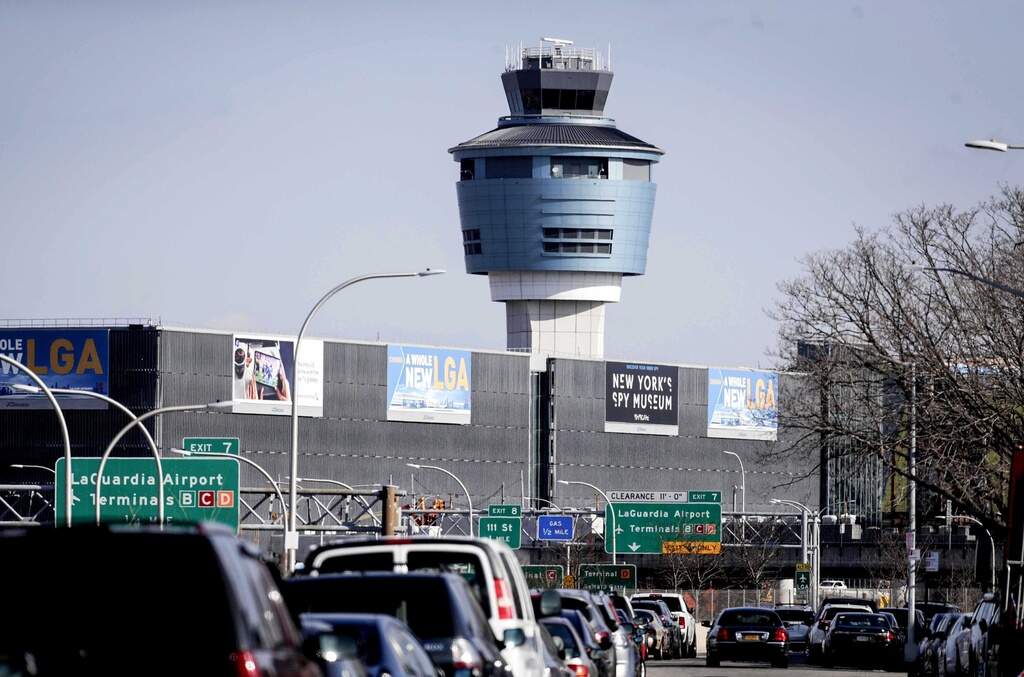
The Trump administration says it's going to modernize air traffic control equipment. Many administrations before have promised the same thing. So why hasn't it happened?
Guests
Dave Spero, president of the Professional Aviation Safety Specialists, AFL-CIO. He spent four years in the U.S. Air Force before joining the FAA as an electronics technician in 1988.
Michael Huerta, 17th Administrator of the Federal Aviation Administration (2013-2018). He was acting Secretary of Transportation in the first Trump administration in 2017.
Transcript
Part I
MEGHNA CHAKRABARTI: It began with this.
Just got told that the approach lost all the radars. Three of the four radar screens went black.
CHAKRABARTI: April 28th, more than a dozen planes in the sky above Newark Airport in New Jersey. According to reports, air traffic controllers at the Philadelphia Terminal Radar Approach Control suddenly lost their radar and their radios. They could no longer see the planes, and the pilots could no longer hear the controllers.
I guess this is a serious issue because I have one more arrival and now, I have nobody else coming inbound.
CHAKRABARTI: Radar and radio were down for a total of 90 seconds. Might not seem very long, but just count it out. One Mississippi, two Mississippi, three Mississippi, all the way to 90, and then you feel the weight of time that potentially dozens of planes were in the sky above New Jersey. Invisible to air traffic control.
Thankfully there were no crashes or disasters, but the stress of potential catastrophe was so great a number of air traffic controllers took leave under the Federal Employees Compensation Act. That act applies to federal employees who are physically injured or who have experienced traumatic events on the job.
Just six days later, Jonathan Stewart looked into his radar scope. He's another air traffic controller at the Philadelphia TRACON facility. He saw two planes near Newark Liberty again, and they were flying directly at each other, almost nose to nose. Stewart quickly contacted the pilots and told them to change course.
They did and narrowly avoided a crash. Stewart later told the Wall Street Journal that the close call happened in part because of creaky infrastructure.
STEWART: I was having to utilize a combination of radar and non-radar rules that I basically just made up on the fly to separate aircraft in such a way that I could be prepared for losing radar. That increased to my workload, which led to me having a close call.
Stewart also took leave under the Federal Employees Compensation Act. Now I'm guessing you know what happened next. Because it always seems to happen following close calls in American airspace, cue the political grandstanding.
SEAN DUFFY: Alright, Mr. President, you're on speakerphone.
DONALD TRUMP Hello everybody. It's a great honor. Great honor. And I'm sorry, what you're going through with the terminals. But we're going to get 'em fixed up. And I imagine Sean's been telling you that. And I was going to do that in my first month of my second term, but my second term got delayed four years.
CHAKRABARTI: Earlier this month, Secretary of Transportation, Sean Duffy, held a press conference on stage with him, old dusty equipment, seeming to aid maybe a date from the 1970s, but Duffy one upped that visual. He got President Donald Trump on the line, on a phone, a speakerphone, in fact, which he held up to the microphone so the audience could hear him, and Trump spoke at length first about his distaste or hatred for the Biden administration.
Then to the idea of modernizing air traffic control systems, and his administration, with Duffy announced a plan to modernize air traffic control. The plan included six new air traffic control centers, updating wireless and satellite technology at 4,600 locations and replacing tens of thousands of radios.
We are going to stand together and as one great country, we are going to build a brand-new system that is worthy again of the greatest country that has ever existed on the face of the Earth.
Now, Secretary Duffy couldn't offer an exact dollar value for modernizing this infrastructure but suggested it would cost billions of dollars to implement.
Now, this second Trump administration is not the first one in the history of America to grandstand around our aging air traffic control systems. In 2023, then transportation secretary Pete Buttigieg in the Biden administration was asked if the FAA system was out of date. Following yet another system outage, he pointed to the need for increased funding.
I welcome the attention from Congress, especially because we're coming up on the period when the FAA reauthorization, the five-year bill that provides funding and direction from the FAA is coming before Congress. It is the right time for us to be taking up those questions.
Then before Buttigieg, there was then Transportation Secretary Elaine Chao, who served in President Trump's first term in 2017. She spoke at the Aspen Institute and made the case for significant overhaul of the FAA's systems.
CHAO: Our air traffic controllers, these hardworking men and women need to have the most up to date tools and technologies to enable them to address this increasingly complicated airspace. So the administration is proposing that the air traffic control be separated out from FAA, be put into a non-governmental independent nonprofit co-op.
CHAKRABARTI: Now, these big ideas, by the way, keep going back in time. You can even jump back as far as 30 years before Chao spoke to 1997, no, 20 years before Chap spoke to 1997, when then Vice President Al Gore released a giant report on modernizing the FAA. Yet overhauling the 138 systems responsible for more than 45,000 flights in the United States, a day has not happened so far.
And today we're actually gonna talk about that actual equipment, the buttons, the knobs, the screens, the wires. What is it that actually needs so desperately modernizing so that air safety in America's skies can be kept as high as possible?
How much will it actually cost? And will there ever be the political will to make it happen? So let's start with Dave Spero. He's president of the Professional Aviation Safety Specialist at AFLCIO. He spent four years in the United States Air Force before joining the FAA as an electronics technician in 1988, and he now represents many of the people who maintain an upgrade the FAA's various systems.
Dave, welcome to On Point.
DAVE SPERO: Thanks for having me on.
CHAKRABARTI: So I really wanna get like our metaphorical hands on the equipment. Dave, if we could, so say you're standing in a tower and if you were looking around at all the equipment around you and little like dates popped up in terms of what year some of this equipment was first made or installed, what kind of dates would we be seeing?
SPERO: Looking out the window of the tower would only give you a snapshot of the vastness of the National Airspace System. We have about 70,000 facilities across the country. So the equipment that the controllers are using in the tower, it has changed over the last 10, 20, 30 years, obviously.
And there are upgrades to the equipment. They call 'em tech refreshes. When I started in 1988, there was a system out there called the airport radar terminal system, and it was a computer that was, came from the 1960s. And it took the input of the radar system.
And created the alpha numerics, the digits that you wanna see on the display where the controller can see the altitude, the range, the azimuth, the airspeed of the aircraft and even the radar that was used at the time was significantly older. Some of 'em are still out there, by the way, but the radar really isn't as much of a problem.
Okay. But the airport radar terminal system, which was a massive system in the terminal world, it's really what we depended everything on, that was replaced oh, probably about 20 years ago. By a system called the STARS, which was a standard terminal automation replacement system.
As you can imagine, FAA is really big on acronyms.
CHAKRABARTI: (LAUGHS) Yeah.
SPERO: And it's been refreshed several times. And it is what the controllers are using now, the STARS which is apart of what's going on in Newark, by the way, the STARS information is being transmitted to Philadelphia and it's working properly.
I think part of what we're seeing here is as some of the, maybe the misnomers out there.
CHAKRABARTI: Okay. Oh so this is good. So then maybe provide a reality check here, because I'm really fascinated, in, as I said, understanding as much of the actual physical infrastructure as we can.
So I'm gonna ask you more about that. But you've said several times that some of these main systems have been refreshed. So are they as outdated as it's being discussed in the media?
SPERO: Not everything's outdated. And there are, look, clearly there are systems out there that are being utilized that need to be changed. When we look at, but as I pointed out, the vastness of the National Airspace System and the numbers of systems and how it interfaces with itself from intra facility and inter facility equipment and the communications. A lot of it is, the agency doesn't have the money along the way to replace some of them.
So they'll get part of the job done. Then they'll move on to a different priority. Something else will pop up and become a more prescient issue. They got to jump on it and have to deal with it. So that's what sort of slows down the implementation of newer systems. We get some of it done and then we go on to something else.
And that has to do with time and money.
CHAKRABARTI: Okay. So help me understand the difference between the kinds of systems that are at airports, right? For local air traffic control, I guess that's mostly ground traffic, right? Versus the kinds of systems that are in the regional centers that, are they handling most of the planes that are actually in the skies.
SPERO: Yeah, let me lay it out for you. It's like you have these little domes and the first small dome is gonna be the airport and the air traffic controllers in the tower that handle that local traffic. That's everything probably within 10 miles and up to about 5,000 feet, I'm ball parking that, depends on the airport. And then you've got the terminal approach, which takes you out about 50 miles and goes up depending on the airport up to about 18,000 feet. And then you have the air route traffic control centers that encompass several of those airports and those facilities in a boundary.
Take you up to 40,000 feet, what they call en route traffic.
And within a vast geographic area, there's 21 centers across the United States.
Part II
CHAKRABARTI: Dave, before the break, you were talking about those sort of domes in terms of who's in charge of air traffic in different places in the United States. Let's go to those big regional ones. What would you describe as the state of the systems there? Which are the important ones and are they up to date?
SPERO: At the air route traffic control centers, which are 21 of those across the country, and we call 'em, as you call 'em, regional facilities. They have an automation system as well that takes in the information from several different radars that comprise a huge geographic area, that system's called the en route automation modernization.
They call it EAM in the FAA environment. And that EAM system has every center can interface with it at the same time. So flight data is being transmitted across the entire EAM system to all 21-air route traffic control centers at the same time. And it's accessible through there.
So it's a pass through and it's fairly modern and it gets refreshed on a regular basis as well.
CHAKRABARTI: Okay. Can I just jump in here, Dave, because this is where, what's being the soundbites that end up in the media versus what actually is a situation, there's a big gap between it.
And I'd like you to help me close that gap, because I was looking at this story from last year, from 2024 in October. And FAA administrator Mike Whitaker then said that he talked about the 21 centers that you just talked about, that control high altitude aircraft. And then he said, quote, those were designed to be a maximum life of 50 years.
And he was telling the House Aviation subcommittee this, and he said quote, they're now on average between 60 and 70 years old. What was he talking about? If they've been refreshed.
SPERO: So the buildings are 60 and 70 years old and they spend a lot of time and money changing out the electronics in those buildings.
They've even done some modernization when it comes to the office space and expansion of it. And there's been a lot of work that's been done, but clearly those buildings are 60 and 70 years old. There's no denying that. And I was recently at the Kansas City Air Route Traffic Control Center.
And they're doing a huge modernization of the power system there. And it's an enormous amount of work, an enormous amount of money. It happens on a regular basis, but at some point, there's got to be a consideration of what do we do with the center environment.
CHAKRABARTI: So then I'm still not clear though, like if, okay, you're talking about the buildings, but the systems there have been refreshed.
So are we talking about a problem that doesn't actually exist? Dave, that seems to be a hard sell to me.
SPERO: No, it's, I don't think it's a problem that doesn't exist. I think that, look, it would be much better if we could replace some of the electronic systems quicker.
And be able to utilize them, enjoy the fruits of our labor, let's say when we install those and move on to the next system. Unfortunately, it takes a lot of time to be able to install an electronic system and assure it works. We're trying to change the wheels on a vehicle that's moving 70 miles an hour let's kinda use that metaphor.
CHAKRABARTI: Or 350 miles an hour, right?
SPERO: Yes. You don't just get to stop and change everything out and then go back to what you were doing. You gotta continue to upgrade the national airspace system while you're utilizing it, which takes a lot of care and consideration.
CHAKRABARTI: I just wanna make something clear.
Because it suddenly occurred to me that you're talking about work that you did yourself with your own hands, plus all your colleagues, right? And this is really personal, right? This is what you've dedicated your life to. I just wanna be clear that this is not a conversation that's pointing the finger at the men and women who are actually charged with taking care of these systems.
Not at all. We are all in gratitude to you for keeping us safe. My overall goal is to get a really big understanding of okay, what should the lawmakers that we put into office, what should they do? How much money will they need to actually shake loose so that the air traffic control system can be as modern and as safe and reliable as possible?
With that in mind, Dave, let me just ask you something maybe I should have started with. If you had a magic wand, name like a system or two that you would say, this is the one that we want to modernize or completely upgrade or change first.
SPERO: Alright, so boy, that's like a Christmas list I can go from.
CHAKRABARTI: (LAUGHS)
SPERO: Let's start out with some of the more simple aspects of things. Instrument landing systems, for example around the country. They're aging. Those are the systems on airports that provide that, signals to aircraft to allow them to determine whether or not they should go left or right or up and down to get down to the runway.
And they're very important in instrument flight rule conditions when you can't see where you're going. Also, there's airport lighting systems at airports that are aging, and they need, that's the flashing lights you see when you're landing. At an airport when you finally come in through those clouds and that string of lights that are shooting toward you, that's what the pilots see as well.
That allows them to land safely as well and to be on course and glide path. So those are obviously systems that I think people can relate to and understand. And there are some more technological ones. One that's affecting the Newark situation is clearly the point-to-point communication system that allows the facilities to communicate with each other across the country.
CHAKRABARTI: Okay. Next on your list?
SPERO: Next on my list. I would want to standardize all of the radar systems that are out there across the country so that we're only using one type of radar for each facility that it needs to be engineered for. And root radars.
And terminal radars and surface radars are different types of systems. But using only one of each would be really helpful. Communications as well. We're talking about voice switches that allow a controller to not only talk on a radio, but to talk to other controllers within the facility or outside the facility or other stakeholders that they might want to communicate with.
It's important to be able to have one type of system for each of these around the country. Scalable, of course, because we've got different sizes of facilities, but that would then streamline a lot of the logistics and the training that we would have, which of course would be a much better process for us.
That's a handful of them.
CHAKRABARTI: Hang on here for a second, Dave. 'cause again, like I'm a lay person when it comes to understanding the systems, you're saying for radar, did I hear you right? That for radar we actually have different types of radar systems in different parts of the country.
SPERO: We do. For --
CHAKRABARTI: That doesn't make any sense.
SPERO: And it goes back to what I was saying before, where they begin to, it takes a long time to put in a radar. You don't just walk up and pull one out of a box and just stand it up and make it work. There's, guess there's some out there you can do now like that, but you've gotta cite it.
You've got to build a tower, you've got to make sure the electronics works. It's gotta interface with the system, the automation system that the controllers are utilizing in the facility. You gotta be able to make all these things work and sometimes getting all that logistics and then of course you gotta train the folks that are gonna maintain it.
That could take you a couple of years just to put one in. It's a significant amount of money to replace those. And I know the administration's talking about putting 500 of them in around the country and that's a good thing. But you get going on a project and it takes, if you gotta replace 400 radars, it's going to take a significant amount of time to do that.
Or a lot of bandwidth on a lot of employees and a lot of money. And sometimes that stops about midway. And then we move on to something else and we slow that, we slow roll the rest of it. Of course, as technology advances over the years, some of these systems become less and less able to be supported because the parts are getting older.
The manufacturer doesn't make 'em anymore.
CHAKRABARTI: Are you saying, Dave, that a political plan for massive overhaul of complicated technology could somehow wither on the vine and we wouldn't get it all done? Never heard of such a thing, Dave.
SPERO: No way. No way.
CHAKRABARTI: No way, man. Okay. I'm learning a lot here, so hang on for a second because I wanna now bring in Michael Huerta into the conversation.
He was the 17th administrator for the FAA, served in that role from 2013 to 2018, and was briefly acting Secretary of Transportation in the first Trump Administration in 2017. Michael Huerta, welcome to On Point.
MICHAEL HUERTA: Thank you. It's great to be here.
CHAKRABARTI: Okay, I don't even know where to begin because the more we learn about the technological complexity thanks to Dave of the FAA system, the more challenging this sort of magic modernization idea seems to become.
So let me just ask you the same thing I asked Dave, where would you start?
HUERTA: At its core, it's a funding issue. As Dave talked about, we have a variety of layered systems that are all put in place. They're all linked together by an incredibly complex communication system that provides all that information into the automation platforms that air traffic controllers use.
And you have to ensure that system continues to operate seven days a week, 365 days a year. 24 hours a day. And so it is an incredibly complex system, but every piece is dependent on all the others. Where I would start are the communication systems. That link everything together. And Dave touched on that in his remarks.
We have relatively modern automation platforms, but they're drawing data from very old radars. Radars that are not as old, more modern surveillance systems called ADS-B that are based on satellites. And all of that information needs to come together. And the network that brings it all together are the communication systems.
And those systems are aging. And that I think is one of the contributors to the problems we've seen at Newark. But the ability to do that is dependent on having, first of all, the level of funding you need to get the job done. But also, the predictability. And the stability of that funding over time.
CHAKRABARTI: Yeah. So again, we'll talk about the big picture of money and stability a little bit more later, but when you say the communication systems, what exactly does that mean? Are we talking about software? Are we talking about, I don't know, relay centers? Like what are we talking about if it's so important?
HUERTA: You're talking about everything from copper wires to more modern fiber-based systems, but think of that as, think of the wiring in your house. You have electrical sockets, you have light switches, you have all of these things that, you know, enable you to take advantage of modern technology in your home, but you have to have something that ties it all together.
And that's the wiring in your house. And that's the network that ties all of these systems together in the air traffic world.
CHAKRABARTI: And Dave, let me turn back to you right now. Let's just say if we were focusing on that communication system and we found a way to do a faster paced upgrade there, do we have the human infrastructure right now, the people who actually understand the systems and how they work to get that done, do we have enough of them?
SPERO: We don't have enough technicians. Let me start with that. Within the FAA we're about 1,000 technicians short from where we were around 2015.
And part of that has to do with COVID and not hiring folks along the way, but we've gotten behind and the FAA is committed to bringing more of them back, but they're going to be an important part of implementing all this new infrastructure. And being able to not only implement it, but maintain it over time.
So there's the talent pool is out there. There's just not enough folks that at this point right now, that can make all that happen. And if I were to look 10 years down the road, that would be something that I would like to see, where we've not only got enough technicians out there in the field that can maintain the system, but they can help implement some of these new technologies when it shows up at their door.
CHAKRABARTI: So let's say we drew that talent pool into the ranks of aviation safety specialists like you, what would it take to train them? How long would it take to train them up?
SPERO: It takes up to three years to get someone trained and understanding all the technologies.
I think it's important that the listeners realize that a technician within the FAA, what we call an airway transportation system specialist, can maintain a dozen different systems, communications, navigation leads, power systems.
You can't even turn on the lights in a terminal radar approach control without the technical workforce that we represent making sure that the power is available and clean and useful for the technology controllers utilized. That's part of it as well. We are a vast sum of information and skill, that our folks are out there do. It takes time to train and understand all of that and be able to be turned loose and know where the buttons are. You don't want people pulling breakers and doing that sort of work that aren't familiar with the facility they're working in.
CHAKRABARTI: Because what you've described is having the kind of knowledge that spans equipment across several decades, right?
So it's not just oh, do I know the latest technology and how to work with that. It's like I also have to understand some of the systems that may be in place from a couple of decades ago. But Michael Huerta, do you wanna respond to what Dave's saying? Just about, do we have enough people to do the modernization task?
If somehow, we came up with a workable plan and the money.
HUERTA: We don't, as Dave said, we're behind in the number of technicians that the FAA is authorized to have. And also the same for the controller workforce. Yes, we can surge hire and bring in people, additional people to really try to accelerate this.
But as Dave correctly points out, they have to be trained, and they have to be qualified and understand the systems they're working on.
CHAKRABARTI: So when you were FAA administrator back in 2013, 2018, that wasn't actually all that long ago, but was the state of the system as concerning then?
And what were some of the, we got 30 seconds before the next break, so was the state of the system as concerning then?
HUERTA: It wasn't as concerning, but we were under significant financial and operational pressure and that has only grown over time.
Part III
CHAKRABARTI: Today we are talking in nitty gritty detail about what the systems actually are in America's air traffic control infrastructure and what it would need, what it actually would take to upgrade them, fully modernize them, and therefore avoid the kind of even temporary outages that we've been seeing over the past couple of years. Okay, here's another example.
Going back to what happened in Newark on April 28th. Recordings from air traffic control show that there's a group of workers actually there who are trying to quickly identify the issue that caused the outage and solve the problem, and when air traffic controllers were 90 seconds later actually able to reach pilots, following the incident, they attempted to update the pilots on the situation.
The approach just told me that the couple texts went in, looked at the radar scope and walked out. They think it's gonna be a likely delay.
CHAKRABARTI: So those delays at Newark were obviously felt for weeks, but Dave when the controller says a couple texts, walked in, looked at the radar scope and walked out, can you guess as to what they were, those techs were asked to do at that moment?
SPERO: That's a good question. That goes to the core of what I started to do in my career as a technician.
So they walked in, I'm sure, and saw that as the controllers were reporting, they didn't have any targets on their display or maybe they weren't getting the communications come through. The technicians would then try to determine, troubleshoot what system was causing the problem.
When you're losing communications and you're losing radar data, the most likely culprit is going to be the point-to-point communication line that's coming into the building. And the way this is set up currently is that communication is coming from the New York Terminal Radar Approach control in Long Island, being fed to Philadelphia.
Because these controllers are not sitting in the New York TRACON. They're sitting in Philadelphia. They're controlling the traffic for Newark.
And that is the problem that they're currently having the difficulty, which by the way, is operated by a third party. The FAA technicians that we represent, they don't maintain or certify or take care of that communication.
The line that happens between those facilities, that's being handled by a third party contractor. And because they set up this new configuration when they moved some controllers from the Long Island the New York TRACON to Philadelphia, that particular part of the infrastructure isn't operating properly.
CHAKRABARTI: So what does that mean? That the solution couldn't be found in Newark? That the problem was somewhere else.
SPERO: The problem was with that third party contractor. And when you send this data and this communication information out the building, it then belongs, it's still the FAA's information, but it's being sent out through various central offices which are part of communication networks, companies that send your internet information out. They're the same companies that are handling this data for the FAA and they're moving it from facility, from central office, and hopping it down, to getting it down to Philadelphia.
And some of these facilities have different sorts of technology available, but what FAA wants to see is what goes out the door in New York, winds up in the door in Philadelphia. However they make that happen along the way is up to the company, and they call this variance of different sorts of technologies that some of these companies utilize.
Something called pseudowire, which is a really deep dive in internet protocol, but it can take older. What it allows you to do is use older technologies along the way and make it appear transparent when it winds up where it's gonna go. And that's one of those, or one or two of those along the way isn't operating the way it should.
CHAKRABARTI: So what was the, Michael Huerta, I promise I'm gonna come back to you, but Dave, what was the ultimate solution here?
SPERO: So I don't think they've come to an ultimate solution yet. I think they've got some stopgap solutions. But the idea clearly is to prioritize that communication, get it on a stable communication feed, and use as much, clearly as much fiber as they can along the way.
But I think it's important to the folks know that, and as Michael pointed out earlier, there's copper out there, there's a lot of copper and you're never gonna get away from the use of copper. Then in various places and different types of systems, you're gonna see copper wires out there.
It's, everything's not gonna go out on glass, on fiber optic networks. So the idea is to make sure that we've got the most up to date state of the art communication lines out there that the contractors can provide. So the FAA can utilize that from intra facility communications.
CHAKRABARTI: I see. Okay. So Michael Huerta, it doesn't sound unreasonable to actually have third party contractors for systems like this. And it definitely also to my ear, doesn't sound unreasonable that in this day and age that communications would have to pass through several different locations.
That's just the way things work, right? I'm thinking like just the internet, in order for me to do a Google search, who knows how many servers it passes through around the United States or even the world to come back to me. So that all sounds reasonable, but clearly something is failing here.
Where would you identify as the failure point just in the Newark example?
HUERTA: I think that as Dave was pointing out, the controllers that operate the Newark sector were originally housed on Long Island. And they were transferred to Philadelphia. And so what that resulted in was a reconfiguration of communication lines of the surveillance data and other information that feeds the scopes that controllers use.
And when those controllers were relocated, all that data now had to move to Philadelphia and the decision was made to route it through the Long Island facility, but then send it on down to Philadelphia. So that added another communication layer. I think what they're working on now is providing a more direct route, because what they're seeing is that third party provider, which is passing that data along.
Something isn't working right and they need to get that fixed.
CHAKRABARTI: So interesting. Okay. Oh, gentlemen, the nerd part of me like really is trying hard to spend the entire episode talking specifically about things like fiber versus copper. But I will, I'll step back from that for a moment, because again, how to solve this problem ultimately requires some political will.
Or a lot of political will and a lot of money. So with that in mind, let's listen to a little bit from Congressman Rick Larsen. He spoke at a hearing on the FAA's systems. This was back in on March 4th, and he called for more funding to be directed towards increasing hiring for open positions at the FAA, for improving infrastructure.
And he said there'd been a failure to do so with past presidencies.
LARSEN: The FAA's safety mission also depends on very complex ATC systems that provide navigation and surveillance services for more than 45,000 flights every day. However, many of these FAA's ATC facilities and equipment or F&E have exceeded their expected service lifecycle, which is made worse by inadequate funding requests over several administrations.
CHAKRABARTI: So that's Congressman Rick Larsen, Democrat of Washington State. So about this funding. Now, Michael Huerta, has Congress made it easy for the FAA to get the money that it needs or has there been some issue in just even like setting FAA's budget at the beginning of each congressional period or budgetary year?
HUERTA: It's a complicated process. The FAA, when it develops its annual budget request, it first has to go through the administration, and it needs to be balanced with whatever other administration priorities which might be out there. Then it goes from there to the Congress, and I think in fairness to Congress, generally, Congress has been supportive of whatever the administration has requested, but the whole FAA budget is subject to agreement on the entire federal budget and getting appropriations that are actually enacted by the Congress.
And we have had a lot of difficulty in just getting through the basic process of getting federal appropriations approved. I was in the agency for seven and a half years, first as deputy administrator and then administrator. During my tenure there, we never started our fiscal year with our budget in place. And so just think about that. If you're a business that's trying to operate a system, how do you plan for what you're going to invest in?
And so there's some process problems and then funding level problems. The facilities and equipment budget, which pays for modernization, has been largely flat for the last several years. And the problem with that is if you factor in inflation and the increasing complexity of the system that have been developed and deployed, it's been declining in real terms. And so what you have is a situation of the agency being asked to do more with less.
Same on the operations budget. The operations budget has seen modest increases over the years, but when you factor in needing to deal with annual salary increases, contractors increasing their prices for providing third party services, there's just tremendous budgetary pressure over time.
And so as you add more complexity and higher levels of service that the industry is looking for, what feels the pressure are some of the legacy systems that underpin the entire system.
CHAKRABARTI: So I appreciate the fairness that you want to apply to Congress. But one can be fair and yet highly critical. Because you're saying the level funding for FAA when a final budget was actually passed in your time there as administrator, is actually decoupled from increasing costs.
Okay. So there's always talk in Washington about reducing government spending, et cetera. But then this is my hobby, Michael Huerta, I have to say, hearing that the FAA isn't getting enough money to keep our nation's air traffic control system up to date modernized and safe. While also knowing that this year the Trump administration has submitted a $1 trillion budget request for the Defense Department, and they're not the first, the DODs budget goes up every year.
Something seems to be a little bit out of whack in terms of national priorities.
HUERTA: I think that there's several things at work. I think that there is a common understanding that this is a critical system, but I think what has developed over time is a belief in the men and women of the FAA, that somehow, they'll figure out how to get the mission done.
And that's really a credit to Dave and his members, the air traffic controllers and all the men and women at the FAA. Who are doers and they will figure out how to make systems operate. They're never gonna compromise safety, but sometimes they will do things that are not as efficient as we would like to see because they wanna ensure that there are safe margins.
But what we see now is things have just gotten to a point where it's unsustainable. There has to be an overall look at what is it gonna take to operate the system? But secondly, how are we gonna pay for it? And this is another problem that I think you have with the FAA's budget. The FAA's budget is largely funded through excise taxes on aviation users of the system.
Those are the ticket taxes that you pay on airline tickets, fuel taxes that are paid by pilots for aviation fuel, and then several other small contributors to it. Those taxes have not been adjusted since 1990. So think about that. There have been a lot of changes in the aviation system since then.
So you have a system that is paid for by the users, but it is still subject to appropriations. Does that make sense? Essentially you have a user pay system, but those funds are still subject to appropriations, just like any other system that is supported by general taxes.
Now, there is a small general fund subsidy that the FAA sometimes receives, but the lion's share of the budget is funded by these aviation user fees. And some of the things that, you know, really have to be looked at is, are those at appropriate levels? As I mentioned, they haven't been looked at since 1990. Think about what's changed since then. We have seen an exponential increase in commercial space launches.
Those impose significant costs on the aviation system. Commercial space pays nothing into the aviation trust fund. Likewise, there have been the development of drone deliveries. Again, nothing is paid into the aviation trust fund.
CHAKRABARTI: My face is just slack jawed right now. Michael Huerta, I'm ashamed to say I did not know that.
HUERTA: So we need to think about, okay, what do we need to spend on the system? But we have to pair that up with a conversation of how we're gonna pay for it.
And both of those things have to be done in tandem.
CHAKRABARI: Dave Spero thinking about, what, since Michael Huerta mentioned space, Elon Musk and DOGE helped to usher a lot of the very doers that Michael's talking about out the door.
We've only got about 15 or 20 seconds left. How much of their institutional knowledge is now gone from the FAA and can we replace it?
HUERTA: Already we're seeing telephone calls not being answered because people that used to work there are gone now. So that's a bit of a problem. And I would say a lot of that institutional knowledge is leaving.
And I don't know how they're going to replace it, because it's going to be an integral part of that aviation ecosystem that we like to refer to keep this national airspace running and moving forward.
The first draft of this transcript was created by Descript, an AI transcription tool. An On Point producer then thoroughly reviewed, corrected, and reformatted the transcript before publication. The use of this AI tool creates the capacity to provide these transcripts.
This program aired on May 27, 2025.