Support WBUR
The federal takeover of Rikers Island
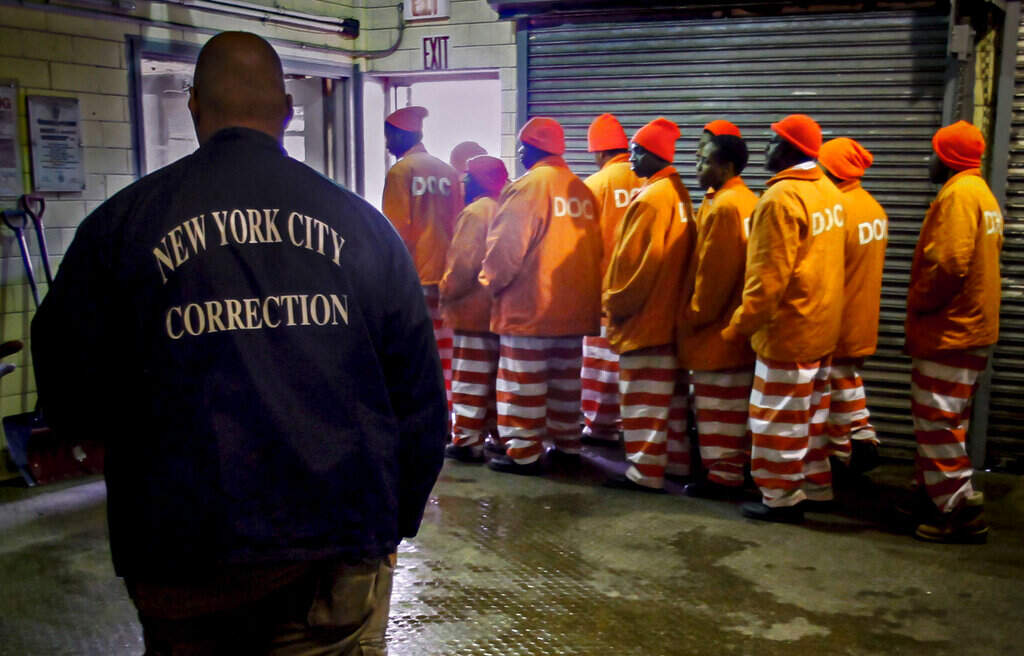
New York City has lost control of its jails. In May, a federal judge ruled that the city’s jails, including Rikers Island, will now be run by a manager who will report directly to the court.
But experts say a temporary takeover isn't enough to fix the deep and troubling problems that have made the city's jails so unsafe.
Today, On Point: Can the federal takeover of Rikers Island end decades of violence and dysfunction in one of the nation's most infamous city jails?
Guest
Hernandez Stroud, senior fellow at the Brennan Center for Justice at the NYU School of Law. His recent writings include The Possibilities and Limitations of Receivership for New York City Jails and The Way Forward for Rikers Island: Receivership.
Also Featured
Earl Dunlap, he ran the Cook County, Illinois Juvenile Detention Center from 2007 to 2015 as a court appointed “transitional administrator."
Transcript
Part I
MEGHNA CHAKRABARTI: Rikers Island. The New York City jail in the Bronx. One of the nation's largest city jails — and its most notorious.
BENJI LOZANO [Tape]: Hell, plain and simple. Hell.
UNIDENTIFIED FORMER INMATE: They taught me how to use a level of violence that I've never, I could never imagine I was capable of doing.
VINCENT SCHIRALDI: You know, there were several units that were unstaffed completely. There was no correctional officer physically in the unit. And I can't remember looking under a sheet or a mattress and not seeing a shank under one of them. Because frankly, anybody would want one to keep themselves protected because there was no correctional officer to keep them protected.
BERNARD KERIK: They're averaging about 150 stabbings and slashings a month.
CHAKRABARTI: Well, from the top you just heard former inmate Benji Lozano, an unidentified former inmate, former New York City Department of Corrections Commissioner Vincent Schiraldi, and former New York City Police Commissioner Bernard Kerik.
Rikers Island has a reputation for violence, physical and mental abuse of inmates, and assaults by inmates on uniformed officers and civilian staff. And back in 2011, a group of incarcerated men filed a lawsuit against Rikers Island, claiming that the prison guards used excessive force that resulted in frequent broken bones, concussions, and other injuries requiring hospitalization and surgery.
That lawsuit dragged on for years until the death of 22-year-old Kalief Browder.
NEWS ANCHOR: Kalief Browder was just 16 years old when he was arrested for allegedly stealing a backpack and imprisoned without a conviction for three years at New York's Notorious Rikers Island Correctional Facility, most of it spent in solitary confinement.
CHAKRABARTI: Browder was arrested in 2010. Bail was set at $3,000, an amount his family could not pay. So he was sent to Rikers Island. And by the way, the vast majority of people held at Rikers are there for similar reasons. They either cannot post bail or are in pretrial detention.
Browder spent 1,100 days at Rikers, almost 800 of them in solitary confinement as a teenager. When he was finally released — again, not convicted — but released in 2013, Browder's family said he was never the same.
Two years later, June 6, 2015, he died by suicide in his parents' home.
The very next month, July 1, 2015, New York City decided to settle the inmates' ongoing class action lawsuit and agreed to finally improve conditions at Rikers Island.
NEWS ANCHOR: The changes include a new federal monitor to oversee the jail, new guidelines for the treatment of teenaged inmates, revised policies on when guards can use force against inmates, and the installation of 7,800 new surveillance cameras.
CHAKRABARTI: Once again, that was in 2015. But nearly a decade later, conditions at Rikers Island have not improved.
So, last month, a federal court announced that enough was enough.
In a 77-page ruling, Laura Taylor Swain, a judge in the Southern District of New York, stated, “Nine years have passed since the parties first agreed that the perilous conditions in the Rikers Island jails were unconstitutional; that the level of unconstitutional danger has not improved for the people who live and work in the jails is both alarming and unacceptable."
Judge Swain went on to state: "The city has demonstrated in virtually every court area that neither court orders nor the monitors interventions are sufficient to push the Department of Corrections towards compliance." She also said the city's failure to comply with the settlement agreement is "troubling."
So Swain decided that the city did not deserve more time. She ruled instead to temporarily put New York City's jails under federal control. A court appointed remediation manager will now take over. Now, that's only happened about a dozen times in the past 50 years.
Rikers Island has received most of the attention, but a careful reading of Swain's decision shows that the ruling applies to all of New York City's jails. So what failed so badly there that a federal takeover was the only next step? And can New York City's jails be fixed? And should the city be looking to other places for examples on how to do it?
Well, joining us now is Hernandez Stroud. He's a senior fellow at the Brennan Center for Justice at the New York University School of Law, and he's been covering the ongoing crisis at Rikers Island.
Hernandez, welcome to On Point.
HERNANDEZ STROUD: Thank you. Glad to be with you.
CHAKRABARTI: So again, just because it's probably the best known, let's keep our focus on Rikers for a few more minutes. Can you tell us a bit more in detail about the conditions there that has led to this major ruling from Judge Swain?
STROUD: Sure. So at the nub of the problems is a failed security system.
There's a lack of cooperation between the supervisors and line officers. There's ineffective staffing protocols. And there's also a limited accountability for staff misconduct. And so to just put all that in simpler terms when a jail or prison is mismanaged, violence and other poor conditions have the opportunity to flourish.
And so, for example, if staff are not situated properly, if they're not at critical posts where violence can take place among detainees — or just to the detainees themselves by themselves, self-harm — then, you know, that creates the perfect storm for violence to proliferate. And that's where you see overdoses. That's where you see suicides.
One man, years ago, choked on an orange. But because of some policy, the lone staff member who was on site, who was staffing that post, didn't believe the policy permitted them to assist. And that man died. And as another example, another man slit his own throat and other detainees were trying to help, calling for help. But that was a situation where no one was staffing that critical post. And so that man died.
And to put a cap on this, Rikers is the nation's most richly staffed jail. So this is not a problem of lack of staff as it is in other jurisdictions across the country. Nor is it a problem of lack of money or resources. Rikers — New York City spends about $500,000 per year per detainee.
"This is not a problem of lack of staff ... Nor is it a problem of lack of money or resources. New York City spends about $500,000 per year per [Rikers] detainee."
CHAKRABARTI: Mm-hmm.
STROUD: So those are some of the problems that really contribute to the culture of chaos that's gripping the jails.
CHAKRABARTI: Okay. So I want to hold those facts in mind and return to them l later, because resources, as you said, aren't a problem.
But then how do we find or discover stories like there was a, you know, there's been a lot of reporting plus examinations by the city itself on conditions at Rikers Island. I mean, unsanitary conditions, fire safety violations.
You heard a little bit earlier, the quotation from someone who'd spent time there about he learned a level of violence that he could have never previously imagined doing. What is that referring to?
STROUD: Yeah, it's — I mean, it's just outrageous.
And part of the problem is the infrastructure itself. If you go onto Rikers Island, into the jails, you can just literally break apart any piece of the, any part of the infrastructure and create a makeshift weapon.
And so when everyone is sort of armed in that way, or could be quickly armed in that way, given the lack of of adequate staffing and the mismanagement, you know, it really does create a perilous situation where you are constantly looking over your shoulder, where you have to make sure that you know, that you yourself are armed.
And so it's a dangerous situation, not just for the detainees, but also for the staff who have to, you know, provide physical security. And if they are sort of in a perilous situation themselves, then it may be easy to understand why their first instinct might be to result to excessive force.
CHAKRABARTI: Wow. So they can just grab chunks of the building itself.
STROUD: Yes. Terrifying.
CHAKRABARTI: Yeah. Okay. And then you mentioned dangers to staff as well. There's been a lot of discussion about, you know, the violence that — I don't wanna call them inmates — but people who are at Rikers have experienced on from the hands of staff and vice versa is also true?
STROUD: Yes. So this is — the sort of violence that is on Rikers, it goes in so many different directions. So it's not just violence between incarcerated people. It's also violence at the hands of staff. It's also violence by detainees towards staff. And it's also self-harm. It's also violence that people, you know, commit on their own selves. And so it's violence going in so many different directions.
CHAKRABARTI: How many people are incarcerated at Rikers Island at any one time?
STROUD: So right now it's over 7,000. That is actually up from what it has been in years past. I don't think the jail population has been this high since before the pandemic. And so because of policies that could be outside of the department's control that affect how many people are moving through the court system. That of course can really play a major role in determining how many people are on Rikers, how quickly the courts move also is another factor.
CHAKRABARTI: Okay. So let's just spend one last second on that before we have to take a break. Because again, to be clear, it's true that the majority of people there are awaiting trial, right?
STROUD: That's right. So most people there are there awaiting trial. The, you know, the so-called innocent until proven guilty.
CHAKRABARTI: And yet some of them, I mean, we mentioned Kalief Browder, can end up spending years at Rikers.
STROUD: That's right, that's right. Because of court delays or, you know, there's a lot of dysfunction in facilitating people through the system from arrest to court appearance. And if you cannot afford to post bail, then you might be subject to being on Rikers even though you've not been convicted of any crime. And I'll just say, even if you've been convicted, you know, it still is the case that you have constitutional human rights not to be subjected to such treatment.
Part II
CHAKRABARTI: Now, Hernandez, how significant is it that even though that class action lawsuit that we mentioned earlier from a decade ago when the settlement was reached was Rikers-specific, I believe — and correct me if I'm wrong — that the judge's ruling from last month encompasses all of the jails in New York City?
STROUD: That's right. So the lawsuit addresses all of the jails.
CHAKRABARTI: As well. Okay.
STROUD: That's right. So most of the focus though, and most of the problems occur on Rikers. There are 10 jails on the island. And so that's why there's always a lot of sort of confusion. Is it Rikers? But then there's these other jails in the city? But this lawsuit applies to all of the city's jails.
CHAKRABARTI: Okay. So the judge ruled that the dysfunction and management that a court monitoring team witnessed created "a polycentric problem and a complicated set of dysfunctional practices unlike any jail system with which the monitoring team has had experience." Decipher that for us.
STROUD: (LAUGHS) Sure. So the problems on Rikers are polycentric. And if you look at the judge's 77-page opinion, you'll note that throughout, she describes the problems in that sort of way.
And what that essentially means is that there are multiple sources to the problems. And that there isn't any one solution that will easily resolve the issues. And, you know, mismanagement is by itself the problem. But that creates a host, a spate of other issues that have this trickle-down effect on all of the jail operations. So it's unlike, you know, unsanitary facilities where a court could order financial improvements and that those would cost money and that would resolve quickly the problem.
Violence and culture are much more difficult to resolve because they are polycentric and the monitors in this case have decades of experience spanning multiple jails in prisons. And so for them to make that sort of observation is really staggering.
CHAKRABARTI: When you say polycentric though, what does that mean?
STROUD: It means that there are multiple sources to the problem.
CHAKRABARTI: Got it.
STROUD: It's sort of like a spider web. If you sort of, think about the webs as the problems. If you tug on one problem, then that might affect another operation or might lead to a different problem.
CHAKRABARTI: Okay. So the ruling identifies four of these centers of problems, right? Staffing practices, security practices, management of people in custody, and timely staff accountability.
I want to just recall something you said in the previous segment, Hernandez, that regarding Rikers specifically, it's richly resourced because it's costing New York City half a million dollars per year to when someone is there at Rikers. And you also said it is adequately staffed. So how can those things be true, and at the same time, these four main problem areas be true?
STROUD: Right. That is why — that is what the court is wondering, I'm sure, also. (LAUGHS) This is at its core a problem of ability or willingness to ensure safety and create a staffing structure that has accountability.
Part of what the judge found is that there is a lack of ability or willingness, lack of skill or imagination to create and implement transformative plans. There in the past was a lack of willingness to cooperate with the court itself, with the monitor. There's been a changing cast of leadership. So there's been inconsistent, unsteady or uncommitted leadership. And that lack of continuity and management has also contributed to the problem.
And of course, you have the nature of the problems themselves, which have, you know, sort of been decades in the making and are not so easily resolvable so quickly. And so when you don't have steady, firm leadership or management, you know, it's sort of like the saying "the fish rots from the head." And that that applies with full force here.
CHAKRABARTI: So, where does the responsibility lie? Various New York City mayors? Various heads of DOC? I mean, I know that some advocates and critics of the jails are saying, well, what we're talking about is not just decades of mismanagement, but even possible just outright corruption.
STROUD: Yeah. There's a multitude of factors that have contributed to, you know, to the situation in terms of where to lay blame.
I mean, certainly city officials down the decades have been unable or unwilling to operate a humane jail system. This is not the sort of issue that people run on when they run for mayor. Nobody is getting elected based on how well or how poorly they are running Rikers.
"This is not the sort of issue that people run on when they run for mayor. Nobody is getting elected based on how well or how poorly they are running Rikers."
And so that is, you know, sort of consistent though across the United States where there is a lack of empathy in the public for people behind bars. Once people behind bars are incarcerated, you know, they're sort of out of sight, out of mind. And that is intentional.
And so, you know, until there is enough will in the public space to push our leaders to do better and to run a humane jail system, then we will continue to see these kinds of court cases. And in the most extreme cases, you know, courts seizing control of these facilities. Because on the other side of that is the rule of law. The idea that regardless of your station in life you still have basic rights to which you're entitled. And here, you know, basic human dignity.
CHAKRABARTI: Now we're really getting to it, Hernandez, aren't we? Right? Because when there is a settlement, a legal settlement, that a city reaches with a group of complainants, they are legally — the city's legally bound to fulfill the terms of the settlement. But a decade has passed. Right?
And I mean, this is what last month's ruling puts into very sharp relief. I understand that there were, what, like some 15 things that the city had agreed to do back in 2015. Everything from updating its use of force policy to improving video surveillance, to staff discipline and accountability, to even having a better housing plans for inmates under the age of 18. All of these things.
And that 10 years later, the city hadn't fulfilled or hadn't been in full compliance with any of them. Is that right?
STROUD: That's right. And in the past since this most recent commissioner has been in place, there has been some limited progress. The judge noted that in her ruling recently. But even that progress isn't enough to offset the deep dysfunction that obviously continues to exist and prevent the city jails from being more humane.
CHAKRABARTI: Is — I mean, sometimes the truth is quite simple. Is it just because it's easy to not care?
STROUD: It's hard --
CHAKRABARTI: Like you said, I mean, like you said, no one runs on this issue. And so, you know, like you can drag, the city can drag its feet for as long as it wants until, you know, something tragic, like another Kalief Browder happens.
STROUD: Yeah. You know, I mean, this is a perfect sort of situation where unless it affects the majority, the public at large, then you might not see a great deal of political action or political will.
I mean, we saw this in the wake of Brown against Board of Education. For a decade after that decision was handed down, Brown against Board of Education, 1954 Supreme Court decision declaring unconstitutional the segregation of school children by race. In many school systems across the country, most of them in the south, but some in the north, there was significant reluctance to comply with Brown. And until the Supreme Court stepped in in a decision and said to federal trial judges, like Judge Swain, you can use compulsory measures to ensure compliance with Brown. Did we see any movement or any change in the composition of public school students?
And the same is true here. Unless you, you know, have a federal court that is mandating the observance of the constitutional rights of a vulnerable population that the democratic process has neglected, you know, what would happen is that these violations would just run relentlessly.
CHAKRABARTI: Okay. So does the judge's ruling state clearly what the consequences would be if the if the mandates set out by the ruling are not met?
STROUD: So the judge is being clear that, you know, this is sort of a last-ditch effort. The court realizes, I think, its place within a democracy. Courts — it's not typical for them to be in this position of supervising or superintending jails and prisons. And so in this case, the judge is hiring a remediation manager, giving that remediation manager broad powers to address the constitutional issues. And that will be guided by a plan that I'm sure we'll talk about, talk about soon.
CHAKRABARTI: Mm-hmm. Okay. Yeah, we definitely will.
But first I wanna note that we did invite New York City Mayor Eric Adams to join the show. His office declined. But during a press conference at City Hall in New York on May 13, Mayor Adams was asked by reporters about his reaction to the judge's ruling. And it's interesting because there was a big debate over semantics. And we're about to hear it. Because he had an issue, the mayor had an issue, with how the question was asked.
MAYOR ERIC ADAMS: You used the term of receivership. Is that what the judge said?
REPORTER: A remediation manager. But in a sense, it is going to, somebody else is gonna be overseeing it.
ADAMS: Okay, so why don't you say the, the remediation manager, why you take, why you putting words in the judge's mouth? The judge know what a receivership is and the judge knows how to say the word receivership. The judge didn't say that. The judge gave you the terminology that she wanted to use. Now if she comes back in court and say, "Hey, this is a receivership," then I could respect that.
But that's not what the judge said. We, I just wanna be clear on that. Because you're gonna report out that Rikers is in a receivership when that's not what the judge said. She knows the term receivership because she used that term while in court that if she's going through determination. So she could have easily said that if that's what she did, but that's not what she said.
CHAKRABARTI: Hernandez, why so prickly about this?
STROUD: Well, you know, in a sense, technically the mayor is actually right. So on page 29 of her ruling, the judge noted sort of what a receivership was. She defined it and said why she was calling the outside authority, not a receiver, but a remediation manager.
And it's an important point because I think it goes to the project that the judge is trying to pursue here. And that is durable change. And so receivers typically supplant, replace entirely, the government officials from their responsibility. And the judge noted that in her opinion.
Here, however, the judge didn't want to call it a receivership because it seems to me that she wants to capitalize on the current commissioner's willingness to cooperate in this case as a way to further durable change. Because — and we can talk more about this — but in some instances when you totally displace the government and install a receiver, some people worry that the gains achieve during that receivership period will be short-lived. Because when the government has to come and resume operations, it won't — they won't be so invested in the reform.
So the idea here is that the judge, by including the current commissioner in this effort, the government more broadly, the hope I think is to inspire sustainable change so that we don't end back here 10, 15 years down the road because these reforms didn't take.
CHAKRABARTI: Okay. A little bit later we're going to hear about how hard it is to not just implement but cement reforms in a completely different correctional system in another part of the country and what we might learn from that.
But, Hernandez, let's talk about the plan. What are the goals that the judge outlined for New York City's jails?
STROUD: So the goals are very simple. The goals are to eliminate the constitutional violations. And so it is to address the mismanagement, the staffing. It is to address the security practices, the management of people in custody. It is to create staff accountability. It is really to address these core reasons that have caused this environment of chaos in mayhem to permeate the jails. This decision, this step, is intended to address that — and the judge gave the remediation manager very broad powers to that end.
"The goals are to eliminate the constitutional violations ... to address these core reasons that have caused this environment of chaos in mayhem to permeate the jails."
CHAKRABARTI: Yes. And those broad powers include that the city's commission can take any steps — or must take any steps that the remediation manager thinks are necessary to fulfill these goals. Or interesting that legal or contractual requirements can be waived if they get in the way of implementing these goals.
But I'm seeing one of the specific goals is a use of force directive. What's that?
STROUD: Mm-hmm. Well, people need to know, staff as well as others, there needs to be an objective policy on the books about when and in what situations staff can use force. This is a case that was initiated over excessive and unnecessary force.
So just like police departments, any state agents where there is the authority to use force on people, you need to have an objective policy that governs the use of that force, that cabins it, that doesn't make it arbitrary. That doesn't make it excessive. And also so that you can measure anybody's, any one particular officer's, use of force against that policy to say, you know, you're out of compliance. You need to do this differently.
CHAKRABARTI: Got it. So an objective policy on the use of force makes a lot of sense.
Part III
CHAKRABARTI: So we talked about the goals — one of the goals in the judge's ruling being the creation of an objective use of force directive. The second one is really interesting to me also. Because you had mentioned that really at the heart of this is the dire need for culture change.
So the second goal seems to be hiring, promoting and deploying staff to provide effective coverage in housing areas and sufficient qualified and experienced individuals to fill supervisory and other uniformed positions. And I think the judge takes time here to note that DOC's mismanagement of staff, or the Department of Corrections mismanagement of staff, is one of the things that's linked to all the violence that we were talking about earlier.
Mismanagement is a really generic term. I mean, specifically, what has that mismanagement been?
STROUD: So it is, as you just noted, it is a big staffing problem, in essence. And if there are staff that are not situated appropriately, if there is no accountability for when staff do things that they're not supposed to be doing, if they, you know, for example, if there're not routine tours of the housing units. If there is not a security protocol and plan in place, if there aren't appropriate leadership in place. All of this relates to management and staffing, of course.
And so even if you had the best policies on the books, they wouldn't be worth very much without adequate management, competent management and leadership that can deploy staff, that can hold staff accountable, that can really operationalize the plans that are needed for a proper and safe environment behind bars.
CHAKRABARTI: Okay, so now's the time for us to take a look at what's happened in at least one other part of the country when similarly, you know, urgent change was needed. So let's go to Chicago for a moment.
Earl Dunlap had over 40 years of corrections experience before a judge tapped him to reform Cook County's juvenile detention center. But Dunlap says what he witnessed in Chicago was unlike anything he'd ever seen before.
EARL DUNLAP: First words outta my mouth when I walked into the door was I felt as if I were walking into the gates of Hell. And I couldn't have been any more sincere.
"I felt as if I were walking into the gates of Hell."
CHAKRABARTI: After years of litigation that dates as far back as 1999, in 2007, U.S. District Court Judge James Holderman appointed Dunlap to be the facility's "transitional administrator."
Now, Dunlap says he soon discovered the juvenile detention facility was understaffed, overcrowded, and severely lacked everything from educational opportunities, healthcare — even basic essentials like food and hygiene products. The biggest problem, he says, was the culture.
DUNLAP: There wasn't a whole lot of difference between the young people that were in the facility and the people who were on the other side of the line in terms of what they represented. There were — some of them were engaged in gang activity away from the facility, any number of things. So it was a cesspool and it could get pretty violent at times. But it was what it was and it needed to change.
CHAKRABARTI: So Dunlap says his main objective was to establish a culture of caring at the facility. That meant totally changing how staff viewed their jobs from simply guarding the kids to working with them.
DUNLAP: What we were able to do, which I was really happy with, was over the period of seven years, we were able to reduce the amount of room confinement time from just unreasonable periods of time — 8, 9, 10, 15, 20 days. We were able to reduce that down to 2.3 hours per kid per month, and that was about as low as you could possibly take it.
CHAKRABARTI: Again, to be clear, he's talking about reducing the amount of what was called "room confinement time" for the kids in the facility from sometimes 20 days down to two to three hours per month for each kid.
Now, Dunlap says that many of the people on staff before he got there were hired as a result of political patronage. So most of them didn't in fact, have any experience or training in corrections.
DUNLAP: And we were able to essentially take the 300-plus people that were in that facility and dump them and create new job descriptions, new requirements. Now, does that mean we had to shut the facility down to do it? No.
And what we were able to do was take some of the existing facility staff and bring that back on, but they had to pass, meaning engage in the testing process, do the interview process, the whole nine yards. So we went from a place that was a cesspool to a place that brought in a whole new environment to develop.
CHAKRABARTI: Dunlap, of course, got a lot of pushback from the staff union. But given that he had a broad authority through the federal judge, if the union had any concerns, it had to take it up with the judge. And this power is why Dunlap thinks he was able to create real change at the detention center.
DUNLAP: There was nobody that came between me and the operation of that facility but the federal judge. As a matter of fact, I remember I had a president approach me of the Cook County Board and say, "Your budget must be reduced by 27%." And I got called on the carpet for not having done it.
And I went to the president of the Cook County board and said, "No, I haven't done it and I'm not gonna do it." Didn't take too kindly to that. And I said, "If you have an issue with it, you take it up with a federal judge, not me." That was the last I heard of that.
CHAKRABARTI: Earl Dunlap spent seven years as the transitional administrator for Cook County Juvenile Corrections. And in that time he improved staffing, housing conditions, education, healthcare, and introduced mental health care at the facility.
His role as transitional administrator ended in 2015 and full control of the Cook County Juvenile Detention Center was returned to Cook County. And that's when Dunlap says all the changes he introduced did not stick.
DUNLAP: Federal courts and the Department of Justice need to give some consideration to the work that's put into these environments. How can they be reasonably sustained?
You know, it's like taking your own child and you know, the child's got problems with behavior. So you work closely with a child, you set up a structured environment, the child's very successful in that structured environment, and then you leave and expect them to keep on performing. Well, that's just not gonna happen without reinforce — without, you know, integrating elements on a daily, weekly, monthly basis.
And that's the problem with these types of activities. The taxpayers and the government pay a lot of money, there are a lot of resources that go into reforming these jurisdictions. But the minute you blow out the door, they're right back to their old habits again.
"There are a lot of resources that go into reforming these jurisdictions. But the minute you blow out the door, they're right back to their old habits again."
CHAKRABARTI: So that's Earl Dunlap. He led the Cook County Juvenile Detention Center from 2007 to 2015 as the court appointed transitional administrator.
So, Hernandez, you had hinted to this before about the need for durable solutions. Here we have at least one example of how the minute, as Earl just said, the money or the federal scrutiny goes away, old habits return.
STROUD: That's right. And that has been, I've studied each and every one of the 13 cases that have gone into receivership. And in each and every one of them that has been the overarching sort of throughline that connects one case to another.
Because even when you have a receiver, an outside authority, a transitional administrator like Mr. Dunlap, who comes in and actually manages to improve conditions, implement policies, you know, address staffing concerns or problems. The problem really is that when the government regains control for whatever reason, they do not commit themselves fully to those reforms.
And there are a number of reasons why that might be happening. And so I'm interested also in what are the ways that maybe Judge Swain can think about now to ensure — or at least to make it more likely, because there's no way to guarantee, but to make it more likely — that the government, when this receivership or this process ends, will maintain those gains.
CHAKRABARTI: And? What are some of those ways, you think?
STROUD: So I do think that Judge Swain is onto something by including the commissioner as part of the reform project, so that there is some level of investment in the reforms. Or someone there to say, you know, no, you know, actually that's not going to be good long term. Because even if it's good in the short term, I mean the goal is long-term, sustainable constitutional compliance. And so, inclusion of the government, I think, is to some extent a good thing.
And another thing that I think the judge could be mindful of is cost. In the D.C. jail receivership, which ran from 1995 to 2000, that was a receivership over the delivery of medical and mental care, the receiver in that case, a former doctor — ironically also from Cook County — managed to implement a lot of positive change that improved greatly the health and mental care.
But when Congress reviewed the receivership's work at the end, what they noted was that this is all great, but the cost, the cost it now takes to maintain the D.C. jail is four, five times what it is for a comparable jail its size. And so the Congress was excited that, you know, conditions had been reformed. But at what cost? And more critically, whether those costs would be sustainable politically by the government.
Of course, receiverships are insulated, like Earl said, from politics. You know, you have the power of a federal court behind you, but that insulation can be a double-edged sword when you're not thinking about the political sustainability as much as you should of these reforms. And so that has to be, I think, a critical component of the receivership.
CHAKRABARTI: In the last minute or two we have, I wanna ask you about some examples that you think did work.
But I'm still struck by something that Mr. Dunlap said about the staffing at the juvenile detention center in Cook County. That many of them were unqualified entirely for the job, that patronage was part of the problem, and he said some of them even were potentially engaging in the kind of criminal activity that would've landed them as inmates in the facility themselves.
But, of course, a union's job is to stand up for its members. I mean, I just, I'm curious about what you — are there similar challenges amongst the very people who make up the staff in New York City's jails or not? What does -- the union's role here?
STROUD: Those are great questions. I think that, you know, who the staff are really does matter. And the job of this remediation manager is certainly going to have to take a hard look at who the staff are. Part of the problem is the jail system hasn't been holding them accountable.
And so even if you had a really well-intentioned staff person but who is under-resourced, is maybe the only one guarding a post, they may have engaged in excessive force. I don't know though that that's a reflection of that staff member as much as it is an indictment on the mismanagement of the place. And so that is a good example of a polycentric problem.
CHAKRABARTI: I see.
STROUD: Where you really have a situation that has multiple sources and it's really going to be the job of this remediation manager to kind of parse through the layers of dysfunction, truly layers.
CHAKRABARTI: Yeah.
STROUD: And get at, you know, what is at the root of the mismanagement or the violence on Rikers.
CHAKRABARTI: Yeah. You know, dysfunction has very heavy inertia. Right?
STROUD: Yes.
CHAKRABARTI: And so, in order to overcome that inertia, do you have, do you look to somewhere else in the country as an example of how that durable change can be achieved and what it took?
STROUD: So, I think right now, California is doing as good a job as any receivership has. Back in 2005, California's medical care, the prison medical care system, went into receivership. And it's a very known, well-known case — well-known to people who study this stuff.
But it went all the way to the Supreme Court. The Supreme Court essentially condoned what the receiver needed in order to continue their work. But once the receiver in California has gotten compliance in one prison, it has turned control back over to the state. And so it is working through all of the 30-some prisons in California, one by one, implementing change and returning control to the state. And that's a system where there's some cooperation between the government and also the receiver.
CHAKRABARTI: I see. Okay. So last question for you, Hernandez. Because I have to mention this. The city of New York voted to close down Rikers Island in 2020 by 2027. So just two years from now.
I understand that is not on track to actually happen in that timeframe. But what impact does that have on this federal ruling and the court-appointed administrator who's gonna be looking over New York City's jails now?
STROUD: Sure. So when I first wrote about this issue back before Eric Adams became mayor, I sort of cast receivership as a tourniquet, as something that could stabilize conditions until closure happens. Closure is a political initiative. It is — it was initiated by the legislature. The mayor has some influence on it. But whether or not that happens is up to the political process, if it happens.
On the other hand, this receivership process is a judicial one, and it is tied to the constitutional rights. And so it is mostly, it is laser-focused on reducing the violence, ensuring adequate staffing and management. And the hope is that once the receivership sort of addresses those issues, you will not export the sort of cancer of violence that has proliferated Rikers into these new jails once they're built.
CHAKRABARTI: Fixing the building isn't enough as if the culture hasn't been fixed either. Point well taken.
STROUD: Absolutely.
CHAKRABARTI: Well, Hernandez Stroud at the Brennan Center for Justice at New York University's School of Law, thank you so much for joining us today.
STROUD: Thank you.
The first draft of this transcript was created by Descript, an AI transcription tool. An On Point producer then thoroughly reviewed, corrected, and reformatted the transcript before publication. The use of this AI tool creates the capacity to provide these transcripts.
This program aired on June 3, 2025.