Support WBUR
President Trump’s proposed 'Golden Dome' vs. the laws of physics
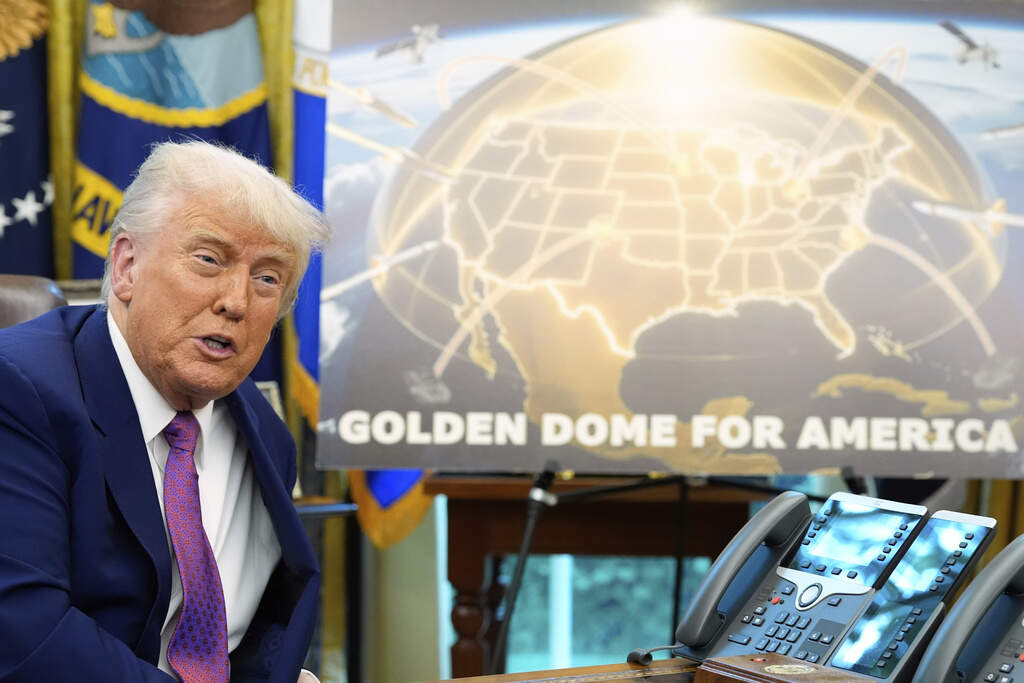
Trump’s space-based missile defense system. Could it protect the country against a nuclear attack, or is it technically impossible?
Guests
Joe Cirincione, national security analyst. Vice chair of the Board of Directors of the Center for International Policy. Author of "Nuclear Nightmares: Securing the World before It Is Too Late" and "Bomb Scare: The History and Future of Nuclear Weapons."
Also Featured
Laura Grego, senior research director of the Global Security Program at the Union of Concerned Scientists.
Transcript
Part I
MOVIE CLIP: It not only makes the United States invincible in war. But in so doing promises to become the greatest force for world peace ever discovered.
MEGHNA CHAKRABARTI: That absolutely delightful piece of archival audio is from the trailer for a 1940 movie called Murder in the Air, and it stars a young, actually, why don't I let you guess, here's a clip.
MOVIE CLIP: Maybe the guy had a good reason for concealing his identity.
CHAKRABARTI: Doesn't quite ring a bell yet. Okay. Okay. Here's another clip. Now really listen in.
MOVIE CLIP: I wanted to break it to you gently, but well, you asked for it the hard way.
CHAKRABARTI: You got it right. It's the Great Communicator himself, learning how to communicate through a great American medium called the Hollywood B movie. Yes, Ronald Reagan was early in his acting career when he starred in Murder in the Air.
The movie was the fourth in the Warner Brothers Secret Service series, and Reagan played a dashing young federal agent, Lieutenant Brass Bancroft. He'd later look back and call himself the B movie Errol Flynn. Now in Murder in the Air, Reagan/Bancroft is tasked with stopping saboteurs from destroying America's newest military technology, the one that would, quote, make the United States invincible in war.
MOVIE CLIP: The inertia projector. It's a device for throwing electrical waves capable of paralyzing, alternate, and direct currents at their source. You remember that news story that broke some time ago and then was hushed up about the amateur radio operator in Kansas who was stopping automobiles and street cars and electrical appliances from miles around with some sort of radio beam.
CHAKRABARTI: The inertia projector, a powerful device mounted on a dirigible. Yes. I actually love this film. A dirigible that almost falls into the wrong hands until Bancroft/Reagan foils the plot and the inertia projector itself is used to bring down the villain's airplane resulting in their fiery deaths.
And oh, by the way, this is 1940. So the villains also happened to be people who were under investigation by the House Un-American Activities Committee. So the movie throws in a hefty measure of red scare rhetoric to boot. 43 years later, Ronald Reagan as president of the United States, announced an initiative that he believed would be à la the Murder in the Air trailer we played at the top, the greatest force for world peace ever discovered. For world peace ever discovered.
RONALD REAGAN: What if free people could live secure in the knowledge that their security did not rest upon the threat of instant U.S. retaliation to deter a Soviet attack. That we could intercept and destroy strategic ballistic missiles before they reached our own soil or that of our allies.
CHAKRABARTI: President Reagan there in an Oval Office address announcing the creation of the Strategic Defense Initiative. March 23rd, 1983. Reagan envisioned SDI as a colossal defensive project capable of intercepting and destroying Soviet ICBMs through, most specifically, space-based technology.
REAGAN: I call upon the scientific community in our country, those who gave us nuclear weapons, to turn their great talents now to the cause of mankind and world peace, to give us the means of rendering these nuclear weapons impotent and obsolete.
CHAKRABARTI: Reagan's SDI initiative would drag on for years and cost hundreds of billions of dollars. But Ronald Reagan was an acutely savvy politician. Just as he announced SDI, he attempted to preempt the criticism he'd most certainly receive with one elegant question.
REAGAN: But isn't it worth every investment necessary to free the world from the threat of nuclear war?
We know it is.
CHAKRABARTI: SDI never came to pass. The space-based missile defense plan was soon called Star Wars by its detractors, and one can only imagine what those critics thought when later it was suggested that one of the reasons why Reagan may have championed SDI so passionately was because the very concept had been made familiar to him, yes, back in 1940 from none other than Murder in the Air and the dirigible mounted inertia projector.
Now, this is not to say that the SDI plan came directly from the movies. No. Rather, as historian C. Vann Woodward wrote, quote: Historians of Mr. Reagan's policies will find many of their sources in celluloid.
He also notes, quote: The implausible scheme is that one with Reagan's politics and personality. A nice weapon system, defensive, not offensive, killing missiles, not people. Another act of American altruism and a bonanza of billions for business. Besides, it recalls the Lone Rangers silver bullet used only to knock guns out of bad guy's hands.
In 1988, along comes a congressional staffer. And Joe, I'm calling you young back then, because you weren't yet 40.
JOE CIRINCIONE: (LAUGHS)
CHAKRABARTI: And this staffer who you just heard giggle now led a task force looking into SDI for the House Democratic Caucus, and his team concludes that SDIs, space-based elements, do not, quote, meet the criteria for military effectiveness, survivability, and cost effectiveness.
In large part because, quote: The major technical problems that remain unresolved are the same obstacles that have ruled out an effective missile defense system for almost 30 years. Joe, that was 1988. And you were saying back then the problem is physics. Physics is the problem, Joe. Yes?
CIRINCIONE: That's right. As former chairman of the Senate Armed Services Committee, Sam Nunn said around that time, national Missile Defense is a theology in this country, not a technology.
And you had a host of true believers who had that vision and it's compelling. What if we could make America invulnerable to the threat of ballistic missiles. Isn't that worth spending every dime? Isn't that worth decades of effort? It is a compelling vision. The problem is you can't do it, and you couldn't do it in the 1960s when we started this effort.
You couldn't do it in the 1980s, and you can't do it now. There just is no way to provide a impenetrable shield over America that can stop a ballistic missile attacks.
CHAKRABARTI: You're hating on the Golden Dome already, Joe. Okay, hang on. Hang on just a second because I should give you your formal introduction.
You're listening to Joseph Cirincione. He has more than 40 years of experience in national security and nuclear non-proliferation. Everything from, as we just mentioned, serving for almost a decade as a professional staffer on the House Armed Services Committee, among others. He was also director of Non-proliferation at the Carnegie Endowment for International Peace.
Serving in other positions, in other thinktanks as well. And he has authored and edited at least seven books on nuclear weapons. And Joe just recently wrote an article in The New Republic titled Trump's Golden Dome Won't Work, but it'll make Elon Musk Richer. We'll have to see after yesterday, Joe.
CIRINCIONE: (LAUGHS) Life is complicated.
CHAKRABARTI: But before we get away from Reagan too far I just wanna ask you, have you ever seen Murder in the Air?
CIRINCIONE: I have not.
CHAKRABARTI: You need to see this movie! (LAUGHS)
CIRINCIONE: I do. You know, I'm a fan of early nuclear atomic sci-fi, like Them and The Day the Earth Stood Still, but I've never seen Murder in the Air.
I'll have to go take a look.
CHAKRABARTI: The cinematographic imagination of putting this inertia projector on a dirigible is honestly something to behold. It's a wonderful, actually it's a quite delightful film to watch. It's very much of its time. Okay. So before we talk about President Trump's desire to resurrect the idea of space-based missile defense for the United States, I'd love you to take me back to the 1980s.
Because you gave us a copy of the 1988 report that you helped author. What was the problem back then? We'll get to the physics a little bit more, but there was also some just like practical dollars and cents problems that would make SDI not feasible.
CIRINCIONE: Sure. Very few people thought Reagan was serious about this when he announced it, he surprised his own military chiefs and his technical advisors. In fact, the day he gave that speech, Air Force leaders were testifying on Capitol Hill that this was not the time to be accelerating laser programs or accelerating anti-missile programs because they thought the physics just weren't there
The whole thing, so one of them said, filled me with a great deal of trepidation. It'd be like trying, it'd be like standing on top of the Washington Monument and aiming a baseball on the Empire State Building while both were moving thousands of miles per minute. You just, or hours. You just couldn't do that.
Well, that night, Trump, I'm sorry, Ronald Reagan comes on and announces this plan and suddenly the whole defense establishment turns on a dime and starts saying, okay, we can do this. Let's move it. It had a lot of skepticism in Congress, but the democratic Congress largely went along with it. They increased the spending on missile defense from about, oh, about a billion dollars a year to $3 billion a year.
Created a whole new organization. The Strategic Defense Initiative Organization, and I joined the professional staff of the House Armed Services Committee in 1985, January '85, and was assigned oversight over this program. So I began what turned out to be 10 years of investigations into this technology, to these military systems.
Would they work? Would they not work? And what I discovered and what we presented in that 1988 task force report. This was a task force of the Democratic caucus which then was the Democrats had the majority in the House of Representatives. We brought all the leading members of Congress together involved in this, authorization committees, appropriations committees, scientists, office of technology assessment, general account.
We brought them all together and the testimony we got was overwhelmingly this thing cannot work. And that's what we presented in that report. Then not only could the proposed system not work, the previous systems from the '60s, from the '70s had, we've had the same kind of promises associated with them, and none of them had worked.
CHAKRABARTI: I'm seeing, looking at the report here and you identify that two years before Reagan announced SDI, so back, this is in 1981, the Pentagon's own Science Board concluded unanimously that it was too soon to attempt to accelerate space-based laser development towards any integrated space demonstration, particularly for ballistic missile defense.
But Reagan's own Pentagon saying it wasn't possible, didn't stop him necessarily, which might be a lesson that we should learn regarding the current president's desire to resurrect the idea of space-based missile defense.
Part II
CHAKRABARTI: So we are talking about President Trump's idea for a Golden Dome to protect the United States from intercontinental nuclear weapons that came about on January 27th of this year, 2025, in an executive order titled The Iron Dome for America. And in the executive order, President Trump directly references President Ronald Reagan's SDI initiative, which he said it was canceled before its goal could be reached.
And then the executive order goes on to say over the past 40 years, rather than lessening the threat from next generation, strategic weapons has become more intense and complex with the development by peer and near peer adversaries of next generation delivery systems. So that is the reason why in May, so just last month, President Trump laid out his plans for the Golden Dome in a press conference. And he insisted on having quite an ambitious timeline.
DONALD TRUMP: This designed for the Golden Dome will integrate with our existing defense capabilities and should be fully operational before the end of my term.
So we'll have it done in about three years. Once fully constructed, the Golden Dome will be capable of intercepting missiles even if they are launched from other sides of the world, and even if they're launched from space. And we will have the best system ever built.
CHAKRABARTI: Now, Joe, in the interest of professionalism, I will not be glib about this, but I was thinking that in 1960, when President Kennedy said, we're going to go to the moon by the end of the decade, that also seemed impossible.
And yet it happened. It required a massive federal effort and the development of technologies at what was then a lightning pace. Why couldn't something similar happen in the 21st century with the realization of space-based missile defense?
CIRINCIONE: Physics. That's why.
CHAKRABARTI: Again, pesky physics.
CIRINCIONE: Yes. Science has a way of intervening in even the most optimistic dreams humans have. You just can't do this. And it's the part of it is what we referenced earlier, the basic problems facing any missile defense system have not been resolved. Let me give you an example. The American Physical Society, the Country's premier organization of physicists in this country, just this year, put out a comprehensive report.
As far as I know, the only independent scientific evaluation of both the current system we have. Which is 44 ground-based interceptors in Alaska and California, and the proposal to do this constellation of space-based systems, an idea that's been around since the 1950s. And every decade this space-based system idea comes up, and every decade they think the technology has advanced.
Now we can surely do it. No, you cannot surely do it. And here's the basic problem. The reason you go to space is because you want to have your interceptors very close to where the enemy missile is taking off. The ground-based systems, the one we now have, try to intercept the missile as it's reentering the atmosphere, as it's coming in very fast and it's very small, very difficult to hit.
You can overcome that problem by putting your interceptors in space, and you think of space as being far away, but it actually could be very close as the satellite orbits over the launch site, so you could be just hundreds of miles away from this launch. Detect the launch, send your interceptor down to this relatively slow-moving missile rocket that's taking 1, 2, 3 minutes to rise out of the atmosphere with a big hot flame telling you where it is.
So you've got a slow, fat, hot target. This is ideal. The problem is the earth moves. And so in order to have your satellite in position, you need to, not one, but a constellation of, and here's the American Physical Society, you're going to need a thousand interceptor satellites to try to intercept one North Korean ICBM. One. And if North Korea were to launch 10, then you'd need 10,000 interceptors up in space.
You can see the enormity, the scale of the problem. And of course, this assumes that there's no effort to try to shoot down your satellite systems before you launch, which of course is what you do in air warfare.
Before you launch a bombing attack, you attack the adversaries' defenses. You blow a hole in their system. What you could do on the ground, you can do in space, and that is why we have never done it before. Nothing has changed.
CHAKRABARTI: You know what's interesting to me? I've got the APS report up here in front of me and they're talking about, as you're describing, what's called the boost phase intercept system.
Is that right? That is the exact same language that I was, I went back this week and re-watched a bunch of Reagan's press conferences from the mid-eighties. And he was also talking about trying to overcome boost phase challenges. So are you saying we really haven't made any progress or insufficient project technologically in 40 years?
CIRINCIONE: No. Progress. Yes. So miniaturization, lower launch costs, more lethal interceptors, sensor technology, all that's better, but those advances are relatively incremental compared to the core challenges of a space-based missile defense system, the ability of the enemy to simply overwhelm the system, the questional survivability of these satellites.
They're very fragile instruments. The inability to discriminate amongst, between real warheads and hundreds of thousands of decoys that could be put up. Oh. And then of course there's the problem of a battle management, command control and communication systems that could function in a nuclear war.
So you have very low confidence that this system could work perfectly the first and perhaps only time it's going to be used. And that is the same set of issues that President Eisenhower confronted when his scientists proposed something called BAMBI in the 1950s. A ballistic missile boost intercept system, same thing.
And that was discussed and rejected by the Eisenhower and then the Kennedy defense systems as wildly improbable. And, but every 10 years someone comes back with that same kind of idea, the same kind of system, and says no. This time it's going to work. It's Lucy and the football.
CHAKRABARTI: BAMBI, SDI, Golden Dome. Okay, Joe, hang on here for just a second. Because I want to just listen briefly to a physicist who concludes basically exactly what you do. But again, this is from the perspective of a senior scientist. Her name is Laura Grego, and she is a physicist and research director of the Global Security Program at the Union of Concerned Scientists.
LAURA GREGO: What the Golden Dome proposes is so comprehensive and so audacious, and I would say in many ways fantastical, because it proposes to defend against any missile, basically any missile from anywhere of any kind.
CHAKRABARTI: Grego says the plan is so audacious, excuse me, audacious that she and fellow scientists characterize it as quote, economically ruinous, strategically unwise, and technically very challenging, if at all possible.
And why? Well Joe hit upon some of these points already, but Trump's Golden Dome, like Reagan's SDI, would aim to prevent nuclear missiles from ever reaching the United States. So this is the key thing, and to do that, the defensive response would have to happen very quickly after ICBMs are launched.
GREGO: For an ICBM, that really is only three to five minutes long, so you'd have to be really close to catch the missile as it's launching. Because three to five minutes is not very much time, so you need to be within a few hundred kilometers of the path of that launching missile. If you're trying to defend against launching missiles from North Korea, maybe it's possible to do that from the air. Because North Korea is a special case of being a peninsula surrounded by international waters and airspace.
You might be able to be far enough from its borders that you could be safe from North Korean air defenses, but close enough that you could catch the launching missile. That's still a very challenging technical problem. And we don't have a system that does that because it's so challenging.
CHAKRABARTI: Okay, so then you look to space, right?
But as both Joe and Grego say, dropping a countermeasure from a satellite orbiting Earth poses its own technical challenges.
GREGO: Weapons in low earth orbits are going around the earth. They're going so fast that they circle the earth every 90 minutes. So whenever they're in the right place, they're almost, then they're in the wrong place, right away. So to have something in the right place, to catch something that's launching from three to five minutes, which could be at any time, you have to have a lot of things.
Because as soon as they're in place, they're out of place. So that's why when you do the calculations and you say, how many orbiting weapons would I need in order to catch one launching missile that North Korea, for example, could launch. You end up needing hundreds and potentially thousands in order to just have enough to catch one launching missile.
CHAKRABARTI: Now you heard a little earlier that it could be as much as 10,000 for one launching missile, but Grego estimates that it could be perhaps even 36,000 orbiting weapons to catch 10 missiles if they were launched from North Korea.
And she also says there are problems if you try to stop a nuclear missile midcourse while the missile is in flight. If you try to stop it with something called a kill vehicle.
GREGO: It's about the size of a mini fridge. It throws something that's meant to run into the nuclear armed, the nuclear warhead, which is also about the size of a mini fridge maybe, and then with the speed of impact, destroy those two.
The problem with destroying something in the midcourse as it's going through space is that's where it's easiest to fool the system, because when you're going through space, there's no atmosphere to slow you down, so a light balloon will move in the same way as a heavy, half ton warhead.
And so you could put a lot of light balloons that are decoys along with your real nuclear weapon and make your defense have to figure out which one is the real target and target that, or to target all the balloons in order to make sure nothing gets through.
CHAKRABARTI: In other words, it could be extremely simple and easy to fool and confuse a potentially trillion-dollar system.
So that's Laura Grego, senior scientist and the research director of the Global Security Program at the Union of Concerned Scientists. So Joe, I want to stick with the technical challenges here for a few minutes. And then we'll talk about the political and economic realities.
But she talked about using potentially a kill vehicle to intercept and destroy a nuclear missile. So that's some kind of projectile, but we, earlier, we were also hearing about lasers. Is that no longer a possibility either?
CIRINCIONE: So because of the difficulties presented by using what they call kinetic kill vehicle, so something that's going to slam into it, the hitting the bullet with the bullet, because the difficulties of that, and because the problem of decoys, you could be spoofed.
Scientists thought that one way to solve that was speed of light weapons, was lasers. And this is where Ronald Reagan comes in and that's why his program was dubbed Star Wars. Because he was told by Dr. Edward Teller, popularly known as the father of the hydrogen bomb, that he had back at Lawrence Livermore Laboratory, Teller had back at his lab, a proof of concept of an x-ray laser, a weapon that could use a small atomic bomb to create enough energy.
And then focus that energy through hundreds of fiber optic tubes and could wipe out the entire first wave of Soviet SS-18 warheads. Several thousand warheads could be wiped out by one x-ray laser. Damn, if you can do that, man. Yeah. Gimme that. I want that. Don't you want that? And that's what Reagan thought he could do, that the time had come that lasers would overcome the problem of kinetic kill vehicles.
It turns out, no. No, we don't have lasers that are that powerful. Still, this, it's a concept, it's a hope. The APS study and other studies say that this kind of technology is still decades away. You have all kinds of problems with that. And of course, the problem of just putting this thing in space and maintaining it for years until it has to be used, that's an enormous problem all by itself.
And then of course, there's the vulnerability of the platform. Just because it's up there doesn't mean your enemy's not going to attack it. There's dozens of ways to attack satellites in orbit. In fact, the Russians, we believe last year started testing a system that could put a nuclear weapon in orbit for exactly this purpose, to blow a hole through your defenses before they would launch their offensive weapons.
So no, not only the satellites not technically capable of doing this challenge with a laser, but even if it were, it'd be a questionable survivability. Hence, we've never done it. Remember, we're not doing this because we're blocked by an arms control treaty. No. George Bush pulled out of the arms control treaty, that limited ballistic missile defenses.
We're not doing it because we haven't tried. We've spent $531 billion on missile defense efforts since 1962, since we tested the first Nike Zeus anti missile system. Nothing has worked. Nothing has worked. It's got an unblemished record of failure. That's why we're not doing it.
CHAKRABARTI: But to be clear, we are talking about space-based missile defense, right?
Because the president's executive order calls it an iron dome for America, referencing of course, Israel's Iron Dome, which is different in very specific ways, AKA its ground base and also, it's defending against missiles that are being launched from very close by. So I just wanted to note that. One more nerdy technical thing. Because Dr. Grego a little bit earlier then talked, she talked about satellites in low Earth orbit.
And you had mentioned this too, that you would need so many of them. Simply because they're orbiting, to catch the missiles in the right place at the right time. I'm just wondering why we would have to rely on low earth satellite or low earth orbit satellites here, and maybe I'm completely off base, but geosync satellites are farther away for sure.
They're 10 times farther away, but they're stationary. You could put 'em right over the U.S.
CIRINCIONE: But then they're 24,000 miles in space and you gotta be close to the rocket that's launching.
CHAKRABARTI: Laser could do that.
CIRINCIONE: A laser might be able to do that. Okay, so that's the idea, right? Then you could do that and speed of light gets there instantly. You have problems as the beam, keeping beam control as it propagates through the atmosphere. Can you keep it that tight over tens of thousands of miles? But then of course you still have the problem of survivability. If the enemy knows you got a weapon that works up there, the first thing they do is suppress the defenses like we do in regular warfare.
The first thing you do is take out the radars, take out the anti-air systems, in this case, take out the anti-missile system, then you launch your offensive attack.
CHAKRABARTI: And so you've said this kind of surreptitiously twice. The other, another major issue is that you can't, it's hard to deploy something like this in secret.
Like Russia would know, China would know, North Korea would know. And it seems like building systems that would confuse a space-based missile defense operation is actually quite a bit technically easier than building the missile defense itself.
Oh, absolutely, in offense always has the advantage.
Think castles and catapults. This is an old military problem. It's almost always cheaper for the offense to accumulate more offensive weapons than it is for you to defend against them. And of course, the adversary has a move in this. Every time missile, national missile defense is presented, it's we're gonna do this thing and then we'll have, we'll make America invulnerable.
The other guy can do it too. So now you'd have Russia deploying systems, China deploying systems. You'd have a proliferation of missile systems in space, the weaponization of space. And if they could target missiles rising from the earth, they can target satellites in space. So for that matter, any target on earth, is that the kind of world you wanna live in?
Part III
CHAKRABARTI: Joe, I want to just hear President Trump himself. Here he is specifically invoking President Reagan's quest to build a comprehensive space reliant defense system.
TRUMP: Hypersonic missiles, ballistic missiles, and advanced cruise missiles. All of them will be knocked out of the air. We will truly be completing the job that President Reagan started 40 years ago, forever ending the missile threat to the American homeland and the success rate is very close to 100%, which is incredible when you think of it. You're shooting bullets out of the air.
CHAKRABARTI: Shooting bullets out of the air with a hundred percent success rate. Joe, you just spent the last 20 minutes taking us through why the success rate would be potentially zero.
What I want to hear from you is you've been doing this; you've been studying this and working this field for decades. I'm trying to figure out a straight-ahead way of saying this. How galling is it to you that claims can still be made in this day and age of a hundred percent success rate and knocking nukes out of the air like bullets?
CIRINCIONE: We live with an administration that's built on lies and grift and missile defense in some ways is the perfect program for them. National Missile Defense is the longest running scam in the history of the Department of Defense. We spent, as I say, a half a trillion dollars and nothing has ever worked.
And yet the snake oil salesman keep rolling their cart up and promising that they got a cure for what ails you. And people buy it. And the reason is twofold. One, there's an ideological appeal to this. Both for the proponents who say this is the answer. We don't need arms control agreements.
We don't have to negotiate with our adversaries. We don't, won't protect the United States with pieces of paper. We'll do it with missile technology, with our own strength, we will be invulnerable. But the other --
CHAKRABARTI: Just to jump in here, the executive order from Trump in January literally says, miss space-based missile defense is essential for peace through strength. The exact language you're talking about.
CIRINCIONE: Exactly. And that's very appealing. Now remember, we can do theater missile defense. We can hit the scuds, the slower, shorter-range missiles. We can hit a bullet with the bullet. It's really amazing we can do that. But that's because they're relatively slow moving.
They're relatively fat targets. They don't go outside the atmosphere, so there's no decoys. Patriot works. THAAD can work. EEG just can work. Iron Dome works against rockets that are traveling tens of kilometers, but nothing works against a fast seven kilometers per second missile that's spanning the oceans and coming in. Space, sea, ground-based, doesn't matter. Can't hit it, won't work. But one of the reasons we get this is not just the ignoring of the technological difficulties or the ideology. It's the money.
It's the money. There's a lot of money to be made in missile defense. We spend about $70 billion a year in the United States on nuclear weapons.
That's a big market. We spend about $30 billion a year on missile defense and defeat programs, and Donald Trump is saying he wants to increase it. The idea that we're going to only spend $175 billion and get it done in three years is nonsense. They're not even going to have the architecture done by three years.
But this could be a trillion-dollar program. I believe to do this, to do what he says he wants to do would probably cost a couple of trillion dollars. The Congressional Budget Office says the high-end estimate for the next 20 years would be $831 billion. If you've got that kind of market out there, you're going to want to pitch a product for it.
In some ways, you can't blame the defense contractors, but the defense contractors sell nuclear weapons the way Kellogg's sells cereal. We don't just have shredded wheat. We have mini shredded wheat and frosted mini shredded wheat and blueberry frosted mini shredded wheat. We have a weapon for every mission.
For every niche. We have a missile defense system for every, short range, medium range, and now long-range, space-based, et cetera, et cetera. You can see, and the beauty of this is that it doesn't matter if it works or not. Elon Musk, who you mentioned in the beginning of the show, was positioning during his time with the Trump administration to have SpaceX be the person that launches these weapons into space.
Now SpaceX is already a leader in space launches. They do about two launches a week. So they have an inside track. But if you have influence in the Trump administration and can get the contract for the initial constellation of sensor satellites, you could make $10 billion right up front. And then even if the lattice systems don't work, you've come away with a nice chunk of change. So everybody's scrambling now.
The nutritional defense contractors and the new wannabe defense contractors are scrambling to get a piece of this pie. That's why you see these sales pitches. That's why you see such enthusiasm among certain sectors of corporate America.
CHAKRABARTI: Again, just this is really triggering all my most cynical genes.
CIRINCIONE: Go with that.
CHAKRABARTI: Because also, why wouldn't you wanna lobby vigorously for a huge trough of money when also you may not ever have to make it work, right? But look, let me argue from a different point of view here. And that is another reality which proponents of more sophisticated forms of missile defense do point to.
And this is true. So let's listen to General Glen VanHerck, former NORAD commander. He spoke with the Washington Times last month and he said he believes the United States does need increased defense capability in order to protect citizens on U.S. soil itself.
GLEN VANHERCK: Largely we're unable to defend our homeland today. You can have a little bit of capability for ballistic missiles with 44 interceptors expanding to 64 with the next generation interceptor. But you can't really defend against a large kind of attack. So you need to defend the homeland to make sure that we stay prosperous, that we're able to be that most powerful nation on the planet.
But most importantly, so that the president has decision space, so that the secretary has decision space, secretary of defense as well. Once you get in a crisis, you can't look out there and go gosh, we can't even defend our homeland. And the will of the people's gonna be crushed at that point.
CHAKRABARTI: So Joe, I mean I think there's actually an important point here that the United States military has historically been, it's been a military that fights wars over there, right?
But that doesn't mean that we shouldn't actually have a vigorous defense system on U.S. soil to protect citizens here in this country. Why can't better missile defense be part of that?
CIRINCIONE: Meghna, I appreciate the vision. I would like to have an effective national missile defense system. I would like to have a cure for cancer.
I would like to have a really good light beer, but some things are just beyond our technological capability and National Missile Defense is one of them. It's not for lack of effort. We've been trying, we've spent the money, we've had the corporations, nothing has worked. The landscape is littered with failed projects, failed installations, BAMBI, project defender, Brilliant Pebbles, X-ray lasers.
Particle beam weapons, ground-based system, the ground-based system that general referred to, 44 interceptors. It performs so badly that we just gave Lockheed Martin an $18 billion contract to build an entirely new one. That's the level of technological reality. And by the way, this old concept, that goes back apparently to 1940 sci-fi movies.
This old concept of having this kind of shield has really been turned, delivered a new blow by what happening with Ukraine and Russia right now. Look at that attack that Ukraine just did. To attack strategic targets, they were attacking long range bombers, thousands of miles away from Ukraine, a strategic assault using what?
Using drones that cost about a thousand dollars a piece. They were destroying billion-dollar bombers. Now if you can do that in an autocratic police state like Russia, what could people do here?
What makes you think that the system you build is going to be safe from drone attack or that the targets you're trying to protect are going to be safe from a drone attack?
That's why Max Boot wrote a great piece in the Washington Post last week saying that not Golden Dome, spend the money on anti-drone defense. That's the threat we have to be worried about. That you might be able to do something about. Those are the real new challenges, not this old, outdated, discredited idea of a shield to protect America from ballistic missiles the way a roof protects a family from rain, as Ronald Reagan told a high school graduating class, right?
CHAKRABARTI: Your article in the New Republic talks about Elon Musk, and as you mentioned, SpaceX. The public Twitter divorce happening between the president and Musk notwithstanding. You pointed out that Musk's legacy or his machinations within the world of defense contracting are really quite troubling, that regarding the Golden Dome, there's evidence that the Pentagon has maybe even sidestepped the usual procurement process in dealing with SpaceX, that they've even perhaps engaged in a subscription model for Musk based services, versus conventional contracts.
This sounds all crazy.
CIRINCIONE: Yeah. When Musk was with DOGE, he was suspected of using his influence to lobby for SpaceX, getting a big chunk of this Golden Dome contracts. In fact, 44 Democrats wrote a letter to the Inspector General, the Department of Defense, asking to investigate, including my friend, the late Jerry Connolly in his role as a vice chair of the ranking member of the government oversight committee.
And they believe that Trump U got special treatment. In other words, he used his public office for private gain, which of course is a violation of law and ethics regulations. And part of that is to position SpaceX to launch these thousands of satellites.
So you can imagine what kind of lucrative contract that could be. And he also apparently proposed that Trump, I mean that that the United States would not own these satellites, but Elon Musk would.
And that he would set up a subscription service the way he does for Starlink, and so the U.S. would rent the services from these satellites, not own the satellites directly, which of course is a very lucrative revenue stream, but not at all in the national security interest of the United States.
CHAKRABARTI: How about a complete like violation of national security?
CIRINCIONE: There you go. Look, we just now, whether any of this will maintain, we don't know. In some ways they each have each other in a tough place. Trump is the one who's awarding the contracts, but Musk is the one who has the capability.
If they decide that SpaceX is not available to launch these satellites, who is going to launch them?
CHAKRABARTI: Okay. Wow. Subscription services for defense in space is a whole nother universe that I didn't think we would get into.
But we're going to return to President Reagan. And here he is in 1985, confronting SDI doubters.
REAGAN: Many of the vocal opponents of SDI, some of them with impressive scientific credentials, claim our goal is impossible. It can't be done, they say. I think it's becoming increasingly apparent to everyone that those claiming it can't be done have clouded vision. Sometimes smoke gets in your eyes and sometimes politics gets in your eyes.
CHAKRABARTI: He was a genius, really a genius communicator. But then he added this as proof of SDI's purpose and utility.
REAGAN: If this project is as big a waste of time and money, as some have claimed, why have the Soviets been involved in strategic defense themselves for so long? And why are they so anxious that we stop?
CHAKRABARTI: Okay, Joe, you mentioned something like this a little earlier, and we have to give Reagan credit for this. He wasn't necessarily just saying it's good for America and defense, but he actually also saw it as a way to forestall mutual assured destruction. Mutually assured destruction.
CIRINCIONE: That's the visionary part.
That's the compelling part. Why should we live under this Damocles nuclear sword? So I get that part. And this, the Soviets, in fact, still, the Russians do in fact still maintain an anti-missile system of 100 interceptors around Moscow. Those 100 interceptors are tipped with nuclear warheads.
This is still going back to the '60s or '70s, not hit to kill, but get close enough to destroy the incoming missile. When we asked the joint chiefs in hearings, were we worried about that missile defense system around Moscow? They said, no. We're confident of our ability to penetrate. If they have a hundred interceptors, we will target 200 warheads.
Bang, simple. It's much cheaper to have the warheads than the interceptors, and then of course you could have stealth technology, maneuvering warheads, all other kinds of things to penetrate any known defense. So ... Ronald Reagan had his chance and others since then, we have given them the money.
We have given them the time. If this thing was going to work, it would have worked by now. Where is it? No one in the world has a national missile defense system. No one, it's not for lack of effort. It's not for lack of resources. You just can't do this.
CHAKRABARTI: Space-based missile defense. Yeah.
CIRINCIONE: Any kind. Nothing that works. The Ground Based Interceptor, we have a system, they've never actually been tested against countermeasures.
CHAKRABARTI: What about the Iron Dome?
CIRINCIONE: See, I'm talking, this is the difference between National Missile Defense protecting a whole country and protecting a port or a city.
You could intercept short range missiles that fly tens or hundreds of kilometers. You cannot intercept long range missiles reliably that fly thousands of kilometers. That's the difference.
CHAKRABARTI: But apparently, we have money to spend to try and make this impossibility happen. Meanwhile, Medicaid, who needs it?
The first draft of this transcript was created by Descript, an AI transcription tool. An On Point producer then thoroughly reviewed, corrected, and reformatted the transcript before publication. The use of this AI tool creates the capacity to provide these transcripts.
This program aired on June 6, 2025.