Support WBUR
What the loss of international students could mean for the U.S.
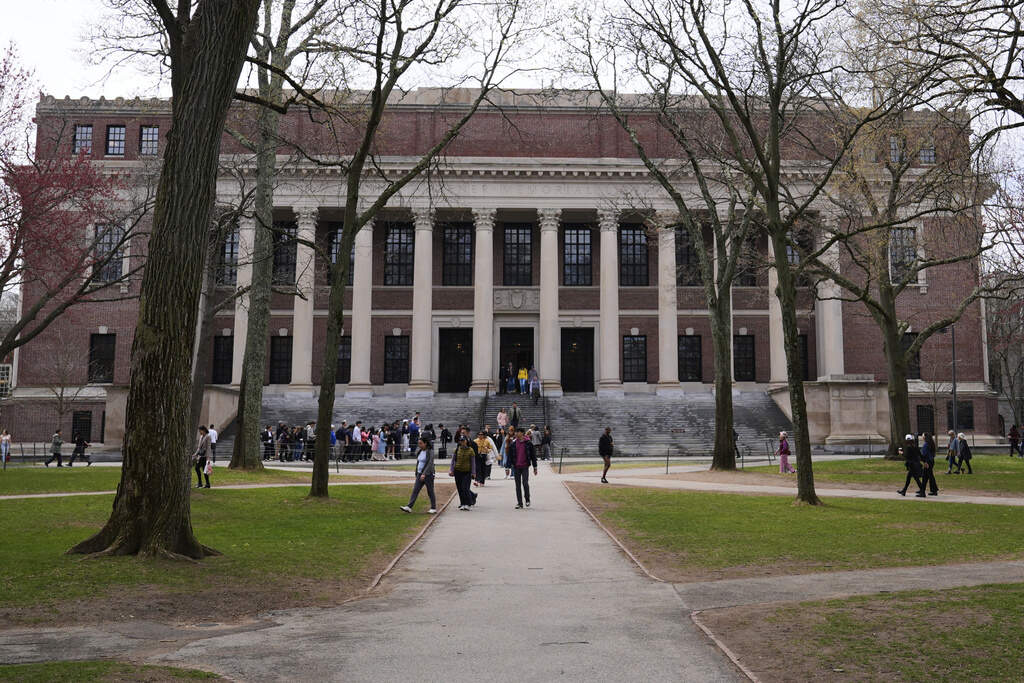
The Trump administration is clamping down on foreign students who want to attend American universities – and the schools that admit them. What that could mean for innovation and enterprise in the U.S. and around the world.
Guests
Stephanie Saul, education reporter at the New York Times.
Jon Fansmith, senior vice president of government relations and national engagement with the American Council on Education.
Also Featured
Chris, international student at Harvard.
Noah Feldman, law professor at Harvard University.
Transcript
Part I
ANTHONY BROOKS: These are disconcerting times for international students in America. The fallout of President Trump's attempt to strip Harvard University of its right to enroll foreign students is being felt across the country and could threaten research science and innovation for years to come. While a federal judge has sided with Harvard for now, the legal battle is threatening international scholarship at the nation's oldest university and beyond.
CHRIS: It's quite frankly, just sad, right? It's a situation where nobody wins and everybody loses. For international students, it's obviously a very difficult situation to exist in uncertainty around the promise of this dream of education that brought you here, right?
The idea that you could go to one of the best schools in the world.
BROOKS: That's Chris, a foreign graduate student at Harvard University. He spoke with us on condition that we use only his first name because he fears retribution from the government. We'll hear more from Chris later in the show. Harvard is pushing back hard against the Trump administration, which accuses the university of antisemitism and of promoting leftist points of views.
At Trump's command, more than $3 billion in research grants and contracts have been frozen, but by far the biggest blow would be to end Harvard's ability to enroll foreign students who comprise more than a quarter of the student population. The administration has demanded that the university turn over information about these students, 7,000 of them, and Trump has even suggested that Harvard should cap their numbers at 15%.
DONALD TRUMP: We have people want to go to Harvard and other schools, they can't get in because we have foreign students there. But I wanna make sure that the foreign students are people that can love our country. We don't wanna see shopping centers exploding. We don't wanna see the kind of riots that you had. And I'll tell you what, many of those students didn't go anywhere.
Many of those students were troublemakers caused by the radical left lunatics in this country.
BROOKS: Trump was referring there to last year's protests against Israel's war in Gaza. Now while some of those protests were raucous, the vast majority of them at Harvard and across the country were peaceful.
Trump's critics say his attacks harm not only free speech, but a major source of U.S. strength. Many foreign students are engaged in cutting edge research, in medicine, technology, environmental sciences, and the humanities that make Harvard and many other American universities the envy of the world. Here's Ted Mitchell, the president of the American Council on Education.
TED MITCHELL: The international students who come here are quite often the very best, the very brightest, the most ambitious students from all over the world. It makes little sense for the Trump administration to be cutting off this important part of what Harvard provides to the U.S. and the world.
BROOKS: I'm Anthony Brooks, and this is On Point.
This hour: Trump's war on higher ed and what America loses if foreign students are banished. Stephanie Saul joins me now. She's a Pulitzer Prize winning journalist and an education reporter for the New York Times who writes primarily about colleges and universities. Stephanie, welcome.
STEPHANIE SAUL: Thank you, Anthony.
BROOKS: Let's back up a bit and talk about the origins of Trump's fight with Harvard. When did it begin and why?
SAUL: I think this really began during the first Trump administration. It's really nothing new. Even then in 2020, in the last year of his administration, he had, his administration had ordered an investigation of donations to Harvard and Yale.
And from foreign countries. There was also a move during his first administration to tax the endowments of wealthy universities, which affects the Ivy League. And I think, the origins of this, as you pointed out in the opening, are that the president says he believes that universities are hotbeds of antisemitism and also that they're promoting liberal thought.
But I think there's also a bit of an effort to generate populous support for his administration and for Republicans generally. If you look at, the University of Chicago did a poll recently. And one of the questions was, how do you view Ivy League schools like Harvard and Yale? And something like 28% of people polled said they viewed them as the enemy.
BROOKS: Wow.
So this is really capitalizing on some populist, a strain of populist opinion out there. Talk a little bit --
SAUL: Definitely.
BROOKS: Yeah. Talk a little bit about why he's going after foreign students. What's Trump's argument there?
SAUL: Part of it is that, as you pointed out, he believes that foreign students are taking up space that could be occupied by domestic students. Part of it is this kind of nationalist viewpoint that it's a reaction against globalization, I think. It's an anti-immigrant, anti-globalist sentiment that I think has grown in the United States. And we see this internationally, as well.
There's a move toward nationalism in a number of countries, and I believe that we've seen this crackdown on universities in other countries as well, including Turkey and Hungary.
To name a couple. I think it's a very broadly, it's a very broad sentiment that also affects the idea that universities should not be connected or operating in other countries. And we see, the latest news that came out this morning from the New York Times is that Secretary of State Marco Rubio is pressing for an investigation of Treasury Department sanctions against Harvard. Based on the fact that Harvard School of Public Health held some conferences in China for the purpose of assisting Chinese conference goers in health care financing topics.
And one of the people, one of the groups that attended was a group called XPCC, which is a large state-owned corporation in China that's primarily known for cotton growing. And however, XPCC had been subject to Treasury Department sanctions because of its treatment of Uyghurs in the northwestern-most region of China.
That's just the latest.
BROOKS: That's just the latest. Yeah, they're going after Harvard on a number of levels. We mentioned cutting off grants and contracts. And then to get back to the foreign students. President Trump doesn't appear to be backing down, following a judge's order to stay, his administration's attempt to ban Harvard from accepting foreign students. So here he is in a recent press conference suggesting that he wants his administration to have a role in evaluating potential and current students.
TRUMP: We want to have foreign students, but we want them to be checked. In the case of Harvard and Columbia and others, all we want to do is see their list.
There's no problem with that. This is anybody outside of our country, international students.
BROOKS: So saying we want to have foreign students, but we want to check them essentially. So it seems like the Trump administration is arguing they won't have a say in who ... Harvard educates.
How is Harvard pushing back against this?
SAUL: The irony of that statement is that the State Department already has the list.
BROOKS: Oh, interesting.
SAUL: The government approves the Visas of everyone who comes in to study. But I think Harvard is pushing back the, as you say, the initial fight that began between Harvard and the Trump administration in April, was started after the Trump administration submitted a list of demands to Harvard. And one of those demands was that they wanted Harvard to admit only students who were not hostile to American values, as inscribed in the Constitution.
And when that letter, which included 10, a list of 10 demands, came to Harvard, I believe on April 11th, that was what precipitated the lawsuit that Harvard filed, the initial lawsuit that Harvard filed in federal court in Boston.
BROOKS: Right. Let me just jump to, I'm interested in asking you because our time is running short in this break and in this segment, a federal judge has ruled twice in Harvard's favor, saying the Trump administration's order, staying the Trump administration's order, at least for now.
What happens next with this case regarding foreign students?
SAUL: The next thing that happens is taking place on Monday in federal court in Boston, and judge Allison Burroughs, who is the judge that ordered the temporary restraining order, is going to be holding the hearing in which she will decide whether to extend that order until this case is completed.
And then of course, after she rules, which it's not clear when the final ruling would be in that lawsuit involving the international students. The case would obviously be appealed and probably would end up in the Supreme Court.
BROOKS: All right. And that's where it's --
SAUL: Who knows?
BROOKS: Yeah, who knows. It's going to be an interesting one to follow for sure.
Part II
BROOKS: Let's hear now from an international student at Harvard. Chris is a graduate student from Toronto, Canada, pursuing a dual degree at the university. He asked that we not use his full name because he's afraid of retribution from the government. Chris told me that being accepted by Harvard was a point of pride for him and his family, and that he finds the Trump administration's assault on foreign students frightening.
CHRIS: I remember when I first to Harvard and just the pride on my father's face, see I could go to this school and the opportunity that came with it. All the work that went into being able to achieve this opportunity, all the work that's gone into this opportunity and to have that, last Thursday, ripped away, even for a moment, before kind of the restraining order was put in place was rattling.
BROOKS: Chris says, attending a university with students from around the world has been enormously valuable.
CHRIS: This broadens your perspectives and for a school that aims to educate the future citizen leaders of the world, I think that's immensely important. Being able to engage with students from the countries that you're studying in the classroom.
And actually, hear their live perspective, rather than parachute in from a textbook. I think learning from other students lived experiences, trying different cultural foods, going to the Diwali celebrations, breaking a fast with a Muslim friend during Ramadan.
These are all incredibly formative experiences that create better citizens, create better leaders, and that's something that Harvard loses. An environment where, you know, international students are present on campus.
BROOKS: Chris says, international students come to the U.S. for a variety of reasons, including a desire to improve American society and the world.
He says his goal, for example, is to figure out ways to reduce economic inequality.
CHRIS: I think America is like this joint collective project that we're all working on, right? Together we put in our time, our energy, in whatever domain we're interested in. For me, it's economic inequality. For another student, it might be health care research.
And when a presidential administration kind of attacks students, attacks the university, attacks the opportunity to achieve these dreams. It hurts our joint project that we're building together. And so we all lose when people are unable to contribute in the ways that they're best equipped.
And that's something that. Again, it's sad.
BROOKS: Chris says, foreign students like him are suddenly on shaky ground and might have to continue their education elsewhere. What he calls making a flight to safety. And the Trump administration's policies not only threaten his academic pursuits, but his personal goals as well.
Chris's partner lives in the States and they're hoping to build a life together, but he says they're now worried that dream could also be ripped away. Jon Fansmith joins me now. He's the senior vice president of government relations and national engagement with the American Council on Education. And Jon Fansmith, welcome On Point. Thank you for being with us.
JON FANSMITH: Hi Anthony, and thanks so much for having me.
BROOKS: I'd love to get you to respond to what you heard from Chris there and give me your top line response with regard to this fight that the Trump administration is picking with Harvard over foreign students.
FANSMITH: I think Chris really said it quite eloquently. He summarized a lot of the real benefits that international students bring to this country and really the harms that are being caused by the administration's rhetoric. And it's worth noting that while we're talking about Harvard in particular, there's 1.1 million international students studying in the United States right now, and they are at institutions all over the country.
And those institutions are community colleges and small religious institutions and large research institutions and every other type of institution. In between international students play a huge role, not just in American higher education, but in our society.
BROOKS: Right. 1.1 million foreign students across the country.
Is it possible to put a number on what that means to America just in terms of what they bring to the economy, for example?
FANSMITH: Sure, and there are a lot of numbers you could put to the benefits of having this collective of the world's best and brightest coming to the United States. Some of the analyses that have been done have estimated that international students generate about $44 billion of economic activity in the United States each year, and that economic activity supports about 380,000 jobs.
So this is not an insignificant contribution to our economy. It really is a very powerful sector of the overall economy that these students are providing.
BROOKS: And what do you say to one of the arguments that President Trump has made about wanting to get a handle, and limit? He's talked about even putting, limiting the number of foreign students, at least he made a comment a few days back about capping foreign students at Harvard at 15%.
And one of the arguments he made there was that there are lots of American students that want to go to these universities and colleges. And I guess the suggestion there is that there's less room for them because there's so many foreign students.
FANSMITH: Well, the president is showing in that statement a real misunderstanding of how this works on the college campus.
If you are a talented American student who has the skills and the ability to succeed in these programs, and at these institutions, those spots are available to you.
International students are not displacing American students. They're not preventing them from enrolling in those programs. It's really the opposite.
International students, many of whom paid the full tuition rate, often are, their presence helps ensure that programs are viable. There's a lot of, especially in graduate fields and STEM graduate fields in particular, where international students are a large percentage of the program. If those students weren't there, it's not that their spaces would be filled by American students, it's that those programs wouldn't have enough students to continue to be offered by the institution. So you would see areas of study simply unavailable. So again, they are a benefit to American students looking to study in those fields.
What's more, that financial subsidy I talked about, the fact that international students bring a lot of resources to them, that is used by institutions to help offset the costs, especially for low- and middle-income American students. They are a net benefit to American students, to have international students on your campus.
And then I would just highlight the other benefit. I know we're talking about economics, but Chris really made this clear. If you are a Fortune 500 CEO, and you are looking at the kind of people you want to hire, the skillset that they have in an increasingly global world.
You want people coming out of college who have experiences with people from different parts of the world, who have familiarity with working across different cultures, who have an understanding that's gained from studying with and living among, and working with people with different viewpoints and different experiences.
This is hugely beneficial to the academic outcomes of American students who gain a lot from having these perspectives, having those interactions. In a way that the absence of foreign students would irreparably damage.
BROOKS: I'd love to get your sort of take on the legal clash that's going on, as we've mentioned, a federal judge in Boston has stayed the administration's order, at least for now.
The case will work its way forward. We've talked to legal scholars about this. We'll hear from one later in the show. And I guess the consensus that I'm hearing seems to be that Harvard will likely prevail in court. So I have a sort of a two-part question for you. First of all, do you believe that to be the case?
And second, even if Harvard does prevail, in some degree, is the damage already done? That is, Harvard has very deep pockets to hire lawyers to fight this. But what's the effect on other universities and colleges that might not have the wherewithal to fight this kind of stuff in court and may feel a little bit cowed by the Trump administration's approach here.
FANSMITH: And I will note, unlike your later guest, I'm not a legal expert, but I will say what seems abundantly clear to people who follow this issue is that Harvard should and will win in court. In part, because the administration for all of their rhetoric about Harvard's behavior are actually the party in this case that's not following the law.
The law is very clear about what are the processes for barring either individual international students or for an institution to lose its ability to host international students. And Harvard has been in compliance with those laws and regulations. The administration has not been, in their attempts to bar those students from being eligible to go to Harvard.
So I think any, it wouldn't take an exhaustive review of the facts for a judge to find in Harvard's favor. That said, your point is absolutely correct. Harm has already been done. And it's not just at Harvard. Chris talked about how uncertain he is, this flee to safety, I think was his term.
BROOKS: Yeah. Flight to safety. Yeah.
FANSMITH: Yep, exactly. And it's not surprising that lots of students on lots of college campuses, not at Harvard, but are looking at this administration's rhetoric about announcements of extending, background checks and looking at your social media feeds and revoking Visas if you express un-American views, are very concerned about whether this will remain a place where they can fulfill their academic goals, their personal goals.
If it's the place that America has always held itself out to be. As a magnet for, and a haven for the best and the brightest of the world. And that's students who are here. If you are a talented student, especially a talented student with resources from across the world. The United States is not your only option.
And we look at countries, China is making efforts. Hong Kong institutions have announced streamlined processes for admitting international students at American institutions. Lots of other countries are looking to recruit these students. Because they know what we know. This is a turbocharge to your economy.
It's a turbocharge to your academics. It's a turbocharge to your scientific research. Not admitting these students is shooting ourselves in the foot, and other countries are waiting eagerly to benefit from our mistake here.
BROOKS: I'm glad you mentioned that. Because of some of the reporting that I've done on this dovetailed with just what you said.
Government officials in Hong Kong have called on the city's universities to open their doors to those affected by Trump's attempted ban on foreign students. We know that. We know as well that Ireland wants to become a first-choice destination for international students. And I read just the other day that Germany's Minister of Culture has talked about establishing a research university for scholars in exile from the United States.
As you suggested, other countries seem poised, are recognizing the value of these students. Even if the Trump administration doesn't appear to fully appreciate the value of these students.
FANSMITH: It's really impossible to overstate what a self-defeating policy this is. And we've discussed the enormous economic benefits.
One other thing I would add to that. One study recently found that about a quarter of all billion dollar plus U.S. startups have a founder who was an international student at an American university. And these are not students who are simply coming here, studying and then leaving. Overwhelmingly, they stay, they contribute to our economy often in massive ways.
And you're exactly right. Every other country in the world has not been able to compete with us for these students. Because we offer what other countries can't. In terms of academic quality, in terms of research opportunities, in terms of the diversity of our institutional types. And previously, the openness and freedom of expression on our college campuses.
They are now able to compete with us in a way they haven't before. Not because they've caught up with us in those areas, but because our own government is making foreign students seem unwelcome here in the United States. And we are gifting our foreign competitors a huge advantage that we previously never really had to compete with them over.
BROOKS: I want to hear a little bit of tape here from the Trump administration. After instructing her department to prevent Harvard from accepting future foreign students, department of Homeland Security secretary Kristi Noem appeared on Fox News to discuss the decision. She was asked if other universities ought to worry about facing similar actions from the federal government.
Here's a bit of what she said.
KRISTI NOEM: There should be a warning to every other university to get your act together. Get your act together, because we are coming to make sure that these programs, that you are facilitating an environment where students can learn, where they're safe and that they're not discriminated against based on their race or their religion.
Antisemitism will not be stood for and any participation with a country or an entity or a terrorist group that hates America and perpetuates this kind of violence, we will stop it and we will not allow that to happen, especially in places where our kids need to grow up and really learn what this country's about, what the world is about and what it means to promote freedom and liberty.
BROOKS: Jon Fansmith, Kristi Noem there, Secretary of Homeland Security. What do you make of that? Because one of the sort of central arguments here in the Trump administration, that the Trump administration has been making, is student safety, especially around the issue of antisemitism, and that goes back to some of the protests on campus last year against Israel's war in Gaza.
What do you make of that as someone who advocates for these universities? Is this a concern that you think is valid or cynical?
FANSMITH: I don't wanna necessarily ascribe their thoughts around this process, but I was struck by how Stephanie Saul earlier was talking about this and the political advantages to the administration, of going after institutions like Harvard and Columbia.
And I think that's very, it's validated by the administration's actions. We have strong and robust legal procedures for dealing with discrimination and antisemitism in this country. We have strong and robust provisions for dealing with foreign students who are committing crimes, who are doing things contrary to why they're here in the United States as students.
The administration isn't doing those things. They're not pursuing the legal avenues available to them. They are coming forward with these arbitrary attempts, broad-based efforts.
The administration hasn't articulated in any way how barring all international students from going to Harvard addresses antisemitism or public safety for that matter. If they have concerns about specific students, there are a variety of tools they can use to pursue those. They're just not willing to do the work of actually documenting where violations have occurred.
Doing what our country generally requires, which is to prove that someone is guilty before you punish them.
They just want big gestures, often illegal. Often being blocked by the courts, that play well to people who have those hostilities towards these institutions that Stephanie was talking about before. And so I guess I am ascribing some motives to their thinking here. But it certainly does seem like a justification and search of a problem, rather than an actual attempt to address what are indisputably real problems at lots of institutions and in our society, but certainly much more self-serving than targeted.
BROOKS: Jon, you talked about the economic benefits to the nation that foreign students bring. Can you also talk actually, you know what, I'm gonna put this off until, that we're coming up on a break and I want to give some time to this question. And that is the idea that foreign students are also integral to the success of universities insofar as they often pay full tuition.
And if they're suddenly gone, it makes it a lot more difficult for a lot of students who can't afford full tuition. So I want to ask you about that after the break.
Part III
BROOKS: In late May, Homeland Security Secretary Kristi Noem ordered her department to terminate Harvard's ability to accept foreign students.
She later appeared on Fox News to address the administration's reasoning for the move, alleging that Harvard endangered students and refused to cooperate with a White House. Here she is, you'll also hear some protest being played during her interview.
NOEM: Harvard brought these consequences upon themselves. They have promoted and allowed violent activity on campus. They have allowed antisemitism participation with CCP and Chinese infiltration and influence on their campus and they haven't protected their students. So we have given them multiple opportunities to share criminal activity with us, backgrounds on these students, to let us conduct the oversight into this program that is our responsibility, and they have refused to do.
BROOKS: That's Homeland Security Secretary Kristi Noem. Let's also here from Christopher Rufo. He's a conservative activist who's had a great deal of influence on the Trump administration's approach to higher education. He's one of the leading voices criticizing critical race theory and what he sees as elitism on a number of university and college campuses.
So he told, Christopher Rufo told PBS NewsHour that he believes schools like Harvard need to be brought down on all fronts, claiming they don't actually support diverse viewpoints in their current incarnations. Here he is.
CHRISTOPHER RUFO: Listen, 1% of Harvard faculty now are conservative because they've been ruthlessly, through DEI policies and other ideological preferences, but weeded out of the university departments. And so the idea that these places are bastions of free speech and open inquiry is not supported by the facts.
BROOKS: Jon Fansmith is with us. He's the Senior Vice President of government relations and national engagement with the American Council on Education.
And Jon, I know you're only with us for a couple more minutes. But respond to that claim by Christopher Rufo. And this is one that you hear a lot from conservative circles and the Trump administration. That, you know, that the academy is somehow this bastion of elitist leftist leaning thought, and this is an effort to correct that.
I guess what do you make of that argument?
FANSMITH: I think most Americans are very suspicious of the idea that it is an appropriate role for the federal government to get involved in the running of an individual institution, but particularly in terms of directly influencing what is being taught there, especially along political lines.
There are certainly lots of evidence about the political affiliation of faculty. This 1% number. I would love to see the source of, because what you generally find when you look at the research is it's much more balanced than it's often portrayed. That said, certainly there is, any institution should be striving to be a place where there is true freedom of ideas and earnest academic debate and free expression on their campuses.
And that can be very difficult to balance with protecting students and making sure that speech doesn't veer over the line into threatening or hateful speech. And that's a real challenge, but it's something universities struggle with but are always working towards.
That said, we have for hundreds of years in this country prioritized freedom of speech, ensuring those protections and have through multiple Supreme Court rulings, codified that colleges and universities have a special place in being independent of government intervention to nurture that environment.
And so when you hear people close to the president talking about, we're going to use the awesome power of the federal government to force institutions to hire professors with views we agree with, to teach courses that align with our viewpoints.
That's not what we do in a free society. That is what we have seen in countries like Turkey and Hungary and other places that Stephanie was talking about, where there are underlying political efforts to control higher education for reasons that have nothing to do with promoting free expression and civil debate.
So I think you hear that. I certainly think those are the kinds of things that when presented to Harvard really clarified for the public what was going on here. It's not necessarily about protecting students, it's about an administration's political viewpoints being enforced on college campuses.
BROOKS: Jon, I want to come back to this idea that I raised before the break and just ask you about the importance of foreign students for another reason, and that is they essentially help American colleges and universities be more affordable for a bunch of people who can't pay full, the full cost. Because foreign students in general do pay the full cost.
Is that a, how important a concern is that?
FANSMITH: It's a concern. And I would say first and foremost, these students are being admitted because they bring something to the institution academically. And culturally. That is a real value, not just for the institution, but for the other students there. They're bringing a viewpoint, they're bringing perspective.
They're studying programs that the institution is looking to build. But there is absolutely an economic benefit as well. This is one of the ironies of some of the president's accusations about taking their spots. A lot of international students pay much higher tuition rates than American students do, and institutions use that money to essentially subsidize support for lower- and middle-income students.
They make certain programs possible, and they make it possible for a lot of American students who attend institutions they otherwise might not be able to afford.
BROOKS: Jon Fansmith, senior Vice President of Government Relations and National Engagement with the American Council on Education.
Thanks so much for all your time today. We really appreciate your perspective.
FANSMITH: Thank you, Anthony. Appreciate being here.
BROOKS: Yesterday I spoke with Noah Feldman about all this. Feldman is a professor of law at Harvard Law School and chairman of the Harvard Society of Fellows. He's also the author of numerous books, including his most recent to Be a Jew Today: A New Guide to God, Israel, and the Jewish People.
I began by asking him to explain the importance of foreign students to a university like Harvard.
NOAH FELDMAN: International students matter in a lot of different ways. They matter to the life of the university, because they provide perspectives from all over the world that you can't get otherwise. So it's a very different experience to teach the First Amendment to students with some Chinese students in the classroom, than it is to teach it without them there. Because they live in a country that's succeeding economically and militarily, in many other ways, but doesn't have free speech.
And they're able to offer their perspective in a way that's profoundly illuminating. So it's great for all of the students in the classroom. It's also really great because especially in the sciences, some of the smartest students from all over the world come to study at Harvard. And if they perform well, they are offered fellowships and eventually job opportunities in the United States, often to do research themselves and a very meaningful number of them choose to move to the United States and even become Americans.
And so in a sense we're borrowing would be a polite word. Stealing would be maybe a more obvious word, the smartest people from all over the world to advance science and technology and medicine here in the United States. And that's a tremendous advantage. And we only get that if we have the best students in the world coming to study at Harvard, which we have had. So that's another huge advantage, right? And that's not just an advantage for the university. That's an advantage for the whole country. It's a kind of national security advantage, and it's an advantage for our economy as well.
BROOKS: So now a federal judge has sided with Harvard and issued a preliminary injunction against the Trump administration.
You are a legal expert. Do you expect Harvard to prevail in the long run in this case?
FELDMAN: I do, definitely on the international student part, where a federal judge has twice blocked different efforts by the Trump administration, but even more broadly on the overall question, which is also before the judge.
Of the Trump administration's efforts to attack the university on many different fronts, cutting off all of our research funding and attempting to pull our, at least they've said they wanna attempt to pull our 501(c)(3) tax exempt status on the whole panoply of things that Trump is doing. I'm pretty confident that Harvard is going to win.
I'm very confident that we'll win in the district court and the court of appeals, and I'm very confident that we will win ultimately in the Supreme Court as well. And the reason for that is pretty straightforward. It's that every single thing that Trump has done is a violation of Harvard's free speech rights, and that's the most important issue for the courts here.
There are also various procedural things that Trump administration has done wrong. Glad to talk about those, but the core reason is that the Trump administration is trying to force the university to teach what it wants, to hire the people that Trump administration wants it to hire and to admit the students that Trump administration wants us to admit.
And those all violate our free speech and free expression rights.
BROOKS: Now, let's assume that Harvard does win and my guess is that you're correct. Does Trump's case against Harvard chill academic freedom at other schools who might not have Harvard's deep pockets to be able to fight back? In other words, even if Harvard does prevail in this case against Trump, is the damage in some way already done?
FELDMAN: Yes, to the first, but not yet for the second.
BROOKS: Okay.
FELDMAN: Yes, in the sense that there is chilling going on right now. There are lots of universities around the country whom Trump has targeted. Not to the degree that he's targeted Harvard, but whom he's targeted, that have not gone to court and stood on their rights and demanded that the Constitution be enforced to protect him, even though they would win the same way we are gonna win.
Because they're scared and I don't blame them for being scared. The administration has, Trump administration has tremendous resources of the federal government at its disposal. It can go after a university in myriad ways, as in fact it's been doing. And the potential loss of funding can be devastating for institutions.
It would be devastating, even for Harvard, which is a very well-resourced university. So the chilling effect is already there. As for the longer term, if the courts ultimately vindicate the rights of Harvard and other universities to stand up for their beliefs and to teach what they want with their proper academic freedom to the students they want.
Then the word will go out across the country, that no future presidential administration can do this. And I think that will go some way to repairing some of the damage to free speech that's happening right now. So in the long run, I'm an optimist about this, but in the short run and even in the medium run, you're absolutely right that there's a real threat to free speech.
BROOKS: Why do you think Trump is picking this fight with Harvard? Over the right to admit foreign students. And the other issues that you brought up, what's motivating President Trump?
FELDMAN: Trump has a short-term goal and a longer-term goal. The short-term goal is to grab headlines by being in a fight with the university that might be the most prominent university in the country, and maybe even in the world.
And Trump knows perfectly well that when he goes after Harvard, he makes a headline. And each time Trump has gone after Harvard, the courts have stepped in thus far and said, you can't do that. And the Trump's response, Trump immunization's response is, let's do it again. Because we'll get a new headline. Just in the last 10 days, Trump ordered the department of Homeland Security to block Harvard's participation to foreign students being admitted.
The court blocked that. So Trump issued another order trying to do the exact same thing, which the court also blocked. So why in the world would Trump do that? He knew they would block it again. The answer is he wanted the headline. So that's the kind of short term goal. Trump knows that he's a populist and he thinks it'll be popular with some of his followers, at least to be fighting with Harvard.
And Trump likes to scare elite institutions. Trump has two kinds of enemies that he likes to go after. He likes to go after those with almost no resources, the most vulnerable among us. Like undocumented people. And then he likes to go after really high profile things like Harvard or like big law firms.
You can see why Trump likes the idea of frightening institutions that are identified with the elites, which Harvard is, let's be honest about that. So that's his short-term goal. But in the longer term, remember that Donald Trump is a guy who lost the race for the presidency. In 2020 and then for the next four years, never admitted he lost.
In fact, he kept insisting that he'd won. So he's someone who has a really powerful reality distortion field, and he wants to go after anyone in the society who has the guts and the institutional credibility to tell him, no, you're wrong. You're not telling the truth. And so he goes after media because independent media have the job of giving an independent reporting on what's true.
And Trump doesn't like that. He's going after the courts because courts have the authority to exercise independent judgment. And universities are the third really great target for him in this regard because universities are aware. There's independent research and independent fact finding, not on the day-to-day way that media does it.
But rather in the longer-term way that academic research does it. And so Trump would like us to live in a country where what he says goes and his view of the world is what everyone accepts. And a university, especially a university like Harvard, is a fundamental, poses a fundamental challenge to that goal, and that makes us dangerous to him.
BROOKS: One last question, Professor Feldman. Among the justifications for Trump's war on Harvard is that Harvard hasn't done enough to combat antisemitism. Now even your president, President Garber has acknowledged that Harvard needs to do more on this issue. So do you think any part of the President's motivation is justified here?
FELDMAN: Antisemitism is a real threat in the United States. Just in recent weeks, we had a terrorist attack in Boulder, Colorado. In which nearly a dozen people were injured by Molotov cocktails. That was a real terrorist, anti-Semitic incident. It's not the only one that's happened. So let me be really clear that I take anti-Semitism incredibly seriously, and I'm Jewish and I don't wanna be attacked by Molotov cocktails or subject to discrimination or any of that.
But Trump is using antisemitism as an excuse to go after Harvard. And I don't think anyone on this campus, and I don't really think anyone in the country genuinely believes that's why Trump is going after Harvard. And I don't think Trump thinks that's the reason. We have had plenty of pro-Palestine protests on Harvard's campus, but most of what got headlines finished a year ago, fully a year ago.
And the reality is that the university has taken meaningful steps to address the possibility of anti-Semitism on campus and also of anti-Arab and anti-Muslim bias. So anti-Semitism is real and it's scary, but it's not what Trump is actually going forward with here, and it's not justified as a basis for trying to ban funding on the Harvard campus.
If I could, I'll just tell you a quick story about this.
BROOKS: Yes, please.
FELDMAN: When the university got notices that research was being shut down, a close friend of mine who's a very eminent physicist said to me very bitterly, he said, we just got, my colleagues and I just got a letter saying that because of antisemitism, they're shutting down our theoretical physics project and all three of my co leads on this project are all Jewish, and so am I.
And he said, he actually said it's obscene. That somehow the university is shutting down theoretical physics research. Because of the Trump administration pulling the funding because of antisemitism. It's just such a preposterous suggestion that nobody believes it.
The first draft of this transcript was created by Descript, an AI transcription tool. An On Point producer then thoroughly reviewed, corrected, and reformatted the transcript before publication. The use of this AI tool creates the capacity to provide these transcripts.
This program aired on June 11, 2025.