Support WBUR
How the ‘One Big Beautiful Bill Act’ impacts health care
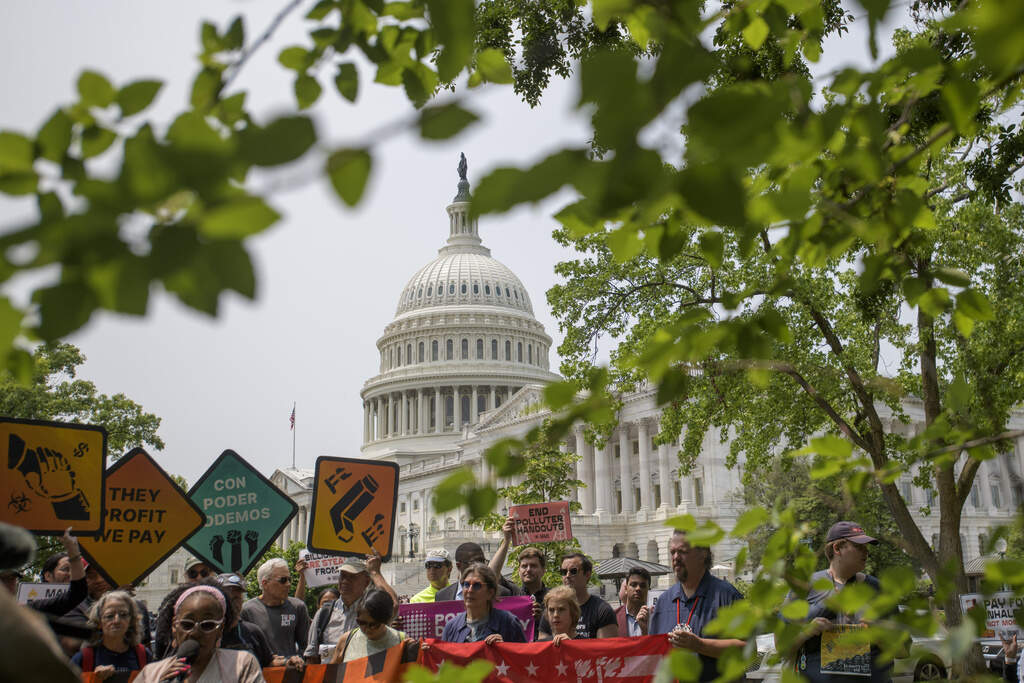
The 'One Big Beautiful Bill' is making big changes to health care. Getting rid of automatic enrollment to the ACA, cutting premium assistance, adding work requirements for Medicaid. What the budget bill means for health care.
Guests
Larry Levitt, executive vice president at KFF – the Kaiser Family Foundation: a non-partisan, non-profit that focuses on health policy.
Paul Winfree, president and CEO of the Economic Policy Innovation Center (EPIC), a conservative think tank out of D.C.
Jessie Hellmann, health care reporter with CQ Roll Call.
Transcript
Part I
MEGHNA CHAKRABARTI: We already know some Republican House members haven't read the bill. They haven't read their own One Big Beautiful Bill Act, the enormous budget reconciliation bill that will change everything from taxes to food assistance to health care. Georgia Republican Marjorie Taylor Greene came clean when she found out there were proposed bans on states passing regulations on AI in the bill.
She said she wouldn't have backed to the bill if she had known the AI provision was in there. Nebraska Republican Mike Flood held a town hall where he had to admit to constituents that he did not know someone had snuck in language that would prevent courts from holding litigants in contempt. He agreed with his constituents that the policy was misguided.
But here's the thing, the truth, hardly anyone had a chance to read the bill. Historian Alaan Lichtman recently said so that no one should be surprised.
Do you know how many pages this bill is, Sam?
Like 1,000?
Even more. It's like over 1,100 pages.
Nobody reads that, right?
Nobody reads it.
So how do they put it together?
Every, they just work in sections and then just Frankenstein it all together or something?
Yeah. The only ones who really know what's in it are the staff.
CHAKRABARTI: But before you start thinking that self-inflicted legislative ignorance is a particularly partisan quirk, let me assure you. It is not, it is a fully bipartisan habit, not a quirk, but a feature of the United States Congress.
Remember the Patriot Act, one of the biggest national security bills in U.S. history? In Michael Moore's 2004 film, Fahrenheit 9/11, Michigan Democrat Representative John Conyers laid out the truth for an incredulous more.
How could Congress pass this Patriot Act without even reading it?
Sit down my son. We don't read most of the bills. Do you really know what that would entail if we were to read every bill that we passed? The good thing, it would slow down the legislative process.
CHAKRABARTI: Indeed. And not slowing down the legislative process is often the goal. 21 years later. That's exactly what happened with the One Big Beautiful Bill Act. House speaker Mike Johnson and his leadership team rewrote the bill multiple times in late night sessions and backroom deals, and they rushed the bill onto the floor before members could fully read it in order to avoid the exact thing that Greene and Flood are doing now.
Those defections. So your members of Congress did not read the bill. Instead for the next five shows, we will. We're picking five major aspects of American life that will be transformed by the One Big Beautiful Bill Act. Health care, taxes, food assistance, the defense budget, and deficits.
And we'll comb through the bill and get details on what's in it about these five aspects and why. And today we're gonna kick off with the big one: health care. To help us get into those details we're joined by Larry Levitt. He's the Executive Vice President at KFF, the Kaiser Family Foundation. It is a non-partisan nonprofit that focuses on health policy. Larry, welcome to On Point.
LARRY LEVITT: Thanks for having me.
CHAKRABARTI: You've read the health care portions of the bill?
LEVITT: I have read the bill, yes.
CHAKRABARTI: (LAUGHS) Okay, good. I'm making all these big promises. We just want to be totally transparent that we will deliver. Alright, so let's chunk it a little bit. Let's start with the Affordable Care Act, a.k.a. Obamacare does the One Big Beautiful Bill Act make significant changes or alterations to how we understand Obamacare today?
LEVITT: It does. Those changes total about $268 billion in savings to the federal government over 10 years. And millions of people would lose coverage. Many of them are very technical, so they do things like limit the annual open enrollment period that people can sign up for coverage. Instead of ending mid-January, that would end in mid-December.
It requires people to provide additional verification of their income before they can sign up for coverage. So essentially buries people in paperwork when they have to sign up for coverage. It would prevent people from auto renewing their coverage. So for those of us who have insurance through our employer, every year, it just gets automatically renewed.
We don't have to go through a process to re-up our health insurance. That would no longer happen with Obamacare.
CHAKRABARTI: Okay, so Larry, hang on for a second because I wanna get into more of the details of those three and then we'll get to more about Obamacare. By the way, folks, the KFF has this incredible chart called Health Provisions in the 2025 Federal Budget Reconciliation Bill.
We'll try to link to that at onpointradio.org. But Larry, you and your team have done a terrific job in just laying this all out. So for the open enrollment period, by the way, by shortening it by a month. Ending at December 15th rather than January 15th. The significant thing there that you and your team have reported is that 40% of people who use Obamacare, this 10 million Americans, they actually selected their plans after December 15th.
So in the period of time that would evaporate if this bill gets passed, unchanged.
LEVITT: That's right and many of those people have their insurance auto renewed, so you know, they're happy with their coverage. They didn't think they needed to go on to healthcare.gov or their state-based insurance exchange to renew their coverage.
It would just continue. So the combination of shortening the open enrollment period and eliminating that automatic renewal option could really affect millions of people. And coverage under Obamacare has grown dramatically. There are now 24 million people enrolled in the ACA.
CHAKRABARTI: Wow. Have you been able to understand better why, what's the logic behind eliminating the auto renewal?
LEVITT: It's the justification for a lot of the changes, both with the ACA and Medicaid, which I'm sure we'll get to. Is eliminating so-called fraud, waste and abuse. The idea that people are getting auto renewed even though they don't qualify anymore. That's the justification for the income verification too, that people are overestimating or underestimating their income in order to qualify.
So, you know, that justification of fraud, waste, and abuse cuts across this whole bill.
CHAKRABARTI: Okay, so about that personal verification of information. I'm seeing here that people would have to attest obviously to their income to enroll in a plan, but the verification then would have to happen against information with the IRS, the Social Security Administration, state Medicaid databases, and the Department of Homeland Security.
LEVITT: Because there are certain immigration restrictions for people to sign up for coverage. And in fact, the bill would eliminate coverage for many lawfully present immigrants who can currently sign up for Obamacare.
And the way this works is, they try to match your income to known databases, let's say the IRS, but if it doesn't match, they would come back to you and say we need more verification. And that process could take a while, particularly with the kind of layoffs we've been seeing in the federal government. And with the shortened open enrollment period, you could find yourself trapped in this verification process and not being able to verify your income until the deadline has already passed.
CHAKRABARTI: Okay, so regarding immigrants, there's a section of the bill that would change the eligibility for some lawfully present immigrants.
LEVITT: That's right. These are not undocumented immigrants. They're not eligible for the Affordable Care Act at all. These are lawfully present immigrants with low incomes who have been here less than five years.
So they came in lawfully, they're not undocumented and they would no longer be able to get insurance. And these people would frankly have no other options. They wouldn't be eligible for Medicaid, they wouldn't be eligible for the ACA, they would be forced to be uninsured.
CHAKRABARTI: Even though they are here in this country legally.
LEVITT: That's right.
CHAKRABARTI: And up until, if this bill passes unchanged, they have been able to get this health care.
LEVITT: They have. People get nervous about --
CHAKRABARTI: They can get it through their employer. I want to say that, but we're talking about health care through the ACA.
LEVITT: That's right.
And that's really who the ACA is there for. It's for people who are working, almost all of them are working, but they just don't get health insurance through their jobs. Many jobs in construction and service and agriculture don't come with health benefits.
CHAKRABARTI: Okay. So that's basically what, not even half of the proposed changes in the ACA.
We'll come back to more on Obamacare in a little bit. You mentioned Medicaid and also Medicare. Huge proposals here for two huge programs. Let's start with Medicaid. What would be the most important thing that you want listeners to understand about the proposals in the One Big Beautiful Bill Act?
LEVITT: Yeah, a whole slew of changes. And again, a lot of these revolve around putting up barriers to people to sign up. The biggest would be a work requirement, so that people would have to be working or qualify for certain exemptions or do community service. And in order to qualify for Medicaid.
Now, the important thing to understand is that almost all Medicaid enrollees are already working or would qualify for an exemption. In fact, 92% of them are either working or would qualify for an exemption, like being a parent of a dependent child or being ill, having substance use, being in school. The key here is that it's not the requirement itself that trips people up.
It's the fact that they have to report it potentially on as frequently as every month. And that's what we saw in states like Arkansas and Georgia that have had work requirements, that many people lost coverage, not because they weren't working, but because they couldn't navigate the process to prove that they were working.
CHAKRABARTI: Was the process in place in these states that had, I guess, during the first Trump administration is the most important part, that a bunch of states got waivers to actually institute these requirements?
LEVITT: A bunch of states got waivers. Arkansas was one that implemented it until it was stopped by the courts.
It was a very hard process to navigate. For example, at the beginning, the website where you had to report your work closed down at nine o'clock every night. So for someone who's working, particularly someone who's working a couple jobs to make ends meet, by the time they got home and could report their work, the website was closed down.
CHAKRABARTI: Why? Oh my God. Larry, hang on here for just a second. We're gonna take a quick break.
Part II
CHAKRABARTI: Larry, I was just, I was asking you why a website designed to help people verify that they're working would shut down after nine o'clock.
LEVITT: The claim was they needed to do maintenance on it, but there's a theme here, and we've seen this a lot in public programs like Medicaid, like DACA, SNAP, which I think you'll get to later in the week. That you put up barriers to people to sign up for these programs and that's how you get savings. When you put up those barriers, which may sound technical and reasonable to people, in some cases, it reduces the number of people who sign up and the government saves money.
CHAKRABARTI: So the savings part is a big deal here because, as you said, it is a significant motivation here.
For example, again, sticking with Medicaid for another second, there's changes to a program called Disproportionate Share Hospital Payments or DSHs. And these are payments made by the government by Medicaid to hospitals that serve a larger than usual proportion of low income or uninsured or Medicaid patients to help them keep going.
Yes?
LEVITT: That's right. And there are a number of provisions here that would affect hospitals. Some of them, just because fewer people would be covered, hospitals would get paid less, they would have fewer paying patients. In fact, they would end up with more uninsured patients who couldn't pay their bills.
But there are other provisions directed at hospitals. So this disproportionate share provision, there's another provision that allows states to direct money to hospitals that would be capped. There are taxes that hospitals and nursing homes pay to help fund the state share of the Medicaid program it's a shared program between the federal government and the states.
The states pay some of it, the federal government pays the rest. And this would limit those provider taxes, which enable states to collect more money and then redirect that money back to hospitals to compensate them.
CHAKRABARTI: Okay.
LEVITT: This is, Medicaid represents about one fifth of all hospital care provided in the country.
In fact, over four in 10 births. So hospitals are quite dependent on Medicaid payment for low-income patients.
CHAKRABARTI: So about that disproportionate share payment, KFF says that in fiscal year 2023, those payments totaled $17 billion in just one fiscal year to hospitals. And that the One Big Beautiful Bill Act would suspend those payments or end them entirely.
LEVITT: Not suspends, but limits them.
CHAKRABARTI: Limits them, okay.
LEVITT: In some cases, yeah.
CHAKRABARTI: Okay.
Got it. Larry, hang on here for just a second because I now wanna bring in Paul Winfree, he's president and CEO of the Economic Policy Innovation Center. It's a conservative think tank, and he is a former White House budget policy director during President Donald Trump's first administration.
Paul, welcome to On Point.
PAUL WINFREE: Thanks for having me. Appreciate it.
CHAKRABARTI: Okay, so first of all, talk to me about the aspect, the health care aspects that you think are most notable or most important in the One Big Beautiful Bill Act.
WINFREE: So one of the issues that we've seen with Medicaid over the last four years is we've seen a massive expansion of the program.
So right now, there are about 80 million people who were on the Medicaid program. The spending on Medicaid just over the last four to five years has gone up over the next 10 years by about $1.2 trillion. And a lot of the reasons for that is, is that there are all of these incentives baked into the financing structure of Medicaid that encouraged states to look for loopholes, to bring in more money to the state coffers, to finance both the Medicaid program, but also to finance other budget shortfalls at the state level.
So Larry just brought up one of those being the Medicaid provider tax. One of the things that the One Big Beautiful Bill does is it caps the Medicaid provider taxes where they currently are. Another loophole that states have used in the past is called the state directed payments which have allowed Medicaid providers to pay up to commercial rates for services, which is much higher than what Medicare pays.
And so one of the things that we've seen within the larger health care system is a redirection of care towards the incentives that are baked into these finances. So in other words, if the Medicaid program is paying more for the provision of care for the able-bodied population, then the Medicare program is for seniors, then doctors and hospitals and other providers are going to respond to those incentives and ultimately shift care more towards the able-bodied and away from seniors and people who truly need health care.
The vulnerable population, who the Medicaid program was originally intended to provide services for.
CHAKRABARTI: Okay, so let me just jump in here. People who truly need health care, let's talk about that for a second because I know there's a lot of thought that young and healthy people don't need to have health care as often, right?
Because, as to your point, they're less likely to break a hip, right? Or maybe if you're in your twenties, you're less likely to have a chronic disease, although in America, maybe not that much less likely. So I see your point there. But the purpose of Medicaid, as far as I understand it, is that nevertheless, these folks who are in their twenties or thirties and working, they're still not getting paid enough or do not have employer sponsored health care such that they can get any kind of health care.
And so why shouldn't the government assist in that case?
WINFREE: So that's a great question. And actually, one of the issues that the One Big Beautiful Bill actually does not get at is the inequitable financing between how the federal government subsidizes care for the able-bodied population versus the traditional population or the truly vulnerable population.
So for instance, for every $1 that states spend on the able-bodied population, the federal government pays $9 on average for every $1 that they spend on the vulnerable population. These are the disabled, pregnant moms, the blind children, the elderly who are in nursing home care, on average states get $1. 33 cents for every $1 that they spend.
And so because of that financing inequity, and I actually think that there's a lot that can be done to correct for that, to actually bring up what the federal government contributes for the vulnerable population, while also bringing down what it contributes for the able-bodied population so that you do it in a budget neutral way.
That will actually help to reset some of those incentives for states to expand Medicaid for the able bodied. Because they bring in more money, while also doing what's right for the vulnerable folks so that we don't have hundreds of thousands of people on Medicaid wait lists across the country, trying to get home health care and nursing home care and other vital services that they truly need.
CHAKRABARTI: Larry, do you have some thoughts on this?
LEVITT: So first you have to look at the history here. Since its inception, Medicaid had this shared financing between the federal government and the states. Then the Affordable Care Act or Obamacare came along and originally this expansion in the ACA to low-income adults who weren't previously eligible, including those without kids, was originally mandatory and it was part of a larger bill, the Affordable Care Act.
That sought to get close to universal coverage. This was a federal bill. It was a mandatory expansion in Medicaid, so the federal government agreed to pay 90% of the cost of this expansion. The Supreme Court made it voluntary. Most states have now expanded, but 10 states have not. Primarily in the south, states like Texas and Florida and Mississippi.
And it is a quirk, certainly in the financing of Medicaid, because of the history. But there's really no evidence that states that have expanded Medicaid are somehow taking money away from people who are disabled or the elderly. In fact, they spend more on those populations than states that have not expanded.
CHAKRABARTI: Okay. Larry and Paul, hang on here for just a second. Because Larry, you had mentioned earlier, the states that had implemented, that received waivers to implement work requirements in the first Trump administration. Arkansas was indeed one of them.
And in 2018, Medicaid recipients, when Arkansas received the waiver, had to report 80 hours of work or volunteer experience per month, which is by the way, similar to the proposal currently in the One Big Beautiful Bill Act. And if someone failed to do so in any three months out of the year, they would lose coverage for the rest of the year in Arkansas. Again, this is back in 2018, but as Kevin De Liban, former legal aid lawyer of Arkansas recalls, the implementation was very rocky.
KEVIN DE LIBAN: What we saw immediately was mass confusion. People didn't know whether the work requirements applied to the type of Medicaid they had. They didn't know how to comply. They didn't know why when they were working jobs or had obvious exemptions, why they weren't exempted. You could only report certain hours of the day and not at others.
You couldn't report by phone initially when you had questions or concerns about whether or not you were reporting or what your status was, you had to call centers that would force you to wait on hold for sometimes multiple hours before you got to anybody. Almost nobody who had to go through that could navigate successfully.
CHAKRABARTI: As part of Legal Aid Arkansas De Liban sued the state on behalf of his clients to end the work requirements. Many of his clients were low wage workers who were on Medicaid, but struggled to keep coverage with the new requirements.
DE LIBAN: They're janitors, they're day laborers, they're nursing assistants, they're the people washing dishes in restaurants or serving us food.
We had clients who went from working 30 hours a week one week to suddenly being cut to 12 hours a week, and they lost their ability to comply for the month because their boss cut their hours. That's no fault of their own right. Or suddenly the boss decides they have to lay people off, so they laid our clients off.
Our clients were unable to comply with the work, require with the work penalties, and then you strip their health care away while they're down and struggling. Low-income work is just not stable or predictable, and you can't always make the pieces fit.
CHAKRABARTI: Now he won the lawsuit, and Arkansas had to stop implementing their work requirements.
But before that happened, many people had still lost their coverage.
DE LIBAN: So in only five months, 18,164, people lost insurance. And there were tens of thousands more who didn't lose insurance, specifically because of the work penalties. But they lost it because of paperwork burdens and extra red tape that the work penalties caused them to have to go through 18,164 in five months in a state the size of Arkansas, which only has 3 million people in it, is just a huge number.
CHAKRABARTI: Now once again, Arkansas wanted to implement the work requirements in order to save money. But according to a GAO report, the implementation of those requirements cost the state $24 million. Now, Paul Winfree, I just wanted to ask you something else about cost savings here, because as both you and Larry have talked about, that's a major thrust in the health care aspects of the One Big Beautiful Bill act.
But if a lot of people end up losing coverage, losing Medicaid coverage, because of implementation issues or the work requirements as you're talking about. Ultimately, someone has to pay that. The cost doesn't just disappear, right? It gets pushed into other places. Because people will still seek health care in the emergency room, and they won't be able to pay for it.
So those hospitals then, who simultaneously are losing some of those extra payments, that they're getting from the government, if the bill passes, push those costs onto insured Americans, premiums go up. So it hasn't really reduced the cost of health care at all writ large in this country, it's just pushed it onto people who are working and have private insurance.
WINFREE: Look, there is a need to have a larger health care reform conversation in this country. That was supposed to unfold during, when the Affordable Care Act was enacted 15 years ago. But ultimately, we see a lot of the same problems today that we had then. It's just that more people are in public health insurance than were in public health insurance before the Affordable Care Act was passed. You brought up the DSH payments earlier. Obamacare intended to get rid of all of the DSH payments because if everybody was insured, then ultimately, we wouldn't need to be paying hospitals on the back end to fund the uninsured who were coming into the emergency rooms and seeking care in other ways.
I think, this is a, but this is a much larger health care system issue. And I honestly think that there is a space for Democrats and Republicans to get together, for liberals and conservatives to get together, and talk about ways that we can all agree to begin to actually bend the cost curve in not just the public financing of health care, but in the private financing of health care as well.
Because if we don't, then ultimately, it's going to bankrupt us. And I don't think that anybody wants that, because the first set of folks who are ultimately going to pay the price if the public health care systems becomes bankrupt, is the people who truly need this, need the care, the vulnerable folks, the seniors, the disabled, the pregnant moms, and everybody who these programs were intended for in the first place.
CHAKRABARTI: Paul Winfree, president and CEO of the Economic Policy Innovation Center. Thank you so much for joining us today.
WINFREE: Thanks so much. I appreciate it.
CHAKRABARTI: Larry, let's turn back to you. You feel free to respond to what Paul said, or if there's another aspect of Medicaid that you think Americans should really know more about, that could be changed by the bill.
LEVITT: Well, Meghna, as you said, this bill does not really, in any way, address the underlying cost of health care. It would eliminate coverage for 10.9 million people between the changes to Medicaid and the Affordable Care Act and the costs of those people would still be in the system. They'd still be going to the emergency room, they would still be getting sick, and someone would have to bear those costs.
I certainly agree with Paul that we should be having a discussion about how to actually reduce the cost of health care, but this bill doesn't do that at all.
CHAKRABARTI: There's also some look interesting, what seemed to be smaller, but funny things in the Medicaid portion. For example, home equity limits.
I didn't actually know that any kind of home equity limit existed in the Medicaid program, and this is for folks who need long-term care. They have to have limits on how much equity they have in their homes.
That's right. A lot of people don't realize that Medicare, which covers all seniors, does not cover long-term care.
It does not cover nursing home care that's covered in Medicaid, or people pay out of their own pockets. Very few people can actually afford a long stay in a nursing home. So typically what happens is people spend down their assets in order to qualify for Medicaid, and there are some limits on how much of the value of your home you can retain as you spend down to qualify for Medicaid.
And this bill lowers that limit somewhat.
Part III
CHAKRABARTI: Okay, Larry, let's listen together to Chairman of the House Ways and Means Committee. He was on Fox News last month, and here's how he describes his view of the changes in Medicaid.
JASON SMITH: And then you can look at Medicaid cuts, Medicaid reforms, I should say. These are all things that were right in the middle.
CHAKRABARTI: Okay, so that's Jason Smith, chairman of the House Ways and Means Committee from Missouri. Are they reforms, are they cuts? Are they both?
LEVITT: They, as we were talking about earlier, Republicans have been framing the changes to Medicaid and the Affordable Care Act as trying to eliminate fraud, waste and abuse. The reality is, there certainly is fraud in these programs. There's fraud everywhere. There's fraud in private insurance as well. Fraud is mainly perpetrated by health care providers. So a durable medical equipment provider that is billing for wheelchairs that they're not actually providing to patients.
There's really nothing in this bill that addresses that kind of fraud. This is a spin effort to try to frame cuts that will result in more people being uninsured as eliminating fraud, waste and abuse. This is very different from past reconciliation bills, which is what this is, a budget reconciliation bill, that had been done in the past, which had a mixture of cuts and expansions in programs.
For example, there was a big reconciliation bill under President Clinton that cut Medicaid substantially, but also created the child health insurance program that insured millions of kids. This bill really does cut. It cuts Medicaid and the ACA substantially and Medicare to some extent, in order to help pay for tax cuts.
CHAKRABARTI: Okay. You mentioned Medicare. Now, this has always seemed to be politically the sacrosanct public assistance program that no one really wants to touch. But KFF has quite a long list of proposed changes to Medicare in the reconciliation bill. A lot of them have to do with eligibility. And enrollment.
Can you quickly touch on that, Larry?
LEVITT: Yeah. And I think it's fair to say that the bill does not go after Medicare in the same way it does Medicaid and the ACA, President Trump and Republican leaders in Congress have said they're not going to touch Medicaid. They have touched it a little bit, but not as much as these other programs.
And as you said, a lot of it revolves around the process for enrolling. And in fact, in a somewhat confusing way, a lot of it involves people who are eligible for both Medicare and Medicaid. Medicare doesn't cover everything, so low-income people often sign up for Medicaid as well. And there are about 12 million people who have coverage through both programs.
The Biden administration had put in place some rules to try to streamline the process to sign up for Medicaid if you also have Medicare. So for example, you would only have to renew your coverage once a year under the assumption that once you're elderly, you stay elderly. Once you're disabled, you typically stay disabled.
And then once you're low income, when you're elderly, you typically stay low income. This bill would remove that requirement, that you only have to renew your coverage every year. The Congressional Budget Office, which is the referee in Congress, has estimated that 1.3 million people would lose Medicaid coverage.
They would keep their Medicare coverage, but they would lose the Medicare supplemental part of that.
CHAKRABARTI: Okay. Now, again, this the theme that's going through here about restricting eligibility. The bill would restrict Medicare eligibility to Citizens, Green card holders, certain immigrants from Cuba.
And people residing under the Compact of Free Association. Essentially people who would no longer be eligible would be folks on TPA or temporary protective status, refugees and asylum seekers. Or people granted asylum in the United States. So that's a theme here that we're seeing in health care.
One more quick thing, and this might be a little bit nerdy or in the weeds, so help me not get too far in the weeds. Their proposed changes to how physicians are paid by Medicare.
LEVITT: Yeah. This has been I guess your definition of getting too weedy here is somewhat in the eyes of the beholder.
CHAKRABARTI: But kind of a big deal for the health care system.
LEVITT: It is. This has been an issue that's been going on for decades, how Medicare pays physicians and there have been multiple attempts to restrict Medicare payments to physicians to try to steer it more towards providing incentives for physicians to provide care that's of higher value, to not just provide more care because you get paid more.
Most of those efforts have been failures. They've resulted in big cuts and payments to physicians, which Congress then reverses, and the full effects never really get implemented. This is one more attempt to try to fix the payment to physicians and avoid big cuts.
CHAKRABARTI: Yeah. Because it seems to actually be, perhaps a good idea because they would convert it to a payment schedule that's pegged to the Medicare economic index or a measure of inflation in medical practice costs, like that makes sense to me. Am I misreading that?
LEVITT: This is probably one of the very few pieces of this bill that there would be bipartisan support for if it were being voted on.
As a standalone.
CHAKRABARTI: But one last thing about Medicare and an impact that could happen to the program, not directly, but by virtue of the deficit spending that the bill will bring about. And by the way, on Friday we're gonna talk about the deficit. But if the bill is enacted, you say in its current form, and this is again from the awesome chart that KFF has, and Congress takes no further action.
The increase in the deficit would trigger mandatory cuts. And those cuts could be approximately $500 billion to Medicare. From 2026 to 2034.
LEVITT: That's right. We've been talking about these cuts to health care, which are substantial, a trillion dollars in cuts to health care, which would be the biggest rollback in federal support for health coverage ever.
Even those trillion dollars in health care cuts don't pay for the tax cuts fully, so the deficit would increase substantially. That would trigger automatic reductions in Medicare, as you said, totaling $500 billion. In the past when this has happened, Congress has voted to avoid those cuts, to nullify them.
We'll see what happens this time.
CHAKRABARTI: Okay, Larry, hang on for just a second, because I want to now bring Jessie Hellmann into the conversation. Jessie is the health care reporter with CQ Roll Call. Welcome to On Point, Jessie.
JESSIE HELLMANN: Thanks for having me.
CHAKRABARTI: Okay, so now that we have all the sort of policy pieces in place regarding a better understanding for health care, what are the political pieces?
I suspect that as people learn more and more about how their personal health care might be impacted by this bill, is it getting less popular? Some of the polling seems to indicate that.
HELLMANN: You have seen members struggling at their town halls to talk about Medicaid. Joni Ernst came under fire about this a few weeks ago when she said something like, we're all going to die.
So I think more and more intention is being paid to what's in this bill, especially as we see the analyses come out from the nonpartisan congressional budget office. Stating that millions of people are going to lose coverage and not really have any other options. And it's been hard for Republicans to defend this, especially when you look at the reason they're making some of these changes, which is to pay to extend some of the tax cuts that passed under President Trump's first term and for border security and other stuff like that.
CHAKRABARTI: So let's be clear, Jessie, have members of the House or even the Senate, we'll talk about the Senate more in just a second. Have they been as upfront as to say we're making these cuts in order to pay for these other things, or is that just coming out from basic analysis that's done by people like Larry and you?
HELLMANN: So when the House started drafting this bill, they gave instructions to various committees, including the House Energy and Commerce Committee, which has jurisdiction over Medicaid to find $800 billion in cuts. And so when you do that, it's a recognition. You're going to have to find something within your committee.
To help pay for this bill. But members haven't been as forthright about it. I think as Larry has said, they'll talk more about, we need to root out waste, fraud and abuse in Medicaid. That's why we're doing this. We're trying to protect Medicaid for the most vulnerable. But they won't say this needs to happen so that we can pay for the tax cuts. They talk about those things separately. They say, we need to extend these tax cuts and also, we need to make changes to Medicaid, but they don't tie the two together.
CHAKRABARTI: I see. Now, of course the bill is out of the House and in the Senate, the Senate likes to think of itself as the more mature, judicious body of the legislature, does that mean that there's gonna be a lot of consideration about the health care aspects? Have people you talked to say said that like some of the stuff may come out or may be changed?
HELLMANN: So there's a contingent of senators, Republican senators who have been really concerned about some of the Medicaid provisions.
And there's Josh Hawley from Missouri, Lisa Murkowski of Alaska, and Susan Collins of Maine. They've all been working with leadership to make changes to the Medicaid provisions in particular. I think right now, I don't any of them would be willing to support the House bill. They all have pretty major concerns about the Medicaid pieces and we're expecting those negotiations to wrap up sometime this week, there's talk that the bill could be released today.
And so we'll see how far they go in making changes, because ultimately the bill has to go back to the House and get support from the conservatives there who actually wanted deeper Medicaid cuts and who might be upset if the Senate really waters down some of these Medicaid provisions.
CHAKRABARTI: That's a good point. But, the chaos of the House, not withstanding, there are some people who are in the House, Republicans who are already upset with the bill that they voted for as they're discovering what's in it. I'm just wondering in terms of health care, Jessie, how much have you seen those ideological differences, which seems to be a major part of the proposed changes to health care that are being played out in this bill.
How much have those ideological differences ever been able to be resolved in a way that that the House and Senate can agree on, without having to do things like Larry talked about, which is kick the can down the road and a couple of years later, vote to save Medicare kind of thing.
HELLMANN: I think it'll be challenging. The, like you've said, the conservatives in the House have been pushing for deeper and deeper cuts, and so Senate Majority leader John Thune has a really tough task ahead of him and we'll see what happens. But I think there definitely has to be any changes. I'm just looking at, can they get the ball out of the Senate at this point?
And there would definitely have to be some changes there to make that happen.
CHAKRABARTI: So tell me a little bit more about what are you looking for about getting the ball out of the senate?
HELLMANN: So I think Paul mentioned earlier the provider tax, that's a big source of funding for state Medicaid programs.
Josh Hawley has been concerned about the impact of those changes on rural hospitals, and he has said he won't support a bill that doesn't, at least, protect rural hospitals from those changes. So there might have to be something done around that. I think Collins and Murkowski are really concerned about the coverage losses.
So they might have to tweak that language, or at least give states more time to comply with the Medicaid work requirements because at the last minute, the House actually moved up the effective date for that. From, it was 2029 and now it's the end of next year, which I've been talking to people who work with states, even red states, and say that's not enough time to actually put together a program that avoids some of these things that you guys have been talking about, people falling through the cracks and losing coverage even if they are working.
CHAKRABARTI: Jessie Hellmann, health care reporter with CQ Roll Call, thank you so much for joining us and for keeping an eye on what may come out of the Senate here. I really appreciate it.
HELLMANN: Thank you.
CHAKRABARTI: Larry. I'm gonna give the last word to you because correct me if I'm wrong, but if memory serves, as people do find out more about proposed congressional changes in their health care, regardless of if they're Republican or Democrat, I'm talking about average Americans, they tend to not like it.
Because we had dozens and dozens of repeal and replace attempts by the House that didn't, that never went anywhere. Now we have a situation where instead of repeal and replace for ACA, it seems like whittle down is what the House is trying to do. But do you think something similar might happen here?
I don't know if KFF has done any polling about how people, what people think about these proposed changes.
LEVITT: Yeah, this has happened to every health care reform effort. It happened to the Affordable Care Act originally. The people liked the idea at first. Then when the details of the bill came out and it became clear that there would be both winners and losers, public opinion turned against it. It then happened with the effort to repeal the ACA which became very unpopular and in fact made the ACA more popular than ever. So I think the more people learn about these provisions and the massive cuts to health care, public opinion will turn even more against it.
The first draft of this transcript was created by Descript, an AI transcription tool. An On Point producer then thoroughly reviewed, corrected, and reformatted the transcript before publication. The use of this AI tool creates the capacity to provide these transcripts.
This program aired on June 16, 2025.