Support WBUR
How William F. Buckley, Jr. created modern conservatism
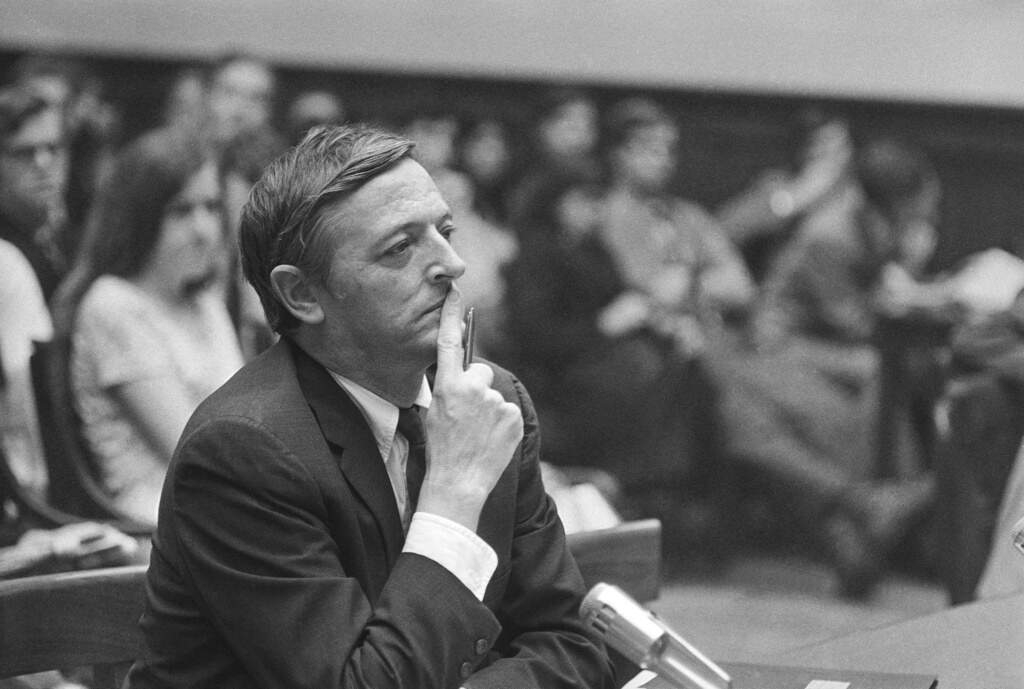
The late William F. Buckley, Jr. is one of the most important figures of the American right. How did the erudite and dapper Yale man pave the way for President Donald Trump?
Guest
Sam Tanenhaus, author of the new biography “Buckley: The Life and the Revolution that Changed America." Former editor-in-chief of The New York Times Book Review.
Transcript
Part I
MEGHNA CHAKRABARTI: The late William F. Buckley, Jr. is often called the architect of the modern American conservative movement. The erudite and dapper Yale man was a prominent and prolific writer, speaker and thinker, known for his sharp wit and biting criticism, proudly on display here from a 1965 appearance on Meet the Press.
INTERVIEWER: Mr. Buckley, you once called Harry Truman “the nation's most conspicuous vulgarian.” You said of General Eisenhower that when he touches a subject, every ray of light, every breath of air is choked out.
Of the Kennedy administration, I quote you, “There are not enough psychiatrists in the country to cure this crazy administration.” And you've called President Johnson “Uncle Cornpone.” In view of your opinions of the last four presidents of the United States –
WILLIAM F. BUCKLEY, JR.: Actually, I didn't say that about Kennedy. I don't know who did. I said the other three though.
INTERVIEWER: Right.
BUCKLEY, JR.: I'd be glad to elaborate on them.
CHAKRABARTI: As Buckley says, "I'd be glad to elaborate," he flashes one of his signature cheeky grins.
While many of the recognizable features that once characterized American conservatism seem to have been trampled underfoot by Trumpism, Buckley nevertheless deserves credit for helping pave the way for the populist stampede led by President Donald Trump.
Now that is one of the many provocative themes explored in Sam Tanenhaus' long-awaited, sweeping new biography of William F. Buckley, Jr. It's called Buckley: The Life and the Revolution That Changed America. Sam Tanenhaus is a biographer, historian, and a journalist. He's former editor-in-chief of the New York Times Book Review. His other books include, excuse me, he's a former editor in chief of the New York Times Book Review and currently a contributing writer for the Washington Post.
Sam, welcome to On Point.
SAM TANENHAUS: Great to be here with you, Meghna.
CHAKRABARTI: You're gonna have to forgive me for having screwed up your other books, but I have it now. It was one of those moments where I wanted to give you credit for your previous writing and didn't have the notes in front of me. But here it is: Whittaker Chambers: A Biography and the Death of Conservatism: A Movement and Its Consequences. So I detect a theme here, Sam.
Let me just first start off by asking you what is it about William F. Buckley, Jr. in 2025 that you think was worthy of the 1,000 or so pages that you devote to this new and important biography of him?
TANENHAUS: He was a man of many faces, of many phases and many personalities that we see alive today in all the facets of conservatism. And I sometimes suggest to people that if you want to understand the landscape we inhabit now, don't look just at President Trump. I know it's hard to take your eyes off him, but there's a surrounding orbit of writers, of thinkers, of activists, of provocateurs. We hear and see them on social media.
But in many ways, that media landscape was anticipated, pioneered, almost sprang out of the head of William F. Buckley, Jr., Bill, as everyone called him, including the people who worked in the mail room at National Review, the magazine he started in 1955. He was a master of media and he understood before anyone else that politics had changed from differences of ideology to a kind of ongoing culture war. And he was the leader of that war.
CHAKRABARTI: Okay. So I'm gonna come back to that a little bit later because I'll make the argument to you that there have been prominent conservatives that have really ably used the media even prior to Buckley, but we'll come back to that.
I think the most interesting one of the most interesting aspects of your book has to do with Buckley's early life, where people who are familiar with his later work may not know so much about this. First of all, let's go to a clip of Buckley from 1980 and he was on The Tonight Show with Johnny Carson.
WILLIAM F. BUCKLEY, JR.: (SPANISH) Y como está usted?
JOHNNY CARSON: Cómo está? Muy bien.
BUCKLEY: Pues me parece que usted quiere que yo sé — yo hable en español para darle oportunidad de desar su promesa de hacer un simulbroadcast.
CARSON: Sí, eso es la chiste. La chista.
BUCKLEY: Es la chiste.
CARSON: Sí, es la chista, es un joke. Okay folks, that’s it for here! (LAUGHTER)
CHAKRABARTI: I did not know frankly, until I read the book, Sam, that Spanish was Buckley's first language.
TANENHAUS: Yes. He did not learn English until he was seven years old. Really didn't become fluent in it until he was eight or nine. He was raised in large part by Mexican servants in his large and wealthy household.
He had a brilliant but absentee father, a lawyer in real estate, and especially oil speculator who was away in Latin America much of the time. And he had a mother who gave birth to nine other children besides William F. Buckley, who came right in the middle. So went to an almost continuous cycle of childbirth, nursing, recovery.
So Bill Buckley and his siblings were raised by Spanish household servants. That was the first language they spoke.
CHAKRABARTI: Okay. So let's talk more about the Buckley family's time in Mexico, right? Because as you said, his father was influential not just in terms of the oil business, but I understand that William F. Buckley, Sr. was also quite influential in Mexican politics during the dictatorship of Victoriano Huerta.
TANENHAUS: He was one of its leading supporters. Tried to counsel Woodrow Wilson and his advisor, the famous Texan Colonel House. William F. Buckley, Sr. was also from Texas. This idea many people have of the Buckleys as a New England aristocratic patrician is totally false. His father was an Irish immigrant via Canada who made — who grew up in South Texas in a rather poor family. His own father had been a sheriff.
And then William F. Buckley, Sr. went to Mexico, grew up speaking Spanish, got involved in oil and also in the counter revolution. I was surprised to discover just how deeply involved he had been in gun running, in recruiting guerillas to fight against the Mexican government. And after it became a counter-revolutionary government, before that in support of its dictator, yes, Huerta. That's the beginning of Buckley family politics. It's the idea that Bolshevism is rampant, it's global.
Mexico's revolution came before Russia's, we sometimes forget, 1910 to 1920. And in the eyes of Buckley, Sr. they were all the same. And so that's really the origins of this counter-revolutionary politics that Bill Buckley openly espoused. He called himself both a radical conservative and a counter-revolutionary.
CHAKRABARTI: Okay. So the Buckley family, in terms of — but William F. Buckley, Jr.'s father was more than willing to engage or become deeply involved in the politics of another nation. And yet when it came to American politics, he was critical to the America First Committee. I'll let you tell this story. First of all, that was most prominently headlined by Charles Lindbergh.
TANENHAUS: Yes. The family were all devotees of Charles Lindbergh. And William F. Buckley, Jr., my guy, at the age of 15, was in Madison Square Garden when Lindbergh gave his last famous address to a packed house and thousands in the streets just before Pearl Harbor.
They were isolationists — if anything, they were likelier to support Germany and the war against the allies — and they believed America shouldn't get involved. And they saw that war as the extension, World War II, of Woodrow Wilson's intervention in Mexican affairs. That's how you link them together, Meghna.
Because when Buckley, Sr. was supporting the dictatorship in Mexico, the enemy was coming from the United States, it was Woodrow Wilson who was intervening, and Buckley, Sr. was on the side of the dictators. Once we got, not all that many years later, a generation later, World War II, the Buckley family had the same opinion.
What's important is that they were living in a part of the country, the northwest corner, as it's called, of Connecticut near the Berkshires in Massachusetts and Dutchess County — where their neighbor Franklin Roosevelt was from — that was very pro English, pro intervention. So the Buckleys as a large brood of Catholics from the South living in this corner of the world, were very much embattled and almost a kind of colony of outsiders.
CHAKRABARTI: Oh, interesting. Okay. So let's listen to a little of Lindbergh. This is not from that Madison Square Garden speech, but it's a speech that he gave in Des Moines, Iowa.
CHARLES LINDBERGH: We cannot allow the natural passions and prejudices of other peoples to lead our country to destruction. (APPLAUSE) If any of these groups, the British, the Jewish, or the administration, stops agitating for war, I believe there will be little danger of our involvement. (APPLAUSE)
CHAKRABARTI: Charles Lindbergh there and the America First Committee. So Sam, we have to talk about the fact that Lindbergh, if the Buckleys and William F. Buckley, Jr. was very swayed or enamored of Lindbergh and the America First Committee, then they were also swayed and enamored of his antisemitism.
TANENHAUS: They were certainly indulgent of it. Bill Buckley's father was an outright fire-breathing anti-Semite. He hated Jews with a passion you almost can't believe. And it was Bill Buckley's youngest sister, Carol Buckley, who at one point, she was married a few times, one of her husbands was Jewish, who told me this, just how extreme it was.
"Bill Buckley's father was an outright fire-breathing anti-Semite."
She said, any evil thing that Jews were accused of being, their father subscribed to. They're communists, but they're also greedy. And they're money-grubbing liars, she said. This from a very elegant man, who read Cervantes in Spanish, the father. But when the subject turned to Jews, everything became very different.
CHAKRABARTI: So then how did this then influence William F. Buckley, Jr.?
TANENHAUS: It took him some time to get over it. Another one of the discoveries I made was Bill Buckley himself at Yale had a very close friend, his co-editor, really, the number two man on the Yale Daily News — Buckley was number one — who was Jewish. Thomas Guinzburg became a famous publisher of the Viking Press later, and he fell in love with one of the sisters Buckley was closest to. And Buckley's father told him, "break up that romance." And he told him, "we don't want a Jew in the family." And I asked Bill Buckley about that later.
Part II
CHAKRABARTI: Sam, you dangled this story in front of us about what Bill Buckley told you regarding his father's interference with the relationship due to his extreme antisemitism. So what did he say?
TANENHAUS: He said it would've been just dumb to have a Jew in the family. And, yeah, that stayed with me because that was how Buckley liked to phrase issues like that, almost to pretend as if there were no emotional component to it. That was sheerly a matter of logic and rationality.
And you see this in his writing and debating, too. That's why the moments come when he is up against very shrewd debaters like James Baldwin and Gore Vidal. Who are able to push a button in Buckley, then that mask falls away and it becomes a much more visceral person.
CHAKRABARTI: Okay, so his father said it would've just been dumb. Do you see evidence of that sort of pretense of logic in Bill Buckley's own views about certain social issues in the United States, particularly race?
TANENHAUS: Race is where its most profound and surprising. One of the revelations I found in the course of long research was that the Buckleys, although they lived in Connecticut, were really Southerners. They had a second home, beautiful Antebellum home in Camden, South Carolina, and while they were there, they were considered, they hired many Black neighbors to work for them. That's what the winter colony in Camden, South Carolina did.
These were northerners who lived in beautiful estates and the help almost always were Black Americans. And the Buckleys treated them exceptionally well. I interviewed someone who'd worked in the Buckley home. At the same time, the family privately funded, and Bill Buckley's sister Priscilla edited a publication that was pro-segregationist after the Brown decision in 1954 and was part of what was called the massive resistance to the court's illegalizing of Jim Crow segregation in schools. And that was the beginning of the backlash politics that Buckley was a leader of, to a far greater extent than anyone had realized, myself included.
CHAKRABARTI: But tell, so tell me more about that. Why is it that a man who very frequently was openly critical about any ideas of racial equality or even just integration, that would come as such a surprise to someone like you who knew him so well?
TANENHAUS: I think it was the extent of it, Meghna, that also how much of it was concealed.
One of the surprising things when you go back and look at the literature and culture of the 1950s is when Buckley wrote what today seemed to us shockingly racist editorials in National Review, his magazine — not always signed, by the way. You had to see the master volumes. That is the original volumes, which I had access to, to see which editorials he wrote.
Those views were not reacted to as exceptional in the period, sometimes, not even by liberals. In other words, they were not the sources of agreement. People didn't think Buckley was right, but they didn't think he was on the fringe either. Because the southern point of view, the white southern point of view, was one that was granted a certain kind of authority in the culture. Takes a long time to get over that for the culture, too. So what that means is Buckley could hold those opinions, and you'd think, he's just another southern conservative. What I hadn't realized was the activism the family had engaged in.
CHAKRABARTI: Oh, that's interesting. Okay, so let's listen to Bill Buckley himself in a couple of different moments here.
This is from a 2024 PBS documentary, and in it, it features a clip of Buckley talking about race. Although it's not entirely clear what year the clip is from, but here it is.
BUCKLEY, JR.: Why are the races unreconciled? Why does poverty persevere? Why are our governors indifferent to us? Why are the young disenchanted? Why do the birds sing so unhappily? It is easy to be carried away. And yet always there is a strain of seriousness. Something in the system that warns us, warns us that America had better strike out on a different course rather than face another four years of asphyxiation by liberal premises.
CHAKRABARTI: Okay, now here's another one.
This is from 1971 when the Reverend Jesse Jackson appeared on William F. Buckley's show Firing Line. And Sam, we're gonna talk about Firing Line in just a couple of minutes. Because it's so important to this story. But here is where Jesse Jackson, Reverend Jackson, discusses race and rights for Black Americans with Buckley.
BUCKLEY, JR.: What is not obvious to me is whether you consider that the mobility in America is best suited for the advancement of minorities, or whether the mobility in other kinds of societies is better. And if so, in which societies?
JESSE JACKSON: Well, number one, I don't have too much experience in other societies. Now, the issue is whether or not a minority can have mobility in this society at all. And we have mobility as a people in proportion to the humanity of the majority. For example, we were ready to play baseball before 1947, but the mind of the American white male was not willing to accept us as a person in the athletic arena before 1947. We were ready to sit on the front of a bus before 1956.
CHAKRABARTI: That's the Reverend Jesse Jackson with Bill Buckley in 1971 on the Firing Line.
Now, Sam, two things there that really jump out at me. First is this continuation, as you talked about this, I'm gonna say the pretense of cold and cool logic in terms of Buckley's objection to certain things like racial integration. He definitely was vociferously against the Voting Rights Act and the Civil Rights Acts.
But at the same time, he, on Firing Line, he had people like Reverend Jackson on, which is something in modern day conservative media, we almost do not have at all. You could actually probably make the same accusation of liberal media as well. So can you talk about that?
TANENHAUS: For one thing, he really liked Jesse Jackson.
He met him, Buckley did, in 1969 when the National Urban League invited Buckley to be one of a dozen journalists who toured what were then called the inner city or ghettos of major cities in the United States. And it was a revelation to Buckley. One of the great things about him was he was a tremendous listener, and he liked smart people who could make sophisticated, clever arguments like his own.
And when they stopped on this tour in Chicago, he was absolutely blown away by Jesse Jackson and he brought him to New York to go on Firing Line, as we just heard, and also to meet with colleagues at National Review. And he said, "I don't agree with anything he says. But you've just got to listen to this guy."
He also liked the entrepreneurial aspect, and that's where Buckley was able to seize onto what was then called Black capitalism. He liked Malcolm X better than Dr. Martin Luther King. He liked the self-help aspect and even defended Black separatism on the grounds that it's no more intrinsically racist for a Black person to be separatist. And this will, the parallel will sound interesting, then for a Catholic not to want, say, a Jew in his family.
CHAKRABARTI: Oh, interesting.
TANENHAUS: (LAUGHS)
CHAKRABARTI: Oh, okay. Okay. So let's take a step back here with all that background. And by the way, folks, this is just giving the surface, because the book goes into just profound detail. But with all that background in mind, Sam, how did William F. Buckley, Jr. define what conservatism meant to him?
TANENHAUS: He almost couldn't do it.
CHAKRABARTI: Oh, okay.
TANENHAUS: He tried over and over again. He wrote a book, his magnum opus that the entire intellectual world was awaiting was William F. Buckley, Jr.'s great defense of conservatism and I found the 60 pages he wrote and he couldn't even really get started. But here's the basics.
His own Catholicism is very deep and abiding Catholic faith, which, Meghna, included charity and philanthropy. You see the word charity often in Buckley's writing. And that meant doing the kindnesses that his family did in the South. Also, it was really, and this is where we get to the core of our modern movement, it was about declaring war on liberals. The presumption is the liberals are in charge. They control, they rule the media, they dominate the universities. They write all the books, they publish the magazines, similar to what we hear today.
"It was about declaring war on liberals. The presumption is the liberals are in charge. [T]hey rule the media, they dominate the universities ... similar to what we hear today."
CHAKRABARTI: Yeah. This is all ringing a bell, Sam.
TANENHAUS: A very loud bell. And so what Buckley thought he could do was if he could isolate the enemy, then he would gather all the different strands of those who felt oppressed by them similar to what we see now in MAGA.
We forget how, as I said in the program, we were talking a little earlier, you've got intellectuals and websites like Compact and American Greatness. These are people with PhDs who are ardently in support of Donald Trump, just the way Bill Buckley was ardently a fan of Sen. Joseph McCarthy. They find the populist tribune who can channel the energies, these populist energies.
And the job of the Bill Buckleys is to say, "here's a higher argument that explains or justifies it," but always the target is the same. It's what he called, great clever phrase, "the liberal monopolists of public opinion."
CHAKRABARTI: Interesting. But this sort of elites vs. elites — or elites criticizing other elites, again, it's not unique to conservatism or the right — but every time I hear it, what troubles me about it, it just smacks of hypocrisy, right? Because these elites are actually running in the same circles, especially the intellectual ones, of this country. And yet the hypocrisy that I smell is one of, we're just gonna be opposed to these elites because that also rings true with non-elite Americans, which is the vast majority of Americans. It's a tool rather than an authentic political belief.
TANENHAUS: The only caveat I would add to that is that if, for instance, you're Bill Buckley at Yale, 1946 to 1950, when there is a quota on the number of Catholics there, you could feel yourself to be somewhat of an outsider even as you're inside.
And I use that to help me understand better JD Vance, Ted Cruz, even Pete Hegseth, these are Ivy League yahoos, I call them. They come right out of the heart of the establishment and they're able to use their own sense of estrangement from the surrounding culture to connect with that broader populist group. And so there is a strain of authenticity to it, but it's also highly calculated. And Buckley was well aware of that.
Buckley was the single most successful socially man at Yale in his year, he was the last man tapped for the secret society Skull and Bones. Last man tapped meant you were the king of the campus, because everybody's huddled around. It was a public humiliation ritual, and everyone sees they're down to the last few. Who will it be? Who caps off the Skull and Bones group? And it's Bill Buckley. So I said it made him the uncrowned king of the campus.
So what that enabled him to do was to make the argument as a kind of insider, almost a sort of muckraker, "here's what's really going on in the Ivy League that you don't know about. Here's what they're teaching kids in the classroom." Almost exactly what we're hearing today, by the way, from wealthy donors and alumni of our great universities. Buckley predicted all of that. Not only did he predict it, he created the playbook for it.
CHAKRABARTI: Interesting. Okay, so let's listen to a little bit more of Buckley. This is in 1965. He was on Meet the Press. And at that time, he was running for mayor of New York City. Another story. He was asked what he thought of the American voter.
BUCKLEY, JR.: I think the American voter often has intuitions which are better than those of their own presidents. Presidents tend to, during the recent period, tend to have drawn more strength from the voters than the voters from their presidents. I rejoice over the influence of the people over their elected leaders. Since by and large, I think that they show more wisdom than their leaders or than their intellectuals.
I've often been quoted as saying, I would rather be governed by the first 2,000 people in the Boston telephone directory than by the 2,000 people on the faculty of Harvard University.
CHAKRABARTI: (LAUGHS) Sam, I have to say, I'm sitting here in Boston and that Boston quip of Buckley's is a double backhanded compliment.
But in defense of Bostonians, Buckley is presuming that the first 2,000 people in the Boston phone book do not possess the intellectual capacity of the Harvard faculty, and I would argue very much against that, but tell me about what you think about that clip.
TANENHAUS: Actually, it's funny, when he first made those remarks, it was in Garden City, Long Island, which is Queens, the outer boroughs of New York. And what he actually said was, "I'd sooner be governed by the first 2,000 names in the Garden City phone book."
CHAKRABARTI: (LAUGHS)
TANENHAUS: And then after John Kennedy got elected, he switched it over to Boston. But that tells you something because who was he speaking to? 4,000 people in the outer boroughs of New York. Exactly the people who voted for him in that remarkable campaign for mayor, which rescued the conservative movement after the defeat — the catastrophic defeat of Barry Goldwater in 1964.
CHAKRABARTI: Sam, let me ask you this. And again, it's about how Buckley shaped what we think of as modern conservatism Now by definition, sort of a brute force definition of small-c conservatism. You want to conserve what's in the present. You want to conserve the status quo. So in that sense, perhaps conservatives have never actually had the obligation to define what they are for, and that conservatism at its root is simply being opposed to change. Is that not satisfactory enough?
TANENHAUS: You would think so, wouldn't you? I struggled with that for a really long time. Because Meghna, you're absolutely right. If you look at the great thinkers in the conservative annals, Edmund Burke and George Santayana and the Adams' in the United States. They are conservers. This is why Buckley was careful to call himself a radical conservative.
And at first, I thought that was a phrase no one else used. Then I interviewed his very good friend, Henry Kissinger, and Kissinger referred in a very casual way to Buckley and company as radical conservatives. And what they meant was if you think the enemy, the liberal enemy has seized hold of the entire civilization, you have to pull it up by the root, and then you become a radical conservative. And what you're really involved in is a restoration project. And kind of reactionism, and that's where the movement really gained force.
Part III
CHAKRABARTI: We had been talking about how William F. Buckley defined modern American conservatism in his mind. And it wasn't necessarily for a particular set of values, but perhaps more energetically defined as against the kind of American liberalism that Buckley witnessed in the middle of the 20th century.
And here's an example. This is Buckley on WGBH, the public television station out of Boston, in 1967. And the interviewer called Buckley one of America's greatest dissenters, and asked him to describe some of the things he disagreed with.
BUCKLEY, JR.: It seemed to me reasonably clear that in the past 40, 50 years, there was a bifurcation politically. People began to do what H.L. Mencken called substitute political for economic means of self-aggrandizement. That is to say, there was a sort of a dawning consciousness of the political instrumentality by which people could vote wealth to themselves, provided somebody got around to creating a surplus.
This had the effect of undoing the sort of generic liberalism which was probably the most striking event of four or 500 years earlier. And this seemed to me a centripetalization, social centripetalization, which would cut the whole energy circuit of civilizations and keep people from maintaining the kind of self-dependence that results in creativity and in freedom. It's that trend, I think, that conservatism has been very much alert to.
CHAKRABARTI: William F. Buckley, Jr. in 1967. Sam, we're gonna talk about in a few minutes again more about how Buckley paved the way for Trumpism. But one of the ways in which the two dramatically depart is put on clear display there.
He really was a man of masterful intellect, and his use of language was unique and the polar opposite. Donald Trump's use of language is rather unique, but it's down at, I think people have analyzed it roughly a fourth-grade level.
TANENHAUS: What's remarkable about Buckley is: What's he really saying there? He's saying he hates the New Deal. He hates Medicare. He hates anti-poverty programs that have rescued Medicare — that have rescued millions of Americans. And yet he manages to make it seem as if he's defending some higher value.
And it comes through the language, just as you say. Buckley was not the best conservative writer or thinker of his time, but he was the most articulate, maybe in person, of his time.
He spoke so well, so easily, and these are the words that just come to him. When I went to his office, he had several of 'em, but the main one was a big garage, he had a carriage house in his home in Stamford, Connecticut, and I saw the full edition of the Oxford English Dictionary. I do not mean — I don't mean the two volumes I've got with the magnifying glass, and I picked them up.
CHAKRABARTI: (LAUGHS)
TANENHAUS: The pages were turned. You could pick a random volume — and remember this, Meghna, it was partly because he came to English so late. So he brought a kind of foreigner, kind of connoisseurship about it.
One of his many literary friends included the great émigré novelist Vladimir Nabokov. They would have lunch every year in Switzerland. Perfect. On their vacations. And Buckley admired Nabokov because of his mastery of English. He also knew Nabokov had come to English as a second or third language, and Buckley had some of that same quality in the way he spoke. So he almost sounds like a kind of foreigner.
What he does that's great. This is what set him apart, was the humor he brings to it. There's an odd sort of warmth to it. He invites you to laugh along with him. He didn't when he was young, but as he grew more mature, he learned to do that.
CHAKRABARTI: He even appeared on shows like Laugh-In. You know what, I was gonna go to his Catholicism, but because you said laugh, I've gotta play this clip.
DICK MARTIN: With us now is the lovely, talented, intelligent, erudite, knowledgeable, articulate, charming, delightful, and controversial William F. Buckley. (LAUGHTER) (APPLAUSE)
DAN ROWAN: We're very delighted to have you on the show with us. Uh, recently, Mr. Buckley, you did an interview for Playboy Magazine. Now you're on our show. Would this indicate you're becoming more hip? (LAUGHTER) Have you decided to loosen up a little bit? (LAUGHTER) You becoming a swinger, as they say?
BUCKLEY, JR.: Well, I did an interview with Playboy because I decided it was the only way to communicate my views to my son.
(LAUGHTER)
CHAKRABARTI: (LAUGHS) William F. Buckley, Jr., 1970. I think the modern-day equivalent would be all the bro-casts that we have the vice president doing right now.
But, so I wanna turn back to something which is so central to Buckley's life. And hear you a little bit more about this. You quote a letter that he wrote in 1961 to a friend, where he talks, he says this: "If I am ever persuaded that my attachment to conservatism gets in the way of my attachment to the Catholic church, I shall promptly forsake the former." He was a Catholic before he was a political conservative.
TANENHAUS: He was, indeed. It's one reason, one of the many apostates as he called them, that ism brilliant young people whom he discovered and later broke away from him. The great historian and think of Gary Wills. To this day, Gary's 91 and he was a real source for this book, always says Buckley was almost a super-Catholic in his utter devotion to the church.
He never had a moment of doubt, which most believers do. He absolutely believed it was revealed truth. And that's the source of much of his thinking and writing, including his very first and still most influential book, God and Man at Yale. It's really a defense of Catholic belief.
CHAKRABARTI: Let me just jump in here actually, because I wanna refine what I said. He is a profoundly conservative Catholic or a fundamentalist Catholic. Because at the same time — the Catholic church has long been internally riven between this tension between the fundamental Catholicism and more liberal branches like liberation Catholicism. So I imagine that kind of Catholic belief Buckley felt was what? Not actually Catholic?
TANENHAUS: His most famous dispute with the church was a battle with Pope John XXIII over a papal letter, an encyclical that urged a kind of socialism. And Buckley called it a venture in triviality and almost had a serious breach with the conservatives, Catholic conservatives who formed the basis of much of his own constituency and with the church itself.
And then he came around and decided he'd been wrong, and he should agree with every encyclical that issued from the Vatican. But yes, there was a tension between his politics, his Catholic politics, and his Catholic belief.
CHAKRABARTI: That's the tension, right? Because if you believe in the absolute power of the Holy See, you don't get to say this particular pope excepted. But apparently Buckley still liked to — he preferred the Latin mass, Vatican II notwithstanding.
Now, I wanna go back to Buckley and race for a second because even though he had this charismatic personality and obviously major intellect. It was not impossible to get the better of him on things of questions of morality in this country. And a perfect example comes from February 18, 1965.
ANNOUNCER: Here we are in the debating hall of the Cambridge Union, hundreds of undergraduates and myself waiting for what could prove one of the most exciting debates in the whole 150 years of the union history.
CHAKRABARTI: So at England's Cambridge University students crammed into a large debate hall, filling the benches in the galleries — even sitting on the floor.
ANNOUNCER: The motion that has drawn this huge crowd tonight is this, that the American dream has been achieved at the expense of the American Negro. Mr. James Baldwin, the well-known American novelist who has achieved a worldwide fame with his novel, Another Country. Then opposing the motion will be Mr. William Buckley.
CHAKRABARTI: Two undergraduates took the podium first arguing for and against the motion that America, the American dream, was achieved at the expense of Black Americans. You heard them use different language there.
Then it was time for James Baldwin, Black writer and civil rights activist.
JAMES BALDWIN: It comes as a great shock around the age of five or six or seven to discover the flag which you have pledged allegiance along with everybody else has not pledged allegiance to you. It comes as a great shock to discover that Gary Cooper killing off the Indians — when you were rooting for Gary Cooper — that the Indians were you.
It comes as a great shock to discover that the country, which is your birthplace, and to which you owe your life and your identity, has not in its whole system of reality, evolved any place for you.
CHAKRABARTI: Baldwin spoke for 24 minutes.
BALDWIN: The harbors and the ports and the railroads of the country, the economy, especially of the southern states, could not conceivably be what it has become if they had not had and do not still have indeed and for so long, for many generations, cheap labor.
I am stating very seriously — and this is not an overstatement — that I picked the cotton, and I carried it to market, and I built the railroads under someone else's whip for nothing.
CHAKRABARTI: There was James Baldwin there. He received a standing ovation. Then it was William F. Buckley's turn. Buckley later told you, Sam, that he remembered thinking, "Boy, tonight is a lost cause."
BUCKLEY, JR.: It is impossible in my judgment to deal with the indictment of Mr. Baldwin unless one is prepared to deal with him as a white man. Unless one is prepared to say to him, the fact that your skin is Black is utterly irrelevant to the arguments that you raise.
The fact that you sit here as is your rhetorical device and lay the entire weight of the Negro ordeal on your own shoulders is irrelevant to the argument that we are here to discuss.
CHAKRABARTI: So not really discussing the argument there. Buckley issued mostly ad hominem attacks on Baldwin, and at one point he even commented on Baldwin's manner of speaking. Many students in the room murmured disapprovingly, and Buckley tried to recover.
BUCKLEY, JR.: Mr. Baldwin can write his book The Fire Next Time in which he threatens America. He didn't in writing that book speak with the British accents that he used exclusively tonight, in which he threatened America with necessity for us to —
STUDENTS: (MURMURING)
BUCKLEY, JR.: For jettison -- for us to jettison our entire civilization.
CHAKRABARTI: The debate ballots were counted and Buckley lost to James Baldwin. The motion carried 544 to 164.
Sam, that's definitely William F. Buckley on the back foot, to put it in a British term.
TANENHAUS: Baldwin was a brilliant speaker. Buckley knew how talented Baldwin was and when he, they debated a second time, he called him one of the most talented writers in the world.
He misread the room, and he misread the moment. He misread the room because I don't think Buckley — who didn't like the British very much — realized that England itself was going through a real soul-searching crisis because of the history of colonization and the first efforts at decolonization in that period.
The moment he got wrong was that he is attacking James Baldwin at the same time the March on Selma is happening in the deep American South and uniformed state police officers, white officers are mercilessly beating and in one case murdered a Black person who were asking only for their constitutional right to vote.
"He is attacking James Baldwin at the same time the March on Selma is happening in the deep American South."
CHAKRABARTI: Yeah. We've only got a few minutes left, Sam. I do wish sometimes that we were the kind of podcast where we could go for two or three hours, but unfortunately, we're not.
But I wanna get back to this, what we started with, President Trump. We have a man of the 21st century who masterfully uses what our current media landscape is like — reality TV shows, social media, et cetera. Buckley, as you've written extensively, was similarly a master of, let's call it mid-century media, starting the National Review, Firing Line as we talked about.
But as I was gonna, as I wanted to argue for, I think conservatism has long known how to harness the media of the moment. I think back to Father Charles Coughlin back in the 1930s, Catholic priest, populist leader, who viciously promoted his antisemitism and pro fascist views on his radio show. So is Buckley, instead of being more an architect of modern conservatism, was he more an accelerant of a trend that conservatism had already embraced for a long time?
TANENHAUS: Yes, that's a really great point. What I would say is he was a modernizer and a legitimizer. With Father Coughlin, everyone understood he was a rabble-rouser and Joseph McCarthy was a rabble-rouser. Buckley never sounded like a rabble-rouser even when he appealed to the same sentiments.
So in that famous campaign for mayor, what he was able to do was to stir what we now think of as Reagan Democrats or MAGA voters with language that sounded thoughtful, refined and seemed to speak to the conscience of the electorate. And that's what was magnetic about it. Also, with wit and style.
Now, at the same time, he was also writing a column, and then out of that mayoral campaign came, as you said, Firing Line. And there you had the idea of debate, of serious argument that Buckley would persuade you.
He didn't always do it. He lost to James Baldwin. He lost just as famously to Gore Vidal, another great debater, an antagonist. But what Buckley was able to do, especially in a really bleak time in American history, late 1960s and early '70s, a time, political assassinations and such, was to make us all sound more civilized.
CHAKRABARTI: In that sense, he's quite different than the Trumpism we have today.
The first draft of this transcript was created by Descript, an AI transcription tool. An On Point producer then thoroughly reviewed, corrected, and reformatted the transcript before publication. The use of this AI tool creates the capacity to provide these transcripts.
This program aired on June 23, 2025.