Support WBUR
How the Scopes ‘monkey’ trial echoes today
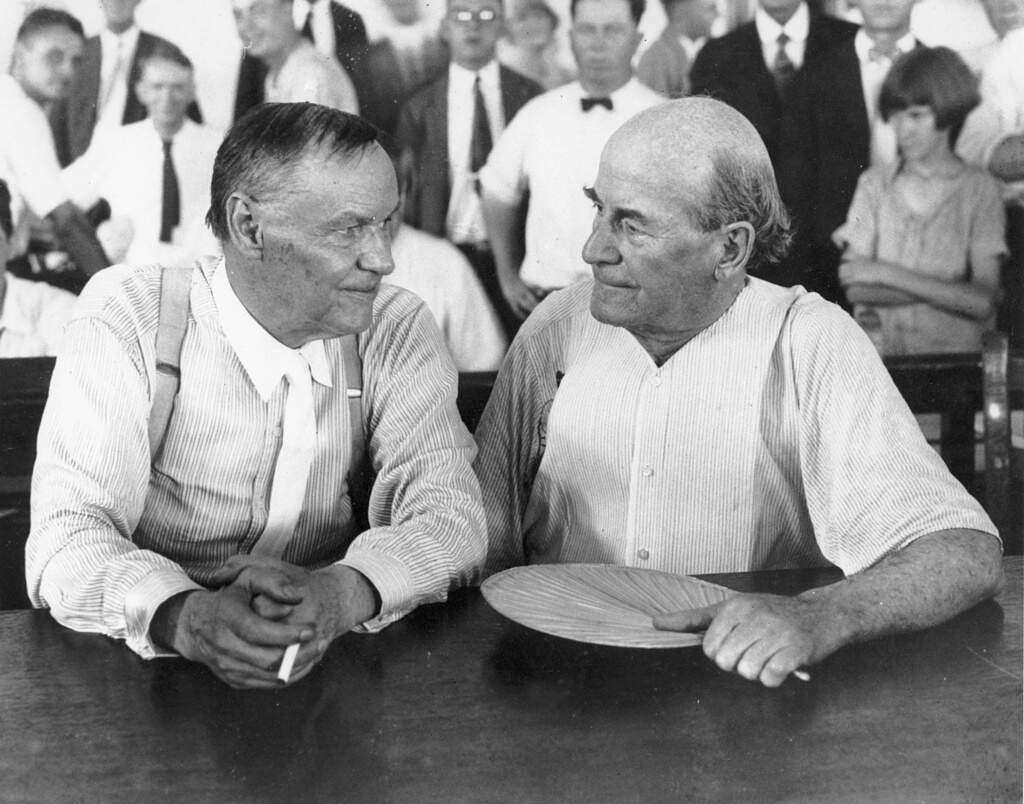
One hundred years ago, teacher John Scopes was arrested for teaching evolution in a Tennessee public school. His trial became a national sensation. Today, we’re still fighting over what should be taught in public schools.
Guest
Ed Larson, Historian and professor at Pepperdine University’s Caruso School of Law. Author of Summer for the Gods: The Scopes Trial and America’s Continuing Debate Over Science and Religion, which won the 1998 Pulitzer Prize for History.
Also Featured
Rick Dye, President of the Rhea Heritage Preservation Foundation.
Transcript
Part I
MEGHNA CHAKRABARTI: Almost exactly 100 years ago. July 21st, 1925, a Tennessee jury handed down a guilty verdict. One that remains as relevant today as it was a century ago. And that verdict had to do with a young man named John Scopes. In 1925, he was a high school football coach and substitute teacher in the small town of Dayton, Tennessee.
By all accounts, he was thoughtful and unassuming. An observer of history rather than a participant. But all that changed that spring when Tennessee's governor signed the Butler Act, it made Tennessee the first state in the country to ban the teaching of human evolution in public school classrooms.
JOHN SCOPES: Law is written in Tennessee said that no theory of the origin of man could be taught that contradicted the story of the origin of man in the book of Genesis.
CHAKRABARTI: That's John Scopes himself, speaking with radio legend Studs Terkel, in an interview from 1960. Now, after that Tennessee law passed, the new, at the time, American Civil Liberties Union put out a newspaper ad offering to finance the legal bills for any teacher willing to be a defendant in the case challenging that evolutionary teaching ban.
A Dayton community leader approached Scopes, even though it was unclear if he had even ever taught evolution.
SCOPES: And he said, will you be willing to allow your name to be used for a test case of this law to determine the constitutionality of this law? And I said, okay.
CHAKRABARTI: What followed was an eight-day trial that would later be called the trial of the century. Hundreds of reporters from across the country descended on Dayton, Tennessee, and Scopes told Studs Terkel that he felt he was standing up for academic freedom.
SCOPES: And I felt that anybody, that any American citizen, who had any feeling for the fundamental rights that was guaranteed in our Constitution would've done the same thing that I would, that I did.
CHAKRABARTI: Scopes was found guilty by the Dayton jury of teaching evolution. He was fined $100. We'll talk about what happened as the case went through appeal later on.
But more important, the original act that prohibited the teaching of evolution in Tennessee schools, the Butler Act, it remained on the books in Tennessee for more than 40 years after Scope's trial. In an exchange, in that Studs Terkel interview, Scopes says that questions about the role of religion in schools were still unresolved.
SCOPES: We haven't advanced too much.
TERKEL: You feel we haven't?
SCOPES: No, I don't think we have.
CHAKRABARTI: That was John Scopes in 1960. In 2025, the fight over what should be taught in American schools has only intensified and it's intensified beyond the question of evolution. The Trump administration has called for the elimination of programs and materials that support diversity, equity, and inclusion.
And in Tennessee, the state passed a law in 2021 that restricts teaching certain concepts related to gender or race. Alexza Barajas Clark is with the state advocacy group, EdTrust Tennessee, and she spoke with Knoxville, Tennessee Public Radio Station, WUOT.
ALEXZA BARAJAS CLARK: I think the rest of the country is catching up to what's already been happening in Tennessee.
And so if you hadn't been paying attention, like this is what it looks like to have a legislative body dictate what's happening in classrooms.
CHAKRABARTI: So a hundred years after the Scopes trial, what are the lessons that trial can teach us now as controversies over what should be taught in school are more intense than ever?
Joining me now is Ed Larson. He's a historian and professor at Pepperdine University's Caruso School of Law. He's also author of Summer for the Gods: The Scopes Trial and America's Continuing Debate Over Science And Religion. That, by the way, won the Pulitzer Prize for history in its first publication.
Professor Larson, welcome to On Point.
ED LARSON: Thank you very much for having me.
CHAKRABARTI: Alright, let's go back to the beginning, because I'd love to actually learn a little bit more about John Scopes himself. Who was he?
LARSON: At the time in 1925, John Scopes was a young, he's 24 then, I think, teacher, he'd been born in Illinois. Salem, Illinois, the same town oddly enough where William Jennings Bryan was born and he'd kicked around, but he eventually graduated from University of Kentucky and became a teacher. He had always wanted to be a teacher, apparently.
And he was hired mainly though in Dayton. It was his first job. It was his first year as a teacher, as a, this football coach. He was an athlete himself, very athletic, and he was, the team had done terribly the year before. He led it to a 500 record that year, by the way, tied schedule. And, but he was also, as this is still true. High school football coach also teaches a variety of subjects. He taught general science.
Now that wasn't biology, but he was a general science teacher. He was popular in town, and he opposed, his father had been a union organizer. He himself leaned towards socialism, and he opposed the law. But he wasn't very political. He wasn't very involved. He wasn't very religious, but as he once said, he would occasionally go to the more liberal Methodist church in town as a way to use his phrase, to pick up nice girls.
And so the townspeople heard about this new law. Of course it was big news. It was front page news, the passage of this anti-evolution law by the state of Tennessee. Dayton had nothing to do with that. But after it passed, the ACLU based in New York, which had been dogging this and similar laws, because this was a national movement. As your earlier speaker mentioned, what's happening in Tennessee now is an echo of what's happening nationally. It was the same way back then. This law had only been passed because of William Jennings Brian, national crusade for laws against teaching evolution. And he'd come to Tennessee and spoken in Nashville in January. And that had led to the introduction in ultimate passage of the law.
So it was big news.
CHAKRABARTI: ... Going to jump in here, Professor Larson and forgive me because there's a lot that that I want to cover. So I'm going to be jumping in quite a bit. But you've touched on something very important, and I think it's something that's not often enough understood by people who have just a casual understanding of the Scopes trial.
I'd like to learn more about the political temperament in Tennessee at the time, and then we'll come back to Brian. Because obviously he's a key figure in this and the national, his national movement against the teaching of evolution. But we also, we're smack dab in the middle of the 1920s. And you talk about Scopes, his father being active in union circles, we have the progressive movement going on, especially with American farmers. What was the political temperament in Tennessee? Even in Dayton specifically about things like the teaching of evolution in schools.
LARSON: I don't think it was a big issue at all in Dayton, because Dayton was not, that's Hill Country of East Tennessee, and that's not part of the Tennessee mainland. Back then, remember that part of the state in the Revolutionary War times had been pro unionist. The state itself was of course left the union.
This war in living memory of the Civil War. People were still alive who'd fought through that battle. It's not far from Chattanooga where battles occurred. There is a deep sense of conservative religion in Tennessee. There is a strong creationist, and a bit of a reactionary, anti-north feeling as a state as a whole.
So the state itself, when this law is pushed on them, you could tell that the legislature didn't really want to pass it and the governor didn't really want to sign it. But when the law is pressed on them by a conservative, the highly religious legislator, they really can't say no.
And so they passed this law to make it a misdemeanor, gross misdemeanor, punishable by between $100 and $500, no prison time involved, making it a crime to teach, that humans descended from a lower form of animal or an other form of animal. In contrary to the biblical account.
It was religious enactment.
CHAKRABARTI: So why was William Jennings Bryan undertaking this national effort, as you said, to try to ban the teaching of evolution in schools? He's obviously very famous in American history, but why try to change this across the country?
LARSON: William Jennings Bryan was a populist. First and foremost. He had been nominated for President in 1896 by both the Democratic Party and the Populist Peoples Party because he was proposing a populist solution to the crisis of 1893, which was the deepest economic recession that America ever faced to that time, biggest ever in history except for the Great Depression. And his solution, like a good populist was a nice, simple, straightforward legislative solution. That is bimetalism. Coin silver, as well as gold make them both currency and therefore you increase the money supply and that'll solve all the problems. He then, after he narrowly lost that election, he spent the rest of his life, preach.
He was a great speaker. Preaching a series of simple populous solutions. And they could come from the left or right. He claimed to be the author or the main person who got across the line four constitutional amendments. That's more than anybody else, except James Madison. And those were, they were all populist solutions.
One was a direct election of senators, one was the income tax, one was female suffrage. He claimed there'd never be a war again if women got to vote. That was his reaction to World War I. And he pushed for child labor law. He pushed for initiative and referendum for a single House state legislatures.
And in that laundry list were some very conservative issues like segregation laws. Jim Crow laws that he supported, immigration restriction which he thought would protect labor. He also was very proud of his British bloodlines. So he pushed for, he supported the Immigration Act of 1924.
Part II
CHAKRABARTI: Professor Larson, you were describing the import of William Jennings Bryan in American history, and what I find so fascinating about him is, as you've outlined, he was this sort of crusading progressive on a number of issues in the early 20th century.
Also, quite reactionary in others. But then it was all grounded in his very fervent almost literalist Christian belief in the Bible. He's just such a fascinating person. But then, and he wanted to tell, help me understand a little bit more about, was his desire to get a national ban on the teaching of evolution, simply part of his overall approach to bringing sweeping change to America?
LARSON: You summarized him very well. He was that mix. But down deep, and this is what you stressed, down deep he was a Christian. He had a Christian worldview, I wouldn't call it literalist, but it was deeply Christian. And he thought that the idea that humans are created in God's image, was what made them special, made them different from animals. To him, they weren't animals. And so if you undermine that faith in humans made in the image of God.
Then it leads to, because he connected his worldview all up. It led to the World War I. He had opposed World War I. He had resigned as secretary, of Wilson's Secretary of State in protest of the drift toward war, and he blamed it on the rising secularism of Europe that he said turned Europe into a slaughterhouse.
He condemned scientists for making the chemical weapons and other weapons that made that war, the deadliest war in history. Now, not only had they, had America suffered that war, but we suffered the greatest pandemic in world history, the Spanish flu, which killed millions worldwide. And over two thirds of a million in America.
And then we had this, whatever you want to call the jazz age. There was the roaring twenties where all morality seemed to be breaking down, at least in his view. Now, he wanted, he had always thought America should be founded on religious values and that would protect the working man, that would protect decency.
And he saw, he came to see that the Darwinian theory of evolution, which he readily mixed. And people would criticize him for this readily mixed with a Herbert Spencer version of social Darwinism. And that sense was corrupting America. It led to war, it led to the loss of faith. It led to the degeneracy as he would view it, of the Roaring twenties.
CHAKRABARTI: Professor Larson, hang on here. Hang on here for a second, because the issue of Bryan's objection to social Darwinism I think is really important, and I want to come back to that a little bit later in our conversation.
But let's return to Scopes himself, because another fascinating thing about the fact that this trial even happened is, in this day and age, when advocacy groups go plaintiff shopping it's a legal practice that's oftentimes frowned upon, but everybody does it right.
They're trying to find the perfect plaintiff to bring a case to trial, to challenge a law. Often at the national level, I was actually quite surprised to learn that this was a common practice even a hundred years ago, when the ACLU essentially plaintiff shopped for someone to challenge the Tennessee law.
And here's how John Scopes himself talked about it. And again, this is from the 1960 interview he did with Studs Terkel.
SCOPES: Well you know, the first I heard of the test case, the chairman of the school board sent word that we would like to talk to me and immediately, well, within 15 minutes, I had arrived at his place of business. And he said, ‘will you be wiling to allow you name to be used for a test case of this law to determine the constitutionality of this law?’ And I said, ‘well, OK.’ And within 30 minutes from the time I was asked to come see Mr. Robinson, it was on the wires out of Chattanooga that I was arrested.
CHAKRABARTI: It's John Scopes from 1960. It's remarkable, isn't it? Professor Larson?
LARSON: Yeah. And he always told the story a little differently because it was a lot of years later, but yes, F.E. Robinson, the was the chair of the school board and he ran, he had a drug store. It was the town watering hole in that time of prohibition. And the manager, the local manager of the mines or the iron processing plant, which it was closed down in Dayton, had opposed the law and he had gone into Robinson's drug store that morning.
And said, I know how we can get a little attention for our town. I read in the newspaper that the ACLU was offered to defend any schoolteacher who is willing to challenge this law in court. If we hold that test case, it'll be a national sensation and it'll bring people to this town and reporters and even some business to your drugstore.
And so they got together with the city solicitors, the Hicks Brothers. And the superintendent of schools Walter White, and they hatched up this plan. Then the question was, who was going to be their Guinea pig? Who was going to be the defendant. Now, they didn't want to use the biology teacher who may or may not have taught evolution.
It was in the textbook, human evolution. But because he was also the principal and he had, his wife was ill and for a variety of reasons. But here was Scopes who was well liked, who was a general science instructor, as Scopes repeatedly admitted later, he never had taught evolution. It really didn't matter.
And so they called him in from a tennis game. He was playing tennis. And they asked him that fateful question that he noted there. And he said, yes, he had opposed the law. He didn't like it, but he never was very political. And so he became what the ACLU later described as the ideal defendant.
He was young. He looked a little bit like Harold Lloyd, if you know what he looked like. And he was a popular entertainer back then. Comedian in the films. And remember, this is a celebrity era. This is the era of Babe Ruth and Mary Pickford. And here was a celebrity case. When Bryan and Darrow got involved, they had their summer event, which they viewed as a way to promote the town and test the law at the same time, but they were not ideologically particularly for or against the law.
Some of them we know supported the law, some of them opposed it, but mostly they wanted as the judge would call it, a Summer Chautauqua, a summer educational event where they would test the law and Scopes was just along for the ride.
CHAKRABARTI: That's so fascinating, and also, it's like an economic boost for Dayton as well.
So here again, here, let's listen to Scopes himself because he's like in this interview with Terkel, they had to actually also prove that I even taught evolution while he was a substitute teacher. And he wasn't actually very clear about it.
SCOPES: One of the things I remember was that I said I will agree to the test case if you can prove I taught evolution, which I'm sure I did.
If I substituted in a class in biology for a period of three weeks. But if you can prove it without making me perjure myself, I'll agree.
CHAKRABARTI: Professor Larson, did it even matter? In terms of the bulk of the arguments made in the trial, did it matter if he had taught it for a day, if he had taught it for three weeks?
Why was this an important issue?
LARSON: No, it wasn't important. And they kept him from perjuring himself by not ever putting him on the stand. There were other interviews where he readily admitted he'd never taught it. He had, remember he wasn't the biology teacher. He did fill in for the biology teacher.
We have his exams from that period. They never mention evolution. There's no indication that he ever taught it, but as you said, it didn't really matter. What they were doing was testing the law. And so the way they proved as it were in court was they had, they introduced the textbook, and the textbook does include evolution.
Nobody ever questioned. The defense, Clarence Darrow or the defense never questioned whether Scopes taught it. Because you're right. It really didn't matter. What they were testing was they thought the constitutionality and validity of, and in a larger sense, the wisdom of such a law where you make the, remember the law specifically said you couldn't teach evolution in opposition to the biblical count.
So they were trying to argue the point that, how can you say that evolution violates the Bible? Because they were going to bring in a variety of experts to say, evolution is readily, I'm a Christian, I'm a scientist, and evolution is readily reconcilable with the Bible in the same way that a heliocentric Copernican universe is compatible with the Bible, even though the Bible sort of implies the flat earth and the earth and a earth that doesn't move well.
CHAKRABARTI: One of the most, of course, but I think generally one of the most famous depictions of the trial was, of course, from the movie Inherit the Wind. And we have a scene here that sort of encapsulates this legal and even intellectual testing of the Tennessee law that went on in the Scopes trial.
Of course, the movie Inherit the Wind stars Spencer Tracy. And he plays a character modeled after Attorney Clarence Darrow and in the scene, he's interrogating Frederic March, who is modeled off of William Jennings Bryan. And Spencer Tracy grills March about the exact details of how God created the Earth.
MARCH: The Lord began the creation on the 23rd of October 4,004, BC at, uh, 9:00 AM.
TRACY: That Eastern Standard Time or Rocky Mountain Time? It wasn't daylight saving time, was it because the Lord didn't make the sun until the fourth day?
MARCH: That is correct.
TRACY: That first day. Well, what do you think it was? Uh, 24 hours long?
MARCH: Bible says it was a day.
TRACY: Well, there was no sun. Uh, how do you know how long it was?
MARCH: The Bible says it was a day.
TRACY: What was it? A normal day, a literal day, 24 hour day.
MARCH: I don't know.
TRACY: What do you think?
MARCH: I do not think about things that I do not think about.
TRACY: Do you ever think about things that you do think about? Isn't it possible that it could have been 25 hours? There's no way to measure it. No way to tell. Could it have been 25 hours?
MARCH: It's possible.
TRACY: Then you interpret.
CHAKRABARTI: That's from Inherit the Wind. Now, Professor Larson, I also actually wanna play another moment from the interview that John Scopes gave with Studs Terkel. Because in 1960, Terkel read the trial transcript to Scopes from the identical moment that's portrayed in the movie.
Here's a bit of the dialogue, the actual dialogue of the trial that perhaps might bring things to your mind. When Darrow has, Bryan is on the stand and he is, he's asking, uh, Darrow is asking Bryan whether he believes in the literal interpretation of the Bible, and Bryan says, yes, sir.
And Darrow says, when was that flood? Do you believe the flood? Literally, he says, yes. When was the flood? Brian said, would not attempt to fix the date. Uh, Darius, about 4,004 BC and Brian, that's been the estimate of a man that is accepted today. Uh, I wouldn't say it's accurate. And Darrow says, what do you think? And Bryan says, I do not think about things. I don't think about.
And Darrow says, do you think about things that you do think about? And then Bryan says, I want Darrow to have all the latitude he wants for, I'm gonna get some latitude when he gets through. And Darrow, you can have all the latitude and all the longitude. Yeah, I remember that. That was pretty rough on Mr. Bryan. Yes. I mean, obviously he was facing, in this instance, n antagonist was much, much too strong though.
Well, I think that the cards were all stacked in Mr. Darrow's favor in that case because Mr. Bryan was taking the position that the Bible as one fundamentalist preacher done, they expressed it the other not so very long ago. Was that it was correct and true, and he believed everything in it, every page in it. Well, anybody that would know then that if you're basing or scientific approach on well, not scientific approach, but trying to teach science based upon the Bible. We probably would be still driving, riding, driving a horse and buggy.
CHAKRABARTI: That's John Scopes speaking with Studs Terkel in 1960.
Professor Larson, that moment of the trial or moments are so famous that people, like what lesson do you have to draw from there? Because while Darrow may have outwitted Brian in terms of legal repartee, Scopes was still found guilty by the Dayton jury.
LARSON: He was, and under the testimony that they heard, they did not hear any of this exchange between Bryan and Darrow because they were excused at the time because it didn't relate to the issue the judge had ruled. The issue in the court was whether Scopes had ever taught evolution.
The prosecution presented evidence that he had in the form of the textbook. And also students who said they had taught him evolution. He had taken him out in a taxi cab the morning before and taught him, told him about evolution, and never asked him if it was in a courtroom in the classroom. And the defense never rebutted that testimony.
Indeed, at the end, Darrow asked them to convict Scopes or implied that he wished them to, and that the prosecution made that clear so that he could bring an appeal. Because only if Scopes was convicted could they appeal and test the constitutionality of the court in the Tennessee Supreme Court.
And ultimately, if they could in the United States Supreme Court. Now the exchange that you heard in the movie, of course, never happened at the actual stand. When asked about the age of the earth, Bryan in line with Evangelical scholarship at the time, said, I don't know how old it is, and adopting the day age theory in an ancient earth.
He said, I don't care whether the earth is 6,000 years old, 600,000-year-old, or 600 million years old. I don't think it matters. The important thing to him was that God created not only in the beginning but also created people. And so the statue doesn't ban the teaching of evolution, only human evolution because he wanted to protect it.
Humans were created in God's image.
Part III
CHAKRABARTI: We are indeed talking about the 100th anniversary of the Scopes Monkey trial and what the country can learn today as debates over what should and shouldn't be taught in schools are as intense as ever. Back in 1925, during the Scopes trial, famed country singer Vernon Dalhart released a song commemorating the trial, and here's a little bit of that.
VERNON DALHART (SINGING):
Then to Dayton came a man with his new ideas so grand and he said we came from monkeys long ago. But in seeking his belief, Mr. Scopes found only grief, for they would not let their old religion go.
You may find a new belief, it will only bring you grief, for a house that’s built on sand is sure to fall. And wherever you may turn, there’s a lesson you will learn, that the old religion’s better after all. (MUSIC)
CHAKRABARTI: That's from 1925 and Vernon Dalhart singing about the Scopes trial in Dayton, Tennessee. Today, the trial remains a significant part of local culture.
RICK DYE: So now we have Monkeytown inflatables for events and you have Monkeytown Lawn and Care, we once again have the community as they did in 1925, embracing it.
CHAKRABARTI: Rick Dye is president of the Rhea Heritage Preservation Foundation, and for more than three decades he has helped put on an annual play commemorating the anniversary of the Scopes trial.
And in that play, his role is as defense attorney Clarence Darrow, in the same courthouse, by the way, where the real historical events took place.
DYE: All the wooden furniture, the judge's original bench the jury chairs, and even the chairs that the audience sits in are all preserved. It's a massive and intimidating room.
CHAKRABARTI: Dye says that when he first moved to Dayton in the 1990s, many people saw the town as a stereotype. They'd compare it to Heavenly Hillsborough from Inherit the Wind and the buckle of the Bible Belt, quote-unquote. Dye, says he's trying to fight against that narrative and 90% of the play uses real dialogue from the trial transcripts.
DYE: It's amazing how many people walked in the door over the years saying, oh, I've seen the movie. I couldn't wait to see this. And then leave going, I didn't know that's how it actually happened. I didn't realize it was a setup. I didn't realize Scopes was a willing participant. I had no idea of the true story.
CHAKRABARTI: And Dye believes the real story of Dayton, Tennessee in the Scopes trial is much better or much more interesting than any fictionalized version.
DYE: What actually occurred in the courtroom, those core arguments we're still having today. The key question, what are the rights of parents? What is their role and proper role in public education?
How does that clash or impact with freedom of speech, academic freedom? Are teachers free to teach what they believe? School choice? Here we are in Tennessee, we just passed a voucher program enhancing School Choice. So all of these issues are still being argued and remain unsettled a hundred years later.
All of these issues are still being argued and remain unsettled a hundred years later.
Rick Dye
CHAKRABARTI: Dye says he's had great response to the play. And remember, they hold it every year in the same courthouse where the original trial was held. This year on the hundredth anniversary of the trial, the play sold out six weeks in advance. And the production not only supports the community of Dayton through the added tourism, of course, but it keeps history alive in the city.
And Dye says, luckily, that's easy to do in such a well-preserved setting.
DYE: I say almost bragociously that I've spent more late-night hours in that courthouse than any other resident in the community. And there is something very awesome to be in that room sometimes late at night, all along, that building, any building, 130 years old will come alive.
The heat comes on or the air comes on and you hear the building creak. You'll hear the stairs moan and sometimes you just literally feel like the words of Bryan and Darrow are still bouncing around in that room. And if you're real silent and hold real still, you can hear a little of them.
CHAKRABARTI: That's Rick Dye, president of the Rhea Heritage Preservation Foundation.
Professor Larson, also in that room, which we actually, we have to know. I haven't, I'm so surprised I haven't said this until now, and I'm sorry about this. In 1925, the trial was also broadcast live on the radio. Yes? So it had, people across the country could hear what was going on in Dayton.
LARSON: You are right. It was broadcast live over the first broadcast tile in American history. On the radio, they'd put up special lines to do it. It was also filmed and you can of course watch some of the film footage. It was the cameras right in the room and the film was flown to northern cities and other cities eventually to shown live in movie halls with people reading the transcript.
That was an era of silent film, of course. There were hundreds of reporters. Every word was clicked out. If you look at virtually any major paper in the country you will see a day-to-day complete transcript of the trial printed in the next day's edition. So America was following this closely. We know exactly what was said in the courtroom.
The one place, I love Rick, and I was there last week in the courtroom just as I was there for the 75th and the first year they did the trial, you wouldn't have heard the words of Bryan and Darrow echoing in the courtroom because this famous interrogation was conducted outside on a bandstand, just outside.
Because the judge wanted the whole community to be able to hear this encounter, and so there were thousands spread out over the courthouse lawn listening to it. It was not inside the courtroom.
CHAKRABARTI: So let's talk for a moment about one of the most famous people who is covering the case. And that's H.L. Mencken.
Again, all of these figures, Darrow, Bryan, Scopes himself, Mencken. We could spend hours talking about each of them. But what do you think Mencken's most important role was in terms of, again, thrusting the scopes case further into the national consciousness when it came to this debate over religion and science??
LARSON: H.L. Mencken was important. H.L. Mencken was the first one to suggest Darrow, Clarence Darrow, that he volunteered. Darrow at the time was the most prominent defense lawyer in the country, trial lawyer of any type in the country. Commanding huge retainers if you take a case. And he did this as a volunteer, the only time in his life he ever volunteered free legal aid because he believed deeply.
Darrow was a nationally recognized, I don't know, village atheist on the national scale, like Richard Dawkins became later. He would speak about the dangers of religious lawmaking, and so he was a natural to try this case. Mencken asked him, Mencken, then went down.
Mencken was nationally syndicated columnist as well as a news writer for the Baltimore newspaper. And he had his own magazine, the American Mercury. And he wrote columns about the trial. And what he did was, remember this really wasn't viewed as Dayton as an anti, as an adversarial event.
They were just testing the law. They didn't think they would be in the center of the storm. What Mencken did was Mencken was great at, well, creating a story. And the story is other Dayton, make it North versus South, make it urban versus rural. Make it religion versus science. And that's how Mencken crafted this for a national audience. And so it became point-counterpoint, that sells newspapers, that creates interest.
They were just testing the law. They didn't think they would be in the center of the storm.
Ed Larson
But it also made creationism or the biblical view or whatever it was that Darrow was opposing and Bryan was supporting it, made it a North-South issue.
It made it urban, rural, it made it modern versus the past, it made it traditional Christianity versus modernist Christianity. And that made the story that resonated. And that's the sort of divide that was, if you want to characterize it as the opening gun in the culture wars, as Rick points out, and as you point out, those cultural wars continue to resonate in Tennessee and nationwide.
CHAKRABARTI: Yeah. So as we round towards the last few minutes here I wanna talk about what I also see as another common thread in those culture wars over this past century. And it has to do with what you said earlier about William Jennings Bryan being very concerned about social Darwinism.
Now I did hear you say that he was conflating social Darwinism with Charles Darwin's actual beliefs, but there's a part of, I believe some remarks that Bryan wanted to make, but he couldn't because he tragically died just a few days after the actual trial. But in these remarks, he speaks or he writes directly at this issue and here's a little bit of it.
He says, quote:
Darwin speaks with approval of the savage custom of eliminating the weak so that only the strong will survive and complains that we civilized men do our utmost to check the process of elimination.
And again, he's confusing what Darwin's actual beliefs were, but he goes on to say he thinks it's injurious to build asylums for the imbecile, the maimed, and the sick, or to care for the poor.
And here's the part that really I think resonates. This is William Jennings Bryan again, he's saying quote:
Science is a magnificent material force, but it is not a teacher of morals. It can perfect machinery. But it adds no moral restraints to protect society from the misuse of the machine. It can also build gigantic intellectual ships, but it constructs no moral rudders for the control of storm-tossed human vessels.
This desire that Bryan had to protect people from the vagaries of what he saw as the advancements of science. I do find a thread between that and the desire that lawmakers have today, or their stated desire at least to protect students from what they believe are the ills of DEI or the threats that come with certain educational materials about gender, for example.
And I'm wondering what you think about that Professor Larson.
LARSON: Bryan, certainly, as you capture it, certainly was concerned about science as an amoral force. So if you looked at all of his speeches and remember this time, his income came as a public speaker. He would give over 200 paid lectures a year at this time, and the associated book sales.
And he had a few sets, stump speeches, and they talk about evolution, scientific evolution, undermining belief in God and by undermining belief in God they also undermine the social order in all the ways you say, and that we can't look for science as a source of right and wrong. We have that same case today.
Think of the debate over AI today. It's very similar, that science is creating something that could destroy humankind, just like back then chemical weapons in World War I. Or later in the second World War, you have the same thing with the atom bomb. And so that science, how do you control this? And Bryan deeply believed that to protect humankind and protect human values, you needed religion.
Think of the debate over AI today. It's very similar, that science is creating something that could destroy humankind, just like back then chemical weapons in World War I.
Ed Larson
And therefore, he wanted to prop up religion and undermined science as a moral force so that echoed from then when in many ways science was viewed as a threat, and it echoes today. So that does continue and how you deal with that issue, then look at what's done ultimately, business requires science, uses science. That's where technology comes from. And so the business interest back then were for continuation of science and scientific development. It produces a lot of good, better health care, better technology. It produces a lot of questionable things, today on the same forces that get in arguing against AI.
Then end up today promoting more AI development and energy building for AI. It's a complicated mix. Bryan saw that in the Harding administration, which was elected on America first platform, return American to normalcy. He was a critic of the Harding-Coolidge administration. But they were elected on a lot of those same platforms.
And then it becomes complex of how they actually implement.
CHAKRABARTI: So fascinating. And I want, in the last minute that we have, I wanna actually give John Scopes, in a sense, the last word here, because in his interview with Studs Terkel he actually says something almost in passing, but I think it gets to the heart of why these, so these battles are actually fought in schools, in public education in the United States.
So here's John Scopes again in 1960.
SCOPES: What happened today, is the statute still on the books? The statute is still on the books and it is my understanding that the teaches in Tennessee have to sign some kind of a pledge that they will not teach any kind of theory of any portion of the theory of evolution. They sign this pledge, but do they teach?
Well, if they have any classes in the biological sciences, they must have to teach it. So then evolution of the bootlegged. And to me that raises a very pertinent point. Is it a good thing for our children to grow up and become ultimately members of society to think that subterfuge is a good thing? That we should use subterfuge? So in the name of what some people think is good, deception becomes the order of the day. I don’t think it’s a good atmosphere.
CHAKRABARTI: That's John Scopes and Studs Terkel in 1960, and it makes the hair on my arms raise a little bit. It seems so relevant for today.
The first draft of this transcript was created by Descript, an AI transcription tool. An On Point producer then thoroughly reviewed, corrected, and reformatted the transcript before publication. The use of this AI tool creates the capacity to provide these transcripts.
This program aired on July 28, 2025.