Support WBUR
Famine in Gaza
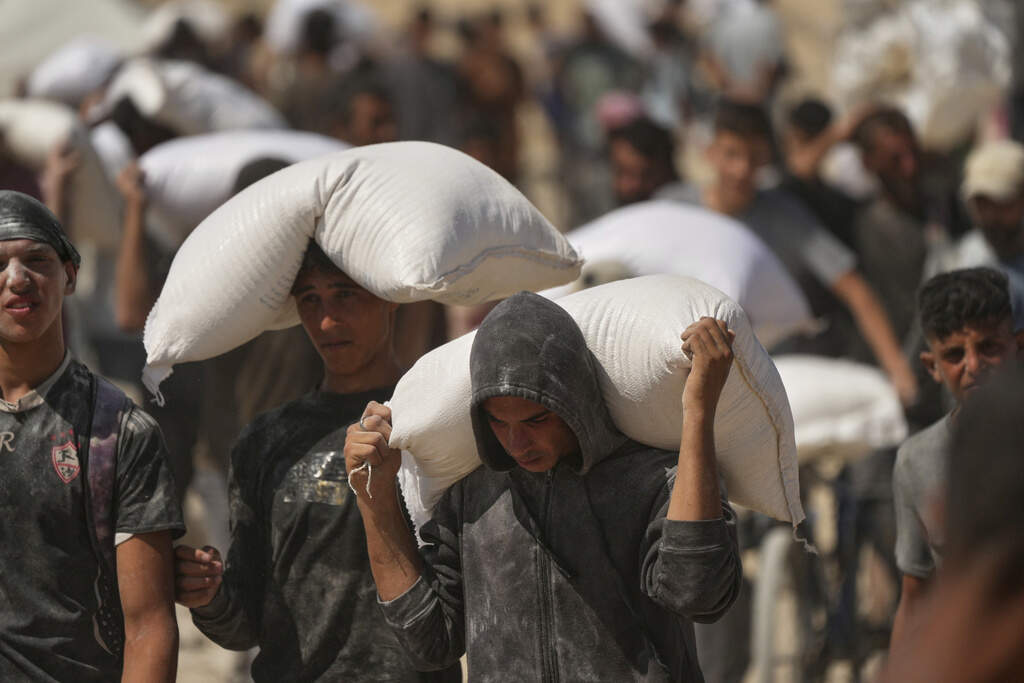
A “worst-case scenario of famine" is currently playing out in Gaza, according to the leading international authority on food crises. It says immediate action is needed to save hundreds of thousands of Palestinians from starvation.
Guest
Louise Wateridge, senior emergency officer for The United Nations Relief and Works Agency for Palestine Refugees in the Near East (UNRWA). She was based in the Gaza Strip but isn’t there now because her agency was denied entry into the area in January 2025.
Alex de Waal, executive director of the World Peace Foundation and research professor at Tufts University’s Fletcher School of Law and Diplomacy. Author of “Mass Starvation: The History and Future of Famine.”
Also Featured
Abeer Barakat, a Gaza City resident and lecturer in English at the University College of Applied Sciences in Gaza.
Transcript
Part I
MEGHNA CHAKRABARTI: Abeer Barakat could not have a cup of coffee this morning. She couldn't have one yesterday morning or the morning before that, or even three mornings ago.
ABEER BARAKAT: So I really miss having a cup of coffee, real coffee, and I miss drinking coffee with milk or whatever. With Coffee-Mate.
CHAKRABARTI: In fact, Abeer hasn't been able to experience the pleasure of savoring a cup of real coffee for months.
BARAKAT: And this brings to something the world needs to know. That we Palestinians, we try to make alternatives of everything because we are trying to preserve our way of living to the most. For example, we love coffee, Palestinians love coffee so much. Now we don't have coffee grains. So what did we do? We have an alternative for it.
We have the chickpeas. They, we burned them. Okay.
CHAKRABARTI: Chickpeas, those small, round, pale yellow legumes. You might also call them garbanzos. Abeer says Gazans now roast the chickpeas over a fire until they're completely black. Then they grind down the small dark spheres and add some spices.
BARAKAT: They put cardamom on it to give them the taste of Arabic coffee, and we drink it like coffee.
So imagine we now laugh about it. We say, would you like to drink some chickpea. Don't say, would you like to drink some a cup of coffee?
CHAKRABARTI: Abeer lives in Gaza City.
BARAKAT: We try to survive, and we have alternatives for everything, even for flour. Can you believe it? We have made bread out of pasta. I know the Italians would be crying right now.
Because we take the pasta, we soak it in water for the whole night, and then we make it like a dough and make a bread out of it. So I'm sure if an Italian person would see what we do with pasta, they would go crazy.
I didn't know what to say. I'm trying to laugh out our misery, trying to make a laugh about it so that we wouldn't really go crazy.
CHAKRABARTI: We've spoken to Abeer several times since Israel began its war in Gaza some 22 months ago. She's a university professor, as is her husband. Abeer and her family have been displaced 14 times since the war began. In May of last year, she told us it was as if her family had been bombed back into the stone Age.
BARAKAT: We are trying just to find water, food, fire. It's like pretty much like the Ice Age or the Stone Age. This is exactly how I feel. I even now call my children the Croods.
We are trying just to find water, food, fire. It's like pretty much like the Ice Age or the Stone Age.
Abeer Barakat
CHAKRABARTI: Gazans are completely dependent on food aid that the Israeli military allows into the territory.
There is no other significant source of nutrition, and now Abeer's pantry has been reduced to three main ingredients. When we spoke with her last week, she said they were flour, beans and pasta, and only when she can get them.
BARAKAT: We barely have one meal per day, one meal, and we try to not to take it early in the morning so that it'll last with us till the end of the day.
CHAKRABARTI: The United Nations says Gaza is on the brink of famine. The UN World Food Program declared last week that 100,000 Gazan women and children are suffering from severe acute malnutrition, and that one third of Gazans must go days at a time without eating. Another world food authority, the Integrated Food Security phase classification, or IPC says a worst-case scenario is playing out in Gaza, and that without immediate relief, widespread death is imminent.
When we spoke with Abeer last week, we asked her if she's seeing people who are malnourished and starving firsthand.
BARAKAT: Of course, this is a silly question to ask because I myself am starved. My family, everybody around us, we are like walking dead. We are like zombies. If you look at us walking the streets, we feel like drunk people.
My family, everybody around us, we are like walking dead. We are like zombies.
Abeer Barakat
I walk in the morning feeling very tired and exhausted. I cannot sometimes get out of bed. When I move from the room to the kitchen, I feel like it's a mile. It's very difficult for me to move from one place to another inside the apartment, I feel dizzy. I have headaches. I have blurry vision. I have memory losses.
I cannot remember very simple details. When I'm working, I read the paragraph in front of me many times just to make it enter into my head, but it doesn't. We have lost many of our weight, body weights, including the muscle. Now we are losing our muscles. My son has lost 30 kilos of his body mass. About the other people around me, I can see children suffering. I can see them like skeletons, in front of me everywhere in Gaza.
You see how people have changed. So for example, when I'm walking in a street and I see someone I know who was a friend or a work colleague before, I just stare at him for five to six minutes trying to remember, who is that person?
And then I just remember and I said, my God, you have changed a lot. You look different. So we barely recognized each other with the amount of weight loss that everyone has is suffering from.
CHAKRABARTI: Abeer's own supply of flour varies from day to day. Sometimes she gets it from a market, sometimes she gets it through friends, but she can never predict how much it will cost.
Abeer says gangs often seize the flower off the few food trucks that are allowed into Gaza. Then they sell the flour at markets for wildly inflated prices, normally a kilo of flour would cost about three shekels or approximately 87 cents for two pounds. Abeer says sometimes she has had to pay 40 times as much.
BARAKAT: For example, today one kilo of flour is 45 shekels. Yesterday it was 40. Maybe tomorrow it'll be 60. So it depends on the news of the negotiations. This is how they fluctuate the prices. So if we heard here that there is a progress in the negotiations, and maybe next time they will declare a truth or a ceasefire, then the prices drop because these mobsters want to fill whatever they have in order to have a speed win.
Okay. If they hear that the Israeli negotiation group just lift Qatar and they are back to Israel, then they just rise up the prices to become 120 shekels. For example.
CHAKRABARTI: Israel has completely blockaded Gaza. In January and February of this year. A ceasefire allowed nearly 600 trucks per day to deliver vital food, water, and medicine, and other essentials into Gaza. But in March, Israel ended the ceasefire and halted all imports, including food. In May, aid was restored, but the average was just 70 trucks a day. There are 2 million people in Gaza. More than 1,000 Palestinians have been killed while trying to get food from trucks or distribution centers.
According to the UN Human Rights Office, both the Israeli Defense forces and the American backed group distributing most of the aid in Gaza, deny that number. The IDF says it only fires warning shots to prevent stampedes. Abeer though will not allow anyone in her family to go near the distribution centers.
BARAKAT: I have instructed my son very clearly. Even if we do not have food to eat, do not go to where these eight centers are because these are the traps, because we know that they kill people for sports, they enjoy doing that. They want to humiliate us, so we are not going to fall for that.
CHAKRABARTI: For Abeer, the battle against humiliation is as all consuming as the battle against hunger.
Late last month, Israel announced that it would allow Jordan, Egypt and the United Arab Emirates to airdrop aid into Gaza. The Israeli military said in a statement, quote:
The IDF will continue to work in order to improve the humanitarian response in the Gaza Strip, along with the international community, while refuting the false claims of deliberate starvation in Gaza.
End quote. Abeer knows about the airdrops, but she refuses to chase after them for food. She says doing that would mean abandoning her dignity.
BARAKAT: ... These are not airdrops.
They are air humiliation.
CHAKRABARTI: How to preserve her dignity. As we talked with Abeer, this issue came up over and over again. Hunger has a debasing effect on a human being. It gnaws away at everything that makes a person whole and happy. Abeer says she is doing everything she can to resist collapsing into desperation.
BARAKAT: You can imagine how hard it is when you build all your life to be a good person, and you have good life conditions. You built everything for you and your family, for your children, to make them live in a comfortable life. And then suddenly, boom, you hit the bottom. And you have to live by the law of the jungle, you have to grab water, grab food.
So sometimes I feel that I hit the limit of my sanity, but I try preserve to my faith in God and to know that this time will pass. We trying to preserve whatever dignity we have not to fall for this law of jungle, not to fall for these monsters. To preserve our morals and values and ethics. This inner struggle is really very difficult, and I hope that I will continue to keep the rest of my dignity until the war ends.
CHAKRABARTI: Abeer Barakat lives in Gaza City. On Thursday, Hamas released a video of Israeli hostage Rom Braslavski. His family allowed the video's publication just yesterday, and in it Braslavski, skeletally thin, saying, I don't have any more food or water before they give me a little bit. Today, there is nothing.
Three crumbs of falafel, he says, and barely a plate of rice. He says, I cannot sleep. I cannot live. I am at death's door.
This weekend, Hamas released another video of another Israeli hostage of Evyatar David. In that video, David too is emaciated. His skeletally thin body is digging a hole, which he says is for his own grave.
Yesterday Hamas announced that it would allow the Red Cross to deliver aid to the hostages, but only on the condition that is real permanently open humanitarian corridors in Gaza. So for millions of Palestinians and for the surviving Israeli hostages, there is hunger, desperation, and the shadow of death.
Part II
CHAKRABARTI: Today we are talking about food as a weapon of war. Louise Wateridge is with us. She's the senior emergency officer for the United Nations Relief and Works Agency for Palestinian Refugees in the Near East. Of course, that group was based in Gaza, but is no longer there now because Israel denied the UN group entry into the area back in January of this year.
Louise, welcome to On Point.
LOUISE WATERIDGE: Thank you.
CHAKRABARTI: What are your colleagues who are still in Gaza telling you about what they're seeing regarding the availability of food?
WATERIDGE: One of my colleagues described it best this week. He said, we are walking corpses. We are not dead and we're not alive. And I think those words have been the most powerful I've heard.
We've just watched everyone we know and love and work with deteriorate over the last few weeks if not months, because they have no food left. The last food that they received was during the ceasefire period, that was at the beginning of March. They've been rationing the supplies that they've had and now they have absolutely nothing left.
Anything that we hear is as appalling as mixing the last bits of flour with dirt in the ground to try and make it last longer. We hear of fishermen who are desperately trying to catch anything from the sea, but then being shot at or detained by Israeli authorities. So just the level of desperation is something we have never experienced and for sure our colleagues have never experienced.
And it's really, I don't have any other words to say. It's just unbearable. We don't have anything left to tell our colleagues anymore. They're trying to continue to do their jobs, but they themselves are also starving, also passing out from hunger and also watching their children disappear in front of their eyes because they have nothing they're able to offer them.
CHAKRABARTI: How many staff do you still have in Gaza?
WATERIDGE: We have around 12,000 working staff in the Gaza Strip. So our international staff, myself included, I'm speaking to you from London right now. I should be in the Gaza Strip providing our response. But it's our staff that are Palestinian, they are trapped.
We are denied entry into the Gaza Strip and they, like all of the Gaza population, they are denied exit from the Gaza Strip. So they're trapped in this living hell where they are bombed day and night. And now on top of that they are basically being starved to death.
CHAKRABARTI: We also spoke with several of your UN colleagues who are still in Gaza.
This is Hazem and he works for a United Nations Relief and Works Agency Protection Unit. He sent us this voice memo and you'll hear a buzzing sound in the background That is the sound of an Israeli drone.
We have nothing. We can't even secure the flower and anything. Every day it become harder to find food to survive for my family. I have one and half year old baby, and I cannot, I can no longer find basic needs for him. One month ago, and until now, I can't even provide for him milk or diapers. It's heartbreaking. As a parent, watching your child suffer and not being able to help is the most painful thing. As a humanitarian worker, also, I try to support others, but I can't even secure my own family's survival.
It's very hard.
As a humanitarian worker, also, I try to support others, but I can't even secure my own family's survival.
Hazem
CHAKRABARTI: Louise, how much aid is sitting just outside of Gaza and not getting into the Gaza Strip?
WATERIDGE: UNRWA alone has 6,000 trucks. Half of those are life-saving food and medicine sitting about two hours away from the Gaza Strip. They could be there as early as this afternoon if there was political will and if the access was given.
These trucks, these supplies have been sitting in warehouses or on trucks, waiting to enter for months on end now. I can't even describe the situation as frustrating because people are being killed, people are dying because of this. It's so far beyond frustrating. But being on the phone to my colleague ... who's been in our warehouse in Gaza City, completely empty.
They've given out the last bits of food and supplies few months ago, and at the same time, I was at our warehouse in Amman and everything that everybody needed was surrounding me. Food, medicine, water, hygiene kits, shampoo. Bear in mind, people, they don't have soap anymore. Just every kind of basic need has been denied and deprived of the population.
Every kind of basic need has been denied and deprived of the population.
Louise Wateridge
And to see it all surrounding me in this warehouse while my colleague on the other end of the phone has absolutely nothing. It's just heartbreaking. It really is heartbreaking.
CHAKRABARTI: Now, I think it's fair to say that attention to the humanitarian situation in Gaza has been extremely heightened recently because of some of the imagery coming out of Gaza, of emaciated babies.
Now there are lots of folks who say that this is just a Hamas propaganda campaign and that the situation on the ground is not as dire as a few images might lead people to believe. You were in, you were physically in Gaza, what, for about half of 2024. Can you tell me, Louise, like what was the situation then?
Is what we're seeing now something new? Or is it a continuation of a lack of humanitarian assistance for, since what, October, November of the beginning of the war?
WATERIDGE: Every week and every month I spent in the Gaza Strip last year, the situation got worse. At the time, I would've convinced you.
I would've told you this is the worst it's been. It can't get worse than this. And yet, every week and month we were proven wrong. I've been in hospitals where there are babies who have their legs amputated and they're missing limbs. Grandparents running around screaming, their children killed and they're looking for their grandchildren.
Paramedics trying to mop up blood from the floor. They don't even have disinfectant. They don't even have clean water. So they're just actually pushing round and spreading infection. We've been held at checkpoints and watched people, real people be eaten by dogs on the ground and just had to sit there and wait and watch these kind of horrors in front of us.
We've seen children and families, large families, crossing through checkpoints, held in the midday summer sun with no water, no food, no nothing. Clearly malnourished, clearly needing everything and been prevented from helping them. So it just, the horrors don't end, I don't know how to describe it without getting too graphic. These images now, yes, they are horrifying, but they're also totally predictable. And this hasn't happened overnight. Children and babies don't starve overnight. This takes weeks to come into effect. And we have been warning about this since March and since the 11-week total siege on absolutely all supplies into the Gaza Strip.
We've warned that this was happened and now that it has, what can you say? Anything that happens now, it's too late. I'm so sad to say. I have nothing but apologies to my friends and colleagues on the ground, because I'm so sorry. It's too late. Anything that we do now, it's not going to save enough people, and that is just the unbearable part of all of this.
It's too late. Anything that we do now, it's not going to save enough people, and that is just the unbearable part of all of this.
Louise Wateridge
The rule of the war has not been providing humanitarian supplies, that has never been the rule. It's always been the exception. Every so often the tap gets turned on, a few trucks can go in, a few movements here, and then it stopped again. The rule of the war has been to block all supplies from getting to the people who need it most.
CHAKRABARTI: Here is another one of your colleagues. This is Manar. And she sent us this note.
Even the simplest thing have become painful. Clean water is hard to find. There's often no water for cooking or washing and food. Food is never enough. Sometimes we cook with only rice if we are lucky.
Many nights we sleep hungry. Our children cry because they are starving. As a mother, this breaks my heart. Medicine are missing and we work for hours in the heat to search for supplies. There are no cars, no buses, no help. We are exhausted physically and emotionally, but we keep going, this is not just one day.
This is our life.
CHAKRABARTI: Louise, let me ask you one more question. Again, you're a senior emergency officer with the United Nations Relief and Works Agency for Palestinian, for Palestine refugees in the Near East or UNRWA.
As you well know, the Trump administration here in the United States long ago lost all faith in UNRWA and actually says that it's part of the problem in Gaza and recently it's been reported that they released a new report saying that UNRWA is quote, irredeemably compromised and now seeks its full dismantlement. This is in relation to reports earlier that some UNRWA employees may have participated in the October 7th attacks.
I just wanted to give you a chance to respond to that.
WATERIDGE: What we can tell you is throughout this war, we have seen a huge dis and misinformation campaign, not only against UNRWA, but also against the entire United Nations, whether it's accusations of Hamas in facilities, whether it's accusations of aid being taken or aid being distributed among Hamas.
It was only in the last week that the New York Times ran a full article to basically discredit this accusation and to discredit using testimonies from the Israeli military themselves, to say that there was no evidence of aid diversion with Hermas. And a U.S. government funded analysis from USAID concluded the same thing.
So yes, we are always under allegations and always under constant pressure from the Israeli authorities. But when the evidence is provided, it's too late. We have had the agency under criticism for 21, 22 months of this war, and now these reports have come out. Where was this last year? When we were the largest agency in the Gaza Strip trying to do anything and everything and constantly coming under criticism just for doing our jobs.
I've been in the Gaza Strip. I've worked with UNRWA for six years now. I knew Gaza before the war. I know Gaza sadly now, after the war, my colleagues are heroes. My colleagues are out there leaving their children at home, and they're trying to provide medical assistance and they're trying to provide food when we have it available.
They're also under a lot of criticism in the Gaza Strip because everybody looks to UNRWA for help. UNRWA has been around in the Gaza Strip for over 70 years. That's who everybody looks to for help in the international community, which by the way, they have absolutely no faith in anymore. And I can't say I blame them.
So they're looking to UNRWA, they're looking to us for support and what can we provide them? We have been under complete and utter attack at every possible stage, and it's very hard for us to do our jobs under these circumstances.
We have been under complete and utter attack at every possible stage, and it's very hard for us to do our jobs under these circumstances.
Louise Wateridge
CHAKRABARTI: It's very hard to tell exactly what is happening on the ground because there has been a very vociferous denial and pushback from Israeli leadership that a deliberate campaign of starvation or famine is going on.
For example, here is Israeli Prime Minister Benjamin Netanyahu. And he gave a very high-profile address at a Daystar TV conference in Jerusalem a week ago. This is last Sunday.
BENJAMIN NETANYAHU: Israel is presented as though we are applying a campaign of starvation in Gaza. What a bold face lie. There is no policy of starvation in Gaza.
And there is no starvation in Gaza. We enable humanitarian throughout the duration of the war to enter Gaza. Otherwise, there would be no Gazans.
CHAKRABARTI: Israel Prime Minister Benjamin Netanyahu, a week ago yesterday. Let me bring Alex de Waal into the conversation. He's executive director of the World Peace Foundation and Research Professor at Tufts University's Fletcher School of Law and Diplomacy, and author of Mass Starvation: the History and Future of Famine.
Alex de Waal, welcome to On Point.
ALEX de WAAL: It's good to be with you.
CHAKRABARTI: There has been no formal declaration as far as I understand, of famine just yet. I mean in a sense, does Prime Minister Netanyahu, is he making a justifiable point? For as long as the international community doesn't say, yes, a line has been crossed and now there is a formal famine going on in Gaza.
de WAAL: So throughout history, those who make famine, who inflict starvation, deny it. There's a Joseph Stalin in the 1930s, famously said, one man's death from hunger is a tragedy. A million deaths is a statistic, he completely prevented any journalists from going to witness what was going on, and I could give a dozen more examples.
So I'm afraid Prime Minister Benjamin Netanyahu, is just one in a long line of those who've tried to conceal the crime of mass starvation. And as we know, no international journalists have been permitted into Gaza. And on the point you specifically make, it hasn't been possible for international agencies to collect the kind of comprehensive data about food security, about malnutrition, about the numbers who are dying, that would allow them to make a formal determination.
And what Israel is saying is, oh, no data for famine. Hence no famine. But those of us who have worked in this business for four decades or longer, in my case for just over 40 years, we can see it. Just as your physician doesn't need to wait for all the blood tests in order to tell you that you have a fever or a bad condition.
We can see this. This is famine and that's why the wording of that you cited at the beginning, descending into famine in the worst-case scenario, that is what we're seeing.
CHAKRABARTI: How often is denial of food or mass starvation used as a weapon of war?
de WAAL: Sadly, it's used very commonly. I can give you many examples from Sudan where I've worked a great deal, Ethiopia, Yemen, Syria, many other places.
What distinguishes the Israeli case is that there is no other case that I can think of in which the international humanitarian agencies are there with all the resources they need, virtually on the spot, just a couple of hours away. As we've been hearing.
If Prime Minister Netanyahu wanted every child in Gaza to have breakfast tomorrow, all he needs to do is say the word. If he wants the world to know whether there is or is not famine in Gaza, all he needs to do is to let in the journalists, he's not doing either of those things. We cannot take his words seriously.
If Prime Minister Netanyahu wanted every child in Gaza to have breakfast tomorrow, all he needs to do is say the word.
Alex de Waal
CHAKRABARTI: And what is the purpose of mass starvation in like places like in Sudan that you have worked in before?
de WAAL: It can have many different functions. Think of starvation as a massacre in slow motion. That is what we are, what is unfolding. Now also think of, let's say, a besieged town with a large civilian population and a relatively small number of armed men fighters. Now a basic rule that everyone knows is it's the armed men who will starve last.
It's the lore of the jungle. And we see that, for example, in the Gaza Humanitarian Foundation, you see the videos of, it's the fit young men who get the food, they pile it into stacks, they take it away. They probably sell it in the market, we don't know. But in order to starve those men, you need to starve everybody else first, and that is what is happening.
Part III
CHAKRABARTI: Let's hear from another person who is in Gaza who was able to get us a message. This is Ahmed Abu Artema. He's a writer and activist. He's in Southern Gaza, and he described to us how he's able to get food and has a lot to do with the fact that he can pay for it.
And again, in this clip, you will hear drones, Israeli drones above him.
And I think my financial situation is better than many of the people in Gaza, but even I feel hungry. I started to minimize my movements and my activities. I don't find words to describe the situation in Gaza.
CHAKRABARTI: Now Abbu artema and also other Gazen we spoke with made a specific claim about some of the food aid that is allowed into Gaza, and that has to do with the gangs that attack the food trucks and steal food off of them.
But Ahmed Abu Artema told us that he believes that there's a plan at work that's allowing the gangs to steal the food. And here's what he said.
So Israel systematically push the trucks to stop in dangerous places where the people cannot arrive there and the thieves attack the laws and steal all the food.
Then they sell it for the people with very high price. So the people cannot buy anything. So Israel is not interested in ending the starvation in Gaza.
CHAKRABARTI: We should note that we cannot confirm this allegation that Ahmed is making. We heard it from other Gazans as well. But due to the basic information blackout that you heard us discuss earlier, it's impossible to confirm it.
But Louise, let me turn back to you. What are you hearing, anything like this or not from your colleagues who are still in Gaza?
WATERIDGE: We've absolutely heard these same reports that you have, and we've been hearing them since the end of last year. You may or may not remember at one point, UNRWA had to stop even collecting aid at the border, Kerem Shalom. Because it was getting so dangerous in the face that our drivers were being killed because of this criminal activity, because of the gangs that were controlling these areas where civilians weren't able to go.
And if we were held at Israeli controlled checkpoints for a long time, everything would just be looted. And it became incredibly dangerous for our colleagues to be involved. So that was the end of last year. Unfortunately, we don't have as much oversight as these crossings.
The last week I've seen a lot of journalists be invited to the Kerem Shalom crossings. It's unfortunate the Israeli authorities won't allow the United Nations to have such a presence at these crossings, because we used to have a presence before the Rafah incursion last year, in May last year, we used to have a whole logistical operation at these crossings.
We had staff there, we had infrastructure. We had complete oversight of what was coming in and out of the Gaza Strip. Now we are denied entry and access to these areas. So I can say that we hear these reports. I can say our colleagues are also hearing these reports. It is becoming more and more lawless and also increased desperation.
We had staff there, we had infrastructure. We had complete oversight of what was coming in and out of the Gaza Strip. Now we are denied entry and access to these areas.
Louise Wateridge
Last week there was a video you may have seen over the weekend, our colleagues from OCHA in one of these UN convoys. They're being held and their convoy is just swamped by thousands and thousands of desperate people. How can you possibly move aid in these circumstances? How can you get it to the people in need?
And on top of that, their video also showed Israeli gunfire towards the crowds and towards children. It just seems of chaos. It seems of absolute chaos and as many people have attested to in the show alone, they will not go to these areas. They will not try and get food these ways because they are seen as a death trap.
CHAKRABARTI: Now, of course, in Israel, Israeli leaders are saying these quote-unquote gangs that are attacking the trucks and stealing the food and selling them at wildly inflated prices at markets and other places in Gaza, that those gangs are Hamas, essentially. Here's Israel's Consul General in New York, Ofir Akunis.
And he did an new interview with News Nation on July 29th, just late last month, and he squarely blames Hamas for conditions on the ground.
I'm sick and tired from Hamas lies. They're shooting the people, they're stealing the humanitarian aid, and they dare to blame Israel.
Enough is enough. I'm not afraid of them. I'm not afraid from the truth, and they'll put the truth on the table.
CHAKRABARTI: Alex de Waal, leaders of Hamas in the past have been quoted as saying that, every Palestinian who dies is a martyr. And that the more Palestinians who die, they advance the cause of Hamas.
It's not impossible to imagine that Hamas is somehow manipulating this food crisis. Your thoughts?
de WAAL: So I think there are many crimes for which we can credibly accuse Hamas and many of which they're clearly responsible. But this starvation crisis is frankly not among them. As you mentioned earlier, there have been investigations by United States, New York Times speaking to Israeli military officers.
And it's clear that they have not been diverting aid at scale and if Israel were genuine in wanting Hamas not to get aid, it wouldn't be running the kind of distribution that it is with the Gaza Humanitarian Foundation. Because it says it distributes 1.3 or 1.4 million meals per day, but it cannot tell you who is eating that food.
All we know from that food is that it passes out of their gates. It calls it a secure distribution, but it's no longer secure. And after it leaves their compounds and what we see there is the survival of the fittest. For all we know, that food is being taken by Hamas. Because it's just thrown into the chaos that is Gaza.
If Israel was serious in wanting a system that did not allow for any Hamas distribution, it would've accepted the proposals put on the table by the United Nations in May for some of the most rigorous monitoring, tracking, auditing of any humanitarian distribution anywhere in the world.
And it simply hasn't permitted that.
CHAKRABARTI: Folks may know that recently, just last week, in fact president Trump's special envoy, Steve Witkoff and U.S. Ambassador to Israel, Mike Huckabee visited Gaza. They went to one of the U.S. backed food distribution centers that are really the only functional distribution centers in Gaza right now.
And Ambassador Huckabee joined News Nation yesterday. He too talked about Hamas stealing aid. And here's what he said.
HUCKABEE: One of the things we heard from Gazans that we spoke to was their hope that Hamas can get out of there, can be done with, they're sick of it, and they know that their suffering is not being caused by Israel.
Despite what you hear on the international media, they're the ones who are telling us that their suffering is caused by Hamas and they want them gone.
CHAKRABARTI: Louise Wateridge. I've been hearing a lot about the lack of security around any trucks or any convoy that's able to enter Gaza. Given the fact that UNRWA has been operating in Gaza until January of this year for some 70 years, do you think that it could be possible if the will was there to create these secure corridors to get more food aid?
WATERIDGE: Yeah, we've been saying this all along, and this is what we demonstrated in the ceasefire. Of course, all of last year we were completely under criticism, UNRWA and the United Nations. We were told we weren't able to do our jobs, we weren't doing our jobs well enough. And then of course the ceasefire came in.
We were getting in something like 600 trucks a day. We were reaching everybody, babies, the elderly, the most vulnerable, people with disabilities, people who need this aid the most, people who aren't able to get this aid and this food through any other mechanisms, whether you're dropping it from the sky, whether it's these death traps or any other chaotic scenes that we're seeing.
That's not what's going to reach the population in need. It's going to be first come, first serve, and there's absolutely no control over who gets that aid. What we have in place is these systems. We distribute food to the community. With the community. There are lists, there are family names. We call people up.
They know when it's their turn to receive the food. And it's orderly. It's orderly because people know the system. And as you say, and as we say, it's been there for 70 years, people trust that system. And they know if it's not my turn to receive food for an UNRWA today, it will be next week. It will be in two weeks, and I'll wait my turn because there's another family in need more than me right now.
That's how we need to return, and we absolutely can't get there if the tap stays off, unless there are meaningful supplies in, we will only continue seeing these chaotic scenes. Because the population has been pushed so beyond anything we can imagine. And so beyond desperation, it's forcing people to do this.
They don't want to choose this life. They're starving. The indignity of having to chase a truck for a piece of flour, a bag of flour.
My colleagues are sick of eating flour. It's all they've eaten for 21 months. They want actual food and substance. It's nothing but desperation. What we're seeing now.
CHAKRABARTI: Here's one more voice from Gaza. This is Mejdia. She works for a meal team with UNRWA and she sent us this note.
We still go to the shelters. We still help the displaced, even when the roads are death traps, even when we haven't slept, even when we are just as broken as the people we're trying to save.
Now there's no difference between work, home and survival. We serve others. While our own families starve, we hold into dignity by threat. We are not heroes. We are just people who refuse to let go. But how much longer can we hold on?
CHAKRABARTI: Alex de Waal, thinking about what you said earlier, as food being used as a weapon of war to even physically break a population.
And also thinking about Hamas' release of these videos, of this extraordinarily emaciated Israeli hostages. It's a psychological weapon as well, but has starvation or mass starvation ever actually worked? Has it broken a populace so much that the people who are denying the food to others actually win the battle or the war?
de WAAL: Sadly, it has. Sadly, there are cases in which starvation not only kills enough people, but breaks the society. Think of just how the fundamental fact of sharing bread, in fact, even the word companion comes from "cum panis," the Latin for having, taking bread together. When people are forced, they can no longer share bread, but they are forced to fight for bread. When families can no longer eat a meal together, but actually fight one another for food. That is a social breakdown that has consequences that live on in that society for generations. That is what genocidal starvation looks like.
And I'm very much afraid that what we're seeing is something that is trying to break, not just to starve many Palestinians, but more fundamentally to break Palestinian society as such, to humiliate, to dehumanize it.
What we're seeing is something that is trying to break, not just to starve many Palestinians, but more fundamentally to break Palestinian society.
Alex de Waal
CHAKRABARTI: So even if food were allowed in, in the coming days or weeks. First of all, there's the biological truth for as far as I understand, that once the momentum of mass starvation gets going, it's hard to turn that around before many more people will still die.
But second of all, and Alex, we have about just two minutes left here. This intergenerational aspect of mass starvation that you just talked about, I understand that you have direct experience with that in your own family.
de WAAL: Yes, on my father's side, the family is from both Austria and from the Netherlands.
And my grandmother would say to me when I said, I'm hungry, she would say, you are not hungry. You just have an appetite. The imprint of hunger is passed down through the generations, both physically and culturally. And what my family had to endure was very mild compared to, let's say, what the Irish went through in the 1840s.
What people went through in the siege of Leningrad and what the people of Gaza are going through today. We were very lucky compared to those miseries, those humiliations, that starvation that we are seeing today.
CHAKRABARTI: You have a Jewish family history, is that right?
de WAAL: That's correct.
Yes, on my father's side, the family originated in Odesa. Ironically, they made their money through selling grain, and then they went to, and they fled because of the pogroms. They went to Vienna. And my father, my grandmother, my great-grandfather fled Vienna when the Nazis came.
So there is, we have a history of being chased out by people who are profoundly intolerant and ready to dehumanize others.
CHAKRABARTI: And you're saying that, what, 3, 4, 5 generations later, that's driven, in a sense, your scholarship, your interest. So it continues to have an impact in your family.
de WAAL: Precisely. It was my interest in that, that 40 years ago led me to Sudan to study starvation there, to work on issues of genocide during my scholarly and professional and activist career. And sadly, now that is all relevant as I never thought it would be to the conduct of Israel, against the Palestinian people.
The first draft of this transcript was created by Descript, an AI transcription tool. An On Point producer then thoroughly reviewed, corrected, and reformatted the transcript before publication. The use of this AI tool creates the capacity to provide these transcripts.
This program aired on August 4, 2025.