Support WBUR
Is there a better way to manage grizzly bears?
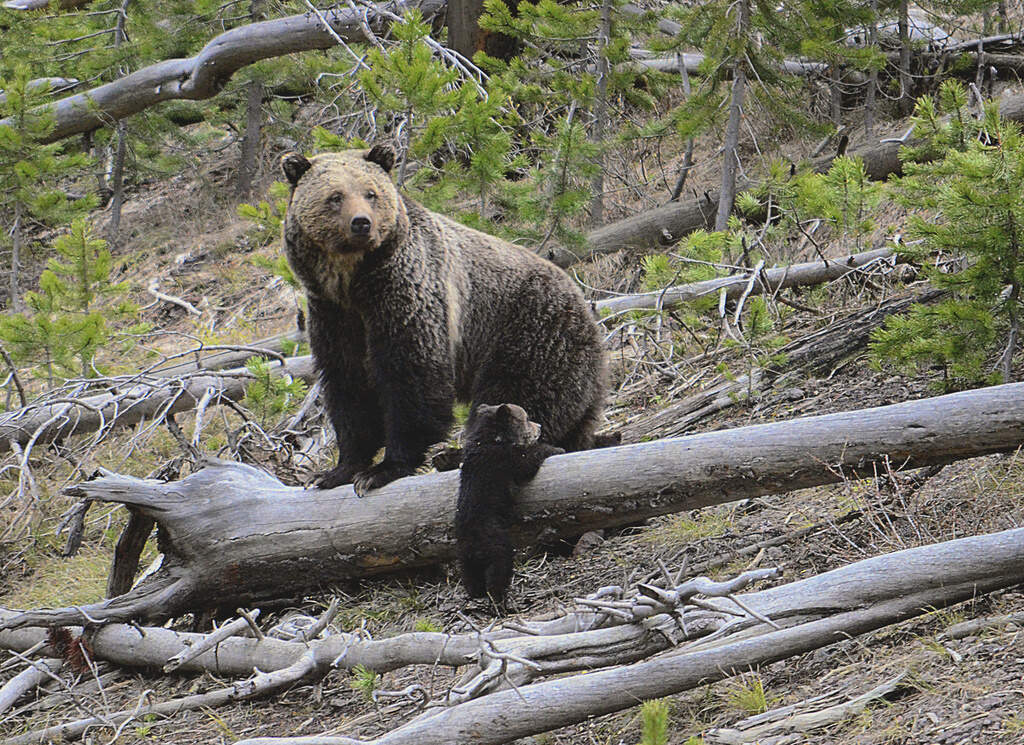
The U.S. House will consider whether grizzly bears in and around Yellowstone National Park should be taken off the endangered species list. How delisting would impact grizzly bears and the people living near them.
Guest
Chris Servheen, co-chair of the North American Bears Expert Team for the International Union for the Conservation of Nature.
Dan Thompson, large carnivore supervisor for the Wyoming Game and Fish Department.
Also Featured
Holly Doremus, a law professor at the University of California, Berkeley.
Coke Landers, a Wyoming rancher and president of the Upper Green River Cattle Association.
Tom Rodgers, founder of Carlyle Consulting and an enrolled member of the Blackfeet Nation in Montana.
Transcript
Part I
MEGHNA CHAKRABARTI: Coke Landers manages a ranch that's been family owned for more than a century. It's in Wyoming, about a three-hour drive from Yellowstone National Park. Coexisting with wildlife has always been part of the job and part of his life.
LANDERS: It's pretty damn cool when you're up there, on horseback in that vast kind of, it's not all wilderness, but there is some wilderness, and you can see a grizzly bear in its natural habitat in the lower 48.
CHAKRABARTI: But whenever he sees a grizzly. In the back of his head, he's thinking about his cattle. Coke manages about 400 cows, and he raises their calves and yearlings every year by letting them graze in the vast public lands around his ranch. Trouble is for a bear, that calf is a potential meal.
LANDERS: We have five riders that live up there all summer long that take care of our cattle.
And they see the bears daily and deal with them and have been charged and bluff charged. And then when they get off to investigate a kill, a grizzly bear kill, sometimes it's pretty spooky to have to run the bear off. Or if it's too spooky, they'll wait for the game of fish to come up and run the bear off.
CHAKRABARTI: Those range riders can't protect a spread out herd of calves around the clock. So every year, Coke loses at least a couple dozen to bears. Most of the time, the bears hunt the calves at night, so his rangers don't see what happens. They hear it, and Coke described that to us. A warning. It's a graphic description.
LANDERS: They say it's unlike anything you've ever heard before in life. It's like a murder scene of a child. And the mom screaming, because you can hear the cows belling and going nuts, and you can hear the bear growling, and you can hear the calf balling. Sometimes the bear, if the cow gets aggressive enough and tries to beat the bear off her calf, then the bear kills the cow as well.
And that's a 1,500-pound animal that's getting killed by a 600-pound predator.
CHAKRABARTI: Last year, grizzly bears killed 91 cattle in the region where Coke ranches, more than 10% of all the cattle that graze in Coke's region. The state of Wyoming saw a record number of cattle deaths due to grizzlies, and game managers say that it's partially the result of a long-term trend.
The grizzly bear population is getting bigger in the ecosystem surrounding Yellowstone National Park, and Coke says he's tried different ways to deter predators with minimal success, like building more fencing or giving his calves ear tags with bright blinking lights on them. He's even tried switching up his grazing technique.
LANDERS: For people that don't know, you don't herd cattle like you do sheep. Sheep, you try to keep your flock together. You don't let 'em spread out. Cattle naturally spread out, so we thought maybe if we concentrate the cattle every night, that maybe it would look like too big of a formidable force for the bears to try to go in there and kill.
And all we did was gathered the food for him. That did not work. That just increased our kills.
CHAKRABARTI: Coke says when he can prove that a grizzly killed one of his calves, the state does pay him for that loss. How much depends on the calf's age and current beef prices, so it can range anywhere from $1,500 to more than $10,000.
But no matter how big the checks get, Coke says he's barely breaking even on his operation. He says his calves are less healthy because they're in constant fear of predators, so he can't sell them for as much. Plus, there's the added time and paperwork to fill out government reports when a kill happens.
And then there's the attachment Coke feels to his animals.
LANDERS: You work hard all year to feed those cattle and take care of 'em, and get a live calf and a good calf through the calving season, and then you're just sending them to their death. 10% of them aren't coming home. So emotionally it's tough.
You work hard all year to feed those cattle and take care of 'em ... and then you're just sending them to their death.
Coke Landers
CHAKRABARTI: Grizzly bears have been federally protected since 1975 in the lower 48 states under the Endangered Species Act. There were as few as 200 bears in the greater Yellowstone ecosystem back then. So the law puts strict rules around bear management to protect the grizzlies. Ranchers like Coke cannot shoot a bear even when it's attacking a cow.
And he says laws like these that favor predators may put him out of business, because now there are more than 1,000 grizzlies in the greater Yellowstone ecosystem.
LANDERS: It's been misused and is the problem with humans? Do they want humans off the landscape, or do they want bears? I don't know how I would argue that on a face-to-face, if somebody came up and said, Hey, I want cows gone and bears there.
I'm just as biased as they are, I guess in their opinion, this is my lifestyle. This is, for five generations my family's been working the land and raising cattle. We're not getting rich. It's just who we are, and this is our lifestyle and we need to feed the nation. So unless they want to start eating the grizzly bear at the store, then we gotta have cattle.
CHAKRABARTI: In July, Wyoming Republican Congresswoman Harriet Hageman introduced a bill to move management of the greater Yellowstone grizzly down to the state level that would require taking the bears off the endangered species list. Hageman spoke at a hearing of the House Committee on natural resources on July 15th.
HAGEMAN: 231 is the average number of verified conflicts with grizzly bears each year in Wyoming, one almost every single day, we have verified conflicts. We have people who have been killed by the grizzly bears, hunters, hikers, backpackers, campers have been killed by grizzly bears in my state. They are saturated.
They far exceed the recovery goals, and it is time to delist them.
CHAKRABARTI: So this hour we're gonna look at the arguments for and against delisting the grizzly bear in parts of the Northern Rockies, and what the future of the animal may look like if grizzlies continue to expand their range. So we're gonna start with.
Chris Servheen he was the U.S. Fish and Wildlife Service Grizzly Bear Recovery Coordinator for 35 years until his retirement in 2016. He's now the co-chair of the North American Bears Expert Team for the International Union for the Conservation of Nature, and he joins us from Missoula, Montana. Chris Servheen, welcome to On Point.
CHRIS SERVHEEN: Hi Meghna. I'm glad to be here.
CHAKRABARTI: So before we talk about the current debate over delisting the bears, I'd like it if you could take us back to when the bears were first listed. If the grizzly had not been listed back in, what, 1975? Would it have gone extinct, at least in the lower 48?
SERVHEEN: I think the grizzly bears would be gone from large areas of the lower 48 if they hadn't been listed.
For example, in the Yellowstone ecosystem, when they were first listed, there were hardly any bears outside the National Park. There were no bears to speak of in Grand Teton National Park, and they were on a decline. It's very likely that grizzly bears would be extinct in the Yellowstone ecosystem and many other small ecosystems in the lower 48 states unless they had been listed under the Endangered Species Act.
CHAKRABARTI: So actually, for listeners who aren't familiar with this part of the country, when we say the greater Yellowstone ecosystem, obviously it's well outside the confines of the National Park. How large is it? What kind of area of land are we talking about?
SERVHEEN: The National Park is about 3,300 square miles, and the area where grizzly bears exist today is well over 20,000 square miles.
They live on the National Park property, of course, and on the national forest surrounding the park and then they get onto the Wind River Indian Reservation, and then in some areas they're on private land as they move further out. The density of bears declines as you get further away from the center of the ecosystem.
CHAKRABARTI: What did the listing of the grizzly allow wildlife managers to do? First of all, obviously it protected the grizzly from hunting, but what else did it allow?
SERVHEEN: The major issues were mortality control. We stopped the mortality of bears. Lots of conflicts occurred around garbage and hunting.
Illegal killing was going on. So we reduced the mortality for bears. We increased habitat security, particularly through motorized road management. And we closed some roads in places where there were lots of activity that displaced bears and put them at risk.
And we increased sanitation across this ecosystem where we got garbage stored so that bears couldn't get into it. Prior to 1975, the big conflict in the ecosystem was garbage and its availability to bears. In fact, garbage was dumped in the national park. Tons of garbage every day and bears were allowed to eat it. And that kind of thing promoted conflicts, promoted difficulties.
And so we sanitized the system, and got garbage secured so that bears were no longer into garbage. And finally, we built public support for bears and so people could understand what was required to live with bears, how to minimize conflicts, and the fact that most people can live with bears fairly successfully.
And where there are conflicts, we want to reduce those conflicts by either relocating or removing those bears. Because managers don't want bears in conflicts, eating livestock and things like that either.
CHAKRABARTI: Yeah. But that's happening, which is the source of the conflict now. Correct me if I'm wrong, but I understand there was a target threshold that was set in order to consider the bears at least partially, if not fully, recovered.
Was that around 500 bears? I don't fully recall.
SERVHEEN: The 500 bears was the minimum number of bears for genetic health in the Yellowstone ecosystem.
CHAKRABARTI: Got it.
SERVHEEN: There was no absolute target number, but we needed at least 500 for that population to be genetically healthy. And of course, we've exceeded that number.
Now we have a genetically healthy population there.
CHAKRABARTI: And so now we have, what, more than 1,000. But to be fair, that's nowhere near the tens of thousands that once roamed the continental United States a century and a half ago. Is 1,000 enough to warrant delisting the bears?
Back in 2007, Chris, if I remember correctly, you actually wrote a rule that it was time to delist them.
SERVHEEN: That's correct. I wrote the initial delisting rule in 2007, and at that point we had in place good management systems. We had sufficient numbers of bears. And I thought at that point that bears would be in good hands turning them over to state management.
And since that time, we've seen changes in the way states manage carnivores in general, and predators in particular in the three states of Wyoming, Montana, and Idaho. And the politicians in those states have become much more aggressive and negative toward predators and have demonized these predators.
A lot of their anger is directed at wolves, and they've put things on the landscape that are designed to try to kill wolves, like neck snares and traps and night shooting. And they even pay bounties for people to kill wolves in Montana and Idaho.
Part II
SERVHEEN: The change that's occurred since 2007 when we initially proposed to delist Yellowstone was that the politicians have now gotten deeply involved in wildlife management in the States, and that wasn't the case in 2007. And I want to make clear that I have complete faith in the state biologists at the state level.
The problem occurs when the politicians get involved and try to put on place anti predator laws and policies that not only risk the wolves and wolves across these states, but the offshoot is that many times these things kill grizzly bears too.
And without these careful controls of management that are necessary, and mortality is one of the things that needs to be managed, grizzly bears shouldn't be delisted until we have secure management systems in place and the decisions are made by biologists and not politicians.
Grizzly bears shouldn't be delisted until we have secure management systems in place, and the decisions are made by biologists and not politicians.
Chris Servheen
CHAKRABARTI: Okay. Speaking of politicians, let's listen to a little bit more of what Wyoming Congresswoman Harriet Hageman says. She spoke in a U.S. House Committee meeting on July 15th. Again, it's the committee for Natural Resources, in favor of delisting the grizzly bear in and around Yellowstone, and she says it should have happened decades ago.
HAGEMAN: The grizzly is in fact the poster child for how the ESA has failed in terms of what it was intended to do and how it has actually been implemented. The purpose of the ESA was to identify threatened or endangered species, develop an effective recovery plan, provide for state involvement in managing and protecting such species and delisting when recovery goals were met.
While the U.S. Fish and Wildlife Service has been successful at listing species, delisting, as per the statute, has been an exercise in futility, regardless of whether a particular species has recovered or not.
CHAKRABARTI: The congresswoman there is saying it's hard to get anything off the endangered species list if it's recovered or not, as she says.
There is opposition to the idea of delisting the grizzly bear. And during that House committee hearing, California Congressman Jared Huffman spoke against Representative Hageman's bills.
JARED HUFFMAN: The gentlelady from Wyoming and I both want the grizzly bear recovery to be a success story, but this is not the way to get there.
To legislatively delist the population located around Yellowstone in Wyoming, Montana, and Idaho from the ESA and then block judicial review, that is not going to lead us down the path of success. That's going to lead us to some really unfortunate consequences, maybe relearning some lessons of history that we ought to know better at this point.
CHAKRABARTI: So that's California Congressman Jared Huffman. I wanna bring Dan Thompson into the conversation now. He is the large carnivore supervisor for the Wyoming Game and Fish Department, and he joins us from Cody, Wyoming. Dan Thompson, welcome to On Point.
DAN THOMPSON: Hello. Thanks for having me.
CHAKRABARTI: So I'm wondering if you could tell us a little bit more about what you're seeing on the ground there in terms of the numbers of grizzly-human interactions, grizzly-livestock interactions.
How has that changed over the past couple of years?
THOMPSON: Great question. We've really seen a change, especially with, as grizzly bears have expanded in distribution and abundance and density, they have expanded beyond the suitable habitats that were identified by the Fish and Wildlife Service. And the result and issue is that we do have more conflicts.
We annually verify just over 230 conflicts between grizzly bears and humans here in Wyoming. Those are bonafide issues. That's not someone seeing a bear. That's a bear devastating livestock or human safety threat. And what we've seen is an increase in that through time. The first decade of this century, we were seeing around 150 annually.
We annually verify just over 230 conflicts between grizzly bears and humans here in Wyoming.
Dan Thompson
It's not a reflection of a lack of work that was done to reduce conflict. I think there's been a great deal of work to reduce conflict potential, but it's more of a function of increasing bears in new areas and also increased human use. And you also asked about depredation. That's our primary source of conflict now.
So three quarters to 80% of our annual conflicts are related to livestock depredation.
CHAKRABARTI: Now is part of the reason why this is happening, simply just the natural behavior of grizzly bears? I understand that obviously they're very territorial and they don't like to overlap territory. So as the numbers increase, the sheer acreage that bears will be on, inevitably grows, Dan, is that right?
THOMPSON: Yeah, exactly. It's a concentric incremental growth from where bears used to be 40 years ago. They're not necessarily territorial like a wolf, but they will develop home ranges that are adjacent to or overlapping other bears. And what we see with females is this concentric growth outward.
While they're maintaining high density within, we see that incremental growth outward, and that's what we've seen in the last decade. We've seen bears expanding beyond those secure habitats. I think Chris was talking about some of the work to secure habitats. We now see bears in agricultural residential areas, and that kind of loses that majestic mystique of wilderness when they're on your front porch.
CHAKRABARTI: So you're in favor of delisting the grizzly from the endangered species list. If that were to happen, how would it change grizzly management in Wyoming? What would you do?
THOMPSON: Honestly, it wouldn't change a lot on the ground. We were very instrumental in working collaboratively with all the agencies involved with grizzly bears to update the overarching strategy for grizzly bear conservation. We've worked on that the last two and a half years, to chart a path forward and to have everything in place to celebrate the success of the recovery of the grizzly bears and move towards that conservation and management. So the on-the-ground work would not change that much.
It would provide us more tools on the ground to work with, and we would not have that federal oversight then that was important early on, but it's more difficult with a recovered population still under that threatened status.
CHAKRABARTI: On the ground, those tools though, you heard Chris a little earlier talking about wolves, as he mentioned, some of those tools included like hunting and trapping and things like that.
Would those become an option for the state of Wyoming if the grizzly were delisted?
THOMPSON: Potentially. I wouldn't say trapping wood. I doubt. But I guess I would point to the most recent time that grizzly bears were delisted in 2017. And our approach was to go to the public and we held public meetings and virtual meetings throughout the state to garner the interest of the public as to what they wanted to see for grizzly bears, as far as conflict management, as far as monitoring, research, outreach, and education and hunting.
And it would be up to them and up to our commission as to how we move forward. But that would be a potential tool that would also be included with grizzly bear conservation.
Okay. Let me go back to Chris Servheen. Chris, Dan just said the most recent time that Grizzlies were delisted, have they been off and on the endangered species list?
SERVHEEN: The Fish and Wildlife Service has proposed to delist grizzly bears twice in 2007 and 2016. And both of those delisting efforts were overturned in federal court.
CHAKRABARTI: Alright so this brings us to just a quick discussion about Representative Hageman's bill. Because as you heard representative Huffman say in opposition to the bill, that this would be a legislative workaround.
In order to get the bears delisted, and he's concerned about proposals to block judicial review. Chris, do you wanna talk about that?
SERVHEEN: Anytime the federal government takes an action like listing or delisting a species, it is subject to legal review. And if the courts decide to get involved, they can make a decision one way or the other, sustain the decision or overturn the decision.
And that's what we have, is we have a rule of law in this country where we have equal efforts. We have congressional branch. We have a judicial branch, and we've got an executive branch. And one branch makes a decision, then it can be subject to judicial review. And that's the balance of power in our country, and legislating the fact that a decision on grizzly bears wouldn't be subject to legal review is eliminating that.
Checks and balances, that we have established under our constitution. I don't see that's a good approach. And even though I was the defendant in cases related to grizzly bear delisting, in fact the first delisting case in 2007, the court case is Greater Yellowstone Coalition vs. Servheen.
That's how it's listed in the court documents. But I think it's okay to do judicial review, because it's important to have that rule of law and have that careful consideration of big decisions that are made by the government. Congressionally preventing judicial review seems to go around the constitution of the country, and I don't like it.
CHAKRABARTI: Dan Thompson, I'm wondering if you wanted to respond to that?
THOMPSON: I can't speak as to the overall reasoning behind the blocking of judicial review, but I think we've observed interesting findings from those that have reviewed this through litigation, as to misinterpretation of some of the regulatory mechanisms in place and what's actually happening on the ground.
And so I think that's part of the reason that was included within that. There's a lot of money to be made to litigate anything involving grizzly bear delisting. Unfortunately.
There's a lot of money to be made to litigate anything involving grizzly bear delisting. Unfortunately.
Dan Thompson
CHAKRABARTI: We very purposefully wanted to invite both of you on the show as ecological and scientific experts about grizzlies. Even though much of the heat of this conversation has to do with political interference in wildlife management.
That got us to thinking about what was the original intent of the Endangered Species Act. So to understand that, we reached out to Holly Doremus, a law professor at the University of California, Berkeley, and she says that when the Endangered Species Act was first passed in 1973, it was because lawmakers did not want listing decisions to become political.
HOLLY DOREMUS: Congress definitely thought it was delegating these decisions to scientific experts. And in fact, in the Reagan administration, they made that clear. They amended the ESA to say that listing decisions had to be based solely on the best available scientific information.
The idea being that politicians should not control them.
CHAKRABARTI: And part of the reason why is because the definition around what recovery is actually unclear.
DOREMUS: Recovery is supposed to mean the species is no longer in danger of extinction throughout all, or a significant portion of its range, and that's one of the things that's never really been resolved under the ESA, is what's a significant portion of the range. And this is hugely important for wolves, but also important for grizzlies, which did have larger ranges before. Wolves used to be across vast portions of the continent and are not now. Does recovery have to mean that they are that widespread again?
That they are as close as we can get to that? And for predators, that's a tough question. Because how much conflict do we think people in grizzly country or wolf country ought to have to endure?
CHAKRABARTI: And there's one more thing she told us. She says, there are ways for state and local governments to have more rights under the Endangered Species Act. And she says, updating the law internally rather than legislatively going around it could be a good compromise. For instance, the federal government could just set regulations for animal populations that states have to meet, similar to how other laws work.
DOREMUS: If you look at the Clean Air Act, it says the federal government sets acceptable pollution levels, but it is up to the states to decide how to achieve those levels. That I think makes a lot of sense. Because that allows the states to look at their economies and what's most important to them, and if they can pick the industries to control aggressively.
And I think in some situations the Endangered Species Act would allow such choices.
CHAKRABARTI: That's Holly Doremus, professor of law at the University of California Berkeley. Dan Thompson. Let me ask you, this isn't what's on the table right now, but in thinking of workable solutions, would something like that actually work on the ground in Wyoming?
Let's just say that the federal government said, Okay. State of Wyoming, you can do anything you want. You just have to make sure that the bear population doesn't dip below 800 in the greater Yellowstone ecosystem. Would that be a plausible way forward, Dan?
THOMPSON: Actually, I honestly think that is what we currently have on the table with our conservation strategy that outlines demographic criteria that we're held to and regulatory mechanisms.
So it sounds like she's explaining what we currently have in place, in a way. There's minimum recovery criteria. I think Chris alluded to those earlier. We've been well above that. Same goes with wolves. We still have to maintain minimum thresholds and stay above those, and as long as we're doing that, they would remain delisted.
But it's still a notion of being threatened and those words matter when they're calling 'em that. But obviously if we were above those thresholds, we could manage the species as appropriately. That would be a benefit.
CHAKRABARTI: Okay. So tell me more. Because again, I think the details of this, most people don't understand as long as they're being called threatened.
What does that prevent you from doing?
THOMPSON: It does not necessarily prevent us from doing things, but it still has this pervasive notion of fragility for these bears, that they need our help and that they're not doing well.
When we hear threatened, people say they need more protections, and that's what happened the last two times they were delisted. And yes, subsequently re-listed, was that protections are stripped, which is not the case. We still have minimum thresholds and above that, we have agreements as to demographic criteria that we will manage above those thresholds, to ensure that grizzly bears are in place in perpetuity. And so again I view that as the path forward and very similar to what she outlined.
But if we can say all those things, I don't understand why we can't say therefore, they're delisted.
CHAKRABARTI: Chris Servheen, do you want to respond to that?
SERVHEEN: A lot of people have the idea that listing means they're totally protected. They're not, they're managed carefully. And in fact, in the Yellowstone ecosystem between 2002 and 2024, 642 grizzly bears, or excuse me 416 grizzly bears have been removed just in the Yellowstone ecosystem over that time period.
That averages about 28 per year. Almost all of those are removed by the state managers and those are bears that get into conflict with people because the managers, both federal and state, don't want bears killing livestock. They don't want bears causing trouble. And so bears that get into conflict are either captured and relocated or killed. And there's not a single bear that I know of in the Yellowstone ecosystem that the states wanted to remove or thought should be removed, that it wasn't removed because of federal protection.
Part III
CHAKRABARTI: Tom Rodgers is an environmental and conservation advocate and founder of Carlisle Consulting, and he is an enrolled member of the Blackfeet Nation. His tribal name is One Who Rides His Horse East, and to him the grizzly bear is sacred.
TOM RODGERS: To see that something that the creator has created, that can run like a racehorse and have such power.
That's what comes to mind, is you're just in awe of such power and speed and just raw nature.
CHAKRABARTI: Tom opposes removing the grizzly bear from the endangered species list. He says individual bear populations in the lower 48 are just too isolated.
RODGERS: You'd have to look at the entire ecosystem, which extends from Wyoming into Montana up until the upper reaches of Canada.
That is the sample size and that's the snapshot you should look at it when it comes to the genetic health of the grizzly bear and how it is actually recovering.
CHAKRABARTI: Tom says, the current conversation around delisting does not take that entire ecosystem picture into account, and he also feels that game managers aren't listening to enough tribal representatives like the Blackfeet.
Even when federal or state plans say they will consult them.
RODGERS: It is not about integrating their perspectives on Native Americans. It's just okay, we'll get to you when we get to you. We'll get to you at the last, and when we talk to you, we've already made our mind up, but we will say we consulted with you so we can check the box as to the process.
It's a process issue. It's not a substance issue, so forgive me for my incredible cynicism. But it's informed cynicism.
CHAKRABARTI: Tom would like to actually ask people to think about grizzlies in a completely different way, about how they can coexist with grizzlies, how they can discourage conflicts without pulling out a gun or simply put trash away more securely so as to not attract the bears, or maybe not build human habitats right next to bear habitat.
RODGERS: And so you have this interface with grizzly bears increasingly. You're in their community and their habitat, and I know you live in other parts of the country and you want to build a gorgeous home in the big sky country of Montana or Jackson Hole, Wyoming. But the question is, should you? It is not all about you.
And that's where I get back to the culture. You should stop and think, is this best for the environment? Is this best for the community? Do I really need to have this magnificent home in the middle of nowhere? No, it is not all about just you. The world and the ecosystem is much larger, and you should take that into consideration.
CHAKRABARTI: Tom also adds that he sees a great opportunity for tourism if the bear population is allowed to keep growing, even beyond its current range.
RODGERS: They're not coming to watch the wheat grow. They're not coming to watch the cattle eat grass. They're coming to see grizzly bears, wolves, eagles, majestic mountains.
Tourism is on its way to be a much bigger industry than even agriculture. That's where the future is. The vision should be built around what is the future and how can we live in harmony and as a sanctuary. I think we've had enough killing.
CHAKRABARTI: That's Tom Rogers, Carlisle Consulting. He's an environmental and conservation advocate.
He's also an enrolled member of the Blackfeet Nation, and his Blackfeet name is One Who Rides His Horse East. Chris Servheen. Let me ask you about this. Tom brings a completely different perspective, but it's a really vital one, and that is the conflicts are happening not just because the bears are expanding their range, but because humans are encroaching on bear territory.
Should we actually be looking at this in a completely different way? And I know this, a lot of this has to do with public lands, which are very fraught in the west, but it's an argument worth considering, Chris.
SERVHEEN: Yes, I think that it's a really important argument. The future of grizzly bears is going to be based on us thinking about how we can balance our needs with the needs of wildlife on the landscape.
The future of grizzly bears is going to be based on us thinking about how we can balance our needs with the needs of wildlife on the landscape.
Chris Servheen
Not all grizzly bears, not all humans, but some level of balance between them. And what we're recently seeing is changes on the landscape where grizzly bears are. Remember they only live in about 6% of their former range in the lower 48 states. So we're seeing climate change is changing the availability and distribution of bear foods.
We're seeing accelerating private land development all across the Northern Rockies where grizzly bears are, with increased conflict. There's increased recreation pressure in the back country on public lands, which displaces and increases stress to bears. There's more conflicts at developments that occur in grizzly habitat.
And on top of this we've got the new administration, the Trump administration, defunding federal science. So the monitoring of grizzly bears in the Yellowstone ecosystem has been grossly reduced and may be eliminated next year, so that there's not going to be any federal monitoring in science of the Yellowstone grizzly bears.
We've got the new administration, the Trump administration, defunding federal science. So the monitoring of grizzly bears in the Yellowstone ecosystem has been grossly reduced and may be eliminated next year.
Chris Servheen
We're seeing decreased federal agency staff in the Forest Service and the Park Service and the BLM. These are the people that manage the public lands where these animals are, we're seeing increased timber harvest and road building. So they want to increase production in grizzly habitat, and it's going to be displacing and increasing mortality risk to bears.
And finally, they're trying to weaken the basic laws like the Endangered Species Act, the National Forest Management Act. They want to eliminate the U.S. Forest Service roadless rule, so that the Forest Service can build roads everywhere. The cumulative effects of all of these things right now with this new administration are staggering to grizzly bears and they make the future for grizzly bears increasingly uncertain.
And it's ironic that the same congressional members who are trying to congressionally delist grizzly bears are supporting the defunding of federal science, supporting the cuts to the federal agencies, supporting increased timber cutting and road building in grizzly bear habitat, and supporting the weakening of the fundamental laws that protect our environment.
All this at the same time, it's really a poor time. It's a perfect storm for grizzly bears.
CHAKRABARTI: Dan Thompson. I wonder if this whole raft of actions at the federal level that Chris just described. Do you feel that could have an impact on how you and your colleagues are able to manage fish and game in Wyoming?
THOMPSON: Not necessarily. There is a lot of things pointed out that could happen. We're still set up to maintain what we've done in the future. We've worked with the study team, the Grizzly Bear Study Team, which houses the science, but that we're a component of, we have multiple plans in place, worst case scenarios to move forward and ensure that we're collecting the data we need to evaluate the population here in the GYE and we'll always be available.
We're bound by statute to deal with conflict proactively and immediately. I guess I have a more positive outlook on it, on the future. From a cautious optimism, that because bears are doing so well, I think what we do and Tom mentioned this, in working more holistically, I think where we have successes, having public ownership in that recovery and conservation, and that includes tribal members, that includes private landowners, that includes all the land management agencies and the Park Service and the state agencies and everyone that's involved.
And while I think there's a lot of unknown in the future, I do think we have a template that we've used for decades to still move forward and garner that public support and ownership to maintain that successful notion for grizzly bears in the West.
CHAKRABARTI: Chris, I'd love to hear your response to that.
Do you not think that template that Dan is talking about is sufficient? Because you definitely don't sound as optimistic at all as Dan does.
SERVHEEN: No. And I wish it was not the case that we're facing all these things right now. I think that if we go on the way we've done things in the past, I think we would be in pretty good shape and the grizzly bears would be in good shape.
But we're seeing a dramatic increase in the numbers of people, the amount of recreation and this defunding of the federal agencies and science and pressure to destroy the laws that are fundamental to the management of grizzly bears. All this is happening just right now in the past six months.
And it's increasingly uncertain and that level of uncertainty makes me pause and wonder, if we take away the ESA protection on grizzly bears. With these threats on the landscape, we would never get grizzly bears listed again. And it's really dangerous to do it right now.
CHAKRABARTI: Okay. Both of you have mentioned a couple of times, wolves. As another example of the challenges and complexities of management, successful management around large carnivores. Now the wolf was delisted from the Endangered Species Act in late 2020 in the first Trump administration.
And a couple of years after that, we actually did a really interesting show about wolves. And in that show we spoke with Adrian Wydeven, who's a wolf biologist in Wisconsin because there's been a lot of controversy over wolf management there in Wisconsin, because it's one of the places where wolf populations are high.
And here's what Wydeven told us back in 2022.
I think state wildlife agencies can manage wolf populations when populations have recovered, if they're not burdened by excessive political involvement. And I think that's been the biggest problem in Wisconsin, is too much politics involved in the management of the wolf population.
I think the state agencies can do it if they're given the option, the tools to do it.
CHAKRABARTI: Dan Thompson. Frankly speaking, do you or any of your colleagues or the department as a whole feel any kind of political pressure, political involvement in decision making around managing grizzlies in the greater Yellowstone ecosystem?
THOMPSON: I think it would be naive to say that there's not political interest in grizzly bears. That's part of the realm of large carnivore management. And so it's a component.
But I also think that's why we rely on all the different things that we have in place, and transparency and working with those political pressures to help them to understand what is in place, what we have in store for the future, and how we're going to respond to these situations that drive these frustrations from a legislative standpoint.
CHAKRABARTI: Chris, the flip side of that is that politics always been a part of endangered species management and conservation in this country.
It's never not been political. So maybe isn't that part and parcel of how any state or federal wildlife employee has to deal with their job?
SERVHEEN: Yeah, the politics have been around all the time. For 35 years I managed the Grizzly Recovery Program and for probably 30 of those years, the involvement of politicians was minimal and the support for grizzly bear recovery was palpable.
They were interested in seeing grizzly bears recover, and over the past, recent time period, we've seen politicians begin to demonize predators like grizzly bears and wolves and pass laws to try to kill them and put new killing mechanisms on the landscape. And it's not the biologists like Dan Thompson that are doing this.
We've seen politicians begin to demonize predators like grizzly bears and wolves and pass laws to try to kill them and put new killing mechanisms on the landscape.
Chris Servheen
It's the politicians that are doing this. And the reason that I supported delisting and wrote the delisting rule in 2007 was that I have so much confidence in the state biologists like Dan, but now we see these politicians deeply involved in these efforts, particularly in Montana and Idaho, focusing on wolves.
But with the scattered effect that grizzly bears are also going to die from these things that are placed on the landscape to kill wolves. And it's really unfortunate. Facts are no longer the decision-making process. It's more emotion. And we go back to the 1880s in terms of how many of these politicians think of predators.
And it's a sad state of affairs.
CHAKRABARTI: Well, Chris, I have one more question for you then before we wrap up, before we run out of time here. Is part of the problem the Endangered Species Act itself, because it's so absolute, right? We're talking about listing or delisting and protections that come with or get removed.
Is there any room for compromise here at all?
SERVHEEN: Maybe. With bald eagles, there was a bald Eagle Protection Act that was put in place there. They were, bald eagles were delisted from the ESA, and that provided a certain level of care and management for bald eagles. And yet they were delisted.
Could such a thing be done with grizzly bears? Something related to mortality management, how bears could be killed, how many would be killed. But the states would be the ultimate managers. I don't know. Maybe there's a possibility for that. If it was a biologist decision and if people like Dan Thompson were making the decisions, I think the bears would be in good shape.
But it's the politicians that really worry me.
The first draft of this transcript was created by Descript, an AI transcription tool. An On Point producer then thoroughly reviewed, corrected, and reformatted the transcript before publication. The use of this AI tool creates the capacity to provide these transcripts.
This program aired on August 8, 2025.