Support WBUR
The fall of Florida citrus
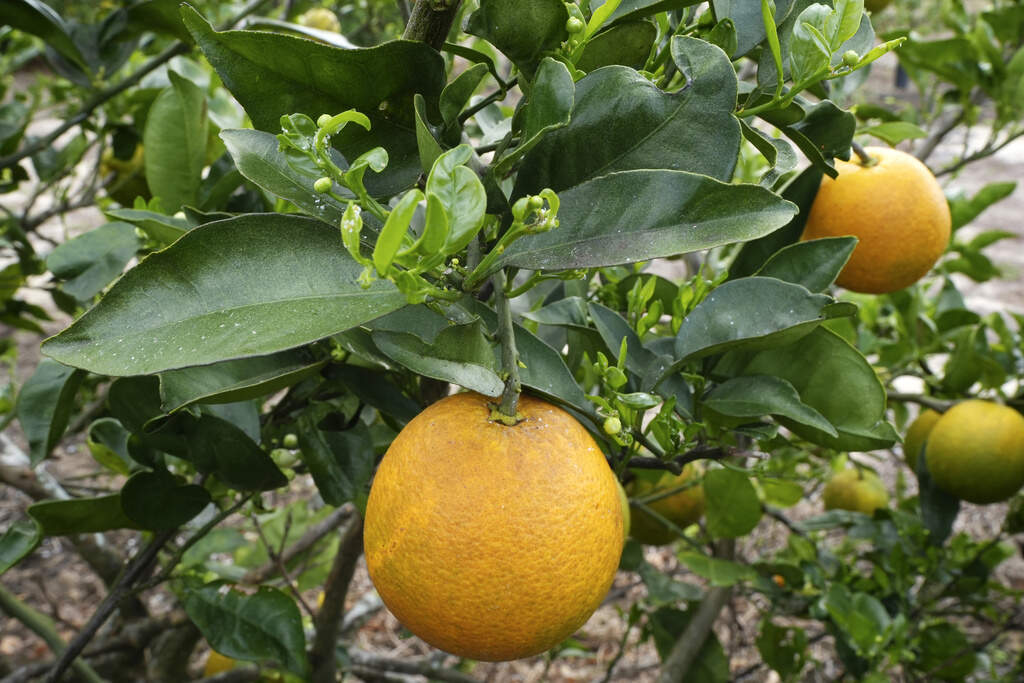
Florida citrus production has dropped more than 90% in the past two decades — a blow for the state's economy and cultural identity. What's driving the decline of Florida's orange groves, and what can be done about it?
Guests
Wayne Simmons, president of LaBelle Fruit Company.
Anne Simon, professor in the Department of Cell Biology and Molecular Genetics at the University of Maryland. Co-founder of the biotech company, Silvec, which develops RNA-based plant protection products.
Also Featured
Philip Rucks, operator of Rucks Citrus Nursery.
Gary Mormino, professor emeritus at the University of South Florida.
Transcript
Part I
ANITA BRYANT: Come to the Florida Sunshine Tree.
AMORY SIVERTSON: This is the late singer Anita Bryant back in the 1970s.
BRYANT: Hey, come back little orange bird. I want to introduce you.
SIVERTSON: She's walking through an orange grove and encouraging you to drink your daily glass of orange juice, Florida orange juice.
BRYANT: Natural orange juice that's so important to good nutrition.
SIVERTSON: At our citrus peak, three quarters of American households had orange juice in their refrigerators.
BRYANT: Orange juice with natural vitamin C from the Florida sunshine tree.
SIVERTSON: This ad was from the Florida Citrus Commission.
BRYANT: And remember, breakfast without orange juice is like a day without sunshine.
SIVERTSON: A day without sunshine. Can you imagine? It turns out we might have to. The Florida citrus industry is in perilous decline. Last year, production plummeted to its lowest level in more than a century.
SHANNON SHEPP: Senators we are admittedly an industry in need of your help on many levels.
SIVERTSON: That's Shannon Shepp, director of the Florida Department of Citrus. In a presentation to state lawmakers earlier this year. Since the industry's peak in the nineties, Florida's citrus output has dropped more than 90%. Industry representatives convinced lawmakers to pass a $140 million relief bill to revitalize Florida citrus this year. It includes funding for research, farm equipment and marketing.
SHEPP: I wouldn't be doing my job if I didn't hearken the words of Henry Ford. Stopping advertising to save money is like stopping your watch to save time. There will be a renaissance in this industry. We need to maintain a market for these growers.
SIVERTSON: But is a renaissance even possible? And how did this decline happen so quickly? This is On Point. I'm Amory Sivertson in for Meghna Chakrabarti and this hour we're exploring the rise and fall of Florida citrus. Joining me first this hour is Wayne Simmons. He's president of the LaBelle Fruit Company and has been growing Sunshine State oranges in the Sunshine State for decades.
Wayne Simmons, welcome to On Point.
WAYNE SIMMONS: Hello, how are you today?
SIVERTSON: I'm doing well. I'm thrilled that you're here joining us and I know that you are a fifth generation Floridian, is that right?
SIMMONS: That is correct.
SIVERTSON: Okay. So the citrus roots.
SIMMONS: Love to see the sun come up.
SIVERTSON: Yeah.
So how did you end up in the citrus business, Wayne?
SIMMONS: ... Really been in agriculture all my life and gravitated to growing things and that's my call of life, to grow.
SIVERTSON: So you founded the LaBelle Fruit Company. How big is your operation? How long have you been running things?
SIMMONS: I've been in existence full over 20 years and got about 250 acres of citrus and certainly been involved in citrus business pretty much all my life.
SIVERTSON: And do I understand correctly that the oranges that you grow are mostly used for making orange juice rather than producing the whole oranges that we might find at the grocery store? Is that right?
SIMMONS: That is correct, mainly for orange juice, the sunshine tree.
SIVERTSON: Okay. So take me back, Wayne, to the boom times of Florida citrus.
When were things going really well for you?
SIMMONS: I certainly was very fortunate that I've had the majority of my career during the boom time probably from the '70s up until early to mid 2000s, somewhere around 2004 peak at just under 250 million boxes. And I surely experienced that and, yeah.
SIVERTSON: And when you say 250 million boxes, how many oranges are we talking, or how many pounds is a box?
SIMMONS: That's roughly 90 pounds of oranges in one box. If you start doing math, 250 million boxes times 90 pounds, and that's the total poundage of oranges that were produced in Florida in roughly 2004.
SIVERTSON: Okay. So what is happening now? What are your orange groves up against right now?
SIMMONS: Right now, to this very day, we experience citrus greening. Citrus greening was found in the state of Florida in 2005. We'd just been through three hurricanes in one season. In 2004, we came into fighting canker, and in 2005 we found citrus greening.
Was not here in the state of Florida until then. And since then, it's been just rampant and certainly has devastated the industry along with some hurricanes in the last seven years. And it's just been a tough decade to be in the citrus business.
It's ... been a tough decade to be in the citrus business.
Wayne Simmons
SIVERTSON: Yeah. And by citrus greening, you're referring to citrus greening disease, which we're going to be talking about, but can you give us a sense of what percentage of your trees are infected with this disease?
This disease for which there is no cure, I should say.
SIMMONS: Yes. Pretty much the whole grove is infected. We have come up with some strategies to prevent trees from getting it for a short period of time, but pretty well any tree that's planted in the state of Florida is infected and has been or will be infected.
And that's just the nature of the beast. Talking about citrus greening equated to malaria and certainly malaria is spread by the mosquito. Citrus greening is spread by an insect called a psyllid.
SIVERTSON: So what has that meant for the LaBelle Fruit Company in terms of production?
We've gone from, as you said, 250 million boxes of oranges. Now down to what was your production say last year?
SIMMONS: The statewide was somewhere around 20 million boxes give or take, I think it was 16 actually. But just say 20 million boxes and certainly my personal grows has mirrored the state production.
But I've been able to stay in business. Just, I like to tell everybody that I've spent my retirement to continue to stay in the citrus business, but that sounds a little bit harsh, but, yeah. I've been able to stay and some of my grows have reacted a little better to greening than others, but it's been tough.
My production has gone down and I certainly have saw the decrease in production and had those problems to deal with.
SIVERTSON: And you mentioned hurricanes before. I know 2017 was an especially devastating year for the industry because of Hurricane Irma. What impact do storms like Irma have on your groves and your crop?
SIMMONS: I'm in the southwest Florida growing area just inland from Fort Myers. And Irma basically came right on top of my groves. And before Irma, we were pretty well holding our own. But combination of Irma, the stress from the hurricane and the stress over the period of years from greening, grows just started collapsing and going downhill and dying. And it's that was the beginning of the downfall of my grows.
SIVERTSON: You mentioned you're in the southwest region of Florida and you were previously the president of the Gulf Citrus Growers Association, which is an advocacy group in that region.
I understand that group does not exist anymore.
SIMMONS: Yeah. And that's certainly one of the casualties from citrus greening is grows go out of production. And basically, being able to support a grower advocacy group is no money, no way to support it. But, certainly our state, national, and local problems that they advocate for don't go away.
But we do have some statewide grow organizations that pick up the slack and help us. Florida Citrus Mutual being the major grower organization for the citrus industry currently.
SIVERTSON: So we've talked about little bit about the financial hit that you've taken, and you said that you're spending your retirement currently to stay in the citrus business.
So very briefly, why is it important to you to stay in the business right now?
SIMMONS: That's my livelihood. I enjoy doing this. And I want to be a citrus grower, and I really don't want to do anything else. And I've got my land and surely some of the costs that certainly very fortunate that majority of the groves, land is paid for, and Florida was just made to grow an orange tree. And some of the other alternative crops are just not conducive for Florida.
Part II
SIVERTSON: The orange is not a native plant to Florida, but its history there dates back to the 1500s. Early European explorers brought the fruit over from Sicily and Southern Spain. It’s said that Juan Ponce de Leon, the conquistador who led the first European expedition to Florida, may have planted the first orange groves himself.
GARY MORMINO: And we know that St. Augustine, the oldest city in North America had groves there in the 16th century and the story is that navigators and sailors coming into the Port of St. Augustine in the springtime could detect the aroma of orange blossoms.
That’s Gary Mormino, a professor at the University of South Florida who writes about the Sunshine State’s history. He says Florida has the perfect climate for citrus. Sandy soil. Good drainage. Minimal frost and enough rain for thirsty fruit. But the industry didn’t really take off there until the 20th century. The problem? Orange juice spoiled too easily.
MORMINO: During World War II, the U.S. government wanted soldiers to have Vitamin C, but how are you going to get Vitamin C to soldiers such as my father in the South Pacific? So you had this mad campaign. It was kind of like the Manhattan Project for orange juice. Is there a better way of preserving the orange juice? And of course what they came up with was frozen concentrate.
SIVERTSON: Frozen concentrate hit grocery store shelves big time during the baby boom. When parents had less time to freshly squeeze their juice and more money to buy freezers.
Remember how simple the instructions were for frozen concentrate? Mix three cans of water and stir.
Millions did it every day. Commercials like this one featuring a woman serving orange juice to her kids on a hot summer day were powerful.
(COMMERCIAL)
Call: It's time for a break. An orange juice break.
Response: An orange juice break? In the afternoons, I always give them something that tastes refreshing. But why orange juice?
Call: Because an orange juice does more than taste refreshing.
Response: More?
Call: Much more. It helps replace energy and the Vitamin C your family has been burning up since breakfast.
Response: I know they burn up energy. But Vitamin C too?
Call: Their bodies can't store Vitamin C, you know?
Response: Well then they’ll have an orange juice break.
SIVERTSON: During this boom, citrus became a central part of Florida’s cultural identity. After tourism, it was the second-largest sector in the state's economy. Miami has the orange bowl. The image of the orange blossom is on the flag and license plate. When you enter the state, its tourism centers still offer a free glass of OJ. Brands like Florida’s Natural marketed themselves as only using Sunshine State Citrus.
It bombarded the American airwaves. I mean, uh, citrus was making a lot of money. Uh, they wanted every more people to drink citrus. So you had Anita Bryant singing the Florida Sunshine Tree.
Donald Duck was doing commercial, et cetera. And it was the, yeah, again, the perfect product for the perfect time. We were convinced that without Vitamin C, communists would take over, youth would wither away, et cetera. And mothers especially wanted their children to be healthy. Avoid colds. So it was almost mandatory to begin the day with a glass of OJ.
SIVERTSON: The final step for the orange juice industry was flash pasteurization, which was invented by the founder of Tropicana in 1954. It allowed the company to pack pure chilled juice in glass bottles and ship it all over the country.
And as refrigeration got better and consumers became more interested in fresh, not-from-concentrate products in the 80s and 90s, the frozen orange juice block fell out of favor, and the cartons we see today became the thing at your breakfast table. And yet, this century, even those cartons have become less popular. OJ consumption has dropped more than 50 percent in the past 20 years.
I teach a class on food history and in Florida history as well, and I'll ask the students. How many of you began the day with a class of orange juice? I haven't had a student in 20 years raise their hand, and if this were 1955 or 1965, the question I would be talking about, there hasn't been a hand not raised. That's how pervasive OJ was in the '50s and '60s. And it's now, it's too sugary. there are too many options now. You can have a Frappuccino at Starbucks, et cetera. OJ just seems kind of fuddy duddy.
SIVERTSON: Gary says that decline in popularity has had an impact on Florida citrus, along with those other factors we’ve been talking about like hurricanes and disease. Groves he used to drive by are now housing developments or solar fields. In 2022, Florida’s Natural had to start adding oranges from Mexico to its juices.
They didn’t get back to us for this story, but the company’s website reads: “The Florida orange crop can no longer meet our consumer demand, so we are adding in only the best Mexican Valencia orange juice. This allows us to continue supplying enough orange juice for consumers’ increasing thirst while maintaining the superior taste they love from Florida’s Natural.”
SIVERTSON: Wayne, when you hear Gary there, talk us through the history as a fifth generation Floridian. I'm curious if you can paint the picture for us. What do oranges mean to Floridians, such as yourself?
SIMMONS: Gary's little spiel there certainly brought back a lot of my childhood, growing up drinking orange juice and it certainly is consumer taste change.
That's basically what pushed the NSC or not from concentrate. And today it's a blend of concentrate and not from concentrate and Florida oranges and certainly foreign oranges, just to meet consumer demand.
SIVERTSON: Yeah, the consumer demand piece of this is interesting because it makes sense that Florida's Natural would say, we need to meet our consumers increasing thirst, but does it also ring true to you?
What we heard Gary say that demand is actually down.
SIMMONS: Yeah. I'm sure. Yeah. It is. As prices go up and preferences change made this comment about the Starbucks and I guess in the health craze of the mid '80s to early '90s, Florida orange juice from the natural sugar source came out of demand.
But it's amazing how today consumers will drink the cappuccinos and all the other coffee drinks, high in added sugar, versus natural sugar.
SIVERTSON: We still need our sugar. We're just not kidding ourselves anymore about where it's coming from.
SIMMONS: Exactly. And so it's ironic, but orange juice is so fortified in other vitamins, Vitamin C and other natural vitamins.
It's certainly, that's how I start my day off, with a glass of orange juice.
SIVERTSON: Cheers to you. Standby here Wayne. I wanna bring another person into this conversation. Anne Simon is a professor in the Department of Cell Biology and Molecular Genetics at the University of Maryland, she's also the co-founder of the biotech company, Silvec, and she focuses on the disease that's threatening Florida's orange groves, citrus greening disease. Anne, welcome to On Point.
ANNE SIMON: Thank you. It's great to be here.
SIVERTSON: It's great to have you. So first, what is citrus greening disease and where did it come from?
SIMON: Citrus greening is the perfect storm of a disease, so it probably started somewhere in China or India. The first publication that we can find where they actually describe what we see today was in 1927 from India.
So it started way over there and then slowly crept its way across Asia into Africa, South America, Mexico, and the U.S. So it's pretty much everywhere now except the Mediterranean basin and Australia.
SIVERTSON: And it was first discovered in Florida back in 2005. Is that right?
SIMON: Yeah. That's when they found the first infected tree.
However, this disease, one of the big problems is that trees that are infected don't show any signs of infection for years. So you actually don't know exactly when it started, but they were certainly finding the psyllids that were transmitting the bacteria around then, and then they found a tree that had the typical disease symptoms.
Trees that are infected don't show any signs of infection for years.
Anne Simon
SIVERTSON: The psyllid being that tiny bug that is infecting the tree.
SIMON: That very tiny.
Yeah. About the size of an aphid. And they just swarm those trees. They love citrus.
SIVERTSON: Okay. Once a psyllid has infected a tree, there's no cure for this, right?
SIMON: It's the problem with bacterial diseases and viral diseases in plants is that there is no cure.
It's very difficult to get at pathogens that are living inside of the tree. Pretty much. At first, the only thing you could do was chop the trees down that were showing signs of infection.
The problem with bacterial diseases and viral diseases in plants is that there is no cure.
Anne Simon
SIVERTSON: So what happens to the fruit on that tree once it's infected?
SIMON: So what happens with the infection is the psyllids, they deposit the bacteria inside the veins of the tree, what we call the vascular system of the tree.
And the tree being not the smartest organism on the planet, mounts this ginormous immune response and it tries to trap the bacteria. It makes all these carbohydrates and these stringy proteins, and as it tries to trap the bacteria in the veins of the tree, it literally clogs off its veins. It's as if in people, if you clog your veins you die. And that's what happens to the tree. The sugars from the top of the tree and the leaves, remember that old topic of photosynthesis from school. The sugars are made in these nice green areas of the tree, but they have to get to the roots. And the way they get to the roots is through the veins.
And if the tree is clogging up its veins to try to control this pretty small amount of bacteria that's inside it, it literally kills its roots. And with that --
SIVERTSON: So this is like the heart disease of the tree.
SIMON: It's the heart disease of the tree. And without the sugars being able to get around, the fruit ends up being misshapen and green.
Hence the name citrus greening, and it becomes sour.
SIVERTSON: Too sour to eat.
SIMON: Much too sour to eat.
SIVERTSON: I don't know. I like things pretty sour.
SIMON: Oh yeah.
I don't think you would really appreciate these oranges.
SIVERTSON: Okay, so sour. But is the fruit technically safe to eat or?
SIMON: Yes. This is strictly a tree disease.
This is completely harmless for people, but it just no longer has the sugar content that the juice is supposed to have. You can actually taste the difference. And I'm not an expert in in orange juice, but when you're eating other citrus that's coming from regions that are obviously very infected, you can taste the difference these days. It's not as sweet as it used to be.
SIVERTSON: Okay. Do we know what percentage of citrus trees in Florida have this citrus greening disease?
SIMON: Yeah, it's probably pretty close to 100%. Right now, they're replanting citrus. They're trying things and they replant them under these canopies.
Think of having a screen around the tree that can keep the insect out so they can keep those trees alive and free of disease for a couple of years. But eventually, when the trees start bearing fruit, you have to pick the fruit. So I think small growers are starting to plant trees inside very large greenhouses.
And I know they're doing this in China. They literally have these giant greenhouses trying to keep the psyllids out. The problem of course, is it only takes one hole. And the psyllids can come in. So these are stopgap measures.
SIVERTSON: Do we have a sense of the scope of the damage the disease has already done to the Florida citrus industry?
SIMON: Oh it's just devastating. I think the latest figure was a 93% drop in citrus production there and elsewhere. Brazil's this huge citrus growing region and they thought they had things under control. And they were wrong. And right now, they have over 40% of their trees, I think, are infected, and they had a 25% drop just in the last year.
This is really, we are looking at planet wide. We may be looking at the end of citrus, and not just oranges, but lemons and limes, grapefruit, kumquats, all the citrus that we're used to having and getting our vitamin C from. May be extraordinarily expensive in the next decade.
We may be looking at the end of citrus.
Anne SImon
SIVERTSON: Like how expensive are we talking here?
SIMON: So I was at a meeting on the disease back in, I think it was 2019, and at that meeting they were talking about oranges maybe being $20 or $30 a piece, and lemons, maybe ... a birthday treat. Have an orange for your birthday. And lemons. Think about how much we use lemons in cooking, for example.
Lemons at maybe $15, $20 each.
Yeah.
SIVERTSON: Wow. Okay. And that's, how far out are we talking? When you say we could see citrus wiped out altogether, we could see an orange costing $20, $30. Is this five years down the line? 10 years? 20?
SIMON: So back in 2019 at that meeting, they were literally talking about a decade away.
And of course, that meeting was six years ago. However, scientists have come up with some stop gap ways of keeping trees alive now. So I think that decade is going further. I think maybe we've got a decade or two right now, but, for example, Australia, they're saying it's not a matter of if, but a matter of when.
That the infection reaches their shores.
Part III
SIVERTSON: Anne and Wayne, I want to hear from someone else quickly here about something that you mentioned, Anne, a little bit, which has to do with how trees are being raised now to try to combat things like citrus greening disease. So Philip Rucks runs a citrus nursery in central Florida, which develops trees in controlled environments and then sells them to grove owners.
And he says he is tried all sorts of complicated therapies to help saplings resist citrus greening, like adding microbes to his soil or even gene editing. But he says it's been hard getting anything to stick.
PHILIP RUCKS: Providing a citrus tree is disease free is one thing, but once it gets out in the field, you've taken all the wraps off and it's really highly susceptible to anything, because we've grown in a controlled disease-free environment, but once it gets in the field, there's a big risk for the grower now to have to develop and grow that tree in a production.
SIVERTSON: So Wayne Simmons, I know that you too are experimenting with some potential solutions at your groves. Can you talk a little bit about what you are trying at the LaBelle Fruit Company?
SIMMONS: Just as Philip said, basically when we get the tree from him from the nursery, it's free of citrus greening, been grown in the controlled environment.
Growers now are putting the little netting on them. They're called IPCs, individual protective covering.
And certainly that keeps the psyllid out for roughly two years. And so basically you can, 99% of the time you have a tree that's completely free of disease. So you've got a structure and a skeleton there that although not fully grown, is certainly has the potential to move forward.
And once it comes out the IPC, the netting, then we have started a therapy where we inject a bacteria side in the trees. Certainly, when the trunk gets about two inches in diameter, we inject the bacteria side in the tree, and that has certainly been a game saver. It's certainly a therapy that's probably not going to last forever. But certainly, will get us maybe until we do find a fully disease resistant type of tree.
And we're also injecting the older trees that does have the greening and go up to about a 20-year-old tree. And it has had an effect on them as well.
SIVERTSON: Okay. And by bacteria side, this is essentially an antibiotic that you're injecting into the tree, right?
SIMMONS: That is correct. It's tetracycline.
SIVERTSON: Okay. Okay. Now, my understanding is that some growers are wary of injecting their trees with this bacteria side. Is there a risk to the tree or to the taste or the safety of its fruit by doing this?
SIMMONS: No, I wouldn't say that, it's been most growers are doing this.
Basically, we do have guidelines that we have to follow. This is a labeled product that has gone through checks and balances with USDA and FDA and EPA. And there's a period at the time that we cannot inject in order not for it to show up in the fruit. It's certainly one of the only tools that are available to get us moving forward.
So most growers are doing it.
SIVERTSON: Okay, so Philip Rucks our Florida citrus nurseryman, explained how you can actually give a vaccine to a sapling of a citrus tree. He has a mother tree that was grown and developed with a gene from spinach that's resistant to citrus greening, and he transfers material from that mother tree to the new tree.
RUCKS: So we take a piece of bark off a mother tree and insert that piece of bark in the mother tree that has the spinach defensive gene in it, and we take that bark and we make a bark patch on the existing little nursery tree in the nursery. So in a way, it's not a shock, but it's a piece of bark from one tree going into another.
And the purpose of this benign virus is it moves the gene throughout the tree's vascular system. And it takes about eight weeks.
SIVERTSON: Anne Simon, are you familiar with this practice? Can you say a little bit more about how this works?
SIMON: Yeah, I should be familiar because we are the ones who are now developing it. And we were partnering with Philip, a wonderful partner who's helping us with our field trials.
I think it's important to understand just why this is such a difficult disease to treat. I think we think about our own diseases and bacterial diseases. And we can put a little Neosporin on it, or we can, if it gets really bad and you have a bacterial disease, you can hook yourself.
You don't hook yourself up, but you go to the hospital, they hook you up to an IV and you can get rid of the bacteria. This just can't be done with trees. So the idea is you've got to figure out a treatment that will kill the bacteria, but at a cost that isn't going to bankrupt the growers.
And these antibacterial agents, these little proteins called defenses is what Philip was talking about, and this was what they found at Texas A&M. ... Found that this natural protein from spinach is able to very effectively kill the bacteria that causes citrus greening. And so then the question is how do you get that protein inside the tree at a level that's high enough to make a difference?
And what we are doing, and this is work that began at University of Florida and we've taken it over, is we use a benign virus. So it's just a virus that causes no disease, no symptoms, but viruses, infect, and they can travel throughout a tree, and they travel right to where the bacteria live.
So when you hook on a gene for this protein, this defense in, you hook that onto the virus. You can get the plant's own cells to then make it exactly where you need it made, and then it's available to then kill the bacteria. So they started working on this using a virus to deliver these defenses into the trees.
Oh, more than a decade ago, and at first it worked. It worked well for a couple of years and then it just was not working that well. And U.S. Sugar who was developing this, they gave up three years ago. They just said, we've spent, $20, $30 million and we're just giving up on citrus.
So my company Silvec, we'd started the company, my brother and I, in 2019 to do exactly this, to use viruses which are just the perfect delivery vehicle to deliver either proteins or to deliver tiny, what are called tiny little siRNAs, which can target genes and can do all sorts of interesting things.
And so we developed the company to actually do this, RNA therapies for trees. When we heard that U.S. Sugar was giving up the license on this virus. We took it over because we realized something very important. We realized why it wasn't working, because they couldn't make enough of it. It should have been made at a very high level, but it wasn't. These tiny little proteins, just like they're finding in humans. Because they're using the same defense in proteins.
It's virtually the same, as the next antibiotic in humans. And they found in humans, yeah, they work great against bacteria, but they don't last. They're made and then seconds later they're gone. So in humans, they figured out how to make them more stable, and we did the same thing. So we can now make it much more stable, have hundreds of times more of it in the tree, and we think this is going to really work.
SIVERTSON: Okay. Alright. That sounds hopeful. I'm glad to hear that. We've talked about prevention in the sense of these nets that Wayne was talking about. This is a treatment solution that you're talking about, but I wonder, can these trees be bred to be just more resistant in the first place to citrus greening disease?
SIMON: Ah, they have been trying this for over a decade, huh? Trying to cross trees with the very, very few varieties of citrus. There's 400 varieties of citrus. The very few which are more resistant to the bacteria, but this takes decades. You cross it, then you have to wait years until you get seeds. Then you have to grow up the tree, then you have to cross it again and continue to cross it so that you can get the citrus back that you started with.
So this is a very long-term possible solution and the problem at the end is you don't know whether you've created a tree that's now more susceptible to other diseases of citrus trees and there are a lot of diseases of citrus trees.
So it's going to take a long time, and at the end you're not sure how long the resistance will even last.
SIVERTSON: Yeah. Wayne Simmons, is this something that you are thinking about or already experimenting with potentially at the LaBelle Fruit Company in your groves?
SIMMONS: Certainly, I've worked with some plant breeders that have come up with some varieties that are maybe more tolerant. No resistant variety or rootstock is available now.
Certainly, as Anne said, plant and breeding on a perennial crop is so long term versus annual, versus something like corn, soybeans, or cotton, citrus is just so long term. And then certainly, as Anne said, you have a tree of resistant, but then if it doesn't produce oranges, it's really, we hadn't gained anything. If it's not good quality oranges or good quality fruit.
So we've got some good plant breeder. ... We just hadn't got there and certainly Anne, what she's doing on the bark patch, certainly our plant breeders are going to more of a molecular type breeding and trying to come up something that is certainly a resistant tree.
SIVERTSON: So we've been talking about scientific solutions right now.
I'm curious also about maybe just band-aids in the meantime from government, state and federal government potentially. We heard from Shannon Shepp at the beginning from the Florida Department of Citrus, appealing to lawmakers for help. And so I'm curious what role, Wayne, are state and federal government currently playing in trying to help citrus growers like you?
SIMMONS: Certainly both state and national government agencies has certainly helped us. Florida legislature this year gave us growers money to help on the replanting. Very beneficial to growers that are struggling to replant. USDA has certainly helped with research.
Growers have spent probably close to $200 million of their own money until they just ran out of growers and production. And now the USDA has stepped in to help research. But I equate citrus greening to cancer research. We certainly haven't solved a cure for cancer, but we certainly got a lot more therapies and developed more strategies on it.
And that's where we have citrus greening and there's just no cure for it.
SIVERTSON: Anne Simon, I have also heard that the U.S. Food and Drug Administration recently proposed lowering the minimum requirement for the sweetness of orange juice. Have you heard of this? Can you say more about this?
SIMON: I have heard of this, and my understanding is that you can't taste the difference. And so why not lower the sugar standard if it's not something which consumers are going to be able to taste?
I think that we have to do what we can to keep the industry going right now as we search for these, they're not cures, but search for means to keep the bacterial population down enough so that the trees can thrive.
SIVERTSON: And the thinking of lowering the minimum requirement for sweetness is that juice producers could use fewer oranges in making their juice, which would help reduce the number of imported oranges. Because it's within the last 10 years or so that the U.S. is actually importing more oranges than it's exporting now.
Is that right?
SIMON: I think that Wayne probably knows more about this than I do. But I would say that's probably correct.
SIMMONS: Yeah. So I would say that certainly, yes. Natural sugar content in citrus greening is lowered than it was prior to greening. And that's worldwide. Orange juice is not as sweet due to citrus greening.
And certainly, if we can have a lower brix or a low lower sugar level, that certainly helps us in not having to bring in as much imported juice to get the higher brix level. People talk about that or sugar content. Certainly, it'll be a lower sugar content, but you certainly cannot taste the difference from a quality standpoint.
SIVERTSON: Okay. So as we think about where we go from here, what do you think needs to change, or what would you like for people to understand about what is happening to the citrus industry and why it matters that we protect this? And don't just say, all right, we'll just drink less orange juice.
SIMMONS: Certainly, drink more orange juice, and more Florida orange juice.
But no, just drink more Florida orange juice. Certainly help us. Certainly, the citrus grower in the state of Florida has been a billion-dollar driver of the state of Florida economy. Certainly, maybe not as much as it was 10 years ago due to citrus greening. But we still are a very viable economic driver in the state of Florida.
And yes, we certainly want to maintain our agricultural land in Florida and certainly, from a standpoint of the natural environment that the citrus groves have. We talked about planting, I like to say planting houses and solar fields. That's a good portion of where the citrus land has gone to since it's gone out.
The first draft of this transcript was created by Descript, an AI transcription tool. An On Point producer then thoroughly reviewed, corrected, and reformatted the transcript before publication. The use of this AI tool creates the capacity to provide these transcripts.
This program aired on August 19, 2025.