Support WBUR
Swipe left: Why dating today stinks
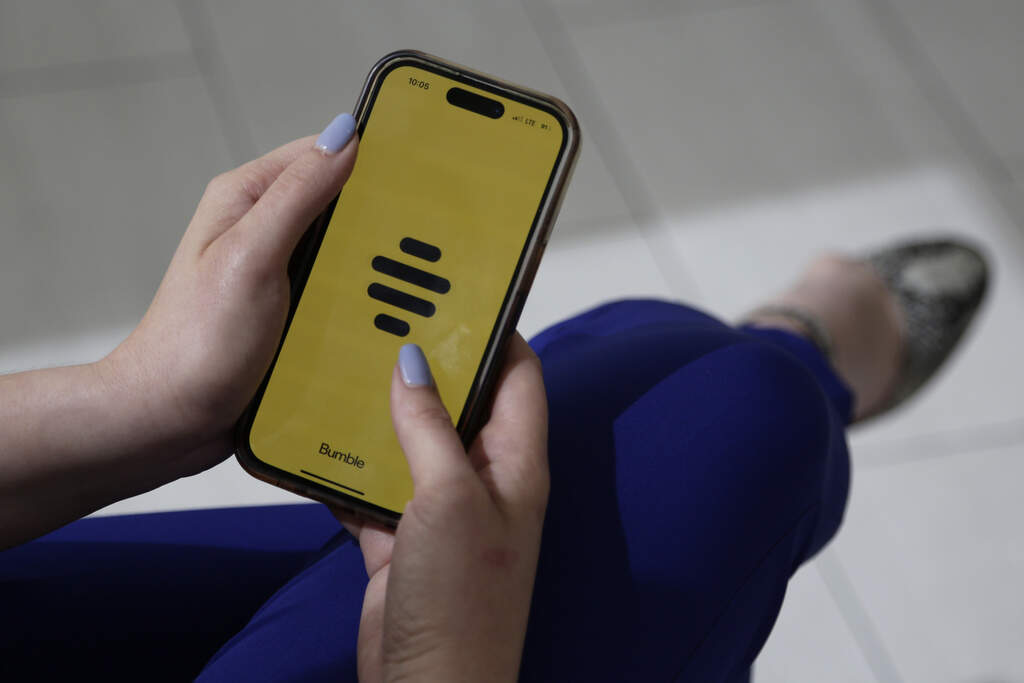
The dating scene can be a frustrating place to be right now. From dating app burnout to the struggle to meet IRL, single folks are fed up. Why modern dating feels so broken and what can be done to fix it.
Guests
Whitney Wolfe Herd, founder and CEO of Bumble Inc.
Adam Cohen-Aslatei, CEO of Three Day Rule, a matchmaking and relationship wellness company. He is also the founder of S’More, a dating app focused on personality and connection over looks.
Steven Cole, founder and CEO of Lunge, a dating app that connects people through fitness communities like running clubs.
Transcript
Part I
ALESSANDRA: Ah, dating Life. My favorite topic.
PEARL: To date online or not? That is the question.
JENNY: I am probably a five-year veteran of the online dating wars, and it is a jungle out there.
PEARL: There's something very dehumanizing about swiping through profiles like I can imagine it's like going through a deck of Pokémon cards or baseball cards and looking at their powers and stats and then keeping the ones you want and discarding the others.
ROSE: It was gamified in a way that was demoralizing so often and really made me question whether or not it was worth it.
CHRISTIAN: My wonderful partner and I Carly met through Hinge. We are currently really enjoying life together. And we have a funny joke that we are each other's best thing we've ever found on the internet.
MICHELE: I'm not currently dating anyone, but I'm on the apps and my experience has been that it's my only option.
PEARL: Another reason why I'm not feeling good is because there are a lot of too good to be true profiles that turn out to be scammers.
ROSE: Not an experience that I wish upon anyone.
AMORY SIVERTSON: Whew! You just heard On Point listeners Alessandra from Austin, Texas; Pearl from Bellevue, Washington; Jenny from Charlotte, North Carolina; Rose from Belmont, Massachusetts; Christian from Pasadena, California; and Michele from Minneapolis, Minnesota.
"There's something very dehumanizing about swiping through profiles."
Pearl, listener in Bellevue, Wa.
Wow. If you have any single friends out there, a lot of this probably sounded pretty painfully familiar when it comes to the state of dating.
These days, in this modern era, a lot of people are turning to modern tools like dating sites — and of course, apps — but according to Pew Research from 2022, only one in 10 people are actually finding committed relationships in these spaces. And for the rest of us, the journey of finding a romantic partner is starting to make the destination feel unreachable.
So today we're asking, is dating broken? Did we break it with the invention of tools like dating apps? And are the dating apps and the way that we are using them today starting to break us? Joining me first today is someone who's made two dating apps. Whitney Wolfe Herd co-founded Tinder in 2012, and then two years later she founded Bumble, of which she is the current CEO.
Whitney, welcome to On Point.
WHITNEY WOLFE HERD: Hello. Thank you for having me.
SIVERTSON: It's great to have you and I guess I'd love to start by giving you a chance to react to some of what we just heard from our listeners when we asked them to share their general thoughts on the dating scene.
WOLFE HERD: There's nothing I feel more fueled by than hearing these testimonies of the disappointment, the dissatisfaction, the shortcomings of our and other products. I was completely obsessed and still am with putting the member first. And my driving force when I was starting Bumble was just listening particularly to women. But I think we have to listen to all of our members and hear all of their sides so intently. I was the one reading all the feedback emails and obsessing over every little detail that was going wrong or hurting someone's feelings.
And I have to tell you. I think that the last decade we have left a lot of people feeling judged and rejected and feeling worse than they started when they came to these products. And that is what my calling is now in this new chapter, to bring back the love to finding online love. Because the power of technology of harnessed properly, it can change your life.
"We have left a lot of people feeling judged and rejected. And feeling worse than they started when they came to these products."
Whitney Wolfe Herd
For all of those bad experiences, the millions of experiences of someone living in the same building with someone for multiple years and never crossing paths until matching on Bumble. There are so many beautiful stories that can come from this too, and that's the energy I'm bringing back to reimagining the product in this new chapter.
SIVERTSON: Yeah. You said so much in there that I want to pick up on. And yes, we do want to shout out Christian, our listener in there who did find love on a dating app. Hooray for Christian! But you mentioned listening to women, hearing from women, and we should point out for people who are not familiar with Bumble or don't really know the difference between the dating apps, Bumble is the one, it was the first one to say, "Hey, the woman is going to send the first message on the app," and this is for hetero relationships that we're talking about. The woman is sending the first message.
So you left Bumble last year. You came back just this past March, saying that you were going to overhaul the whole thing. What did you mean by that?
WOLFE HERD: Sure, let's go back in time and we'll address the first part of your question. I had come out of an era as a young single woman, when this was pre #MeToo, pre kind of women feeling equal in their relationships. And it was just expected that women needed to wait for men. And it was expected that men were going to be aggressive and chase and do all this, which isn't fair to men either.
And so being on the front lines of Tinder, I had seen just how toxic dating in the real world was, and how it just got maximized by a product just accelerating human behaviors without any thoughtful design intervention to redirect a kinder, more accountable path. And so when I left Tinder, I had a bit of an epiphany both as my own woman, which was, "Oh my goodness. I don't want to be this woman."
I don't want to be a woman who perpetuates negativity, where women just for thousands of years have to just be lower and wait around. And I channeled all of that into a new product called Bumble. And I said, what if, similar to maybe the Sadie Hawkins dance that we all heard about growing up, what if we made this women in the driver's seat all day, every day? And not just to promote women, but to soften the experience for men, as well.
So I ran the company, I started the company in 2014 as a 25-year-old. And I ran it until I was 35. And then I left and hired a really special woman to be the CEO. She did a great job. And then after about a year, it was basically brought to my attention or opportunity for me to step back in. And I went for it. Because I was tired of listening and seeing and hearing the impact of these products having not the positive, beautiful, life changing outcomes that I had intended and worked so hard to create. So now I'm back and I want to fix the product in a way that really reignites the magic and curiosity and beauty of love and connection.
SIVERTSON: So are you coming back with maybe a clearer diagnosis of what is broken? What is it that you want to fix about Bumble or just about dating apps in general?
WOLFE HERD: I'll tell you what I think is broken. I think that dating pre-technology was broken, frankly.
Now, love is the most beautiful force in the world. There's arguably nothing more important, more powerful, more meaningful than love. It's the meaning of human life. However, if you look at the history of dating, it was quite objectifying. It was exhausting. It was taxing, even pre-technology.
"If you look at the history of dating, it was quite objectifying. It was exhausting. It was taxing, even pre-technology."
Whitney Wolfe Herd
And then, technology hits the scene and just took it online, which gave you more choice, more options. It distorted what the human mind was really meant to be able to handle in one given moment. You don't go to a bar and talk to 600 people. That's just not how humans really function. So all of a sudden you have these products where you can just eeny, meeny, miny, moe and yes and no based on just a photo or just swipe away someone into oblivion.
Now there's certain power to that, because you might have love at first swipe and you might find your special someone, and millions of people have. But for the vast majority of folks, it's left them feeling pretty bummed.
And I'm not here to play perfect. And just to pretend we've got like this great, perfect corporate narrative. I'm here to be real and I'm here to bring the world closer to love. And so the future of this product is all about what are the real issues behind broken relationships, and I'm a firm believer that it really comes down to helping people connect with more compatibility and more relevance. So let's help you instead of just connecting based on physical flash judgment. Let's help you really meet people that are deeply compatible to you and share the same values and want the similar lifestyle as you.
Because ultimately, the goal isn't just to get you on a date, it's to get you into something meaningful, connected, and lasting. And so we're going to redesign and improve, and that starts with safety at the helm, quality at the helm, and you'll see a launch from us later this month, and we're really excited to bring more love to the world.
Part II
SIVERTSON: We are talking today about the woes of dating these days, and you don't have to take it from me. Take it from our listeners.
(MONTAGE)
ROSE: Over those years of using the apps, I think I tried almost every single one of them.
PEARL: I think part of the problem is that dating profiles don't give me enough info to actually want to meet someone.
CHADBORNE: I've got a good profile, according to everyone that I've ever asked. I should be getting at least some kind of attention. I should be getting at least some kind of feedback and replies, but for the most part, every message I send out gets ignored or never read. I don't know.
"For the most part, every message I send out gets ignored or never read."
Chadborne, listener in Minneapolis, Mn.
JENNY: The political climate today makes it difficult to online date, as if it's not difficult enough.
SAM: As an autistic person I have been using the apps for well over a decade now. Unfortunately, fairly unsuccessfully.
ROSE: I had such a low opinion of using the apps that I just didn't care what I was going to encounter anymore, and that's ironically when things finally did happen. I was like, I had to stop caring in order to actually find someone that I care about.
SIVERTSON: You just heard from On Point listeners Rose from Belmont, Massachusetts; Pearl from Bellevue, Washington; Chadborne from Minneapolis, Minnesota; Jenny from Charlotte, North Carolina; and Sam from Parker, Colorado.
And I'm talking to Whitney Wolfe Herd. She's the founder and CEO of the dating app Bumble.
And Whitney, I want to pick up on a couple of the points we just heard from our listeners there. One being this idea that the apps don't give you enough information about a person to know if you even want to date them. And I was not that familiar with Bumble, like the visual of Bumble myself. I have never been on the apps. But I have a good friend who's on Bumble and she gave me a tutorial, a spin-through the other day.
So I could see all of these sorts of clever prompts and ways to share more about yourself and your interests and your values. I will say, in looking through her account, I saw a lot of profiles that just weren't fleshed out at all. So it left me feeling a little — what good are all of these great categories and tools if people aren't taking advantage of them?
WOLFE HERD: Let me give you a little bit of historical context. I think it may be interesting for the listeners.
SIVERTSON: Okay.
WOLFE HERD: So pre-mobile dating, we had web dating and that was the era of eHarmony and products like that. And frankly, many people felt that getting into these online dating products made them feel bad about themselves, like it was a last-ditch effort to meet someone, and they felt like they were filling out doctor office reports on themselves to make a profile.
So when the mobile phone really became this app-explosive moment, and we were an app for this and an app for that, of course, dating went mobile and digital. And when we were re-imagining how could we make this fun, easy and more casual for a different generation — which was the millennial market, not the Gen X market — the first thing we did was say we gotta take out that long-winded form.
Nobody wants to give, you know, every detail about themselves to be able to find a date. Let's make this more casual and mimic real life more, where you're just saying hello to someone at the bar.
So that was really the beginning of taking out a lot of the human contextualization of your personality and your characteristics. It went too far, frankly. It worked great for a few years. It felt like a game. People were enjoying it and then all things, it was time for something new. And that is precisely what I'm building right now with our amazing team at Bumble.
What you'll see from us is exactly what you just said. Let's get rid of this world of just non-filled out, non-complete profiles where you have no clue who someone is, and it just feels like a deck of cards. And so we're really re-engineering the chemistry compatibility. The things that matter most. Shared values, shared goals, shared life beliefs, but still allowing opposites to attract and that magic to happen.
I think something that your listeners may be interested in is BFF, which is our friend-finding product. People want to get online, to get offline as quick as possible, to meet real friends and have real community, and then maybe start dating through those connections IRL, which we all really are craving more than anything.
SIVERTSON: I do want to go back to this idea of gamification because we heard over and over again that it just feels like a game and that feels so dehumanizing. And gamification, for the app maker, feels like a double-edged sword. Because on the one hand, it's what makes the app feel fun. It's what keeps someone in the app. But on the other, you just start to feel disconnected with all of the swiping and the scrolling.
So given that swiping and scrolling still seems to be a fundamental part of dating apps, how do you think about balancing, making this feel fun, not making this feel like work, but also still making these feel like actual people on the other end?
WOLFE HERD: Do you think gamification is the best way to bring the world closer to love? Do we think just rejecting more people is the way to do that? Do we think judging more people is the way to do that? So you can see how the decision-making matrix becomes extremely different and much more purposeful when you know where you are going.
And I would say that is the anchor of Bumble, is that we have such a strong connection to our mission, to our purpose, that now we are re-imagining how we get you there. So what you will see in this next iteration of Bumble — and let me be clear, it's not going to be perfect overnight, this is a work in progress, just like everything all of us are working on — but it's about more authenticity. More genuine expression of who we are, bringing out the best in you so you can express yourself and find more compatible relationships.
SIVERTSON: I so — I do really believe in the sincerity of the purpose that you're talking about there. And also, Bumble is a publicly traded company that's had highs and lows along the way, as a business. And I wonder how you think about all of these things that you're talking about, staying true to the mission of helping people find love, when fundamentally you have to keep people in the app, to keep the business going. So how do you serve both interests?
WOLFE HERD: So I think you can approach that from two ways.
You can either keep someone somewhere in a way that doesn't make them feel great, but they feel like they have to be there for some reason. Or you can keep people there because they're having the most amazing experience and they're enjoying what they're doing on your product.
I think where these products maybe went into a direction that wasn't authentic to the real purpose of what they're meant to do, is you can't build a dating app like a social network. This is not about chaotic scale and just more engagement and more eyeballs and more time in app. It's not the purpose of this thing. It's not a distraction tool. It's not an entertainment mechanism.
And so when you don't design thoughtfully with all of the things that love requires, respect, safety, understanding, compatibility and self-understanding. Knowing who you are and what you're looking for, you're going to get outcomes that are not aligned with what people want.
"When you don't design thoughtfully, with all of the things that love requires ... you're going to get outcomes that are not aligned with what people want."
Whitney Wolfe Herd
And your intro is a perfect example for what happens when products chase scale, and when they chase randomized growth or they chase randomized expectations and they don't chase what their members truly are seeking, which is feeling good about themselves, while they are on the quest for dating and love.
SIVERTSON: I wonder if there was any kind of epiphany for you. Because you've been in this space for a long time. And it's changed a lot over the course of that process, and it hasn't, it's exciting to build a company and watch it grow, and yet I also wonder if there's part of you that hears things like what we're hearing and goes, "Oh no. Did I help build that? Did we all help build that as participants on this platform?" How do you think about it today, more than a decade in, going, "What happened here?"
WOLFE HERD: Yeah. I would say two key moments stand out, and I'm gonna be extremely vulnerable and honest here.
The first was at Tinder. I didn't like who I was there. It felt like it was going against my constitution, my inner compass. But the pressures of culture, society, growth, the culture of that company, it was intoxicating. When you're a young woman, you're 22 years old and you're part of a startup that's just growing like a weed and it's taking off like a rocket ship, you start to fight with yourself internally.
What's not right? What's not progressing women's experiences and, frankly, wasn't designed to be an empowering experience for women? But shoot, I was a part of that. I can't blame anybody but myself for being a part of that cultural part of technology. And I'm not talking about the company. I'm talking about the chapter and like how it made me feel, because I didn't like how it was making people feel. You can abandon yourself in the quest for success. It's something that happens to a lot of us in our lives. I was 22 and stupid, frankly.
And when I left Tinder, that realization gave me the learning experience and the playbook for what I didn't want to be and what I didn't want to build. So enter Bumble. Something rooted in something different, in kindness and love and respect, accountability, safety. But the intention is not enough. And frankly, there were a few years into Bumble where I was hearing about women not enjoying it, men feeling terrible, other genders feeling left out. And I thought, "God, what have I done now? What have I done now?"
I tried my best to do something different, but maybe that wasn't enough. But this is life. This is the entire point of life, is to grow, to learn, to grow, to learn.
"There were a few years into Bumble where I was hearing about women not enjoying it, men feeling terrible, other genders feeling left out. And I thought, 'God, what have I done now?'"
Whitney Wolfe Herd
And so this is my third moment. And I'm staring at it saying, "It's my duty to reimagine love, to help people feel better. And to not just make this bigger and a further growth story of the past, but let's do this differently in a way that people fall back in love with our product and they fall back in love with themselves and with others."
So that's the goal. I'm trying my best. I'm definitely not perfect, that's where we're at right now.
SIVERTSON: Whitney Wolfe Herd, founder and CEO of Bumble, thank you so much for taking some time to talk to us.
WOLFE HERD: Thank you so much for having me, and I really hope all of you listeners, even if you've had those bad experiences, please give Bumble another try, and please check out BFF. You're going to love the way we help you find friends.
SIVERTSON: Thank you, Whitney.
Okay, I want to briefly turn to our next guest to get some initial reaction here. Adam Cohen-Aslatei is the CEO of Three Day Rule, a modern matchmaking company as it describes itself. Adam, welcome to On Point.
ADAM COHEN-ASLATEI: Hi, how you doing today?
SIVERTSON: I'm good. So I have so much that I want to dig into with you. We have a break coming up here shortly. So I guess first I just want some initial reaction to what we just heard there from Whitney Wolfe Herd of Bumble.
COHEN-ASLATEI: So I used to work for Whitney Wolfe Herd, so we're all connected by a degree.
I was running one of the apps, part of the Bumble portfolio. So I know Whitney very well. I know the company very well and I know the struggles that many singles around the world face when they're using these dating apps and hoping and desiring for something more. And they're let down in many cases because the features don't support their long-term goal.
So I'm very inspired by what Whitney said in terms of the new features that are going to be more proactive in helping people get what they're really looking for out of relationships. The reality is a lot of people do feel like they need to be on these apps to find love, and in some cases that's true. In other cases, millions of singles are turning to the old-school matchmaking. Because in reality, it works much better for long-term relationships.
Part III
SIVERTSON: We're talking about the dating scene today, which a lot of people feel is broken. So broken that they're turning to new methods of trying to find the one, as some of our listeners told us.
(MONTAGE)
MICHELE: Joining some group that focuses on one of my interests, like hiking or tennis in the hope that there might be someone there I'm compatible with. But that in my experience, is pretty hit or miss and could take forever. Actually, mostly miss.
ADAM: I am a member of many running groups, and it's in theory, a good way to meet people with whom I share an activity, but then you don't know if they're available or not. And I don't want to make people feel uncomfortable, don't want to hit on them when they're just there to run.
JOE: I don't really have hobbies that would allow me to join clubs and things like that. And I'm not really interested in most types of clubs that exist. I like running by myself. I don't like running with other people.
KAYLA: I personally am not dating at the moment. I am open to it. I am not seeking it out as a means to complete my life, but rather to add to my life. I figure it will happen when it happens, if it ever does, and if it doesn't, I'm okay with that.
PEARL: I want to make sure that if I get married, it's not out of settling or desperation or thinking that I'm not complete without someone. It will be because this is someone who I want to be a partner in for the rest of my life.
SIVERTSON: That was On Point listeners Michelle from Minnesota; Adam from Colorado; Joe from California; Kayla from New Mexico; and Pearl from Washington State.
And I'm talking to Adam Cohen-Aslatei, the CEO of Three Day Rule, which describes itself as a modern matchmaking company. Adam, what is the three day rule of dating?
COHEN-ASLATEI: Yeah, so we believe in a three-day rule approach to successful dating. For us, it's about what you do to get ready for the date.
How do you mentally, physically prepare? Do you need to energize? Do you need to feel grounded? How do you come across in terms of your first impressions? What do you do actually the day of the date? How are you focused on the individual? What story about yourself are you planning to share with the person across the table from you? How do you present yourself? What are you looking for in terms of what you want to get out of the date, things that you like about them, deal breakers, et cetera.?
And then after the date, we always like our clients to wait 24 hours. Because we want you to be operating from a place of being rational as well as emotional. We want you to feel that connectedness, but we don't want you to rush into a yes because of lust, or, "No, because he didn't meet the 25 criteria that I have on my list." And so we take a very disciplined approach to the day before, during, and after to help you get on more second dates, which then leads to the long-term relationship.
And then I would say the final point of this is that a company like Three Day Rule, we don't just think about the dates. In many cases, the actual date itself, finding your person, may be the easier part in this process. The harder part is staying connected.
SIVERTSON: Adam, why does dating feel so hard? Are we just bad at this? Have we always been bad at this, maybe? Are we getting worse? Are the apps making us worse? What's happening?
COHEN-ASLATEI: Here's the thing, guys and gals out there. Dating is a skill, and the skill of dating is not taught in high school, and it's not taught in college. And it's a trial and error. And also, we're watching the media. We see how other people date, and we absorb those habits, and we think that they're correct.
Then reality hits us and all of a sudden, we're on an app with infinite possibilities. And apps like Plenty of Fish tell us, "If there's one thing not perfect about them, throw them back in the water, because there's plenty of other fish in the sea."
And the reality is, in some cases, and in many cases, dating apps have helped us treat relationships and people like they're objects, like they're not an actual human being that we should treat with respect and honor and give a person a shot. It's literally treated like a material item and we're, in many cases, disrespectful to individuals. Because we don't need them. They're transactional.
"Dating apps have helped us treat relationships and people like they're objects ... They're transactional."
Adam Cohen-Aslatei
And with a company like Three Day Rule or a matchmaking company, we get back to the humanistic approach to relationships. We wanna know about you. We wanna know what makes you tick. We wanna know your X factor. And knowing more about our clients helps us match you successfully with someone else and seeing if they have that same X factor that will lead you into success.
SIVERTSON: Okay. I want to bring one more voice into this conversation because I feel like we've talked about the apps, we've talked about what you're offering, sounds like a really careful and curated experience. And there's also this idea of just serendipity. And people, a lot of people want to feel like they can get as close to that idea of serendipity as possible, while still being genuinely interested in the other person and in what they're interested in.
So Steven Cole is with us. He's the founder and CEO of Lunge, which is a run club-meets-romance. Steven, can you tell us how this works?
STEVEN COLE: Absolutely. So we actually originated as a dating app to make dating more about in real life, what we heard from everyone is you can't date through a phone. It takes the average male 1,500 likes to actually get one date in real life. For hundreds of years people have dated in real life and we felt like someone, what Adam said, it's tough to date through a phone. It's superficial and it really changes the dynamic. So we're taking the clock back to make dating more about in real life.
"It takes the average male 1,500 likes [on an app] to actually get one date in real life."
Steven Cole
Our app, rather than having a million profiles out there, makes it so that you actually date people within the most common third place for Gen Z, which is your fitness communities. So you sign up with a gym, a run club, to even something like the New York City Marathon, and you match only with that social group of people. And then to even take that one step further, Lunge host the largest singles events of any dating app ever, because dating has to be about in real life.
One of our bigger dating events is the Lunge Run Club, and every single week we bring together over thousands of people to date in real life. And we're open to anyone — any gender, any race, any age. But our one rule is if you are single, you wear black.
SIVERTSON: Okay. So to signal to other people, "I'm single, I'm ready to mingle on a run?"
COLE: Yep. You're literally wearing it and showing to everyone. "I'm here to be intentional about meeting people."
"Every single week, we bring together over thousands of people to date in real life ... [O]ur one rule is if you are single, you wear black."
Steven Cole
SIVERTSON: Okay. Adam, I'm curious. I have heard this idea that run clubs are the new dating apps, the new way to meet people. Is this something that you're hearing from your clients, that they just want to find people in physical space?
COHEN-ASLATEI: Yeah. Look, I think at a company like Three Day Rule, we're trying to educate. We're trying to inform, and we're trying to upskill singles out there so that they're better hunters, they know how to have these conversations.
I love what Steve is doing. I also know Steve pretty well and I'm a big fan of what he's doing with his app and also the run clubs. I actually just joined a run club. And 50% of the run club that I joined in Newport Beach, California are singles. So it's certainly a great place. It's in a way easier to meet people in groups. It's less intense. There's less pressure.
But at the same time, you still need to have the skills of communication. And so with spending so much time online, and especially with COVID, you want to really understand how to have the conversation with an individual so that it doesn't feel like an interview. So that it feels fun, that it feels light, and that's what really leads into these longer-term relationships.
So the event, having meeting people through an activity, I love that idea. At the same time, I think we also need to learn how to date successfully so that we feel good about ourselves. We have self-confidence, we have self-esteem. We know what we're looking for, and all those elements, again, at Three Day Rule is what we teach our clients and also our date candidates.
SIVERTSON: There's so much kind of big picture that I'm curious to dig into with the two of you. And one of these ideas is that dating has always felt a little — I guess something that fundamentally feels broken about it to me is that attraction is such a big part of dating. And yet what we are attracted to and what makes someone the right life partner for us can be very different things.
Adam, as you are making matches, and Steven, as you are thinking about how to bring people together to maybe not just go on a run and have a good time, but to maybe someday build a life together, how do we get past this sort of attraction trap, if that's even a fair way to think about it?
COHEN-ASLATEI: I can tell you what my opinion about it is. Again, these dating apps that we're on, we're giving people less than two seconds to make a first impression, and it's mostly based on a photo. When you're using either meeting people in person, you're getting some of their personality, you're getting some of their physical cues, and you're understanding a bit more about them. Same thing with matchmaking.
For us, we very much care what you're physically attracted to, but that's only one piece of the pie. And that's not going to lead to a long-term relationship. So I know a lot of people out there think that opposites attract. What we find in our industry — and we've been doing this for 15 years and have over 21,000 successful matches and have become the fastest growing matchmaking company in the U.S. For us, people that have shared goals, values, morals, and outlooks on life, the more similarities you have in those true values, the longer-term relationship elements are there.
If you are totally opposite to the person that you're dating, it may be fun, but it's less likely to lead to a long-term relationship. Complimentary personalities, that's true. For long-term relationships, two people with the same personality can be fire and fire. So you definitely want personality differences, but if you don't have similar goals, values, ambitions, even heritage, religion, even views on politics. Politics have become core values to so many people. If those things aren't in unison, then it's much more difficult to become a long-term partner with that person.
"You definitely want personality differences. But if you don't have similar goals, values, ambitions, even heritage, religion ... it's much more difficult to become a long-term partner with that person."
Adam Cohen-Aslatei
COLE: If you don't mind me piggybacking off of that, I think Adam actually is 100% correct on that. And it's funny, at our run club, I can't tell you how many times I hear couples who come back wearing colors say, "I would not have swiped right on this person on a dating app. But when we met at run club, there was just so much chemistry and just we really enjoyed being around each other."
And adding that extra layer of shared values, which is what we really do with our app, which is connecting people through the same fitness communities. It's about connecting people who spend their time doing the same thing in the same place. That is really meeting like-minded, compatible people. And I think that's a shift that we're going to see in dating over the next couple years.
SIVERTSON: Something I'm thinking about that is just hitting me is running is such a — makes you vulnerable because it is exhausting and it maybe helps us get a little closer, a little faster to this idea of authenticity.
We so often hear this almost patronizing refrain of, "Just be yourself." And it's so hard to just be yourself! It's like someone telling you to calm down. You know, as soon as you tell me to calm down, I'm not calm. How do you two think about staying authentic and true and what advice you give to people that isn't just, "be yourself," which is impossible for some reason on a date?
COLE: You know, what's funny about Lunge Run Club is we'll have a bar with north of a thousand people. Everyone is all sweaty, in black, just talking and mingling. And it's actually a pretty unbelievable sight to see because everyone is just — barriers are down. They're not out on a date with all their makeup done.
And it's a really cool way to have this low-pressure environment to meet in real life. And I would encourage anyone to, whether it is a Lunge Run Club or any other, just in-person event to go out and just put yourself out there. Because you'd be shocked by how easy it is to really connect in real life than try to put the pressure on you just swiping on a bunch of people and going on these random dates through these random apps.
SIVERTSON: We just have a little bit of time here left, but I would love to leave our listeners with a little bit of hope here. For anyone who is just really in the thick of it, it's easy to write off dating struggles as superfluous, but it really does shape how we move through the world and think about ourselves.
Adam, is there hope? And what would you say to people who are just at their wit's end and ready to give up on dating these days?
COHEN-ASLATEI: I would say email me personally. I'm gonna put it out there. I'm gonna get a thousand emails, but adam@threedayrule.com or find me on Instagram. We do an amazing job at finding you a person with a 70% to 80% success rate for relationships.
SIVERTSON: But what if you don't have a matchmaking budget, Adam?
COHEN-ASLATEI: So here, I'm happy you asked. Because at a company like Three Day Rule, we have a free database so anyone can join Three Day Rule's network. And if you match with one of our clients, it's completely free for you. So you have nothing to lose and everything to gain, to throw your hat in the ring and say, "Yes, I may be on these dating apps, but I'm also high intent and I also want to be part of the Three Day Rule network."
In addition to that, we're going to be the first matchmaking company in America to launch an AI app, which will be competitive to any dating app out there. And instead of sifting and swiping through all these profiles endlessly, you're gonna get your own AI matchmaker that was built on 15 years of data from Three Day Rule and all of the post-date feedback.
Keep in mind, one of the reasons why matchmaking is so successful is because we asked both parties after the date why it went well and why it didn't. And so all that extra data helps us with the next match, and that's why it's an iterative process and you end up finding love at the end of it.
The first draft of this transcript was created by Descript, an AI transcription tool. An On Point producer then thoroughly reviewed, corrected, and reformatted the transcript before publication. The use of this AI tool creates the capacity to provide these transcripts.
This program aired on August 21, 2025.