Support WBUR
How Trump is transforming the way corporations do business in the U.S.
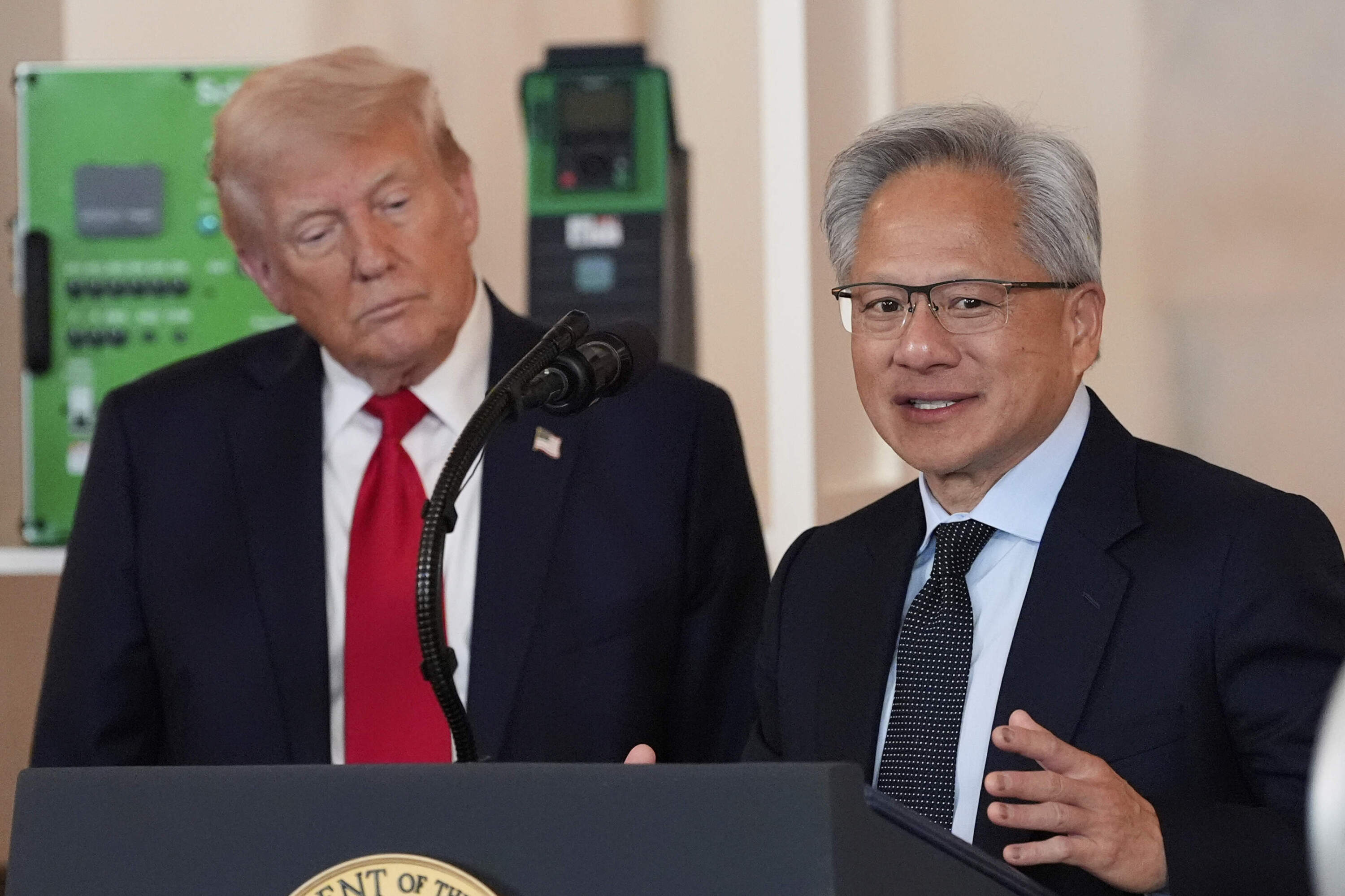
President Trump demanded cuts from private businesses. Blacklisted major law firms. And threatened companies to invest more in America. The uncertain legal landscape for U.S. businesses today.
Guest
Max Cherney, tech correspondent at Reuters who reports on the semiconductor industry and artificial intelligence.
Philip Nichols, professor of legal studies and business ethics at the University of Pennsylvania’s Wharton School.
Also Featured
Russ Buettner, co-author of “Lucky Loser: How Donald Trump Squandered His Father's Fortune and Created the Illusion of Success."
John Babina, president and CEO of MetaRetail.
Transcript
Part I
MEGHNA CHAKRABARTI: President Donald Trump has changed the way corporations think about doing business in the United States. A recent and truly remarkable example came just last month. On Thursday, August 7th, Trump posted the following on Truth Social. Quote: The CEO of Intel is highly conflicted and must resign immediately. There is no other solution to this problem. Thank you for your attention to this problem! End quote.
Now it is highly unusual for an American president to publicly demand the resignation of a private sector CEO. Intel's CEO Lip Bhutan wrote internally to staff that the Trump criticism was quote, misinformation.
No matter, markets responded, Intel's share value began to swan dive. So you can imagine that Bhutan and shareholders prayed for respite over the weekend, but that weekend something else happened. Because on Monday, August 11th, just three days after that first incendiary post, Lip Bhutan met with President Trump at the White House. And soon after Trump posted a head spinning 180, writing about Bhutan, quote:
The meeting was a very interesting one. His success and rise is an amazing story. And then he ended with his customary, Thank you for your attention to this matter! End quote. Intel's stock also recovered. And then a few days later, the president announced:
TRUMP: And I said, I think you should pay us 10% of your company.
And they said, yes.
CHAKRABARTI: Max Cherney joins us now. He's a tech correspondent at Reuters who reports on the semiconductor industry and AI, and he's with us from San Francisco. Max, welcome to On Point.
MAX CHERNEY: Hi. Thanks for having me.
CHAKRABARTI: Just to check myself here, it is highly unusual for a president to demand the resignation of a corporate CEO in this country.
Yes?
CHERNEY: Absolutely.
CHAKRABARTI: Okay.
So can you explain to me, first of all, what we know. We'll talk about how the meeting happened, but what do we know about what happened in the meeting?
CHERNEY: Sure. From what we understand, the Intel CEO discussed, among other things, his plan to fix Intel. Because the companies had a number of troubles in the recent past. They discussed the 10% stake evidently.
And it appears like the meeting was enough to turn the president around on a CEO that he very recently had just asked to resign. So --
CHAKRABARTI: Yeah, and I find it fascinating that Trump posted specifically about Lip Bhutan's story. So let's talk about that a little bit. Who is this? He's actually also relatively new CEO of Intel.
CHERNEY: Yeah, he took the job in March. Mr. Bhutan is mostly known for his investing in the chip industry. He's one of the most prolific venture capitalists and is investing in chip companies for decades. And among his notable exits were RNA Labs, which Amazon bought and turned into their homegrown chip division.
He also invested in a company called NUVIA that Qualcomm bought recently. So he's known in semiconductor circles for those many investments. I think he's invested more cash single-handedly than the rest of the venture capital world combined in chips.
But he also notably ran a company called Cadence Design for 15 or so years. And Cadence, when he took over just before 2010, was in a lot of trouble, much in the same way that Intel is in trouble. And he effectively turned the business around over, it took, I think he says, it took him like 10 or 15 years to do it.
So he has interestingly, some, a lot of operational experience in the chip industry. And even though Cadence is a pretty niche company, it makes software that people use to design chips. He spent years working on relationships with all his big customers. Which appears as though he's gonna do again.
CHAKRABARTI: So he's Malaysian born, but a U.S. citizen. Long time U.S. citizen. It's not, maybe it's not out of the ordinary that in an era where sort of reshoring technology that goes into making these critically important chips and semiconductors, that would bring a lot of sort of political attention to a giant like Intel.
But this whole idea of Lip Bhutan being conflicted, explain that. Because it begins with Senator Tom Cotton of Arkansas. Yes?
CHERNEY: Yeah, it does. Although my colleagues and I reported a story in April about tan's numerous investments in Chinese companies, roughly, I think hundreds of them.
I think we found as many as 600-ish. And he's invested roughly 200 million in these companies between 2012 and 2014, some of which have ties to the military. That reporting came to the Senator's attention, as well as two other sort of critical pieces of information. One is, remember the company I was just mentioning, Cadence Design.
It agreed to plead guilty and pay a $140 million penalty for selling its chip design products to a Chinese military university that was believed to be involved in simulating nuclear blasts. The Senator raised questions about that. And finally Intel has an agreement with the federal government to essentially make chips for the Defense Department.
There's a, it's a $3 billion deal, and the Senator had a number of questions related to that.
CHAKRABARTI: So we have you to blame and your reporting Max. (LAUGHS)
CHERNEY: I wouldn't go that far.
CHAKRABARTI: I'm just kidding. Just kidding. But obviously your reporting is important and it caught Senator Cotton's attention.
But just to be clear from your reporting, did you, can you conclude that Bhutan has any kind of conflict with these business dealings and investments in China, or no?
CHERNEY: Like I said, we found that he has, at the time we reported in April, he still held stakes in hundreds of companies.
So I think that's up to the board, whether that's a conflict or the Intel shareholders. That's not really for me to say if he's conflicted or not. Typically, public company CEOs have to take steps to avoid conflicts in companies that they're not running. But involved in, if they have board seats or whatever personal investments and so on.
CHAKRABARTI: Okay. We also used to live in a time where presidents had to take steps to avoid conflicts of interest with business. Maybe the rules are changing. That's exactly actually why we're having this conversation.
So tell me more than Max about this 10% equity stake. What are the specifics of this deal that the U.S. government is now, what? Is going to be Intel's largest shareholder?
CHERNEY: Yes, it will be Intel's largest shareholder. So you and I and every other American will now own a piece of the company. The stake is in exchange for, so a few years ago following COVID and some of the realizations around how important chips were for the economy, the Biden administration helped Congress pass a law called the CHIPS Act, which pledged roughly $52 billion to fund any number of semiconductor projects around the country.
The idea being to stimulate factory construction, essentially. Intel was, managed to obtain the largest grant under this program, roughly $10 billion. That all happened under the prior CEO Pat Gelsinger, who spent a great deal of time in Washington lobbying for this money, because it's important for Intel's future.
Intel has received $2 billion under this grant program, but it's the equity stake that the U.S. now has is essentially what's left of the money. So about $8.9 billion of this. CHIPS Act Grant and the Secure Enclave Program, Intel has not received.
And the plan that the president and his advisors hatched with Bhutan was to convert this equity, or excuse me, to convert this CHIPS Act grant into an equity sink. Which meant Intel is going to have to, has to give up something in exchange for money it was going to get otherwise.
CHAKRABARTI: And I believe, if we're going to talk about deals, is this a good deal? Because I understand that the $8.9 billion equates to what, $20.47 cents per share in Intel, which is what, at a $4 discount from a recent closing price that Intel had.
CHERNEY: So 2047 is not an accident. That's a very particular number, and I think everybody who understands presidents can understand why that number exists. It was at a discount to the market rate for the stock on the given day. Existing shareholders are going to be diluted and earnings, if Intel had any, would be also be diluted.
So in that sense, shareholders had to give up something in exchange for this. But I think the implicit understanding is that now the U.S. government is firmly supporting Intel. Yeah.
And I think the hope is that it'll help them attract customers for its next generation manufacturing process.
The implicit understanding is that now the U.S. government is firmly supporting Intel. ... The hope is that it'll help them attract customers for its next generation manufacturing process.
Max Cherney
And many other things. But yeah, it's a totally extraordinary situation.
CHAKRABARTI: We're gonna talk a little later with a professor who has a big picture view on how actions like this are really changing how corporations do business in America. We'll get to that in a few minutes, but Max, I still have a couple more questions for you, just to be clear.
Because sometimes the details can be confusing. This deal now that the Trump administration is struck with Intel is different from what the conditions were in the 2022 CHIPS Act. Is that right?
CHERNEY: Yes. The CHIPS Act grants to anybody that received them, that includes companies like Taiwan Semiconductor Manufacturing, which is one of Intel's biggest rivals on the chip manufacturing front, or Samsung, which also manufacturers chips in the United States.
The grant recipients all had to achieve certain milestones. We don't know what the milestones are, because they were not made public. Some of them are related to industry, like trade secrets essentially. But Intel would've had to hit a number of milestones in projects in places like Ohio, in Arizona, in Oregon where it does all its R&D, and with this equity stake Intel does not have to hit any of those milestones anymore.
Just last week, the CFO Dave Zinsner said that Intel got the cash, $5.7 billion of it on Wednesday night. So they don't have to, there are no more performance related goals that the company has to hit.
Part II
CHAKRABARTI: We're talking about how President Trump is changing how corporate CEOs think about doing business in the United States. And we're focusing for a few moments on Intel. Now on August 22nd, and this is 11 days after that remarkable meeting between President Donald Trump and Intel's CEO.
The president was asked by reporters at the White House about that equity stake deal, and here's what Trump said.
TRUMP: If we're going to give somebody a free out, a restrictive covenant, we have a strong restrictive covenant on certain industries, and I will absolutely give somebody an opening or a restrict to do a lot of business, which is good for us, as long as it doesn't hurt us in a security or military way.
And if I do that, I think the country should be paid. Because anybody else, I have it in real estate, where I'll have a deal with somebody. And I'll have them restrictive covenant. Then they'll come back and they'll say, I'd love to be able to build over here, but I'm not allowed to because you have me covered.
You have me restricted. I say, I'll let you build over there, but pay me a lot of money. No different. But the country never did it because the country was run by foolish people.
CHAKRABARTI: President Trump on August 22nd. Now, Max Cherney, it's not unprecedented that the United States government takes an equity stake in companies.
I think maybe the most well-known example is from back after the housing and financial crisis in '08 when the Obama administration bailed out the auto industry and once the government exited that actually I think made some money on being a short-term shareholder in automotive companies in this country.
Is that analogous to the position that Intel's in right now? Because you did say it was struggling.
CHERNEY: Intel's struggling, but it's struggling in like the long-term sense. Like for example, it's got $21 billion in cash on the balance sheet right now, it's got $2 billion coming in from an investment from SoftBank.
It's got the $5.7 billion coming from the federal government. It's selling a part of its business for roughly $3.5 billion; it's spinning out another business which probably will net several billion dollars more. So it's not like Intel is in financial trouble in the sense that it's going to default on its debt next year or completely collapse operationally.
For, at least again, for the next year. Intel's struggle is more in the long term. It's trying to do something very difficult at its core. Intel is in the physics business and because it manufactures chips, most chip companies in the U.S. are designers only. So Nvidia and AMD, for example, just design chips, they don't actually make them.
Intel is in the very, very challenging business of manufacturing these atomic scale microprocessors. And so to get to it, companies are always pushing on the sort of boundaries of physics to achieve superior manufacturing processes. And Intel at the moment is pushing to build its next generation process that it calls 14A. And that is where it's going to run into sort of financial problems.
According to estimates, it needs $20 billion that it does not have in order to get there.
CHAKRABARTI: Interesting.
CHERNEY: So that's the problem that they're facing. So it's not really analogous in the sense that it's going to collapse in the next couple of months, but it does have longer term financial challenges.
CHAKRABARTI: Understood.
Okay. That's really interesting. Because okay. In that case, again, we did live in a time where that was simply just how markets run. You either stay competitive, or you don't, and the government was supposed to stay out of it. But I appreciate that clarification because it makes it very different than when the government has stepped in before to like literally do a bailout or shore up collapsing major industries.
That was not what happened here. So Max Cherney, tech correspondent at Reuters reports on the semiconductor industry and AI, with us from San Francisco. Thank you so much for getting us started, Max.
CHERNEY: Absolutely. Thank you so much for having me on your show.
CHAKRABARTI: Okay, so here is Commerce Secretary Howard Lutnick describing how he sees the Intel deal.
He was at a cabinet meeting on August 26th.
HOWARD LUTNICK: The Biden administration had given $11 billion to Intel, given it to them, done, corporate, just gift. And you turn that into, really, it was like less than five minutes of conversation and Intel agreed to give us 10% of their company, which of course was worth $11 billion.
So it's not socialism. This is capitalism. If you give someone $11 billion, who's just building in America, they're not doing something special, they're building in America. And their CEO told the president he didn't need the grant, and you said, then why don't we get something for it?
CHAKRABARTI: That's the Commerce Secretary Howard Lutnick.
Joining us now is Philip Nichols. He's a professor of legal studies and business ethics at the University of Pennsylvania's Wharton School, and he is joining us from On Point Station, WHYY in Philadelphia. Professor Nichols, welcome to On Point.
PHILIP NICHOLS: Hi Meghna. It's really good to see you.
How are you doing?
CHAKRABARTI: I'm doing great. So first of all, there's a lot in the commerce secretary's clip there that I'd like to dissect with you. First of all, this Intel deal, he says it's not socialism, it's capitalism. Thoughts?
NICHOLS: Socialism is a very hard thing to define, but the rough definition is that the means of production are held collectively.
And usually by a government, and so he can say whatever he wants, but the government is taking over a means of production, and that is the paradigmatic definition of socialism.
The government is taking over a means of production, and that is the paradigmatic definition of socialism.
Philip Nichols
CHAKRABARTI: Interesting. But then Lutnick says though that what Intel, that the Biden administration had handed $11 billion to Intel to quote-unquote, not do anything special just building in America.
But my understanding of the CHIPS Act was the implication, or the insinuation was building in America was the right thing to do, and the government wanted more of that, which is right, especially in the tech sector, which was the entire impetus of the CHIPS Act.
NICHOLS: Part of it was restarting the economy after COVID, but more pointedly, as you say, and that's hardly unique.
Governments all over the world, including the United States government, frequently nudge activities in the market by giving grants, by endorsing basic research, by giving tax breaks, by changing zoning, it's commonplace. So the notion that this was some freakily lazy conduct by previous administrations, whom I guess were, quote, foolish, end quote. That doesn't really align with history or how governments interact with markets.
CHAKRABARTI: Okay. So then why do you think that this Intel deal is different then, your specific view on that?
NICHOLS: There are two aspects of it that are unusual.
One is this kind of, Okay I'm the president of the United States. I'm going to demand that you get fired. Half an hour later. Hey, guess what? We now own 10% of your company. That smacks of extortion in a creepy kind of way. And the other is that, as Max just said, previous interventions that involved ownership of shares were short term, they were for a specific thing. Bail out the auto companies, right?
Increased war production during World War II. This one seems open-ended, and it includes, President Trump referred to covenants. We want to think of it as a golden share. A provision that the federal government can dictate certain aspects of Intel's conduct in the marketplace. Which again --
CHAKRABARTI: Can I just jump in here? I would just want to give a shout out to a previous show that we did about the golden share. Because we did, we talked about what that is regarding the approval of Nippon Steel's purchase of U.S. Steel and the golden share that the United States government has there.
So just, folks, go to the On Point podcast feed. Look for the words golden share. S-H-A-R-E to be clear. And it's a really great show. Okay, so I didn't mean to interrupt you there, Professor Nichols. But this is really interesting. So those two ways make this a completely different kind of deal.
But the thing is that the Trump administration has made it clear that it may not be the last one. Because just on August 25th, White House National Economic Council Director Kevin Hassett, he was interviewed by Andrew Ross Sorkin on CNBC and Sorkin asked Hassett specifically about the Intel deal and if the U.S. government or the Trump administration plans to do it again, to take more equity stakes in other companies.
And here's what Hassett said.
HASSETT: It's possible. Yeah, that's absolutely right. In the past, the federal government has been given money away, lickety-split to companies and the taxpayers have received nothing in return. And so now what's happening with the Intel deal is the CHIPS Act of money is going out as planned, but instead of it just going out and disappearing into the ether, the U.S. taxpayers are getting a little bit of equity.
I can really not see how anyone would think that's a bad thing unless you thought that the government was then going to go in and run the company. But these are going to be shares. That don't have voting rights, the government's going to stay out of it.
CHAKRABARTI: That's a little different than what you just said, professor. Right?
NICHOLS: There's so many things in what Hassett just said. Dr. Hassett just said, whose doctorate, by the way, is from the University of Pennsylvania.
CHAKRABARTI: Shout out to Penn.
NICHOLS: He goes on to say, or I don't know if it was in that interview, but he said elsewhere that this could be the nascent, he and the Secretary of the Treasury have said, this may be the beginning of a Sovereign Wealth Fund in the United States. But the shareholders in general do not have day-to-day management, shareholders without voting rights generally have less say in day-to-day management, but shareholders who hold, who have power to disallow activities by a company have a say in management.
And so the notion that the government is not taking a role in management is just blatantly untrue. Not day to day, of course, but there is a role in management and that should be of concern to people who embrace a market that's generally free from government interference. There's also the concern that the U.S. government will steer business to Intel.
And even though that's not interfering with the day-to-day conduct of Intel, it certainly puts a lot of pressure on the day-to-day operation of Intel's competitors.
CHAKRABARTI: Okay.
Professor Nichols, let me jump in here there, because there's a lot of what you said, which I just, I wanna almost repeat the question that Hassett asked in that clip, what's wrong with it?
Because, okay. If the U.S. did start a sovereign wealth fund, companies from Norway to Saudi Arabia have those. What's wrong with that? And second of all, you rightly said, it's up until now, we've had a generally free market, meaning the government's always been somewhat active in the free market.
But as Hassett said, given those customary expectations, another expectation is if taxpayers help shore up or advance a business, why shouldn't they get something in return in the form of an equity stake? Because look, I guess here's the point I'm trying to get to. The sense that free market capitalism in this country has actually failed tens of millions of Americans is one of the things that propelled President Trump to office in the first place.
NICHOLS: Sure.
CHAKRABARTI: And now he's saying that's exactly the kind of thing we need to fix. We need to get something back from these companies that have always benefited from the beneficence of the federal government. We, being the taxpayers, need to get something back from that. What's wrong with that?
NICHOLS: Sure. And first of all, you can call me Phil. Professor Nichols is what my students call me when they're afraid of me. And there should be no fear here.
CHAKRABARTI: No fear.
NICHOLS: But second, so the notion that this money just goes to Intel and then disappears into the ether, that's not at all the case.
The whole objective was that money would be given to, as you said, to CHIPS Industries for the design and or manufacturer of chips locally here in the United States and how that benefits everyone, not just those of us who pay taxes, but everyone is in security or is in access to next generation technology.
Hopefully in a wider distribution of access to that kind of technology. And so it's not, it's not like we have to have a share or we don't benefit. Everyone in theory, benefits. Now are mistakes made? Absolutely. Do some efforts not achieve fruition? Absolutely. The notion that the generally free market has not benefited everyone equally is absolutely correct. ... You can't really debate that. So the question now is, how do we want to address that? Do we want to address that by the government? And it is very simplistic to say that now taxpayer's own shares in Intel. The federal government owns shares of Intel.
Not the taxpayers. Not the general public.
CHAKRABARTI: No dividend checks in the mail for the taxpayer.
NICHOLS: We're not Alaska, we're not going to be getting those checks. How the federal government uses those may benefit some people, may benefit other people may benefit no one. But it's not like there's a direct link between you and Intel now, just if you pay taxes, I don't know.
CHAKRABARTI: Yeah. You know what's so fascinating to me about this? Is that as far as I can tell, there this like really significant sea change in the government's involvement in corporate America. There hasn't been a lot of outcry from Democrats, for example.
And I'm thinking it's partially because Democrats may actually be on board with a lot of what's going on here. Our wonderful producer, Paige, who put this show together, she dug up a fact that back in 2022, Senators Elizabeth Warren and Bernie Sanders co-sponsored an amendment to the CHIPS Act that would have, as a condition of funding, it would've granted the government an equity stake in Intel in exchange for federal funding for childcare, early education and infrastructure development.
There may actually be a lot of common ground here between Republicans and Democrats now about more and more active government in business. I think the only people who are truly lamenting this are those who, maybe the oldest of old school Republicans, back when the GOP actually believed in the sanctity of a free market.
NICHOLS: I did not know that. That is awesome. That is utterly hilarious. But it's interesting to look at what Senators Warren and Sanders proposed. Or what I'm hearing, they proposed a direct link between any revenue the government would accrue and a specific benefit to the general public.
What we're seeing now is just, hey, more money coming into the federal government. Who knows what's going to happen to it.
CHAKRABARTI: Got it. And by the way, I should note that that amendment failed.
Never actually made it into the CHIPS Act.
Part III
CHAKRABARTI: We're talking about how President Trump is changing doing business in this country. And of course, Phil, it's not just the taking the equity stake in Intel, this question is urgent because of all the other things that the Trump administration has done. Making threats against the legal industry.
The tariffs, Capital T. Threatening to void contracts, et cetera. It's a whole suite of things. Yeah. How much has that changed this core question I'm asking? How much has that changed how business leaders think about doing business here? We contacted many of the biggest business lobbying groups in the United States.
NICHOLS: (LAUGHS)
CHAKRABARTI: Zero of them would talk to us.
NICHOLS: Absolutely. Yeah. I totally get that. So the big story is not President Trump. The big story is actually a sea change in law and legal theory. And that sea change is, to get technical for just a minute, and I apologize, Meghna, already.
The big story is not President Trump. The big story is actually a sea change in law and legal theory.
Philip Nichols
CHAKRABARTI: No fear, no apologies.
NICHOLS: Okay. Article 2 of the U.S. Constitution, which is the article that deals with the executive, begins with the sentence, the powers of the president shall be, the powers of the executive shall be in the hands of the president. And for about 200 years that has been interpreted as the president is a co-equal, or the executive branch is co-equal with the legislative and the judicial.
They check one another, they balance one another. They have certain responsibilities. This fringe theory of interpretation, it's called the unitary executive theory, basically says no. What that really means is that in the United States there'll be a president, and he apparently will have all the powers that are inherent to being an executive.
And that means that the president has already been given immunity by our Supreme Court. It means something different than what we've understood for the last 200 years. Unfortunately, we don't know the boundaries of what this means. Because our current Supreme Court, which seems to have adopted this theory, or parts of this theory, issues its rulings under an emergency docket and doesn't explain them.
CHAKRABARTI: The shadow docket, right?
NICHOLS: Yes, exactly. And so business leaders who have huge teams of lawyers, these lawyers understand the risks yesterday, but there's no way to understand the risks tomorrow. And so if you put your head up, you're taking a risk that you can't calculate, you can't plan for, you can't deal with.
And that means the best strategy is just put your head down and hope that nothing calls you to the attention of whoever is sitting in the executive office.
Today it's President Trump, who's particularly mercurial and somewhat thin skinned. Tomorrow it will be somebody else, and after that it will be somebody else. But this change will continue, and business leaders don't, they may not understand it in terms of constitutional law theory.
But they certainly understand the environment they're in. And that environment is one you just can't predict.
CHAKRABARTI: Frequently, forever we've heard that what business leaders hate is uncertainty, because not only is it legal uncertainty. But it's just plain economic uncertainty that they, it's hard to make decisions, not even just in the short run, but in the long run for your business when things are changing, left and right. And that's why markets respond so powerfully when in these quote-unquote uncertain times.
NICHOLS: Yeah. Yeah.
If I can just jump in for a second.
Yeah. So we are facing this incredible sea change in the law. But you're right. Huge sea change in social norms. Huge sea change in social media, has just changed everything. Huge changes in technology. All these changes are happening at the same time, and being a business leader right now, man --
CHAKRABARTI: They get paid a lot.
NICHOLS: They do.
CHAKRABARTI: The top ones do. So they're supposedly, we've been told repeatedly they're the smartest people in the room, which is why they get paid a lot. So maybe they can handle this or should be able to handle it, but yeah.
NICHOLS: Okay.
CHAKRABARTI: But let me ask you though. It's not just an issue, this sea change that you're talking about.
And the rapid impact of this uncertainty currently driven by President Trump. It's not just a domestic one, right? Because these are corporations that do business around the world and other corporations do business in the United States. You've talked to and traveled to a lot of these areas around the globe.
What are people abroad saying?
NICHOLS: So this year, calendar 2025. I've made it to six of the seven continents. And I've talked to hundreds of business leaders across the whole world, except Antarctica.
I was hoping NPR would send me down there for a story, but just not happening.
CHAKRABARTI: You haven't heard, we don't have the money anymore.
NICHOLS: Oh, I have heard. Just go on. It kills me. I'm an avid fan.
CHAKRABARTI: Go on.
NICHOLS: I'm constantly hearing everywhere I go, different versions of for our own benefit, we're developing strategies, we're working on strategies, we're creating relationships that make us less dependent on, or we have less to do with either the United States or businesses predominantly from the United States. This uncertainty is something that's felt around the world. And as you said, they're trying to avoid it.
CHAKRABARTI: Wait. Clarify that. That international business leaders are trying to move in a direction where they're doing less business with the United States.
NICHOLS: Yes.
Yeah. If you are working with a place where a contract can be nullified because the person in the executive or in some in branch of the executive doesn't feel it fits into an ideology, then it's probably better, even if the product or the service or the relationship is a bit less, it's probably better to enter into a contract with someone from someplace where that isn't a possibility.
And so they're diversifying, there's less reliance on the United States, a broader reliance on other parts of the world.
CHAKRABARTI: Wow. Okay. And other parts, meaning what? China?
NICHOLS: Yeah. I just got back from a few weeks in Africa, and I heard over and over again, we prefer products from the United States, but China's more reliable.
I just got back from a few weeks in Africa, and I heard over and over again, we prefer products from the United States, but China's more reliable.
Philip Nichols
CHAKRABARTI: Unbelievable. That is so fascinating.
Okay, so look, I've heard the Trumpian view of government and businesses as political capitalism, of paternalistic capitalism. We're gonna try and figure out what to call it later, down the line. But what would you compare the situation in the United States now to, are there other countries that are practicing something similar?
NICHOLS: Sure.
So I'll say this, and I don't mean to be political. Countries, people in countries are free to choose the government they want to choose, and I'm going to use words that may sound critical, but everybody's free to choose what they want. Command economies, economies where power is centralized in an executive branch are similar to the direction that the United States is moving, has chosen to move.
And in those kinds of countries, businesses like we're seeing now in the United States tend to keep their heads down. They tend to try not to grow too big. Because that attracts attention and they're very thoughtful in the creation of relationships. And that might be the direction that we see the United States moving in now.
It was really interesting to see at the inauguration, the much-touted photograph of the richest men in the world all sitting up there on that podium or on that stand signaling their fealty. But more importantly, establishing that relationship.
CHAKRABARTI: Okay. I'm going to come back to this in just a second Phil, but since I take your point about the unitary executive very much to heart, but right now that executive is Donald Trump. And part of what propelled him to office was he said he was a great businessman, and now he's like acting as the CEO of the United States.
So we actually wanted to look for a second at his true track record. And to do that, we turn to Pulitzer Prize-winning New York Times reporters, Susanne Craig and Russ Buettner. And here's Russ's takeaway.
RUSS BUETTNER: I would define his record as a businessman as not very good. Not even very impressive.
CHAKRABARTI: Now, Russ Buettner and Susanne Craig made that claim in their 2024 book, lucky Loser, how Donald Trump squandered his father's fortune and created the illusion of success.
And Russ tells us that where Trump has had success is in maintaining the myth of success.
BUETTNER: He's very good at promoting himself. Bringing attention to his businesses. And The Apprentice helped rebuild his reputation in that regard. But in terms of knowing how much to spend, figuring out how much to spend on a business, so he would make a profit on it, he's got a really poor track record of that.
And without the money from his father and the money from being essentially a game show host on television, there's no way we would even be talking about him as if that was a question. Is he good at business?
CHAKRABARTI: Now Russ reports that Trump inherited almost half a billion dollars from his father, Fred Trump, a major New York real estate developer.
He also received another half billion dollars from being on that NBC reality TV show The Apprentice. Now, that was reality tv. Meanwhile, in actual reality, Trump's businesses have gone bankrupt at least six unique times, and besides touting himself as a successful businessman, President Trump has also cast himself as the masterful deal maker.
Russ says, that doesn't check out.
BUETTNER: When you look at his deals, what happens is that he pays too much for almost everything that he buys, and then it doesn't make money because he's spent too much to buy it or spent too much money to build it. That's a recurring theme. Even if you look at his most recent two, his last two significant real estate deals.
Converting the old post office in Washington, D.C. into a Trump branded hotel and building a tower in Chicago, which was completed in 2011. Both of those were money losers, the tower in Chicago, he had to declare worthless on his income tax forms. He never made any money on that, that we can see any evidence of at all.
And the old post office, he had to put seven to $10 million a year in that every year just to keep it open because he had spent, as all his competing bidders said he would, he had spent too much money to make it.
CHAKRABARTI: Now, after the publication of Russ's book, Lucky Loser, President Trump's lawyers sent him and his co-author a 10 page letter.
It was to the New York Times and Penguin Random House for false and defamatory statements, and the lawyers demanded $10 billion in damages. Those threats never materialized. And Russ says he stands by his reporting and based on that reporting, he says that Trump's business record should have Americans worried.
BUETTNER: I don't think Donald Trump could get a job as a CEO for any company in America if the board looked at his record in business. But we're putting a tremendous amount of faith, and that is his main credibility for all these large, economic decisions that he's making. And the record's just not there to support that sort of confidence in his history.
CHAKRABARTI: So that's Russ Buettner, Pulitzer Prize-winning investigative reporter at the New York Times and co-author of Lucky Loser: How Donald Trump Squandered His Father's Fortune and Created the Illusion of Success. Now, Phil. In business, if a CEO doesn't do well, the board fires him. And I think you can make the argument that the United States voter, American voters are the board.
Let's just put, let's just use that analogy for now. So maybe if they're not happy, they could eventually fire President Trump, but I still, I'm thinking about these other countries that the United States is behaving like, now Russia comes to mind. China comes to mind. Although China experienced tremendous growth under its sort of centralized control model.
What do you think the long term implications? It did, but not anymore. But what do you, we just have a minute left. What do you think the implications are for this country? Its companies and its workers in the long run.
NICHOLS: I think the U.S. economy will contract a bit. I think the U.S. will become not the dominant player in the world, but an active and important player in the world.
I think the world will possibly, not certainly, but possibly be more resilient when there are multiple ways of thinking about and doing business. So I think if you're in the United States, you're gonna see more of the hurt. If you're in the world, you're gonna see more of the benefit.
CHAKRABARTI: If you're in the United States, you'll see more of the hurt.
Are you also saying that the previous era of the sanctity of the free market in this country is over?
NICHOLS: I hope so, because as you point out, the way things were structured wasn't working out for a lot of people. Maybe we'll find something better. And that's cool. That's really cool.
The first draft of this transcript was created by Descript, an AI transcription tool. An On Point producer then thoroughly reviewed, corrected, and reformatted the transcript before publication. The use of this AI tool creates the capacity to provide these transcripts.
This program aired on September 4, 2025.