Support WBUR
Why it's the end of the road for the Humvee
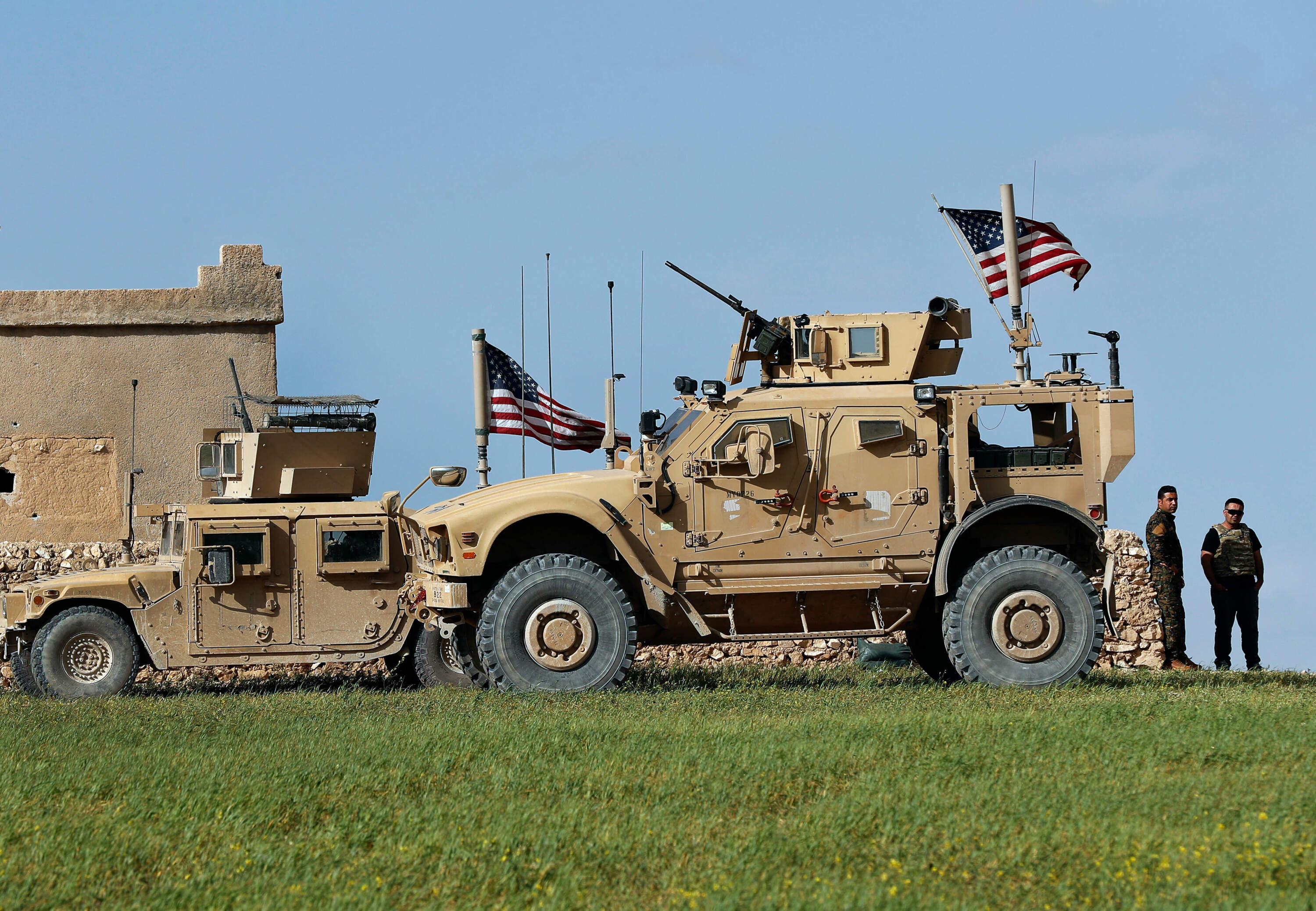
The Humvee is an American military icon. Yet the Department of Defense has announced the vehicle’s retirement. What does this say about our shifting military priorities?
Guest
Chris Panella, defense reporter for Business Insider who has written about the Defense Department’s decision to no longer purchase Humvees.
Mark Cancian, senior adviser with the Center for Strategic and International Studies’ Defense and Security Department.
Also Featured
Gen. Paul Eaton, former major general with the U.S. Army. Senior advisor with VoteVets.
Transcript
Part I
MEGHNA CHAKRABARTI: If there's one iconic U.S. military land vehicle of the past quarter century, it's the Humvee.
ANDREW RUSSO: I remember it jostling you. It was loud. It sucked through gas. It was powerful.
CHAKRABARTI: Andrew Russo is a former Army Field artillery officer. He served two tours in Afghanistan and earlier this week we asked for listeners to share their experiences of using Humvees and Andrew left us this message.
RUSSO: One story that comes to mind is I decided to get in a little bit of trouble and see how many things we could knock over in the forest with it. Not my smartest move, and I've become an environmentalist since then. However, my platoon sergeant and I bonded over trying to figure out how to dislodge a tree stump from the axle before our commanding officer would know.
So to me, it represents a different time in my life, a time that was adventurous, a time that was problematic, but a time that was life changing and set me on the trajectory that I have today.
CHAKRABARTI: After hearing that message, we called Andrew back to hear more, and he tells us he was the poster child for Army recruiting in the early aughts.
He wanted to give back to society. He wanted to travel, pay for college. So after he finished school, he decided to go into active duty.
RUSSO: First time I got into Humvee, I was tasked with finding a place to shoot off some practice rockets. Welcome to the military.
CHAKRABARTI: The Humvee became more than just a vehicle.
It became another home, a place where soldiers slept and ate together, where they built camaraderie and trust.
RUSSO: It gets to the point where you need to take a nap. Everyone trusts you to be in the side seat, taking a nap, and they'll wake you up when they need you, that type of thing. Dare I say, it's like you've got a new little family, and you learn to live with each other, learn to argue with each other and survive in that sort of, in that realm.
CHAKRABARTI: And just like with all families, Andrew says he didn't just argue with his fellow soldiers to keep morale up in the middle of what would become America's longest ever war. They also tried to have fun.
RUSSO: When somebody says, Hey, sir, let's race the other platoon. You race the other platoon, you do it, and you don't worry about the repercussions. That's a morale thing at that point. You're just trying to keep soldiers' morale up, and so you push those things to the limit. You drive over, washed out, whatever.
You take shortcuts through the forest. You land out of your way to your final destination, and you just hope nothing breaks along the way.
CHAKRABARTI: But Andrew also says he never forgot why he and the Humvee were in Afghanistan in the first place.
RUSSO: You quickly come to realize that it's not practice, it's not fun. You are perhaps going to live, die in that vehicle.
You are perhaps going to live, die in that vehicle.
Andrew Russo, former Army Field artillery officer
CHAKRABARTI: As an artillery officer, Andrew didn't spend a lot of time, quote, outside the wire, but he frequently saw live drone feeds of fellow soldiers who weren't so lucky.
RUSSO: Watching convoys get hit or coming in the aftermath of a convoy, getting hit by an IED, an ambush or whatever, and knowing that you can't do anything to help.
That experience with Humvees and seeing them smoking through spread feet on the side of the road or hearing the radio chatter, that is something I don't often like to return to.
CHAKRABARTI: The Humvee entered service in 1985. Its formal name is the high mobility multipurpose wheeled vehicle or HMMWV, the Humvee. Diesel powered. Four-wheel drive tactical vehicle. The specs vary by type, but generally the Humvee had a 16-inch ground clearance, could climb a 60% forward slope, a 40% side slope, and four to 60 inches of water.
It weighed approximately 5,200 pounds. They were to be a centerpiece of the Army's force modernization efforts in the 1980s. But by the early 2000s, the Humvee revealed a weakness, or perhaps more accurately, the Humvee revealed a critical weakness in the U.S. Army. As it became clear the vehicles were being sent to what was becoming a protracted war and occupation in Iraq. And by December 2004, soldiers had enough.
Thomas Wilson, Army specialist in the 278th regimental combat team confronted then defense secretary Donald Rumsfeld in Kuwait. The secretary had been giving what was supposed to be a pep talk to soldiers who were about to move north into Iraq.
THOMAS WILSON: We've had troops in Iraq for coming up on three years, and we've always stayed here, out of Kuwait.
Now, why do we soldiers have to dig through local landfills for pieces of scrap metal and compromise ballistic glass to up armor our vehicles, and why don't we have those resources readily available to us?
(CHEERS AND APPLAUSE)
DONALD RUMSFELD: I missed the first part of your question, and could you repeat it for me?
WILSON: Yes, Mr. Secretary. Our soldiers have been fighting in Iraq for coming up on three years. A lot of us are getting ready to move north relatively soon. Our vehicles are not armored. We're digging pieces of rusted scrap metal and compromised ballistic glass that's already been shot up, dropped, busted.
Picking the best out of this scrap to put onto our vehicles to take into combat. We do not have proper armament vehicles to carry with us north.
I talked to the general coming out here about the pace at which the vehicles are being armored. They have been brought from all over the world, wherever they're not needed to a place here where they are needed. I'm told that they're being, the army is, I think it's something like 400 a month are being done. And it's essentially a matter of physics. It isn't a matter of money. It isn't a matter on the part of the army of desire. It's a matter of production and capability of doing it.
As you go to war with the army you have, not the army you might want or wish to have at a later time.
CHAKRABARTI: That was December 2004. You go to war with the Army you have. One of the most famous or infamous lines Rumsfeld uttered during the Iraq war, which was, as we remember, a war of choice. Soldiers also remember that time.
Just this week, we had soldiers contact us who remember having to up-armor their Humvees on their own because the vehicles had been delivered to them in the war theater with vinyl or canvas doors. J.R. Martinez is a motivational speaker and bestselling author, but in 2003 he was an army infantryman serving in Iraq. And that April, his Humvee hit an IED.
He was severely wounded and needed 34 different surgeries. Martinez detailed his experience in an Instagram post last year.
MARTINEZ: Three weeks into my deployment, I'm driving a Humvee through a city called Karbala when a front left tire runs over a landmine, I'm the driver. There's three other troops in the Humvee. It explodes.
I'm trapped inside. I'm completely conscious. I can see guys running in front of the Humvee on the outside and how chaotic things were. I could hear people, like, yelling. I could hear myself screaming, and then I could actually hear myself gasping for air. Like, (gasps). Three other troops, that were in the Humvee with me were thrown outta the vehicle, and they all walk away with minor physical injuries.
But I'm trapped inside screaming and yelling at the top of my lungs for someone to come pull me out.
CHAKRABARTI: The Humvee's tour of duty in the United States military will soon come to an end. In April of this year. Secretary of Defense, Pete Hegseth, released a memo directing the Army to once again comprehensively modernize its force structure and increase efficiency.
The memo called the Humvee program wasteful and obsolete. The Army has ended the procurement process for the Humvee and notably it's also ended procurement for the vehicle that was supposed to replace it. The joint light tactical vehicle known as the JLTV, the federal government has spent billions on developing these vehicles.
Hegseth's memo indicates a shift away from that investment and towards new defense priorities, but it doesn't necessarily outline the path to achieving those goals. And according to the military, 100,000 Humvees are still a part of the armed forces. So what does the retirement of the Humvee say about how the military views future conflicts?
Will the nation have, in Rumsfeld's words, the Army it wants for the 21st century? Joining us now is Chris Panella. He's defense reporter for Business Insider, and he's written extensively about the Defense Department's decision to retire the Humvee. Chris, welcome to On Point.
CHRIS PANELLA: Hey, how are you?
CHAKRABARTI: I'm doing well, and I'm grateful that you could be with us here. Because there's a lot to talk about.
First and foremost, tell me a little bit more about what was in Secretary Hegseth's memo, specifically about the Humvee program.
PANELLA: Yeah, so broadly speaking, so much of that memo is focused on a broad transformation initiative, a major overhaul, one of the biggest, since the end of the Cold War.
That is basically outlining forced restructure, programs that they deem no longer necessary to be prepared for potential future conflict. And really just setting clear what this Pentagon's vision is for what it means to be prepared to deter or fight a future conflict. I think the Humvee is really just one example of that, but it's definitely a top example. Because the vehicle has been so iconic and been such a staple for the last 40 years.
CHAKRABARTI: Yeah, your point is well taken about, this is a whole military look in this memo talking about building a leaner, more lethal force. Quote, the Army must transform at an accelerated pace, the secretary says. We've got about 30 seconds before our first break. Chris, can you tell me a little bit more though about why Hegseth called the Humvee wasteful and obsolete?
PANELLA: I think there's this understanding or belief, rather, in current army leadership that the Humvee is not necessarily survivable against many of the threats that the U.S. military believes it will face in a future war, like drones and uncrewed capabilities and sensors, and so on and so forth.
Part II
CHAKRABARTI: Chris, we got a lot more responses from listeners. And of course, the internet is just full of soldiers' remembrances of the Humvee, because they spent so much time in them, particularly in Iraq and Afghanistan.
So let's listen to this. This is Eduardo Diaz from Perry, Iowa. He served in the U.S. Marine Corps, and by the way, I should emphasize, I've been mentioning the Army a lot. The Humvee was also extensively used by U.S. Marines. So Eduardo served during the Iraq war and in a video produced by the Iowa Gold Star Military Museum, Diaz outlines how dealing with insurgency in Iraq exposed some of the Humvee's tactical weaknesses.
DIAZ: The insurgency quickly realized that they couldn't take us on head on, and so they started developing IEDs. Our equipment was not ready for it. Our Humvees didn't have the metal armor on it. So when an IED would hit us, it would take out the entire Humvee.
Our Humvees didn't have the metal armor on it. So when an IED would hit us, it would take out the entire Humvee.
Eduardo Diaz, served in the U.S. Marine Corps
CHAKRABARTI: And Diaz says, troops and leadership had to adapt quickly, but to varying degrees of success.
DIAZ: Leadership quickly realized that we were not ready for IEDs. So they tried getting up-armored, but between when we got there and when we left, we would just up-armor the Humvees ourselves with like flak jackets or metal.
CHAKRABARTI: And here's another one. Duane Held listens to On Point. He served in the Army from 1983 to 2019, and Duane remembers when the first Humvees were introduced into his unit as a replacement for the Jeeps that soldiers were used to.
HELD: We were told that we couldn't break the vehicle. So myself and a couple other drill sergeants decided to test that out. We ended up getting the first one hung up on a falling over tree, broke it pretty bad. So we took a Jeep back to base to get another Humvee to try and pull that one off. And we ended up breaking that one, trying to get the first Humvee off the fallen tree.
So we took the Jeep back, got a third Humvee. That one didn't even make it. We basically, he stole the Commander Humvee, and we ended up breaking that one. So that first day all four of our unbreakable Humvees were broken. The Jeep still got us back to base.
CHAKRABARTI: That's Duane Held, On Point listener and Army veteran.
Joining us now is Colonel Mark Cancian. He's senior advisor in the Defense and Security Department at the Center of For Strategic and International Studies. Previously worked on force structure and acquisition in the Office of the Secretary Defense. And of course, as I said, he's a Colonel. United States Marine Corps, served in the Marines for over three decades.
Colonel Cancian, welcome to On Point.
MARK CANCIAN: Thanks for having me on the show.
CHAKRABARTI: So I've heard that you've been in just about every type of land vehicle that the Marines have used. Is that correct?
CANCIAN: It is.
CHAKRABARTI: And so what is it like riding in the Humvee?
CANCIAN: The Humvee is actually a better ride than the Jeep, which preceded it, very versatile vehicle.
There were many different styles of it. They turned some into ambulances, some into gun vehicles. It was the go-to vehicle for every unit, because most jobs didn't require a big truck. You just needed to get a few people or a few things around. So it was ubiquitous. And the fact that the United States bought something like 120,000 meant that they were everywhere and they were in all of the services.
Of course, the Marine Corps had a lot, even the Air Force and the Navy bought some.
CHAKRABARTI: Yeah. Chris, let me just turn back to you quickly. Have you been inside one?
PANELLA: I have.
CHAKRABARTI: And what was it like? Because most Americans have never been inside a Humvee.
PANELLA: It, from my perspective, it felt relatively spacious and comfortable.
I don't know. It's not anything like a luxury car, right? But it feels secure and feels safe and feels like you got enough leg room in there.
CHAKRABARTI: Except if you're basically living in it for days on end, we heard about from soldiers.
PANELLA: Sure. Which I was not.
CHAKRABARTI: Yeah. Okay. So Colonel Cancian, this is a really interesting moment, obviously to talk about the Humvee, not because of its retirement from service but from the fact that this is a modernization effort that mirrors the one that took place in the '80s that brought us the Humvee to begin with.
So can you talk about how we got there to the '80s, that this then new vehicle was believed to be so important for the military?
CANCIAN: Absolutely. In the beginning, there was the Jeep. And the Army saw that it was very useful and produced them in huge quantities. And the Jeep and its successor variants were sufficient up until the '70s, late '70s. When they were too small and they weren't meeting a lot of the environmental regulations and regulations required to go on the nation's highways. So the Army looked for a replacement. Came out actually with two vehicles. One was the Humvee, that idea was that would be the tactical vehicle.
And then for running around bases and on roads, they got a commercial utility vehicle, which was basically a Ford truck that was spray painted green. The problem was that people used this commercial vehicle the same way they used the Humvee, and of course, they fell apart, so that faded away and the Humvee remained and remained in the force, well to this very day.
CHAKRABARTI: And so it was designed for, let me go back here. Because I'm trying to think, in a sense we ask the military to do what is both expected of it and perhaps seemingly impossible. And that is design for the far future. And given that, in the mid '80s, did the Humvee achieve what the military believed its purpose would be for whatever the future conflicts that it expected then at that time?
CANCIAN: It did. At that time, of course we were looking at, we were in the middle of the Cold War, looking at large scale combat in Europe. But also, with the notion that this vehicle would be deployed worldwide. When we got to Kosovo, actually, interestingly it was clear that the Humvee did not have enough protection in certain circumstances.
Now, in Kosovo and Bosnia, these were riot situations where civilians would be throwing things at vehicles and because the Humvee isn't armored, it was sometimes damaged. So the military police came up with a different version, an up-armored Humvee. They built them in small numbers. Then we get to Iraq, and the insurgency started using IEDs very extensively. Something that we had not faced before. So this was new, that Humvee was not designed to protect against this kind of threat. And as we've heard, first units began to put on improvised armor, sometimes called Mad Max Armor, because they were very ingenious.
And then the military ramped up production of these up-armored Humvees which were much larger. Or rather much heavier. But they had a good deal of armor and fielded those. But the vehicle, it was really too heavy at that point. It was not as well protected as it might have been.
So they bought a successor, which were called the MRAP, and these were vehicles that were designed from the bottom up to have armor and to move cross country.
CHAKRABARTI: So Iraq and our long-term occupation thereof was really a turning point in what kind of warfare constitutes modern warfare.
And we're at a turning point again right now. Chris, I'm going to come to you about that in just a second. But I want to listen to Major general Paul Eaton. Because we spoke with him earlier this week. He served for more than 30 years in the U.S. Army before retiring. And during his tenure he was in charge of operations to train Iraqi troops in Iraq during Operation Iraqi Freedom.
And he still stands by the Humvee for its versatility.
PAUL EATON: The Humvee as a replacement to the Jeep was brilliant, and compared to the Jeep, is still brilliant. It has extraordinary mobility. It can haul a lot, pull a trailer. It can just solve a lot of logistics problems on the battlefield, and I think there's still a place for the Humvee in the inventory. The Humvee was brilliant in its original capacity. And for what it was designed, I think it's still brilliant.
The Humvee as a replacement to the Jeep was brilliant, and compared to the Jeep, is still brilliant.
Paul Eaton
CHAKRABARTI: By the way, Major General Eaton was not in a Humvee when we talked to him. He was actually in his car driving somewhere. It was the only chance we could get to get him on tape.
And during that conversation, he said that he also does agree that the Humvee has its drawbacks, especially given what warfare looks like now.
The vehicle was introduced as we've talked about, when, as Eaton says, warfare was still fought in a linear fashion with what he calls a forward edge of the battlefield, and the Humvee was never supposed to be a combat vehicle.
EATON: It was originally designed to just basically provide a logistics function. Then we had to product improve it, pivot, to meet a non-linear battlefield and insurgency, if you will, in Iraq and Afghanistan. And we had to up-armor it. We put machine, gun and rocket launching systems on pedestals in the vehicle.
We made it a vehicle that could return fire or assault. The vehicle basically hit the limits of what it could do in a non-linear battlefield environment.
The vehicle basically hit the limits of what it could do in a non-linear battlefield environment.
Major General Paul Eaton
CHAKRABARTI: So that's major general Paul Eaton. He served in the United States Army for three decades and was in charge of training Iraqi troops during Operation Iraqi Freedom.
Now, Chris Panella, on that note. The Humvee still is in use, not only by the United States military, but it's in Ukraine right now. The Ukrainian Army is using the Humvee, which maybe it epitomizes what one version of modern warfare looks like. Now can you talk about that?
PANELLA: Yeah, we've seen the Humvee in combat and the war in Ukraine.
The Ukrainians have thousands of them, some from before the full scale invasion, others supplied by the U.S. as part of aid packages. And the Ukrainians, like they have with all military vehicles and tanks that they've been using, have been making modifications to them. Probably the most significant one being the anti-drone cages, often called cope cages, which both Russia and Ukraine have been putting on vehicles as like an extra last line of defense against drones and uncrewed capabilities.
They're, in some cases, crude metal structures that are really just designed to be that last ditch defense. But since their introduction and over the past couple of years, they've become far more sophisticated as a way to defend those one-way attack drones or other uncured systems, and Humvees have definitely been equipped with those.
CHAKRABARTI: It makes me wonder if the other thing about Ukraine is that it shows that there is still a need, at least in that war right now, to provide some kind of heavily armored or protective vehicle for troops to move around. Because as we heard Eaton say there, there's no clear frontline and all of Eastern Ukraine is essentially a war zone. And it doesn't really beg your disbelief at all that the United States could, excuse me, could encounter something like that in the future.
PANELLA: And I would also add that when you're having conversations about this Army transformation initiative, and seeing the Humvee as this per current Army leadership obsolete system, you look at what's happening in Ukraine and it definitely does raise questions about whether it is a system that can be adapted for future conflict or if Army leadership has deemed that's not the case and there are other systems to go for.
CHAKRABARTI: Well, Colonel Cancian, though, this brings us back to something Chris said earlier, that right now we are seeing that again, we'll stick with Ukraine as an example. Drone warfare as being a critical part of how wars are fought. And given the way that the Ukrainians have had to modify the Humvee, doesn't it still, it does not seem to be a kind of survivable, as Chris said, or reliable vehicle. Just your thoughts about what the Ukraine war tells us.
CANCIAN: The Ukrainians have put on these cages to protect against drones.
Drones are a threat to everything that moves near the front lines. Now, the Amy's solution to this problem was the JLTV. The joint logistics tactical vehicle. Which was armored all the way around, which would give more protection against drones, as well as against IEDs and other threats.
The problem is, it's much more expensive. It's much more heavy. It's all trade-offs. So if you want a light maneuverable tactical vehicle, Humvee is your choice. If you want one with more armor, more protection, then you've got to go a step up in both weight and cost.
CHAKRABARTI: Except if memory serves, the JLTV is not on the table anymore for the Pentagon.
CANCIAN: And that's correct. As part of the movement away from combat in places like Europe. And in order to focus on places like Western Pacific, both the JLTV and the Humvee have ceased production for the Army. There was still building some for the Marine Corps.
CHAKRABARTI: Okay but I want to get some clarification on this, Colonel, if I may. Folks, some folks out there might remember that back in 2015 there was a kind of requiem for the Humvee, because that was when the Pentagon announced, again, this was 10 years ago, that Oshkosh defense had won a $6.7 billion contract to deliver thousands of JLTVs to the Army and the Marine Corps.
And just a couple of years ago, in 2023, the company AM General who won that first Humvee contract 40 years ago. Won a recompete contract for $8 billion to produce more than two 20,000 JLTVs. But Colonel Cancian, again, I just, I want to be honest about the limits of my knowledge. Does this mean that JLTVs, were they actually ever delivered, were they in widespread use by the Army or the Marines, or did all that sort of money go down the drain?
CANCIAN: No, the Army has about 7,000 JLTVs. What happened was that the JLTV was a bit heavier and more expensive than they had expected, and initially they had thought they would replace all of the Humvees with JLTVs, it became too expensive. So the later plans were to replace some of the Humvees with the JLTVs.
But now all of that has stopped. And with this reorientation. And I also note that development for a ground vehicle tends not to be terribly expensive. It's the development for aircraft, for example, are stunningly expensive.
Part III
CHAKRABARTI: We heard from a lot of veterans of the United States military.
Here are a few more. This is Steve Colina. He's from Andover, Minnesota. He was in the Marine Corps for a decade, did several tours in Iraq and like other members of the armed services, he spent many hours, many days, I should say, living out of a Humvee.
STEVE COLINA: Our version of Humvees is probably a little different than the Army or other branches.
Our Humvees had vinyl doors when we showed up in Iraq, and so we had to barter for steel plates to up-armer our vehicles before the up-armoring became more popular. And it was our little living space for weeks on end, and had a wooden box attached to the exhaust pipe as our toilet for many weeks on end.
And we'd eat out of our Humvees and sleep in our Humvees. So it was like our little homes.
We'd eat out of our Humvees and sleep in our Humvees. So it was like our little homes.
Steve Colina, was in the Marine Corps for a decade
CHAKRABARTI: So that was Steve Colina in Andover, Minnesota. Now we have Major Johnson. He served as a combat medic while deployed, and he became all too familiar with the exact dimensions of a Humvee.
MAJOR JOHNSON: But I also happen to be six foot six and sitting in the backseat, it gets very cramped.
But I wasn't allowed to sleep layout on the ground, due to incoming artillery or weather. So that's what we had to do. I guess it's safe to say I'm intimate with the Humvee. Not gonna miss the back seat. But we changed the doors. We didn't have up-armored at the time.
... So we had to have makeshift up armorer, where we just literally would weld slabs of metal to the sides, because before all we had was canvas. They worked great. It made it a little bit heavier, but we just kept rolling. But the reliability of the Humvee is the reason why it lasted so long. Not for the leg room, in the back seat.
CHAKRABARTI: Of course, there's not a uniformity opinion on this. We also heard from Staff Sergeant Miriam Smith. She's currently serving in the Reserves in Hawaii, and she had this opinion about seeing the Humvee get retired.
MIRIAM SMITH: I'm overjoyed to hear that it's going to be retired. They've been terribly difficult to maintain for every reserve unit that I've been a part of.
I'm overjoyed to hear that it's going to be retired. They've been terribly difficult to maintain for every reserve unit that I've been a part of.
Staff Sergeant Miriam Smith
They deteriorate in ways you could not possibly imagine. Things that I've seen happen to Humvees, I've never seen happen to other vehicles, other military vehicles, or personally owned vehicles. And then you just end up dealing with it and you have these enormous, expensive pieces of equipment that you shuffle around. Because I don't want to have to drive it. Let's have to drive it. Or, Nope, we can't drive that one. It's not safe anymore.
CHAKRABARTI: So that's Staff Sergeant Miriam Smith who listens to OnPoint in Hawaii. Chris Panella. What kind of conflict or what are the dynamics of a future conflict that the Pentagon now thinks they should be preparing for?
PANELLA: I think that's a great question that they're also trying to figure out.
And in interviews I've had with Army Secretary Daniel Driscoll and General James Rainey, Commanding General overseeing Army Futures Command. A lot of the focus is on two kind of what you would call buzzwords, one being lethality and the other being readiness. And those have existed long before this Pentagon and the second Trump administration.
But they're really the key focus for military leadership right now. And it seems that is from, especially from a program and systems perspective, focused on accrued capabilities, drones and counter drone systems, things that are going to make the force better equipped for potential future war.
Things related to data, quicker decision making, artificial intelligence, so on and so forth. So a lot of modern warfare technologies and elements.
CHAKRABARTI: So Colonel Cancian, that actually does beg the question of, Does the Army or the Marines, do they actually need in the long run, conflict ready troop transport systems?
And I ask that because we've talked about drones already, extensively. They are in extensive use and have been, actually, for a few decades now, a lot by the United States military. AI. The idea of that may be more robotics or automated systems. The Hegseth memo, as I said, also targets manned aircraft as well as maybe being a thing of the past.
Is there a need for a land-based vehicle that can survive actual hot war to move troops around anymore?
CANCIAN: The answer is absolutely. Because if you don't have vehicles, that troops can move around on foot, and that's very slow and they can't carry a whole lot. So once you need vehicles, you need a spectrum.
The Army has medium trucks, it has heavy trucks, and it's always going to need some sort of light truck. Now the Army's thinking about what that light vehicle should look like. The Humvee has filled them in the past.
The JLTV of course, is essentially a Humvee like vehicle with armor, but they're also now looking instead towards what they call an infantry support vehicle, which is even lighter, with the idea that this would just be basic transportation and that troops would get off when they get close to the front line, it would not expose itself to any fires. We'll see how that works out. That does fit the notion of an army that's lighter and maybe more agile. On the other hand, we've seen in the past that vehicles tend to get used in all different kinds of ways.
Whatever the unit needs, and they may not make this distinction between what operates in the rear and what operates at the front.
CHAKRABARTI: So a really important point. And I think going back to Iraq there are many lessons to learn there, which is first, as we heard, soldiers and marines basically had to modify their vehicles for whatever situation they found themselves in, almost day to day in Iraq. And also, there were front lines there, but as the occupation wore on, the frontline was essentially almost everywhere.
If the United States gets into another conflict like that, or starts one, it seems like there's quite a risk there with even more lightly armored vehicles, Colonel.
CANCIAN: There is. Now the strategy says that we're not going to do that again. And I applaud the notion, but we said that after Vietnam and then we end up in Iraq and Afghanistan. Things happen.
What's important is to maintain some capabilities. A spectrum of capabilities so that militaries can handle whatever arrives in the future. And we saw that with the Humvee. That is, I mentioned that the military police had developed an up-armored Humvee to protect themselves in cases of crowd control.
When the IEDs start producing casualties in Iraq, the Army sent all of the these up- armored Humvees to Iraq, and then of course built many more. So having that capability hedges against the possibility that the future may not be what you think it is.
CHAKRABARTI: Chris Panella, you wrote an article that was headlined the U.S. Army's Done with Humvees and Robotic Combat Vehicles. So what did your reporting find that military leaders actually want next? Colonel Cancian talked about these more, these lighter vehicles. Tell me more about what you found.
PANELLA: Yeah, I would say in those conversations with Army leadership, they saw success in the ISV that is being, that we're talking about here. Because it's fast, it's light. And soldier feedback on that had been positive. They wanted something that could drive quickly over various terrains. They didn't want it heavily armored and weighing it down.
And something that both Secretary Driscoll and General Rainey said was that they're right now in this kind of transformation initiative, they're looking at having a broader range of offensive and defensive capabilities. Some of those would apply to one mission set and some would apply to another, but maybe there's nothing in there that's really a catchall system.
So I think that's an interesting thing when we're talking about the Humvee. Because could the Humvee still have a place in some mission sets, could it not in others? But the Army leadership also sees the ISV as being a success story in program management. Knowing the capabilities they wanted to put on it, getting that produced and delivered on time, getting user feedback from soldiers and iterating on that.
They see that as really an example of a type of program that they did well with and could do well with in the future.
CHAKRABARTI: I wonder if we can actually pull our lens back here much further for a second, because when we're talking about the Humvee, of course, by definition we're talking about a land-based vehicle that moves troops around.
It seems to me that a lot of the Defense Department's focus for some time now has been on a completely different type of war. And when we're thinking of vis-a-vis China, for example, and what would the U.S. do, say, if China invaded Taiwan? There's always been that shift towards Asia Pacific, not only politically, but militarily as well.
Colonel Cancian, doesn't that actually put the focus more, not on the Army necessarily, but on another service, on naval emphasis.
CANCIAN: Absolutely. And this is one of the great concerns of the Army leadership. That is that a conflict in the Western Pacific is a theater that is mostly maritime and air.
It favors the Navy and the Air Force. The Army has an important role, not with large land forces, but with air defense and logistical capabilities, but not the kinds of forces that had built, for example, for a conflict in Europe. This ceasing of production of the Humvee and the JLTV and the movement to the ISV is part of this effort to be lighter, be more mobile, and therefore be more deployable to the Western Pacific.
Ceasing of production of the Humvee and the JLTV and the movement to the ISV is part of this effort to be lighter, be more mobile, and therefore be more deployable to the Western Pacific.
Mark Cancian
Because of the long distances, you don't have those problems in Europe. But of course, the administration wants to pull back from Europe. So this is a reflection of the Army's attempt to adapt to this new environment and to the reduced resources that have been a result for the Army.
CHAKRABARTI: Colonel, let me ask you, I'm still thinking about the JLTV. That you're right. There were many of them delivered. But the Humvee was still riding alongside them now until, I guess now, and it was billions and billions of dollars to develop them. I'm just wondering if there still is room for improvement in the Army, in particularly their procurement system, their design system for the materials they think they're going to need in the future.
Because at the end of the day, I think the taxpayer has the right to say we just spent $20 billion on a vehicle that now has been canceled. Did we get our money's worth? Can that be improved? Colonel?
CANCIAN: I think the public got their money's worth with these two vehicles.
Remember, we produced 120,000 Humvees and the development was not very expensive. The public really got a good deal here. And even with the JLTV, even though we didn't buy as many, the develop, it was not that expensive. So these were, I think, two reasonable success stories.
Two places where this did not happen. One was with the MRAPs, these emergency vehicles that were sent to Iraq. These are mine resistant, armored protected vehicles, a better up-armored Humvee. We spent $30 billion on those and essentially threw them all away.
When the wars were over. Now, we sent them over there to save lives and they did. That now I think people are looking back and recognizing the great value in those, but also asking the question, could we have done it in a way that we didn't have to throw those away at the end of the war?
CHAKRABARTI: Yeah. Chris, I think I'm going to throw the last question here to you. Because you said a little earlier that this emphasis on lethality, which isn't necessarily new to the Trump administration, but it's definitely, it seems like a passion of Secretary Hegseth. Lethality seems to be like very loosely defined, if at all.
And I also wonder if it potentially misses the point of what future war may look like. You talked about AI. And I'm also thinking about the preparation and reporting that's been done over, what if China wins a war by just turning off the lights, like physically turning off the lights in America?
We may have a kind of war that disables us or disables an enemy without the need for any actual lethality. I'm just wondering what you think about that.
Yeah, I think that there's a lot of discussion right now on a lot of these future warfare technologies. And things that, you know, capabilities like artificial intelligence and software and space cap visibility capabilities, satellites, things that are going to, that military leadership deems to be the focus points and focal areas of a future war.
But then there's also questions about what could that future war even look like? Is it going to just be drones and uncrewed systems? What, how much can we learn from the war in Ukraine in that way? And how much would have changed by the time there's a potential future conflict? And how would that change if it's in the Indo-Pacific against China?
I think that there's a lot of kind of growing and questioning and challenging and at least from conversations I've had. Whether that's Secretary Driscoll or General Rainey, they are aware, but also hyper-focused on examining that more. And, trying to figure out what the solutions are.
The first draft of this transcript was created by Descript, an AI transcription tool. An On Point producer then thoroughly reviewed, corrected, and reformatted the transcript before publication. The use of this AI tool creates the capacity to provide these transcripts.
This program aired on September 5, 2025.