Support WBUR
The 'hotshot' life
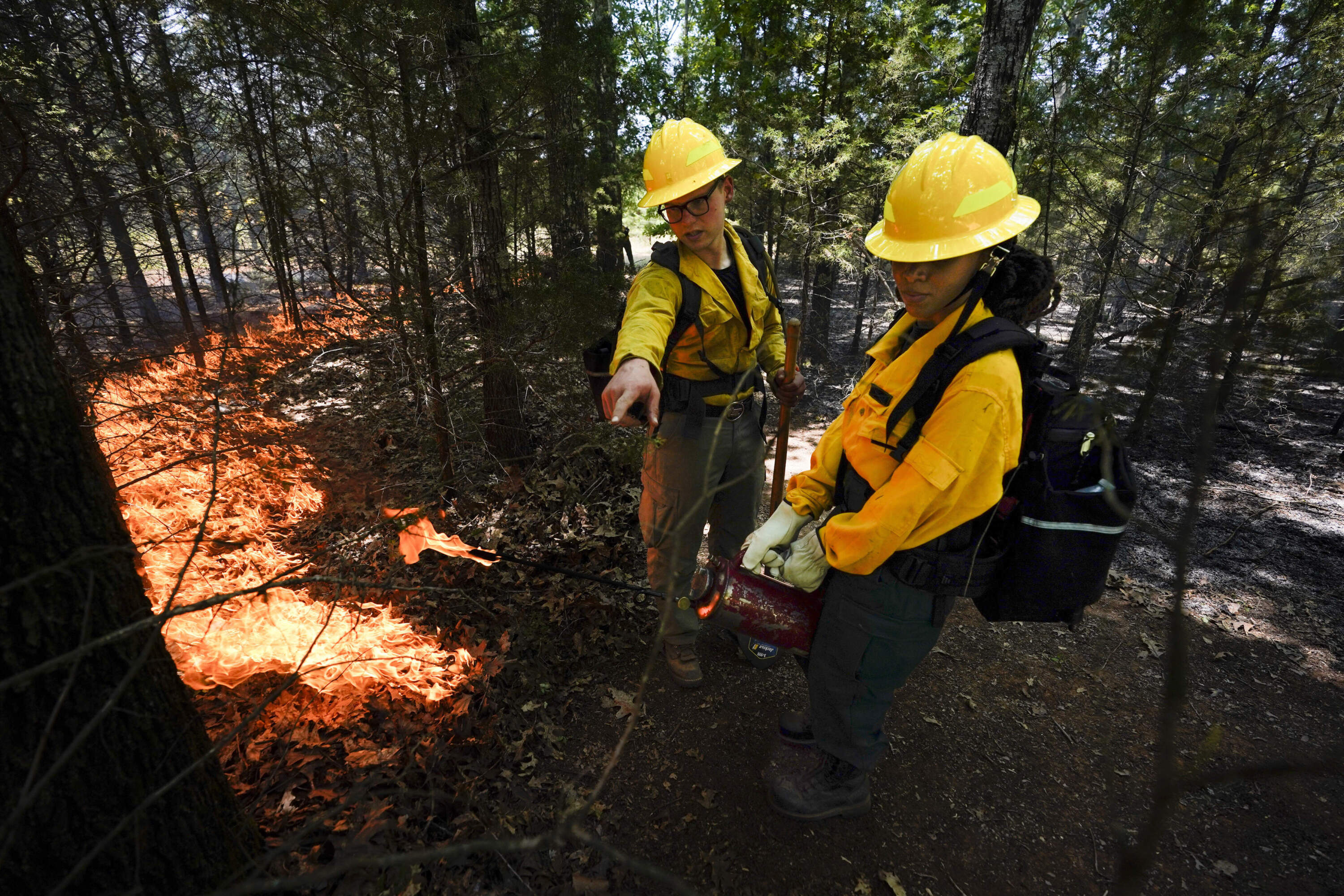
River Selby served as a hotshot – an elite wildland firefighter.
Selby shares the reality of the life and work of firefighters trying to save America’s western forests. And how despite fire seasons getting longer and longer, fewer people want to join hotshot crews.
Guests
River Selby, author of “Hotshot: A Life on Fire.” Selby was a wildland firefighter from 2000 to 2010 and worked on an elite hotshot crew for four of those years.
Book Excerpt
From Hotshot: A Life on Fire. Used with the permission of the publisher, Grove Atlantic. Copyright © 2025 by River Selby.
Transcript
Part I
MEGHNA CHAKRABARTI: In the Western United States, there's really no such thing as fire season anymore. Risk of catastrophic wildfire is basically year-round, and the fires have only gotten bigger. In 1993, the federal government fought wildfires on about 1.7 million acres. By 2024, that number rose fivefold, almost 9 million acres.
But very few people really know what it's like to be right in the middle of one of those wildfires, trying to fight it, trying to stop it from taking homes and lives. River Selby knows. Because for a decade, Selby served as a wildland firefighter. For four of those years, Selby was what's known as a hotshot, an elite wilderness firefighter. Selby's author of a new book about that work and the thrills and hardships that come with it.
It's called Hotshot: A Life On Fire. And Selby joins us now from On Point station WFSU in Tallahassee, Florida. River Selby, welcome to On Point.
RIVER SELBY: Thank you so much, Meghna. It's great to be here.
CHAKRABARTI: Before we get to how you became a hotshot, I really would like you to help us understand just the sort of bodily experience of fighting a wildfire.
So if I were you, in the midst of one of the hardest fires you ever fought and I closed my eyes in the middle of that work, first of all, what would my body feel?
SELBY: You would feel adrenaline. You would feel very energized and overstimulated. There's a lot happening around you. It's difficult to speak to the purely embodied experience. Because when I was in situations where I was fighting a fire that's immediately there, and needs to be immediately extinguished, I wasn't necessarily in my body. Because I was so focused on what I was doing.
CHAKRABARTI: I see. So the immediacy and urgency of the work, you weren't really in your body. So where, like consciousness, where were you?
SELBY: So I'm thinking back to one fire in particular. It was a small fire, but my crew was the first crew there and so we were doing initial attack. It was at night, so it was dark, and I was with my squad boss at the time. I had what's called a bladder bag on my back, which is 45 pounds, a bag of water with a pump, and he had a tool, and we were running along.
The edge of the fire as it was burning, and I was spraying water wherever it needed to be sprayed so that he could dig. And so it was just running. And I also had my tool with me, so sometimes I would also dig. But it was really just completely focused on the present moment, focused on what he was asking me to do, and focused on making sure that fire didn't burn any further than it already had.
CHAKRABARTI: Where was this fire? This was in the Sierra Nevadas in California. It's so interesting to me. Because I genuinely thought that when I asked you that question, if I closed my eyes, what would I feel? I thought you'd say heat.
I guess that shows how much we don't know about the work that wildland firefighters, in particular hotshots do.
SELBY: It is very hot and again, if I had been aware of the heat all the time, I don't think I would've been able to do the job. Sometimes it would sweat so much that there would be a white salt residue that took the shape of my backpack straps, and the hip straps on my shirts and would bleach my undershirts.
So it is very hot. But usually we only feel the pain of the job when we slow down or when we go to sleep, and that is when the pain really sets in.
We only feel the pain of the job when we slow down or when we go to sleep.
CHAKRABARTI: What does it sound like?
SELBY: Oh, it depends on the landscape that you're working in. When I worked in California, we were often in brush, so lots of loud chainsaws.
I would often have earplugs in my ears. Sometimes I would be pulling brush, helping the saw team. So usually saw team with two people. I would help pull the brush, taking huge chunks of brush and pulling them away. Chainsaws, aircraft, big tankers dropping water or fire retardant, helicopters, the chatter of the radios, everyone's radios talking to each other.
Sometimes there's yelling, the crackle of the fire if it's nearby, the [clink] of the tools on the ground as well. So lots of stimulation, lots of sounds.
CHAKRABARTI: Yeah. And what are you breathing? You're breathing air, but this is air that's on fire and I'm sure it's full of dust. Dirt.
SELBY: So much dust. Even if there's not any smoke, even if we're not near the fire, there's so much dust.
My mouth would just be coated in it. Often, there'd just be a layer of grime on my teeth. And then, when we are in proximity to the fire, we're breathing in just straight smoke all the time. And if we're doing a back burn, we're breathing in quite a lot of smoke and then often we're hiking through burnt areas, so we're breathing in all the burnt ash material and ash is a very abrasive substance, so it's very bad for respiratory systems.
When we are in proximity to the fire, we're breathing in just straight smoke all the time.
CHAKRABARTI: Yeah, and a back burn is what?
SELBY: There are two ways that hotshot crews can help to contain a fire. One of those ways is to create fire line, which is creating a break in the fuel. And the hope is that when the fire reaches that line, it will stop. And another way is to also create a fire line or use natural breaks or manmade breaks in the fuel and burn back from that line towards the fire itself, so that the fuel is burned once the main fire reaches it.
CHAKABARTI: So you've exhausted anything that the fire could burn and then continue to expand. I really appreciate you giving us a sort of visceral sense of this incredibly dangerous work. Now, can you put that in context with an actual fire that you fought? You write about several, but one of them in the book that I'm particularly thinking of, it's chapter four, titled Slop Over. I think it's a close call that you had.
SELBY: Yes. That was my second year on the hotshot crew, and we were in Southern California. And Southern California is very steep. So often you're flown in by helicopter, and when a crew is flown in by helicopter, it's several drops, because a crew is about 20 people. So the first drop came, and I was in that load.
And we realized that we were right on top of a ridge, and the fire was making its way to slop over that ridge, which if it did, we would be in danger. And also what happens when a fire is burning is throwing embers. So if embers go over the ridge and down into the canyon, it's going to catch fire and burn up very quickly, because fire preheats fuel as it goes up.
And so each load that came after mine, the rotor wash would bring up all these embers and they would start these small spot fires. So we would just be catching these little tiny spot fires, hoping that they wouldn't catch, and there was no safety zone identified. There was nowhere we could really go if something had gone wrong.
And luckily, we did catch all the spot fires, but it was a very close call. If one of those embers had gone in the wrong direction or we hadn't caught it, it could have been a very bad situation.
CHAKRABARTI: Because the fire would've overtaken you?
SELBY: Yes, because we had the flaming front coming up, and then if an ember had gone over, then we would've had a flaming front coming up the other side, and there's nowhere to go in that situation.
This is what a hotshot crew does. Hotshot crews are elite firefighters, because they train for situations like this. We were in top physical shape, so we were just really focused on getting out these little spot fires, and luckily, we were able to do it, but that is definitely not an ideal situation, and there were no structures being threatened there, so it theoretically wasn't necessary.
CHAKRABARTI: Yeah. I keep thinking of how you're doing all this work also with a 30-to-40-pound pack on your back and on hilly/mountainous terrain, right? It sounds incredibly difficult. What is the difference between what a hotshot crew does versus other wildland firefighters.
SELBY: So there are a few different resources used for wildland fire.
There are type two crews, which can also perform initial attack, but they're not trained to the fitness level of hotshot crews and usually don't have the experience level of hotshot crews. And hotshot crews are type one, which means they're only for initial attack or specially trained. And then there are engines that come and use water and tools and helicopter crews.
And so they're helitack crews, so several different types. And hotshot crews are the ones that are trained to do that initial attack. There's also smoke jumpers who jump into fires from planes, which is pretty amazing and usually work either individually or with a couple other people. A lot of smoke jumpers have been hotshot previously.
Now I want to be clear that I'm not ranking wildland firefighters in terms of importance or how much we value their work. All of it is so risky and so vital, especially in the Western United States. But with you, River, we're going to want to talk a lot more about how you became a hotshot when we come back from the break.
Part II
CHAKRABARTI: River, I understand that you weren't necessarily the kid who said, when I grow up, I'm going to be a hotshot. I'm going to be a wildland firefighter. What did you want to be when you grew up?
SELBY: I think at one point I wanted to be a veterinarian, which I think all children want to be at one point or another.
But as I got older, I didn't necessarily think about what I wanted to be because I didn't think that far ahead. I left home for the first time at 12 and was homeless off and on throughout my adolescence, and I also just, I wasn't athletic. As I write in my book, I got kicked off the volleyball team for smoking cigarettes.
So yes, it was not a profession I had ever thought of doing.
CHAKRABARTI: Can you tell me more about your childhood and young personhood? Because you write about it with brave frankness, I have to say, in the book, about why you were struggling so much, before your thoughts, through a friend, turned to firefighting.
SELBY: Before I found firefighting, and even for a couple years after, I struggled with addiction to all sorts of substances, including heroin. And I struggled in general to just be a human in the world. I didn't know for a long time that I was autistic or that I had ADHD, which I learned a few years ago. And I spent a lot of time trying to stay alive really, and/or being very self-destructive.
And so during my childhood, my mother struggled a lot. I lived with my grandparents for a couple years. She just dropped me off and left me there, and my dad was pretty much totally absent, so I didn't have any stability other than maybe my grandparents, and my grandmother had died when I was 19, and that was devastating to me.
I dropped out of community college. I had really been trying to do well and was really spiraling in a really terrible way. And so my friend was just like, why don't you try this job? And I said, okay. I would try anything.
CHAKRABARTI: At this part of your life, you were in the Seattle area.
SELBY: So I grew up in the Seattle suburbs and went to high school, partially in Olympia, and then I was in Eugene at this time in my life. Oregon.
CHAKRABARTI: Eugene, Oregon. Did those forests and just wandering around trees and nature, was that also part of your life, even as you really struggled with so many challenges?
SELBY: It was a huge part of my life, the forests and the ocean as well.
I've always had a really deep connection with the ocean and just the land. I grew up in apartments and around Seattle, when I was growing up, there was still a lot of kind of parcels of undeveloped land.
So I would find these parcels and go explore them. And I found refuge there a lot of the time, just being in that universe without other human beings and feeling connected to the earth.
CHAKRABARTI: I wonder if that's part of what made you think, oh yeah, let me give wildland firefighting a try. Even though the places that you were going to go into nature maybe weren't exactly refuges at that time, they were hellish fire escapes.
SELBY: I didn't think of it at the time. Definitely, I was just desperate for anything.
Once I got out there, that was one of the reasons I loved the job. And even though we're on fires, I worked on a type two crew for my first two years. So usually you would come in, in the places where the fire had burned, and it was just always so beautiful to me, these landscapes where some of the land was burned and some of it wasn't and there was this patchwork.
I loved being out in nature and still do, so that was definitely something that kept me connected to the job and kept me wanting to come back.
CHAKRABARTI: I do find it really moving river that you were struggling so much with life, that doing something as dangerous as dropping yourself into the middle of a ginormous wildland fire seemed to be a better option, or at least something that you were willing to give a try.
Now you also write in the book that at that time, again, you were 19. You maybe weren't in the best shape of your life, but there's a really hard test that people have to take in order to become, especially, a hotshot.
CHAKRABARTI: Can you describe what that test is?
SELBY: It's not too tough, but it's 45 minutes with a 45 pound pack on three miles of flat ground. So as long as you do that in under 45 minutes --
CHAKRABARTI: (LAUGHS) You say that's not too tough. Some people out there may gently disagree.
SELBY: (LAUGHS) It's not intuitive, because you're just, and then for the hotshots, the minimum is still the same. But then there are all these extra requirements for hotshot crews, certain number of pushups, pullups, sit-ups, and then always the physical training, which can be running or hiking or both.
CHAKRABARTI: So you put what, almost 50 pounds on your back and you're doing a mile every 15 minutes for this test. You did great, right? Because you were hired a week later.
SELBY: Yeah, I passed it. I think barely, but I will say, our first training when we went out into the field, my crew boss was 100% sure I was not going to come back the next day.
And he only told me that like a month later, but I came back.
CHAKRABARTI: Now, when you looked around, even during the test and the tryout period, who else did you see?
SELBY: For the type two crew, I worked on what's called a contract crew. Contract crews are contracted out to the government when federal resources and state resources are spread thin, and they will hire pretty much anyone.
And that's one of the reasons I got a job there, and so I was one of the only women, but there were people of all ages, all backgrounds, very diverse. And then for the hotshot crew, each hotshot crew is different. There are over a hundred hotshot crews in the United States, and they're all based in different places, usually tied to a forest or an area of land.
And so my first hotshot crew was a very rural crew. It was predominantly white. It was all men. And I struggled. I struggled to fit in on that crew, for sure.
CHAKRABARTI: You write that it seems that being a wildland firefighter almost immediately provided you something that you desperately needed, which was a structure away from civilization and the forces in civilization that were leading you to, as you said, drugs, get in trouble, run away, all the difficulties that you have, or had, I should say, is that true?
SELBY: That's very true. I had grown up with very little structure. I almost want to say no structure. And so having a structure, waking up at a certain time every day, going out to work, there are expectations of how you do your job.
You come back and eat your dinner and you go to bed and you get up, it's the same thing every day. That was, especially I think, because I am autistic, that was very comforting to me. And also, I think that, as far as the danger of the job, my tolerance level for danger, and I think this is true for many people who grew up in traumatic environments, was very high.
So what feels like danger to some people didn't necessarily feel like danger to me. And that could be problematic in some ways, but it made me perfect for fighting fire.
What feels like danger to some people didn't necessarily feel like danger to me. And that could be problematic in some ways, but it made me perfect for fighting fire.
CHAKRABARTI: Do you remember the first fire that you fought?
SELBY: Yes. It was the Viveash fire in New Mexico. We were there for two weeks and it was right after the Cerro Grande Fire, which was a prescribed fire that was lost and burned into Los Alamos. And yeah, I remember it in such granular detail and, yeah, I just, I fell in love with it. I loved New Mexico too.
CHAKRABARTI: What details still stand out to you all these years later?
SELBY: The sense of safety that I felt, which is so funny, but we were a type two crew, so we weren't doing a lot of initial attack. We were on quieter parts of the fire, and we would ride this school bus up into the mountains and then spend our day doing what's called gridding, which is essentially a search for heat or hotspots to make sure that the fire doesn't pick up with the wind.
And I just remember the white of the aspen trees against the green, lush green of some of the grass, and then the black of the burned areas and how beautiful it was, and the smells. And also connecting with my coworkers who, like I said, were all very diverse and almost all of us were brand new to fire, so we were all having this kind of same experience, and some of us were liking it more than others.
And yeah, and we woke up every day together, there's a crew member who would sing every morning and it just, it felt like a community in a way that I hadn't really had growing up.
CHAKRABARTI: Was it on that first fire, River, that you saw a hotshot crew?
SELBY: Yeah, so I saw my first hotshot crew on that fire, and I was mesmerized by them.
Hotshots travel in these vehicles called buggies. They're like short buses, but they all have the name of the hotshot crew on them, the forest and the men just tumbled out of their buggies and went to the chow, which is what we call the kitchen place in the fire camp. And everyone was in awe of them.
And I told my crew boss at the time, or asked him what they were. And he was like, those are hotshots. And I was like, I want to do that. And he said, you can't do that. You're a girl. And I think that was the moment I decided I wanted to do that. For real.
CHAKRABARTI: Nothing like a challenge, right? Yes. Did he explain why he thought that women couldn't be hotshots?
SELBY: There were a lot of reasons, and I heard these reasons throughout my career, one of them was that women aren't strong enough, but other reasons were that women can be disruptive to a crew, that women gossip too much. Just all these kinds of stereotypes about how women are on crews. So it wasn't just about the physical aspect, it was also about this is a man's job and women aren't meant to do a job like that.
CHAKRABARTI: Yeah, because in a sense the physical aspects of the job are so demanding that, of course, I'm not saying that women can't do it, but there is a threshold that anybody has to pass. You passed it in terms of that test. But the culture, though, I didn't realize this. Because your book is such a, like, a first-time insight into the world of hotshots. You write about how there's this really overall macho culture, especially not just in terms of views of can women be hotshots, but even just Hey, like we're not going to wear a ton of safety gear.
And I don't want to misrepresent what's actually happening, but so can you tell me about that?
SELBY: Absolutely. And I left fire in 2010, but I still speak to a lot of firefighters, and I've heard from a lot of firefighters, especially after my book has come out, especially women.
And yes, it is an overarching macho culture that really is scared of softness, which in a way is understandable. Yeah, you have to be very tough to do the job. But talking about injuries or even reporting injuries, using certain safety gear, there are a lot of rules that have been passed down from the beginning of hotshot culture that don't necessarily fit.
And aren't necessarily productive for people's mental health, no matter what gender you are.
CHAKRABARTI: Can you talk more about that? What were some of the kind of mental health impacts that you saw, I don't know, in yourself or your fellow crew members?
SELBY: In myself, I saw a real fear of looking like I didn't know something, a fear of complaining or expressing my feelings about anything, of being vulnerable at all.
Even smiling was not something that was super accepted. You go into fire camp on a hotshot, who no one smiles, and then in others I would see this posturing, and I did it too. A kind of posturing of knowing more than you think, or pushing yourself further than maybe you need to push yourself.
For instance, when I first came on the crew, I would put rocks in my pack as I was on fires, which didn't make sense. A lot of behaviors like that just weren't necessary.
Part III
CHAKRABARTI: I should make it clear that sometimes wildland firefighters, or maybe specifically hotshots. You're out there for a long period of time, right? You're not just helicoptered in and at the end of a workday, you're helicoptered out, right?
SELBY: Yes. My first season on the hotshots was 2002. It was very heavy fire season.
We had maybe 15 full days off in the entire season, and usually were gone for two to three weeks at a time. If you're gone for two weeks, you get two mandatory days off. If you're gone for three weeks, you get three mandatory days off and you can be extended on a fire, and so you can get those days off in a town where you're not from and then go back in for two weeks.
And the days are usually 16-hour days and can extend up to 48 hours, if there's what's called imminent danger. So if structures or people are threatened.
Days are usually 16-hour days and can extend up to 48 hours ... if structures or people are threatened.
CHAKRABARTI: Yeah. The way you write about just almost the animal nature of a wildfire. You use that exact word. You write that wildfire is like an animal running from a predator, right?
I'll just quote you here:
"Swerving unpredictably with changes in wind, fuel type and/or topography. The fire's head is like its front legs, its flanks, usually less volatile, run parallel to the head. But if the wind shifts, a fire's flank can easily become the head, driving the fire crew in a new direction, and this sometimes happens without warning."
We have to talk about how dangerous the job is, honestly, when I found out that you agreed to do the conversation, I was A) excited, and B) the first thing that came to mind was perhaps the worst event that happened in wildland firefighter recent history, it was in 2013. This was three years after you stopped being a hot shot, but that the 2013 Yarnell Hill Fire in Arizona where 19 hotshots were killed.
I wonder if you remember when you heard about that moment.
SELBY: Absolutely. I remember the moment I heard about that, I was actually working in Big Sur, California and I had left fire and really just tried to forget it, because I would miss it. And when I found out, I kind of lost it. And I remember a day passed and a friend of mine was like, I think you need to stop looking at your phone because you don't seem like you're doing very well.
It is truly horrible what happened. And I think that we do need to think about the reasons that we're fighting these wildfires and how we can mitigate them in other ways as well. Yeah, and that is just such a tragedy.
CHAKRABARTI: The immediate threat of harm and death from the fire itself in the moment is just one thing.
Sometimes I think that the longer-term health effects may be where even more focus should be paid. Because there's evidence now that wildland firefighters have an increased risk of cancer, obviously, because, in part, all the smoke that you're inhaling, virtually 24/7. Even things like fungal infections because of microorganisms that are, what, pushed up into the air as a fire burns.
Can you talk about those things, and did you suffer from anything like that?
SELBY: Obviously, I breathed in a lot of smoke. And yes, that's something I wrote in my book, which is the fungal infections, which there's new research happening about those all the time. I have an autoimmune disorder, rheumatoid arthritis, and I do think that it could very easily be linked to my having fought fires.
And the challenges here with wildland firefighting, in particular, especially when it comes to federal workers, is that they just don't have the protections that they deserve. Especially when you're a seasonal worker, you're working on a temporary basis. There's no real paper trail. So for instance, if I were to develop a certain cancer that's linked to wildfires, there's no recourse for me necessarily to get any support with that.
And I think that is really just part of how wildland firefighters, especially federal firefighters, have been marginalized by the federal government in order to spend less money, essentially.
CHAKRABARTI: It was only in 2022 when Congress granted federal wildland firefighters the ability to get preemptive coverage for things like cancer, right?
SELBY: Yes. And for a long time, they didn't even provide health insurance while firefighters were fighting fires, and wildland firefighters weren't even called firefighters. They were called forestry technicians, and so only recently did that term change to a firefighter classification.
For a long time, they didn't even provide health insurance while firefighters were fighting fires.
CHAKRABARTI: Wow. There's at least one study that says that wildland firefighters are 35% more at risk for lung cancer than the general population.
We could throw out a lot of statistics around just that one issue about lung health, but also, I'm still thinking about the mental health that you raised earlier. I think there's evidence that shows that the suicide rate is higher amongst wildland firefighters than it is the general population.
Do I have that right?
SELBY: That's correct. And there is a really great nonprofit group called Grassroots Wildland Firefighters, and they've done a lot of research and pushed for a lot of research on this. I believe it's 45% of wildland firefighters have considered or had suicidal ideation, which is a much higher rate than the general public.
CHAKRABARTI: How much did you get paid while you were doing this job?
SELBY: I was paid from $12 to $17 an hour, depending on if I was getting hazard pay or location pay. And all of my money that I made was in overtime. And that is true for most wildland firefighters. Unless you work your way up to a supervisory position, a lot of your money is made in overtime.
So we would just hope for fires.
CHAKRABARTI: So that you could make money to live.
SELBY: Yes, we would hope for fires so we could make money in order to make it worth it, to sacrifice a whole six months of our lives. And we still would make our hourly base pay if we were not called to fires or on fires. Which could be as little as now, I think as little as $20,000 to $22,000 a year.
CHAKRABARTI: Wow. Now, if you're making all your money in overtime though, that means you're physically out there for that many more hours. It immediately raises the concern of a kind of like negative feedback loop, right? In terms of you're more tired, you're out there more hours, you're fighting more fires, just to make money, not just, but in order to make more money.
But then doesn't it just get more and more dangerous that way?
SELBY: It definitely does. The sleep deprivation is cumulative by the middle of the season. Usually everyone gets sick, and it affects your body. It affects your mind. It affects your ability to make decisions. People often don't think about the level of skill it takes, especially for those who are superintendents, captains, squad bosses, making very important decisions on a daily basis.
Usually, everyone gets sick, and it affects your body. It affects your mind. It affects your ability to make decisions.
The stress that induces in people, having people's lives in their hands. And then on top of that, being so sleep deprived, not necessarily having access to really healthy meals, sometimes being camped out in the wilderness, which actually would be better, because we wouldn't be at fire camp where we would be exposed to more sickness.
And yeah, it is incredibly difficult to work that much. And my first year we got over a thousand hours of overtime that summer.
CHAKRABARTI: Wow. Now, I just wanted to add one thing when you said you got paid about $12 to maybe a couple more dollars an hour, some folks might say it was back in the early 2000s, so maybe that makes sense.
But here we are almost a quarter century later, and I understand that the hourly rate has only gone up, what, like a couple of dollars.
SELBY: A couple, few dollars, there has been a little bit of movement, but yeah, that was in the early 2000s. So it's wild that it is essentially firefighters are being paid, you know, what a fast-food worker in a place like Seattle is being paid, maybe even less.
CHAKRABARTI: River, you know better than anybody that all of these factors together are causing what I think some are calling this one of the worst crises in the history of wildland firefighting in this country. The Forest Service says by their own measurements, there's an attrition rate of about 45% among its permanent employees overall.
And as the fire season basically becomes an entire calendar year event now, and more and more acres burn, they're burning hotter. They're burning closer to populated areas, let alone out in the sort of remote wilderness areas that you may have been in as a hotshot. We need more firefighters than ever, yet the opposite is happening.
I'm wondering what your experience has led you to believe or think about how we got here in terms of the West basically blazing all year round now.
SELBY: So I spent six years researching my book, including a lot of archival research about the history of fire in the United States. And I think what a lot of people don't know is that for thousands and thousands of years indigenous people throughout North America lived with fire and tended the land with fire. And used fire in very scientific ways for agriculture and culture.
For thousands and thousands of years, indigenous people throughout North America lived with fire ... and used fire in very scientific ways for agriculture and culture.
So almost all of the landscapes in the United States are fire adapted, meaning that they evolved with specific fire regimes and throughout the U.S., different fire regimes. And it's not just the West; it's also the Midwest and the Southeast and the East.
And essentially, fire exclusion began in the 1800s in earnest, and then in the early 1900s really legally with the Forest Service, passing certain laws for fire exclusion, which essentially criminalized fire and therefore gave them reason to remove indigenous people from their lands and also starved lands that were adapted with fire, of what was a cleansing force. And so all of these lands got out of balance in very specific ways. And over time, that has led to just a huge imbalance and collided with climate change.
So there are all these different factors, and on a federal level, this is very difficult to address. Because there are specific ecosystems throughout the United States that need different ways of tending. And so as a nation, we tend to think of these large-scale solutions, one solution or two solutions for a problem. But really, it's so much more complex than that. And I think we need to lean into that complexity rather than trying to simplify a solution.
CHAKRABARTI: Point taken. Part of me also wonders whether more creative solutions are still currently out of reach, thinking about federal lands because the Forest Service itself is in the USDA, right? It's the Department of Agriculture. So overall, the view of these forests is still as agricultural resources, which should be preserved, right?
And which is one of the major reasons why there's so much effort to stop all fires, let alone the risk to property and life. I'm going to return back to your life before you became a hotshot, and then just compare that to where you are now. Is it too much to say that becoming a wildland firefighter may have, in a sense, saved your life?
SELBY: No. I know for almost a fact that becoming a wildland firefighter saved my life. Working with fire, whether it's becoming a firefighter or becoming somebody who helps conduct prescribed burns, or becoming someone who involves themselves with cultural fire, that is a huge way to help guide people into a connection with our natural lands.
The first draft of this transcript was created by Descript, an AI transcription tool. An On Point producer then thoroughly reviewed, corrected, and reformatted the transcript before publication. The use of this AI tool creates the capacity to provide these transcripts.
This program aired on September 9, 2025.