Support WBUR
The great freight recession
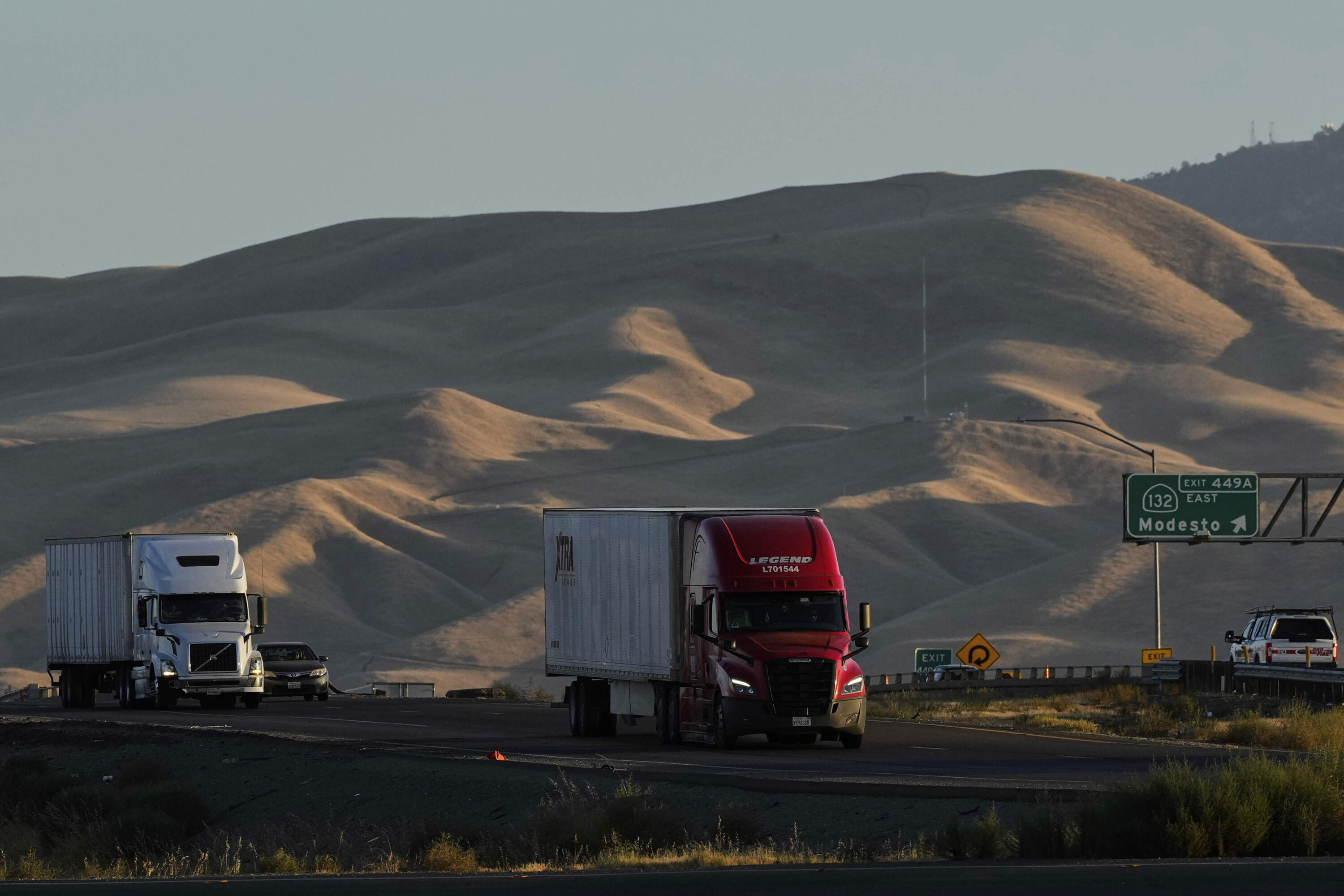
The trucking industry, and more broadly the freight industry, still hasn't fully recovered from the business impacts of COVID. What's behind that?
Guests
Jim Meil, principal industry analyst with ACT Research. Forecasts and analyzes trends and outlook for manufacturing and construction industries in the North American economy.
Alex Leslie, senior research associate at the American Transportation Research Institute. Author of the annual report “An Analysis of the Operational Costs of Trucking.”
Also Featured
Lewie Pugh, vice president of the Owner-Operator Independent Drivers Association.
Andrew King, director of the Owner-Operator Independent Drivers Association Foundation.
Mary Lovely, senior fellow with the Peterson Institute for International Economics.
Transcript
Part I
ANDREW KING: If trucks don't move, you don't have anything. Your grocery stores aren't stocked, your gas stations don't have fuel in them. Everything relies upon trucking.
MEGHNA CHAKRABARTI: And yet that industry on which we all rely is struggling for more than three years. The freight industry has been slipping, costs are increasing.
If trucks don't move, you don't have anything. Your grocery stores aren't stocked, your gas stations don't have fuel in them. Everything relies upon trucking.
Andrew King
Pay rates for truckers are stagnant, and it's gotten so bad that truckers, shippers, warehouse operators, and more have taken to calling it the great freight recession.
You just heard Andrew King, president of the Owner-Operator Independent Drivers Association, he says this wasn't what people expected going into 2025.
KING: So everything was poised to be turning up and we should have seen the market flip into an upcycle in the beginning of this year, around March timeframe, March, April. But obviously we have not seen that come to fruition, and we are now in one of the most maybe historic recessions we've ever been in as far as the length.
CHAKRABARTI: And truckers are feeling the pinch. Pay per mile is still 30% less than it was in 2021, but costs for the trucks and trailers themselves rose by 8.3%.
Those are payments truckers have to make, and truckers already operate on razor thin margins.
DUSTIN ROSS: Frustrating is the exact word for it.
CHAKRABARTI: That's Dustin Ross. He's an owner operator at the father-son trucking company, D.J. Ross Trucking out of Robertsdale, Alabama. When we spoke with him this week, he just finished fueling up at Opelika, Alabama on his way to Charleston, South Carolina to deliver aluminum ingots.
ROSS: It's just a block of aluminum that the place I'm delivering to will melt it down to either make a coil out of, or they'll use 'em for aluminum engine blocks and transmissions. Or anything else that, you know, might be made out of aluminum these days.
CHAKRABARTI: Generally, Dustin seems like an optimistic guy.
You can almost hear the smile in his voice as he talks, and if you ask him how business has been, the first thing he will note is that 2021 was probably his best year ever. But he says things have changed drastically since then.
ROSS: It's almost on a weekly basis where volumes continuously keep dropping more or less.
And I'll see a lot more with empty trucks and a lot more trucks that might be sitting around. And, likewise, a lot of people that are selling off their equipment and going to go do something else.
CHAKRABARTI: Although Dustin says his business is still doing well, that's not the case for everyone, including Dustin's best friend.
ROSS: It's disappointing, because a friend of mine, he just closed up his trucking company and his father had started it, I believe, in the mid '70s. So it's disappointing to see something like that where, you know, everybody's been trailer trucking their whole life and now because of how things are, economy wise.
CHAKRABARTI: Truckers move 72% of the nation's freight value.
Almost three quarters of it, according to the National Transportation Research nonprofit. And for Dustin, his friend's decision to leave the industry highlights the very real impacts of a rough couple of years.
ROSS: This year, especially, a lot of mental challenges at play and if you're not mentally strong enough, in my opinion, it'll cause more bad than good.
And I've even had times where I'll wanna just start selling off equipment. I don't know as though I could ever sell my truck, but at least trailers and whatnot, and try to figure something else out. And then you take a minute to collect your thoughts and realize, okay, just because you're experiencing an unfortunate turn of events at the current moment doesn't mean it's always been this way.
CHAKRABARTI: There are more than three and a half million truckers in the United States, according to the American Trucking Associations. The group also reports that in 2024 trucks transported 11.3 billion tons of freight, and that's just primary shipments, meaning it doesn't even include reshipments. And commercial trucks paid more than $30 billion in federal and state fuel taxes in 2023.
So how is it that the industry has entered its longest running economic slump in modern history? What could that mean for truckers and their livelihoods and for everyone else? The rest of us who depend on the goods they're moving across the country.
Jim Meil joins us now. He's principal industry analyst with ACT Research where he's responsible for forecasts and commentary on manufacturing, construction and freight in North America. And he joins us from Cleveland, Ohio. Jim, welcome to On Point.
JIM MEIL: Hi Meghna. Thanks for having me.
CHAKRABARTI: So before we get to understanding the causes of the trucking, the great freight recession.
I'd actually like to start with you helping us understand how the industry is organized and works to begin with. Because I think the most that the average person might know is just seeing those trucks on the road, but there's a whole system behind that. So if you were to describe the org chart of the freight industry, Jim, where would you start?
MEIL: You bet, Meghna. Transportation is a remarkable and a very diverse industry that embraces not only trucking, but embraces plane, let's say planes and boats and trains too. And it encompasses private fleets that are owned by businesses. It embraces for higher fleets that are engaged in the business.
And it reaches all the way down to parcel delivery that when your listeners make an online order. And the goods show up on the doorstep. There's an entire infrastructure of transportation, not only local but global that stands behind getting those goods from point A to your business or to your home.
Very complicated. And it tends to be a silent business. It works in the background.
CHAKRABARTI: Yeah. We only notice when it doesn't work, right?
MEIL: Indeed.
CHAKRABARTI: So those private fleets are, they say, owned by the companies whose goods are being shipped, I mean that chunk of it.
MEIL: So let's take two examples of trucks that your listeners are probably seeing as they work their way down the interstate or around town.
Amazon, to site one example, Walmart to site another example. But there are also many retailers, many manufacturers, many wholesalers, construction companies that operate their own fleets. They can be as few as 10 or 12, or they can be number in the thousands.
CHAKRABARTI: Okay. And then the drivers for those fleets, are they contract drivers, are they employees of the companies? How does that work?
MEIL: All across the board many of the drivers are owner-operators, okay? That is to say they own their own rig. They actually run a business. Sometimes they might run two or three or four trucks, with colleagues or friends or family.
And that will range all the way up to some of the big names again, that you see on the highway. The Old Dominions, the Knight-Swifts, the Schneiders. So diversification and the fact that the industry is made up of a wide spectrum of players from those private carriers or for higher carriers all the way down to the guy or gal running a truck up and down an interstate.
CHAKRABARTI: Okay. But just to be sure I understand you correctly, the sort of owner operators in terms of drivers and their rigs, is that like the most common model at the driver level?
MEIL: I'd have to say it's diverse.
CHAKRABARTI: Okay.
MEIL: You do get many employee hires who are paid by a Walmart or are paid by UPS or FedEx, for example.
CHAKRABARTI: Got it. Okay. As you said, it is complicated. But I really appreciate this level of detail, Jim, because I'm striving to understand this background, so that why there's such a recession makes much more sense to us when we get there.
Okay. So for, on the level of those drivers, again, whether they're hired by the companies or their owner-operators, what determines how much they get paid?
MEIL: It's Pretty simple. If there is freight to be hauled and let's profile calendar year 2021 as a major freight year. Big time money, high per mile freight hauled.
We had the situation, that's the inverse of what we have today, which is too few trucks, too few drivers to haul freight. So it was fat city and participating in the business, having a truck, being a driver, meant that you could command top tier wages, top tier compensation, because there was a trucking shortage. And that situation persisted in 2021 and 2022, peaked out in 2022.
And since then, we've been on this downhill slide, this freight recession, which is historically unprecedented in terms of duration. So the flip side is today there's skinny money and there's exiting out of the business. It's just hard to turn a dollar, whether you're an owner operator or whether you're a major for-hire carrier.
CHAKRABARTI: Got it. So essentially, and again, I don't want to oversimplify. Because I know there's different employment models, but for the folks behind the wheel, they get paid when they're on the road hauling freight and if maybe a per mile kind of situation. But so if they're not hauling, they're not getting paid.
MEIL: That is correct.
CHAKRABARTI: Okay. So that kind of gets us to the heart of the problem. And yet, especially for the owner-operators, they have costs thatthey've gotta pay.
MEIL: That is correct too. When you own a truck, even if it's not on the road, you probably borrowed money in order to make that purchase.
And if we go back to the fat city year of late 2021, early '22, trucking equipment was commanding a premium. And if you borrowed money from a bank in order to make those monthly payments don't stop just because you have no freight to haul. So that puts you in a world of hurt.
CHAKRABARTI: Okay. Now I just also want to acknowledge that you said that the overall industry involves boats and airplanes as well, and I don't want to ignore that. But for the sake of today's conversation, we will keep our focus on trucking.
MEIL: Absolutely.
CHAKRABARTI: Especially since those trucks are bringing goods most critically across that last, the quote-unquote last mile.
Getting it to Americans and to customers.
Part II
CHAKRABARTI: Jim, I just wanna give the voice to some other folks who are in the industry for a quick second. Let's listen to Colin. He's a delivery driver, not a long haul trucker, but as we talked about earlier, he still obviously is an active participant in the freight industry. He asked us not to name the company that he works for because he is not authorized to speak to the media, but he says the current economic environment is leaving workers in his position squeezed for time.
COLIN: We are absolutely thrashed and always are. Peak season doesn't end, so to speak. And there's folklore in my organization that once upon a time, our drivers used to work eight-hour days, but there's no such thing as an eight-hour day.
We are absolutely thrashed and always are. Peak season doesn't end.
Colin, delivery driver
CHAKRABARTI: And this is Robert. He's a local trucker that delivers bottled water to various grocery stores in Ohio.
He keeps shelves stocked, working 50 to 60 hour weeks, although things used to be better. He says the job is now dominated by cheap rates.
ROBERT: At first, it was a great job that paid great benefits, but as time has gone on, it hasn't kept up with the pace and we're just being priced out of our own industry.
All the prices of everything keeps going up and the industry seems oversaturated to where you can have a good paying load and there will be a flock of people trying to pick that up.
Shippers realizing they can start cutting back on the rates, paying less and less.
CHAKRABARTI: Again, that's Robert in Ohio.
Okay. Jim, how did we get here? Because it seems on the surface, kind of counterintuitive, totally understand that in 2021 there were too few trucks, the shortage of drivers as things started rebounding, but I don't know why now we're in this slump. Because consumption overall has definitely rebounded since COVID.
So what exactly is going on here?
MEIL: Meghna, let's roll the clock back to 2020 and let's take it, first of all, once we got past the existential period of the spring of 2020 and moved into the summer and fall of the year, we were still very much in isolation. And part of that isolation was detaching your activities away from what one might call group collective activities, things like dining out, entertainment, going to a movie, travel. We're all in our own isolated little cubes. So one of the behavioral fallouts of that was that households, consumers started to spend money on stuff, that's a technical term.
But they started to, let's say, pick up hobbies. I can't go to a restaurant, so what I will do is I will start cooking at home. So I buy one of these big $400 or $500 mixers. And then I go from there and saying, I really like this. So let's remodel the kitchen. Maybe you start taking up some hobbies, golf or outdoor activity.
Point is you shifted away from the services-oriented collective activities and you push to things like home entertainment. I can't go to a concert. I can't go to a movie. I build out a new deck for my home. Because I can't go to places. So I think it's fair to say that is the story of late 2020 and early 2021.
And all those activities that I mentioned are goods dependent. You have a shift away from services and you can't visit the grandchildren over the holidays, so you send them a boatload of holiday gifts. That went on, I think it's fair to say, right up to 2022. But as you had that profile of consumer spend, what that meant was you had to move those goods.
You still had the same old trucks and the same old drivers. I think I mentioned before, fat city in 2021 and it persisted in 2022. But then you'll recall, all of a sudden, the COVID isolation started to relax. You started to say, entertainment, movies. Let's go to Taylor Swift. When you get right down to it, Taylor Swift is not truck intensive.
She might have three or four trucks hauling her stuff. But that world of education, that world of medicine, that world of entertainment, that world of dining out, which tends not to be goods intensive, transportation intensive, came back with a roar. But we still had the capacity that had been built up in 2021 and into 2022.
And now it's idled because of a consumer shift to services and away from goods.
Online retailing, for example, came into its own. You couldn't go to a retailer, so lo and behold, that online retailing, very truck intensive. I think that's much of the evolutionary story over these last five years.
CHAKRABARTI: I see. Just as an aside, Jim, I think a Taylor Swift concert is more than three or four truckloads of stuff. (LAUGHS) It's probably 30, 40, even 50. Who knows? The Swifties out there will tell me. Okay, so Jim --
MEIL: Maybe what we should do is go to truck drivers' school so we can haul it around. I'm given to understand that she awards $100,000 bonuses to her truck drivers, pretty good money.
CHAKRABARTI: Wow. Okay props to Taylor. Jim, hang on here for a second because this is like the perfect moment for me to introduce Alex Leslie. Alex is senior research associate at the American Transportation Research Institute, an author of a report, an annual one called an Analysis of the Operational Costs of Trucking.
And Alex joins us from Roseville, Minnesota. Welcome to On Point.
ALEX LESLIE: Great to be here, Meghna.
CHAKRABARTI: Okay. Before we get down and dirty into some of the numbers, given the trajectory that Jim just described from basically 2020, 2021, and then 2022 onwards, I have to ask, is this actually a great freight recession?
Or if we take a slightly broader timeframe, is this simply a return to pre-COVID normal? Alex, what do you think?
LESLIE: It's a great question and I think the most direct way to answer it would be to say that the costs have not returned to pre-COVID normals. If you look at the amount of inflation that we've had since 2020, we're up in costs over a third from where we were at the end of 2019 and that's just as of 2024. So even as rates have come down, and even as spending patterns have maybe returned to something more like that before the pandemic. what we've seen is that costs have remained very sticky. And again, those huge increases, over a third are still what fleets are dealing with right now.
The floor is so much higher, even when the ceiling has returned to its previous level.
CHAKRABARTI: I see. So what's on average? If there is an accurate one of, let's say, the margins, profit or net revenue margins, that the industry or even truckers specifically as individuals themselves are working with.
LESLIE: Yeah this varies a lot by sector. Lots of different types of freight. They have their own unique factors. But if you just look at the truckload dry van sector, those standard 53 foot trailers, not temp controlled, the most common kind going down the freeway. That sector we saw had actually an operating loss on average in 2024 of 2.3, negative 2.3.
CHAKRABARTI: An average loss, in last year. I'm sure there have been times in the past where that's happened.
LESLIE: I'm sure there has, but not since we've been tracking those numbers, at least.
CHAKRABARTI: And just to, so we know, how long have you been tracking those numbers?
LESLIE: We've been looking at that, those profit numbers for basically about a decade.
So that's included some ups and downs, certainly not some of the really big ones if you go back before that period. But again, as Jim has been saying too. It's not just the severity of any given year, it's the fact that this particular recession has lasted so much longer than, for example, the freight recession coming out of the '08 crisis.
We're in our third year now.
CHAKRABARTI: Do you have any theories as to why it's got this longer duration? Alex, and then, and Jim, I wanna hear from you. Same question in just a second.
LESLIE: That has certainly been a challenging question. Jim's been drawing a really great picture of how the freight market does follow these supply and demand polls, and part of it is that when rates were so good for a few years there, that allowed a lot of fleets to remain in the industry.
It attracted a lot of drivers and new fleets, new owner-operators to the industry. So we have all this supply of capacity now. And meanwhile, even though in the broader economy we're not looking at a horrible, broader economy. The spend that we see on consumer retail, for example, has been fairly persistent.
Over these last few years, but it's not been enough to trigger a market flip.
CHAKRABARTI: I see. Okay. I guess that's the part that, like, seems again counterintuitive, but Jim, I'd love to hear your thoughts on that.
MEIL: You bet. I think the best way to describe some of the dynamics of the last few years is to reach back to 2022.
And you'll recall that was the year that we had inflation creep up to 10% by the common measures, and it caused the federal reserve to swing into action. They had been saying before, oh, inflation, transitory, transitory, the Fed got religion about inflation in calendar year 2022, and we started seeing rates hiked.
And I think it's fair to say that when you have high interest rates, it tends to have a light touch on the services sector and tends to really start to impact the goods producing sectors like housing, like manufacturing, car production, capital goods production, building materials. Those are in the crosshairs of Fed moves that are intended to slow down the economy. That translates directly into freight and is one of the fundamental causes, I think, for this freight recession and this freight slowdown that we've experienced really since early 2022. It's no coincidence that you have high interest rates and lackluster freight activity.
CHAKRABARTI: Alex, that's a really interesting angle that Jim brought in terms of the role of monetary policy. What do you think?
LESLIE: Yeah, that's certainly a factor that is impacting the cost side of the equation for freight as well. One of the biggest costs that a trucking company or an owner operator incurs is their tractor, their truck tractor.
And we've seen those costs go up by huge rates, double digit rates, multiple years in this past five year period and 8% alone in 2024. And so those are, again, those are payments that you're having to make. And that price is something that, again, it shows up on that cost sheet in a way that can be really prohibitive.
CHAKRABARTI: Yeah. And also, so there's the sort of the capital costs of the trucks themselves. But also do drivers get other benefits as well? Whose costs have been rising? Because, every year, after year, things like health care costs continue to go up in this country.
LESLIE: Of course.
So for employee drivers, what we've seen coming out of the pandemic is like with a lot of other professions, their wages went up considerably, in trucking that's often on a per mile basis and their benefits costs went up as well. Whether that's additional benefits being offered to attract more drivers, again, during that period when we had more freight than we had folks to drive it, or simply medical inflation.
Again, in terms of driver wages, in 2022, we saw those go up by about 15% per mile. And that increase has remained. You don't as often see wages go down, of course, as when they go up. And driver benefit costs, just in this last year alone, up by about 4.8%.
So yet another factor that's pushing those flood waters up on the cost side.
CHAKRABARTI: Okay. You mentioned wages though, and I don't, apologies if you had already said this and I just didn't catch it. Have wages for drivers or per mile rates increased in a way that matches those rising costs.
LESLIE: So the important distinction here is that you have the rate that a trucking company, whether that's a one driver company, an owner-operator, or a 10,000 truck company, the rate that they are paid to move a load of freight. And those are what have been, essentially, they've come down to these stagnant levels over these past few years. And then on the other hand, you have the wage that is being paid by a company to its drivers. So even though we've seen those rates to actually move freight come down.
Most companies are still paying drivers wages that have seen all of those increases from the pandemic years. So per mile pay is up quite a lot compared to where we were five years ago. Though, of course as Jim did mention, if there isn't freight to be moved, then that per mile pay isn't going to be realized.
CHAKRABARTI: I got it. Okay. So as we head towards the break I just want to talk about one more aspect of that increasing cost floor that you talked about, Alex. This is Lewie Pugh, his executive Vice President of the Owner Operator Independent Driver's Association. He has a desk job now, but before that, Lewie spent decades driving a truck, and one of his roots included bringing steel and plastic pipe into New York and hauling garbage out of New York City.
And Lewie says that the toll increase during his time trucking literally like things like bridge tolls, helps illustrate the rising cost of operations for truckers over the years.
LEWIE PUGH: At the time, I would take $125 cash with me for the week to pay my tolls, and I would usually have money left over, because I think the GW was like $16.
The inner bridge was like $8, the water gap was like $4 or something. And the Jersey Turnpike, some little stuff here. When I quit trucking in 2017 and came in here in the office, I couldn't get to New York City for $100. And on the Island for $125. Just to get there it was over $100.
The GW was, I think, $100. The inner bridges were like $35 or $40. So in that length of time, that's how much inflation has affected the tolls.
CHAKRABARTI: So that's Lewie Pugh, executive Vice President of the Owner Operator Independent Drivers Association.
Part III
CHAKRABARTI: I want to ask both of you the bigger question of how this industry slowdown could have an impact on the broader economy. Because I keep struggling, and maybe I'm just misunderstanding here, but I keep struggling with, is this a correction that simply is coming because of changes in the overall economy?
Or Jim, could this trucking recession itself have a negative impact on the economy. What do you think?
MEIL: I think it's fair to say that if you have a major industry, a major contributor to the economy that has suffered for as long as it has and has dealt with the profitability issues that it has, sooner or later you're going to have your day of reckoning.
And perhaps that day of reckoning is really here, where there'll be enough exits out of the business to force freight rates higher. Ultimately, as we say at ACT Research, the cure for high prices is high prices, and it's not very hard to figure out that high prices, the prospect of high prices in 2026 or 2027 to move freight could be a headwind or an obstacle for the federal reserve, which is trying to lower rates, but has to lower rates in the context of lower inflation.
CHAKRABARTI: Explain that to me more about then how that could actually impact, let's say, other industries, endpoint consumers. Is it essentially that you're saying that costs overall could go up in other places?
MEIL: Costs overall could go up. Ultimately, businesses can perhaps over the short term, take a hit out of margin, but there in essence is no margin for trucking operators, for most trucking operators, to be able to absorb extra costs, let's say, like tariffs. Maybe we can tag that one for a little bit of our discussion.
CHAKRABARTI: Oh yeah, we're coming back to that. But go ahead. But as Alex has outlined, if you have, in the same sense, in the inverse, that you had costs associated with trucking move up to hinder trucker profitability. The flip side might be at work as we close out 2025 and go into 2026. And what that does, it punches up transportation costs. Punches up supplier costs, and again, delivers up inflation for your everyday consumer as they go to the grocery store, do their holiday shopping.
CHAKRABARTI: Got it. Alex, love to hear you on this.
LESLIE: Absolutely. As we do see more capacity leave the market, eventually we are going to see the inflation that we see now is in a market where trucking companies are pretty squeezed. As more capacity leaves, eventually we will see that cycle flip and then trucking will have those better margins.
At a certain point. These cycles are a natural part of the trucking industry, to go back to your broader question, but again, it's the sheer duration of this one that has been such a unique challenge for trucking. And I think a lot of us think about trucks as transient, right?
You see them on the highway, they're passing through, they're always going somewhere else. But the fact is that this industry employs over 8 million Americans and that's in all of our communities. It's an important part of the web of this country. And so when we are talking about such a huge and vital industry that's on the ropes for such a protracted period, that's impacting a lot of Americans, a lot of consumers, a lot of home buyers.
And it's, I think, hard to understate that kind of significance over this long duration.
This industry employs over 8 million Americans ... it's an important part of the web of this country.
Alex Leslie
CHAKRABARTI: Yeah. And so on top of that, or on top of Jim's analysis of the role that the Federal Reserve may be playing here. Jim, you mentioned the tariff word. There's also the impact of a political set of decisions coming from the White House, because of course, tariffs have an impact on all goods coming into the United States.
Which eventually then get moved around the country, whether they're end consumer goods or just supplies and parts that American businesses need. So to that point, we spoke with Mary Lovely, an economist currently studying the effect of President Trump's tariff policies.
And as part of our analysis, she is actually specifically looking at freight coming in through U.S. ports and how fluctuations or reductions in that freight volume has the potential to affect the larger freight industry. Because shippers may change what ports they use, which will change freight lanes and the work that's available in different locations.
MARY LOVELY: The president's tariffs will decrease exports and imports, and it will affect those jobs.
That effect will be felt differently in different parts of the country, because different parts of the country receive trade in different types of goods. And from different countries. A good example of this might be the 50% tariff on India that will affect shipments coming from India, because companies will have to turn away from their suppliers in India and turn to other sources.
If that trade mostly ends up landing on the East coast. That's gonna affect port jobs on the East coast, trucking jobs on the East coast and warehousing on the East coast.
CHAKRABARTI: Mary Lovely, by the way, she's at the Peterson Institute for International Economics. She says that Trump's tariff policies may already be affecting the freight economy.
She was talking about jobs, so here's a little bit more.
LOVELY: We are seeing a hiring slowdown. Those will affect the level of the economy. In effect, even truckers are only served domestic manufacturing. For example, a guy who delivers lumber from the factory to the wholesaler is going to be affected, partly because when the price of foreign lumber goes up, the domestic price goes up.
Not as many people will be able to add on a new bathroom or renovate. So these effects will be felt throughout the economy.
CHAKRABARTI: Again, that's Mary Lovely of the Peterson Institute for International Economics. Jim, do you mind, I just want to share a quick story about how this was really driven home to me this summer, about the impacts of tariffs on people who move things around in this country.
I was in Portland, Oregon, and my kiddo and I went to this local hobby store. There's a couple of locations in and around Portland, Oregon. We wanted to buy rocket parts and RC car parts. So we walk into this store. I am not kidding. It was almost entirely empty. There was nothing, I thought they had literally gone out of business.
All you could see was the dusty outlines of where boxes used to be on the shelves. So I was, I asked the guy who was working there, I said, sir, what's going on here? And he looked at me, he said, there's nothing coming into the Port of Portland because of tariffs and all their goods are essentially made in China.
He has longshoreman friends who are idle at times now, the truckers that he knows have nothing to move, he's getting no deliveries at his door. It was so, like, visceral that I couldn't believe that the impact had been so quick, Jim.
MEIL: Meghna, now I'll share a small story and anecdote with you and see if we can extrapolate from that.
I do business with an online retailer, and one of the aspects of the recent tariff actions is the elimination of the de minimis exemption. Which is that you could bring in imports in small packages under $800, and it would be tariff free, that was lifted, that is to say the exemption was removed on August 29th.
So I went into my Market Basket on this online retailer, and I'll name it, they're Amazon. And I saw that all the small parts and packages that have been shipping in my shopping cart waiting for me to make a decision, were up by 10 to 30%. So this is a very, number one, it's a very real phenomenon. That will impact, I think, consumers right in the pocketbook.
And number two, I think it's fair to say in the industry, there were expectations one year ago that there might be a freight revival. The freight recession would be over in 2025. And we'd have, let's say, if not wholesale prosperity like a repeat of 2021, at least we'd have better times than we'd see an upturn.
Right now, the truckers that I talk to use the F word and the U word a lot. Which is to say, it's flat at bad levels and uncertain. So it's an FU environment, if you will.
CHAKRABARTI: I want to make that into a bumper sticker, Jim, because you really had me there for a second. But your point is well taken. Alex, I just want to get your quick view on the impacts that tariffs could have on the freight industry.
LESLIE: The uncertainty, I think is one of the biggest aspects of this and that is, if you knew all the tariffs were coming down on Day X, what you would normally see is a lot of companies would be bringing in freight ahead of that date. It would be predictable. You'd have a nice little freight bump in advance of that date even though it would fall off a bit after that.
But in the current environment, it's the uncertainty about what and when that causes a lot of this difficulty, in terms of understanding even what is going to be available over the next couple months. And I think really that is what we have seen, whereas in 2023, a lot of trucking companies were still adding to their fleet.
We saw an average of about 4% increase in truck counts in 2023. Even in that down market condition. In 2024, I think we really saw the industry change its attitude. This isn't just going to be a blip that we want to get out ahead of, in order to position to capture new market share, but actually that it's going to be protracted.
We saw a decrease in fleet sizes of about 2%, and we saw a decrease in non driver headcounts at motor carriers by over 6%. So again, the reaction now is very different than what it was even in 2023.
CHAKRABARTI: But Jim, let me ask you, so the near-term impact of tariffs, both of you have really clearly laid out here, but the president would argue that this period of uncertainty, like he would just tell everyone, hold fast.
Because the uncertainty is simply because, in his view, that it takes a little time for the reshoring efforts, let's say, that are part of the stated reason for these across-the-board tariffs, and that specifically for the freight industry, as more and more production or manufacturing comes back to the United States.
If it does, that then perhaps that would lead to better times. When there would simply just be more domestic movement of goods and not necessarily from port. I think he'd probably tell the truckers, and the freight industry, just hang on. The business is coming back. Jim, your thoughts about that?
MEIL: I think as Alex was outlining there are a number of operators in the business that say those kind of dreams and ambitions for perhaps 2026 or 2027 look great, but I'm trying to get the business through the next day or the next week or the next month. So I think the uncertainty element is one factor at work that says, you can promise me the world.
But I have to get through the next three or four days, or the next three or four weeks. So I think that's factor number one. Factor number two is that whether you're, let's say, John or Jane Doe in the street or a decision maker at a Fortune 100 firm, the prospect of reshoring and a relocation of the manufacturing footprint as a result of tariffs is an iffy proposition at best, not the kind of thing that at this point in time, that you might be inclined to bet the business on.
Different strokes for different folks, both the forecasting community and the business community might have different takes, but I think the tariff program is a reassuring program, is one where the jury is very much out.
CHAKRABARTI: Alright, we have a minute to go gentlemen. Are there any near-term solutions or changes that could be made to take the edge off this great freight recession?
Alex, what do you think?
LESLIE: I think the most important thing to keep in mind is that we're in a hole right now. Again, minus 2.3% was the operating margin for the truckload dry van sector, costs up by over a third in the last five years. So it's not just that we need a little bit of improvement across the board necessarily.
If we just, there's a little more manufacturing, just a little more housing. It really seems to turn this market needs something bigger, a bigger push, and it's really hard to see right now, at least, what on the horizon might give that spark to again be able to generate profitability, given the nature of the hole we're in and the nature of how much costs have gone up.
The first draft of this transcript was created by Descript, an AI transcription tool. An On Point producer then thoroughly reviewed, corrected, and reformatted the transcript before publication. The use of this AI tool creates the capacity to provide these transcripts.
This program aired on September 10, 2025.