Support WBUR
Why the flag burning debate is still not settled
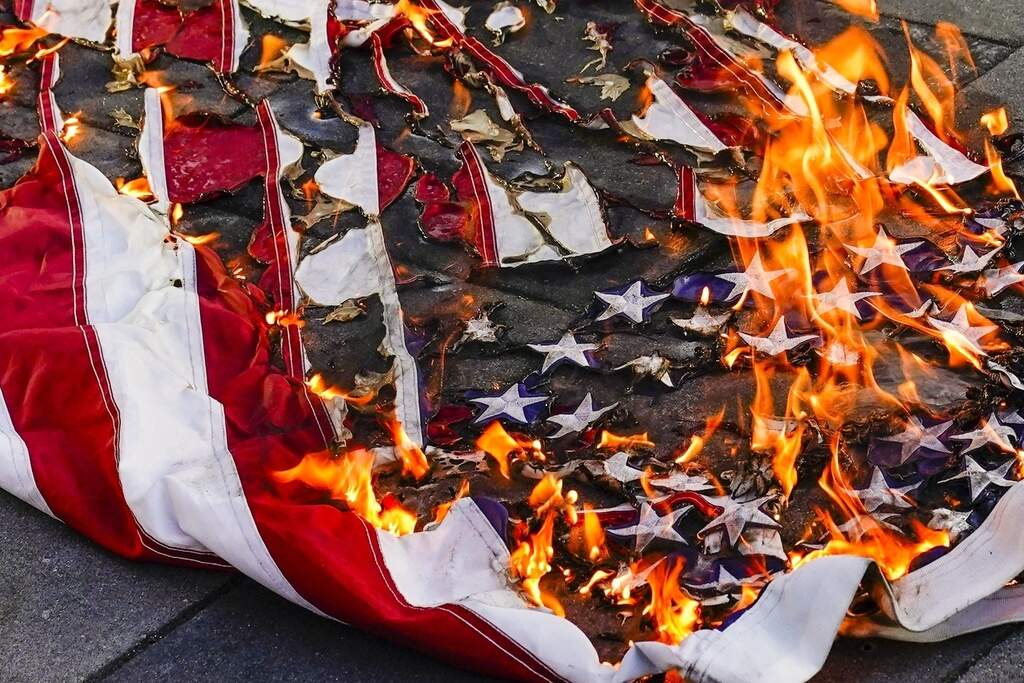
President Trump has issued an Executive Order requiring the Justice Department to prosecute people for burning the American flag. But the Supreme Court has ruled flag burning is free speech. What the debate reveals about the value of national symbols.
Guests
David Cole, Georgetown Law professor and the former legal director of the American Civil Liberties Union from 2017 to 2024. Author of the op-ed “Trump Just Made Burning the Flag a Little Easier.”
Josh Hammer, senior editor-at-large at Newsweek and host of “The Josh Hammer Show.” Senior counsel at the Article III Project, a non-profit advocacy organization focused on promoting the confirmation of conservative judges. Author of the op-ed “Flag Burning Is Not Protected 'Speech.'”
Also Featured
Jeffrey Alexander, sociology professor emeritus at Yale University.
Transcript
Part I
MEGHNA CHAKRABARTI: In 1984, the Republican party held its national presidential convention in Dallas, Texas. Ronald Reagan was both the incumbent president and the party's nominee. The convention drew protestors for and against various causes, protestors marching against U.S. foreign policy on Iran, protest marching for Christian values, protestors gathering in opposition to all war.
Well, a local Dallas reporter noted that protests of any size were unusual for the city at the time.
REPORTER: This labor rally at the San Francisco Convention drew some 100,000 people, but then marches of that size are not unusual in San Francisco, but a turnout of three or 4,000 is remarkable in Dallas, where political protests of any kind are a rarity.
RYAN HUNT: So that's why I say it couldn't have happened in a better place. This town needed the convention, if it's ever going to be progressive. The progressive community has to learn to work together. It has to look, learn the basic skills of organizing and putting on functions and things like this. And they've done an excellent job. It was a good opportunity for them. It was a good experience for them, and they're now working together in a way they never would've before.
CHAKRABARTI: That's Protestor Ryan Hunt there speaking to Dallas Local Media again in 1984. Another group was in Dallas that week, the Revolutionary Communist Youth Brigade, and among them, an Atlanta native in his late twenties named Gregory Lee Johnson.
GREGORY LEE JOHNSON: The whole express theme of that convention was new patriotism, bringing America back, prouder, stronger and greater. And I think this is a theme that the government had been trying to rehabilitate the American people around, since the end of the Vietnam War, when patriotism was a nasty word.
CHAKRABARTI: That's Johnson in an interview with C-SPAN in 1989.
Now, during one protest, again in 1984, the group reached Dallas City Hall. Someone grabbed an American flag and then Johnson poured kerosene on the flag and set it on fire. The group was chanting phrases like America, the red, white, and blue, we spit on you.
JOHNSON: In 1984, the Republican Convention was right around the time of the U.S.' invasion into Grenada.
Reagan's little jokes about having outlawed the Soviet Union. The bombing was going to begin in five minutes. The threats against Nicaragua to say uncle. So we wanted to do as much as possible to pierce the whole chauvinistic Rambo atmosphere around that convention. And I think the flag burning did that very sharply.
CHAKRABARTI: Johnson was arrested on the spot. Here's an ABC News report from the time.
ABC NEWS REPORT: Gregory Johnson drew a $2,000 fine and a year in prison for violating a Texas law that makes the desecration of the flag a felony.
CHAKRABARTI: In 1984, it wasn't just Texas, 48 out of 50 states in the US had laws explicitly outlawing flag desecration.
Therefore, as you heard, Johnson was convicted. He appealed. Because to him, burning the American flag was protected by his First Amendment right to free speech.
Once they've opened this door that says flag burning should be prohibited because it harms nationhood and national unity, then they've opened the door for any number of things to be prohibited.
CHAKRABARTI: The case made it all the way to the United States Supreme Court. The justices issued their landmark 5-4 decision. On June 21st, 1989, here's how ABC News's Peter Jennings led that night's broadcast.
PETER JENNINGS: We begin tonight with a decision by a supposedly conservative Supreme Court. It's about free speech and a powerful symbol of the nation.
The court ruled today that burning the American flag as a form of political protest is a right protected by the First Amendment to the Constitution. The decision reflects a very divided court. The debate as always, deeply divides the country.
CHAKRABARTI: That was Peter Jennings in 1989 on the date of that U.S. Supreme Court decision.
Well, Johnson also reacted himself. This is again from that C-SPAN interview.
Had they ruled against me, it would've been very blatant to many people in this country that I was being suppressed and imprisoned precisely for making anti patriotic statement with the flag. And I think that's something that would've been very disturbing to millions and millions of people.
I think the Supreme Court got caught in somewhat of a bind. It's a very delicate and sensitive issue in the world today, how different governments treat political dissenters within their own borders. So I think it was a very calculated political decision on the part of the Supreme Court.
CHAKRABARTI: Gregory Johnson continues his protests against U.S. policy, and he's still burning the flag.
In 2016, Johnson burned the flag at the Republican National Convention in Cleveland. Media and law enforcement surrounded the protestors and melee broke out, and 18 people were arrested.
(PROTEST SOUNDS)
Sounds there from that 2016 protest in Cleveland. Flag burning, though it is protected by the Constitution as deemed by the U.S. Supreme Court remains deeply unpopular in the United States. This summer one CBS News YouGov found that 66% of Americans polled want flag burning to be against the law.
President Donald Trump agrees.
DONALD TRUMP: Because the people in this country don't want to see our American flag burned and spit on and by people that are, in many cases, paid agitators.
CHAKRABARTI: So that's the president in the Oval Office. Just last month, when he signed an executive order directing the Justice Department to investigate and prosecute people for burning the American flag.
Trump says the punishment should be one year in jail.
TRUMP: All over the country, they're burning flags all over the world. They burned the American flag, and through a very sad court, I guess it was a 5 to 4 decision. They called it freedom of speech. But there's another reason, which is perhaps much more important.
It's called death. Because what happens when you burn a flag is the area goes crazy. If you have hundreds of people, they go crazy. You can do other things. You can burn this piece of paper. You can, and it's, but when you burn the American flag, it incites riots.
CHAKRABARTI: Again, President Donald Trump, just last month.
But what will enforcement look like if the executive order as the president himself acknowledges is unconstitutional? And what does the President's efforts tell us about the state of free speech in America? And here's the big question. What is more worthy of protection? A symbol, i.e. the flag, or the values that symbol is supposed to represent?
We're going to start today with David Cole. He's a professor at Georgetown Law and a former national legal director at the American Civil Liberties Union. He's also one of the attorneys who represented Gregory Johnson during that case, Texas v. Johnson in the 1980s. Professor Cole, welcome back to On Point.
DAVID COLE: Thanks for having me.
CHAKRABARTI: Can you start by putting us back in the sort of political atmosphere of 1984 through 1989 when the Supreme Court decided the case, what made Johnson's actions that day in Dallas so provocative that he was arrested immediately?
COLE: I think burning the flag is provocative whenever it is done.
And to do it in Texas, to do it during the Republican National Convention at a time when the country was divided, not as divided as today, but divided, led to his arrest, led to his prosecution. But remarkably, the Texas Supreme Court for criminal cases, it's called the Texas Court of Criminal Appeals, held that he could not in fact be punished for his flag burning.
He was convicted at the trial, but in the Supreme Court of Texas for criminal cases, that court said, no, this is First Amendment protected speech. Texas took the case up to the Supreme Court and the Supreme Court essentially reaffirmed what the Texas Court had held. The Texas Court was not a liberal court.
The U.S. Supreme Court was not a liberal court, but this was a fundamental premise of the First Amendment.
CHAKRABARTI: Ah, interesting. Because I was just going to ask you, I was thinking, listening back to Peter Jennings' characterization of the court at that time, he called it a supposedly conservative court. But that a 5-4 decision came out of that.
What were some of the arguments made? Both in favor of calling flag burning a form of a symbolic speech under the deserved protection of the First Amendment, and some of the arguments that, I guess, the state of Texas made against it.
COLE: So this was not the first time that the Supreme Court had taken up that question of whether or not flag burning is protected by the First Amendment. There had been three prior cases in which people had been convicted for burning flags. In all three cases, the Supreme Court had reversed the convictions, but it had always done so on narrow grounds. Reserving the question, whether a proper statute properly applied could in fact hold someone liable for burning the flag.
And so the argument, and there were substantial number of justices, including liberal justices who indicated that it might well be permissible to put someone in jail for burning the flag. The argument for putting people in jail is this is not very valuable speech.
There are lots of other ways that you can express your views other than burning the flag. And it really offends a lot of people. It deeply offends a lot of people and since it's so offensive, and it's not very valuable speech, we should allow, the First Amendment should permit the government to prohibit it.
And indeed, as you indicated in the opening, 48 states and the federal government had laws that made it a crime. It was broadly criminalized. The argument on the other side that we made for Mr. Johnson is the sort of core of the First Amendment. The core of the First Amendment is that the one reason the government cannot seek to penalize speech is because of the message it expresses, because they disapprove of that message, because that message is deemed defensive.
That is, if the First Amendment means anything, it means that the government has to be, neutral vis-a-vis the ideas that people express. And people are free to express those ideas in whatever nonviolent way they choose. Whether by waving the flag or by waving somebody else's flag or by burning the flag or by burning somebody else's flag.
And the Supreme Court, 5 to 4, ruled in our favor.
Part II
CHAKRABARTI: Today we are talking about President Donald Trump's recent executive order that would penalize or criminalize flag burning. Even though in 1989 the U.S. Supreme Court ruled that flag burning is a form of symbolic speech protected by the United States Constitution.
Let's listen to one of the justices who ruled in favor of protecting flag burning in 1989. Again, it was a 5-4 decision, and one of those justices was conservative Justice Antonin Scalia. He explained his decision in a 2012 interview with CNN.
ANTONIN SCALIA: Yeah, if I were king, I would not allow people to go about burning the American flag.
However, we have a First Amendment. Which says that the right of free speech shall not be abridged, and it is addressed in particular to speech critical of the government. That was the main kind of speech that tyrants would seek to suppress. Burning the flag is a form of expression.
Speech doesn't just mean written words or oral words, it could be semaphore. Burning a flag is a symbol that expresses an idea.
CHAKRABARTI: Antonin Scalia in 2012. Professor David Cole. Can I, let's just quickly hop over to the political response that happened in 1989. Because I think comparing then and now is a pretty interesting exercise.
Obviously, there was pretty muscular response from certain members of Congress. Can you remind us what happened?
COLE: Sure. Like many controversial decisions the court issued its decision at the very end of its term, which happens to be just before the 4th of July break for Congress.
Congress responded to the decision by holding off on starting their 4th of July break and staying in session for an extra day or two so that virtually every member of Congress could get up and land based the Supreme Court for the decision that it had just issued. The Bush administration responded by. the George H.W. Bush administration at the time, responded by saying if this is what the Supreme Court says, we have to amend the Constitution. But Democrats did not say this is the right decision. Democrats said we think flag burning is terrible. We can make it a crime. The Texas statute was a particularly poorly drafted statute.
We can amend the federal flag banning statute and that will be constitutional. So everybody in Congress on both sides of the aisle was basically taking the position that we should make it a crime to burn the flag. The only dispute really was whether we should do it by amending the constitution or by amending a statute.
They eventually amended a statute, the Federal Flag Protection Act of 1989. That law went into effect. The very night that law went into effect, Gregory Johnson burned a flag, put out a press release saying he was going to burn a flag. His only mistake was he burned it in New York City, and no one really cared.
No one responded. Meanwhile, a group of young people in Seattle took down the Post Office flag, burned it, and they were arrested and charged. The first defendants charged with burning the flag in violation of the federal Flag Protection Act. Gregory and his friends responded by, they were outraged to read that somebody else had this case.
And so they got on the train from New York, went down to Washington with new flags. Went to the steps of the Capitol, burned their flags on the steps of the Capitol and were indeed arrested. Although the next day when they were arraigned in court, the prosecutor came in and arraigned Gregory's compatriots, but not Gregory.
Gregory objected, said it was selective non-prosecution. Because he wanted to be the defendant in the case, and the government, I think, knew that. So they didn't charge him. But we were back before the Supreme Court the very next year on the very same question. And again, the court ruled in our favor, 5-4.
And that's where we stand today.
CHAKRABARTI: Okay. A little later in the show, I want to dive into some of the details in both the majority decision from 1989 and some very interesting aspects of the dissent that was written, because I think the dissent captures a lot of why flag burning remains politically unpopular, even if deemed legal by the Supreme Court.
We're going to bring in another voice on that in just a second, but Professor Cole, let's talk for a moment about the distinct difference that the presidential Executive Order signed by President Trump makes when it comes to why the White House thinks that people should be able to be arrested for flag burning.
They actually note exactly what you note, the EO notes that there is a Supreme Court ruling on First Amendment protection, but then the EO says the court has never held that, quote, American flag desecration conducted in a manner that is likely to incite. This is the key part. Imminent lawless action, or that is an action amounting to fighting words is constitutionally protected.
So you can say whatever you want, but in the Trump administration's view, the problem is the violence that can then follow from the burning of the flag.
COLE: That's right. And there's a way in which that's true in the sense that the Supreme Court has said that incitement is not protected by the First Amendment.
Fighting words are not protected by the First Amendment. True threats are not protected by the First Amendment, but they've defined each of those very narrowly, so it's extraordinarily difficult to fall within them. Incitement you have to intend to incite lawless action. It has to be likely that you will, in fact, incite lawless action and it has to be imminent.
That's under a case called Brandenburg v. Ohio, very hard to meet that, fighting words have to be personally directed at a particular person. The kind of words that the only response is fisticuffs. Again, very hard to prosecute anyone for that. If you do that with a flag then yeah, you could be prosecuted if the government could meet those very demanding standards.
But it's not the case. And certainly not the case that every time someone burns the flag, it constitutes incitement or constitutes fighting words. Joey Johnson burned the flag in 1984. No one fought him. That did not incite a riot. There was no intent to incite a riot, et cetera, et cetera.
And that's true of flag burnings through history. Plenty of flags were burned during the Vietnam War. I don't think a single riot broke out as a result or violence. So I think it's true as a formal matter, but it's actually that language of the executor is actually meaningless, because I think they will not find a flag burning that fits within those very narrow confines of unprotected speech.
CHAKRABARTI: Okay. So Professor David Cole, hang on here for just a second because now is a great time to bring in Josh Hammer. Josh is senior council at the Article III Project. It's a nonprofit advocacy group focused on promoting the confirmation of conservative judges. He's also senior editor-at-large at Newsweek and host of the Josh Hammer Show.
Josh Hammer, welcome to On Point.
JOSH HAMMER: It's a pleasure. Thanks for having me.
CHAKRABARTI: First of all, respond directly to what Professor Cole just said, that the definition of incitement is so narrow. You heard him just say he doesn't think that any act of flag burning would meet that definition when it came to whatever riot or violence or upheaval might happen after an act of flag burning.
HAMMER: Yeah. Look, if you go back and you look at the case law beginning with the 1960s and the Warren court, the Ohio case that the professor mentioned. it is definitely true that taking this line of cases on its own terms, that incitement has repeatedly been defined narrowly by the court.
I think that frankly though, having this conversation about incitement is missing the forest for the trees here to an extent. Because it's missing the forest for the trees, for at least two separate reasons. One is that as an optical matter, my impression of this President Trump executive order when it comes to the Flag Protection Act of 1989, the one that was held to be unconstitutional in the U.S. v. Eichman case of 1990, that's the one-year criminal provision that they're alluding to in the executive order there.
Yes, there is a narrow legal way to try to actually get this statute and apply it when it comes to imminent assignment of violence. But I think above all is actually purely a political measure, if I'm being very honest with you. This executive order, I think this is what President Trump ... frankly one of the things he does best.
Is he makes his political opponents defend something that on the underlying policy, merits and substance, looks to be pretty indefensible in the eyes of the broader public. And certainly, holding the First Amendment aside, when it comes to general public sentiments. When it comes to burning the American flag, this is probably something close to an 80-20 issue.
So that's my view of the executive order. I don't think it's necessarily an ultra-legalistic document. That's the first reason that I think this incitement conversation is missing the forest for the trees. I think the more important point. Which will take us in a more constitutional direction.
I actually personally wish the executive order went quite a bit further.
I actually personally wish the executive order went quite a bit further.
Josh Hammer
Because I actually wish that it didn't get bogged down in trying to carve out these incitement dispensations to the Texas v. Johnson case and the U.S. v. Eichman case from 1989, 1990. For the very simple reason that those cases are flagrantly and egregiously wrongly decided.
There is this blatant act of bipartisan historical revisionism that tends to look back on the American founding in the First Amendment as some sort of Voltaire French enlightenment-esque libertarian liberal paradise, that is literally not the first amendment that we have as the extraordinary First Amendment scholar. Jud Campbell, a professor at Stanford Law School, as he has put in a law review article, quote, the First Amendment, did not enshrine a judgment that the cost of restricting expression outweigh the benefits.
At most, it recognized only a few established rules, leaving broad latitude for the people and the representatives to determine which regulations of expression would promote the public good.
That's from a 2017 Yale Law Journal article. And more generally speaking, this notion that literally setting an item on fire, setting something alight, that this is an act of speech, that these are words coming out of your mouth, is preposterous and ludicrous. In any other context, short of the flag and its unique emotional appeal, we would immediately recognize that setting an object on fire is an action. It is an act that a human being takes that is subject to the normal political processes when it comes to regulation and criminalization, if so desired.
This notion that literally setting an item on fire, setting something alight, that this is an act of speech, that these are words coming out of your mouth, is preposterous and ludicrous.
Josh Hammer
CHAKRABARTI: Okay, so let me just turn that right back to Professor Cole. You heard Josh there saying flag burning is not speech, it's physical conduct. So therefore, does not deserve or warrant first amendment protection.
COLE: So yeah, it is physical conduct, but the question is not whether it's physical conduct or whether it's speech.
Lots of physical conduct is expressive. If I march down the mall, I'm engaged in physical conduct, but everyone recognizes it's expressive. If I'm a ballet dancer, it's physical conduct, but everyone recognizes that it's expressive.
And what the Supreme Court said in Texas v. Johnson was, what you do is you look at why is the government regulating this physical conduct. Does it have to do with something about the conduct irrespective of a message that it sends? Or is the government's interest in prohibiting this physical conduct, in this case, burning the flag, about the message that it sends?
And it concluded, absolutely correctly, that the only reason the government prohibits burning of the flag is because of the message it sends. Indeed, every flag burning statute has a exception, because the proper way to dispose of a flag is to burn the flag, and so if you do it in a way that expresses respect for the flag.
Perfectly okay. If you do it in a way that expresses disrespect, not okay. That's viewpoint-based discrimination. That is targeting the conduct because of what it expresses, and that's why the Supreme Court said it has to satisfy First Amendment scrutiny. It can't. Because as the Supreme Court said, that if there's any bedrock principle of the First Amendment, it is that the government cannot punish expression because people find it offensive.
As the Supreme Court said, that if there's any bedrock principle of the First Amendment, it is that the government cannot punish expression because people find it offensive.
David Cole
CHAKRABARTI: Josh. Let me ask you, you said you just believe that it was full-blown, wrongly decided. And I heard your point about conduct obviously versus speech. But I feel like the court does take up these questions of what should be protected on the First Amendment and what should not be protected, and the court itself doesn't distinguish between speech and action.
For example, I'm thinking 2010 and Citizens United there, the issue was the spending, political spending of corporations and unions. The issue wasn't like what that spending symbolizes. Because the political ads that are bought by that money could be anything, but the court in that case ruled that the action of spending money for political purposes, for corporations and unions is protected speech.
How does that differ from flag burning?
HAMMER: I think Cities United is actually an interesting question, frankly, and I think there are a lot of folks, even on the political and legal right of center, Senator Josh Hawley in Missouri would be a good example, who are coming around to the opinion that maybe the court actually potentially did error in Cities United.
So I think that's an interesting conversation, perhaps better suited for another day. But more generally here, again, there's been a lot of talk here about what the liberal, post 1960s, post-war court.
CHAKRABARTI: Actually, Josh, I'm going to totally let you respond, go down the path that you were going to. But I do actually, I would love to hear your answer about how, if you think Citizens United and the logic that the court used there in terms of protecting an action of spending money, how and why that's different from the 1989 case on the action, as you say, the conduct of flag burning.
HAMMER: Okay, so for starters. Making a political donation to a cause. Literally the crux, the First Amendment, the crux of the free speech clause is political speech. Period. Full stop, end of story. I think that we probably all agree on this call that is the unambiguous purpose of the free speech clause, is political speech.
Now it depends then how you view money as an instrumentality. If it is, in this case solely, exclusively oriented towards the pursuit and the dissemination, the propagation of political speech, then it is one, the same as speech. There are no physical externalities, for instance, such as literally setting something on fire.
Again, I think that this is a very obvious physical detail that is being lost in this conversation, is that this is a literal physically setting something on fire. Less I have to remind listeners here is a pretty dangerous thing here. We have fire codes in this country. We have firemen. When you have bonfires at high schools for ... the fire department has to be on hand with a fire truck in case the fire gets out of hand.
Fire is something that is inherently associated, when it is done in a public space, oftentimes with discord and disarray and perhaps even an archaic sentiment, which is the heart of President Trump's executive order there, but even holding that aside, it is on its face, a dangerous thing and a way that money very clearly is not there.
But again, I think that Cities United is actually somewhat interesting question there. And again, I'm not sure that we're going to have the full Citizens United debate on this particular call. But again, what we heard from Professor Cole is a very interesting summary of post 1960s Warren Court liberal jurisprudence.
It is not inaccurate summary whatsoever of how the American founders viewed the First Amendment in line with the quote from Professor Campbell that I read earlier. At the time of the American founding, you had things like obscenity that were criminalized there. For instance, in the state of New York, there was a case called People v. Ruggles.
If I remember the state, if I remember the case correctly, where they had a prosecution for obscening Jesus Christ, into the 1800s, there are all sorts of prosecutions when it comes to lascivious behavior and pornography. The notion that pornography was First Amendment protected there, was ludicrous there. The First Amendment perhaps reads in a literalist, contextually neutered place as an absolutist assertion, but it is absolutely not when one reads the political theory of the American founding.
Part III
CHAKRABARTI: I just want to take a second to explore in more detail. Not just the flag, but what it actually symbolizes and why symbols are profoundly important in the civic life of a nation. And to do that, let's listen to Jeffrey Alexander. He's a sociology professor at Yale University who studies these kinds of questions.
And Professor Alexander says, human beings have always been drawn to objects that represent shared values, from religious symbols to even brand logos or team colors, and flags are no different.
JEFFREY ALEXANDER: Perhaps the most powerful way to symbolize is through what I call iconic objects or material things that appeal to the five senses, so that we have not just a intellectual or cognitive reaction or understanding, but we have a visceral one.
CHAKRABARTI: And Alexander says, respect for the flag is imbued deeply in American culture. Every morning in school, students pledge allegiance to the flag. Americans face the flag and sing the national anthem, which of course is all about the flag, before sports games. People may hang the flag on porches during the 4th of July.
So Professor Alexander is not surprised that flag burning is extremely unpopular regardless of what the First Amendment says.
ALEXANDER: People have often thought of modern society as a rational, scientific, simply maybe judicial, legal, constitutional order, but it's a lot more than that. The division between the old religious order and the new secular order is not really a radical separation.
So symbols are a kind of shorthand for powerful collective sentiments.
CHAKRABARTI: Alexander says Trump's executive order deliberately uses religious terms such as desecrates to describe the flag.
ALEXANDER: And in a way it's correct if a political opponent of Trump burns the flag. They are desecrating a sacred symbol, and that's precisely a way to create alarm, concern, to draw people's attention.
CHAKRABARTI: But the professor says that for a symbol like the flag, it's impossible for society collectively, everyone, to feel exactly the same way about it. For anti-war protestors such as Gregory Johnson, the flag is something that incites very negative feelings. But Alexander says the act of debating what these important symbols mean, that is what is essential to democracy.
Unlike in most other countries which do not allow the burning of the national flag, the United States should encourage disagreement and debate.
ALEXANDER: So rather than outlawing the desecration of the flag, what you want is ideally somebody sees the desecration and then gets into an argument with the person doing it, Hey, stop that.
Rather than outlawing the desecration of the flag, what you want is ideally somebody sees the desecration and then gets into an argument with the person doing it, 'Hey, stop that.'
Jeffrey Alexander
What are you doing that for? I think this country sucks. I think this policy is terrible. And that person says, it's not the country that sucks. It's the political party. Let's talk about the politics, on and on. That would be much, that would be productive, that would be healthy. But to say you can't do that means we would become something like a church, rather than an open constitutional democracy.
CHAKRABARTI: That's Jeffrey Alexander, sociology professor at Yale University. David Cole, let me turn to you about this idea of what the flag symbolizes and whether that actually puts it at a higher level of deserving protection in this country. And I'm looking back at what the dissent was in 1989 and Chief Justice Renquist, I believe, authored the dissent.
It's very interesting because in the dissent the national anthem is quoted. The dissent quotes a poem by John Greenleaf Whittier, almost in its entirety, I think. There are citations of phrases that rallied union troops in the Civil War about, yes, we'll rally around the flag boys in order to keep up morale for union troops.
The argument being that the flag just, it isn't just a symbol in a form. It's the embodiment of what they called national property or property over a set of values that binds the American people together. And because of that, since it's imbued in the flag, it must be protected from desecration, because desecrating that flag or burning that flag is equal to burning the values that it stands for.
And that's just separate and apart from other forms of protected speech, Professor Cole.
COLE: So it's without question. It's a very powerful symbol and it's one that people feel very strongly about, especially people who have fought for this country under the flag. Justice Stevens, for example, a noted liberal, was in the dissent in that case and was clearly visibly upset at the argument, and I understand at the conference discussing was near tears.
He fought in World War II and he really felt like this is one symbol that we should just keep sacred. But I think the First Amendment says that there are no sacred symbols in a civic government. And precisely because the symbol is powerful, the government doesn't get to tell us, the people, how we use it.
We can use it to waive it. To express support for the government, we can burn it to express opposition to the government. That's ultimately our choice in a free society. You don't have the government coming in and saying, if there's a particularly powerful way to express a message, we are going to suppress it altogether.
And what Justice Brennan said in the majority in Texas v. Johnson was that we are a stronger country for tolerating the burning of the flag, because it sends a message. Our tolerance of that sends a message that we are not just a country that worships a particular symbol.
Justice Brennan said in the majority in Texas v. Johnson was that we are a stronger country for tolerating the burning of the flag.
David Cole
But it instantiates a commitment to freedom of expression, in which all of us are free to express ourselves. And we are not dictated by our government as to what we can or cannot say, or how we can or cannot say it.
CHAKRABARTI: Josh Hammer, looking back at that majority opinion, it's interesting, because the majority opinion actually quotes a previous decision from the court.
A decision from 1943 in which it says, quote, a government cannot mandate by fiat, a feeling of unity in its citizens. Therefore, the very same government cannot carve out a symbol of unity and prescribe a set of approved messages to be associated with that symbol. I think that's what David Cole is getting at.
There may be popular sentiment about the flag, but the government can't say, this is how you have to feel about it, and therefore we're going to protect the flag. What are your thoughts?
HAMMER: Yeah, I think that both right liberal and left liberal jurisprudence have just totally forsaken the commonly understood historical notion of the common good, which was the be all, end all for how many early politicians and jurists alike thought of their tasks.
Again, it's true on the one hand that read quite literally the First Amendment reads a pretty absolutist assertion that Congress will make no law abridging the freedom of speech. But again, on the other hand, there were any number of things that today through an anachronistic historical prison we might call speech in the year 2025, whether it is obscenity, whether it is defamation, whether it is pornography or otherwise.
But they had no problem whatsoever subjecting those things I just mentioned to either the various regulations of tort law or criminal law. And flag burning, one, I think unequivocally, the reason that you don't have a very particularly long history, frankly, of flag burning cases going back to the late 1700s, early 1800s is because it was completely unheard of.
It was something that no one really would've ever thought to do. And part of that was due to political culture, which again was, I think there was this understood notion that we are in a polity together. We all have the interdependent mutual bonds of civic loyalty with that which no polity or republic can cohere, which is what Chief Justice Rehnquist was getting at in a Texas v. Johnson dissent from 1989.
On the one hand, I think what would, it would've been readily understood that if you had tried to burn the American flag in public, in Boston Commons in 1792 or whatnot there, you would've been much more likely to have been literally tarred and feathered by your common citizens in the Commons than you would've been to have gotten a First Amendment affirm to express yourself accordingly at trial.
So I think there's just a lot of historical revisionism here and if we want to just make the interpretive and jurisprudential claim that everything I'm saying is nonsense because originalism is nonsense and we shouldn't care what the founders thought, what the First Amendment actually meant when it was ratified in 1791.
If we want to go down that road, that's fine. That's interesting conversation to have there. But I think from an actual original perspective there, and look, a lot of people say, oh, but Antonin Scalia, right? This is oh, Antonin Scalia joined the majority pinon in both the Johnson case in 1989 and the Eichman case in 1990.
With respect to Antonin Scalia, who I have tremendous respect for, he was not perfect. There was no individual who was perfect. Antonin Scalia definitely did error, I would argue, in a number of high-profile cases. Perhaps no more so the Employment Division v. Smith case 1990 when it comes to religious liberty in the POD case in Utah.
Oregon. Excuse me. So he was not perfect. And I think that he very much erred in this case as well.
CHAKRABARTI: So Professor Cole, let me just turn back to something again. Agreed, Josh, we're not gonna debate originalism now. But I do wanna place this conversation in 2025 versus what America was like in 1984, 1989. and I think Professor Cole you said at the beginning of the show, the country maybe is more divided now, which I wanna go back to this incitement issue.
Because in 2016 at the Republican National Convention, there was, I don't know if we would call it a riot, but there was some violence around that flag burning protest. Some people might say the law enforcement started it. Other people might say it was the act of burning the flag that started it. My point is that I think one can argue that whether the intent is to incite or not, we are in a country right now that is such a political tinderbox, so divided, that it is fair to say some kind of violence or riot may happen around flag burning.
Now what to do about it is left to law enforcement at the site. So I guess what I'm saying is I'm not sure that we can say with such confidence that flag burning in 2025 wouldn't meet the criteria for incitement that you laid out earlier.
COLE: Yeah. I'm going to turn to that, but let me just for a moment, respond to Josh's argument that the First Amendment, at the time of the framing did not understand this. We opened our brief in the Texas v. Johnson case by saying this nation was founded on the burning of a flag. And indeed, the burning of the British flag was a key aspect of the colonies' protest of the British rule.
So a flag, using the flag and burning the flag to express a message goes back to the founding, number one. Number two, the First Amendment has definitely evolved over the 200 plus years, and thank God it has evolved, right? Because in World War I, for example, people were thrown in jail for merely speaking out against the war, for merely praising the courage of someone who opposed the draft.
Burning the flag to express a message goes back to the founding.
David Cole
In the early first decade the Congress passed a law that made it a crime to criticize the government. So if Josh wants to go back to that First Amendment, I think he should move to a different country. Our country is one where we respect the right to speak out against the government and we prohibit the government from dictating how we do so.
Our country is one where we respect the right to speak out against the government.
David Cole
Now to your point, as to whether or not it might cause an audience to riot. The Supreme Court has addressed that question as well. Of course, in all sorts of times, there are situations in which what someone says or how someone says it, might offend deeply other people and those other people might respond violently.
What the Supreme Court calls that is a heckler's veto, and it has said, we cannot in this country respect free speech and nonetheless give hecklers the right to veto any speech that they disagree with. There are plenty of people who disagree with Donald Trump, but we can't silence him.
There are plenty of people who disagree with Bernie Sanders, but we can't silence him. And even if people respond violently, it's on the police to, the Supreme Court has said, it's on the police to go after the people who respond violently, not the person who expresses a message that other people don't like.
CHAKRABARTI: Josh, we have one minute left. My last question for you is there's always a concern about a slippery slope. Here again, it's this incitement issue that I'm really focused on, whether you, both gentlemen want me to or not, but it's what happens when a president says if a protestor tears up my picture.
And other, that could be an incitement to riot too. I just wonder if there is any fear or concern you have about a potential slippery slope.
HAMMER: No, not even remotely actually in this case. Frankly I think it's actually a somewhat interesting argument to make on the flip side, especially given the state of assassination culture in this country, of the recent high-profile murder of my late friend Charlie Kirk.
I think there's actually an interesting argument to be made, frankly, on the other side here. I also, over the course of our conversation, I still have not heard a clear and coherent argument as to why taking any object, even holding aside the historical uniqueness of the American flag, which again, is one of the late motifs of the Great Chief Justice Rehnquist descent in the Johnson case.
Even holding aside the potent symbolism of the American flag, I still have not heard an argument as to why setting any object on fire, literally, is not an action that can be regulated and/or criminalized depending on his level of danger and as opposed to constitute protected quote-unquote speech.
The first draft of this transcript was created by Descript, an AI transcription tool. An On Point producer then thoroughly reviewed, corrected, and reformatted the transcript before publication. The use of this AI tool creates the capacity to provide these transcripts.
This program aired on September 22, 2025.