Support WBUR
The legacy of the 5th Circuit: Past and present
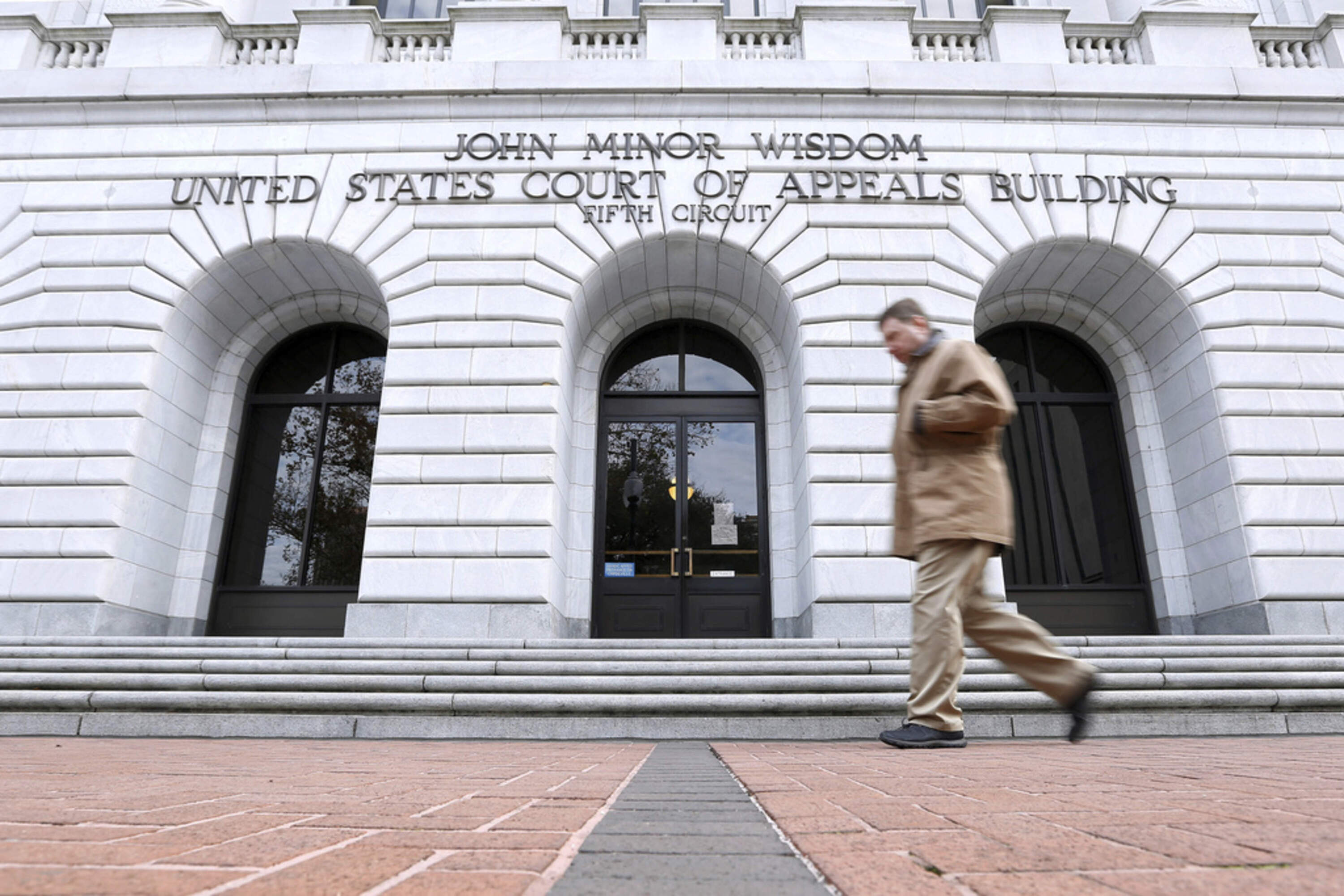
Today, the 5th Circuit Court of Appeals is known as a conservative juggernaut. But that hasn’t always been the case.
Guests
Brian Fitzpatrick, professor of Law at Vanderbilt University Law School. Author of "Scotusblog: Is the 5th Circuit too extreme for the Supreme Court yet?"
Also Featured
Stephen Vladeck, law professor at the Georgetown University Law Center.
Jonathan Entin, retired law professor at Case Western Reserve University.
Part I
MEGHNA CHAKRABARTI: The United States 5th Circuit Court of Appeals handles cases out of Louisiana, Mississippi, and Texas. And it has a certain reputation:
JONATHAN ENTIN: The most conservative of the federal courts of appeals. That's, I think, a deserved reputation.
CHAKRABARTI: That’s retired law professor Jonathan Entin from Case Western Reserve University.
The 5th Circuit’s conservative reputation comes from any number of cases it’s ruled on in recent years. Cases where the court ruled to restrict access to abortions, curtailed gun regulations, and limited the power of federal agencies. We will talk much more about these specific cases later on in the show.
But if you look back at the 5th Circuit’s history, you find a very different kind of appellate court.
ENTIN: The old 5th Circuit was in fact a bastion of civil rights liberalism.
CHAKRABARTI: Professor Entin says 70 years ago, the 5th Circuit covered more states – Mississippi, Louisiana, and Texas, like today, but back then, also Florida, Georgia, and Alabama.
ENTIN: Because it had the Deep South — a very significant number of important civil rights cases arose for a very long time, particularly in the aftermath of Brown v. Board of Education. Between the time that the Supreme Court decided Brown, the major ruling in 1954 declaring segregated schools to be unconstitutional, and then the follow-up remedial order in 1955 that simply sent the cases back to the lower courts for crafting remedies. That's where most of the litigation was taking place.
CHAKRABARTI: Things like...
ENTIN: Cases involving sit-ins, freedom riders, discipline of school and college students who were participating in civil rights activities.
CHAKRABARTI: While the overall 5th Circuit Court issued those major civil rights rulings, that doesn’t mean that all the judges themselves were pro civil rights.
ENTIN: There were several staunch segregationist judges on the 5th Circuit, but there also were some really pioneering figures. Many of them, most of them I think, were Republican appointees of President Eisenhower.
They weren't what you would call, you know, flaming liberals on any traditional standard. But in the 1950s and particularly after Brown came down, Southern politics moved dramatically to the right. If you simply took the position that following the law was the right thing to do. Then you were almost, by definition, pretty liberal.
CHAKRABARTI: One of the Eisenhower appointees was Judge John Minor Wisdom.
In 1993, Judge Wisdom was awarded the Presidential Medal of Freedom. Here’s how President Bill Clinton described Judge Wisdom’s legacy on the 5th Circuit during that ceremony.
BILL CLINTON: In the following year in 1957, Eisenhower named John Minor Wisdom to the U.S. Court of Appeals where he and his colleagues pioneered our nation's landmark decisions on civil rights.
Made a lot of good appointments, Mr. Eisenhower. (LAUGHS)
CHAKRABARTI: Judge Wisdom is known for several key civil rights cases that led to the desegregation of schools, juries to even public parks. Wisdom was born in 1905 in New Orleans. He died in 1999 in his hometown. Here he is in 1985, reflecting on his desegregation rulings.
WISDOM: When you get down to the problem of accommodations of transportation, of elementary education, of parks and playgrounds, voting rights, those are the big areas which are, where there have been, I think, substantial improvement and I don't think the Supreme Court was moving very much in any direction in those areas.
CHAKRABARTI: Judge Wisdom was a key force behind one of the most consequential civil rights rulings in the 1960s. Meredith vs. Fair. The University of Mississippi had refused to admit James Meredith because he was Black. In 1962, the 5th Circuit ruled that under the Brown v. Board decision, Ole Miss’s rejection of Meredith was unconstitutional. The Supreme Court upheld that ruling.
But Mississippi Governor Ross Barnett refused to comply. Judge Wisdom and his colleagues on the 5th Circuit didn’t back down. The court held the Governor in contempt.
Barnett, we're going to leave these summons here with you. And I want to explain to you that the Circuit Court of appeals for the 5th Circuit entered a temporary restraining order at 8:30 this morning, enjoining you from interfering in any way with the registration of James Meredith at the University of Mississippi. Pursuant to order of the court for the full panel of the 5th Circuit. And we would like to get on now, governor, with the business of registering Mr. Meredith.
CHAKRABARTI: James Meredith went on to become the first Black student to go to a public university with white students. He graduated in 1963 with a degree in political science.
Just about thirty years later, 1994 - the 5th Circuit courthouse in New Orleans was named in honor of Judge John Minor Wisdom. It still holds that name today.
Here’s Professor Entin again:
ENTIN: It was really physically dangerous for a lot of these judges. I mean, you know, these judges were often under armed guard because of the controversy surrounding some of their civil rights rulings.
But they stood up at a time when it was not so easy to stand up and say that the law means that pure unadulterated racism is unconstitutional. And that if good cases, challenging, pure unadulterated racism came to them, they would rule for the law.
That was Jonathan Entin — a retired law professor at Case Western Reserve University.
So today, we’re going to talk about the U.S. 5th Circuit Court of appeals. Its history, and its influence on U.S. law today. How it changed, and how it’s changing legal arguments around some of the most contentious issues in America.
And joining us now is Brian Fitzpatrick. He's a professor of law at Vanderbilt University Law School, and he's also clerked on the U.S. Court of Appeals on the 9th Circuit, and as well for Justice Antonin Scalia on the U.S. Supreme Court. He recently wrote an op-ed in SCOTUS blog called "Scotusblog: Is the 5th Circuit too extreme for the Supreme Court yet?"
We have a link to it at onpointradio.org. Professor Fitzpatrick, welcome to On Point.
BRIAN FITZPATRICK: Thank you so much for having me.
CHAKRABARTI: I'm wondering if you could first start with your reflections on the 5th's history. Again, specifically during that civil rights era. Were those cases that were so consequential, were they decided by virtue of, as we heard earlier, just the 5th Circuit's geographic location, or were who the judges were on the bench at that time really as consequential as the story of Judge Minor makes it seem.
FITZPATRICK: I think it's probably a combination. There's no doubt that the geographic location led those cases to be filed there in greater numbers than other parts of the country. But you also need judges who were willing to rule in those directions, despite the fact that there was going to be a lot of political blowback.
I definitely think it's a combination. I think Professor Entin did a great job of summarizing how things were back then.
CHAKRABARTI: And by the way, I should have said Judge Wisdom, Judge John Minor Wisdom there in that previous question. So in that case, let's jump right to today. Because I actually want to start with your bottom line.
If the rulings from the 1960s were, again, a combination of geography and who's on the bench and we ended up with this quote-unquote liberal 5th Circuit, do the same things apply today as the 5th Circuit is described as being quote-unquote conservative. And I wonder if this also applies for every one of the U.S. Circuit Court of Appeals.
FITZPATRICK: I think it does. Judges are human beings, and they have their views of the world, and there are certain ways you minimize your views of the world entering into your decisions, but it's impossible to remove your views entirely from your decisions. And I think the 5th Circuit has judges that are much more conservative than the judges on the 5th Circuit used to be.
The 5th Circuit has judges that are much more conservative than the judges on the 5th Circuit used to be.
Brian Fitzpatrick
And I thought it was comical in Professor Entin's remarks to mention that Judge Wisdom was appointed by Eisenhower, Republican president. President Eisenhower was famous for saying, in response to the question, what was the biggest mistake that he made?
He would respond, both of them are sitting on the Supreme Court, Earl Warren and William Brennan. So he was a bad judge picker by today's standards. There judges have become a big political issue and back then it was more of a patronage thing, to be honest with you. But now it's an ideological thing that really started with Ronald Reagan a little bit, Richard Nixon.
But Ronald Reagan really perfected the judge selection apparatus. And so, you know, these days, judges don't get put on the courts of appeals unless they are reflecting the viewpoints of their parties.
Ronald Reagan really perfected the judge selection apparatus.
Brian Fitzpatrick
CHAKRABARTI: I don't know what's worse. Patronage selections or ideological selections.
FITZPATRICK: It's a good question.
Now, I will say this. The Republican Party has embraced a judicial philosophy that is supposed to be neutral. It's called textualism or originalism, and I think it does a pretty good job of minimizing the role that a judge's worldviews play in making their decisions.
Back before the Reagan revolution, these philosophies really were not on the radar and judges kind of did what they thought was best for the country. And so you heard when President Clinton gave the medal of freedom to Judge Wisdom, he said that he was a pioneer. The notion that judges should be pioneering the law is a notion that's out of favor right now. The notion now is judges should be following what the law says, not pioneering new laws.
The notion that judges should be pioneering the law is a notion that's out of favor right now. The notion now is judges should be following what the law says.
Brian Fitzpatrick
Part II
CHAKRABARTI: I actually just do want to spend one more minute on history here because I noted at the top of the show that the 5th Circuit actually used to cover more states. Can you just briefly describe to us why the 5th Circuit's purview was shrunk down to just three states?
FITZPATRICK: Yes, and the reason is because that area of the country was growing very quickly, and the original 5th, which went all the way down to Florida, just became too big in terms of the number of cases that the court had to decide. And so Congress decided to split the 5th Circuit into two. And Alabama, Georgia, and Florida are now called the 11th Circuit.
And then Texas, Mississippi and Louisiana retained the 5th Circuit name. And it just is, it was just really a product of size and the population growing so quickly down there. And there are similar calls right now. To break up the 9th Circuit. Because the 9th Circuit now is much bigger than any circuit's ever been allowed to get before.
And so people are saying the same thing. There's 29 active judges on the 9th Circuit and tons of senior judges, and there's only 17 active judges on the 5th. And so people say maybe it's time to split the 9th.
CHAKRABARTI: So the 5th was split in the very early 1980s. So population growth, clearly one of those issues, but there's also some legal observers who say perhaps the split was politically motivated as well because of the very civil rights cases we talked about that came out of the 5th in the 1960s. Your thoughts.
FITZPATRICK: That's interesting. I'd like to see those commentators and the evidence that they marshaled for that particular view, because I have not seen that myself.
CHAKRABARTI: Okay. The other thing about shrinking it down well or readjusting the 5th's coverage to Alabama. Sorry, Texas, Mississippi, and let's see if I remember the fourth one. Anyway --
FITZPATRICK: Louisiana.
CHAKRABARTI: Louisiana, thank you. Of course. Because the seat of the 5th is in New Orleans. Is that from the 1980s to now, all of those states have moved politically more to the right, therefore, is it logical to see the same thing to have happened to the judges who were on the bench in the 5th Circuit?
FITZPATRICK: Yeah, I think there's no doubt about this. The south has become more and more conservative, more and more Republican and that translates into judges that reflect those views and the reason it translates, because the president gets to pick federal judges. Yeah, all federal judges, Supreme Court, district Court, Court of Appeal, doesn't matter.
The president picks them, they have to be confirmed by the Senate. And there has been a rule in place for about 100 years called the Blue Slip Rule. And this was a rule created by the chairperson of the Senate Judiciary Committee. And the rule basically says if the home state senators for a federal appointment do not return their blue slips, a piece of paper that was blue to the Senate Judiciary Committee chairman, then those people can't get a vote in the judiciary committee.
And this rule, it's been enforced with greater and lesser emphasis over the last 100 years, but it's basically stuck around until 2017. During this time when these states were becoming more Republican, the senators had the power to veto the judicial nominees from their states, even if the president was a Democrat. And I think that explains a lot of why the circuit became more conservative.
CHAKRABARTI: I see. So if the nominees didn't match the ideological preferences of those senators who would reject them.
FITZPATRICK: Exactly. They would deny a vote to those nominees and the presidents know this, and so the presidents consult with the senators to try to find someone that's mutually acceptable. And so the senators had a lot of power for a long time over who the judges in their states would be.
CHAKRABARTI: I see. So now that leads us to now having, of the 17 judges on the bench in the 5th Circuit, I believe that six of them were appointed by President Donald Trump, Bush or Reagan. So that's --
FITZPATRICK: Six. Just from Trump.
CHAKRABARTI: Just from Trump.
FITZPATRICK: And you've got 12 Republicans overall. But six from Trump.
CHAKRABARTI: Understood. Okay. So that's a really important history of this court, but I want to now get to what you pointed out in your piece on SCOTUSblog, is that various courts do have various reputations.
They have different perceived slants, and you quoted some of the accusations that are placed against the 5th Circuit, such as being accused of dismantling democracy, being too conservative, even for the U.S. Supreme Court, spearheading a judicial power grab. Do you think that those criticisms are warranted?
FITZPATRICK: No. No. I don't. There's no doubt the court is more conservative than it used to be, but if you actually look at their performance with neutral data instead of just like picking out one case here, and one case there, they're reversed by the Supreme Court at a very ordinary pace. Much like every other court of appeals.
The reason they are reversed more often in absolute numbers is because they decide a lot more cases than most of the rest of the courts of appeals. They decide between three and 4,000 appeals every year, and the Supreme Court reverses them five times a year or 10 times a year. And if you divide the number of reversals by the number of appeals they decide, it's pretty ordinary.
Other circuits look much worse. So I don't think they're outside the mainstream. I think they're doing their best to follow what they think the law is and the numbers, I think, back that up.
CHAKRABARTI: I just wonder if it's, again, how politics and ideology influence the public perception of an appellate court. Because Professor Entin earlier made this very interesting observation that in the 1960s, if you were a judge who was simply following the law at the time, i.e. rulings that came out of the Supreme Court, you would be seen as a liberal judge.
And I wonder if the same thing is happening now, if judges are following the law as determined by rulings that come out of this Supreme Court. They are seen as conservative judges.
FITZPATRICK: I think that's a great way to put it.
The Supreme Court is a lot more conservative than it used to be, and so the 5th Circuit, it could be said that they are doing a good job of staying within the lanes set by the Supreme Court. And at the end of the day, that's their job, isn't it? The Supreme Court gets the final say on what the law means. And the lower courts should be trying to anticipate that.
CHAKRABARTI: It seems though that each of the political parties or liberals versus conservatives, they all have their bete noire when it comes to the various appellate courts. Because for ages until actually the first Trump presidency.
The 9th Circuit out of the West Coast was seen as a quote-unquote flamingly liberal appellate court. That was almost, in a sense the other side of the coin from the 5th Circuit. Was that a fair assessment of the 9th Circuit?
FITZPATRICK: I thought that one was a little fairer just because of the data.
The 9th Circuit, even though it decides the most appeals every year, it was reversed at a very high rate compared to the other court of appeals. And actually, I think the best measure of whether a circuit is out of the mainstream is how often it's unanimously reversed by the Supreme Court.
Because if you can't even pick up one vote at the Supreme Court, I think that says a lot. And in the 9th Circuit, for many decades, was a leader in unanimous reversals, even when you controlled for the number of cases they decided. So I thought that one was a little more fair, that's changed. The 9th Circuit's now at the bottom of these reversal statistics.
CHAKRABARTI: But how can we use the U.S. Supreme Court as the measurement of what's in the mainstream when. and the reversals versus upholding rulings from lower courts. When you said a little earlier that since the 1980s, justices and judges have been nominated based on ideology, now ideological nominees don't necessarily, are actually, say, frequently out of the legal mainstream?
FITZPATRICK: That's a good question, at the end of the day, the Supreme Court gets the final say on what the constitution means, on what various statutes means. And so I think that we have to accept that, they have that role in our legal system, and it's not the job of the lower court judges to try to defy that.
And so I think that is a fair baseline against which we should judge our lower courts. Now has the Supreme Court gotten more conservative? Yes, a lot of people would say the country's gotten a lot more conservative than it used to be.
And the political parties just end up reflecting that in their judicial nominees. In addition to all the other policies that they put into law.
CHAKRABARTI: Let's bring in a different point of view here. Because as Professor Fitzpatrick, there are quite a few other illegal observers who do think that the 5th Circuit is highly conservative and highly influential.
When it comes to the kinds of cases it's ruling on, whether or not the Supreme Court reverses those rulings. And just as to remind listeners last term, the U.S. Supreme Court heard more cases from the 5th Circuit Court of Appeals than any other lower court in the country, and that hasn't happened in more than a quarter century.
STEPHEN VLADECK: There are all these cases where the 5th Circuit is handing down rulings that really are outliers compared to the rest of the lower federal courts and either formally creating the type of circuit split that really forces the Supreme Court to step in, or even if it's just the 5th Circuit, the ruling is so impactful and so massive that the justices have no choice but to take it.
CHAKRABARTI: That’s Stephen Vladeck - a law professor at Georgetown University. He’s talking about cases involving abortion, guns, and social media.
VLADECK: I think that there are courts of appeals that are more influential in the moment because of the volume of cases related to the Trump administration that they're handling. But I think that in any sort of medium- or longer-term analysis, there's no court of appeals today that is having more of an effect than the 5th Circuit.
CHAKRABARTI: But at the same time – the Supreme Court disagrees with the 5th Circuit loses more often than it upholds the 5th’s rulings. In the 2024 term - the Supreme Court reversed 70% of the cases it heard from the 5th Circuit.
Professor Vladeck argues that even when they lose, the 5th Circuit is still winning.
VLADECK: So, the 5th Circuit is for better or for worse, really having a lot to say about the Supreme Court's agenda, so that even when it's getting reversed, it is still moving the Overton window. And it's moving the needle on the kinds of cases the Supreme Court is deciding on the kinds of legal arguments that are getting into the mainstream.
Part why the 5th Circuit is so important, and part of why its impact is so significant is because the theories that are losing today, you know, in 10 or 15 years, if the Supreme Court keeps moving to the right, could be the theories that form the basis of majority opinions tomorrow.
CHAKRABARTI: Professor Vladeck admits that yes, the Supreme Court doesn’t just rubber stamp conservative rulings out of the 5th Circuit. However:
VLADECK: I think it's important for folks to worry about what it means that the Supreme Court is being asked so often in so many cases to push back if you can't get this Supreme Court at this moment to agree with your particular, you know, right-leaning theory of the Constitution or right-leaning interpretation of a statute that ought to say something. And I think increasingly it's actually just saying, let's keep trying.
CHAKRABARTI: So that's Stephen Vladeck, law professor at Georgetown University. Professor Fitzpatrick respond to that. Vladeck is basically saying the number of cases coming out of the 5th could have this pressurizing force on the Supreme Court itself.
FITZPATRICK: I have to disagree with Professor Vladeck on that. I clerked at the Supreme Court and I don't think the Supreme Court Justices care one whit what the lower court judges think of them. And I don't think that the 5th Circuit is pressuring the Supreme Court to move the law in one direction or another.
I clerked at the Supreme Court, and I don't think the Supreme Court Justices care one whit what the lower court judges think of them.
Brian Fitzpatrick
I just think that's a bit of a fantasy. And again --
CHAKRABARTI: Let me just jump in here. Because I don't think Professor Vladeck is saying that does the high court care about what the judges on the 5th bench think about them.
But it's more every time a major case, that according to Professor Vladeck, that contains fringe, right wing legal theory, that every time that comes up before the United States Supreme Court, and the Supreme Court decides to take the case, it's yet another opportunity, as he said, for the justices on the Supreme Court to move that Overton window, as he said.
It's just the sheer volume of cases that continuously test the legal thinking of the justices on the Supreme Court.
FITZPATRICK: The Supreme Court gets asked to review 10,000 cases a year. And so they're used to dealing with a big volume of requests to intervene with lower courts and so I just don't think that the fact that the 5th Circuit is deciding a lot of cases that Professor Vladeck thinks are fringe theories is going to move how the Supreme Court rules now.
Or in the future. And I don't think that the Supreme, that the 5th Circuit is engaged in some kind of fringe theory decision making. Reasonable people can disagree about what the Constitution was originally understood to mean. What statutes can be understood to say and sometimes they're going to lose. But again, they're deciding 3,000 or 4,000 of these appeals a year, and if we can only find five or 10 a year where the Supreme Court disagrees with them, that's really not that bad.
CHAKRABARTI: And so then, would you say that the 5th Circuit is, its impact is the same as other appellate courts?
Because I think that there's still something a little bit different, whether it's the kinds of cases that are brought before the 5th Circuit, or again, as we've been talking about, the frequency which those cases move on.
FITZPATRICK: So I will admit there is one way in which I think the 5th Circuit is different.
And that is there are district judges in the 5th Circuit who attract a lot of cases filed by conservative lawyers, because of some quirks in how judges staff certain courthouses around the country. There are certain courthouses in Texas where there's only one federal judge that hears cases.
There are district judges in the 5th Circuit who attract a lot of cases filed by conservative lawyers, because of some quirks in how judges staff certain courthouses around the country.
Brian Fitzpatrick
If you file the case in that courthouse. So you know what judge you're gonna get. And those judges are conservative district judges. And so during the Obama and Biden administrations conservative lawyers went to that courthouse. And said, we're filing here. And they knew they were going to get a conservative judge.
And so that did lead to a lot of filings in the 5th Circuit that were ideologically tinged cases. And so the 5th Circuit had to deal with those in a greater number than a lot of other circuits did.
Part III
CHAKRABARTI: So Professor Fitzpatrick, there are a lot of cases that have come out of the fifth that we could focus on. One of the big ones was from last year, and that had to do with mifepristone, which is a FDA approved and legal drug that is used in the majority of doctor provided abortions. It's also used to help a woman overcome and clear miscarriages as well.
And a little bit of background for listeners, following the Dobbs ruling out of the Supreme Court, which overturned Roe v. Wade. This mifepristone case came up. It's formerly called Food and Drug Administration v. Alliance for Hippocratic Medicine. Because there were some medical advocates who believed that mifepristone, they argued was unsafe and should never have been approved by the FDA.
So Professor Fitzpatrick, as you said, the first place that case went to was a district court in Texas. Where Judge Kacsmaryk, if I remember correctly, judge Matthew Kacsmaryk in Amarillo ruled, indeed, that he believed the FDA overstepped its federal power.
And that mifepristone presented some significant safety concerns. That was his ruling, which a lot of people looked at as a fringe ruling. Because a single judge was asserting in their minds that he could determine the safety of a drug better than the FDA. That one then went to the 5th. So talk to me a little bit about the dynamics that you see playing out in that case.
FITZPATRICK: Yeah. That is an example of taking advantage of these courthouses where you had a high likelihood of getting a certain judge. And it did go to the 5th Circuit after the judge enjoined the FDA. And the 5th Circuit, large, halfway affirmed what the judge did, and then it went to the Supreme Court.
And the Supreme Court unanimously reverses the 5th Circuit. And I like this case as a good example in this discussion, because this is a unanimous reversal. And so as I was saying earlier, if you can't even pick up one vote up there, that's saying something. And so I think these are the kind of cases that I think we should be focusing on and assessing how the 5th Circuit is performing.
CHAKRABARTI: Let's listen to what Stephen Vladeck had to say about, again, this issue of forum shopping. And he notes he thinks that there's a very concerted effort to steer cases to the 5th Circuit.
VLADECK: Some of those cases are brought by Texas, the state, but they could be brought by any state.
Some are brought by big businesses; some are brought by small businesses. But there are so many examples of cases that really had no unique connection to Texas or Louisiana or Mississippi that started in district courts in one of those states. Often Texas. Sometimes it started in district courts where you could hand pick who the district judge would be with the confidence.
There are so many examples of cases that really had no unique connection to Texas or Louisiana or Mississippi that started in district courts in one of those states.
Stephen Vladeck
Not only that, you would have a lot of say over who the district judge was, but that the appeal would be heard by the most conservative, right of center court in the country. And I think that's driving a lot of business into that jurisdiction in ways that just were not true as recently as 15 or 20 years ago.
CHAKRABARTI: Professor Vladeck also notes that he doesn't think that this is just a quote-unquote Red State problem. That forum shopping also exists in a handful of blue states, but Vladeck says some courts have actually tried to address this.
VLADECK: So a really powerful example came in February of this year, the District of Massachusetts, where so many of the lawsuits challenging President Trump are being filed, used to have single judge divisions in its two courthouses that aren't Boston, in Worcester and in Springfield.
And in February, very quietly the district court changed its rules so that if you file a lawsuit in Worcester or Springfield seeking any kind of nationwide relief against a federal policy, that lawsuit was going to be assigned to a judge randomly selected from across the district.
CHAKRABARTI: Again, that's Professor Stephen Vladeck.
Professor Fitzpatrick. Do you want to respond to that?
FITZPATRICK: Yeah, I think Professor Vladeck's right about this. I really do. So the problem is, you can sue the federal government anywhere, because you can always find a plaintiff that is injured anywhere, because the federal government operates everywhere. So if you have these courthouses where there's only one judge hearing the case, and the judge is pretty conservative or pretty liberal.
During the administration that you want to sue, you're going to flock to the districts that have hostile judges. And this problem was really exacerbated until recently, because these judges could enter what's called a universal or nationwide injunction. They could shut down a presidential program for the entire country.
And then it would take months or years to undo that through the appellate process. And he's 100% right. Texas is where everyone went when they wanted to sue Biden and Obama and the 1st Circuit, New England, where everyone's going when they want to sue Trump.
We had a birthright citizenship case that the Supreme Court heard in in May, is out of New Hampshire. How many immigrants are there in New Hampshire compared to other states. But that's where people are going and I also think Professor Vladeck is right that the district of Massachusetts did step up and do something about it.
And I think that the district courts in Texas should follow suit. I think they need to change their rules about who sits in some of these rural courthouses, because I don't think it's good for the country to have one judge making law for the entire country.
I don't think it's good for the country to have one judge making law for the entire country.
Brian Fitzpatrick
CHAKRABARTI: Tell me more about that. In fact, the mifepristone case maybe is again a good example. Because the district court judge, Judge Kacsmaryk had known deep ties to the anti-abortion movement. And actually, even in his ruling, he used specific language used by the anti-abortion movement, such as calling abortion providers abortionists and describing the use of mifepristone as killing or starving the unborn human until death.
FITZPATRICK: Yeah. I don't want to go too deeply into the particular language that he used.
I don't want to pre-judge the merits of the case, because the Supreme Court actually decided unanimously against the 5th Circuit, just on a question of what we call standing. Of whether the doctors had standing to sue to challenge the FDA policies regarding the pill. And they didn't actually get into whether the FDA had checked all the boxes, crossed all the T's, dotted all the I's in the changes that they made to the access to the pill that were being challenged there. So I don't want to prejudge the merits too much there, but I will say that he's a well-known judge.
He's a conservative judge and if you know you're going to get him, then you really have a strategic advantage when you file your lawsuit. And that's the problem, is we shouldn't have one judge courthouses.
CHAKRABARTI: And just to be clear, I think you said this earlier, but I want to be sure I understand you right.
You're saying that a solution could be adding the number of judges to the district court level.
FITZPATRICK: Or just randomizing who gets to hear cases in these courthouses. So what happens in, so the Northern District of Texas covers a big chunk of Texas, and there's some little towns in that big chunk that don't get many cases.
So they've assigned one judge to go one day a month, for example, to hear cases in those little towns. So if you file in a little town, you know who the judge is going to be. They just need to randomize it. That's what Massachusetts did.
CHAKRABARTI: I see.
FITZPATRICK: Massachusetts said, when you file in Springfield, you get any one of the nine or however many judges there are in Massachusetts, you don't just get the judge who sits in Springfield.
CHAKRABARTI: I got it. Okay. So that's interesting. That seems like a very fair and workable solution. We are already seeing it work in one state.
FITZPATRICK: Absolutely. And I don't really understand the resistance to making this change. I just think it's a good government change, and I think it doesn't matter what party you're a part of, because you can be on the wrong side of this whether you're a Democrat or Republican president. As we discussed, forum shopping affects both sides.
And so I don't know why the Northern District of Texas insists upon keeping things the way they are.
CHAKRABARTI: Professor Fitzpatrick. If you forgive me, I'm going to suggest that you do know why, because of what you said earlier.
FITZPATRICK: (LAUGHS)
CHAKRABARIT: No, that ideology, presidential and congressional ideology is one of the major pressures on the federal appellate system.
Or even just the federal bench at all levels. And so if it's working for advocates from a certain point of view, why would they change it?
FITZPATRICK: Because the northern district of Texas has a lot of judges and don't just have one or two. And I would think that good government instincts would prevail among the majority of those judges.
And I'm just, I'm surprised we haven't seen a change there, because I think this is one issue where there's bipartisan agreement that there's a problem.
CHAKRABARTI: One would hope good government instincts would prevail. But I want to go back to where we started here in terms of the popular conception of the 5th Circuit or the 9th Circuit, I feel like what's really underlying all of this is a failure of other branches of government.
And also, as we talked about earlier, how advocates now have turned to the federal judiciary instead of to Congress to enact legal changes in this country, when on one hand, the ideology is a primary factor in choosing who's going to be nominated to the federal bench, that's an issue.
And then at the same time, we have people from, arguing various points of views, turning their back on Congress, and instead saying we actually, whether we're liberal or conservative, we are going to ask judges to quote-unquote, essentially legislate from the bench. That's a failure in the other two branches of government, don't you think?
And then the pressures are then redounding on the judiciary.
FITZPATRICK: Absolutely. And this problem was exactly what Textualism and originalism were supposed to solve. That's why those philosophies were invented, was because the courts were making up a lot of new rights and people said, Hey, that's undemocratic.
If you want to say change the constitution, amend the constitution. Don't run to unelected judges and ask them to create new rights for you. And so that was supposed to be what Textualism and Originalism did. And that's in the eye of the beholder, whether it's succeeding in that. There's going to be a lot of tension between old precedents that were not textualists and originalists, where the judges did make up things and these new philosophies that say, judges should not be making up new rights.
You should go through the Democratic process to do it. My hope, which was Justice Scalia's hope, that if we have enough judges who follow textualism and originalism as best they can. Like I said, is not perfect. Your views still creep in and you're human. But if judges follow these in greater numbers, people will know. The courts are not the place to make new rights. You do have to go to Congress to get that done.
The courts are not the place to make new rights. You do have to go to Congress to get that done.
Brian Fitzpatrick
That was his hope. That's my hope, and we'll have to see if that comes to fruition.
CHAKRABARTI: Imagine with me for a moment and describe to me what would America look like if pure originalism and pure textualism were faithfully adhered to?
FITZPATRICK: I have to disagree with a little bit of how you characterize it earlier.
I didn't want to say anything because we were going into a break, but I have to disagree a little bit. The constitution can change. The question is simply who changes it? Do the nine unelected Supreme Court justices change the Constitution? Or do we, the people, change it through the amendment process? And so I totally agree with you.
There's a lot of terrible ideas in the original Constitution and they needed to be changed. And we have amended those ideas, and we have changed things through the amendment process, and I just think that's the better, more Democratic way to change the law.
CHAKRABARTI: Do you know what's so interesting? I was just reading an article in The Atlantic by Professor Jill Lepore. And she was talking about how yes, the Constitution in fact is a document that because of the amendment process says it should be changed, but we haven't had an amendment in decades at the federal level.
But state constitutions are changed frequently and through mutually agreed upon processes. We're getting away from the issue of the 5th here, but since you brought it up, what do you think is driving the sort of state of the willingness to amend the U.S. Constitution?
FITZPATRICK: I think it's a great question and I think there's two potential causes. Justice Scalia would say the first cause is people learned that they could change the Constitution more easily just by running to the courts and not going through the very considerable and costly process of trying to amend it.
So he would say that's cause number one. But he also acknowledged that probably the biggest mistake the founding generation made was by making the federal constitution too difficult to amend. The state constitutions are a lot easier to amend. It takes a lot of pressure away from the judicial branch when you can go and amend the Constitution more easily.
And so I think maybe that's a design defect of the original Constitution, that they made it so hard to amend. And maybe if we're going to amend it now, we ought to take a look at maybe weakening some of the difficulties that are in there for amending it.
Maybe that's a design defect of the original Constitution, that they made it so hard to amend.
Brian Fitzpatrick
CHAKRABARTI: Oh, that seems like a Catch-22 for originalists, though. (LAUGHS)
FITZPATRICK: Listen, they're not perfect, the founders, but we have to follow it until we change it.
CHAKRABARTI: Oh, but then a judge, a person is bringing in their personal beliefs about what should be changed in those original documents. I don't want to go through the --
FITZPATRICK: Well, that's the Democratic process. The Constitution got there through the Democratic process. And if we want to change it, we are free to change it however we want to, through the Democratic process.
CHAKRABARTI: We have just one minute to go here, Professor Fitzpatrick. If there's a case that's currently or could come to the 5th Circuit that you think we should be paying attention to, what would it be?
FITZPATRICK: That's a good question. There's a lot of litigation going on down there regarding some of the immigration policies of the administration, including this Alien Enemies Act and whether some immigrants from Venezuela can be deported, because Venezuela is invading the United States.
And thus far, the 5th Circuit has said no. Said that's a misuse by the Trump administration of the Alien Enemies Act. And so those are some of the cases that I'm watching from the 5th.
CHAKRABARTI: And I understand that case was likely going to be heard by the full 5th Circuit.
The first draft of this transcript was created by Descript, an AI transcription tool. An On Point producer then thoroughly reviewed, corrected, and reformatted the transcript before publication. The use of this AI tool creates the capacity to provide these transcripts.
This program aired on September 23, 2025.