Support WBUR
The real story behind the slump in Las Vegas tourism
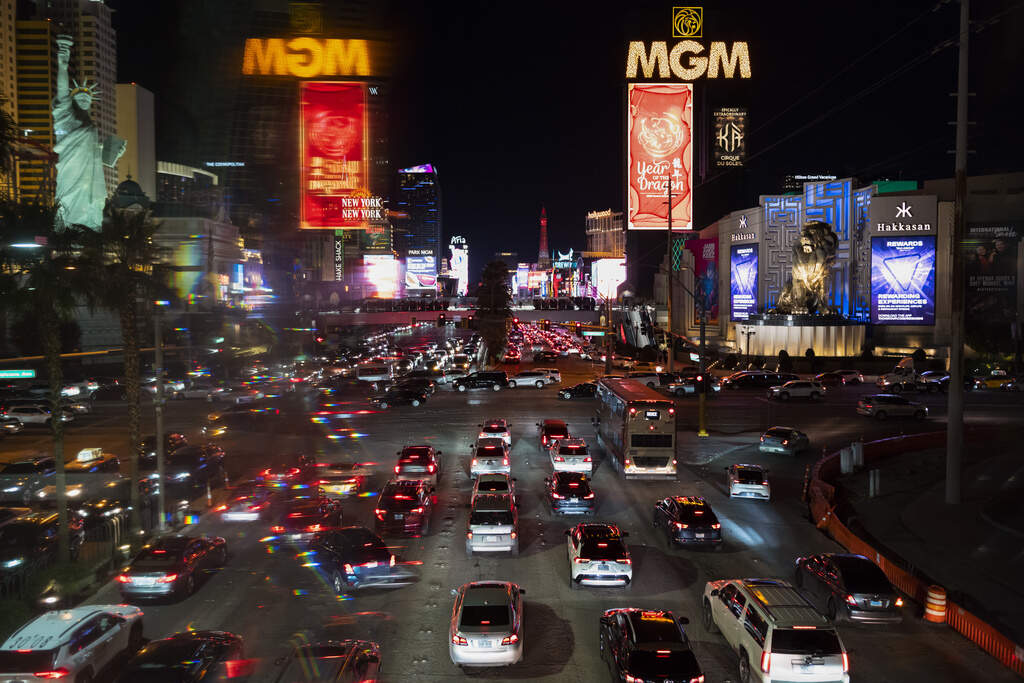
Las Vegas is in a tourism slump. Hotel occupancy and air travel are down, and many local hospitality employees are experiencing layoffs or cuts in their hours. What's driving this downturn, and can Sin City bounce back?
Guests
Jeremy Aguero, principal analyst with Applied Analysis, a Las Vegas–based research and consulting firm. He has been tracking the economy of Southern Nevada – and gambling and tourism economics in general – for more than two decades.
Tick Segerblom, chairman of the Clark County Nevada Board of Commissioners and represents part of the Las Vegas Strip at the county level.
Also Featured
Steve Hill, President and CEO of the Las Vegas Convention and Visitors Authority.
Diana Valles, President of the Culinary Workers Union Local 226.
Larry Turner, a utility porter at Four Queens Hotel and Casino.
Jonathan Jossel, CEO, Plaza Hotel and Casino.
Transcript
Part I
MEGHNA CHAKRABARTI: Sin city, the neon desert, the entertainment capital of the world. Las Vegas goes by many nicknames. Whatever you want to call it. Vegas is a city that lives and dies by tourism visitors, and the money they bring with them create hundreds of thousands of jobs in Southern Nevada and more than 30% of the area's gross domestic product.
For decades, Vegas has marketed itself as glamorous, opulent, and one of a kind. This commercial from 1986 aired throughout the country.
The stars by night, the sun by day. It's the American way to play.
CHAKRABARTI: Legalized gambling, low taxes, and room to grow. You know that phrase, what happens here stays here. But recently Vegas has had a problem. There's just less happening there.
LARRY TURNER: We used to stay busy until about three, four in the morning. Now around 1:30, it is dead. It is dead downtown.
CHAKRABARTI: Larry Turner is a utility porter at the Four Queens casino. He's worked there for 16 years and first moved to Nevada in 1983.
TURNER: I work night shift, in a graveyard shift cleaning, shampoo, and scraping and waxing and stuff like that. I like my job, I like doing my job. I like the workers and also some of the customers and stuff. As long as they coming at me, my job is secure.
CHAKRABARTI: Larry says that recently he's had to take up some double shifts at the Four Queens. Other casino workers, restaurant employees and entertainers report their hours being cut or even being laid off. It's all because of a major tourism slump. Vegas has seen drops in visitation for six straight months this year.
It's down about 12% year over year from July 2025 compared to last July. Airport traffic, hotel occupancy, and vehicle traffic from California all lower.
TURNER: A lot of people just come here. They came from California and stuff like that. Tourists from all over the world.
They don't really come like that no more, because we used to have buses come from, think of Europe, some places like that, you don't see them buses like that no more.
CHAKRABARTI: So what's going on in Las Vegas? One often repeated answer, Vegas has just become too expensive.
(MONTAGE)
These casinos are already making billions upon billions of dollars from people coming to gamble. And they're still going to upcharge food and drinks by 200%. I ordered two Mick Ultras from the casino bar, $30 for two beers.
Are you kidding me?
You want a bucket of Coors Lights? 24 Coors Lights going to run you $290.99.
Even just to park on the strip was $20 for an hour.
Let's talk about the parking that you have to pay for now when it used to be free. Let's talk about a $10 table games. Let's talk about slot machines that you could actually play and win something at. And let's not even mention the amount of money that you spend on drinks and food now. The quality is still the same.
$200, $300 for a room with Luxor is not tenable. $50 for a buffet is not workable. $300. To see a Cirque du Soleil show is not, it's not worth it.
CHAKRABARTI: Christopher, Ryan, Nathan, Nikki, and Alexander there. All on TikTok. This week, Las Vegas launched a citywide sale offering discounts on hotels, entertainment, and experiences. The city also has a new ad campaign trying to entice people to come back.
(SONG PLAYS)
CHAKRABARTI: Jonathan Jossel is CEO of the Plaza Hotel Casino downtown. And he says he's seen drops in hotel occupancy and room rates, in part because the city, he says, is still coming down from a high in 2023 and 2024, which were banner years.
JONATHAN JOSSEL: Last summer and the summer before, the best months we've ever had in our entire 53-year history at the property.
And so there is an expression that trees don't grow to the sky. And at some point, you can't keep growing indefinitely. So we have seen a decline in rates. And we have dropped our rates to compete. But there's still some decent business.
CHAKRABARTI: Jonathan also says he's been offering all-inclusive packages that eliminate things like resort fees or other extra charges.
Those have been popular. So he is optimistic that things can turn around.
JOSSEL: Las Vegas maybe's forgotten some of the messaging, which is to say it's not just an event town and people can still come here and have a great time at a great price point and enjoy a weekend without going to see a crazy concert or without having to spend a fortune.
Maybe they have, maybe we as a group have forgotten that messaging and need to get back to that messaging, but it's just not dead.
CHAKRABARTI: But here's the thing, tourism money is by definition, discretionary spending. So when Las Vegas has a tourism slump, that's saying something about how much money Americans have and how they want to spend it.
So what can Las Vegas tell us about the economy across the rest of the country? That's what we're going to talk about today, and we're going to start with Tick Segerblom. He's chairman of the Clark County Nevada Board of Commissioners and represents part of the Las Vegas Strip at the county level.
Commissioner Segerblom, welcome to On Point.
TICK SEGERBLOM: Thank you. How would you first describe the shift in tourism just in this calendar year in 2025?
SEGERBLOM: As you said, it's clearly down. We don't know how far down and whether it's a reflection of the economy or the president. But we've clearly seen --
CHAKRABARTI: Numbers go down, but you heard a little earlier Jonathan Jossel say maybe this is just a correction from the sugar high of 2023 and 2024.
What do you think about that?
SEGERBLOM: It could be. We had Formula One was the first time we had that, and we also had the Super Bowl. So those were two major events. But when looking at the numbers it's pretty clear that international tourism, particularly Canadians and Mexicans, is down. And then if you look at the traffic from Los Angeles, which is our number one source, the Latino community is clearly down.
So I think we can attribute at least a lot of it to the president.
CHAKRABARTI: Oh, interesting. Just again, to stick with 2023 and 2024, without those two huge events, Formula One and the Super Bowl. You're not sure sort of how those years might have gone?
SEGERBLOM: Yes. I mean they clearly were a high.
But honestly, we've been doing really well. The Sphere has really made things big. We've become much more of a sports town, so until, say, February or March things were looking great. So it's pretty tough not to decouple or to not attribute it to the current administration.
CHAKRABATI: Okay.
I promise you we'll get to that in just a second. Okay. But for folks who don't know the about the Sphere, there might be still some of them in America.
SEGERBLOM: (LAUGHS)
CHAKRABARTI: Just since you mentioned it, can you quickly describe it? Because it's quite a site, right?
SEGERBLOM: It's this huge sphere, but inside it's got fantastic entertainment concerts.
It was designed really for concerts. U2 was the first one and then the Eagles, but now it's having the movie, the Wizard of Oz has been transformed. So it's 10,000 person a day show. So lots of people, now, anytime you come to Las Vegas, one of the things you have to do on your must list is go to the Sphere.
CHAKRABARTI: Got it. And the outside of it is also one giant, enormous screen as well.
SEGERBLOM: Absolutely.
CHAKRABARTI: Which I saw from an airplane when I landed in Vegas back in April. It's amazing. Okay. But Commissioner Segerblom getting back to the more serious matter at hand. Again, I promise we'll talk about the national policy and how that's playing out in Las Vegas, but can you describe to me how this 12% drop year over year in tourism? What actual economic impact is it having on the city? And I guess more importantly, city residents who work in the industry in Las Vegas.
SEGERBLOM: 10% is a huge number, and that's the gravy. So that's the tips and the things that people would normally get that are not getting. It's stabilizing the workforce as far as maids and porters, dealers. So all those jobs are flexible as far as when you have a big weekend or something, there's more people hired, more people, more money coming in.
So that's down. But it ripples through the whole economy, because this town is based upon, on the strip. If the beds are full, we say, then everybody else does well. And if the beds go down, that impacts everybody.
This town is based ... on the strip. If the beds are full, we say, then everybody else does well. And if the beds go down, that impacts everybody.
Tick Segerblom
CHAKRABARTI: So it's not just the resorts or the casinos, it's the whole ecosystem around that.
SEGERBLOM: Absolutely.
CHAKRABARTI: Okay. So let's start with one of the first major reductions. I'm reading here that international tourism has dropped pretty significantly to Las Vegas.
SEGERBLOM: Absolutely. And that happened right as soon as he declared Canada being the 51st state and started the war against Canada.
CHAKRABARTI: He being the president of the United States.
SEGERBLOM: Yeah, I'm sorry. He being the president. And then of course he went after Mexico, which is our number. So Canada's our number one destination, Mexico's our number two. So that was a huge impact. And frankly, those international tourists stayed longer, spend more money.
And so that's the gravy on top of everything. So if they're down 30% that's probably going to be 5% as far as our tourism through the airport. And that really, that's when we first started feeling the hurt.
CHAKRABARTI: So just to be clear, that 30% number that you just gave, is that a 30% drop in Canadian tourists or overall?
SEGERBLOM: That's my understanding, as far as international tourism. That could be worse. But 30% from Canada is the last number I saw.
Part II
CHAKRABARTI: Let's listen to a little bit of the Las Vegas Mayor Shelley Berkley. She spoke with Las Vegas TV station KTNV earlier this month about the tourism slump, and the mayor says part of the issue is that Vegas needs to continue to provide a good value vacation for people.
SHELLEY BERKLEY: I was accustomed to leaving my car in valet, coming back, and I don't want to date myself, but giving the valet a dollar and that was a big deal, or giving them $5 and telling 'em, keep my car up front.
Those days are gone forever. But having said, that doesn't mean that we need to rip off the people that are coming to Las Vegas, the tourists are what make us.
CHAKRABARTI: So that's the mayor on KTNV. Mayor Berkley also gave a press conference last month and she too, as you heard a little earlier from Tick Segerblom, the mayor says the tourism plunge is due to a significant drop in international visitors, particularly from Canada and Mexico.
BERKLEY: We get, have a rather a large market with the Canadians. Gone from a faucet to a drip. Same thing in Mexico. We have a number of very high rollers that come in from Mexico that aren't so keen on coming in right now. And that seems to be the prevailing attitude internationally.
That is the mayor of Las Vegas, Shelley Berkley in a press conference earlier. Oh, excuse me, from last month. Joining us now is Jeremy Aguero. He is Principal Analyst with Applied Analysis, a Las Vegas based research and consulting firm. He's been tracking the economy of Southern Nevada for more than two decades, and he is a fourth generation Las Vegan.
JeremyAguero, welcome to On Point.
JEREMY AGUERO: Thank you. Has the city ever seen a similar slump like this that's happened so dramatically in such a short period of time?
AGUERO: Absolutely. Certainly, after the events of September 11th, the slowdown in southern Nevada was significant. And then during COVID-19, which is probably not comparable to anything that we've ever seen in the history of the United States, at least modern history or in Southern Nevada, but both of those had a much greater downturn than what we're seeing today.
CHAKRABARTI: Okay, so that's actually a really important context, showing that obviously in national, international major issues can immediately have an impact on Las Vegas being so tourism dependent. But similarly, once things settled down, if I can put it that way, in terms of post 9/11 or when lockdowns, et cetera, were removed in the COVID pandemic, did the city bounce back quickly?
AGUERO: Absolutely. Las Vegas has been as resilient and resourceful, I would argue, as any major metropolitan area, anywhere in the United States.
CHAKRABARTI: Okay. So then is the slump that the city is seeing now, are the dynamics similar to post 9/11 post COVID?
AGUERO: I think, look, economies grow for very similar reasons.
They decline for very different ones. If you're asking me whether this is more structural or whether it's more cyclical, the answer is it's probably more cyclical. There are certainly structural concerns that we've had, some of which you've already discussed a bit this morning. But the cyclical nature of the economy, the reality is we pumped $5.3 trillion into the United States economy, and people were spending like we pumped $5.3 trillion into the United States economy.
And while those dollars were intended to be used for keeping food on the table and lights on and people in their homes and apartments, they were also used to stimulate the economy in remarkable ways. And Las Vegas benefited disproportionately from that.
CHAKRABARTI: So you're talking about COVID relief funds, essentially?
AGUERO: I am.
CHAKRABARTI: Okay. Okay. So in that case, maybe the macro level problems, like they just need to shake out after a time, and things will get back to normal in Las Vegas.
AGUERO: I think that's generally true, but I think the operative term in your question is what is normal?
What we've seen is a tremendous increase since 2019. The gross gaming revenue between 2019 and where we are today is, up 30, 40% depending on which submarket you're looking at. You look at visitor spending or spending per visitor, was under $1,000 in 2019, it's over $1,300 today.
That change is pretty dramatic and that has to do with a number of things, not just stimulus. Obviously the economy itself here has transitioned and as much as the focus has been on the decrease in visitation, which is very important and very germane, and I'm glad we're having the conversation about it, some of the major sources of revenue.
Just earlier this morning, about 30 minutes ago, the gaming revenue. Numbers came out for August. They were up 5.5% when comparing August of 2025, against August of 2024, to just over two-point, excuse me, $1.22 billion. Overall, the economy is trying to find that equilibrium. And what we're seeing is a bit of a push-pull in some of the key metrics.
CHAKRABARTI: But do workers in Las Vegas benefit directly when gaming revenue is up. Because it makes sense to me that the companies running the casinos would of course love those numbers. But is that then being spread throughout that broader ecosystem that Commissioner Segerblom was talking about?
AGUERO: A hundred percent. They do. Look, I think we have to be very concerned about layoffs and reductions in hours.
Chairman Segerblom is absolutely right. That instability, that ripple effect associated with our tourism economy is real. And we are feeling it across southern Nevada today. But between 2019 and 2025, leisure and hospitality employment rose by about 2%. Leisure and hospitality, wages and salaries increased by almost 20% during that period, including some of the most lucrative collective bargaining agreements that we've ever seen in southern Nevada's history.
That ripple effect associated with our tourism economy is real. And we are feeling it across southern Nevada today.
Jeremy Aguero
At the same time, the tax revenue that's being generated, that supports things like roads and schools and police and fire protection have also increased, live entertainment tax alone. Which is the tax that we have that's imposed on major events that take place here in southern Nevada. That's increased from about $100 million a year to $250 million a year.
So yes, the workers have benefited, yes. The public has benefited from this uptick that we've had. The dialogue that's been existing in this community for the better part of the past, really two years, has been the sustainability of some of the trends that we've seen. We knew that this spending was high.
That the sustainability of it was going to come into question. And now you combine that with record debt across the United States, geopolitical concerns that are making less people are getting on planes and flying into the United States, including Las Vegas. And the very real concern about the value of Las Vegas and the sentiment around that.
That's a pretty formidable set of circumstances that is leading to the uncertainty and the downturn we're seeing today. Commissioners Segerblom, would you like to add to that or respond to what Jeremy is saying?
SEGERBLOM: No, he is absolutely right. We've done so well the last few years. And the fact that it's down is scary, but we just don't know.
My question or concern is going to be how long it stays down or which direction we're going at the county level, where our revenue's down about 5%, so that's livable. But if it drops another five. And the other part is when people are laid off, then that provides, requires a lot more social services.
So if we have less income and then more, have to spend more for social services, that puts us in a bind. But we're got our fingers crossed and hold our breath and hopefully this is the bottom and we can go back up. So that's a very interesting point.
CHAKRABARTI: Jeremy Aguero, let me go back to you on that. Because I have to say, I'm a little confused and forgive me. Because you asked the right question, what is normal for the city of Las Vegas? And I'm trying to, I'm trying to gauge where a good place to land is on that question.
Because as you well know, a lot of the reporting. Not just nationally, but from local outlets right there in Southern Nevada, are reporting that a lot of workers and employees, they are at risk for what Commissioner Segerblom is talking about. If they fear being laid off or they already are having hours reduced, et cetera.
So I'm just wondering how that sits next to what you said earlier about over the past couple of years, those same workers have richly benefited from it. Do you see what I'm saying? I'm just trying to gauge where we are now. If you're a worker in Las Vegas.
AGUERO: Sure. Look, and I am concerned, and I think the chairman expresses concern from the local government level.
The reality is that, and you mentioned it earlier on in this piece, in that we are dependent upon this core industry, and as those wages and salaries decrease, we're seeing it in other sectors of the economy, which has led to an increase in our unemployment rate and an increase in some of the instability that we do not want to see in a community.
Things like the potential for homelessness or eviction related activity starting to uptick. Of course we don't want that. My point earlier was that the increase, the momentum that Southern Nevada has had, has been a shared benefit. And the articles that we are seeing today are largely concerned about the sustainability of that and that downtick.
And if for every one job that exists within our tourism industry, another job is created somewhere outside of that tourism industry, which is principally dependent upon that spending and of those visitors that are coming to southern Nevada. And so as that downtick takes place, I think that's absolutely going to be reflected in the employment numbers or the total amount of hours numbers or the total wages and salary numbers.
That is a truism, that I don't think there's any way to escape that. We are going to have to find a sustainable labor equilibrium, as well. As we're going through that process, as we're finding our way to that. My point earlier was that it is made at least somewhat more difficult by the fact that the expense side of the equation within the tourism industry is also elevated.
And as a result of that, it makes it a little harder to be flexible and make adjustments. Okay, we're going to get to that.
CHAKRABARTI: Because that's a huge part, right? It's not just demand drops, it's expense rising as well. But since we are talking about employees and workers who rely on their income from the tourist industry.
Let's just give a little bit more voice to those folks. Diana Valles is president of the Culinary Workers Union, Local 226 in Las Vegas, a huge and important and influential union. And she says it's President Trump's immigration policies that are having an impact on her members.
DIANA VALLES: Our union is 50% or more Latinos, immigrants.
And not only that they are in the middle of thinking of how, if I get a layoff, how am I going to be able to provide for my family, but some of them, they have people that they worry about it because of their immigration situation and so there's a lot of stress, a lot of fear. A lot of uncertainty in all members right now.
CHAKRABARTI: And Valles has a simple way of putting it.
Here's what she sees is the cause of the tourism slump in Las Vegas.
VALLES: It is a Trump slump. That's what it is, when you have the leader of this country telling the world that they're not welcome here.
It is a Trump slump. That's what it is, when you have the leader of this country telling the world that they're not welcome here.
Diana Valles
CHAKRABARTI: That's Deanna Valles, president of the Culinary Workers Union, Local 226 in Las Vegas. Tick Segerblom, love your response to that.
SEGERBLOM: Unfortunately, I'd have to 100% agree, when you declare war against your number two, one and two tourism places. And then, as I said, all the people coming from Southern California, but honestly, what we need to really worry about is if they start having raids here or a National Guard or something like that would really send a message around the world.
But we are a city of immigrants. We have the largest percentage of immigrants of any city in the country, a major city. And so they're feeling the impact and they're feeling the policies. So it's impacted us personally, but also economically. So it really is the worst of both worlds.
Again, we can survive anything and we're gonna go forward, but 'cause we're resilient. But you couldn't ask for a worse set of national policies for our economy.
CHAKRABARTI: Jeremy Aguero, so this gets back to something you said earlier in terms of how long. What's the trajectory of this current, downward trend?
Las Vegas being resilient. Both of you have proven, but you know how long until that resilience actually has a chance to settle in. Since many of the policies that we're talking about are coming directly from the current administration, think it's arguable that those policies may stay in place for the next three and a half years at least, possibly even longer.
What impact would that have on Las Vegas?
AGUERO: Look, I think there's a great danger in politicizing or overly emphasizing federal policy relative to Las Vegas visitation. And not that it's not having an effect, I do believe that it absolutely is. But Canadian visitation to Las Vegas makes up somewhere between 3% and 3.5% of total visitation.
So if it's down 30%, we're talking about 1% reduction in total visitation coming to Southern Nevada. I think that the greater challenge that we are seeing from a policy standpoint, Meghna, is that consumer confidence has dropped dramatically. People are having real concerns about what the future looks like.
The greater challenge that we are seeing from a policy standpoint ... is that consumer confidence has dropped dramatically. People are having real concerns about what the future looks like.
Jeremy Aguero
Some of the best data that's out there takes a look at, are you better off today than you were a year ago? And many Americans still feel like they're better off today than they were a year ago. But when you ask them whether they expect to be better off six months from now, those numbers are abysmal.
As a matter of fact, the Michigan sentiment is about as low as it was during the pandemic, and certainly lower than it was during the Great Recession. And when people feel that way, when they have that level of uncertainty, combined with a level of debt that is at or near the highest level we've ever seen in United States history and this, I'm talking about household debt.
Not only things like the federal debt. But when they start to see that and they're constantly inundated with the controversy and the angst to the comments that came before, this creates anxiety among consumers at all levels. And when consumers have that level of anxiety, they make different consumption decisions.
And that's why we're not just seeing it here in Las Vegas. I think Las Vegas is certainly having a clearly clear example of discretionary spending, but we're seeing it across the United States. That level of uncertainty is really putting a chilling effect on consumer activity.
Las Vegas is certainly having a clearly clear example of discretionary spending, but we're seeing it across the United States. That level of uncertainty is really putting a chilling effect on consumer activity.
Jeremy Aguero
CHAKRABARTI: Yeah, no, this is an excellent point.
In fact, you got to what I was gonna ask you, Jeremy, which is Las Vegas kind of a canary in the coal mine? About consumer sentiment and spending patterns nationwide, but you got to that.
AGUERO: Yes, ma'am. I think that it is. Las Vegas, however, has this unique ability to constantly transform itself.
I guess that's the remarkable ability to have a hotel room that you can sell for $300 or a hotel room that you can sell for $100. And I think Las Vegas's ability to recognize these trends and rapidly adapt to them ought to minimize the length of the downturn.
CHAKRABARTI: Okay. Commissioner Segerblom, what do you think about that?
SEGERBLOM: Absolutely. As I said earlier, our job is to fill those beds and the hotels more than anyone know how to do that. So if people are begging to come here, the range will go up to $300. And if people, we need to attract people, they'll go down to $100. But end of the day, we're very flexible.
And so as the mayor talked about, the parking and all that stuff, the hotels will sense that right away. And if they need to make a change, they'll make the change. ... We're very flexible.
Part III
CHAKRABARTI: This is Steve Hill, he is president and CEO of the Las Vegas Convention and Visitors Authority, and he says that he does think politics are playing into why some of those international visitors aren't coming to Las Vegas.
STEVE HILL: I on a trade mission to Canada, four or five weeks ago in Western Canada and got an opportunity to talk with our partners there. Mostly like tour operators and travel agents and airlines and there's just a portion of the population that our national policies have angered and they are not coming into the United States out of principle.
CHAKRABARTI: So that's Steve Hill, president and CEO of the Las Vegas Convention and Visitors Authority. So I want to talk about something else that has to do with the Convention and Visitors Authority. That was that ad that we played at the very beginning of the show about fabulous Las Vegas.
And there was an immediate response on social media that kind of universally, or not universally, but largely hated that ad for several reasons. Because it doesn't name, primarily doesn't identify the high costs going on for tourists in Las Vegas. So here's a little survey of some of the social media responses.
Can you add a character that also says, Slay resort fees, $25 water and $30 cocktails. Another person on social media says, Wow, that ad is horrible. I'll do their Vegas ad for free. No resort or parking fees, cheaper eats and stays.
And one more here of a social media user who says, This trip is good for my brain? Now my brain hurts after I do the math and all the ridiculous fees. Resort fees are charging these days. Not to mention how they get away with fees on things like food. You guys don't get it. Push your politicians to really put pressure on the extreme price gouging and maybe the tourists will come back.
Jeremy Aguero. This is what you talked about in terms of expense side issues. How do you see those or what's driving the higher costs?
AGUERO: I think what's driving the higher cost is, there's always profit motivations, but there's also additional cost just in terms of operations. We've all dealt with increases in inflation and certainly the tourism industry has not been immune to that in any way, shape or form.
I think also some of it has been remarkably aggressive. We have to own that as a community, look, anytime you want to go find something negative, you can go onto social media and find all kinds of negative commentary, right? The other side of that equation is that surveys get done of people that come to Las Vegas all the time.
The satisfaction rate tends and has remained above or near 90% in terms of satisfaction with Las Vegas. Where we have seen is some of the younger generation those satisfaction levels are a little lower, which is not unusual as they age into that. And certainly, dealing with aggressive nature of the inflation that we've been dealing with in the United States.
The expense side of the equation has been a part of the dialogue for some time, probably two years. Certainly, mounting more today as we've seen some of the decreases in visitor volume themselves, but part of those increases in expenses have given rise to that increase in visitor spending overall.
Is that good for our community? Absolutely not. Is it something that we need to address? Absolutely. Is it something that we are addressing? I think that is certainly taking place, as the commissioner mentioned earlier, right?
You've got, we have 150,000 hotel rooms and some people that are pretty good at operating those, I think that they've taken note and I think some people believe that note came a bit late, but we are seeing not only this sort of citywide sale, but we are seeing almost every major property along the Las Vegas trip and in downtown hear what those consumers are saying and react positively to it.
CHAKRABARTI: Reaction is good, but I still want to understand why a cocktail can cost $30 or a cup of coffee can cost $14. Those are numbers that didn't come to us through social media. Those are like local TV stations interviewing tourists on the strip who are like, it's crazy. These resort fees are too high.
Yeah, I'm having fun. So maybe on a survey they'll say, Yes, I'm satisfied. But that doesn't mean that paying that much money is leaving them with a great feeling overall about the experience. And maybe it's having an influence on whether they're going to come back or not. So Jeremy, really help me understand here in detail what are the costs drivers for that. You mentioned inflation, that's one thing, but are there others that have led to Sure these really sky-high prices? Go ahead.
AGUERO: Yeah. Yeah. Look, and I don't want to minimize the concern over prices. Let me be clear. There are examples that are absurd relative to those prices, right?
And you just pointed out a few of them, that's not okay. But what are those cost drivers? Increased interest rates, development costs, the cost to remodel and keep the upkeep on $50 billion worth of assets along Las Vegas strip. Substantially higher increases in the cost of labor, which is the single largest cost.
When we talk about that inflation, where is it that we've seen that inflation run up? Things like utilities, things like food, right? The single largest revenue generated outside of gaming and some of those other things. Our food and beverage type activities, all of which have seen that high inflation.
Now, I am not here to apologize for the industry. I'm not here to justify the expensive water or the expensive nachos or any of those things that have permeated what's out there. I'm also not here to essentially tell operators how to operate. I believe in free markets and the way that they work, and I think we've all traveled to places like New York and Chicago and other major cities around the world where there are parking fees and there are resort fees, and there are all of these things that exist.
I think we had a problem with transparency. I think we had a problem with value, and I think we had a bit of a problem with history as it relates to all of this, because Las Vegas, everyone wants to focus on Las Vegas being based on return on investment. That's what our conversation has pivoted over today.
That's not what Las Vegas cares about. What Las Vegas cares about is return on experience. It wants those folks that come here, whether they're coming for a concert or they're coming just to hang out for a weekend, or they're coming for whatever reason. To have the best time possible while they were here.
And if what they're leaving with is they did not get that value, that return on that experience, they didn't get what they bargained for, then we need to make a change. And I think what you're seeing is a lot of awareness relative to that and that change rapidly underway.
CHAKRABARTI: I hear you, but you're not saying there's no relationship between return on experience and return on investment, though.
AGUERO: I am absolutely not saying that. I understand that they are interlinked, but if we focus 100% on return on investment and do not win the battle on return on experience, if people don't go home and say, I want to go back, or I'm going to tell my friends about that, then some of the magic of Las Vegas is going to be lost.
And getting that back, it's a lot easier to turn it down than it is to turn it back up.
CHAKRABARTI: So Commissioner Segerblom, Jeremy Aguero very accurately points out a lot of the cost drivers. And also, I want to acknowledge these are the things that are happening in other cities across the country for sure.
But I'm wondering if either of you are also willing to say or acknowledge, or maybe you're just, maybe I'm just wrong about this, but we've done analyses on previous shows about how yes, after the COVID stimulus that did put a lot of money into the economy. We got inflation, but we also, there's economic evidence that at the same time, corporations were like we can raise prices, so let's just raise them more to the maximum tolerance that consumers have.
And that was above and beyond their own expense increases as businesses. Has that happened in Las Vegas and is part of what the consumer sentiment about high prices, is it coming because folks are just reacting to, they're calling it price gouging.
What do you think about that, commissioner?
SEGERBLOM: That's certainly one of the talking points around. But honestly, as we've both said, we're very flexible. We may have overreached, but when the economy's doing well, you'd never want to bump too much. So you may have bumped too much at one time thinking it's going to catch up.
And then that last bump was too far and we're not catching up. Because we're going down. So the key is going to be whether we do adapt and get rid of the parking fees. Get rid of the resort fees. Get rid of the $20 coffee or the $30 bottle of water. That's easy to fix.
Get rid of the resort fees. Get rid of the $20 coffee or the $30 bottle of water. That's easy to fix.
Tick Segerblom
The end of the day, there's also some issues. We have the lowest gaming tax in the world. These companies that are here run around the country and around the world begging to pay more to get a franchise. We also have a lot of investors that have come in and bought properties that have to get their return.
So a lot of the money that's made here is going to other places. And that can be brought back too. So I'm confident that we'll get there. It is just a question of when we'll get there. And more importantly, right now, are we going down, are we stabilized?
And that's what we're going to see in the next few months because in the wintertime we're basically a convention center city, and so if those numbers are down, then that portends a more serious problem. But anyway, the main thing is we're resilient. We're still a great place to come.
If you know how to spend your money, we're a great bargain and we're the entertainment capital of the world.
CHAKRABARTI: Tick Segerblom is chairman of the Clark County Nevada Board of Commissioners. Commissioner Segerblom, thank you so much for joining us today.
SEGERBLOM: Thank you.
CHAKRABARTI: Resorts and casinos have been responding to these concerns about high prices.
MGM Resorts CEO Bill Hornbuckle spoke with CNBC earlier this month, and he says they're responding.
BILL HORNBUCKLE: Today. If you check in the Excalibur, New York for $85, including your resort fee, you can play a $5 table. You can have a $5 beer. You can go to a restaurant and dine a three-course meal for under $33 a person.
There is value there and there's always been value. We let the narrative get away from us and shame on us. We need to do a better job, but we've not lost track of who and what we are and where we're going.
CHAKRABARTI: So that's MGM Resorts CEO Bill Hornbuckle. Jeremy Aguero. In the last few minutes that we have in our conversation here, I want to turn to something else about Las Vegas.
And that's the fact that it's deeply embedded in the American imagination, right? After all, I can't think of any other cities that are instantly recognized by just half its name, right? We don't call San Francisco just Francisco, I'm sorry. Pause there. Because I just can't even imagine calling San Francisco that or Corpus Christi just Christi. But everyone knows Vegas, baby.
And now ladies and gentlemen, the Sands Hotel probably presents the star of our show. Direct from the bar, Dean Martin.
CHAKRABARTI: Right from the Sands to the Sahara, the 1950s Rat Pack. Dean Martin, Frank Sinatra, Sammy Davis, Jr. They all made Vegas cool.
Nightclubs were where people wore suits, and yes, there was also, of course, the mob. Later on, there were All You Can Eat buffets for a $1.99, free parking on the strip and free drinks at blackjack tables.
TRU HAWKINS: I love Vegas when I'm winning. I love it when I lose. I love Vegas like the Army loves its manuals. I love Vegas like Sinatra loves Jack Daniels.
CHAKRABARTI: That's from a 1963 recording live at The Sands Hotel. Of course, everything, seemingly, has changed since the Rat Pack era. We've mentioned the mafia's influence on the city, but nostalgia for that time really runs deep.
And here's Tru Hawkins. He's a DJ and his father used to work at the mob-run Riviera Casino in a National Geographic documentary called Vegas Mafia, Hawkins describes how his dad helped the mafia with the skim.
HAWKINS: One of his jobs became to put $100 bills in a lockbox drawer and set it on the back counter, and it disappeared, and an empty one showed up.
That was every day, five days a week while he was at work. And it was just understood that box didn't exist, never happened. Nobody talked about it. In my father's eyes, he was just doing his job. What I gotta do. That's what they told me. And here's your paycheck. You did it. You knew what was going on.
However, the approach of all of those mob connected guys, they were perfect gentlemen to everybody at work.
CHAKRABARTI: Hawkins also told National Geographic, by the way, that yes, the mob was a criminal enterprise, but the casino business was so profitable that they kept violent crime out of Las Vegas to protect very illegal skimming and money laundering operation.
So there's still this strong sense of nostalgia because I'm getting the sense that some folks even say the mob days were better than the cold corporate hand that runs Las Vegas now. So Jeremy, we just have two minutes left and your family moved to Nevada in 1905.
You've got a long family history there. Many different versions of Las Vegas. What do you make of this era in comparison to the past and some folks saying that maybe a little bit of that old magic of Las Vegas is gone?
AGUERO: Yeah, look, on my father's side, my grandfather immigrated from Cuba in the late 1950s and moved here in the early 1960s, 91. And he would tell you the exact same thing, right? That he misses the good old days and what it was like to work and be in Las Vegas. I think every generation likes to look back and think about how things were better before. But when you look at Las Vegas today and you think about the remarkable things that you can do here and see here, you started at least part of this conversation talking about the one of one Sphere.
A piece of technology where the sound is so remarkable and the visuals are so remarkable, I don't think there's anything like anybody's ever seen it anywhere on planet Earth, it's unbelievable. At the same time, a week or so ago, Las Vegas hosts the Canelo-Crawford fight. 70,000 people, probably the highest revenue generating fight anywhere in the United States history.
Probably, maybe history anywhere, and some 50 to 60 million people tuned in to watch it. The magic of Las Vegas is its ability to capture culture and deliver on that experience, that escape that people yearn for. And whether that is going to see Dean Martin and Frank Sinatra, 40 years ago, or whether that's coming to see Bruno Mars and Crawford win a remarkable fight today.
What Las Vegas tries to deliver on is that return on experience. It's what's made it right since day one.
The first draft of this transcript was created by Descript, an AI transcription tool. An On Point producer then thoroughly reviewed, corrected, and reformatted the transcript before publication. The use of this AI tool creates the capacity to provide these transcripts.
This program aired on September 26, 2025.