Support WBUR
Is there really a rise in left-wing political violence in America?
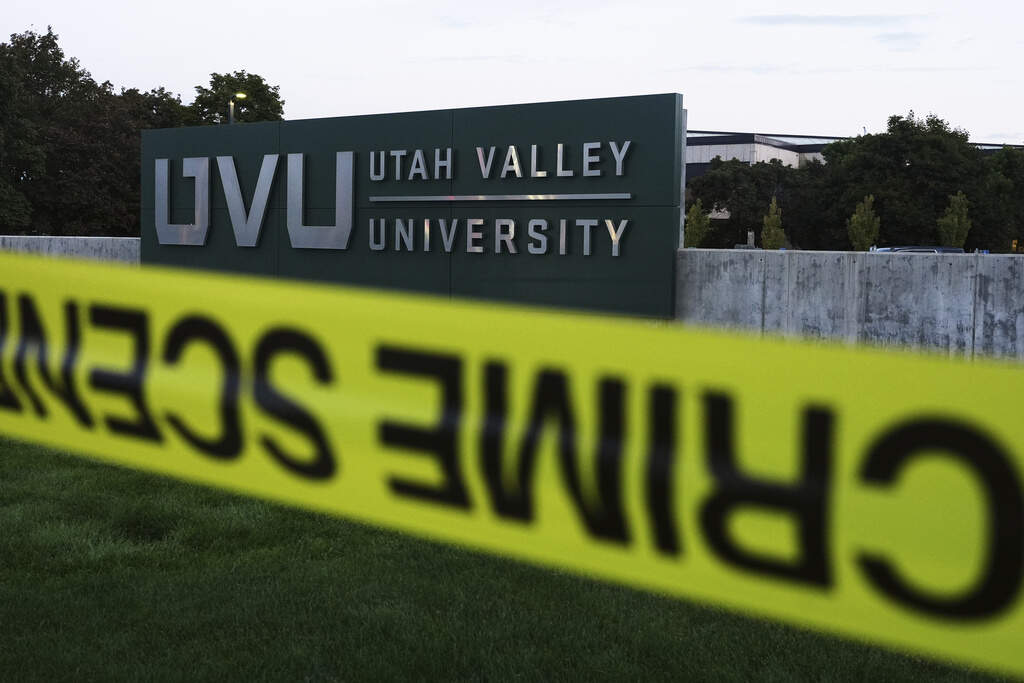
Charlie Kirk's assassination. The United Healthcare CEO's murder. Several recent high-profile killings seem to have political motivations. What’s driving this — and what can we do about it?
Guests
Daniel Byman, professor at Georgetown University. Senior fellow at the Center for Strategic and International Studies.
Robert Pape, professor of political science at the University of Chicago.
Transcript
Part I
MEGHNA CHAKRABARTI: On December 4th, 2024, Brian Thompson, CEO of the American Health Insurance Company United Healthcare was shot and killed in Midtown Manhattan. On June 14th of this year, the speaker of the Minnesota House, Melissa Hortman, her husband, Mark and their golden retriever were fatally shot in their home.
On September 10th, conservative activist Charlie Kirk was shot and killed while hosting an event on a Utah college campus. On September 24th, a gunman shot at people at an immigration and customs enforcement facility in Dallas, Texas. One detainee was killed and two others were critically wounded. So political violence is on the rise in the United States and has been for some time, but now for the first time in more than 30 years, left wing terrorist attacks outnumbered those from the right wing.
That's at least according to a new report from the center for Strategic and International Studies. And joining us now is a co-author of that report, Daniel Byman. He's a professor at Georgetown University and a senior fellow at the Center for Strategic and International Studies. Professor Byman, welcome to On Point.
DANIEL BYMAN: Thank you for having me.
CHAKRABARTI: First of all, on what basis what are, what is the evidence that you compiled to come to this conclusion that left wing terrorist attacks are, at least right now, outnumbering those from the right wing?
BYMAN: So we've compiled a database that tracks terrorism trends in the United States for years.
It goes back to 1994. And what we've seen in our data in 2025 is really a dramatic change. Where in most of the last 10 years, right-wing attacks have dramatically outnumbered those on the political left. And while the left-wing attacks are not nearly as high as right wing attacks were in the past.
They are increasing and right-wing attacks have fallen significantly to the point where so far, at least in 2025, there were fewer right-wing attacks than there are left wing attacks.
CHAKRABARTI: Okay. Let me just clarify one thing that I mentioned in the introduction, Professor Byman, because that list, as I put it together, might seem as if I was lumping them all as left-wing attacks, but of course the assassination of house speaker Melissa Hortman from Minnesota. She's the speaker of the Minnesota House there. Was potentially carried out, but was carried out by someone who had potentially right wing associations. In fact, he had a list of some 70 Democratic representatives from Minnesota that were on an alleged target list there.
So I didn't want anyone to think that I was lumping those all together. But Professor Byman, actually, out of the sake of clarity, let's get some definitions out in the open. When we say, when you say terrorist attack, that's different than more broadly political violence.
So how are you defining what qualifies as a left-wing terrorism act of terrorism?
BYMAN: So let's start with the word terrorism. We define terrorism as political violence, so not simply violence. It has to have a political purpose. It's done by a sub-state groups or individuals. So we're not looking at government violence against its own people, for example.
And also and very importantly, the violence is meant to have a broader psychological effect. So by killing an individual or doing an attack, it's meant to send a broader message. Now, to be clear, in practice, all that can get pretty messy. Sometimes it's hard to tell where politics begins and kind of individual delusion comes into play.
Sometimes the psychological effect is unclear, but in most cases you can tease that out. And left wing and right wing are also a bit blurry. So in a lot of cases, we simply follow what is the mainstream in U.S. politics. So for example, if you have an anti-trans agenda, we would consider that to be right wing.
If you have a pro trans agenda, we would consider that to be left wing. And there are similar divisions on things like abortion and immigration issues. But then there are some issues. For example, attacks in the name of male supremacy that could be coded one way, could be coded another way, and are pretty messy.
And most political violence, I think you can characterize in a relatively straightforward way, but there's a lot of, I'll say, confusion on some cases and in some individual cases, people seem to draw from multiple ideologies.
CHAKRABARTI: Okay. So in that case, with those definitions, and as you said, some caveats in mind, and again, we're focusing on 2025. Are you still, do you still think that we're seeing a swing or a shift in terms of the center of gravity of where the acts of political violence are coming from?
BYMAN: So I would stress that terrorism has a lot of randomness in it. And it depends in part on the law enforcement response. So to make a judgment on terrorism trends based on, really less than a year, which is what we're doing in this report. You have to take it with a lot of grains of salt.
And we urge our readers to do. But it is pretty striking if you look over the years, where if you go back to the years before 9/11, there was fewer than one left-wing attack a year on average. So really tiny numbers. And that starts to increase in recent years, till it's up to about four.
If you go back to the years before 9/11, there was fewer than one left-wing attack a year on average. ... That starts to increase in recent years, 'till it's up to about four.
Daniel Byman
And by attack, I should say, some are successful, some are not. But both of those. And in those recent years, it's still a pretty tiny number compared to a lot of types of violence, but it's an increase. And then in 2025, we've seen even more attacks than that. So it's a steady increase. But I would highlight the drops so far in 2025 in right wing ballots.
So that's also very dramatic. And that had gone from at times as much as 30 a year in recent years to a lot, depends on particular quoting, but really only a handful in 2025.
CHAKRABARTI: Okay. So this is very helpful. Because again, one of your chief findings in this report about 2025 is that again, in this year, thus far, as you said, it marks the first time in more than 30 years that left-wing attacks are outnumbering those from the far.
But you also, as you've said, it's not nearly as common as it was in the '60s or '70s, but let's dig into the difference between absolute numbers and percentages, right? Because if we're rising from a really small number, just generically speaking, if something goes from one to two, that's like a 50% increase, right?
We could, the headline can be that. Or actually one to two is a 100% increase. The headline could be that, or it could just be like, it goes from one to two, still relatively small. Is that not part of the difficulty in parsing the significance of this trend, Professor Byman?
BYMAN: Absolutely.
And that's why even though we are highlighting the change in 2025, we're more confident just noting that it's been a steady, steadily rising number in recent years. So we saw an increase really starting around 2016 when President Trump began to dominate a lot of the American political discourse.
And this is a continuation of that trend. But when you get to small numbers, especially with data to have, I think, a high degree of randomness, as terrorism numbers do, you really have to be careful about drawing huge conclusions. But at the same time, it's, I think, important to note possible trends as they're developing, because counterterrorism depends a lot on prompt responses, and you want that prompt response.
CHAKRABARTI: Okay, so let's just confront something that I'm sure a lot of listeners are shouting at their radio or into their headphones right now. Which is given this small number, even if it's on the rise, there's a massive asymmetry here between acts of left-wing terrorism or violence and the greater numbers of acts from the right wing over the past many years.
So that this is essentially, are we drawing a false equivalence here? Is this whole analysis moot?
BYMAN: So if this were simply a change in the numbers as a blip from a few months to another month, yes, that would be not the appropriate conclusion. And I would not say the 2025 left wing terrorism threat is comparable to right-wing terrorism at its peak.
I would not say the 2025 left-wing terrorism threat is comparable to right-wing terrorism at its peak.
Daniel Byman
It's far lower. So certainly, there is no equivalence to right wing terrorism at its peak. At the same time though, I think it's important to acknowledge the growth in left wing terrorism, just as it was very important to recognize the very dangerous right-wing terrorism that characterized American political violence for many years.
And the Biden administration, to its credit, in my view, did a very aggressive campaign against many sources of far-right violence. And that was very appropriate. And so you want counter-terrorism resourcing to be based on threat. And so you need to look at how threat changes. One more thing I would highlight is a lot of the right wing violence was targeted at masses of individuals.
So for example, the 2018 attack on the Pittsburgh synagogue that I believe killed 11 people. The attack on a supermarket in upstate New York, targeted at the Black community. So we saw mass killings of individuals. That is different than what we're seeing on the left. And there's, I would say, both a better and a worse category.
Better is it's more targeted. It's at individuals. It's not someone going into, say, an NRA rally and just shooting lots of people. And otherwise trying to create a large body count. But the flip side is there seem to be some attacks, at least, that are what we call partisan extremism.
And the attempted assassination of President Trump last year at a Florida golf course. The attack on Charlie Kirk. These are very high profile and that has greater political consequences. Now, you mentioned the killing of Congresswoman Hortman. That's an example of partisan extremism on the right, right?
That kind of horrible killing, that not only is the tragic death of two individuals. But is also political leadership being targeted, which can have broader implications for America beyond the individual death toll.
CHAKRABARTI: Okay. Point taken then, Professor Byman. So I guess the underlying message that you're trying to deliver here is it's best to, when you see anything political violence on the rise.
Even when it's small, it's best to do something about it then, right? That's essentially what you're saying.
BYMAN: I would say it's best to at least acknowledge it and prepare for it. Counterterrorism programs don't turn on overnight. You need to develop expertise. You need to resource it.
You need to identify where to focus. And you want that sort of attention to be brewing, if you will, as trends develop, so people can adjust. You also, and to me, very importantly, a lot of this is a leadership story. You want leaders on both sides of the spectrum to be engaged.
Part II
CHAKRABARTI: Let me bring Robert Pape into the conversation now. He's a professor of political science at the University of Chicago, and for decades has been following and analyzing acts of terrorism and political violence. Professor Pape, welcome back to the show.
ROBERT PAPE: Thanks for having me, Meghna. Hi Dan. Good to talk to you.
BYMAN: Nice to talk to you.
CHAKRABARTI: So Professor Pape, let me just get straight to something that you told our producer, Claire as she was putting together this show. You have said that we are in an era of violent populism. What do you mean by that?
PAPE: The era of violent populism, as you played in the very front end of your show, that was me, is characterized by two things. High levels, historically high levels of political violence on both the right and the left. And historically high levels of support for political violence on both the right and the left.
And Dan's study basically proves it. I'm glad to get into the details here, but we haven't talked about that in the first segment, but Dan's got data that's directly relevant to this and supports the both sides of this.
CHAKRABARTI: Okay. So identify, actually before we get to that data from Daniel Byman, how are you defining what violent populism is?
PAPE: Violent populism again is the combination of high incidents of political violence and high mass support for political violence. Okay, so this is what is historically new about the era that we are in. So in the last few years, as we all know, and Dan's data is going to show this, there are higher levels of right-wing political violence than we saw say in the '90s and in the aughts.
Violent populism again is the combination of high incidents of political violence and high mass support for political violence.
Robert Pape
There are also higher levels of left-wing political violence than we saw in the '90s and the aughts. Both of these are in Dan's data of incidents. What's not here and not covered is not just other incidents like violent protests, which would further prove this, but the survey data that we do at our Chicago project on security and threats that the University of Chicago.
Which we've been doing for four years on a quarterly basis, which showed in May high levels of support for political violence across the political spectrum. 39% of Democrats agree the use of force is justified to remove Donald Trump from the presidency. With 25% of Republicans agree the use of the U.S. military, the most lethal force on the planet is justified to suppress Democratic protestors.
That adds up to tens of millions of people on each side of the political spectrum, very aggressive and supporting political violence, which is why I think you're getting this high levels of political violence on both the right and the left.
CHAKRABARTI: Both of you will have to forgive me if through this hour I keep asking you for how you defining terms because this whole area is so slippery and given the massive amounts of polarization.
PAPE: Meghna, I definitely know that is an easy thing to say and that's true to some extent here. And we do this in graduate seminars and so forth. That's not really the fundamental thing going on in Dan's data or in the Cato study or in my study, we all mean, first of all, there is no standardized definition by the FBI, so Congress has not passed a law that allows the FBI to have a specific definition of political violence.
That said, we are all operating with generally the same idea of what counts as political violence. It's not perfectly the same, but it's pretty close, which is where the perpetrator is using political violence to advance a political or social agenda. Now there's differences in the thresholds.
Does somebody have to die to count as an event? In the Cato study, Yes. In Dan's study, no. But the bottom line here is that there, this is really, all these studies, once you get under the hood, actually paint pretty close to the same picture. This is not where experts are really disagreeing. The headlines are disagreeing.
Once you get under the hood, which I'm glad to do, and I realize your listeners are not, they don't have the time to be it. The University of Chicago and do this. But, look, Dan and I, we're fifth degree black belts here. I've known Dan for 30 years. I've supported him professionally many times in ways he probably doesn't even know.
I have great respect for Dan as I do for the Cato folks. This is not about people being bad scholars or good scholars or having arcane definitions. There's a little bit of that. The bottom line is you gotta get under the hood. Just as you go to a doctor to find out what's really wrong, you gotta sit there and look at the scans.
That's what we gotta do here. And when you do, you'll see all these studies paint essentially the same picture. And they're, of course, they're trying to get different headlines to get on shows like this, but the bottom line is they are both showing the rise on the right and the left, starting, as Dan said, about 2016, 17, 18.
You can date it a little differently, but the bottom line is in Dan's own data. Which he's kind enough to send me last night so I could review this in some detail. Year by year, there's a break point in his study. It's 2016, as he just said, on your program. And what happens in 2016 is both the right-wing attacks jump.
They double and triple starting on that date and the left-wing attacks go up now.
CHAKRABARTI: Professor, can I just jump in here for a second because I feel compelled to clarify something. Because I appreciate the passion in your response, but I also got a little hint that you were questioning why I was asking for definitions.
I am trying to not to be that annoying grad student in a grad student seminar, who [goes], 'Professor, but what about?' No. In fact, I define, to use that term, my own role here as being the fulcrum between the fifth-degree black belts with the expertise in political violence and as you point out, the general public.
Okay. So many of my questions are being framed as what is it that the general public isn't understanding so that when we do get under the hood, we have a common basis of knowledge to do that analysis. Okay? So that's why.
PAPE: The general understanding of what political violence is, Meghna, is that the actor is trying to advance a political or social agenda. They don't have a personal beef with the target. The target is a symbol of their political or social agenda. And therefore, when they attack the target, they're also sending a signal to a wider audience. To try to get them behind their political or social agenda. That's what makes it political as opposed to a workplace grievance where somebody got fired and they're mad at their manager for firing them.
The general understanding of what political violence ... is that the actor is trying to advance a political or social agenda.
Robert Pape
So that's what Dan and all these studies and ones I do, that's what we're separating out. We're separating out a school shooter who's really mad because they were bullied and insulted by a certain group of kids, and that's why they're going to shoot up the school. A workplace incident where they're mad because they had a workplace incident.
They're really mad at specific coworkers or a manager, from political violence, where there's really very little personal background between the perpetrator and the target. But what there is a political connection where the perpetrator is trying to send this political message. It's sometimes called in our business, the propaganda of the deed.
There's a whole book with that.
CHAKRABARTI: So I don't, I do not take disagree with that at all. No disagreement whatsoever. Again, I'm just trying to perform a service here for listeners because what I want to get to is the popular support part, which we will in a second. But Professor Byman, since Robert Pape has referenced your study many times. I'm just wondering what aspects of it you would say dovetail with Professor Pape's description of violent populism?
BYMAN: So this is a really interesting question and thanks also to Bob for his kind words on our work. So we are not measuring public opinion in study, so this is not something that we have anything original to add.
But terrorism trends often reflect public attitudes. I would highlight in two ways. One is right now most of the terrorism we're seeing are individuals acting in an inspired way. It's not a well-organized group like Al-Qaeda sending in operatives to do an attack. It's individuals picking up a gun or setting off a bomb, often on their own or in small groups.
And individuals are more likely to act when they feel frankly, they're the kind of heroes of their own stories. When they believe that there's a community behind them, they're the ones acting. And so popular attitudes matter in that sense. And they also matter in the current terrorism response. Because they shape how much communities are willing to work with government and law enforcement to identify problems within the community's ranks.
And we saw this very effectively with the American Muslim community after 9/11, where you had tremendous cooperation with law enforcement and that led to a number of people who were possibly dangerous being identified in advance. And that's a sort of response you want, and that's harder when you have a broader atmosphere where the other side, politically, is not just wrong, but somehow fundamentally evil.
CHAKRABARTI: Okay. So Professor Pape, let's now get to this public support or rise in public support. You've actually been on this show several times before talking about this, but for those unfortunate few who missed that, can you go over some of the polling data or evidence that you found that shows this rising support?
PAPE: Absolutely glad to. So starting in the summer of 2021 our center at the University of Chicago Project on Security and Threats started to conduct quarterly surveys of support for political violence among the body politic, that is all adults in the United States. And we've done this about every three or four months.
We've done about 15 of them. In about a week, we're about to have more data, by the way, and our newest one is about to come out. We don't have the data right now, but we will in about a week. And so what we found in these studies are done at the gold standard, just so people know. Because they're so used to hearing studies that their eyes could easily glaze, their ears could just not understand.
In this case, these cost about $100,000 each. These are not $5,000, inexpensive studies. And they're built, we use a panel of 50,000 American adults that's been built by NORC on their AmeriSpeak panel. And this 50,000 match, the 270 million American adults in the United States on dozens and dozens of factors.
Then we draw randomly 2,000 to 4,000 from that 50,000. So we really can extrapolate our findings with margins of error under 3% to the population as a whole. And we're also not trying to call a horse race where the outcome of an election could be 1%. So we're not in the business of trying to get under a 1% margin of error.
3% is really very good and highly reliable. Now what did we find in May? So we've been asking questions for, again, a long period of time, number of years, and we asked questions in May, which I just mentioned before in the earlier segment, were high levels of support for political violence.
On the right, on the left, I mentioned just one of the questions on each side. We actually have many questions on each side, so we're not just drawing from one specific question to draw this. And what we found is that the support in terms of quantity essentially was doubling from just a year before.
That's really stunning. Now, that's why then I published this big warning essentially, as an op-ed in the New York Times in June. Called, we are on the brink of an era of major political violence. And it goes through, and it explains all the reasons. And unfortunately, it's come to be the case with the Kirk assassination.
And then all the aftermath of the Kirk assassination. So the era of violent populism isn't just about, 'Will there be one more attack?' It's, 'What will be the consequences?' Will you have the effort by the wounded community on the right to end civil free speech for Jimmy Kimmel and others on the left.
The era of violent populism isn't just about, 'Will there be one more attack?' It's, 'What will be the consequences?'
Robert Pape
This is the true danger to democracy. It's not just about predicting a data point.
CHAKRABARTI: I think this is a really important point, right? What will happen in the aftermath? What will the ... people demand of their leaders in an era of rising political violence.
Absolutely. And I want to touch on that, but since you mentioned the New York Times, Professor Pape, I'm sure you probably saw that a little earlier this month. Nate Cohn of the Times, he wrote up a big piece that kind of asked the question of whether this support that you've been tracking is as high as it is because in his Times piece, he pointed to other surveys that used very specific language in their questions.
For example, one, this is, I'm quoting Nate Cohn here, that Bright Line Watch found that when they asked if it's ever justified to commit violent felonies to advanced political goals, only 4% of respondents said yes. Another group asked Trump and Biden supporters if they thought that, quote, physically attacking the other side was justified if they thought the election was stolen.
And that poll found only 3% to 4% support for that. So Nate Cohn says as poll questions get more specific, and the broad range of imagined violent acts actually becomes narrower as defined in the question. He says support for violence falls close to zero.
PAPE: So what we do to get at this issue, and the way you get at this issue is you start with the finding, like I just gave you.
39% of Democrats agree that the use of force is justified to remove Donald Trump from the presidency. Now, we've been doing these for four years, so what we have done is we have stress tested the phrase, the use of force, and what we've done is we've conducted separate, more expert surveys where we ask people that question, do you support the use of force for X, Y, Z grievance?
Then we follow up and we ask them in text boxes, what do you mean by the use of force as you just answered the question. Now we don't do this every time because that adds a whole nother level of cost. And the other reason we don't do it every time is because the findings are almost always the same.
So we get redundant findings. But the bottom line is other people besides Nate, high level political leaders, which I won't name on the air, have asked the same question over time. And what we've done is conducted those expert surveys for them. And what we found is that when we use the term use of force justified to remove Trump, 55% of the people who answer that or agree with that mean assassinating Trump, killing Trump.
The Kirk shooting, this is what they say, so we have done it, so I understand. So for years, people have wanted to debate me on this issue. And it's absolutely fine. We live in a world, as Dan knows, of universities where we debate every single little thing we can think of to debate.
But what we do is we've gone further, and we've done it in the context where really important people are asking that question here so we can then justify the extra cost here. But it really is the case that these are not, you're not going to get these answers with a $5,000 poll. You just need, if you really want to get the answers, we can get those answers.
But you've got to do the work the right way and not just different polls disagree. Disagree. It's again, you gotta get under the hood and once, Meghna, you get under the hood. Oh, you start to see that there's a lot more similarity here than you would think by it's really the case that sometimes studies disagree.
A lot of times you get under the hood, 80% of it is in agreement.
Part III
CHAKRABARTI: Professor Byman, you'd actually begun to talk about this at the beginning of the show, so I want to return to it for a moment about, again, this shift since 2016, right in the rise of the absolute numbers of acts of left-wing political violence. So that obviously indicates that the rise of Donald Trump onto the political scene is correlated with that and even more strongly.
Now in 2025, I'm wondering if a good example to look at, and correct me if I'm wrong, is I was thinking of when politics becomes so polarized that it's enough for a small group of people whose desires are total change, right? Not their desires aren't compromise, but their desires are total change enough to push that small group of people into acts of violence.
And I was thinking about, in the '80s and the '90s for even after that, for a couple of decades, anti-abortion activists, some of them went out and shot up abortion clinics. They bombed abortion clinics. Because at that time, a safe abortion was legal in the United States, and their desire was to ban all of them.
So some of them went so far as to these terrible acts of violence. Is that analogous? Professor Byman?
BYMAN: So the broader question as I think about it is, can the political system deliver change and do so in an effective, timely way? And for those who were very anti-abortion after 1973 the vast majority of the movement of course worked peacefully to try to overturn Roe v. Wade. And they succeeded in the end, of course. But for many years you had a small fringe that said, look, this is not working. From their perspective, mass murder was being committed in the United States every day. And what many people who turn to violence believe is that the system itself is corrupt.
It's incapable of reform. And we are now seeing that viewpoint more on the left. And I want to stress, again, these are small numbers, but we are seeing that viewpoint express more frequently.
CHAKRABARTI: So Professor Pape, with that in mind then, another set of data that keeps being affirmed over and over again is just the falling amount of trust that Americans across the spectrum have in exactly what Professor Byman is talking about, the ability of our democracy to deliver timely and effective change.
Is that, could that continue to feed into the other trends you were talking about?
PAPE: Absolutely. So several years ago, we started what we called at my center, the Dangers to Democracy Tracker. And for over a year, every quarter The Guardian published the results of this. So if your listeners will go to The Guardian and look at stories quoting our surveys in 2023 and '24, they'll see that we had routinely were asked, we have asked questions, and we still do it in our current survey.
Do you believe that elections will solve America's most fundamental problems? Do you believe a small group of elites controls all the levers of power in America? Do you believe our political leaders are the most immoral and corrupt people in America? And what you will see is 40 to 50% of the American public, across, and this is cutting across both sides of the political spectrum.
Agree with this. So that what you're talking about, it's not just what Gallup found 20 years ago about the declining trust in institutions, which they've tracked for two decades. What we're doing in our surveys is more pointed versions of that to get at these more hard edge outcomes, which we're now experiencing.
And so that I agree fully with your point, we have the data showing that, and it's really disturbing that this has been, this is like a powerful part of the public for years. It's not just simply the result of the Kirk assassination, for example.
CHAKRABARTI: Okay. So now let's get to another one of those under the hood aspects that deserves a lot of conversation.
Professor Pape, as you talked about it, and that's this leadership question, right? Because in times of not just polarization, but these trends towards supporting more extreme acts in order to, I don't know, get what you want, we ostensibly look to our leadership to provide the calming effect, let alone a unifying effect.
But here's some of the language that we've been hearing specifically after Charlie Kirk's assassination from, the most powerful man in the United States. Here's President Donald Trump. He spoke at Charlie Kirk's memorial service earlier this month, and in part of his speech, he said clearly, he hopes Kirk's assassin is punished harshly.
DONALD TRUMP: God willing, he will receive the full and ultimate punishment for his horrific crime. It's a terrible thing, because you can't let that happen. You can't let that happen. Can't let it happen to a country. The Department of Justice is also investigating networks of radical left maniacs who fund, organize, fuel and perpetrate political violence.
And we think we know who many of them are.
CHAKRABARTI: And here's a little bit more of what Trump said, and he was specifically, first referencing what Trump believed Charlie Kirk believed in.
TRUMP: He did not hate his opponents. He wanted the best for them. That's where I disagreed with Charlie. I hate my opponent, and I don't want the best for them.
I'm sorry. I am sorry Erika, but now Erika can talk to me and the whole group and maybe they can convince me that's not right, but I can't stand my opponent.
CHAKRABARTI: Daniel Byman, how do you respond to that?
BYMAN: Of course, we want leaders to bring Americans together in times of crises, not drive us further apart.
Let me highlight what I think is a valuable counter example which is after 9/11, President Bush went to a mosque. And he was trying to say to the American people, not just American Muslims, that we are all one. And this was a man who, his own Christian faith was very open and he was trying to say, look what we saw on 9/11.
That was not the American Muslim community. That was a very small group of extremists. And obviously Islamophobia increased after 9/11. There were a lot of bad things, but you had leaders trying to move in the right direction. When a KKK figure ran for political office in Louisiana, at different times, President Reagan and President George Herbert Walker Bush condemned this. And urged people to vote against him even though he was running as a Republican. So leaders can play a tremendous role in making sure that fringe figures stay on the fringe. But the polarization that Bob has talked about, that can be increased by political leaders and is being increased by political leaders.
Leaders can play a tremendous role in making sure that fringe figures stay on the fringe.
Daniel Byman
And there are certainly plenty of counter examples even today in the United States, but this is a fundamental task of leaders and we're often failing.
CHAKRABARTI: One of the counter examples that people have pointed out is Utah's governor, Spencer Cox, who actually put forth a lot of very thoughtful and unifying statements after Kirk's assassination, but Governor Cox really did a good service to the American people there, but he's also not in the White House. Here's again, I'm gonna give two more examples here. This is White House Deputy Chief of Staff Stephen Miller.
His speech was very extreme. And once again, this is from Charlie Kirk's memorial service earlier this month.
MILLER: The light will defeat the dark. We will prevail over the forces of wickedness and evilness. They cannot imagine what they have awakened. They cannot conceive of the army that they have arisen in all of us. Because we stand for what is good, what is virtuous, what is noble, and to those trying to incite violence against us, those trying to foment hatred against us. What do you have? Nothing. You have nothing. You are nothing.
CHAKRABARTI: Miller then also directly addressed, in his words, people he called, quote, our enemies.
MILLER: You cannot defeat us. You cannot slow us. You cannot stop us. You cannot deter us. We will carry Charlie and Erika in our heart every single day and fight that much harder because of what you did to us.
You have no idea the dragon you have awakened. You have no idea how determined we will be to save this civilization, to save the West, to save this republic.
CHAKRABARTI: Now Robert Pape, some folks have noted that Miller's evocation of nobility, right? His evocation of the people that he believes are aligned with him as being virtuous.
He also used the language later of like that they are the builders and the left wing are not, that there are echoes there even of a speech that Joseph Goebbels gave in Nazi Germany. We can do that analysis because there are some overlaps there thematically. But what I want to ask you, Professor Pape, is how is this kind of rhetoric at all going to turn the tide of political violence in this country, when all it does is it seems to call for more of it? And in fact, so completely otherizes a huge percentage of Americans that it doesn't even seem as the current, as if the current administration is interested in reducing support for political violence.
PAPE: That's right, Meghna. What you're seeing, and we know this from our other studies, mine and others, is gasoline pouring, being poured on a fire. So the moral, what you're hearing is that tone of moral superiority here that is going to convince the Democrats that they really mean it, and that is terrorizing, being terrified.
It's terrifying. People On the other side of the aisle, anybody who voted for Kamala Harris, that's 75 million people they're justifiably really worried if not terrified by listening to that. So what that tends to do then is not just produce the terror, but then it produces the defiance and then it produces the spiral effects.
And you're already hearing them. Just in the last week, Kamala Harris is saying, we gotta fight fire with fire. If you hear that, is also now gonna be, if not incendiary, quite tough rhetoric, where the spiral effects are kicking in. And what Miller is saying and others are saying on the right is actually going to encourage blowback, we call it.
Where it will actually increase the probability of violence against Republicans. This is, in general, the last thing we should be doing as a country right now. Political leaders can produce defiance across the aisle. They can't restrain the other side by threatening them.
The only thing political leaders can do is restrain their own constituents. That's what Erika Kirk did when she offered the olive branch. And I would say that you saw the division that we see in our surveys, literally in national, on national television when Erika Kirk offered the olive branch that was one part of MAGA. And Trump said, no way.
That's that more violent part. That is what we can see in our surveys, and we need to lean into the Erika Kirk side. And also there are other people, Bill Maher, others who on the left are trying to lean into the other side here, which wants a more reasonable future.
CHAKRABARTI: Yeah, I'm glad you mentioned Erika Kirk because we have that tape from Charlie Kirk's memorial service earlier this month, and this is the moment where she told the crowd that she'd forgiven the shooter.
ERIKA KIRK: I forgive him because it was what Christ did and is what Charlie would do. The answer to hate is not hate. The answer we know from the gospel is love and always love. Love for our enemies, and love for those who persecute us.
CHAKRABARTI: So that's Erika Kirk. A little earlier this month, by the way, just after her husband's assassination, just two days after her tone was much more combative, right?
She talked about that the left had no idea what they'd unleashed across the country. Cries will echo around the world like a battle cry. But in his memorial there afterwards, she used that language of love. But Daniel Byman, let me ask you this. Part of what seems to be happening is not only a massive exponential ratcheting up of the extreme rhetoric here, but it's also coming at a time where is political violence, has it already been somewhat normalized in this country?
And that in and of itself may make it difficult to find a way out of the rising support. Is there just already a self-feeding cycle going on?
BYMAN: This is always the risk. I would highlight in that context though, the relative good news, at least so far, in 2025, which is the decline in terrorism on the political right.
So we are certainly worried that as you see leaders on one side attack, you'll see leaders on the other. That this will be something that becomes part of the repertoire of politics as opposed to rejected firmly by political leaders on all sides. But you have different time periods in American history where violence flared up, and at the same time you have periods where it comes down.
So to me, the cycles are not inevitable.
CHAKRABARTI: Professor Byman, if I can be frank, why resort to political violence when you can just use the Department of Justice? That's what the Trump administration seems to be doing.
BYMAN: Perhaps, and I actually think that is a big explanation for why you've seen a decline in this violence, but we didn't see it in the first Trump administration.
And one could argue, as I would, that the second Trump administration is far more aggressive in many of the policies, especially on immigration than it was in the first Trump administration. But that's important to note. And if the concern is a cycle of violence that individuals take up arms against one another, and it's actually declining on one side, that's important to recognize the positive as well as the negative.
CHAKRABARTI: Professor Pape, we only have 30 seconds left, I'm afraid, but is there anything that can be done to curb political violence and its support?
PAPE: We have an anchor of optimism in our surveys. 70% of the public, and that's on both sides, want a poor political violence and they want a bipartisan solution.
What we need to do is change the incentive structure for our politicians to stop leaning into the radical wings of both sides of their party, and realize there's more votes in the middle. There's more money for the media in the middle, and that is the 70% that are just crying for a solution to this problem that don't want to go down this road.
We need to lean into the 70%.
The first draft of this transcript was created by Descript, an AI transcription tool. An On Point producer then thoroughly reviewed, corrected, and reformatted the transcript before publication. The use of this AI tool creates the capacity to provide these transcripts.
This program aired on September 30, 2025.