Support WBUR
The Supreme Court case that could upend the Voting Rights Act
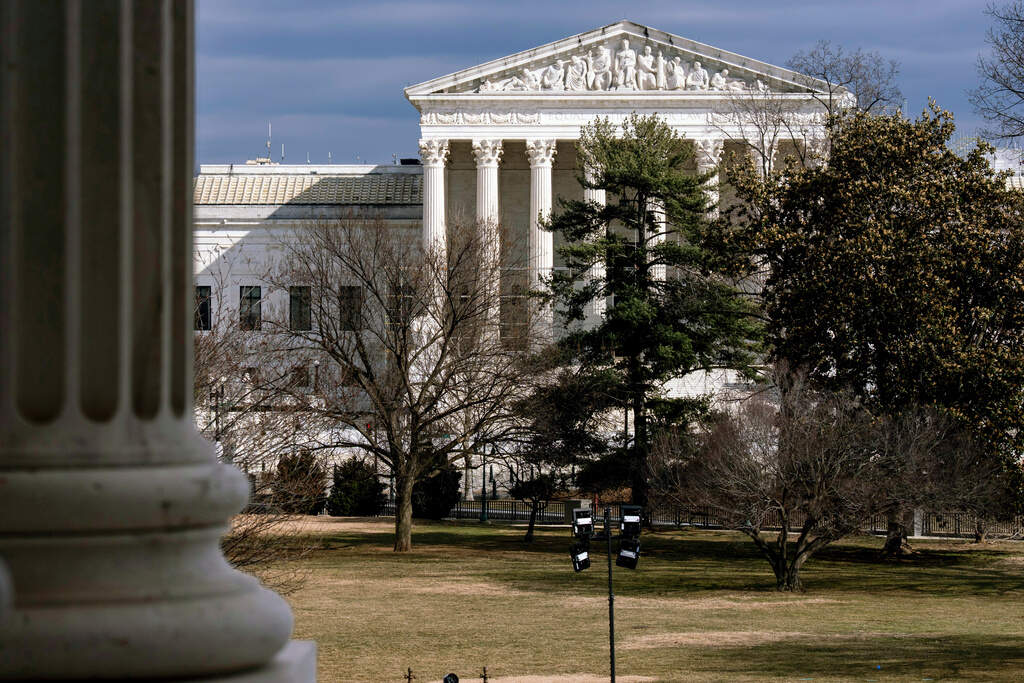
Later this month, the Supreme Court will hear a case that could overturn a key provision of the Voting Rights Act of 1965 that protects against racial discrimination.
Without it, some legal experts say states and local jurisdictions would be permitted to effectively silence the votes of millions of people.
Guests
J. Morgan Kousser, professor emeritus of history and social science at the California Institute of Technology.
Kareem Crayton, vice president of the Brennan Center’s Washington, D.C. office — a nonpartisan law and policy institute.
Also Featured
LaTosha Brown, co-founder of the voting rights group, Black Voters Matter.
The version of our broadcast available at the top of this page and via podcast apps is a condensed version of the full show. You can listen to the full, unedited broadcast here:
Transcript
Part I
MEGHNA CHAKRABARTI: This year marks the 60th anniversary of the Voting Rights Act.
JOHNSON: Millions of Americans are denied the right to vote because of their color. This law will ensure them the right to vote. The wrong is one which no American in his heart can justify. The right is one which no American prove to our principles can deny.
CHAKRABARTI: President Lyndon B. Johnson, August 6th, 1965.
JOHNSON: This law covers many pages, but the heart of the act is plain. Wherever by clear and objective standards, states and counties are using regulations or laws or tests to deny the right to vote, then they will be struck down.
CHAKRABARTI: In 1965, the United States was still not fully enforcing the rights conveyed to Black Americans via the 15th amendment.
That amendment granted Black men the right to vote, and it was ratified in 1870.
95 years later, many Black voters in the South still faced deliberate bureaucratic hurdles to voting, such as poll taxes and literacy tests.
JOHNSON: The vote is the most powerful instrument ever devised by man, for breaking down injustice and destroying the terrible walls, which imprisoned men because they are different from other men.
Today, what is perhaps the last of the legal barriers is tumbling.
CHAKRABARTI: The Voting Rights Act of 1965 was a success. By the end of that year, a quarter of a million new Black voters had been registered. By the end of 1966, only four out of 13 states had fewer than 50% of Black Americans registered to vote. But 60 years later, that very landmark law itself might come tumbling down.
On October 15th, the U.S. Supreme Court will rehear a case that could upend a key provision of the Voting Rights Act. That provision is known as Section 2. It's the enforcement tool that prevents states and local jurisdictions from diluting minority voting power, from congressional districting, all the way down to city councils, county commissions to local school boards.
The court has already made other rulings that have weakened the Voting Rights Act, and it could do so again in this case. So we're going to talk about it today and let's start with the history of Section 2.
J. Morgan Kousser joins us. He's Professor Emeritus of History and Social Science at the California Institute of Technology.
He's a renowned historian of voting rights and author of "The Shaping of Southern Politics: Suffrage Restriction and the Establishment of the One-Party South, 1880-1910." He's also author of more than 160 other published works. Professor Kousser, welcome to On Point.
J. MORGAN KOUSSER: Thank you. Glad to be here.
CHAKRABARTI: So obviously, unfortunately, we don't have time to retrace the entire history of the VRA from 1870, all the way to 1965.
But I would like to actually start closer to the VRAs passage in 1960 because there was a critical case called Gomillion v. Lightfoot. Can you tell us a little bit about that professor?
KOUSSER: Yes, it was a racial gerrymandering case. The county where Tuskegee Institute is located had the highest percentage Black of any county in the country, and also the highest percentage of African Americans with graduate degrees.
So it was difficult to keep them from voting using a literacy test, though they tried for a long time. Finally, they decided that what they would do is they would gerrymander the city of Tuskegee, such that it had only white voters. There were, I think, six Black voters in the city of Tuskegee, in a county that was 85% Black, which it was a beautiful job of gerrymandering.
CHAKRABARTI: Yeah. Can I just jump in here, professor, because I'm actually looking at the map before and after the gerrymander. And before, before 1957, the district was a square, as you said. And the percentage of Black voters in that district was 79% black. But then after the gerrymandering it was a very different shape.
So here is Civil Rights attorney Fred Gray arguing Gomillion v. Lightfoot before the Supreme Court in 1960. And he described the map to the court on October 18th, 1960, in this way.
FRED GRAY: Now in comparing the old limits of the city with the further limits, we have the following aftereffects. Prior to the enactment of Act No. 140, the city, as you can see, was a perfect square, was a square.
Now the city begins at this point, it weaves around, and as best we can detect, it includes, it has 28 different sides.
CHAKRABARTI: 28 different sides in the map of the district. It looks like a building that's been both collapsed and fallen over with a weird arm sticking out. And it had 100% white representation, correct?
KOUSSER: Correct. It's the only racial gerrymandering case that the Supreme Court heard until 1993. The Civil Rights forces kept bringing up other racial gerrymandering cases, but the Supreme Court wouldn't hear them until 1993.
CHAKRABARTI: I also want to emphasize something you said earlier, that in Tuskegee, the Tuskegee Institute was there, so it was a very highly educated Black populace.
And this new map as of 1957 put the Tuskegee Institute outside of that Congressional district. Now, what justification did the state give for redrawing it that way?
KOUSSER: They wanted to. No justification. They did not defend. Fred Gray really had no opposition before the Supreme Court.
CHAKRABARTI: But Congress had passed two bills that had to do with voting, I guess between 1957 and 1960.
Was this following Gomillion v. Lightfoot?
KOUSSER: It was before.
CHAKRABARTI: Okay.
KOUSSER: And it authorized the United States government to sue, but these were very weak bills and so it was, it was difficult to sue if you were a private party. Because there was no clear law that had been passed since the reconstruction laws to allow for lawsuits to take place.
So there had been almost no lawsuits on minority voting rights that went to the Supreme Court over the 20th century. I think there had been six by the time that Gomillion came up.
There had been almost no lawsuits on minority voting rights that went to the Supreme Court over the 20th century.
J. Morgan Kousser
CHAKRABARTI: Okay. Interesting. So obviously this case has a very strong influence on the Voting Rights Act of 1965 being passed.
So let's talk about Section 2 in more detail. What exactly does it say?
KOUSSER: Section 2 is permanent, and it is national. Those are the most, the two most important things, and they're being challenged now in the case that will be heard in a couple weeks. It provided that there could not be discrimination on the basis of race, either by intent or by effect.
And that was what was originally passed. It was not the propaganda focus, the public focus of the Voting Rights Act. At first, that was Section 5, which required deep south states to pre-clear laws, but this could be any law. Whenever it had passed, it was not just new laws, and it didn't apply only to the deep south.
CHAKRABARTI: Okay. But the key thing here, and correct me if I'm wrong, professor, but because intent to racially gerrymandering did not have to be proven under Section 2, it just was simply the mathematical fact of inadequate minority representation, which was good enough to be a violation of the Voting Rights Act.
KOUSSER: Yes, exactly. What had to be proven was not very much set out in 1965, but it got set out in 1982.
CHAKRABARTI: Okay, so let's talk about that. Because it was a mere 15 years after the Voting Rights Act that the Voting Rights Act was challenged, that it was, excuse me, today's Friday, professor, you gotta forgive me.
It was a mere 15 years after the Voting Rights Act was passed, that it was challenged in the courts again, 1980 in front of the U.S. Supreme Court in the case of Mobile v Bolden. Now, Mobile, Alabama had been governed since 1911 by a city commission that consisted of three members elected by voters of the city at large, and the plaintiffs in this case argued that the practice of electing city commissioners at large, unfairly diluted the voting strength of Black citizens.
So the court made its ruling, and here's Justice Potter Stewart reading the court's ruling on April 22nd, 1980.
POTTER STEWART: The question in this case is whether this at-large system of municipal elections violates the rights of Mobile's negro voters. In contravention of federal, statutory, or constitutional law as held by the district court and the court of appeals for the Fifth Circuit. For the reasons expressed in an opinion filed today, the Chief Justice, Mr. Justice Powell, Mr. Justice Rehnquist and I have concluded that Mobile's electoral and governmental system does not, on the record, in this case, violate the United States Constitution or Federal Law.
Part II
CHAKRABARTI: Before the break, we had heard some archival tape of Justice Potter Stewart in 1980 reading a ruling on Mobile v. Bolden, and the justices then concluded that Mobile's electoral system did not violate the U.S. Constitution or federal law. So give us a little bit of background on this case and why the justices decided the way they did.
Justice Stewart said that unless the Section 2 were interpreted to require a proof of intentional discrimination, that it would be unconstitutional. So despite the fact that Section 2 said you could prove either intent or effect, he decided that it should be interpreted only to allow proof of intentional discrimination.
The Section 5 of the Voting Rights Act was with time limited. So it was amended, reenacted in 1970, 1975, and it was coming back up for renewal in 1982. So the voting right forces knew that the Congress had to act on Section 5 of the Voting Rights Act. So they decided to piggyback an amendment to Section 2 at that time in the consideration that Congress would have.
So they proposed reinforcing the idea that it only required the proof of effect. Not that it did not require necessarily the proof of intent. And they set out in the Senate report, they set out very clearly the way that you would go about proving racially discriminatory effect. So the law became much clearer because of this senate report, which was used by judges and attorneys afterwards to see how whether the law had been broken in any particular instance.
CHAKRABARTI: So, very interesting. Because of this case, Section 2 is essentially strengthened, is what you're saying. And it was interesting because the president at that time was President Ronald Reagan. And on June 29th, 1982, Reagan signed that bipartisan legislation you were talking about, professor. That extended the Voting Rights Act of 1965 and amended and strengthened Section 2. Here is a clip of Reagan's remarks from the signing.
RONALD REAGAN: Citizens must have complete confidence in the sanctity of their right to vote, and that's what this legislation is all about. It provides confidence that constitutional guarantees are being upheld and that no vote counts more than another to do to so many of our people, our Americans of Mexican descent and Black Americans.
This measure is as important symbolically as it is practically. It says to every individual, your vote is equal. Your vote is meaningful, your vote is your constitutional right.
CHAKRABARTI: President Ronald Reagan on June 29th, 1982. Before we move forward, Professor Kousser, I just wanna quickly ask you, you actually testified before Congress at this very time, in fact, was it about Mobile v. Bolden?
KOUSSER: It mentioned Mobile v. Bolden, but it was mostly about the history of voting rights in general. And trying to talk about the first reconstruction and what the implications were for the second reconstruction.
CHAKRABARTI: What kind of response or what was the, to use a modern term, what was the vibe from the members of Congress when you testified?
KOUSSER: The most important vibe was that a freshman congressman named Harold Washington, who later became mayor of Chicago, was in the room. There weren't a whole lot of people. And he actually asked some very good questions about the history of voting rights in general.
Very impressive. I thought this guy is gonna go somewhere. And he did.
CHAKRABARTI: And he did. Yeah. No. I didn't mean to interrupt you. Go ahead, professor.
KOUSSER: No, the amendments led to setting out a seven-factor test in a Senate report. And those seven factors have been really important ever since.
The most important of those was racially polarized voting and also and when the law got interpreted by the U.S. Supreme Court in a case called Gingles in 1986, it was made clear by Justice Brennan in his opinion that in assessing racially polarized voting, the question was only whether there was racially polarized voting, not why. Not whether it was caused by partisanship or incumbency differences in campaign contribution or anything else. That is very much at issue in Callais.
CHAKRABARTI: Okay, Callais is the current case. Okay so of these seven factors from the Senate report, you talked about racially polarized voting, a history of discrimination, also another important factor. And in mentioning Washington, the extent of minority office holding under the current system.
But just again, underscore. Because the law can be a confusing thing, there was no need to prove intent anymore when it came to?
KOUSSER: That's correct.
CHAKRABARTI: Section 2, and that was set into stone in 1982. So briefly, professor, what happened after that? What was the effect of Congress strengthening Section 2?
KOUSSER: Well, from 1964 to 1982, there were only 76 Section 2 cases. From 1982 to 1986, there were 212. From 1986, after the Gingles case, to 1990, in those four years, there were 321. So there's a general theme here. When Congress or the courts make it easier for minority plaintiffs to win, cases are filed and they're won.
When Congress or the Supreme Court makes it more difficult for minority voters to win, there are fewer cases, and they lose more of them. And that's true today. That's one of the major themes of the overall history of the of the Voting Rights Act and of voting rights in general.
When Congress or the courts make it easier for minority plaintiffs to win, cases are filed and they're won. When Congress or the Supreme Court makes it more difficult for minority voters to win, there are fewer cases, and they lose more of them.
J. Morgan Kousser
CHAKRABARTI: Okay, so Professor J. Morgan Kousser.
Hang on here for just a minute. Because now I'd like to bring in Kareem Crayton. He's Vice President of the Brennan Center's Washington, D.C. office, and the Brennan Center is a non-partisan Law and Policy Institute. Previously, he was the Senior Director of Voting and Representation there. Kareem Crayton, welcome to On Point.
KAREEM CRAYTON: Delighted to be with you.
CHAKRABARTI: So the historical background helps us understand what is at stake with the current case before the Supreme Court. That's Louisiana v. Callais, and it has to do with the constitutionality of Louisiana's congressional map. Can you give us a little bit more of the background of what is being argued in Louisiana v. Callais?
CRAYTON: Sure. To understand this case, you kind of have to talk about a case involving Section 2. I know you all have been having a great exchange about it. An earlier case after Louisiana created its congressional math after the 2020 census. The state, which at the time was driven by a Republican majority in the legislature, drew a map where only one out of its six districts had a majority of African Americans in them, centered in New Orleans.
Some plaintiffs said, look, we think under Section 2 you should have an additional district where African Americans have the ability to elect a candidate. So they went to court, a court agreed with them that under Section 2, the state should have drawn a second district. They issued an order to do, the state chose not to take the formulation that the original Section 2 plaintiffs offered.
They instead drew a map that essentially, according to them, favored incumbents among the Republicans that they liked and disfavored those that they didn't. And drew a district on the other side of the state involving areas like Shreveport, the northwest part of the state, on down through the center.
And that district, the second of the districts that would satisfy Section 2 was objected to by some white voters. So this new district map that had two African American opportunity districts, not the one that the Section 2 people wanted, but nonetheless, was then the subject of a second lawsuit by white voters who showed up in court and said that these maps were taking race too centrally in the development of their district configurations.
And they said it violated the 14th amendment of the Constitution. Which kind of goes back to this thinking that tracks to the Tuskegee, Alabama case you described earlier, a racial gerrymander, and that was the case that was brought to the court last term.
Argued and the court heard it and decided we want to hear re-argument on a different question or related question. And that is whether or not the state's intentional creation of a second district, that had opportunity for African Americans to elect a candidate that they preferred, that they want to know whether or not that second district or the intention to draw that district, which takes race into account, violates the 14th and 15th amendment to the Constitution.
That's the question.
CHAKRABARTI: This is so fascinating. So to put it in lay people's terms. First of all, the requirement for a second district is not arbitrary, right? Because I'm looking at 2020 census numbers from Alabama and more than 32%, excuse me, from Louisiana, forgive me. 2020 census numbers from Louisiana and more than 32% of Louisianans are Black.
And so that's a third. And out of the six congressional districts in the state, that would mean two of them, at least, would have to have a substantial number of Black voters. So it's not an arbitrary number. I just wanted to lay that out, but it's so fascinating.
CRAYTON: Absolutely right.
CHAKRABARTI: So fascinating to me, Kareem, to hear you say that then white voters, they're arguing that their equal protection rights were violated by this redistricting. So let's listen to, for a moment, to some of the oral argument that happened back in March. You're going to hear attorney Edward Greim. And he is arguing for the plaintiffs in this case.
EDWARD GREIM: So those white voters who object to the creation of that second district in Louisiana, and Greim told the court that the major issue that he has with the case is that Black voters who initially requested the redistricting of Louisiana did not bring, according to him, ample evidence that racial discrimination existed, that would've required Louisiana to create a second majority Black district.
CHAKRABARTI: So here again is Attorney Edward Greim, oral argument before the U.S. Supreme Court.
GREIM: They didn't bring in any Gingles evidence, let alone the kind of evidence that would say. If you look around Louisiana, there are still a lot of barriers to Black citizens voting. That's not the record. I think there's a reason for that, and I think that shows us that Section 2 is no longer performing the function that it was assigned, that Congress thought it was going to perform back in 1982.
Now, why are we seeing so many Section 2 cases? Why are we suddenly, now, as voters are becoming more integrated, why are we suddenly finding new Section 2 districts everywhere? I think that's a problem.
CHAKRABARTI: So Kareem, what I hear there is the fundamental argument that because Black voters can vote with fewer impediments than they had in the 1960s, there's no need for Section 2.
CRAYTON: Yeah. The passage reveals real ignorance of what Section 2 actually requires of plaintiffs to bring a claim, but also the history and the record of what Section 2 has accomplished and really what remains to be done in the area. And I'll try to hit on that pretty briefly by saying, first, you hear the lawyer talk about Gingles.
This is the case that the Supreme Court heard after the Section 2 reboot, if you will, in 1982. 1986, the Supreme Court says, look, we're going to put some rules into place to help district courts when they hear Section 2 claims based on effects. Determine whether or not it's a live case, whether there should be a remedy.
And they lay out a series of factors that essentially synthesize what Professor Kousser talked about, into a sort of legal regime that's been in place for 40 years. It is a rigorous test. Fewer than about half of the time people bring these claims, they fail. So this is not just a simple thing to do, but racially polarized voting is a significant part of it.
The other thing to mention, and this just reveals in my view, that it is not a complete picture that the attorney offered to the court. Louisiana and a lot of other states still have certainly made some progress, but they have still a significant pattern of polarized voting. And we know this from a few reasons, for a few reasons.
One, we can look at measures of polarization over time, but we can also, you can even need to be an expert on polarization. You don't have to have a PhD in politics to look at the outcomes and look at how African Americans and non-white candidates don't fare well when they run in largely white jurisdictions in the South, particularly in Louisiana, there hasn't been a statewide Black elected official, and that's not for lack of trying in politics in Louisiana in decades.
You don't have to have a PhD in politics to look at the outcomes and look at how African Americans and non-white candidates don't fare well when they run in largely white jurisdictions in the South.
Kareen Crayton
And that didn't, that's a pattern that's not possible without the presence of racially polarized voting. So the suggestion that things are better now. Certainly, partly due to the application of the Voting Rights Act, but to suggest that there's no evidence at all of there being the kind of discrimination that Congress had in mind to use Section 2 to work against, so that voters could have an opportunity to elect.
That's the part that I take great issue with.
CHAKRABARTI: Interesting. Professor Kousser, I'd love to hear you on this. Because, in addition, what I hear attorney Edward Greim arguing there is Kareem might be laying out what the numbers say, in terms of, for example, hardly any non-white candidates being voted into certain offices in Louisiana, but Greim's making an even more fundamental argument.
That be that as it may, maybe that has nothing to do with how places are districted, may have to do with voter choice. Because voting itself is easier than it was in 1960. He's talking about a fundamental shift in America that maybe our current metrics of measuring electorally equality don't adequately measure. What do you think, professor?
KOUSSER: One of the things that the plaintiffs, the white plaintiffs here and the Justice Department, in its amicus brief in this case are asking for, is not only that you have to prove intentional discrimination, that really the 1982 amendments requiring the proof of effect were wrong. That you still have to prove intent.
And second, that you have to show that the intent was not actually partisan. So if they would say that if you measure racially polarized voting, you have to control for partisanship that Blacks lose in Louisiana, not because they're Black, but because they're Democrats.
That's what they're really pushing for.
Part III
CHAKRABARTI: The dates can get a little bit confusing here, so let me just recap.
This case was actually heard first last term by the U.S. Supreme Court. It was argued on March of 2025. A ruling came out on June 27th, 2025, but it will once again be reheard by the court on October 15th. Kareem, just very quickly, how common is a rehearing of a case? And why did that happen here?
CRAYTON: It's not very common. One or two times. We usually talk about in law school where it has come up is, say, a justice becomes incapacitated or dies before a decision's rendered. They will hold over a case for re-argument. That's not the case here. And of course there's a lot of speculation as to why.
What's quite clear is that some members of the court want to address a question that they don't feel has been squarely before the court for now, and it's the constitutional question as it's been framed by the court here.
CHAKRABARTI: Okay. So let's listen to a little bit more from that first oral argument back in March.
You're about to hear Justice Ketanji Brown Jackson pushing back on the argument against considering race when redistricting, here's her exchange with defense attorney Stuart C. Naifeh of the NAACP Legal Defense Fund.
KETANJI BROWN JACKSON: Has the court ever held that race predominates whenever a state draws a district to comply with Section 2?
I thought we suggested the opposite in Shaw v. Reno.
STUART C. NAIFEH: This court has not held that. The court has expressly said that intentional creation of a majority-minority district does not on its own prove racial predominance. That was, that court said that in Bush v. Vera, and then in Bethune-Hill, the court refused to find predominance even where the state had a 55% target.
That was just one consideration in the predominance analysis. It wasn't the whole analysis.
CHAKRABARTI: Professor Kousser, just really briefly, can you decipher what the attorney is saying there, because we've been throwing around these terms of intent and not intent.
KOUSSER: There are a series of cases starting with Shaw v. Reno in 1993.
In which it was ruled that a redistricting could be found unconstitutional if the predominant motive for drawing a particular district was racial. So that's the that's the tie in to predominance. The question is how you prove predominance and whether if you use, if you argue that in fact something else which is highly correlated with race, was the real reason for doing things, whether that is going to be approved by the court.
That's very much an issue right now in a case in Texas on the midterm redistricting, the state is arguing that it was all because of partisanship. And the plaintiffs, the minority plaintiffs are arguing that it's all because of race. The only members of Congress that were challenged were minority members of Congress, not any of the white Democrats that were charged.
CHAKRABARTI: Okay. Okay. So that helps us make sense of this next clip that we're going to hear. Because the state of Louisiana argued that when it drew that second majority Black congressional map in 2024, as it was required to do, it drew the lines in a certain way to save three incumbents. And that the Supreme Court precedent allows partisan gerrymandering, but not racial gerrymandering, but the plaintiffs in the case are arguing that race was a driving factor.
Remember, in this case, the plaintiffs are a group that describes themselves as non-African American, non-minority, a.k.a. white. So here's an exchange from oral argument with the plaintiff's lawyer, Edward Greim and Justice Neil Gorsuch.
GORSUCH: Your friends on the other side say, okay, race predominated in creating a second district. But race didn't play a role in the squiggly line district. It was politics.
GREIM: First of all, Senator Womack, in his presentation, he's the sponsor of the bill, said there is just not enough Black voter population in southeast Louisiana. And he says, that is why the district is drawn up to Shreveport, up I-49 and up the Red River to Shreveport.
The sponsors were very clear that's what they were doing. So you could look just, you could look at the evidence.
CHAKRABARTI: Okay. Kareem Crayton, I just want to get to some fundamentals here of what's really being argued in the midst of all of this sort of legalese in before the court. And I think that it's distilled down almost perfectly by none other than Justice Clarence Thomas.
Because in June he wrote a separate opinion on this case saying that the Voting Rights Act and the 14th Amendment, essentially the requirements of equal protection are fundamentally in tension, and that tension has to be resolved. That's really what's at stake here. Is it not Kareem?
CRAYTON: That's what he says.
I think the people on the court when this was initially challenged, that is the Voting Rights Act was challenged, in 1965 in a case called South Carolina v. Katzenbach. That court fundamentally understood this to be wholly consistent with the edicts that were contained in the 14th and the 15th Amendment.
But as Justice Thomas, who has certainly been on the court from the time that Professor Kousser talked about, from Shaw v. Reno to now, has largely been in the driver's seat moving policy more into, I think, the direction that he would offer. We're now at a place where I think the position of politics vis-a-vis race is more in question than it was, even as recently as 1993.
The position of politics vis-a-vis race is more in question than it was, even as recently as 1993.
Kareen Crayton
But I think from his way of thinking, it is fair to say that if the court believes that politics and partisanship aren't the driving factor of how the court ought to regulate district drawing, the way that this map was drawn, that would regulate what the Republicans want to do, to help Republicans, raises in particular in service to the question of race discrimination, raises some concerns on the part of people like Justice Thomas, but it does overlook a tremendous part of the complexity that exists in the South, because party and race are terribly intertwined.
And there are ways of understanding the presence of racially polarized voting, even when partisanship as such isn't in the mix. And I think that's the piece that, unfortunately, Justice Thomas' analysis doesn't really include.
CHAKRABARTI: So Professor Kousser, let me turn to you on that. Because you could say that it's, strictly speaking, maybe Justice Thomas has a point here, that any law that seeks to enhance representation or protect representation of any American over another, whether it be by virtue of race or party affiliation, that any one of those laws would fundamentally violate the spirit of the 14th Amendment, which is we are all equal under the law.
But if that were the case, and as Kareem's saying, partisan gerrymandering shouldn't be legal either.
KOUSSER: Partisan gerrymandering was not clearly legal until a case called Rucho in 2018.
It was always in question. But the connection that, just to reaffirm what Kareem said, the connection between race and partisanship in the South is exceedingly difficult to distinguish. The reason why we have a Republican party that took over from the Democratic, the segregationist Democratic party that existed in 1965 in the South.
The reason that we have that is predominantly because of race. So the basis of the Republican party more than anything else, and it continues to be, is racial issues and racially connected issues. Issues that the Black and Latino populations are particularly interested in. So it is exceedingly difficult to disentangle them.
And if the Supreme Court is going to decide, as it did in Rucho, that partisan gerrymandering was perfectly constitutional. And as the Department of Justice says in its brief in Callais. It's a race neutral reason for drawing districts. It will be virtually impossible to contest a district that got rid of a particular Black incumbent.
If the Republican Party were to do midterm redistricting on every state in the south that has a Black or Latino Democratic representative, and get rid of that district and say that it is because of partisanship, not because of race, under the Justice Department's standard, it would be virtually impossible to overturn those.
We could see the largest decline in minority representation in Congress since redemption after the after reconstruction.
CHAKRABARTI: Ah, okay. So this is the perfect moment to bring in LaTosha Brown. She's the co-founder of the Voting Rights Group Black Voters Matter. We spoke with her a little earlier this week and she told us that Section 2 of the Voting Rights Act is the very heart of the law.
LaTOSHA BROWN: When you look at the diversity that is in Congress, when you look, and we're still, we still don't have the representation that we should have, but when you look at the diversity, that can be pointed to the Voting Rights Act, and particularly with Section 2, the drawing of congressional districts and representation, that has been the vehicle that we've been able to actually amass political power and be able to have representation for our communities.
With Section 2 ... that has been the vehicle that we've been able to actually amass political power and be able to have representation for our communities.
LaTosha Brown
CHAKRABARTI: And Brown says if the Supreme Court guts Section 2, she says progress made over the past 60 years for racial equality would be lost.
BROWN: It would be devastating. It would change the entire political landscape of the South. It has the potential to literally wipe out representation and not have competitive districts all across the South. This ruling would not only hurt the South, but it would embolden legislatures all across the country to draw maps that would entrench white majorities.
CHAKRABARTI: And as a reminder, the plaintiffs in the case are arguing that Americans no longer need the protections of the Voting Rights Act because so much progress has been made.
But LaTosha Brown says that couldn't be further from the truth.
BROWN: There is no evidence to suggest that America is anywhere near to being a post-racial nation, and in fact, it is the exact opposite. This is the time that Section 2 is needed more than ever. This is the time that when you're thinking about the reason for the Voting Rights Act, it is because of the precise circumstances that we see ourselves and find ourselves in now.
This is the time that Section 2 is needed more than ever.
LaTosha Brown
CHAKRABARTI: That's LaTosha Brown, co-founder of the Voting Rights Group, Black Voters Matter. Kareem Crayton, it seems like there's several possible scenarios that could come out of the court's ruling. They could leave Section 2 entirely alone.
They could maybe change it a little or they could maybe change it in a way that either, that makes having to prove intent in terms in gerrymandering and put that back into the law when, after it was removed by Congress in 1982.
Are those sort of the span of potential decisions?
CRAYTON: I think those are the three general buckets that could characterize the approach to the court would offer, and I'm not sure that the court understands yet where a majority of the members fall, but I just want to add one piece of assessment of what the stakes are in this case.
You mentioned it at the top of the hour, and I don't want it to get lost. I know America's been rightly focused a lot on the redrawing of congressional districts. And this obviously is one of the cases where it could, as the panelists have been describing, have impact there. But I want to just remind everyone that three-fourths of the cases that are brought under Section 2 are local jurisdiction, right?
Bodies like city council, school boards, county commissions. These are areas of government that are closest to the public and the voters. And those are the very places whose level of representation changed because of Section 2.
And if it is undone in any significant fashion, that is also at risk. And that I think is not just something, as much as it is important in the South, it's a nationwide challenge. So this case really does raise high stakes for our understanding of what political representation is going forward.
CHAKRABARTI: So Professor Kousser, we've just got a minute left to go. And again, for further context, the Supreme Court in recent years has shown some willingness to make major changes to the Voting Rights Act, from in Shelby v Holder. They basically got rid of, what, Section 4(b) and 5 in the Voting Rights Act.
But I understand that thus far the court hasn't really shown in previous cases, if I have this right, the willingness to tamper with Section 2. Is that a fair reading?
KOUSSER: Yes. And one of the things in Shelby County v. Holder that the Chief Justice said was you may not have Section 5 anymore, but you still have Section 2 nationally as a guard.
And the question is whether he's going to keep to that, whether his vote and his leadership are going to continue. What he said there, or he's going to change.
CHAKRABARTI: That was more than a decade ago.
KOUSSER: It was 12 years.
CHAKRABARTI: Yeah. What would, you said after 1982 there was a golden era of the Voting Rights Act.
What could happen if Section 2 were eliminated now?
KOUSSER: I think that it could be large numbers of minority office holders could lose their seats and we could go back to basically an almost all white congressional delegation from the South and all white governments in large parts of the United States that have minority representation on them now.
CHAKRABARTI: There's also another possibility. Maybe Congress could step in after a court ruling and do exactly what it did in 1982 and pass a law again to restrengthen the Voting Rights Act. But, we'll have to see.
The first draft of this transcript was created by Descript, an AI transcription tool. An On Point producer then thoroughly reviewed, corrected, and reformatted the transcript before publication. The use of this AI tool creates the capacity to provide these transcripts.
This program aired on October 3, 2025.