Support WBUR
‘It affects your wiring’: Jake Sullivan on the weight of his work as national security adviser
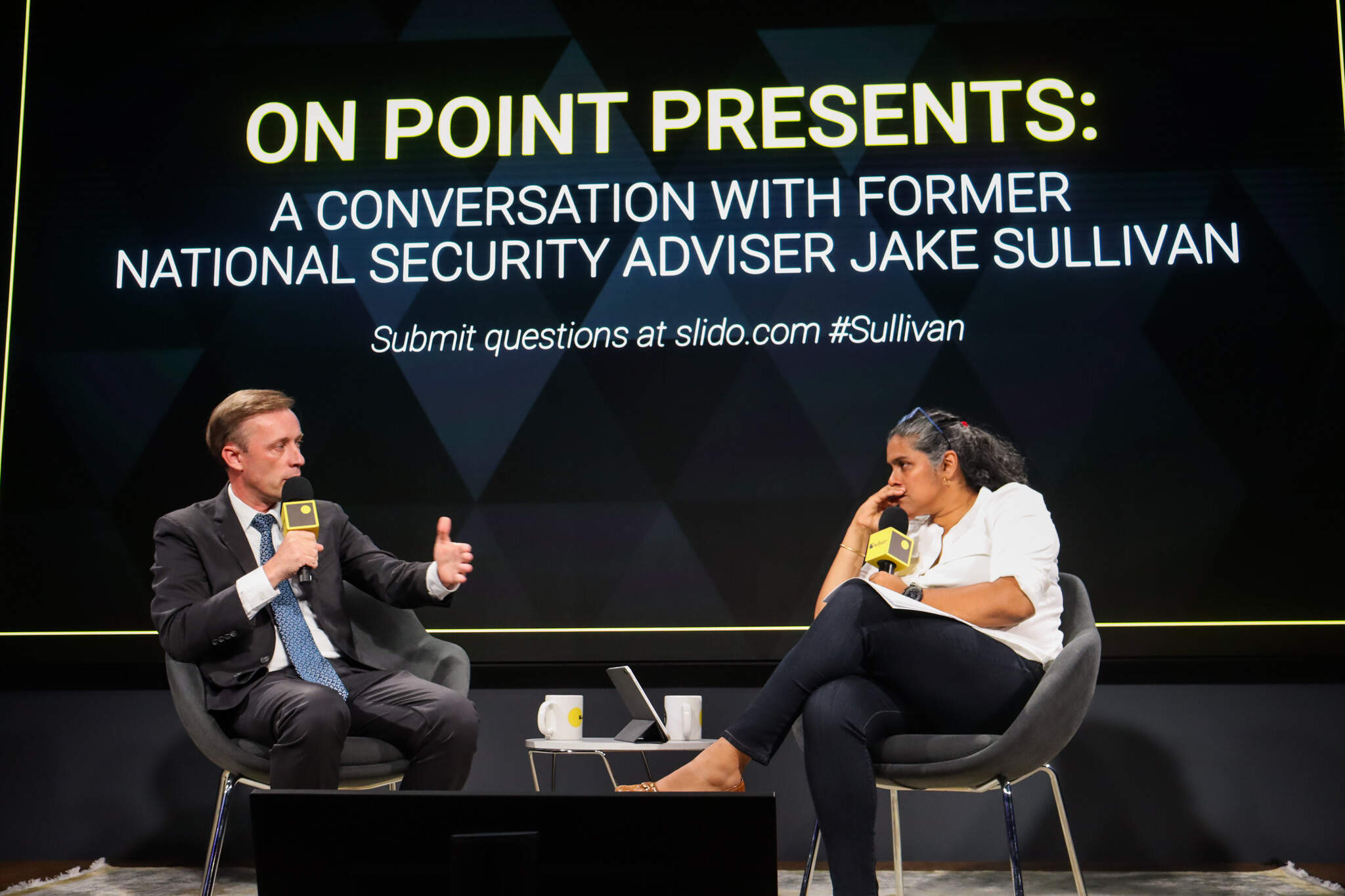
From 2021 to 2025, Jake Sullivan served as President Joe Biden's U.S. national security adviser. He had enormous influence on the U.S. response to some of the deadliest conflicts in the world.
Guests
Jake Sullivan, he led major foreign policy initiatives for President Barack Obama, Secretary of State Hillary Clinton and most recently President Joe Biden as national security adviser.
The version of our broadcast available at the top of this page and via podcast apps is a condensed version of the full show. You can listen to the full, unedited broadcast here:
Transcript
Part I
MEGHNA CHAKRABARTI: Jake Sullivan served as President Joe Biden's U.S. National Security Adviser. He'd previously served in the Obama administration, both in the White House and as Deputy Chief of Staff to then Secretary of State Hillary Clinton. As Biden's National Security Adviser, Sullivan influenced U.S. response to some of the most globally significant conflicts in recent memory, including Russia's invasion of Ukraine and the Israel Hamas war.
Sullivan recently joined me on stage at WBUR's CitySpace events venue before a live audience. We talked about a range of national security issues, including failings in the Biden administration, and here's how that conversation began.
CHAKRABARTI: I actually wanted to start tonight setting the table a little bit. Because I found that recently at On Point we spend a lot of time just defining terms because they mean so many different things to people these days.
So what would you say are the most critical pillars that hold up what we consider U.S. national security?
JAKE SULLIVAN: It's a great question, and I think when most people think of national security, they think of hard security issues, nuclear weapons, terrorism, great power conflict. But really at the end of the day, national security is what it takes to make people in the United States of America, to make their lives better, safer, and easier.
National security is what it takes to make people in the United States of America, to make their lives better, safer, and easier.
Can they go to sleep at night secure? Do they have the opportunity to participate in an economy that supplies jobs and allows them to access the opportunity they want? Can they live on a planet that isn't burning? And in this regard, I think the COVID-19 pandemic really drove home that the definition of national security is much broader than you'd see in the movies or on TV in the Situation Room.
What did we learn from that? First, we learned that a virus that comes from very far away can cause more harm, death, pain, dislocation in this country than basically all the terrorist attacks of the last 25 years or more combined. We also learned something else though. We learned that supply chains are national security, that if we can't access masks it's going to mean that more people are at risk and more people are harmed.
And that in fact, not having diversified, resilient supply chains puts the American economy, American security, and Americans health in peril. And we've seen this just most recently, of course, in this trade war with China, where the cutoff of rare earth elements and magnets, 90 plus percent in some cases, a hundred percent of which are produced in China.
Not having diversified, resilient supply chains puts the American economy, American security, and [American] health in peril.
I mean that we have a strategic dependency on another country for a product that's critical, not just to our military, but to our auto industry. So this is not a super formal answer to your question in terms of pillars, but I would just say that at the end of the day, America's national security is about sustaining the American way of life, and that is about our security, our prosperity, our democracy, and our values.
CHAKRABARTI: No, I appreciate that definition actually, because it really helps us understand the actions and motivations of presidents and their advisers. But at the same time, that sort of broader sense of American national security ... the security of the American way of life.
That would be not so far away from what the current administration defines as national security. And therefore, their justification for a lot of actions that are unprecedented. Today, we just did a show about the military strikes on those Venezuelan alleged drug smuggling boats. That was done in the name of national security because of drug deaths in the United States.
It's not that different of a philosophical view. Wondering your thoughts on that?
SULLIVAN: I guess the way I think about this is there are two ways to have a broad definition of national security. One way to have a broad definition is to look at the things that impact the daily lives of Americans and say, what can we do to make that better?
Another way is to say, I have a very broad definition of national security because there are certain groups I don't like. Or certain policies that I want to pursue and I need a pretext for it. And that comes down more to motive and to purpose than it does to what falls broadly within the ambit of national security.
For example, I think that the issue of fentanyl coming into the United States is a national security issue. Tens of thousands of Americans, in some years, more than a hundred thousand Americans die because of fentanyl, and there is an international nexus to it, and it is right and important for a president to think of that as a security issue.
But that doesn't mean that a particular policy being pursued to try to deal with that is necessarily good or bad.
CHAKRABARTI: Or lawful.
SULLIVAN: Or lawful for that matter. Yeah, exactly. Yeah.
CHAKRABARTI: Okay. For the moment, one more thing about how our national security is also defined by how we treat each other. This might seem extreme, Lincoln's house divided against steal cannot stand.
It does pop into mind. And I'm just wondering, right now, the nation is still, and it's going to take a long time, working through the implications of the shooting death of Charlie Kirk. And the ever ratcheting up concern of political violence in this country.
So in terms of national security and leadership, I just want to play one quick clip of President Trump and one of the things he said in response to the shooting of Charlie Kirk.
DONALD TRUMP: My administration will find each and every one of those who contributed to this atrocity and to other political violence, including the organizations that funded and supported.
As well as those who go after our judges, law enforcement officials, and everyone else who brings order to our country.
CHAKRABARTI: People have opinions about that domestically, but I'm wondering from your experience, how does the world respond to when they hear President Trump say things like that about the actions he's going to take within the United States?
SULLIVAN: Let me start by saying that I much preferred Governor Cox's response to this. Because I think the way that he put it, the humanity with which he spoke and the unequivocal rejection of political violence and the shocking, brutal and horrible crime against Charlie Kirk does deserve to be condemned.
But then the answer is that we all have to pull together. Not try to use this as some pretext to go after political opponents. And to your question of how the rest of the world would look at this, this would look really familiar in other parts of the world. It would look familiar in countries where some awful act happens. And the leadership, usually autocratic leadership says, it must be the civil society.
It must be the NGOs. It must be all of the people I don't like who are behind this. And those people are terrorists and we're going to go after them. And that is a very dangerous thing. And we should be speaking out and pushing back against that. Because this should really be a moment for the United States, a bracing moment, for us all to say a whatever your political persuasion, we reject political violence. But we equally reject the idea that political division. A political division means that you can turn the other person into an enemy who is beyond the pale, simply because they hold a different view than you do.
And I fear that given both what President Trump has said and subsequently what other officials in his administration have said about the investigations they're going to open, into places like the Ford Foundation, which has been investigated in other countries, by the way, on similar thin, ridiculous pretexts. This is out of a playbook that leads to a dark place, and I think we all have to stand up and say something about that.
CHAKRABARTI: Of course, we're right now, just this is the latest chapter of, again, political violence has been part of American history since its founding in different ways.
In that sense, we are not unique. As you said, it'd be familiar in a lot of other countries, but it takes on a particular tenor post January 6th. And I'm wondering, do in your time serving in the Biden administration, as you were traveling around the world, did people behind closed doors express doubt about whether they can trust the United States?
And I ask it because of this. I remember on January 6th, on that day, there was a British reporter who somehow got into the Capitol with the insurrectionists, and he wrapped up his report saying, today is the day that the rest of the world must start asking about the stability of the world's oldest and most, thus far, most stable democracy, or modern democracy.
It's a really shocking thing to hear, but it was a good description. Did people behind closed doors say, you're working for Joe now, but we don't know what's going to happen in four years.
SULLIVAN: Look, people looked at January 6th, which of course happened two weeks before President Biden was sworn in.
And they found it just as shocking as I found it, that you had an armed mob storm the Capitol, try to overturn a Democratic election and people could not believe this could happen in the United States of America. And it was absolutely something on their minds. And on their lips, and they did ask about it.
What does this mean for the future of American democracy? How stable and sustainable is it? That was a question that was absolutely raised by what happens on January 6th, because people look to the United States of America. And they have historically looked to us as a model, and now they were looking at the United States as a risk factor, a significant risk factor.
And it wasn't like I could just say to them, ah, it's all cool. Because what happened on January 6th had a dark current under it. And we have to acknowledge and be humble about the fact that our own democracy, we are dealing with challenges, which means that when we talk about democratic challenges in other countries, we come to that conversation with that sense of humility.
But at the end of the day, one of the things I would just say is, as having served four years as national security adviser, if I think about the actual threats to the United States of America, no foreign actor represents as great a challenge as we potentially could represent to ourselves.
Unless we collectively pull together, and that's not a casting blame or aspersion on any person or group or otherwise. It's saying that actually the United States is a big, complex, unruly country and our capacity to do damage to ourselves is actually greater in many ways than the capacity of others to do damage to us.
The United States is a big, complex, unruly country and our capacity to do damage to ourselves is actually greater in many ways than the capacity of others to do damage to us.
And that's why focusing on the health and vitality of our democratic institutions, our civil society, our rule of law is so important to our country thriving in the future. Because those are the things in my view that are the ultimate pillars of America's national security.
Part II
CHAKRABARTI: Now more from my recent live conversation with former Biden National Security Adviser, Jake Sullivan. In this segment, you'll hear discussion about Israel and Gaza. We recorded this conversation before Prime Minister Benjamin Netanyahu endorsed the latest ceasefire proposal from the U.S.
Now, before the break, Sullivan had said the greatest threat to U.S. national security is the U.S. itself and decisions made by leaders that harm the strength and integrity of the American economy and society. I followed up by asking him how the global community has been responding to the U.S.' recent domestic instability.
Specifically, I asked Sullivan, in the transition from the first Trump presidency to President Biden, did other countries tell you that an unreliable United States has a destabilizing ripple effect around the world?
SULLIVAN: I think they were a little more polite than that, but was that some subtext?
President Biden tells the story of going to the first G7 meeting, which was in Cornwall in the UK, and saying America's back. And one of the leaders saying to him, yeah, America's back for how long? And I think that kind of answers your question in a way.
CHAKRABARTI: I just want to say that I believe that you have been in situations, in rooms where the questions and the interactions were much tougher than you're going to get from me today.
So I'm still, I'm gonna creep forward a little bit here.
SULLIVAN: Alright. Fair enough.
CHAKRABARTI: A little bit more, a little more daring. And I've never been known for being terribly diplomatic, you'll have to forgive me in advance, Jake. The reason why I'm asking is that I think it's arguable that after the first Trump administration, and even though the Biden administration was very intentional in trying to shore up international relationships, that the persuasive power of American diplomacy is not what it once was.
And let's take Israel and Gaza, for example. I recall that President Biden after October 7th, very rightfully, stood up and said it's an atrocity, is a violation of humanity, unspeakable, unsupportable attack on Israel. He also said, he cautioned. He said in your response, Mr. Netanyahu, don't go too far. Don't make the same mistake that the United States did a la Afghanistan and Iraq, but then he also said the United States will forever be almost an unquestioning ally to you, Israel. Those are conflicting messages, I think. And I think it's arguable that post October 7th, Israel has felt no need at all to listen to diplomacy, overtures, what have you, from the United States, that the U.S. influence just isn't there.
SULLIVAN: What happened on October 7th was a just a god-awful tragedy. And what's happened every day since is a godawful tragedy. And too many people have died. Too many civilians, Palestinian civilians have died. Not enough aid has gotten in.
But in the days after October 7th, the Israeli government position was, we're not letting any food in. That was their position. And President Biden and the team pushed day in, day out, week in, week out, and we didn't get enough in. But over the course of last year, we averted the famine that had long been warned about.
And at the end of last year, there was a ceasefire. Hostages were coming out. There was a pathway to negotiations to fully end the war, and a significant amount of food aid was going in. That's what we handed off to this administration. This administration said, green light basically on a complete blockade of food into Israel, into Gaza.
And the result has been a famine was declared this year. And just today, they've said, go ahead, basically go into Gaza City. So I lie awake at night thinking about what other steps we could have taken, when, how, et cetera, in an incredibly difficult set of circumstances. Where Israel is fighting a terrorist foe that's embedded among a civilian population, with a tunnel network that has never been seen before, but was also acting in ways where their military operations were killing too many civilians.
And I think about that a lot, but at the end of the day, we took steps to try to improve the situation, especially when it came to the flow of humanitarian aid into Gaza. And did we have all the influence we wanted? No. But the question is, were we prepared to cut off weapons to Israel? And people have to remember that at the time last year, Israel was under attack from Hamas, under attack from Hezbollah, under attack from Iraq, under Iraq, under attack from Syria, under attack from the Houthis, and directly under attack from Iran itself. So the president was not prepared to say we're going to cut off weapons from an ally, a country that is under attack from six different sides all at once.
And that's the kind of difficult call a president has to make. But nonetheless, the president on the phone with the Prime Minister, me on the phone with my counterparts, traveling to Israel, we never lost sight of first, the fact that we wanted to support our ally who was trying to deal with a serious set of threats from multiple directions. But at the same time, we wanted to do what we could to reduce harm and suffering and get to a ceasefire that we finally got to at the end of last year.
CHAKRABARTI: But with all due respect ... at least in some important places within the administration, there was a lot of debate over the weapons, right? Because in the State Department, we had a fairly high profile departure of a person who, we actually interviewed him several times, and now I've forgotten his name, so forgive me.
But who said that within the State Department in terms of authorizing and advancing congressionally approved weapons sales, that for the first time in his career, he felt like there couldn't even be any discussion about whether the weapons were being used in accordance with the U.S.' stated goal of not having them being used against civilians. You recently said on The Bulwark that you think that perhaps the case for withholding weapons from Israel is stronger today than it was before.
SULLIVAN: Yes. For one thing what I just laid out for you. The threats that Israel faced. That picture looks very different today than it did a year ago. So obviously as the situation evolves, our considerations on this should evolve. Secondly, as I mentioned before, we spent most of last year working towards that ceasefire and hostage deal, and we achieved it.
Israel walked away from that, despite the fact that there was, as part of the deal, a timetable for negotiations to try to get to a permanent end to the war. Third, this year we've had this declared famine. And finally, and this is very important, senior military and intelligence officials in Israel are basically saying now, as opposed to a year ago, is difficult to identify what the actual military objectives of continued operating in Gaza are.
I wrote an op-ed in an Israeli newspaper actually saying that we've got to go beyond these short-term hostage deal. The war just needs to end, and an argument that I made there was killing every last Hamas terrorist is not a necessary condition to end the war any more than killing every last Hezbollah terrorist was a necessary condition to get to a long-term ceasefire, which the Biden administration negotiated between Israel and Lebanon.
If you're worried about resupply, there are ways to deal with that. If you're worried about the threat coming back, there are ways to deal with that. We've shown that. And Israel has shown that with respect to Hezbollah. And the same thing could be true with respect to Hamas.
So the time has come for the war to end and all the hostages to come home, and I think that is something that we should all say clearly with one voice today. In September of 2025.
CHAKRABARTI: By the way because we have amazing people working behind the scenes, I was reminded that Josh Paul is the gentleman who we interviewed, he oversaw, or was of a group of people who oversaw arms deals for the United States government, within the State Department.
One, again, we're gonna do some globetrotting here, so I don't wanna spend too much time on any one region, but one more question about the Israel-Gaza conflict. Do you believe the actions and decisions of the Netanyahu government in the past year are in line with what the United States would want from the region for our own national security?
SULLIVAN: Oh, I believe the fact that they are continuing to prosecute this war when all of the conditions I just laid out, have obtained, is not in Israel's interest, and I don't think it's in America's interest. And I have been unequivocal about that and made my case directly to the Israeli people.
I believe the fact that [Israel] are continuing to prosecute this war ... is not in Israel's interest, and I don't think it's in America's interest.
CHAKRABARTI: Okay. I want to get some good news stories from you too.
(AUDIENCE LAUGHS)
We'll get there; we'll get there eventually. National security is what it is though. And right now there are intensely important conflicts going on and they're important for this country. So let's move to Ukraine. You've argued in the past, and correct me if I'm wrong, but you've argued in the past that it's not necessarily up to the United States to dictate terms for a peace deal between Ukraine and Russia.
Is that correct?
SULLIVAN: Yes. It is correct.
CHAKRABARTI: Okay. But elaborate on why.
SULLIVAN: Russia invaded a sovereign country, tried to take out its capital, decapitate its leadership, and subjugate the country, and ultimately really erase it off the map. Because as Vladimir Putin has said and written, he doesn't really regard the Ukrainians as an independent people and an independent nation.
And the Ukrainians are out there every day fighting to defend their territory, their identity, their country. So the idea that the United States of America should be telling Ukraine what to do about those things which are existential and elemental to Ukrainians, I think is just wrong. I think this has to be up to the Ukrainians to make the decision about achieving a just and sustainable piece, and it's the United States' responsibility to support Ukraine.
To put it in the best possible position on the battlefield so that it's in the best possible position at the negotiating table to achieve that just peace.
CHAKRABARTI: And how should the U.S. be doing that?
SULLIVAN: I think there are two things that we should be doing right now, building on all of the work that we have done.
One is to continue to supply Ukraine with the means necessary to defend itself and to fight back against the Russian invaders. Rallying the rest of the world to help us do that. And second, I think we should be increasing pressure on Russia. Particularly pressure on Russia's oil sector by finally imposing the oil sanctions that President Trump has toyed with, talked about, but not ultimately followed through on.
Now is the moment to do that, and that's in part because the oil market now today is quite different from what was two years ago. There is space to do this, to reduce Russian oil revenues without really hitting Americans and others in the pocketbook. And because Russian economic officials themselves are speaking increasingly publicly about the fragile state of Russia's economy.
So now's the time to press, to put Putin in a position where he has a much harder call to make about continuing to prosecute this war.
CHAKRABARTI: But I believe even President Trump mentioned recently on Truth Social, which is apparently now the White House Press Office. But that he and others have identified one of the biggest obstacles in doing what you're calling for regarding oil sanctions is European dependence on Russian fossil fuels.
SULLIVAN: I'll say a couple things about this. I don't like the fact that there are European countries still buying Russian oil. I don't like it. Okay. But that's not an obstacle to the United States of America. Imposing sanctions on Russia's oil sector. And the effort to say that it is, I think is just an effort to deflect responsibility.
We can at once make the case to the Europeans that they should stop that, and at the same time actually follow through with these sanctions. And I think what President Trump is trying to do, it seems, is evade himself taking an action that is available to him, which is to move forward with meaningful economic sanctions.
He could do that tomorrow if he chose to do it. He's choosing not to, and that's not because of the Europeans, even though I agree with him that the Europeans should get on board, should end any further purchases of Russian oil. But whatever happens there, this I think is a very important thing for the United States of America to step forward and do.
CHAKRABARTI: Well, let's listen to a little bit of what President Trump said about Ukraine from late last month.
This is during his cabinet meeting from August 26th. And he talked about what he believes is his ability to end the war at Ukraine.
TRUMP: And if I can stop it because I have a certain power. Or a certain relationship. I had a very good relationship with President Putin. Very good. That's a positive thing again, and I think I'm probably the only, Steve Witkoff would tell you I'm the only one that can solve it.
I don't know. You told me that a few times.
SULLIVAN: This essentially was the pitch that he made. I can end the war on day one, because of my relationship. Whatever's behind that relationship, we don't know. Okay. It's September, Russia has increased dramatically it's aerial assault on Ukrainian cities, way beyond anything it was doing before. Putin is showing up in Beijing and basically giving the diplomatic version of the middle finger to President Trump.
Putin is showing up in Beijing and basically giving the diplomatic version of the middle finger to President Trump.
With Kim Jong-Un and Xi Jinping, and you've got Russian drones flying around NATO territory. So somehow this theory of the good relationship with Putin leading an end to the war in Ukraine, or more security for NATO or better situation for the United States, that has not happened. None of that has happened.
What has happened is things have gotten considerably worse, and look, I'll be the last person to armchair quarterback, how difficult it is to bring an end to the war in Ukraine. Obviously the war went on for a considerable period of time. President Biden was in office and I was National Security Adviser, so I'm not going to sit here and say, oh, he can't end the war.
But what I can say is he cannot stand by the claim that it's so easy to do and he could do it because he hasn't done it. And the other thing that's really important to keep in mind is he's constantly said, if I don't get X, then I'm going to do Y. I'm going to impose some sanctions. I'm going to do, there's gonna be held to pay, there's gonna, and we haven't seen any of that follow through.
He has not done the things he said he was going to do, including months ago, weeks ago, and days ago, suggesting that he would impose sanctions on Russia. And to this day, from beginning to end, he hasn't done that. What's actually amazing is that on Liberation Day, he imposed tariffs on everyone everywhere in the world, even poor little Lesotho got tariffs, Ukraine got tariffs. You know who didn't get tariffs? Russia. I think for those who thought, let's have this guy come in, he'll solve it all, we'll be fine. We're playing that experiment out in real time, and it is not going the way that President Trump told people it was going to go, and I'm not surprised by that.
Part III
CHAKRABARTI: President Trump is, if nothing else, maximally inconsistent, right? Maximally hypocritical. But the idea that the United States at critical times has not actually followed through on things that it said is not unusual.
I'm thinking of President Obama and his red line on chemical weapons. That also told a message or sent a message to the global community that here was a highly respected, globally popular, deeply intelligent president who was careful with every word he said. And seeing, saying the words red line, chemical weapons, Syria.
That is, do not cross it. And then when it happened, the U.S. did not respond. I'm not sure other than the sort of in the maximalism of the Trump administration that let me just say that the U.S. not following through is something that should come to as a surprise to the world.
SULLIVAN: Okay.
I'll say two things about this. One, I did not expect the red line in Syria to come up tonight of all things, but there you go. Fair. Totally fair enough. It's true that the United States did not conduct military action against Syria, but you know what the United States did do? Brokered a deal to remove a massive amount of chemical weapons from Syria.
So I acknowledge that there wasn't the military attack, but there was a significant diplomatic achievement that led to a practical result of the removal of large stores of very dangerous chemical weapons. So it's not about the sanctions, it's not about President Trump imposing the sanctions. If he had some other method of generating a just and sustainable peace in Ukraine, fine, I'd be all ears. But what appears to be the case is that President Trump will not actually put pressure on Russia. So this goes beyond a question about generically credibility. It goes to a core policy issue, which is, at this moment, what Ukraine needs is more military support and more pressure on Russia.
And I think a lot of Republicans on the Hill would acknowledge that too. It's not a partisan thing. And that's what I think we would hope to see from this administration. And that's frankly what all of our allies are asking for, and it's what Ukraine is asking for.
CHAKRABARTI: This question comes from an audience member. Did the Biden administration go too slowly on providing arms sufficient for Ukraine to defeat Russian forces?
SULLIVAN: I hear this a lot and my answer, it won't surprise you, is No. I don't think so. I think there are two different arguments, and I'd like to distinguish between them, because I think they're both serious and they deserve an honest answer.
One is that we moved too slowly, and the other is that we didn't provide particular weapons systems in a timely manner. So on the first, just generally move too slowly, we actually set up and executed an unbelievable feat of logistics, to move mountains of lethal material into Ukraine in the days and weeks that followed the invasion.
We got them Javelins and stingers and other equipment that they used to incredible effect with incredible bravery to stop and turn back the Russians at the gates of Kyiv.
And I sat in my office every day as National Security Adviser, and I held a meeting every day. The Russia, Ukraine daily meeting with 15 to 20 people standing in my office.
Some of them had been detailed over from the Pentagon. Some of them had been detailed over from the intelligence community, some from the State Department, some from USAID, and we went through, are we getting them the defenses for their energy grid so that they don't go cold and dark this winter? Is there a new type of investment we can make in their drone program so that they can have what they need?
In terms of new technologies, and so I think it's the opposite. We moved fast and we moved big. Now there is a separate argument, which is for three weapon systems in particular we should have given them earlier. One is F-16s. President Biden authorized the transfer of F-16s. In May of 2023, it's now September of 2025.
Ukraine has a small number of F-16s two years later because it's really hard to build an Air Force on an entirely new platform. And Ukraine didn't have the pilots to do it, and that's what our military said. We shouldn't give you F-16s, we should give you other stuff. Second was Abrams tanks.
We gave them in early 2023 and Ukraine really never asked for more. Because they're not, as our military said, a particularly useful instrument that Bradley, which we've given them a lot of from very early on, has been very effective. And the last is ATACMS. We authorized hundreds of ATACMS, these 300-kilometer range cruise missiles.
And Ukraine used them to very good effect, but they're not a silver bullet to change the course of the war. And I think it helped the Ukrainians who deserve all the credit for their courage and bravery, be able to stay in the fight, save their country, and keep the Russians from achieving their objectives.
CHAKRABARTI: Can we step away from policy for just a moment? Because in listening to you just now, what is it like having a job or jobs where every decision that you make can have an impact on whether people live or die? How does that sort of weigh on your soul?
SULLIVAN: It still weighs on my soul. I've been out of the job for eight months and I still don't sleep at night.
And I don't know if that'll ever change. Because it affects your wiring as a human. And whether it's a decision about trying to protect American troops abroad. Or the American people from a terrorist attack of cyber-attack at home, or whether it's a question of whether we're getting food into Palestinians.
I've been out of the job for eight months and I still don't sleep at night. And I don't know if that'll ever change. Because it affects your wiring as a human.
These things sit heavy on us and the U.S. government, like any institution, is just the sum total of a bunch of human beings with all of their strengths and their creativity, but also all of their weaknesses and blind spots too. And I remember the first time I ever walked into the situation room during the Obama administration and my first thought was, wow, this is it.
Now I'm really here. This is cool. And then I thought, this is it. There has to be another meeting down the hall where the real people are making the real decisions. And I'm not casting aspersions on anyone in that room. It's one of them was really tired, because their kid had kept them up all night the night before.
Two of the others had a big fight because they didn't like each other from 20 years ago. It's human. It's human, and it's imperfect. People with imperfect information, facing imperfect choices. So I really respect people who have great certitude about it's this and not that, and you're an idiot and whatever.
I almost envy their level of self-confidence for us. These are hard calls. They're calls that you're making in real time, and that's the reality of a job like this. And one of the amazing things about it is you get to do it with a whole lot of people who never end up on this stage or in the newspaper.
Or on TV, many of whom have been fired by this administration. Totally unceremoniously. Who just give their lives to being experts at what they do. We had a person in our government who knew the Ukrainian electricity grid as well as any person in Ukraine. And that person was a career official from the energy department, and all they did was wake up in the morning and think, how do I keep the lights on in Ukraine?
That is so cool. It's cool that we have a government full of those people and it's just a humbling and blessing opportunity to be a part of that. Sorry to go on for so long.
CHAKRABARTI: No, that's why we were here to listen to you about making those calls. There must have been times where you were part of a decision that was made, that later on, even with all the uncertainty, proved not to be the right decision.
SULLIVAN: At a strategic level, I think that the president's decision to end the war in Afghanistan was correct, and I think America's better off that war is over and that there are not Americans fighting and dying in Afghanistan.
But the execution of that drawdown, we lost 13 Americans. We had an incredibly challenging period of days. The images of someone falling off a plane. You gotta sit there and watch that. And that next day after that happened, I had to go stand at the White House podium and take questions.
Kind of like the questions here tonight. Maybe a little harder. And stand there and try to be honest and sincere but also be direct and clear. We were moving forward, we were going to do what we needed to do, but those days were hard days because Kabul collapsed, the government fled, and we were dealing with great difficulties.
And then on August 26th, the worst thing happened. Over the course of the four years, we lost 16 American troops to enemy fire. 13 in that attack in Kabul, and then three at Tower 22 in Jordan when a drone came in from a militia route back by Iran. And when you look at the last presidents, they had to deal with a lot more combat death than we did.
But it doesn't change the fact that every one of those, I think about what decisions could we have made differently. And there are plenty others besides, of decisions over four years that you can look at, recalculate, reconsider, and so forth. But at the end of the day, you have to think about two things. One, what are we trying to accomplish?
And two, what lessons can we learn from what came before? And one of the lessons that we learned from Afghanistan was, in that case, we waited because the government of Afghanistan asked us not to so panic. So we waited to draw down. In the case of Ukraine, we drew down our embassy very rapidly so that we didn't have American diplomats in Kyiv when the shots went off.
So that's the kind of lesson that we learned from that. So that moving forward we take from the challenging things that happened and try to apply the lessons in the future.
CHAKRABARTI: Yeah. One more very important region to talk about and then we'll close with some more audience questions. But China, this may be one area in which there is some overlap between the Biden administration's position on the threats that China poses to U.S. national security and the Trump administration.
So I'm just wondering how you would evaluate the Trump administration, the second Trump administration's handling of China thus far.
SULLIVAN: Here's how I think about it. I spent dozens of hours with my counterpart, who's a poly bureau member in charge of foreign policy and national security for China, Wang Yi.
So I think about how would Wang Yi look at what's happening right now. And I think what he would say is, what are America's advantages in this competition? One, the ability to attract talent from around the world. America's kind of hanging an unwelcome sign. Okay, cool. Two, America's unique innovation ecosystem where it's got basic research universities, the private sector.
Oh, America's kicking out the legs of that stool. Cool. Three, America's allies. America's launching a trade war against all of its allies and its key partners. So that Modi's actually showing up in Beijing to hold hands with Xi. Cool. We are, in my view, systematically taking the major advantages that the United States has in this competition and choosing to impair them.
And I think this is a huge problem. And then launching a massive trade war and then backing off does not do wonders for our capacity to manage the economic relationship, in my view. So I don't think that this has been sound. And there are other examples as well, but I'm quite concerned about the state of play with U.S.-China policy right now.
There are two things the United States of America must do, in my view, to effectively compete. One is invest in the sources of our own strength at home. The kinds of things I just described. Our innovation, our attraction of talent, our economic wellbeing, with broad-based inclusive prosperity, and yes, sustain our democratic institutions and our rule of law. If we look out for ourselves, which is fully within our power to do, I will bet on the United States.
And then the second thing is, my former colleagues, Kurt Campbell and Rush Doshi wrote, I think a very important piece in Foreign Affairs and then followed it up with an op-ed in the New York Times where they point out, yes, China's very impressive on all the metrics you just described, but if you take the United States and our allies and you look at the allied scale of our economic, technological, military diplomatic throw weight.
We have an enormous advantage, and that means cultivating and sustaining those relationships, which of course, to get back to the early part of our conversation, are now very much in doubt. And that's a tragedy for the United States. Because that asset, allies, every other country in the world, including China, would kill for what the U.S. has built over the course of the past several decades.
CHAKRABARTI: Yeah. Okay. From the audience. What do ordinary Americans need to know in order to evaluate if their national security leaders, including the president, are doing a good job?
SULLIVAN: That's a great question. Honestly, I think first and foremost, it comes down to are they safe? Are they subject to attack, insecurity, destabilization, or have we managed to avert, prevent, deter that. And then second are they able to get more prosperous over time? Because I think that prosperity as well as security is part of national security. And on that, to me, the question is, do we have diverse and resilient supply chains? Are we investing in our technology and manufacturing base?
And are we making sure that we're not letting other countries pursue policies that directly harm our workers, our businesses, and our communities? And then finally, I think Americans should ask, are we subject to these non-state threats like a COVID-19, like the climate crisis? And what are our leaders doing about those things, health, climate and other issues that definitely affect their lives?
And that's how I think you assess whether things are going well or not.
The first draft of this transcript was created by Descript, an AI transcription tool. An On Point producer then thoroughly reviewed, corrected, and reformatted the transcript before publication. The use of this AI tool creates the capacity to provide these transcripts.
This program aired on October 6, 2025.