Support WBUR
Trump's plan for the military to serve his political agenda
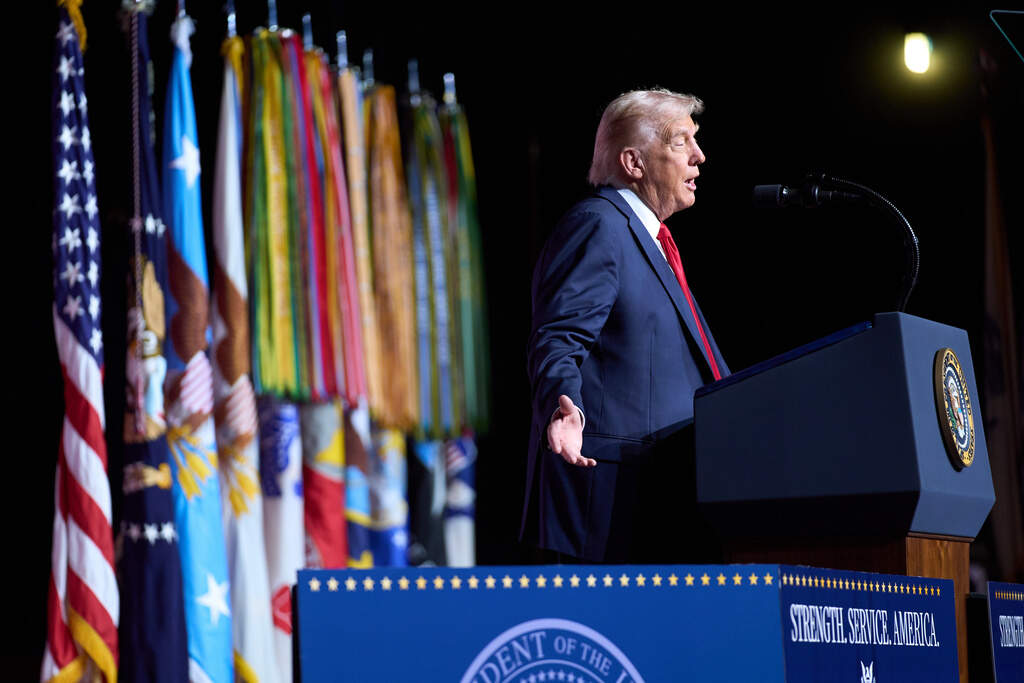
In recent speeches to the U.S. military, President Trump has laid out a politicized vision for America's armed forces. How Trump could change what the U.S. military is for, who it serves and who it’s fighting against.
Guests
Colonel Larry Wilkerson, retired United States Army Colonel and former chief of staff to United States Secretary of State Colin Powell.
Colonel Douglas Macgregor, retired U.S. Army Colonel and combat veteran.
Also Featured
Geoffrey Corn, law professor and director of the Center for Military Law and Policy at Texas Tech University.
The version of our broadcast available at the top of this page and via podcast apps is a condensed version of the full show. You can listen to the full, unedited broadcast here:
Transcript
Part I
PETE HEGSETH: Good morning.
AUDIENCE: Morning.
HEGSETH: Good morning and welcome to the War Department. Because the era of the Department of Defense is over.
MEGHNA CHAKRABARTI: That was Secretary Pete Hegseth talking to a room full of more than 800 U.S. admirals and generals last week at the Quantico Marine Base in Virginia.
In an unprecedented meeting, top military leaders were gathered from around the world to hear their defense secretary and commander in chief tell them that change is coming.
DONALD TRUMP: Secretary Hegseth beautifully described the name change, reflects far more than the shift in branding. It's really a historic reassertion of our purpose and our identity and our pride.
CHAKRABARTI: In a 73-minute speech, President Trump told senior military officials that America is at war, but not with a foreign enemy. An enemy here on American soil. In quote, inner cities, but not just any cities. Ones run by, quote, radical left Democrats. The president then told the room of generals and admirals that, quote, we're going to straighten them out one by one.
TRUMP: Last month I signed an executive order to provide training for quick reaction force that can help quell civil disturbances. This is going to be a big thing for the people in this room because it's the enemy from within. And we have to handle it before it gets out of control. It won't get out of control, once you're involved.
CHAKRABARTI: Thus far, President Trump has deployed Federalized National Guard Troops to Los Angeles, Washington, D.C., Memphis, and Portland, Oregon. But Trump says he plans to send more soon. To places such as Chicago, San Francisco, and Baltimore, cities that all happen to be led by Democratic mayors.
TRUMP: But I want to salute every service member who has helped us carry out this critical mission.
It's really a very important mission, and I told Pete we should use some of these dangerous cities as training grounds for our military. National Guard, but military.
CHAKRABARTI: When addressing the military thus far in his second administration, President Trump has unfailingly done this. Cast Democrats as the party that disrespects the military. Cast U.S. cities as places so dangerous that only military intervention can save them. Cast anyone who disagrees with him as radical leftists whom the military should consider the enemy.
So under the current Trump administration. What is the purpose of the United States Armed Services? Who does it serve? And who is it fighting against? In a few moments, we're going to hear from a senior military leader who served in the first Trump administration, but let's start with Colonel Larry Wilkerson.
He's a retired United States Army Colonel. He served for more than three decades in the United States Army and also as former chief of staff to then U.S. Secretary of State Colin Powell, and also when Powell was head of the Joint Chiefs. Colonel Wilkerson also happened to be director and deputy director of the U.S. Marine Corps War College at Quantico, Virginia back in the late '90s.
Colonel Wilkerson, welcome back to the show.
COL. LARRY WILKERSON: Good to be with you, Meghna.
CHAKRABARTI: Can I just lean on your Quantico experience for a moment and ask you, given that you've walked those same halls, what was your reaction, your overall reaction to both Secretary Hegseth and President Trump's speech before the gathered brass?
WILKERSON: That it was one of the, if not the most, with regard to the military, bizarre things I had ever witnessed. I had to watch it several times to get myself to believe what I was watching. And there were three dimensions of it. Lots of dimensions of it. I could go on all day about it, but there were three that truly disturbed me.
It was one of the, if not the most, with regard to the military, bizarre things I had ever witnessed.
Larry Wilkerson
One was Hegseth himself, who has the depth of knowledge and experience in the military to talk about maybe platoons, maybe companies, but certainly not any higher than that. The second thing that, and some of the things he said that change 150 plus years of warrior ethics, if you will, magnified majorly recently.
Recently, in terms of that 150 years by the Nuremberg Trials and the Geneva Conventions produced afterwards, with which we had a heavy hand in crafting. The second thing that really troubled me was the silence of the lambs. That's what I'll call it. No one in the audience saying anything, including the Southern command commander who is now supervising extrajudicial, violative of international law and domestic law, killings on the high seas.
And then the third thing that bothered me was what you animated in your opening remarks there, the politicization of the military. And principally to go after his political opponents in their strongholds. All three of these things truly troubled me.
CHAKRABARTI: Can you explain a little bit more about what you're telling, talking about regarding the reversal of 150 years of military tradition that also goes against, as you said, the hand that we played in creating the Geneva Conventions and the Nuremberg trials.
WILKERSON: Surely. There was no more circumspect a warrior and political expert, military expert, et cetera, than George Washington, and Washington was so careful. He even read a lot of the dispatches that Alexander Hamilton prepared for him and changed wording because he was very careful to make sure that he was not, as he put it, like the British.
He wanted to treat prisoners of war well; he wanted to do things with regard to the battlefield that didn't put him in the same category as George III and his terrorists. He wanted to do things, very politically astute. He wanted to do things with his military, which was largely militia, and he insisted on.
That contrasted sharply with the British troops, because they were pretty bad with regard to the colonialists, especially when they were quartered in their homes. So he created an ethic for the military that lasted for a long time. We violated it. Of course, we violated it majorly with the Native Americans.
We violated in other places like the Philippines. Generally speaking, we adhered to what we talked about in the military all the time, especially the Army, the American warrior ethic. And Hegseth just reputed that completely on the stage, repudiated it in the name of what I call Special Operations Forces Ethics.
From whence he came, which is kill everything in sight. Clean the battlefield up later. And then to get to get to World War II and the Nuremberg Trials and to the victor belongs to the spoil is the criticism of it. But nonetheless, we saw all that had happened in that monumental conflict.
A hundred million casualties across the globe. And we said, we want something to come out of this. And we selected some people like Justice Jackson, for example, who we knew would craft the best possible law of war, if you will, post Nuremberg. And that produced, of course, the Geneva Conventions. And all the things we've been going on since.
And we have more or less tried to adhere to that. Look what we did with the My Lai massacre in Vietnam. We tried to cover it up, but then it came out and we then tried to deal with it. We have had problems, no question about it. We have tortured in the Philippines in particular, but we have never had from the presidential office, if you will, authorization for torture as we have with George W. Bush, in my administration.
And that started this off with the Patriot Act and other things. And Trump is really just bringing to ultimate fruition and for political purposes more than anything else, what my president George W. Bush started, which was not a good thing to start.
Especially with regard to the military.
CHAKRABARTI: Understood. Okay. So Colonel Wilkerson, stand by for just a moment because I would like to bring in Colonel Douglas Macgregor. He's a retired U.S. Army Colonel and Combat veteran, served from 1976 to 2004, and he's also former senior advisor to then Acting Secretary of Defense, Chris Miller, that was in President Trump's first term from 2020 to 2021.
Colonel Macgregor, welcome to On Point.
COL. DOUGLAS MACGREGOR: Thank you.
CHAKRABARTI: I just want to play another clip from what the president told the gathered brass in Quantico last week, because to me it's the closest I've heard the president come to articulating essentially what I might call now a Trump doctrine for the United States military.
So here it is.
TRUMP: But together with many of you in the room, we've brought back the fundamental principle that defending the homeland is the military's first and most important priority. That's what it is. Only in recent decades did politicians somehow come to believe that our job is to police the far reaches of Kenya and Somalia while America is under invasion from within.
We're under invasion from within. No different than a foreign enemy, but more difficult in many ways. Because they don't wear uniforms. At least when they're wearing a uniform, you can take 'em out. These people don't have uniforms. But we are under invasion from within. We're stopping it very quickly after spending trillions of dollars defending the borders of foreign countries.
With your help, we're defending the borders of our country from now on. We're not gonna let this happen.
CHAKRABARTI: Colonel Macgregor, respond to that. Because it seems as if the president is saying quite clearly that the U.S. military's primary posture should now be essentially boots on the ground within the United States.
MACGREGOR: I'm not sure that I would interpret it as you just have. I know that having spoken to him privately years ago, that he was very frustrated with the fact that we were prepared to spend all sorts of money, commit large numbers of forces to the defense of other people's borders.
And he didn't want to do that, and I happen to agree with him. I thought that most of our forces that are overseas at the moment should be back in the United States. I'm not just talking about the Army and Marine Corps, but also the Navy and the Air Force. In other words, let's change the posture to fundamentally hemispheric defense.
[Trump] ... was very frustrated with the fact that we were prepared to spend all sorts of money, commit large numbers of forces to the defense of other people's borders. And he didn't want to do that, and I happen to agree with him.
Colonel Douglas Macgregor
And first and foremost, defense to the continental United States. That is a mission of the United States Army, by the way. And that has nothing to do with internal national defense, that has everything to do with the borders and coastal waters and airspace in and around the United States. And I happen to think that's a very good thing.
I'd like to get most of the troops that are sitting in places like Germany, Korea, The Middle East, back to the United States. I don't think they should be overseas anymore. This is part of the Empire problem. It's a huge drain on us, and it's worn out and exhausted the Armed Forces.
Part II
CHAKRABARTI: Colonel Wilkerson, following up on what Colonel Macgregor was saying there before the break, here's another clip from the president. It actually, it seems like he's directly responding to criticisms from, coming from people who say, no, the U.S. military shouldn't be primarily focused on domestic peacekeeping or the protection of the actual borders of the United States.
So here's what he said once again, in that speech at Quantico last week.
TRUMP: Our history is filled with military heroes who took on all enemies, foreign and domestic. You know that phrase very well. That's what the oath says. Foreign and domestic. We also have domestic. George Washington, Abraham Lincoln, Grover Cleveland, George Bush, and others all use the armed forces to keep domestic order in peace.
Many of our leaders used the military to keep peace. Now they like to say, oh, you're not allowed to use the military.
CHAKRABARTI: Colonel Wilkerson?
WILKERSON: There's a real way to look at that and there's another way to look at that. There's several ways to look at it actually. I was there in '92 when H.W. Bush used the military in Los Angeles, for example, and I was there when Colin Powell went over as chairman to the White House.
With the Secretary of Defense's permission and talked President Bush into doing the whole operation a lot differently than he had contemplated. So there is a way to use force domestically, and then there's a way you shouldn't use force domestically, and one of those ways is not to fight your political enemies in their strongholds.
There is a way to use force domestically, and then there's a way you shouldn't use force domestically. And one of those ways is not to fight your political enemies in their strongholds.
Colonel Larry Wilkerson
And let me back up a little bit, and I'm not taking exception to what Doug said, but for the period 1945 to the turn of the century. Every president agreed with this, and both political parties agreed with it. The decision made in '43 and '44, and it was made that early by people like George Marshall and Admiral King and others, and Franklin Roosevelt, was that we would not get caught again.
We would defend forward as it were. And so that's why we put troops overseas. That's why we formed alliances with Korea, Japan, NATO, and other places. Even more alliances than that. Some of them went more done really early, but that was our strategy. I agree with Doug that it's time we probably revisited that strategy.
And focus more on the Western hemisphere, partly because the empire is losing power rapidly and we don't have the power to focus anymore like we have across the globe. But that doesn't mean you turn the military into a political instrument. And that's what I read in both Hegseth's and President Trump's remarks.
CHAKRABARTI: Okay. So Colonel Macgregor, on that point, let's once again hear more of what the president said about how he wants to use, or actually, in fact, currently is using certain parts of the military domestically. And here's more of what he said.
TRUMP: Washington, D.C. went from our most unsafe city to just about our safest city.
In a period of a month. We had it under control in 12 days, but give us another 15, 16 days. It was, it's perfect. And people, other than politicians that look bad, they think, the Democrats run most of the cities that are in bad shape. We have many cities in great shape too, by the way.
I want you to know that. But it seems that the ones that are run by the radical left Democrats, what they've done to San Francisco, Chicago, New York, Los Angeles, they're very unsafe places and we're going to straighten 'em out one by one. And this is going to be a major part for some of the people in this room.
That's a war too. It's a war firm within. Controlling the physical territory of our border is essential to national security. We can't let these people in.
CHAKRABARTI: Colonel Macgregor, here's where I think the President in fact is echoing exactly what Colonel Wilkerson's concerns are, that he's explicitly speaking about cities that are run by Democratic mayors.
He acknowledges there's other cities in the United States that aren't run by Democrats. But he doesn't seem to also acknowledge that those cities, as well, have unauthorized immigrants, they have drug problems, they have crime, but they're nowhere near on his radar. So how can we do anything but wonder if the president is trying to overtly politicize the military?
MACGREGOR: The military has been politicized for some time. Unfortunately. That's not a new phenomenon in the history of the United States. Having said that, if you look at the top 10 cities in terms of population size, they are in fact all run by Democratic administrations. I'm originally from Philadelphia.
I grew up in that city at least until 1969. And that city is a catastrophe, and it's been a catastrophe for a long time. I hope that they'll consider going into Philadelphia because I don't know that there's any alternative, but to use the National Guard. And that may not be enough. This is another distinction that needs to be made.
There's a big difference, frankly, from federalizing Guard troops and using regular Army or Marines. And let me be explicit about that. When you federalize a national guard, ideally the National Guard should come from the area where they're being employed. They're not usually sent all over the countryside.
The reason for that is they're citizen soldiers and it's expected that they will have a direct connection to the population. Now, sometimes, as we found in 1968, during the riots, the National Guard could not master the situation, and in Detroit, for instance, in the summer of 1968, we had to send in troops from the 82nd Airborne Division.
It all depends on the level of violence, the resistance to lawful authority. These are the things that constitute the decision-making process. I think it would be a mistake to assume that President Trump expects to use the regular Army and the Marines. Now, we did use Marines out in Los Angeles to help the ICE agents.
We did that because they were readily available and could be quickly deployed. I don't recall any problems with the Marines. I think they did a great job. If I look at Washington, D.C. and I certainly have lived close to Washington for several years. I think the National Guard in Washington, D.C. has done an excellent job.
An awful lot depends on how you approach it, and you want the local police to be in the lead, and the military inevitably is there to support and only intervene when the police can't handle it. Just as you only intervene with regular Army or Marines in the event that the National Guard can't master the situation.
Now Trump's hyperbolic rhetoric and reckless language are a problem. I don't dispute that. And I find it very disappointing sometimes the way he articulates the purpose, the mission. But I know what he's looking for and what he wants to do is something I'd like to do. The area where I grew up in has been a war zone now for 40 years.
It's a disgrace and the criminality is widespread, and nothing has been done about it. In fact, things are worse. I see this in Baltimore every time I take the train up to Philadelphia and I just want to hang my head in shame at how badly these cities look and how badly policed they are. And I don't blame the police in many cases, because in some cases, obviously they're afraid to even intervene for fear that they will be charged with crimes.
But these things are massive. Anybody who [has] spent any time in any of the nation's largest cities know we have a huge problem in our urban areas with criminality.
Anybody who [has] spent any time in any of the nation's largest cities know we have a huge problem in our urban areas with criminality.
Colonel Douglas Macgregor
CHAKRABARTI: So Colonel, if I may, as this is a national show, you are directly speaking to people who are living in those very places right now.
And I think, I know you'd get a variety of opinion on what you just said. But let me ask you. When you say you wish that, for example, in Philadelphia, that the military could go in, specifically, what would you have them do that law enforcement has not done? Or has been, in your view, incapable of doing so far in order to, I don't know.
Are you talking about rooting out drugs? Are you talking about unauthorized immigrants? What specifically would you have the military do?
MACGREGOR: You can come up with a whole list. You just named some of the things, but the military --
CHAKRABARTI: I named the problems, but I'm wondering, what I'm asking is what you would have the members of the military do.
In those cities, what would they do?
MACGREGOR: As I pointed out earlier, first of all, you take the local police, and you closely integrate with them, and you support them. And when they run into hard resistance to arrest or outright violence against the police, then the military steps up to the plate and assists the police.
This is not a case of where you appoint a major general with 30,000 troops, which is being done by the way, and put him entirely in charge. We did that under JFK, we did it under Eisenhower with 101st, and in Washington, D.C. we had thousands of troops that went in because they were burning down shops in riots and property damage in Washington within blocks of the White House.
But that's not necessarily what Donald Trump is talking about. I think he's just talking about ensuring that the police can do their jobs and that these criminals are arrested, they're incarcerated, and eventually tried. That's what I think he's talking about. I don't think he's talking about wholesale military occupation.
CHAKRABARTI: Let me go back to Colonel Wilkerson. You heard Colonel Macgregor say a minute or two earlier that there's essentially no other options, no other choice in some of these cities. What do you think?
WILKERSON: I would point Doug to the, and I know he is probably read it, the very brilliant op-ed that Judge Napolitano put in the Washington Times recently. And his disquisition on James Madison, the father of the Constitution and on where security belongs in a federal republic. And it belongs with the people.
And with the people's state representatives, this used to be a mantra of my political party, Republican Party, to the state and the people remain all else that's not articulated in the Constitution. When you federalize security, under any guise than a total insurrection, which I think is what Trump is trying to produce, maybe not Trump per se, but the people around him like Steve Miller and others.
Then you're using it in a way that is not constitutional, and it goes against every grain and every fiber of what we stand for. Furthermore, I've lived in Washington, D.C. for 35 years. My granddaughter went to college in Baltimore. My other granddaughter went to college in Chicago. She used to walk from her dorm to her classes, and they're spread all over the city of Chicago.
When you federalize security, under any guise than a total insurrection ... then you're using it in a way that is not constitutional.
Colonel Larry Wilkerson
And I asked her one night when I was visiting with her, I said, are you afraid? She says, no, I'm not afraid. This is, at that time, a 19-year-old young lady who's walking around in Chicago. I'm not quite sure where Doug gets his appreciation of the problems in the cities. Now, I'll admit having been in and out of Baltimore at least a thousand times, that there are problems there, but those problems are mostly based on the fact that we still have not solved.
And the Republican party is a big part of this. I won't spare the Democrats either. We've not solved the issue of race in America. We have not solved it. And what we've done with desegregation in many respects is to resegregate, but under the covers as it were, and to destroy the ethics and family values that existed in the Black communities before we did it.
Alma Powell used to tell me all about how she thought Blacks had a better situation in cities in particular when they were segregated than after desegregation. So this is a much bigger problem than crime and the kinds of things that my political party is always citing. It's a problem of race and it is very much still a problem of race.
CHAKRABARTI: Colonel Macgregor, before I come back to you, I just want to remind folks that earlier this week we actually put the call out to On Point listeners who are also either current members of the United States military or veterans, to ask them what they thought about the president and the secretary's recent speeches and the direction that they want to take the military.
And we got quite a few responses, so let's just listen to at least two of them before our next break. Frank Winston lives in Beaufort, South Carolina. He's 26 years old and he just got out of the Marines only a year and a half ago, and here's what he thought about President Trump's recent speeches.
FRANK WINSTON: I voted for Trump. All right. I'm a Trump fan myself, but I felt as if it almost crossed a line, right? And what I mean by that is that while, yeah, he's the commander in chief, he's never been in the military. Not only that, he dodged the draft or got out of Vietnam with the bone spurs or whatever it was.
So I don't like him coming up and saying what the status quo should be when he hasn't been in it. There's some things that Hegseth said that I agree with. We shouldn't have beards in the military and we should be in good shape in the military. All this other woke nonsense and everything, especially talking about women in the military, I trust them more than I trust most of the citizens in the country. And I think that they are a big part of the backbone. And I'm just displeased; I'm still going to be a Trump voter. I still support Trump, but I think he's just got his finger in the wrong pie on that one.
CHAKRABARTI: So that's Frank Winston from Beaufort, South Carolina, when he mentioned women in the military.
That's not actually something we brought up in the course of this hour yet, but of course Secretary Hegseth especially has raised concerns about women in combat roles. Here, in fact, is a woman member of the military, Alisha Kleinman. She's in Miami, Florida. She served for 18 years in the military, and she says she wore the uniform with pride through every administration that she's served.
Here's how she feels after hearing President Trump's recent speech.
ALISHA KLEINMAN: I felt something I've never felt in nearly two decades of service. That my own government might despise me for who I am and for what I believe. I stood beside sailors and soldiers of every background, race and political view, and we've always had one mission.
I felt something I've never felt in nearly two decades of service. That my own government might despise me for who I am and for what I believe.
Alisha Kleinman
And that's to protect this nation together. I don't feel like any service member should ever feel fear, shame, or rejection from the leadership we serve under. Patriotism isn't defined by party lines, and love for country isn't reserved for one ideology. With that said, I am proud of my service, proud to defend democracy, and proud to be an American no matter who tries to tell me that I don't belong.
Also, as a female, just another thing that strikes fear in my heart, and it's a shame. It's honestly a shame. It's not the America that I grew up in. It's not the ideals that I swore to protect.
CHAKRABARTI: That's Alisha Kleinman. She served for 18 years in the military. Colonel Macgregor, we have about a minute before our next break.
Would you like to respond to these two service men and women.
MACGREGOR: I have to think about it. The first thing is that decisions on the composition of a military organization are not up for democratic decision. Either something or someone is a liability or an asset. We have concluded over many years, I would say roughly the last 5,000 years, that women on the battlefield inside combat units are a liability, not an asset.
That doesn't mean we don't like women. It is simply a fact of experience based on thousands of years of warfare. The other thing is, I'm not sure we're talking about the same kinds of things. There is nothing in the U.S. Constitution that stipulates that the president of the United States or the Secretary of the Service must have served in the military.
I certainly understand the man's feelings about President Trump. And I appreciate his emotion. But the truth is we've had many presidents, and the vast majority did not serve in the military.
Part III
CHAKRABARTI: Now gentlemen, I want to talk a little bit more about something that you specifically Colonel Wilkerson mentioned, and that was President Trump and Pete Hegseth's view of basically the rules of war, the rules of engagement and how they seem to be, they find those rules to be utterly contemptuous.
One thing, one concrete change that has happened under Secretary Hegseth at the Pentagon is that he has gutted offices of the judge advocate general. In February, Secretary Hegseth removed top Army Air Force, and Navy lawyers saying that the men and women in charge of assuring the military is in compliance with its own law are "roadblocks to orders that are given by the commander in chief."
Now here's how Hegseth elaborated on that at his speech before military brass at Quantico last week.
HEGSETH: War is something you do sparingly on our own terms and with clear aims, we fight to win. We unleash overwhelming and punishing violence on the enemy. We also don't fight with stupid rules of engagement.
We untie the hands of our war fighters to intimidate, demoralize, hunt, and kill the enemies of our country. No more politically correct and overbearing rules of engagement, just common sense, maximum lethality and authority for war fighters. Geoffrey Corn is a law professor and director of the Center for Military Law and Policy at Texas Tech University.
He served for 21 years in the United States Army and during that service he was a Judge Advocate General, or JAG, where he advised the army on the laws of war. He retired with the rank of lieutenant colonel. And he told us that he believes the Trump-Hegseth view of the rules of engagement have long-term consequences that are deeply troubling.
GEOFFREY CORN: The norms are changing; the guardrails are being eroded. The institutional barriers of military, a military legal corps that is indoctrinated in independent judgment, courageous counsel, speaking truth to power is being diluted.
CHAKRABARTI: Professor Corn believes that this erosion of the rule of law as he sees it, is only the beginning.
CORN: These overt messages of stupid rules, excessive force, JAGS don't matter. They are going to have a corrosive effect on respect for the rule of law. In military terms, this is not the decisive action. This is setting the conditions. This is preparing the battlefield. That's my fear, and I think it's a fear of a lot of people who've been in the military legal institution, that's what they're seeing.
You are building an architecture that allows you to do whatever you want to do, so who knows? I don't think we know how far this will go.
CHAKRABARTI: Thus far, President Trump has used the U.S. military in unprecedented ways. Colonel Wilkerson earlier mentioned those airstrikes on Venezuelan boats that were allegedly transporting narcotics.
Professor Corn believes Trump commanded the military in those cases to violate international constitutional and domestic law.
CORN: The analogy would be I'm a police officer in Boston. I know that Joe is a drug dealer. He sells fentanyl. I see him two blocks away transferring fentanyl to a buyer. Do I have the authority to take out my nine-millimeter and kill him?
We would all say that's excessive force. Go apprehend him. But that's what we're doing on an international level. We're basically saying, because you're a drug dealer bringing drugs into the United States, we can kill you as a measure of first resort.
CHAKRABARTI: And Professor Corn tells us this is his primary worry, that without guardrails, the military has become President Trump's favorite new tool in the presidential toolbox.
CORN: And what happens when your favorite tool is a hammer? Every problem starts to look like a nail.
CHAKRABARTI: And right now, President Trump sees democratically led U.S. cities as nails. And as we've discussed, thus far, Trump has deployed federalized National Guard troops to places like LA, D.C., Memphis, Portland, Oregon.
Professor Corn believes this is an abuse of statutory authority.
CORN: I think the administration is abusing the authority that Congress gave presidents to respond to an actual domestic emergency. Whether the president can get away with that is going to depend on how these appellate courts handle these district court decisions that reach that exact conclusion, that this is a pretextual assertion of emergency.
And the facts on the ground simply do not justify invoking these statutes.
CHAKRABARTI: Okay, so about that pretextual assertion of emergency. Professor Corn says he believes that the Trump administration is moving in a direction where anything it thinks is contrary to the Trump agenda, the president will ultimately deem that to be an insurrection, a domestic emergency, an attack on the government, what have you.
CORN: So he can use his favorite new hammer, the military. This is inconsistent with the deeply rooted history of the United States that requires chief executives to acknowledge that deploying the military to the streets of America from Federal authority is an extraordinary exception to the norm and should only occur in the most dire situations.
CHAKRABARTI: And the professor left us with one last thought. He reminds us that in the United States military, you take an oath to obey orders from the commander in chief. And without offices like JAG offices to guide members of the military, soldiers and officers are more or less going to have to do what the president tells them.
CORN: A philosophy of this administration, that they will push the envelope as far as they can until they're told to stop, until they're checked.
And so ultimately, whether we like it or not, the only real check here, meaningful check, is Congress.
CHAKRABARTI: Geoffrey Corn is currently a law professor and director of the Center for Military Law and Policy at Texas Tech. He's a 21-year veteran of the U.S. Army, and during his service he served as an Army Judge Advocate.
General Colonel Wilkerson. How do you respond to Professor Corn's concerns?
WILKERSON: I agree with everything he said, and I was in councils with Colin Powell, with the Vice Chairman, sometimes with the Chiefs, sometimes with others. He would debrief me on his meetings with the president, both George H.W. Bush and George W. Bush. Debrief me on his meetings with the Secretary of State.
Sometimes I would be there, and I will tell you that as a military officer, Powell was as restrained as anyone else when he wanted to do something. And the lawyer said, here's my advice, and I don't think you should do it. But he always did what they told him to do. He always corresponded with what they wanted and what they said the law advised, or just the kind of ethics that lawyer was hinting at, that you talked to there.
And I grew very respectful of him as a leader because of that. All to say that if you disregard your lawyer's advice, you better make damn well sure that you are right and the lawyer was wrong. And most often are not, the situations I've been in, the good leaders backed up when the lawyer told them what they told them.
And let me just add something else here too. When we slipped into torture, I knew that the United States had tortured people before, I knew our military, our intelligence services, in particular in Vietnam, had tortured people.
What struck me at the time we were torturing under the George W. Bush administration, was that it was articulated by the president of the United States at a National Security Council small meeting, and that it actually was promulgated throughout the military as well as the intelligence services and others. And became practice.
We actually murdered 31 people under that program. That's what happens when you disregard the lawyers and you take the law, so to speak, in your own hands. And when you do it with a military instrument or the intelligence instrument or as there, both, you are really courting tragedy.
CHAKRABARTI: Colonel Macgregor, I'm gonna turn back to you, but once again, let's have a chance to listen to some members of the military who shared their thoughts with us.
This is Michael from Stoughton, Wisconsin. He's an eight year veteran of the Air Force, and he was worried by President Trump's recent remarks.
MICHAEL: He's already weaponized the Justice Department and federal law enforcement, and I fear that he will use the U.S. military against his political enemies. But I also have faith that those high-ranking officers will stand up to him and defend the Constitution.
I fear that he will use the U.S. military against his political enemies. But I also have faith that those high-ranking officers will stand up to him and defend the Constitution.
Michael, On Point listener
CHAKRABARTI: And here is Dexter Belgard. He's in Providence Forge, Virginia former soldier himself and part of a multi-generational military family.
DEXTER BELGARD: What Trump did and what he said was the most embarrassing thing I've ever seen. I cannot believe that people fall for this crap. His ideas and his beliefs and his policies are exactly the kind of thing that the military is set up to fight against, period.
CHAKRABARTI: Now one thing that I believe both Dexter and Michael were responding to was the president's repeated invocation, again, of specifically Democrats and the Democratic party. Not only as being, in his words, incapable of governing, but also not even loving the military. So here's something he said along those lines.
Last weekend at the 250th anniversary celebration of the United States Navy in Norfolk, Virginia.
TRUMP: And I want you to know that despite the current Democrat induced shutdown, we will get our service members every last penny. Don't worry about it. Don't worry about it. Don't worry about it. Do not worry about it.
It's all coming. It's coming. And even more, because I'm supporting the across the board pay raises for every sailor and service member of the United States Armed Forces. (CHEERS)
But we have to take care of this little gnat that's on our shoulder called the Democrats.
CHAKRABARTI: Colonel Macgregor, the president also said, quote, the Democrats do not treat you with respect. They never do. That's just not true. We all know that. And so when those overtly political statements come out and to, from the commander in chief to the military, how can we interpret that as anything other than the president saying, you, American armed servicemen and women are for the Republican party.
And not for the Democrats.
MACGREGOR: You can interpret what the man says any way you'd like. You live in the United States, and we have freedom of speech. To go back to a couple of things that have been mentioned that are very important. I'm not sure what Hegseth was specifically referring to.
What I have witnessed when I went into combat in 1991, and we fought for three and a half days against the Iraqi Republic, actually Iraqi armed Forces, period. We were very concerned about opening fire in an area where there might be people who were non-combatants. As it turned out, we managed to avoid that.
But even going into combat we asked, what are the rules of engagement? And it came down to, if you can identify where the fire is coming from, if it's a built up area, in other words, an urbanized area of some kind. Not that there was much urban out in the desert. And you're absolutely sure you've taken fire from it.
Okay? You can return fire, but if you're not taking fire from any of these dwellings or homes or businesses or anything else, don't shoot at them. So I think we were very concerned in '91. I think every time I have been involved in the things like the Kosovo Air campaign or in Bosnia in '95, everyone was very concerned about that.
I don't see any evidence that's going to change. What I did see while I was on active duty, something that had happened that I think may be at the heart of what Hegseth was referring to. We had a report that came into General Wald, who was at the Combined Air Operation Center in 2001, about a caravan of white SUVs coming out of Kabul, and they had about a 90 plus percent certainty that Osama bin Laden and Mullah Muhammad in that convoy.
And so he called General Tommy Franks and said I've got, we've got about a 90% certainty that Osama bin Laden's in that convoy. I've got an unmanned aircraft overhead, a predator, can I shoot at it? And he said, wait a minute. Let me ask the lawyer, 40 minutes later we got an answer. Yes, you can shoot at it.
Obviously, he was long, long gone at that point. I think maybe that, but I don't see, I don't see any evidence that people are interested in committing crimes against civilians or humanity. This whole thing of a politicization is not new.
Franklin Roosevelt didn't give a damn who became Chief of staff of the Army because he said they're all Republicans anyway. They all hate the New Deal. And ultimately, we got George Marshall. Largely because General Pershing recommended to FDR that they pick him. We've always had a problem with that.
CHAKRABARTI: Yeah. Colonel Macgregor, point well taken. And since we're running out of time, I'm afraid I have to say goodbye to you. So Colonel Douglas Macgregor, thank you so much for joining us.
MACGREGOR: Sure. Thank you. Colonel Wilkerson, there's one last thing I wanted to actually play for you, and since Colonel Macgregor mentioned Osama bin Laden, the president said something bizarre at Norfolk Naval Base this weekend.
And here's what it was.
TRUMP: Exactly one year ago, one year before he blew up the World Trade Center, and I said, you got to watch Osama bin Laden. And the fake news would never let me get away with that statement unless it was true. But I said one year before, to Pete Hegseth, I said, one year before, where's Pete? In the book I wrote, whatever the hell, the title, I can't tell you, but I can tell you there's a page in there devoted to the fact that I saw somebody named Osama bin Laden.
And I didn't like it and you got to take care of him. They didn't do it. A year later, he blew up the World Trade Center. So we gotta take a little credit. Because nobody else is gonna give it to me. You know the old story, they don't give you credit. Just take it yourself.
CHAKRABARTI: Colonel Wilkerson, we've only got 30 seconds left, but I wanted to get your view on this since you were literally in the State Department at this time.
This seems like a total fabrication to me.
WILKERSON: Total fabrication in my mind. And Donald Trump will take claim for anything that he thinks he was extant during. In other words, if he was alive and six years old and something occurred that he can remember, and that's a difficulty for him at times.
CHAKRABARTI: But he's making decisions.
He takes credit, he's making decisions for the United States military while living in his fantasy land.
WILKERSON: I know. It's very disquieting and I don't look for a good next three or four years.
The first draft of this transcript was created by Descript, an AI transcription tool. An On Point producer then thoroughly reviewed, corrected, and reformatted the transcript before publication. The use of this AI tool creates the capacity to provide these transcripts.
This program aired on October 9, 2025.