Support WBUR
What can Americans learn from Stalinism?
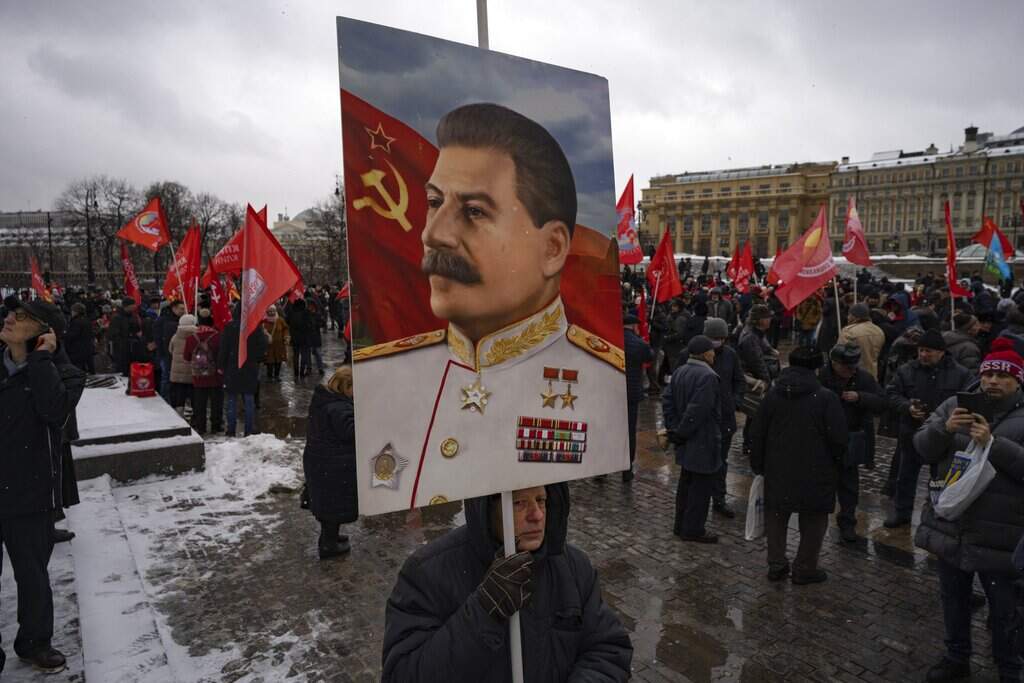
Some historians argue that President Trump is using a Stalinist-style playbook to amass power, silence his enemies and suppress science. What Americans should know about notorious Soviet dictator Joseph Stalin's style and political tactics.
Guests
Wendy Goldman, Paul Mellon distinguished professor of history at Carnegie Mellon University. Author of multiple books on Stalinism, including "Inventing the Enemy: Denunciation and Terror in Stalin’s Russia."
Also Featured
Nina Khrushcheva, professor of international affairs at the New School for Social Research.
Paul Josephson, professor emeritus of history at Colby College.
The version of our broadcast available at the top of this page and via podcast apps is a condensed version of the full show. You can listen to the full, unedited broadcast here:
Transcript
Part I
MEGHNA CHAKRABARTI: It would later be called the Secret Speech, but on February 25th, 1956, a cold morning in Moscow, no one knew what to expect. Soviet Premier Nikita Khrushchev stood before the 20th Congress of the Communist Party and did the unthinkable.
NINA KHRUSHCHEVA: It was an absolute dead silence for all four hours.
CHAKRABARTI: Khrushchev spoke of the annihilation of Soviet military commanders before the Second World War.
He excoriated the lying, the vindictiveness of his predecessor, the quote, paranoia, the persecution mania. Quote: 'Everything was decided by him alone. Without any consideration for anyone or anything,' Khrushchev said to his stunned audience. And he quoted Vladimir Lenin at length, who also had grave concerns about the man who later led the Soviet Union through the devastations of World War II.
Lenin had hoped that the Soviets might have replaced that man with someone who differed in, quote, only one quality, namely, greater tolerance, greater loyalty, greater kindness, and more considerate attitudes towards the comrades, Khrushchev recounted. In other words, quote, a man with a less capricious temper. End quote.
For four hours, Nikita Khrushchev systematically tore down the legacy of a man who many in the audience listening to Khrushchev had loved. He denounced Joseph Stalin.
Joseph Stalin led the Soviet Union for almost 30 years, from 1924 until his death in 1953. A period which included the catastrophe of World War II when more than 20 million Soviet civilians and soldiers died holding back Nazi Germany and Imperial Japan.
The Communist Party's purpose was to ease the suffering of people under the capitalist yoke, Stalin said in his final public speech, given in 1952. The party had fulfilled this hope, he said, smashed the German and Japanese tyranny and liberated the people of Europe and Asia from fascist slavery. End quote.
What Stalin did not mention was the tyranny he had imposed upon his own people. In 1956, that was what Nikita Khrushchev intended to expose in the secret speech.
Nina Khrushcheva is the great granddaughter of the former Communist Party leader and a professor of international affairs at the New School in New York City.
NINA KHRUSHCHEVA: It was a very long four-hour speech where he outlined the problems with Stalin. There was, of course, contradiction. Stalin was a great Leninist. He was a great communist. Oh, but he killed all these people, and he was not doing the right thing. And all his colleagues were eliminated with no crimes whatsoever.
It was a very long four-hour speech where he outlined the problems with Stalin.
Nina Khrushcheva
CHAKRABARTI: Stalin used, quote, extreme methods and mass repressions at a time when the revolution was already victorious, Nikita Khrushchev said in 1956.
The Soviet State was strong. Yet, from 1936 to 1938, Stalin instituted what became known as The Great Purge, when, as Khrushchev told the stunned audience, quote, Stalin showed in a whole series of cases, his intolerance, his brutality, and his abuse of power, instead of proving his political correctness and mobilizing the masses.
He often chose the path of repression and physical annihilation, not only against actual enemies, but also against individuals who had not committed any crimes against the party and the Soviet government. End quote. Nina Khrushcheva says it was the first time many in the party got the full picture of what had been happening.
KHRUSHCHEVA: And my grandmother was saying that telling me that he was, he thought he would get arrested. He thought he would get killed. He thought he would never come back in one piece. So he was incredibly nervous.
CHAKRABARTI: The speech was about three years in the making. Khrushchev had been consolidating power behind the scenes before finally publicly denouncing Stalin's legacy.
This, despite the fact that he himself was a major figure during a brutal dictatorship where millions were executed, starved, or sent to Gulag labor camps.
KHRUSHCHEVA: He was probably the only one of that whole dozens of people who were in a high position of power, to say that, his exact expression, my arms are in blood up to the elbow.
And he was the only one who to say that, everybody else was explaining it or saying Stalin was right. And we needed to do that because the enemies all around. And Khrushchev was saying you cannot have the whole country of enemies. It just doesn't, like what then what are we leading if the whole country is of enemies?
And at the beginning when he was leading towards the secret speech, when he was still trying to convince his colleagues, he said, we need to repent. We need to repent.
CHAKRABARTI: Though Khrushchev's expose became popularly known as the secret speech. Its formal title and the official state report that came with it are even more revealing.
It's called On the Cult of Personality and Its Consequences.
Comrades, Khrushchev said, the cult of the individual acquired such a monstrous size, chiefly because Stalin using all conceivable methods to support the glorification of his own person. End quote.
Khrushchev said, those around Stalin, willingly, quote, used the most dissolute flattery, made Stalin into a Godhead, transforming him into an infallible sage. End quote. They believed Stalin's own description of himself as, quote, the greatest leader. Quote, sublime strategist of all times and nations. Quote, finally, no other words could be found with which to lift Stalin up to the heavens, Khrushchev said.
Comrades, it is impermissible and foreign to the spirit of Marxism-Leninism to elevate one person, to transform him into a superman possessing supernatural characteristics akin to those of a God. Stalin practiced brutal violence, not only against everyone who opposed him, but also against anything that seemed contrary to his despotic and capricious character.
Stalin acted not through persuasion, explanation and patient cooperation with people, but by demanding absolute submission to his opinion. Whoever opposed his viewpoint was doomed to moral and physical annihilation.
CHAKRABARTI: That dramatic reading of a translation of the secret speech comes from a 2006 radio documentary from American Public Media.
Once again, Nina Khrushcheva, Nikita Khrushchev's great granddaughter, and a professor of international affairs at the New School in New York City.
KHRUSHCHEVA: It was an absolute shock, but Khrushchev didn't get arrested. And that's what's so interesting about dictatorship. So dictatorial mindset, as Russia is, as Soviet Union was, absolute monarchy was. The party says things are like that, and then suddenly everybody is expected to live according to that. So five minutes before that, Stalin was God, and now he was a criminal and the whole country of 300 million people was supposed to follow this new formula. So that also was a difficult transition.
Wendy Goldman joins us now. She's the Paul Mellon Distinguished Professor of History at Carnegie Mellon University. She's a social and political historian of Russia and author of multiple books on Stalinism, including Inventing the Enemy: Denunciation and Terror in Stalin's Russia. And she joins us today from WESA in Pittsburgh, Pennsylvania.
Professor Goldman, welcome to On Point.
WENDY GOLDMAN: Thank you for having me, Meghna.
CHAKRABARTI: How much of a shock was Khrushchev's speech to the Soviet, the Communist Party and the Soviet people more broadly?
GOLDMAN: I think it was an enormous shock. It was a shock to all of the people that listened to him for hours in the hall.
And it was also a shock for the country. Because there were large changes that had to take place in order to de-Stalinize the country.
CHAKRABARTI: But why was it such a shock? Because, perhaps with the 2020 hindsight of history, Stalin's depredations are well known now, were they not so well known in Stalin as Russia?
GOLDMAN: I don't think that the numbers were known. I don't think that the degree of the terror and its impact from the late 1930s was fully known. And I also think it was a terrible shock to have lived within a kind of cult of personality which Nina Khrushcheva described, and then to all of a sudden have the next leader of the country talking about a cult of personality.
CHAKRABARTI: Okay, so there's that phrase, cult of personality. Correct me if I'm wrong, Professor Goldman, but that emerges from Marxism itself, or is it even older than that?
GOLDMAN: I'm actually not sure where that phrase comes from.
CHAKRABARTI: Okay. My understanding is from having read Khrushchev's speech, once again, he dates it back to Karl Marx.
But the idea is that, what? There is such a cult around an individual figure that anything is possible if done by that figure.
GOLDMAN: The cult of personality functioned in a variety of ways. For example, in every institution, in every office, in every school room, there were portraits of Stalin.
The cult of personality functioned in a variety of ways. For example, in every institution, in every office, in every school room, there were portraits of Stalin.
Wendy Goldman
People doing dissertations on mathematics had to have an opening paragraph. Even though their work had nothing to do with Stalin, thanking Stalin for his insights into the field, it permeated everything.
CHAKRABARTI: Thanking insights, thanking Stalin for insights. Okay, so we have invited you on today, Professor Goldman, to talk about what Stalinism actually is and was. Because quite a few historians and thinkers out there have wondered out loud whether the United States right now under Trumpism has anything to learn from Stalinism.
What would be your answer to that?
GOLDMAN: I think that there were certain signposts which were important on the road to terror in the 1930s, and I think these signposts are important for Americans to learn to recognize. So it's not that there's a direct comparison necessarily. And comparisons, I think, as many people have said, can be very easy or facile.
There were certain signposts which were important on the road to terror in the 1930s. ... These signposts are important for Americans to learn.
Wendy Goldman
But in terms of looking at signposts, I think these are important, and I could talk a little bit about what some of them were, if you'd like me to.
Part II
CHAKRABARTI: Let's go through those signposts that you say that Americans should pay attention to now. What would be your first, most important one?
GOLDMAN: The first thing is that the terror did not dawn overnight. People did not wake up to a terror. There was a slow escalation, and I think it's important for people to see and understand how that happened.
CHAKRABARTI: Actually, professor, before we get to how that happened, it occurs to me that there may be some folks listening who don't exactly know what you mean when you say the terror.
Can you explain what that was and then we'll go to the signpost.
GOLDMAN: What we call the terror was a series of mass repressions that occurred in the Soviet Union that began after one of the leaders of the Communist Party, Sergei Kirov, was assassinated at the end of 1934. And after that, we see a pattern by which there are a series of arrests in the hunt for Kirov's assassin.
And those arrests then become larger and larger as they widen out to engulf all of society. The period of the terror lasts from roughly, I would say 1935 to 1939, and its height was 1937, 1938.
CHAKRABARTI: It would seem to make sense though that there would be some kind of nationwide search for a political assassin.
GOLDMAN: Of course, and that was the assassination of Kirov, was what we might think of as a trigger event. People were appalled. The nation went into mourning, and initially what we call the terror actually began as an anti-terrorist campaign. In other words, it was a campaign to discover Kirov's assassin, which they did very quickly, but then that hunt began to grow larger and larger.
So the second signpost that I think it's important for us to look at is that dissent then is reclassified as domestic terrorism. And that's something that is really important when that happens, that those words, domestic terrorism, the assassin was arrested, he was interrogated and then circles around him began to be arrested and interrogated.
And at that point, I would say the party leadership over time was convinced that there were actually hidden networks of domestic terrorists, and those were people mainly who had adopted dissenting views in the 1920s during the great debates over how the Soviet Union should move forward, both politically and economically. So members of the left opposition were arrested.
Then members of the right opposition were arrested. And what we have as a situation is from that trigger event, the reclassification of dissent as domestic terrorism. So that's our second signpost. We then have a third signpost. People were encouraged to inform on coworkers, colleagues, their teachers, if they had any suspicions about them, and the country was basically told, don't worry about whether you have any evidence.
If you hear somebody say something that makes you suspicious about their political beliefs or opinions, just go ahead and inform. You can inform the NKVD, that's the political police, or you can inform your employer. You can inform a member of the party. You can just inform anyone. And that of course led to a mass wave of denunciations that swept the country and widened the terror even further.
CHAKRABARTI: Okay. Professor Goldman. Just a few days ago, Timothy Snyder, the historian whom I know you know very well, he's also a historian of Russian and Soviet history and that of the Eastern Bloc, the former Eastern Bloc as well. On his Substack, he posted a video where he goes into detail about why he believes there may be some similarities between Joseph Stalin.
And not Donald Trump specifically, but he points to Stephen Miller, the current White House deputy Chief of Staff. And actually, the first similarity that Snyder pointed to is exactly the one that you did, and that is that trigger event of the murder of Kirov.
TIMOTHY SNYDER: And then to move from there to the claim that they were giant but unseen conspiracies inside the Soviet Union, linked to vast powers beyond the Soviet Union, whose only goal was to destroy Soviet power, and, of course, make life difficult for Stalin himself.
He proceeded on various versions of that plot to move through waves of great murderous terror in 1937 and 1938. All of them, whether they be show trials or whether they be much more silent, but much larger mass killing operations, depending upon various non-existent plots.
Now, of course, Mr. Miller isn't that far along yet, but in the last few days, he's shown a remarkably consistent propensity to insist on the existence of vast conspiracies inside the United States, linked of course to vast forces beyond the United States with the goal of destroying American power or making life difficult for Mr. Miller himself.
CHAKRABARTI: So that's historian Timothy Snyder. Let's listen to Stephen Miller, actually himself, he appeared with Vice President JD Vance on Charlie Kirk's show, and this was the Monday after Charlie Kirk was assassinated.
And Miller talked about channeling his angry and sad emotions about Kirk's assassination to create a, quote, organized strategy to go after the left-wing organizations that are promoting violence in this country.
STEPHEN MILLER: The thing about anger is that unfocused anger or blind rage is not a productive emotion.
JD VANCE: Right.
MILLER: But focused anger, righteous anger, directed for a just cause is one of the most important agents of change in human history.
VANCE: Charlie showed that. Amen.
MILLER: And we are going to channel all of the anger that we have over the organized campaign that led to this assassination to uproot and dismantle these terrorist networks.
CHAKRABARTI: Okay. Here is President Trump himself. Actually, just a year ago yesterday, October 14th, in 2024 when he was on Fox. And host Maria Bartiromo asked the president if he was worried about outside agitators disturbing election day. This was then when he was candidate Trump, and here's how he responded.
DONALD TRUMP: I think the bigger problem is the enemy from within. Not even the people that have come in and destroying our country. By the way, totally destroying our country. The towns, the villages, they're being inundated.
But I don't think the other problem, in terms of election day, I think the bigger problem are the people from within. We have some very bad people. We have some sick people, radical left lunatics. And I think they're the, and it should be very easily handled by, if necessary, by National Guard or if really necessary, by the military, because they can't let that happen.
CHAKRABARTI: And of course, subsequently as president, President Trump this year has actually deployed National Guard to several U.S. cities.
Professor Goldman, can you touch on what your thoughts about what Snyder said earlier? And then we heard echoed in these cuts from Stephen Miller and President Trump about the fear of a broader conspiracy.
GOLDMAN: I would very much agree with what Tim Snyder said, but I would broaden it somewhat. Okay.
When we listen to these quotes from President Trump or from Stephen Miller, one of the things that is of great concern is not just a question of single individual, but it's the ways in which large numbers of people in a country, be it Americans here in the United States or Soviet citizens in the Soviet Union can come to believe the narratives that are being promulgated from above.
So for example, this is a direct quote from Stephen Miller. He says, we are going to use every resource we have to dismantle, disrupt, and destroy these networks and make America safe again for the American people. Now, this appeal to the American people is really dangerous because what it does is it puts out the idea that there are hidden enemies.
That's a direct almost a quote from the terror of the 1930s. That there are hidden enemies lurking in all kinds of places. That those hidden enemies, those networks, those cells, and these are all quotes from the Trump administration, have to be rooted out. And exposed.
CHAKRABARTI: Are you saying that Stalin himself used the language of hidden enemies of the people, that kind of thing?
GOLDMAN: Absolutely.
CHAKRABARTI: Tell me more about what he said.
GOLDMAN: It wasn't just Stalin, it was the entire party and the newspapers the radio the schools. Everyone during the terror was talking about hidden enemies, or they called them at the time, masked enemies. Enemies of the people, saboteurs, people who were lurking in all kinds of capacities.
The fact that they were masked meant that you might not recognize them right away. And then you had a mass campaign whereby all accidents at the workplace, anything that went wrong, any problem, were blamed on hidden wreckers or saboteurs. So in this sense, the terror began to engulf the entire country.
It wasn't just a question of one man, namely Stalin. It was a terror that engulfed every institution and was believed, actually, by many Soviet citizens who participated in the hunt for enemies, and that's what's really scary. Because that's what dismantles a democracy.
It was a terror that engulfed every institution and was believed ... by many Soviet citizens who participated in the hunt for enemies. And that's what's really scary. Because that's what dismantles a democracy.
Wendy Goldman
CHAKRABARTI: There's a way in which Stalin's spreading of terror throughout the Soviet Union had an impact, not just on people and Stalin's perceived enemies, but on the very sort of functioning and development of the country itself. Lots of folks have pointed to Stalin's impact on the development of Soviet science.
Can you talk about that briefly?
GOLDMAN: I think Stalin really got involved in Soviet science in the period after World War II. And there were all kinds of debates about genetics. And Stalin weighed in on the side of scientists by the name of Lysenko. And this was one of the things that really set back Soviet science immensely.
But it wasn't just science. By the time the late 1940s and 1950s, Stalin was getting involved in just about every area of culture and of science, linguistics, philosophy that you can imagine. And this, of course, had a terrible impact on the development of creative thought and on the development of science.
CHAKRABARTI: I want to stick with Lysenko for just another minute because as you said, he's a scientist who studied agronomy and horticulture before Stalin came into power. But he rejected modern theories of genetics, for example, he believed that plants could be trained to adapt to any condition if you subjected in this, for example, cold air repeatedly. So that they could maybe grow north of the Arctic Circle.
PAUL JOSEPHSON: He believed that by changing the environment, he could provoke changes in grain, animals, tomatoes, what have you, and make them highly productive, much more highly productive than in capitalist systems.
CHAKRABARTI: Paul Josephson is a history professor at Colby College, and he says, Lysenko's promises sounded good to Joseph Stalin, who was then trying to feed a hungry nation.
JOSEPHSON: Stalin was impatient and Stalin wanted Soviet agriculture to be independent of world agriculture. Lysenko seemed to promise this, but it was all quack biology. It was biology that would operate animal husbandry, plant science, soil science without any understandings of genetics or modern evolution.
CHAKRABARTI: In 1940, Lysenko became director of the Institute of Genetics of the Soviet Academy of Sciences, and Professor Josephson says that he used his position to suppress and even imprison scientists who disagreed with him.
JOSEPHSON: Geneticists were fired. Genetics books were moved out of libraries. Genetics research almost ceased.
Some geneticists were arrested and put in labor camps. Some of them died. This is not the way you do science. You have scientific disputation based on discussion. And a repetition or failed repetition of published results. None of that was happening from the late 1940s, and it has set back genetics in Russia. One could argue to this very day, that is 60 years later.
CHAKRABARTI: Across the Soviet Union, farmers also planted their seeds too close together because of Lysenko's false claims that plants of the same species do not compete for resources. This led to crop failure and widespread famine, and millions suffered, all while the state claimed that the science was sound.
For Professor Josephson, the story of Lysenko is a warning for the United States. Because he sees parallels with President Trump's elevation of Robert F. Kennedy, Jr. to the Secretary of Health and Human Services and the administration's attacks on science and academia more generally.
JOSEPHSON: To see that the French and the EU generally and other countries are now trying to lure U.S. scientists away is truly a sign of Stalinist practices in U.S. Science. You don't like it? We're not going to fund it. We're going to put an end to this research. We find it false. You can't use these words; you can't publish these articles that have already been written, bureaucrats are saying, because Bobby and his MAGA-lites don't find them valuable.
CHAKRABARTI: That's Paul Josephson, a history professor at Colby College who studies 20th century science and technology.
And by the way, the Secretary of Health and Human Services, Robert F. Kennedy, Jr. For example, has recently linked both Tylenol consumption during pregnancy and then later on circumcision to autism. Both claims that have been widely rejected by medical professionals.
Part III
CHAKRABARTI: Professor Goldman, if I can, I'd like to go back for a moment to the concept of the cult of personality. Because it was so central to Nikita Khrushchev's secret speech after Stalin's death. I think you can argue in the affirmative that there is a, in fact, for probably a decade, there has been a cult of personality built around President Donald Trump.
And it may, Trump, it may be reaching, its apotheosis right now. For example, this summer at a cabinet meeting of the president's chief advisors, this is how all the cabinet members began their remarks. This is from August 26th.
LUTNICK: This is the greatest cabinet working for the greatest president, and I just want to say thank you. I'm having the time of my life.
NOEM: You committed when you ran for president to make America safe again, and today the average family and individual that lives in this country is safer than they've been in years because of what you've done.
WRIGHT: God bless your efforts. God bless your assembly of this team around this table. We're bringing the American dream back.
CHAVEZ-DeREMER: If you all haven't stop by the Department of Labor, Mr. President, I invite you to see your big, beautiful face on a banner in front of the Department of Labor because you are really the transformational president of the American worker.
ROLLINS: I do believe we're in a revolution. 1776 was the first one, 1863 or so with Abraham Lincoln was the second. This is the third, with Donald Trump leading the way.
WITKOFF: And there's only one thing I wish for that Boel Committee finally gets its act together and realizes that you are the single finest candidate since the Nobel Peace, this Nobel Award was ever talked about, to receive that reward.
CHAKRABARTI: All right. In order, that was Commerce Secretary Howard Lutnick, Homeland Security Secretary Kristi Noem, Energy Secretary Chris Wright, Labor Secretary Lori Chavez-DeRemer, AG Secretary Brooke Rollins, and Special Envoy to the Middle East, Steve Witkoff.
This is from August 26th. Professor Goldman, about the cult of personality around Stalin. Is it something that he cultivated himself purely for the service of his own ego, or did that cult of personality also allow him to much more easily transform the Soviet state, did they work hand in hand?
GOLDMAN: I think they did work hand in hand, but I also think on just a personal level, Stalin himself was quite modest in his claims and his lifestyle.
And in that sense, I think we see differences. He, if you read his speeches, for example, he does not extol his own person continuously. And that's a difference that we see as well. It's clear that the people around our president understand that he craves flattery and they provide it. They feel like it is something that can help promote them, both with him and also with the American people.
And I think in that sense, when we look at cults of personality, they have wider appeals and more, let's say, complex ways of interacting with a larger public than just flattering the leader personally in an individual setting.
CHAKRABARTI: Can I ask ... so then about Stalinism and the cult of personality there, in Khrushchev's speech, he denounces Stalin as having put himself above the Soviet state.
And from my understanding, that is quite a denunciation. Because of course the collective, the people, the state, are central to the whole concept of Soviet communism. Who was then cultivating this cult of personality in Stalinism. And why? What was it useful for?
GOLDMAN: The cult was widely cultivated throughout the entire country, and it became a sort of, Stalin became a sort of symbol, a leader, that people could look to, that encapsulated a set of policies and a set of ideas. And in that way, I think for people who, let's say, had a sort of simplistic view of politics. And when the Soviet Union came was developed, there were many people who were illiterate. They lacked education, and that of course changed in the 1920s and the 1930s.
But I think people needed this idea of a leader, of someone that they could look to, who could lead the country and move it forward. So it served a definite purpose at that time.
The purpose it serves today, I think, is probably somewhat different.
CHAKRABARTI: Tell me how.
GOLDMAN: We have an educated population, and we have people who have variety of sources of information from many different sectors. And we don't have a kind of simplistic view of the need to be led by a leader or by one single strong man.
Although I would say that appeal, especially when people are going through difficult times, does seem to be almost perennial.
CHAKRABARTI: Okay. So this is one of the, and I'm glad you brought this up, because it's one of the major differences of many, between pre-World War II Russia. Or pre-World War II Soviet Union and the United States now, and other people have mentioned this on our show in the past. And that is the United States has a two and a half century long tradition of democracy.
Now that democracy itself has evolved over time, but it's not as if we are coming out of an immediate period of tsarism, for example, or a monarchy, which was just deposed a generation ago, it's completely different than that. And so there is the rule of law, there are established and strong independent institutions.
And so to that end, [is] that where the comparisons between Stalinism and Trumpism, do they just fall flat?
GOLDMAN: Yes and no. It's hard to say. It's hard to know what direction we're going in. So for example, you've named a number of guardrails that protect American democracy. And just right off the bat, we can think of three that come to mind, probably would come to the mind of every American. We have a free press; we have an independent judiciary.
We have the protection of civil liberties. During the terror in the Soviet Union, all of these institutions were destroyed. And here in the United States, can these institutions be destroyed? They can certainly be weakened. They can be severely weakened. So for example, now there's enormous pressure being placed on the universities.
There's pressure being placed on the press. There are countless lawsuits that are often baseless, that are launched against various people and institutions and that inculcates, I think, a sense of fear, both in people and in institutions. So can we maintain those commitments to the things that keep us genuinely free?
Yes, we can, but we're going to have to fight for it.
CHAKRABARTI: Just as a reminder about how long President Trump has been both through his own rhetoric and now through the instruments of government and the law, how long he's been going after the press. This is from February 24th, 2017, at the Conservative Political Action Conference.
DONALD TRUMP: And I want you all to know that we are fighting the fake news. It's fake, phony, fake. (AUDIENCE CHEERS) A few days ago I called the fake news, the enemy of the people. And they are the enemy of the people.
CHAKRABARTI: Donald Trump in 2017. Now, Professor Goldman, you had asked how long can the institutions and the rule of law last? To that point, I want to once again turn back to Professor Timothy Snyder. Because he does actually see a similarity between Stalinist, the Stalinist Soviet Union, and once again, he's specifically pointing to White House Deputy Chief of Staff Stephen Miller.
And that is because of what he saw as Stalin operating within what was then the rule of law in the Soviet Union. And here's what Snyder said.
SNYDER: So even the Soviet Union had laws, and in order to carry out moments of vast, coordinated and rapid terror, even the Soviet Union had to suspend the rule of law for a formal state of exception.
If we look at Mr. Miller's utterances in the last few days, we see a similar hankering for a state of exception. Again and again, in his wild critiques of judges, and in the way he characterizes law, he is clamoring for precisely a moment of exception where all things will be permitted, where only power matters, with only the executive having the personal ability to decide whether power or indeed terror is going to be used.
CHAKRABARTI: And here in fact is Stephen Miller, white House Deputy Chief of Staff in an appearance with Sean Hannity in September.
MILLER: To all of the domestic terrorists in this country spreading this evil hate. You want us to live in fear. We will not live in fear, but you will live in exile because the power of law enforcement under President Trump's leadership will be used to find you, will be used to take away your money, take away your power, and if you've broken the law, to take away your freedom. Sean --
CHAKRABARTI: Stephen Miller. Just last month, Professor Goldman, your thoughts on this forceful stretching of the limits of the rule of law, even in the Soviet Union under Stalinism.
GOLDMAN: I think this is something we need to all, as Americans, pay very close attention to. Folks, there's a playbook here. And when we study history and then when we live through these tumultuous contemporary times, we hear echoes of that history. And those echoes are chilling. So for example, part of the playbook is that certain groups are demonized.
There's a playbook here. ... When we live through these tumultuous contemporary times, we hear echoes of that history.
Wendy Goldman
That happened in the Soviet Union and it's happening here. Here, we're demonizing immigrants, often hardworking people who have been in this country for many years. Some of them may be here illegally. They pay taxes. They do some of the most difficult jobs in the country. Their children go to school.
We have people here who are illegal, whose children are in the military. These groups have been demonized as criminals. And sometimes it's difficult to know what kind of America we're living in. So on the one hand, everything is going normally. And people can say, fascism, this is nothing like fascism, Soviet terror.
This is nothing like Soviet terror. And then at the same time, you can look out the window and see masked men who are armed, who are literally disappearing Americans off the streets of our cities. That's a different America and that's an America that I think we all need to pay attention to. Similarly with the attack on left wing people, this is reclassification of people with dissenting views as domestic terrorists, that is straight out of the playbook of the terror, and these are the kinds of things we really need to pay close attention to.
CHAKRABARTI: Professor Goldman, there are many people who soundly reject the entire premise of our analysis today, I was reading a 2024 interview in Foreign Affairs with Stephen Kotkin, who's also a historian of Stalin, and here's what he told Foreign Affairs.
And it's a lengthy quote, but it's worth quoting it almost in full. He says, quote: I'm not sure Trump's personality would be conducive to wielding that kind of power or control. A la Stalin, or even Xi Jinping in China, or Putin in Russia.
Because he says, quote: Stalin was effective in his system. But what if you put a personality like Stalin in our system? What do you get? Someone who is supremely skilled at despotism may be finds himself bereft. In a system with innumerable checks and balances and a free press and an open society, he simply does not know how to manage himself in that kind of system. So you must consider the larger system, the sets of institutions, the political culture, not just the personality, not just the fantasies of the individual person.
And I would also note that this is the second Trump administration. Now there are many people out there who say, and factually the nation survived the first Trump administration, so therefore, the strength of our political history and those very institutions has already proven to be capable of withstanding whatever Trumpism wishes to bring.
GOLDMAN: I would certainly hope so, but this is not an abstraction. It's people getting involved to protect the things that they believe in. So it's not a question of will the nation survive? And it's not a question of having some kind of abstract intellectual debate about what are the similarities and the differences between Trump and Stalin, both personally and in terms of the larger social situation.
That's a very interesting debate to have, and I think it's important and everyone should think about it, and everyone's entitled to their own opinion about how many similarities and differences actually exist. But that's not the main point. The main point now is that we have groups of people in our country who are under attack.
That's one. Second, we have institutions in our country that are critical to a functioning democracy that are under attack. And Meghna, you've read the quotes to us. This is not something that's being invented. This is something that the Trump administration says, they say it boldly, they say it openly.
They say it very clearly. We should be paying attention as Americans and not sitting back and saying, oh, we have 200 years of democracy, so therefore we don't really need to stand up for democracy. That would be the worst conclusion that anybody could come to about all of this. The reason we have 200 years of democracy is because people have fought and died for it over 200 years.
Workers have died for it; other people have died for it and have fought for it. So that's the takeaway.
The first draft of this transcript was created by Descript, an AI transcription tool. An On Point producer then thoroughly reviewed, corrected, and reformatted the transcript before publication. The use of this AI tool creates the capacity to provide these transcripts.
This program aired on October 15, 2025.